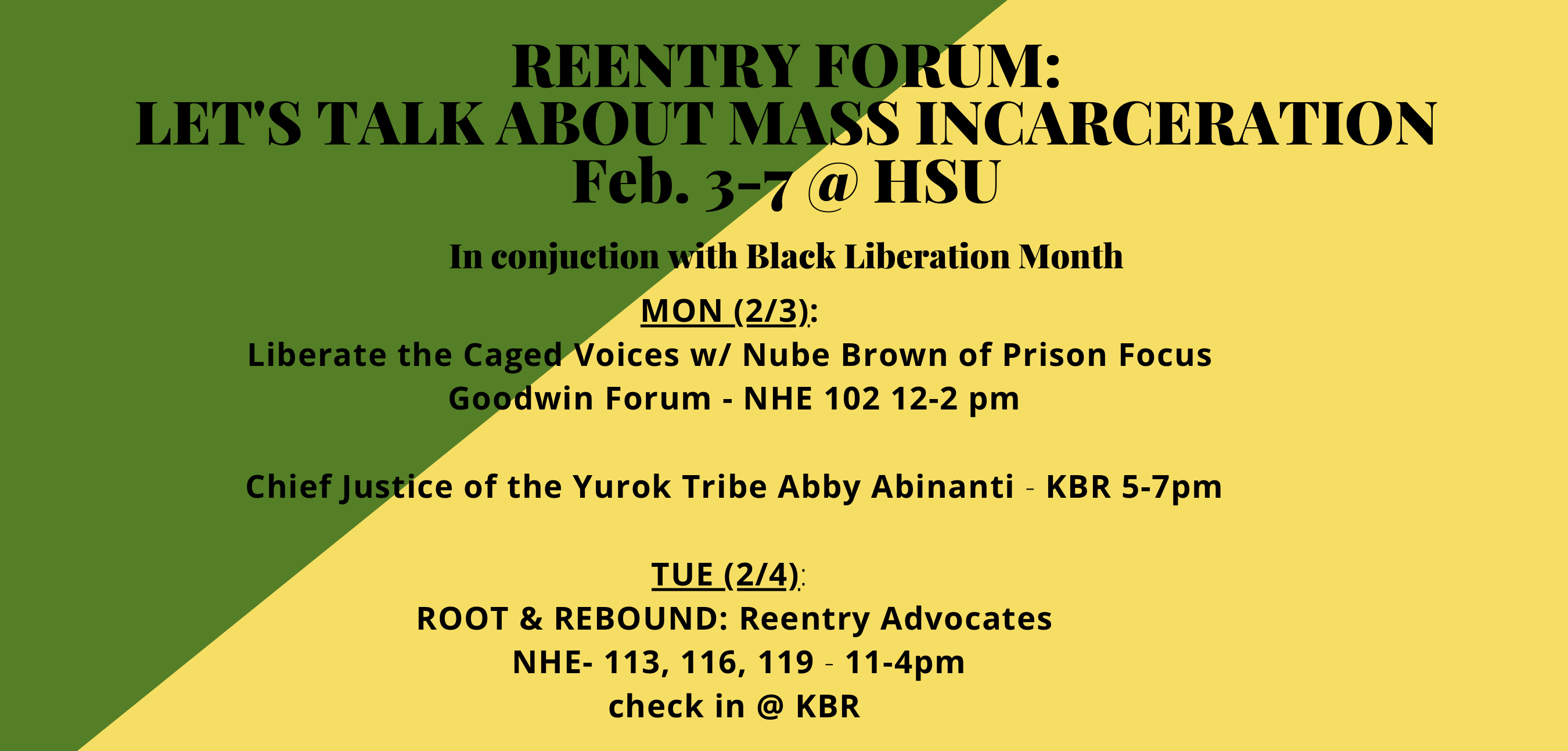
A press release from the HSU Formerly Incarcerated Students Club
Full press release:
Humboldt State University’s Formerly Incarcerated Student’s Club and Student Legal Lounge in conjunction with Clubs and Activities, Black Liberation Month and Associated Students will host a week long event titled Reentry Forum: Let’s Talk About Mass Incarceration. The event will be from Feb. 3-7 at Humboldt State University with nearly two events a day. Our goal is to provide support for students and community members who have been impacted by the criminal justice system. This event will provide education around transforming the system, inform our university and community on the pervasiveness of the criminal punishment system in our everyday lives, and build support in reversing the school to prison pipeline. Attendees will receive resources pertaining to record expungement, child custody, licensing, and other tools that help folks with the re-entry process.
Schedule: Feb.3-7
Day 1: February 3, 2020 [Monday]
❏ Nube Brown, Liberate the Caged Voices; 12-2 p.m. @Goodwin Forum (NHE 102) ❏ Judge Abby Abinanti, Chief Justice of the Yurok Tribe; 5-7 p.m. @KBR
Day 2: February 4, 2020 [Tuesday]
❏ Root and Rebound (Training/Clinic); 11-1 a.m./p.m., 2-4 p.m. @KBR
Day 3: February 5, 2020 [Wednesday]
❏ Tory Eagles, Pelican Bay Scholars Program Director/ William Feather, Ukiah Inmate
Scholars Program Director talk about scholars programs in locked facilities; 12-2 p.m.
@Goodwin Forum (NHE 102)
❏ Jimmy Santiago Baca, Chicano-American Poet & Writer from New Mexico; 5-7 p.m.
@KBR
Day 4: February 6, 2020 [Thursday]
PANEL DISCUSSION: @Green and Gold Room (FH 166)
❏ Andrew Winn (Project Rebound Sacramento), Joseph Osario (Anti-Recidivism Coalition), Mike Bishop (Children and Family Services Counselor), Mark Taylor (Anti-Recidivism Coalition), Jason Bell ( Project Rebound Director San Francisco), Mike Bishop (Children and Family Services Counselor) Working in Re-Entry Panel Discussion; 5-7 p.m.
❏ Joshua Meisel, (Moderator) Working in Re-Entry Panel Discussion; 5-7 p.m.
Day 5: February 6, 2020 [Friday]
❏ Movie: 13th; 11 a.m. @ Siemens Hall 108
❏ Collaboration; AACAE Presents: Cornel West @ KBR
For more information or concerns contact fisc@humboldt.edu
Living in a community full of love, fear and a growing void of justice
Thirty-three months after a black HSU student was murdered in the city of Arcata, a circle of family, friends, students and community members huddled together, clasped hands and shouted his name.
“Justice for David Josiah Lawson,” the group said loud and clear over and over from the steps of the Arcata City Hall. The sun had set hours ago, and a winter wind was biting at those gathered in attendance, but weather wouldn’t stop the crowd.
“The vibe itself is very upbeat considering the weather,” said attendee Andre Ramos, who wore a heavy winter coat and a beanie pulled over his ears.
Every month since the murder of David Josiah Lawson, a crowd has gathered around Charmaine Lawson, the mother of Josiah Lawson, and together they demand justice for Josiah. Lawson remains steadfast in her belief that justice will happen. She makes the journey all the way up to Humboldt from her home in Southern California to remind those in power that she will make it happen.
“It will happen,” Lawson said. “I serve a mighty god. As long as I have breath in my body I will continue to be here.”
“There are beautiful, amazing, wonderful, compassionate people here. There is love within this community, but there is evil and darkness here.”
Charmaine Lawson
To Lawson, this was an open and shut case. The original suspect, former Mckinleyville resident Kyle Christopher Zoellner, was apprehended the night of the murder. Lawson said the murder weapon was also found. She said DNA evidence should presumably solve this case.
“Why we’re still here? Dumbfounded,” Lawson said.
As the months go by, more and more students move to Humboldt to attend Humboldt State University. Yet Lawson is concerned these students don’t know the situation they’re moving into.
HSU has a much higher population of people of color than the surrounding community. Most HSU students come from Los Angeles or the Bay Area and the small-town culture of Humboldt is different from what they’re used to. Lawson wants to ensure that all students who start the next step of their lives in Humboldt make it out again, but she feels that students of color simply aren’t welcome.
“If you’re a student of color, be careful,” Lawson said. “There are beautiful, amazing, wonderful, compassionate people here. There is love within this community, but there is evil and darkness here.”
Kwame Achebe, a San Diego native, agreed. Achebe has attended every vigil since the murder, but his voice still shook when talking about what happened. He chose his words carefully but spoke with a grim humor when recounting one of his first experiences in Humboldt.
“What’s funny is in San Diego I’m pretty light skinned,” Achebe said with a laugh. “In San Diego I’d have to be convincing people I was black. I didn’t need to convince anybody here. My first day at Arcata High I was greeted as ‘the nigger,’ OK? I was greeted as ‘the nigger.’”
Achebe said his experiences in Humboldt have told him that this isn’t an aberration.
“For us not to have justice 33 months after the murder of a young black man? It’s not out of the norm at all,” Achebe said.
Achebe said the elected leaders of Arcata don’t care about what happened to Josiah Lawson, so it’s up to the people.
“I’ve been out here from the very beginning. I see the look on their faces when they’re addressing us. They have no souls in their eyes,” Achebe said. “They don’t care.”
Part of the goal of the Justice for Josiah movement is justice in the form of political change, not just for Josiah Lawson, but for the whole system. Lawson vowed to keep working to elect people who she thinks will be able to uphold justice.
“I will continue to call people in power out that are elected officials who are not doing their jobs and make sure we get people with integrity and love and compassion in seats,” Lawson said.
Over the course of the almost three-year history of this case, it has faced numerous setbacks. The case against Zoellner was dismissed in 2017. In 2019, a criminal grand jury decided not to indict anyone for the murder of Josiah Lawson, and the California Attorney General declined to take the case.
“Justice for me is having Kyle Christopher Zoellner arrested for the murder of my son David Josiah Lawson and held accountable for his actions,” Lawson said.
The history of the case shows that a system that could bring about the justice that Lawson wants is not the one Humboldt has, but Lawson is convinced it will one day. Until then, Lawson is concerned for the students of color in the here and now.
“Don’t go anywhere alone in this town,” Lawson said. “Stick together so someone can tell your story if you’re not able to.”
When Vanessa Vrtiak started volunteering at the Humboldt County Correctional Facility, she noticed that the inmates didn’t have many resources needed for success after release.
Vrtiak is a graduate sociology student at HSU. Vrtiak coordinated and organized the Criminal Justice Dialogue. The dialogue centered on discussing and identifying challenges and resources related to currently and formerly incarcerated people. (jump)
“I organized the event because there is a need for support services for people impacted by the criminal justice system,” Vrtiak said. “It’s supposed to be a correctional facility meaning we’re going to help you.”
Hector Verdugo speaking to correctional officers and law-enforcement at the Criminal Justice Dialogue. Photo courtesy of Vanessa Vrtiak.
Vrtiak now works at the Humboldt County Correctional Facility as the programs coordinator for reintegration work. She helps incarcerated people get the resources they need to succeed while they are in jail. She helps them find a ride home when they are released, a job, and housing. According to Vrtiak, people who have gone to jail often have trouble finding work and housing when they are released. A study by Urban Institute found that only 45 percent of formerly incarcerated men are employed eight months after they are released from prison.
“When people go to jail they are forgotten about and when they get out they’re still being punished,” Vrtiak said. “These are people who deserve second chances.”
Vrtiak said that incarcerated people are a part of the community. If the community invests in them they improve the community as a whole.
“I’m a firm believer in helping incarcerated people get better,” Vrtiak said.
Vrtiak worked alongside other sociology students and the Sociology, Criminology and Social Justice club to organize the event. Ian Kochinski is a sociology major at HSU and the president of the Sociology, Criminology and Social Justice club at HSU. Kochinski was approached by Vrtiak to help organize the dialogue. Kochinski had been interested in helping with the dialogue since day one.
“Prisoners are locked in a hole and we hardly ever see them so it’s hard to empathize with them and address the inequalities they face,” Kochinski said. “I think they are deserving of a little more attention.”
The dialogue was a week long discussion filled with guest speakers who were impacted by the justice system. Hector Verdugo is part of Homeboy Industries, a gang intervention program centered in Los Angeles. Verdugo came to HSU to speak at one of the discussions. He spoke about what life was like as a gang member in Los Angeles and the trauma he faced.
The housing reentry roundtable talking about housing facilities in Humboldt county. Photo courtesy of Vanessa Vrtiak.
“I saw a lot of things that went on in my house like overdoses and people getting shot,” Verdugo said. “I was scared but I had to act tough.”
Verdugo said he met the founder of Homeboy Industries as a gang member ready to change his life.
“I want to give an understanding that gang members are people that just need to heal,” Verdugo said.
This website uses cookies to improve your experience. We'll assume you're ok with this, but you can opt-out if you wish. Cookie settingsACCEPT
Privacy & Cookies Policy
Privacy Overview
This website uses cookies to improve your experience while you navigate through the website. Out of these cookies, the cookies that are categorized as necessary are stored on your browser as they are essential for the working of basic functionalities of the website. We also use third-party cookies that help us analyze and understand how you use this website. These cookies will be stored in your browser only with your consent. You also have the option to opt-out of these cookies. But opting out of some of these cookies may have an effect on your browsing experience.
Necessary cookies are absolutely essential for the website to function properly. This category only includes cookies that ensures basic functionalities and security features of the website. These cookies do not store any personal information.
Any cookies that may not be particularly necessary for the website to function and is used specifically to collect user personal data via analytics, ads, other embedded contents are termed as non-necessary cookies. It is mandatory to procure user consent prior to running these cookies on your website.