The Lumberjack


Students Serving The Cal Poly Humboldt Campus and Community Since 1929

Tag: csu chancellor

  • CSU Unions bargain with Chancellor’s Office; California Faculty Association considers going on strike

    CSU Unions bargain with Chancellor’s Office; California Faculty Association considers going on strike

    by Andres Felix Romero and Emma Wilson

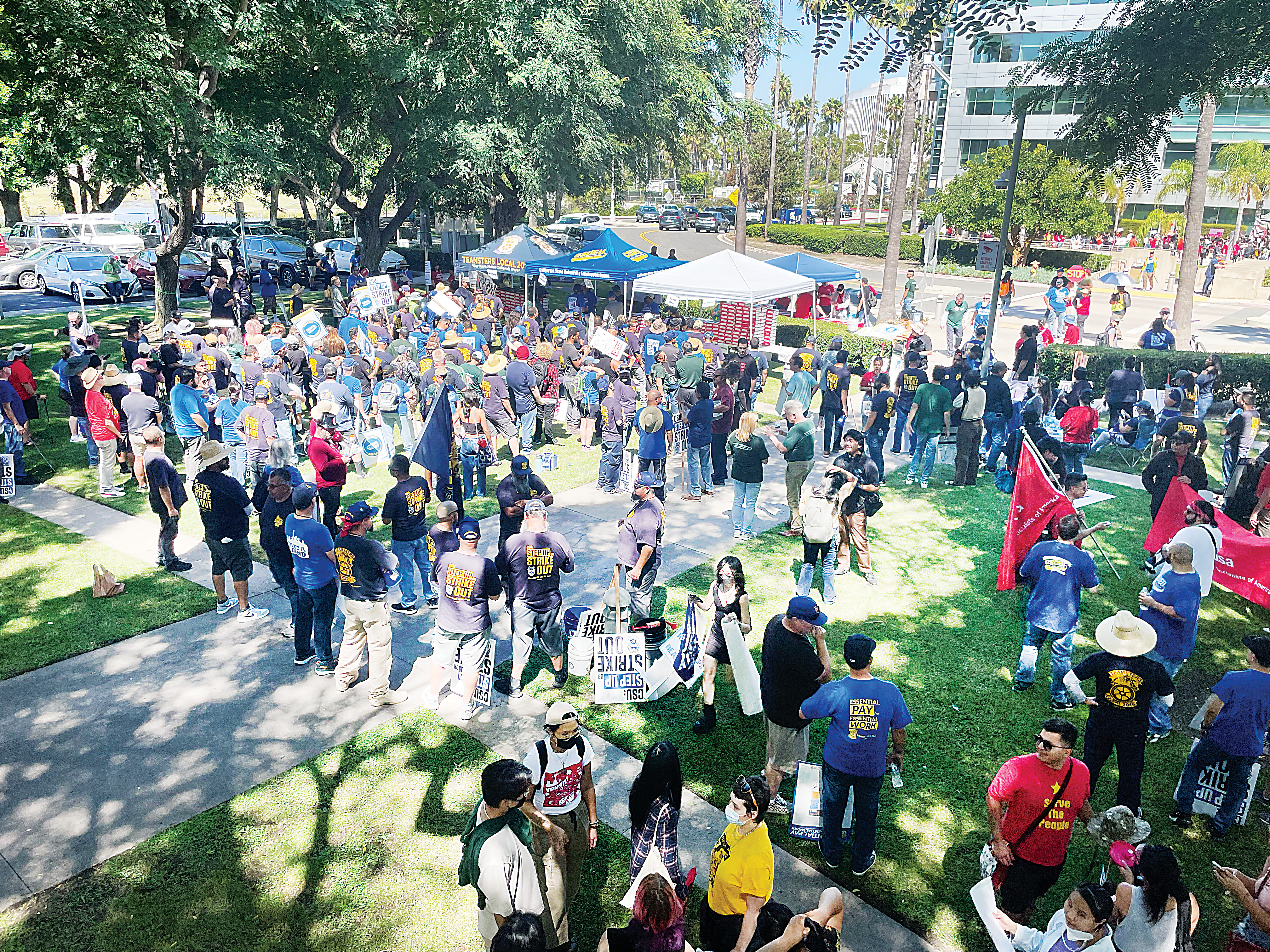
    Hundreds of miles from Humboldt county in Long Beach, dozens of people are rallying against the decisions of the Chancellor’s and the Board of Trustees that hold the fate of our communities’ future outside of the headquarters of the California State University (CSU).  

    What the CFA is fighting for

    The California Faculty Association (CFA) is one of six CSU Unions present across the 23 campuses. The CFA focuses their support on staff that work directly with students such as lecturers, coaches, and counselors. 

    The other unions are the CSU Employees Union (CSUEU) who support staff that provide essential services to students such as those in admin, the Union of American Physicians and Dentists, Teamsters Local 2010 that supports skilled trade workers such as painters and carpenters, the student union UAW 4123 and finally, the Academic Professionals of California (APC) which provides support to campus staff that work with students outside of the classroom such as financial aid and residence life.

    Currently, the unions are collectively bargaining, and they are fighting for many of the same things. The CFA is campaigning on two main fronts, better wages and financial compensation, as well as better workloads and support to faculty

    Wages

    The CFA is asking for a 12% general salary increase. Cal Poly Pomona CFA member and associate professor of Political Science Marc Scarcelli reasons that although a 12% increase may seem like a lot, it’s essential to keep wages fair as the inflation rates increased 8% since the last bargaining session between the CFA and the CSU.

    “If your wage increases don’t keep up with inflation, your wages are actually going down,” said Scarcelli, “and so if you think about it, we have to threaten the strike just to break even if we’re not actually fighting for more. We’re fighting just to break even. We [got a 3% pay raise] at a time when inflation was over 8%. What we got is effectively a pay cut.” 

    The CFA is also hoping to raise the salary floor for lecturers. Chief Steward of the Humboldt APC Chapter Tania Marin-Zeldin feels that this proposal is needed to help faculty with their standard of living.

    “To hear that some of our members have two jobs because they can’t afford to have a decent living and provide for their families, that’s the sad part,” Said Marin-Zeldin. “We shouldn’t have to have two jobs. We shouldn’t have to be barely living, paycheck to paycheck.”

    Freshman Evaluator and Union Representative of the APC Sierra Farmer hopes that having more competitive wages could help with retention of workers within the CSU system. She explains that because of what feels like unfair wages, many CSU workers, including alumni, leave because they can’t live comfortably with the wages provided.

    “We lose good employees in the Cal State system,”  Said Farmer. “We have lower wages than the UC’s and the community colleges. So we lose really good people to the other systems all the time because they don’t make a living wage.”

    Another financial goal to increase fair wages and combat inflation resulting in pay cuts, is the unions fighting for yearly step-raises within the CSU system.

    Better support for staff and faculty

    To also help with retention rates for faculty and staff, especially counselors, Professor and CFA President of the Humboldt Chapter Marisol Ruiz notes that better policies surrounding tenure and more long-term contracts can help with the feeling of stability for employees.

    “We want [counselors] to get three year contracts,” said Ruiz. “When you’re in a [year-long contract], you’re in a precarious situation. You don’t know if you’re getting your job back or not, so people sometimes don’t want to stay. We’ve had a hard time getting good counselors to stay. We need to offer them better [contracts], where they will be more likely to stay due to better conditions.”

    On top of contracts, the unions want there to be more fair workloads for faculty, as well as better ratios between students and faculty. Ruiz remarks on the importance of a healthy ratio between students and faculty.

    “We want to give [students] more attention,” said Ruiz. “We want to lower class sizes, and focus on [student’s work]. But the [CSU] just wants to cram everybody in. The more care that we have for our students, the better they will do in their classes and the more effective they will be as [learners] and we want that. ”

    Beyond workloads and wages, the unions are also wanting to ensure more gender equity on campuses by providing bathrooms and changing facilities that people can feel safe with no matter their gender. They also want better paid parental leave and more lactation stations for parents across campuses. 

    Process of Union Bargaining and Current State of Negotiations

    Every few years, each of the unions on the CSU campuses reopen their contracts with the CSU to bargain. This year’s cycle is unique as it was delayed due to COVID, and instead of bargaining in a staggered way, every union is negotiating their contracts at once. As of the writing of this article, every union aside from the CFA is still at the bargaining table. The CFA has declared an impasse with the CSU since they did not come anywhere close to an agreement, and has moved onto the fact-finding stage. Faculty Rights Chair for the CFA Humboldt Chapter and Lecturer in the Philosophy Department Loren Cannon explains the process

    “Fact finding is where [the CFA] and [the CSU] produce information and argumentation as to why our proposals are good. [The CSU] will probably try to produce information that says, ‘Oh, we just can’t afford it.’ [The CFA] will produce information that says, ‘well, actually, you can.’ We could go back to bargaining somewhere in the middle here, but if we don’t have any agreement at that point, there might be collective action.”

    If the mediation following the fact finding stage again fails, the union can then vote on to take action, such as a strike. If the CFA does decide to strike, it will likely be in early November as of the time of writing this article. Scarcelli notes that a few within the CFA are looking forward to a chance to strike.

    “In terms of willingness to strike, I talked to a lot of my colleagues and honestly, they’re not just willing, they’re eager,” said Scarcelli. “Colleagues all over the place are chomping at the bit like, ‘when do we get to strike,’ because they’re pissed. They’re just furious. You know, when our incomes are effectively going down. And then we keep seeing that they give appalling raises to university presidents and the Chancellor.” 

    CSU Response

    In a video message and written statement from interim Chancellor Jolene Koester, she affirmed that the CSU is committed to fair pay and compensation for faculty and staff. The CSU has proposed a salary step structure for faculty and staff in the CSU’s to reach 12% over three years, however the increase will be 5% in the first year. The CFA has rejected this and declared impasse following the offer. The CSU leadership say they will be challenged to meet the proposals of the CFA and other unions throughout the CSU.

    CFA flyer

    Why Faculty are Fighting

    With the CSU rejecting some of the union’s requests, many within the union are becoming more frustrated, especially with the wages that the CSU higher-ups and presidents are making. Ruiz notes that on average, after the average CSU president’s salary and allowances for their car and housing, they generate more income than the governor of California.

    “I do not think it is acceptable for us to have a housing allowance for anybody who’s making $300,000. it’s not right, when our students are homeless and are living in cars, and we don’t even pay a living wage to lecturers,” said Ruiz. “ How [is the CSU] getting all this money for car allowances? How are you getting a housing allowance? How are [CSU presidents] being provided for? And our students are not? Your job is not as important as the governor of California, let’s put back the money where it needs to go.”

    Farmer also notes that her yearly wage barely compares to Humboldt President Jacskon’s yearly housing allowance

    Overall, the unions and their members such as Scarcelli are working towards better compensation and working environments to continue supporting students in their journey of creating a better future for themselves.

    “We do what we do because we love education,” said Scarcelli. “We love our students. It would pain me to skip classes, but I will, and I find most students are very receptive to our cause.”

  • HSU Cultural Center Budget Slashed

    HSU Cultural Center Budget Slashed

    Associated Students leaves student body devastated after significant reductions in cultural center’s budget.

    Two months ago, Associated Students released its proposed budget for the 2020-21 school year at Humboldt State University. Included in this budget were major budget cuts to on-campus cultural centers such as the Multicultural Center and the Eric Rofes Multicultural Queer Center.

    For the budgeting process to begin, A.S. applications are submitted by various campus-based clubs to the A.S. Finance Committee, previously known as the Board of Finance. From there, the committee reviews all the incoming applications and after holding public appeals, creates a Recommended Budget that is sent over the A.S. Board of Directors, a mix of A.S. elected representatives and faculty advisers. The Board of Directors then holds another round of public appeals, drafts a revised Recommended Budget and sends it over the A.S. president, who promptly turns it over to the campus president for official approval.

    David Lopez, the Associative Vice President of A.S. and a sophomore at HSU, emphasized that he still greatly values the cultural centers but they will be funded differently.

    “We really appreciate them for the work they do,” Lopez said. “So to make sure that they continue to do that work still because we’re not funding them, we’re doing it through the clubs grant, and we’re forming this grant process to be as neutral as possible with funding student organization needs.”

    Lopez is personally leading the charge for these new clubs grants, which aim to support student organizations like the Asian Desi Pacific Islander Collective and the Women’s Resource Center in a reduced capacity.

    One thing that factored into the decision by Associated Students to sever the cultural centers’ funding was the Apodaca v. White lawsuit that took place between a pro-life student organization at CSU San Marcos and CSU San Marcos’s Associated Students. The pro-life student organization claimed that it was being discriminated against by CSU San Marcos because requested funding for a pro-life speaker was denied while other groups were recieiving the same funding. The final ruling by a federal court was in favor of the student organization, arguing that the funds that come from student fees need to be allocated in the most viewpoint neutral way possible. The CSU Chancellor’s office has yet to clarify what this means.

    For Lopez, this new funding procedure is radical but also necessary given the circumstances.

    “We’re supporting the greatest amount of viewpoints and opinions possible,” Lopez said. “The plan for this club grant is to further diversify the opinions on campus per Apodaca v White and to err on the side of caution while awaiting the Chancellor’s interpretation of Apodaca v White.”

    Lopez recognized that he and his staff are working with a limited financial capacity and therefore need to distribute funding in a way that will keep clubs satisfied and avoid a lawsuit of their own.

    “What’s happening is we’re being faced with the choice of either becoming a club or becoming absorbed into an administrative or academic department.”

    Amanda Huebner

    “Our total budget is less than eight hundred thousand dollars,” Lopez said. “Meaning that by not funding in a viewpoint neutral manner, we are potentially risking over a fourth of our budget, a fourth of student fees that could go to things like our Club Grants Committee or that could go to other campus resources if we were to risk not funding in a most neutral way possible.”

    Celene Gonzalez is an HSU grad student in the psychology program and an El Centro employee. She has worked closely with the cultural centers and has seen their collective downfall over the years.

    “What gives me hope in what I had seen in that time is that students were getting really connected with each other,” Gonzalez said. “They were finding their communities. It is not shocking to me that the school felt the need to kind of push that down a little bit.”

    Gonzalez is disheartened by the disconnect that has been formed between her and these students through said budget cuts.

    “I feel like our work gave us a way to connect with one another and I feel like our activism gave us a way to connect with one another,” Gonzalez said. “That it’s going to be hard to maintain and it’s going to be hard to ask of them when I know that they aren’t being compensated for that work.”

    The Eric Rofes Multicultural Queer Resource Center is getting hit hard by the extreme budget cuts. Concerned about the future of her cultural center, Amanda Huebner, a rangeland and social sciences senior and an employee at the ERC, wants to see it remain in the state that it’s in already.

    “What’s happening is we’re being faced with the choice of either becoming a club or becoming absorbed into an administrative or academic department,” Huebner said. “So I think there has been dialogue by students in the past that this would be a bad move being absorbed by a department or by an administrative department because it would make the group not be as student-run.”

    In other words, the absorption of the ERC into another department would be ill-advised because there would be more faculty interference in how it would be managed, and that wouldn’t align with the goal of this cultural center of being a student-led one.

    Student leaders like Katherine Nguyen who work in the cultural centers are frustrated with the fallout from all of this. Nguyen doesn’t feel like the administration cares about its marginalized students.

    “Are you going to be supporting your cultural centers, are you going to be supporting your students?” Nguyen said. “I’m not confident about that and I’m tired of just being told by admin, like: ‘Oh, you got it wrong, like we actually care about you. We’re going to figure out a way,’ but it’s like if you did, why didn’t you make a plan? Show that you’re invested in students.”

    When it comes to the shrinking budgets for the various cultural centers, neither the students nor the administration can be totally satisfied. After the Fall 2020 census, the A.S. cumulative budget will be reevaluated.

  • Humboldt State President Speaks on Fall 2020 Instruction

    Humboldt State President Speaks on Fall 2020 Instruction

    President Jackson speaks with Faculty Senate over virtual teaching

    Editor’s note: Grace Caswell is a student of Journalism Department Chair Vicky Sama. Almost the entire staff of The Lumberjack has also had Sama as an instructor in journalism courses.

    Tuesday, May 19, President Tom Jackson of Humboldt State University resurfaced from his hiatus to discuss the fall 2020 semester instruction plan with the Faculty Senate due to COVID-19.

    The transcripts of the meeting between Jackson and HSU Faculty Senate were provided in an email by Journalism Department Chair Vicky Sama. The meeting regarding online instruction for the Fall 2020 semester built off of CSU Chancellor’s Timothy White’s recent statement.

    “The chancellor’s statement last week, which we were pretty sure was coming, we knew that was the direction he wanted to take, that leads us in this position as a university that we are 100% virtual,” Jackson said in the email transcripts. “That’s done. We are 100% virtual but we also knew we would have an opportunity to ask for an exception.”

    The exception will be sent to the Chancellor requesting face-to-face instruction for classes that are unable to make the direct translation to online instruction. About a quarter of HSU’s classes are hands-on courses, Jackson provided examples that would be included in the request.

    “We are preparing a request, in response to the Chancellor’s statement, that HSU be allowed to establish a hybrid approach to instruction in the fall.”

    HSU Interim Provost Lisa Bond-Maupin

    “One of which was our labs– labs activities-based work– studio, art, ceramics– those elements that can’t easily be converted to a virtual modality but is a really strong core of who we are as a university, could be a reason to make an exception,” Jackson said in transcripts. “Another one, in general, would be the continuation of very specific research or farms or agriculture, forests, oceans, rangelands, other things like that.”

    The request is almost finished and asks that HSU be considered for hybrid instruction. HSU Interim Provost and Vice President of Academic Affairs Lisa Bond-Maupin stated that the request for hybrid instruction would still operate and emphasize online curriculum with little in-person contact.

    “We are preparing a request, in response to the Chancellor’s statement, that HSU be allowed to establish a hybrid approach to instruction in the fall,” Bond-Maupin said in an email. “That would include virtual instruction, and very limited face-to-face instruction where it’s safe to do so per county health guidelines. This planning requires extensive work, and no final decisions have been made yet.”

    Jackson elaborated on Bond-Maupin’s emphasis of following and abiding by county health guidelines. Fall instruction really depends on the Chancellor’s decision to approve or dismiss HSU’s exception request which is estimated to take a day or two. Then, if permitted by the Chancellor to proceed, a chain of discussion will occur between administration, faculty and department chair members.

    “With that decision we will know if we are 100% virtual or if we have been permitted to develop face-to-face curriculum based upon on our request,” Jackson said in the email transcripts. “It then shifts to the faculty and the chairs of those specific sections, which are 593, as far as lab-based activities going into the fall, that’s a rough number, and it may change here or there. And then specifically what items need to be taken care of in terms of a safety protocol in accordance with public health, and that will occur very rapidly over the summer.”

    Over this coming summer, HSU will enact development plans for professors and lecturers. Those teaching lecture classes that can operate in tandem with online instruction will continue developing those skills. Those who teach labs or studio classes have a chance of having to develop hybrid teaching methods over the summer.

    “If you’re scheduled to teach a lecture class, the answer is already there. We’re in virtual mode,” Jackson said in the email. “But if you’re scheduled to teach a lab or studio art or something like that then I encourage you to give it some thought and chat with your chair because there is a 50-50 chance.”

  • COVID-19 Cancels Fall 2020 Face-to-Face Instruction

    COVID-19 Cancels Fall 2020 Face-to-Face Instruction

    Face-to-face instruction for Humboldt State’s fall 2020 semester has been canceled due to COVID-19. California State University Chancellor Timothy White announced Tues. May 12 that instruction will primarily be offered online. A virtual plan is expected to be implemented into the entire CSU system as the possibility of a second COVID-19 wave of cases is predicted.

    “Our planning approach will result in CSU courses primarily being delivered virtually for the fall 2020 term,” Chancellor White writes in a CSU press release. “With limited exceptions for in-person teaching, learning and research activities that cannot be delivered virtually, are indispensable to the university’s core mission and can be conducted within rigorous standards of safety and welfare.”

    Academics that can not make the direct translation to an online format, such as artistry and laboratory classes, will be conducted through a hybrid approach which limits in-person contact as much as possible and continues to emphasize online instruction. 

    HSU, along with other CSU systems, are subjected to differing class standards based on the level of necessity placed behind face-to-face instruction. The fall semester is projected to primarily remain online, however, updates and further information will be announced later in the week.

  • HSU president search update

    HSU president search update

    CSU Chancellor Timothy White sends update regarding ongoing HSU president search

    A message containing an update for the Humboldt State University President search was sent campus wide today. According to CSU Chancellor Timothy White the eighth HSU president will be announced May 22, 2019. This will be in between the end of the spring semester and beginning of summer session classes when no students will be on campus.

    The last update from the administration was when they held an open forum for the first meeting of the Trustee’s Committee for the selection of the president on February 4, 2019. The Lumberjack has been unable to speak with Lisa Rossbacher on her departure as of yet.

    Rossbacher will retire at the end of June after a controversial five-year run as HSU president. Under her presidency HSU lost their football team, the Third Street Art Gallery, the community radio station KHSU and not to mention what many observed as a lack of responsiveness for the April 15, 2017 fatal stabbing of HSU criminal justice major, David Josiah Lawson.

    According to the press release the search is “on track” and there has been interest to fill the position of HSU president across the country. Finalists will be chosen and ultimately interviewed by the full Board of Trustees.


    The press release is as follows:

    Sent on behalf of the CSU Office of the Chancellor:

    The search for the next Humboldt State University president is on track. From a sizeable group of candidates that included interest from across the country, the search committee has culled the pool to a handful of semifinalists.

    From that group, finalists will be interviewed by the full Board of Trustees. We are on schedule to announce the eighth HSU president on May 22, 2019.

    A growing and thriving HSU is key to the prosperity of the North Coast community. It provides transformational educational opportunities and generates a substantial economic impact for the region.

    Thank you to everyone who attended the forum on campus or who has shared input about the knowledge, skills or experience requisite of the next campus president. Your feedback has been invaluable as we work diligently to identify the next HSU president.

    Timothy P. White
    Chancellor