The Lumberjack


Students Serving The Cal Poly Humboldt Campus and Community Since 1929

Tag: diy

  • How to Sew Your Own Face Mask

    How to Sew Your Own Face Mask

    A step-by-step guide to making face masks

    Although N95 face masks are the only masks proven to protect against COVID-19, companies and people across the nation are rushing to their sewing machines to help produce protection for frontline healthcare workers.

    New York City Governor Andrew Cuomo asked companies to shift their operations to make face masks and ventilators at a press briefing March 20.

    “I’ll fund a new business if you can make these products,” Cuomo said. “I’m trying to make these products. If you are in this line of work, we need masks. If you are making clothing, figure out if you can make masks. I’ll fund it.”

    Deaconess, an Indiana healthcare provider, has also asked the public for help to produce masks. They released a video tutorial in which they show how to sew a surgical face mask that complies with the Centers for Disease Controls and Prevention guidelines.

    Hand-sewn masks compliant with CDC guidelines are permitted to be used by healthcare workers, but the masks are still considered a last resort by the CDC.

    Considering the dire circumstances, a homemade mask is better than no protection at all. Here’s how to hand sew a face mask (all photos by Rachel Marty):

    Materials needed:

    • Two pieces of 7-inch elastic
    • Two sheets of 9-inch by 6-inch tightly woven and recently-purchased cotton
    • A sewing machine
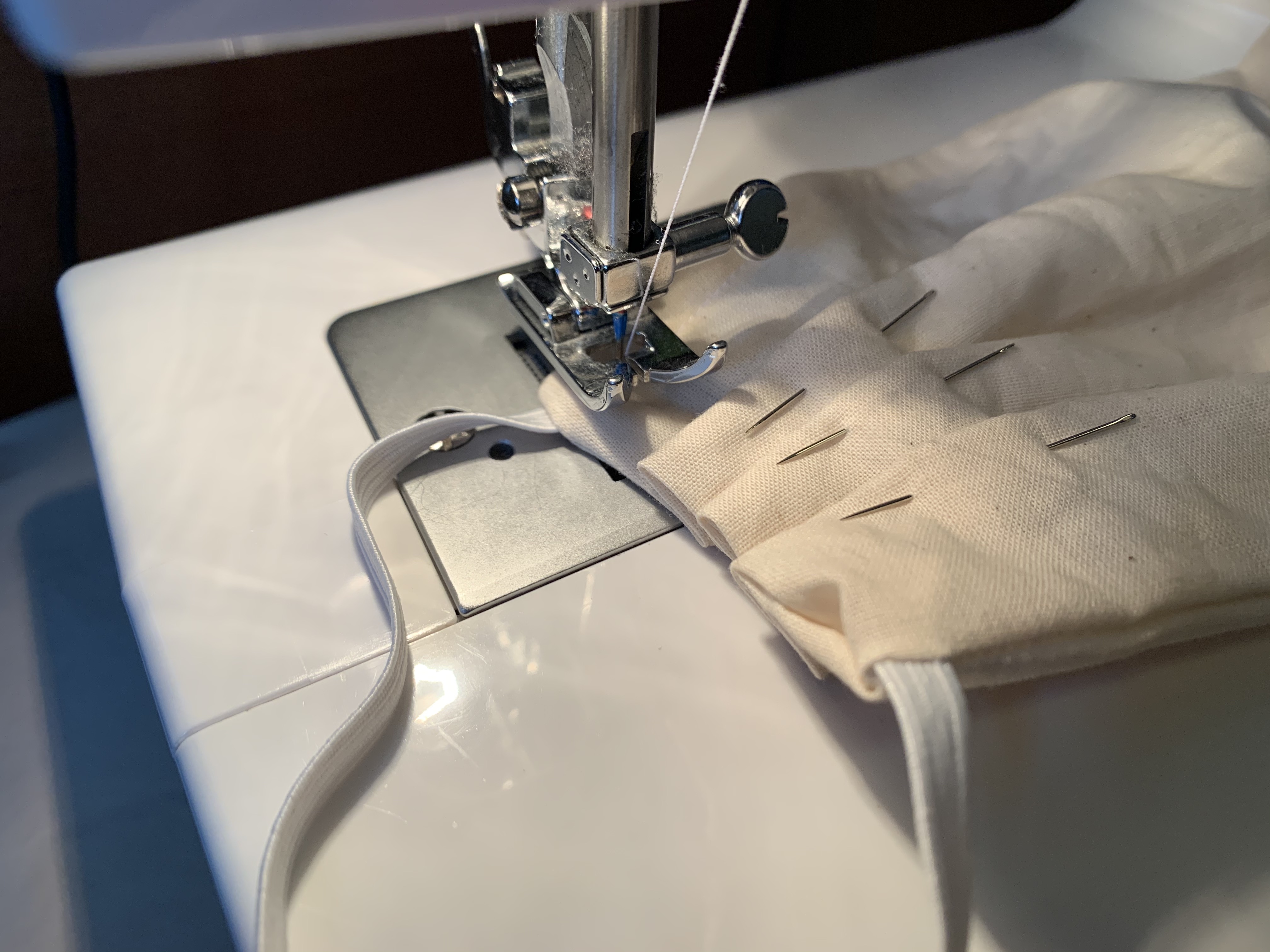
    1. Pin the two sheets of cotton fabric together and start sewing around the perimeter, leaving a quarter of an inch for the edge.
    2. At every corner, stop and place the end of the elastic in between the seam, making sure you place the straps horizontally on the 6-inch sides. The straps should go behind the ears, not vertically, or the straps will rest above your mouth and chin.
    3. Make sure to leave your perimeter undone. Leave an inch or two so you can turn it inside out.
    4. Turn inside out.
    5. Make three tucks on each side of the mask and pin them in place. Make sure they are going in the same direction on each side.
    6. Again, sew around the perimeter of the mask, leaving a quarter of an inch on the edge. Repeat twice to make sure it’s secure.
    7. And you’re done!
  • Myths and Truths of Surgical Face Masks

    Myths and Truths of Surgical Face Masks

    Mirage of safety causes mask supply to plummet and xenophobia to reemerge

    The emergence of everyday people using surgical masks amidst the COVID-19 pandemic has caused mass misinformation and the perpetuation of xenophobic ideas.

    Myth: Surgical masks make you immune to COVID-19

    Typically found on hospital workers and sick personnel as a safety barrier, surgical masks are almost regarded as invincibility devices, protecting the body from outside pollutants and threats. The implied purpose of surgical masks is to protect patients from the secretions of a doctor’s mouth or nose during surgical procedures or to protect doctors and nurses from infected patients. Either way, a basic surgical mask prevents the exchange of bodily fluids, not air particles. Surgical masks are often mistaken as invincible shields against all viruses and bacteria.

    Surgical masks show no evidence of prohibiting the inhalation or contraction of the virus that causes COVID-19. The COVID-19 virus particles are too minuscule to be stopped by a surgical mask barrier. According to the Centers for Disease Control and Prevention, “most facemasks do not effectively filter small particles from the air and do not prevent leakage around the edge of the mask when the user inhales.” In no way do surgical masks prevent or obstruct contaminated air.

    While surgical face masks are virtually pointless against COVID-19, N95 filtering facepiece respirators are different. These masks are personally fitted to the face and “filter out at least 95% of very small (0.3 micron) particles, capable of filtering out bacteria and virus particles,” according to the CDC. These masks are typically worn by hospital and treatment personnel that come in direct contact with infected patients. N95 masks prevent the inhalation of micro-particles.

    Truth: Surgical and N95 masks are running low

    Due to the personal fitting of each N95 mask, they begin to degrade overtime depending on their usage, storage and environment. The assigned expiration date and high demand due to the current pandemic has resulted in an unexpected shortage in supply. Doctors are now reusing their masks, but they risk contamination due to degrading components affecting the protection and performance of the mask. Government administrations are requesting N95 donations as well as demanding some occupations to give up their assigned mask for medical workers.

    While N95 masks are needed most, surgical masks are running low as well. Infected patients wearing masks benefit surrounding parties by limiting exposure of emitted particles into the air. The pandemic panic has misinformed the public to go buy surgical masks when patients and medical workers need them most.

    Myth: DIY masks provide reliable protection

    YouTube and social media platforms are advertising do-it-yourself face mask tutorials in response to the shortage in surgical mask supply. The misinformation has continued as people attempt to protect themselves with faulty protection materials. Bras and bonnets to sandals and plain cloths are being cut and trimmed to replicate surgical face masks. But, as previously mentioned, surgical face masks provide no protection against COVID-19 virus particles. Any alteration of store-bought or recycled material will have the same, if not less, protection against COVID-19 than a surgical mask.

    Truth: Mask usage has reignited xenophobic ideas

    Surgical masks provide zero protection from contracting COVID-19, but they have effectively reignited xenophobia. It’s completely normal for the mind to want to assign a face to an infected COVID-19 individual or picture what a threat would look like out of caution. Assuming someone wearing a face mask has the virus and extending that assumption past the mask, to their race or ethnicity, is disgusting, racist profiling. In a time of crisis, people should be exercising neighborly behavior and picking one another up, not perpetuating racist, profile-based assumptions on others in an attempt to accuse others of the chaos. It’s unproductive and invasive.