The Lumberjack


Students Serving The Cal Poly Humboldt Campus and Community Since 1929

Tag: emotions

  • Jasmin’s Corner; you need therapy

    Jasmin’s Corner; you need therapy

    by Jasmin Shirazian

    Hey Jasmin, 

    I think I need therapy, but I’m afraid. I’m not the type of person who likes to share my sad feelings with anybody, so I shove them down and pretend like they aren’t there. Recently, I’ve been noticing that my sad emotions are starting to catch up to me and are taking over my thoughts. I can’t really sleep because of them and it’s making all of my days seem mushed together. So back to the therapy thing, I’m afraid to tell someone about how I feel because I don’t want to get judged. In my mind, I feel like it’s silly for someone like me to be sad because I don’t really have anything happen to me recently to have sad emotions. 

    If you think you need therapy, you need therapy. If you don’t think you need therapy, you’re wrong and you need it more than anyone else. To me, therapy is just as important as a regular doctor or dentist appointment. Your mental health is just as relevant as the physical stuff. 

    Shame, pride and embarrassment are what stop many people from seeking help, but you can’t let your fear prevent your growth. Therapists are awesome because they get paid to care, so you don’t have to feel like you’re burdening anyone in your life with your problems. Their job isn’t to judge you, but to help you, though it may take a few tries to find a therapist that you feel comfortable with. Life is about trial and error. 

    Journaling your feelings throughout the day can be a good starting point in expressing your feelings. Getting them down on paper can help organize your thoughts and maybe recognize some patterns, like certain triggers. At the end of the day though, a proper diagnosis can seriously help you navigate your emotions and make sense of your brain. 

    You have to take chances and put yourself in uncomfortable positions to create change in your life. Being vulnerable is one of the strongest things you can be, which is why it can be so hard to get to a point of comfortability within it. 

    There’s no reason to feel silly for having emotions just because you’re not actively going through a tragedy or a trauma. If you can’t find the means to validate yourself, let me put it clearly: you are allowed to have feelings. More than anything, you are allowed to feel your feelings. 

    Shoving your feelings down into an endless pit will only fill it with emotional-vipers that’ll come back to bite you in the ass later in life. Make your life easier and deal with them now. 

    xoxo,

    Jasmin

  • Dealing with Sh*t During COVID-19

    Dealing with Sh*t During COVID-19

    The reality of ‘going through it’ during a time of a pandemic

    Being trapped in your house with your mind feels like the worst thing possible, but right now is the time to allow yourself to heal. It is more than okay to not be okay, all the time and even more so now. Although we wish this was just a vacation for us to sit around and do nothing, sometimes sitting around and doing nothing makes us feel out of control. It feels like we have lost whatever stability we had before.

    We have been in quarantine for over a month now and things were not going too bad. Well, that’s what I thought until I was left alone with my mind and as a result, my anxiety started acting up. Since quarantine started I have gone back to Humboldt to pack up my stuff and move back to my hometown. I made a long-distance relationship plan with my partner only for us to break up less than a week later. I came back to a house where I do not have my own space since I share a room with my teenage sister. Everyone is always in everyone’s business. There’s just no privacy and rules to follow. Plus, dealing with family stuff has really taken a toll on half of the household.

    I will always be grateful for the love I had and for the good times.

    Everything was happening all at once, I felt as if I wasn’t getting a chance to catch my breath. With the quarantine, it’s not like I could get out of the house or go out with my friends to talk things out or distract my mind. Not to mention, in Southern California you can only go outside for so long before the heat is suffocating you and you’re dripping in sweat. With all that being said, I would rather be dealing and healing with all of this right now, where I’m forced to sit in my home and deal with my thoughts.

    I cried for three days straight after my breakup and still find myself tearing up from time-to-time, even as I write this. However after eating all the ice cream I wanted and receiving some tough love from my loved ones, I decided that my world was not going to end just because a relationship did. I will always be grateful for the love I had and for the good times.

    As far as dealing with the family drama, all I can really do is take myself out of it. I make some tea and go outside for as long as I can. My sister and I lock ourselves in our room. I FaceTime my friends at least once a day just to have contact with people that live outside the house. For a while, I let my family pull me into each of their own drama, when it really didn’t have anything to do with me since I just got here. I was taking on their issues as if they were my own and they weren’t. Of course, I will always be there for my family, but I have my own things going on and my own healing to do. My responsibilities right now are my school work and taking care of myself. I mean we’re still in school even though it doesn’t feel like it. That degree is the only thing I have my eyes on right now.

    If I was still going to work and face-to-face classes, I would have so many distractions that I would forget what was going on or I was feeling some type of way. This might be ideal for some people but in my experience if I do not deal with or acknowledge my feelings, it builds up. The end result is much worse than what would have happened if I just took the time to heal right then and there. Now, of course, I would love to go get drunk with friends and forget about real life for a second, but we can’t because of quarantine. However, when you’re not drunk or hungover anymore your problems will most likely still be there so you will have to deal with them eventually. This quarantine has allowed me to deal with everything at once which has been hard, but it is reassuring knowing that once we are allowed to roam freely, I’ll have my mental and emotional shit together.

    Take the time to focus on your well-being. We will be let out again someday. Also, rest assured that you are not the only one. We would all rather not deal with our feelings alongside a pandemic, but it happens and that’s okay.

  • Sarah Ray keeps emotions and knowledge together in her teachings

    Sarah Ray keeps emotions and knowledge together in her teachings

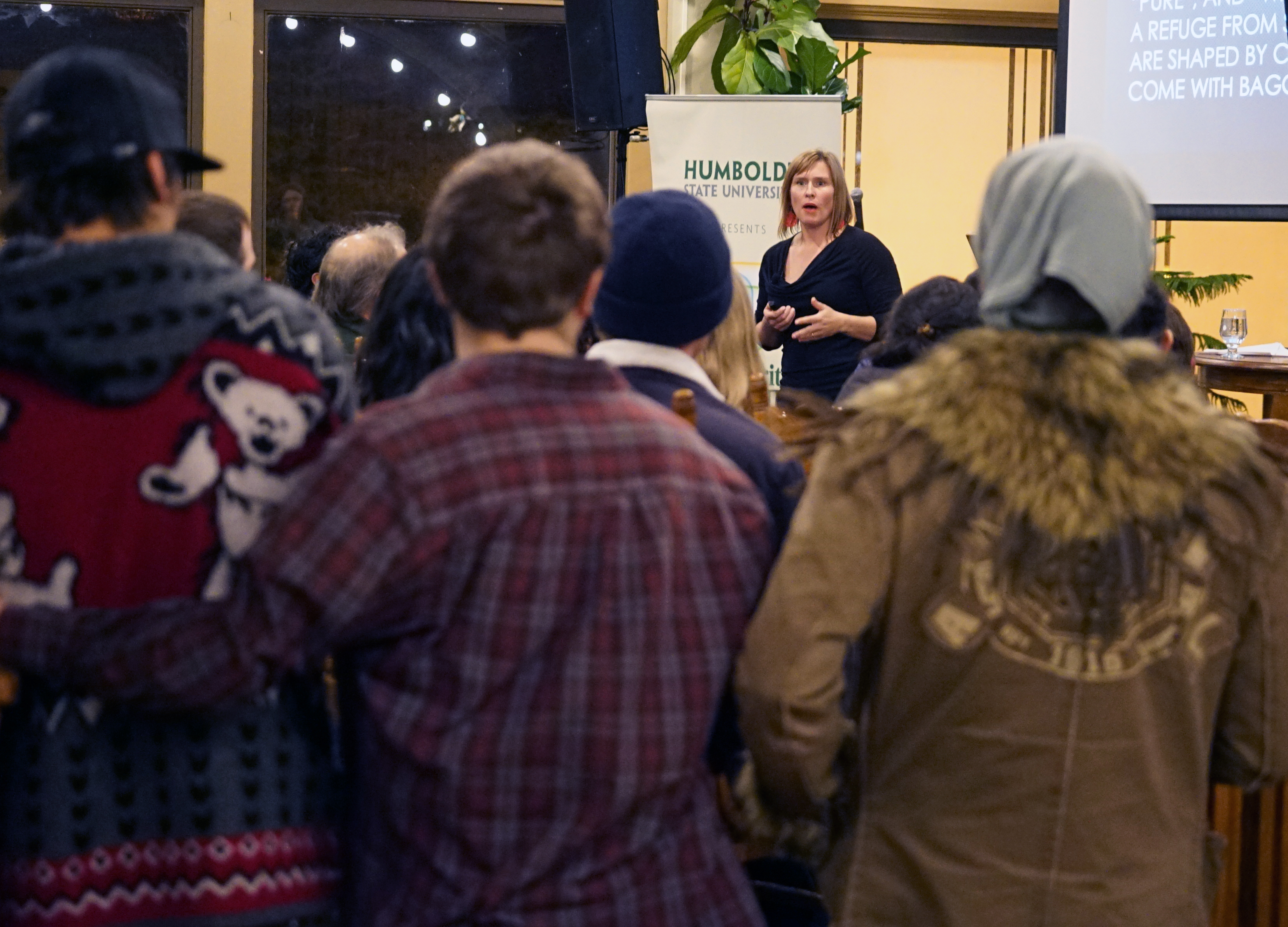
    Sarah Ray inspires students and faculty at Humboldt State. During her lecture, “Coming of Age at the End of the World: Eco-Grief, College Students, and Teaching Climate Change,” she inspires community members as well.

    Sarah Ray, environmental studies professor at Humboldt State, spoke as part of the “My Favorite Lecture” series at the Plaza Grill in Arcata on March 8.

    The lecture discussed ways to be empathetic to students’ emotions and the methods Ray uses to inspire her students, all while acknowledging the grim realities of past environmental decisions.

    “Emotions take on a life of their own in the classroom,” Ray said.

    When Ray took the position to lead the environmental studies program at HSU in 2013, there were 11 environmental studies majors in her program. As of 2018, there are 150 environmental studies majors at HSU.

    Ray says that humans emotions play a big role in environmental studies.

    “Not surprisingly, guilt, despair and negative news do not inspire students to [take] action,” Ray said. “It creates apathy and nihilism. There is a lot of research that shows this is not an effective tool.”

    Over time, students’ emotional responses became overwhelming for Ray herself. Out of self-preservation, and for the success of her students, Ray has come up with new teaching strategies for environmental studies.

    Ray believes these strategies will be beneficial to everyone who questions the importance of their own environmental role.

    “Teaching students environmental content is going to have a negative affect on them,” Ray said. “If the affects can be anticipated, the more effective the curriculum will be.”

    As a professor, Ray has watched many environmental studies students learn that their college journey is not what they expected.

    Faced with intractable, unsolvable problems, students become incapacitated. Ray calls this “getting the rug pulled out from underneath you.”

    After watching students repeatedly get the rug pulled out from underneath them, Ray realized these students need emotional support to deal with the curriculum.

    Brooke Holdren, a biology major at HSU, attended Ray’s talk and thinks ethics should be part of science.

    “There needs to be more critical scientists,” Holdren said. “Science is political as fuck.”

    Ray utilizes inclusive pedagogy to promote not only a students academic success, but their social, cultural and physical success.

    Inclusive pedagogy is a way of teaching that uses varying learning techniques, multicultural content and multiple means of assessment.

    Going off of Bell Hooks teachings, Ray said, “We have to make the personal political and we have to make content relevant to students.”

    Ray also uses social movement theory in her teaching.

    “The outcome of social movement theory is to give students a sense of belonging in a larger community. They are not isolated against the tidal wave of society,” Ray said. “Students are involved in a bigger group of people working towards the same goals.”

    Ecopsychology uses both ecological and psychological ideas to study the relationship between human beings and the natural world. Ecopsychology includes theories about emotional responses to climate change and has become useful in Ray’s teaching, showing how environmental change causes emotional distress.

    Last semester, Ray tried a change-vision-action workshop with her students. Ray had students list how they would like to see changes in the world, and make a personal action plan. Students have put these ideas into actions. This has given Ray inspiration to improve and instill greater lessons onto her students.

    Ray doesn’t simply tell her students how to fix the current environmental issues. Instead, she gives them the information and emotional support they need to come to their own conclusions.

    “Efficacy is better than hope,” Ray said.

    Efficacy is the ability to produce a desired result. Students envision new ways of living with their outcomes.

    “Sometimes the outcomes are hopeful and lead to resiliency, while other times outcomes are negative,” Ray said. “These workshops are not monolithic. They can go in many different directions.”

    HSU alumnus Larry Goldberg, who started the Campus Center for Appropriate Technologies at HSU in 1978, attended Ray’s lecture.

    “You can’t get incapacitated by fear and depression. Get off your ass. You got to do something,” Goldberg, said.

    The changes and theories Ray has implemented in her classroom have inspired her to write a book on emotions in the classroom. Ray’s book will look at different aspects to the emotional consequences of climate change. She plans to write the book on her sabbatical next year.

    “You have to come up with your own reasons and solutions to our problems, because self-righteousness is not enough,” Ray said.