Faults give clues to the history of the earth’s crust and how it impacts our future
Earthquakes are more than just shaking. Turns out the rumbling is sound vibrations from the massive snap caused by slipping, bending and breaking rock.
Deep below Earth’s crust, a mantle of plastic-behaving rock bends and twists under immense pressure. Its mass is 67% of the Earth’s mass. Its temperature ranges from 392 degrees Fahrenheit at the upper boundary of the crust to an incendiary 7,230 degrees Fahrenheit at the core-mantle boundary. Sometimes the overlying, thin 50 to 20 kilometer thick crust cracks.
“The earthquake is the sound waves moving through the rock, elastic waves propagating through it,” said Dr. Mark Hemphill-Haley, a Humboldt State University neotectonics professor and the co-chair of the geology department. “People who have seen the ground moving are seeing the surface waves of rock bending back and forth.”
According to Hemphill-Haley, imagining the scale of the mantle is challenging both in size and as a metric of time. Some people have compared the movement in the mantle to lava lamps or boiling water, a force called convection, where hot liquid bubbles up through cooler liquid, but Hemphill-Haley said that can be misleading.
“We’ve had these old models of the mantle convecting but it’s probably less like that- we’re talking about solid rocks,” Hemphill-Haley said. “They’re solid but they are plastic too. Tectonic plates, which consist of the crust and the upper mantle are in motion and can move faster than four to five centimeters per year. Mantle convection is likely a more slow process than that.”
Like the snap one hears when a pencil breaks, the sound vibrations from the snapping rock shake the ground all around the breaking point, quaking the earth.
Giragos Derderian, a fourth year geology student, explained the nuance between elastic, plastic and brittle rock. Generally, a rock seems solid but if enough force is applied, the rock can change shape. Derderian said the change in a rock is called deformation.
“Plastic deformation is when structures change shape due to a force and the rock stays deformed when the force dissipates,” Derderian said. “After elastic deformation, the rock returns to its original shape when the force is removed.”
Brittle deformation, Hemphill-Haley said, is when forces are so great, the stress exceeds the rock’s elastic limit and snaps it, like a pencil bent too far. An earthquake is when massive bodies of rock experience so much force that they become brittle and break. Like the snap one hears when a pencil breaks, the sound vibrations from the snapping rock shake the ground all around the breaking point, quaking the earth.
The earth’s crust is made up of massive plates that fit together like an ill-constructed puzzle with some plates pushed too hard into each other and some plates pulling away from each other. Force builds up where these plates meet and can deform each other in elastic, plastic and brittle ways.
Hemphill-Haley said the big thing that causes plate motion is the weight of oceanic plates. In this example, oceanic plates have converged with continental plates. he denser oceanic plates are diving below the less dense oceanic or continental plate.
These convergent plates cause a few things to happen on the surface. The leading edge of the less dense plate can crumple into massive mountain ranges like the Klamath Mountains. The oceanic plate descends deep into the mantle at submarine trenches referred to as subduction zones like off our coast—the Cascadia subduction zone. Geologists research the effects of plate tectonics here on the northern California coast in a variety of ways.
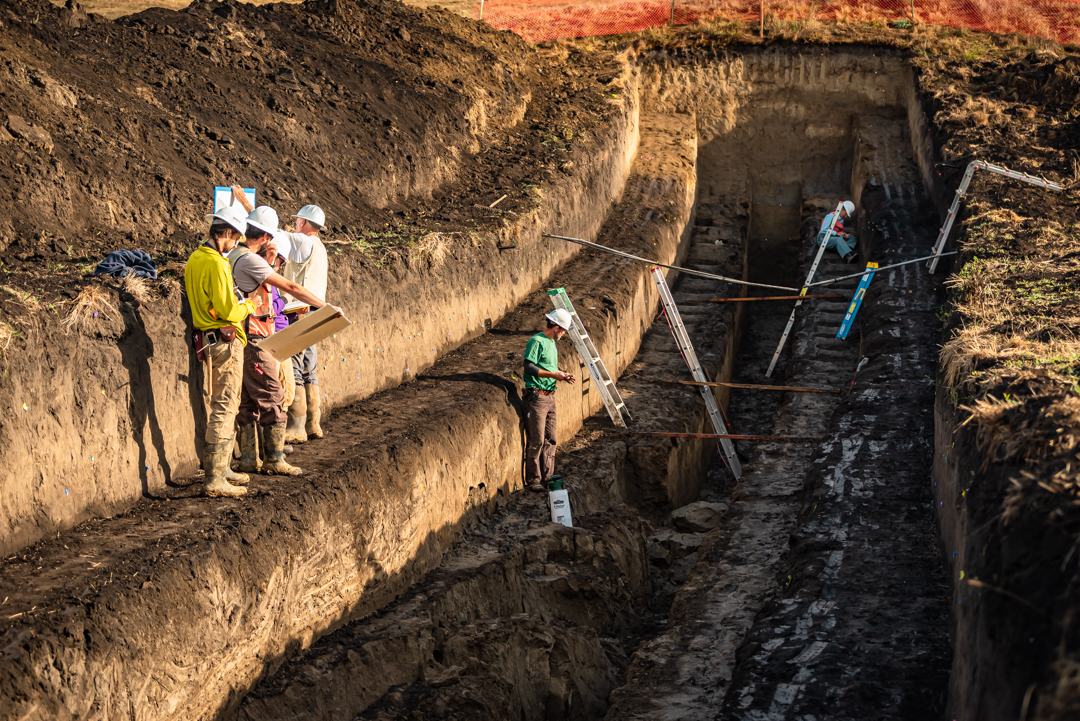
Hemphill-Haley’s colleague Dr. Melanie Michalak researches the Klamath Mountains in northern California and Oregon, and the Coast Range closer to HSU. In one research effort, she and her team trench the ground and look at rock layers that have been changed by faults. They seek material that can be used to estimate the age of the rock. Some of her research is also on recently active faults.
“As a geologist I care about all faults, the ancient ones, the active ones, I don’t discriminate,” Michalak said. “But people though, from a risk perspective, they’re more concerned about which ones will cause an earthquake and damage their house.”