The Lumberjack


Students Serving The Cal Poly Humboldt Campus and Community Since 1929

Tag: George Floyd

  • It’s not just the Capitol Police

    It’s not just the Capitol Police

    As the world watched from their televisions on January 6, we witnessed scenes unfold before our eyes that were, to many, unimaginable: supporters of President Trump swarmed the steps of the U.S. Capitol Building, then proceeded to break in and advance as far as the Senate Chamber. 

    In the build up to the attack, Trump and his allies delivered speeches near the White House reaffirming his baseless claim that the election was fraudulent and that they must fight to overturn the election results.

    As rioters made their way past the barricades and through the doors, one thing was clear: at the time of the attack, there were few attempts made by police to stop the rioters. This comes as a sharp contrast to the Black Lives Matter protests that took place just this past summer, in which peaceful protestors were frequently met with violent police intervention.

    According to The Armed Conflict Location & Event Data Project that took place May 1 to November 28, 2020, Black Lives Matter protesters were significantly more peaceful than right wing groups, but law enforcement resorted to using force in 51% of Black Lives Matters demonstrations they engaged with, while only restoring to using force in 34% of right wing demonstrations they interacted with during the same period. 

    These statistics confirm what many activists already knew. The Lumberjack has documented the Eureka Police Department using more force against protesters in Eureka this past summer than the capitol police used when an attack was made against the capitol. The police use more force against journalists documenting protests than when right wing groups raided the capitol building. 

    On January 6, it took the National Guard four hours to deploy from the D.C. Armory from the time that the mob began making their way from where Trump was speaking. In contrast, in June at the height of the Black Lives Matters protests, there were about 1,700 National Guard members from Washington D.C. alone who were mobilized to respond to the demonstrators. 

    The feeble response from authorities in Washington D.C. to the attack on the Nation’s Capital is another undeniable example of racial biases that remain alive and thriving in this country. Our police protect white domestic terrorists and continue to endanger the lives of Black protesters advocating to have their voices heard and their equality recognized. 

    It is a message to all of the activists who choose to speak out against police brutality and all the journalists who cover the efforts of activists. Even here in Humboldt County activists face police brutality for daring to ask for an end to police brutality. Meanwhile, police open the gates across the country for violent extremists. The department might be different, but the institution is the same.

    It will take a dramatic institutional change in how the country approaches law and law enforcement to begin to dismantle the structure of white supremacy. The attack on the capitol showed the world that the institutions of law in D.C. need to change, but we have the same institutions here at home. Humboldt needs to change, too.
  • Music of the Moment

    Music of the Moment

    The hip-hop community rallies behind the Black Lives Matter Movement

    When footage of an unarmed black man named George Floyd being murdered by police officer Derek Chauvin was uploaded to the internet on May 25, Black Lives Matter protests began erupting across the country and throughout the world. Given the role hip-hop plays in the black community, it’s natural that protesters adopt anthems from the genre to fuel their cause.

    In the weeks following Floyd’s death, several members of the hip-hop community took their frustrations to the studio and created new anthems to further fuel the protests, notably including FTP by YG, Other Side of America by Meek Mill and The Bigger Picture by Lil Baby, all of which are raw reflections of the artists’ real experiences as black men living in America.

    An unlikely protest anthem came from the late Pop Smoke, who was gunned down in his Los Angeles residence earlier this year. Thousands of New Yorkers took to the streets of Manhattan during the initial protests, chanting the words to the former rapper’s hit song “Dior.”

    To celebrate Juneteenth, the holiday commemorating the abolition of slavery in the United States, Beyoncé released her own Black Lives Matter anthem, “Black Parade.” On July 31, she delivered an entire visual album titled “Black is King” celebrating the African race throughout history.

    When the protests were at their height, another song from Beyoncé’s 2016 album “Lemonade” titled “Freedom,” featuring Kendrick Lamar, was also being played across the country. Along with Lamar’s own song, “Alright.” Another artist with a critically acclaimed album celebrating Black excellence in “To Pimp A Butterfly,” Lamar has remained suspiciously silent since the protests broke out, beside participating in the Compton Peace Walk.

    Regarded alongside Lamar as one of the best and most progressive rap artists of the era, J.Cole chose a different path that landed both him and Lamar on the list of Twitter cancellation campaigns.

    Afterwards, Cole admitted in a tweet, “[he hasn’t] done a lot of reading and [doesn’t] feel well equipped as a leader in these times.” Cole released a song on June 16 titled “Snow On Tha Bluff,” addressing both his own ignorance of the plight of his people, and the criticisms of an unnamed Black woman, quickly discovered to be Chicago rapper, Noname. On the track, Cole compels Noname to preach her knowledge rather than shame those unwilling to speak up and to share it with audiences outside of those that already have access. Cole’s “queen-tone” lyric, however, muddied the message with accusations of policing a Black woman’s tone and inspired a response track from Noname with “Song 33,” in which she questions how he could write about her in a time of such international tragedy.

    As the Black Lives Matter movement carries into the fall, hip-hop continues to celebrate its roots, most recently with the release of the first official, full-length Nas album in over eight years, “King’s Disease,” preceded a week by his own Black Lives Matter anthem, lead single “Ultra Black.”

  • Humboldt State Students Stand Up And Stand Out Against Racism

    Humboldt State Students Stand Up And Stand Out Against Racism

    Actions are being taken to bring about change in a country dominated by racism and police brutality

    Fueled by the Josiah Lawson case and the George Floyd murder, Humboldt State University students are taking to the internet and the streets in protest of systemic racism. Students and community members alike are actively displaying their pent-up anger and fear surrounding being marginalized.

    Kiara Mixon, a fourth-year psychology student, has been trying to educate herself and those around her about what’s going on. Namely, she has been sharing different resources with people who are unaware of the Black Lives Matter movement and watching documentaries about racism to get a deeper insight into it.

    While she hasn’t really been going out in the streets and protesting, she has still seen both sides of the movement.

    “I see people who are of color protesting and, truthfully, it means a lot that those people are standing up when it’s an issue for them as well,” Mixon said. “But I’ve also had people who aren’t really speaking up or haven’t said anything or don’t really have a personal opinion on the matter and that makes me a little bit uncomfortable because you never know where they’re standing.”

    Senior psychology major Edwin Rosales has become more outspoken and animated in the wake of the revamped BLM movement. He lives with his mother’s side of the family and has gone back and forth with them about everything going on.

    “After talking with them, it’s kind of difficult to talk to them about it because they’re very, you know, still in the olden ways and are very ignorant about it,” Rosales said. “So, I’ve had to be outspoken about it and be like ‘You know what? You’re not understanding the cause’ or having to explain to them what it is.”

    Rosales has carried his new-found, forthright persona around racism into the land of social media as well.

    “I never really posted about that stuff,” Rosales said. “I’m not helping if I don’t say anything, and so if I am posting about something, maybe someone will read it and maybe someone will help in some way.”

    Julianne Blandford is a senior majoring in child development. She is feeling a lot of mixed emotions in the midst of the string of racist events that have occurred from the George Floyd murder to the leaked video of three HSU students making racist taunts toward Black people. She is attending protests and doing everything she can to move the conversation about racism along.

    “It is my time to sit down and listen and also stand up for those who can’t speak,” Blandford said.

    Blandford recognizes her own status but also wants to work with those who are being suppressed.

    “I’m seeing it as an opportunity to continue to create change, create a more peaceful place to live, create new systems that aren’t founded upon racism, and a world where no-one has to live in fear,” Blandford said.

    “We need to redistribute resources and really build communities.”

    Dr. Ramona J.J. Bell

    Dr. Ramona J.J. Bell, a critical race and gender studies professor, believes that there are a number of factors to look at that are feeding into a racist America.

    “We’re a country where we put so much money into our military, but there’s people without health care, so we concentrate on, you know, defending the country,” Bell said. “But we have to reconfigure and reimagine what that really means to defend the country, to defend America.”

    Bell emphasized the importance of unifying communities in a country where the opposite is happening at the hands of the police.

    “We need to redistribute resources and really build communities,” Bell said. “When you are killing black folks in communities and the police are killing us, that’s not building our community — that’s killing our community. So we have to look at ways in which we can build America because our country was built off the backs of Black people, particularly during the Holocaust of enslavement.”

    Bell recognized a need for change in America when it comes to race and embraced the protests that have spawned from it.

    “We have to revisit America’s notion of belonging and we have to revisit race in America,” Bell said. “There’s never been a real conversation about race and racism in America. And I think the protests going on all over the country, all over the world are telling us something’s wrong and it needs to be fixed.”

    More than anything, Bell emphasized that we are all in this fight together, no matter the color of your skin.

    “That’s part of the fight. That’s part of the struggle to get people to understand that Black lives matter,” Bell said. “It’s about letting us be free to live lives like America has promised.”

  • Protestors Make Themselves Heard in Arcata

    Protestors Make Themselves Heard in Arcata

    A photo essay of the Arcata protests: fists high and voices raised


  • Protests Occur in Arcata After George Floyd’s Murder

    Protests Occur in Arcata After George Floyd’s Murder

    Protesters gathered at Arcata City Hall and the plaza to speak out against police brutality and racism

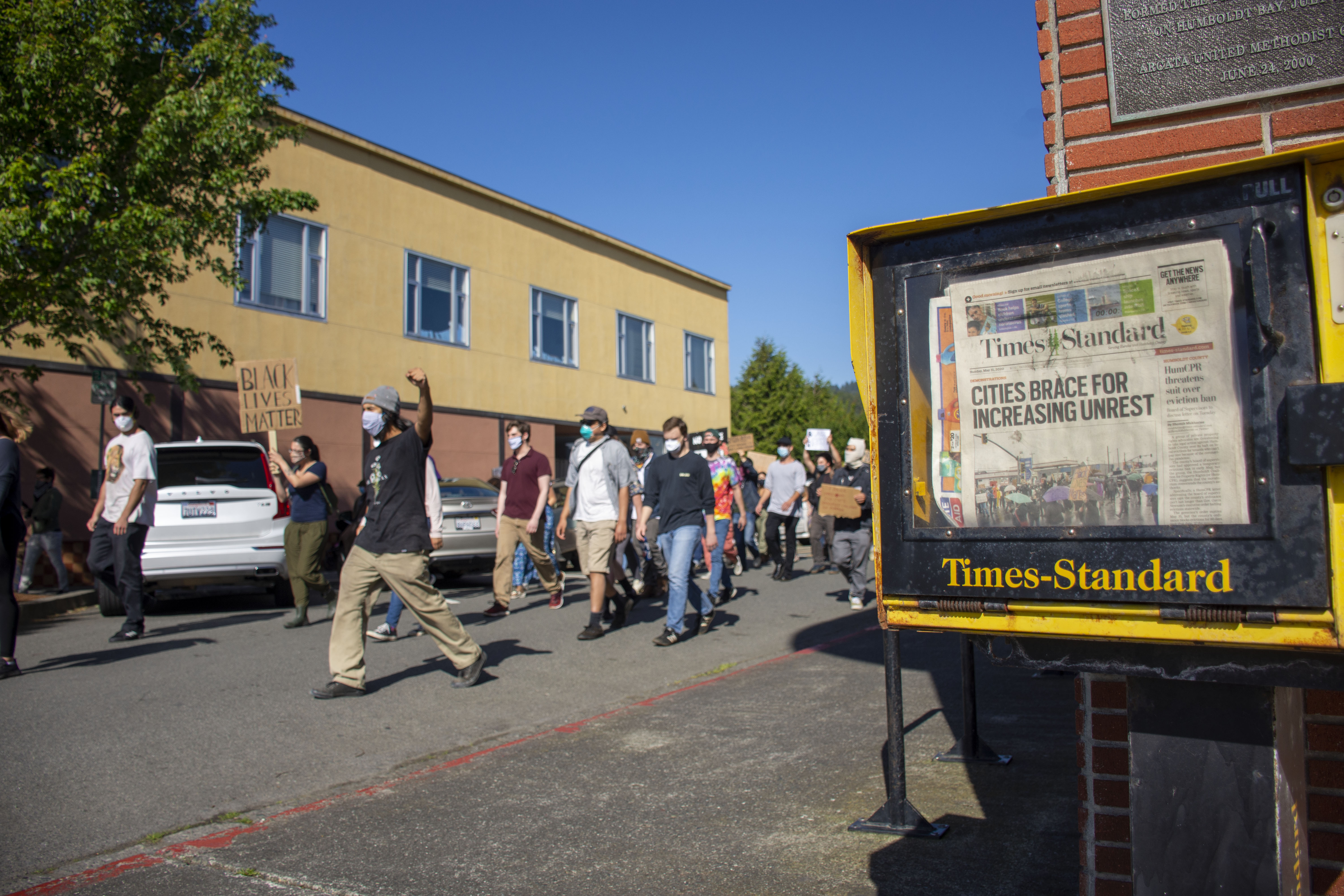
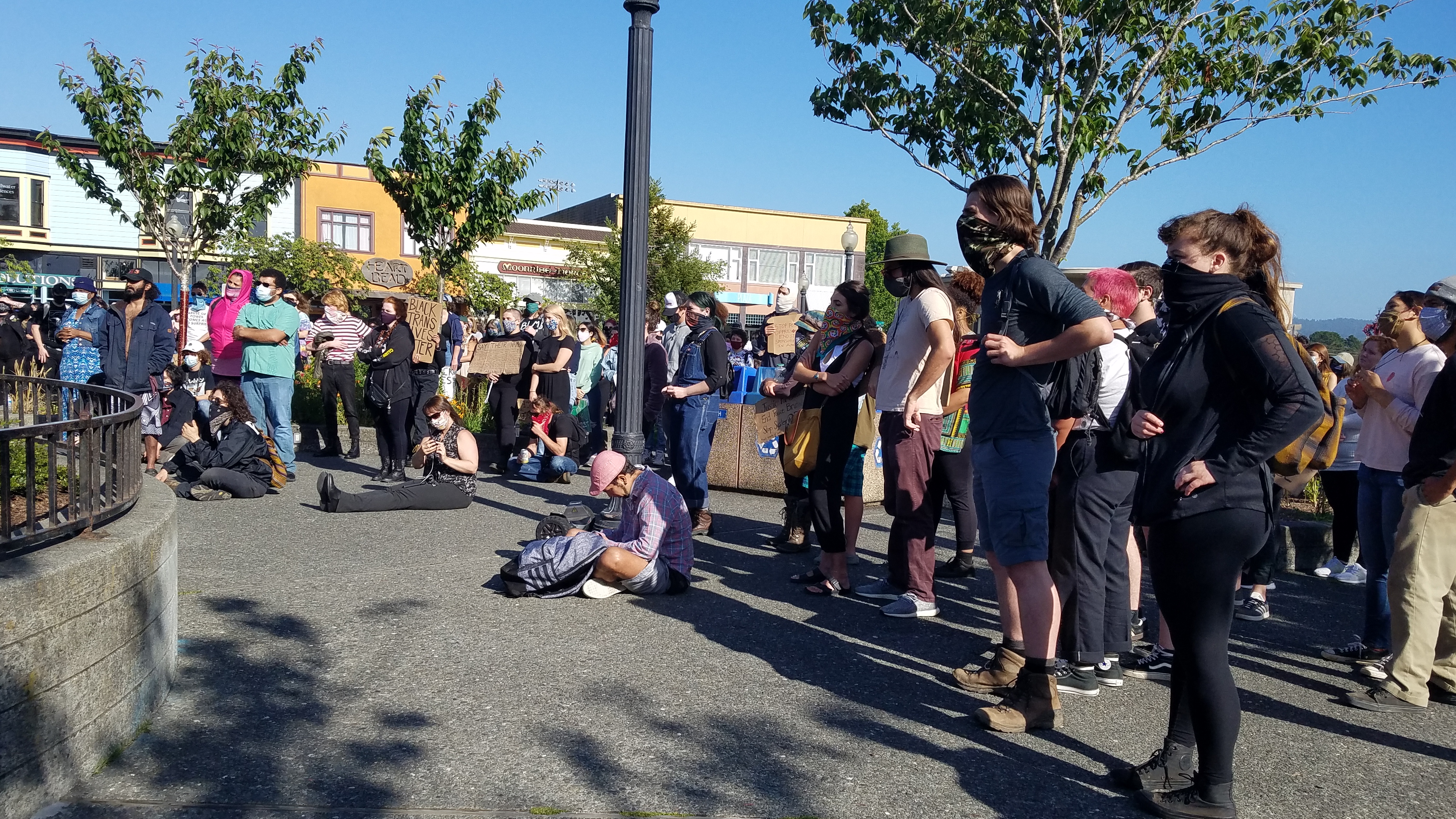
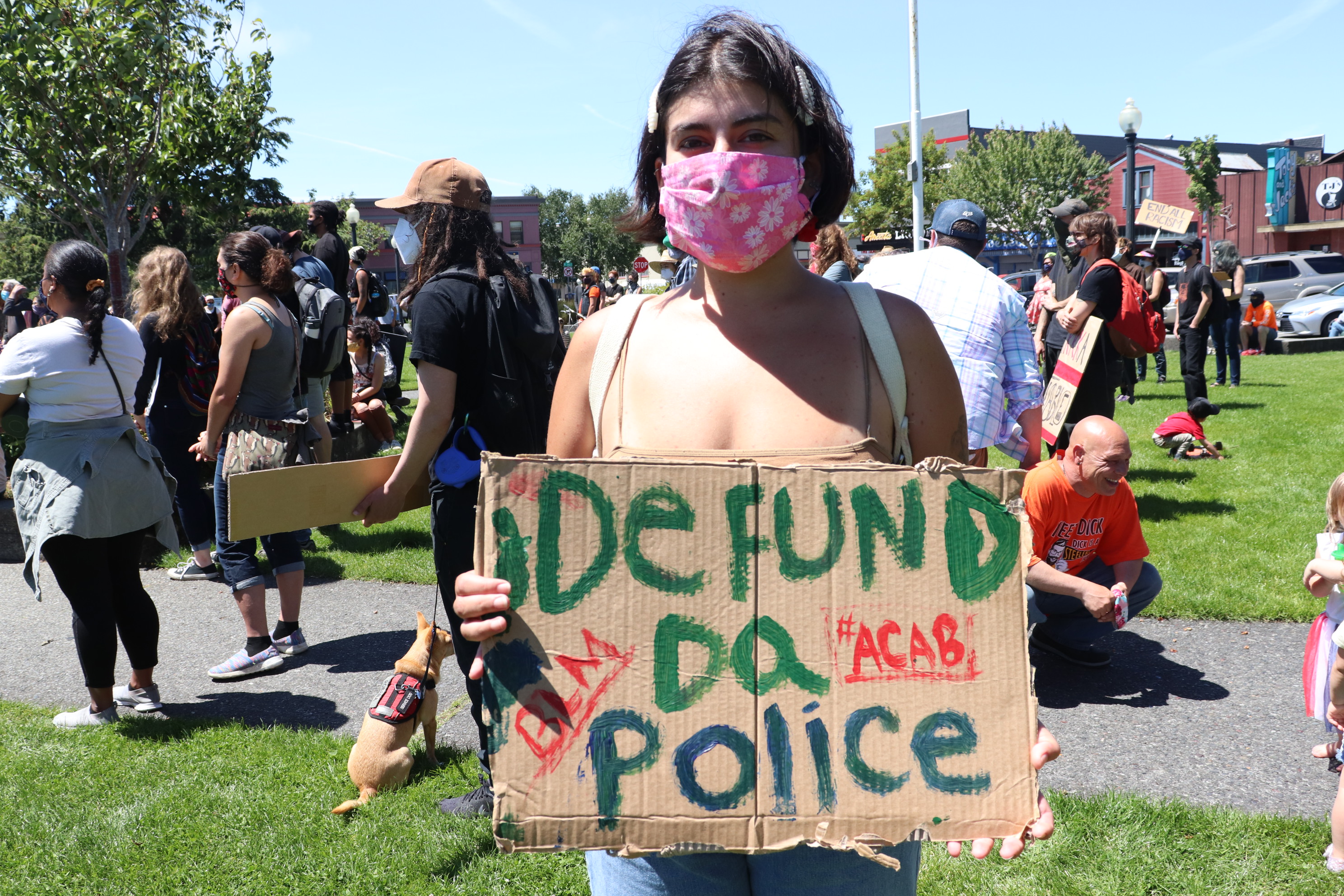
    Peaceful protesters gathered in Arcata on June 1 to continue their demonstrations against police brutality and racism across the nation. People gathered around Arcata City Hall, bringing signs and wearing facemasks while listening to members of the community speak.

    Demonstrators spilled off of the lawn and into the streets, taking a moment of silence in remembrance of George Floyd and Black lives that have been unfairly and unjustly taken in police custody.

    A moment of silence for George Floyd outside Arcata City Hall on June 1 | Video by Thomas Lal

    As demonstrators marched toward the plaza, they chanted in unison, “no justice, no peace,” which quickly became a rallying cry across the country.

    Protesters marching to the Plaza, chanting “No Justice. No Peace” on June 1 | Video by Thomas Lal

    There was no police present at the gathering which encouraged community members to stand up and share their stories in the center of the plaza where the President McKinley statue used to be. Community members rallied together and demanded for better education on racial issues and systemic injustices. Allies were called upon to do more than simply showing up to rallies and to exercise their rights to reinforce just advocacy.

  • Eureka Protests Erupt After George Floyd Murder

    Eureka Protests Erupt After George Floyd Murder

    Eureka protesters gathered in front of the Humboldt County Courthouse

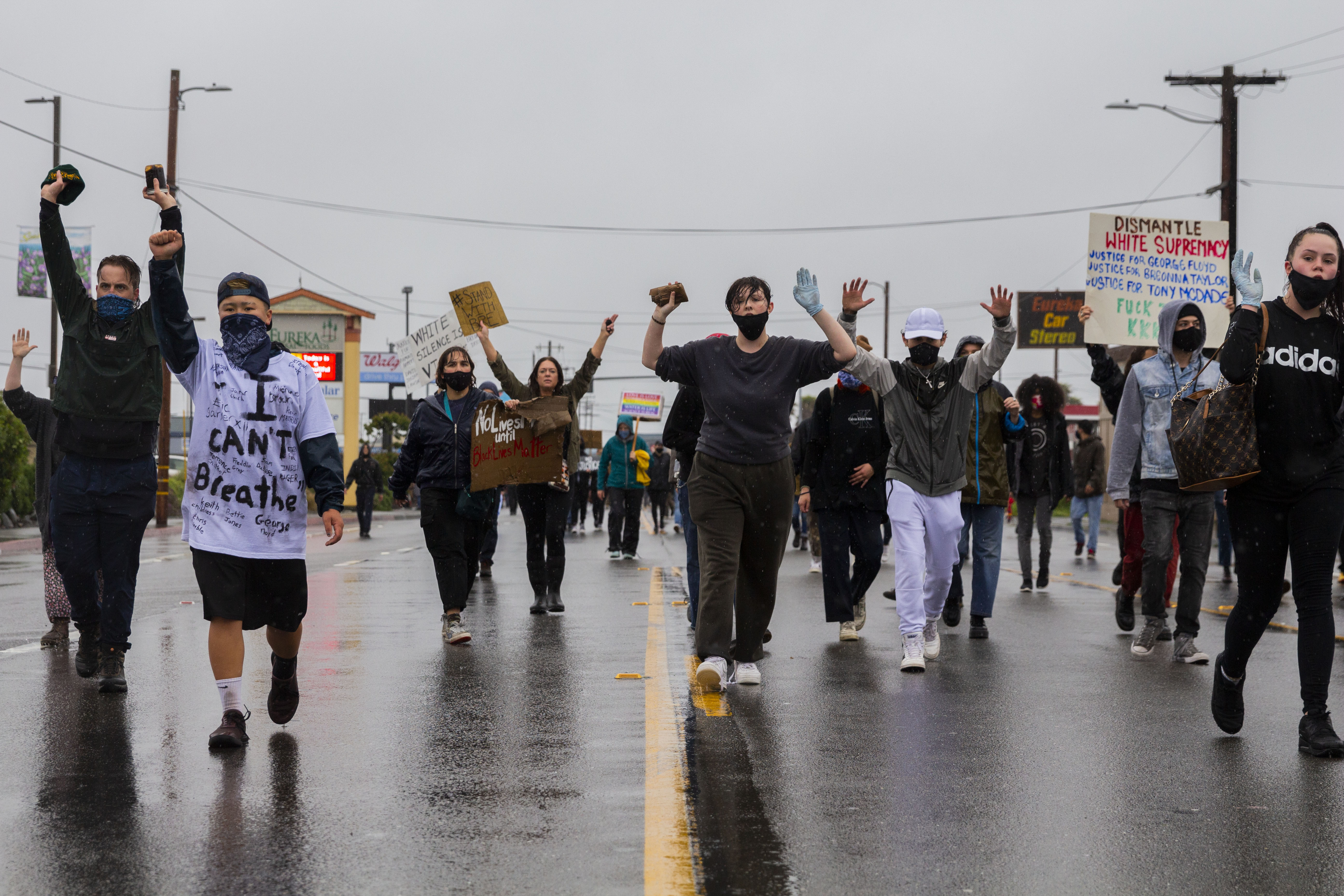
    Hundreds of community members gathered in the rain outside of the Humboldt County Courthouse, Sat. May 30, to protest the death of George Floyd who was murdered while in police custody in Minneapolis, MN. From 3 to 10:30 p.m. demonstrators marched through Eureka up to the Slough Bridge, back through town and then down Broadway. Law enforcement was largely cooperative with demonstrators, blocking intersections as people made their way through traffic. Chants could be heard the entire way even as groups split up and went to various parts of the city. 

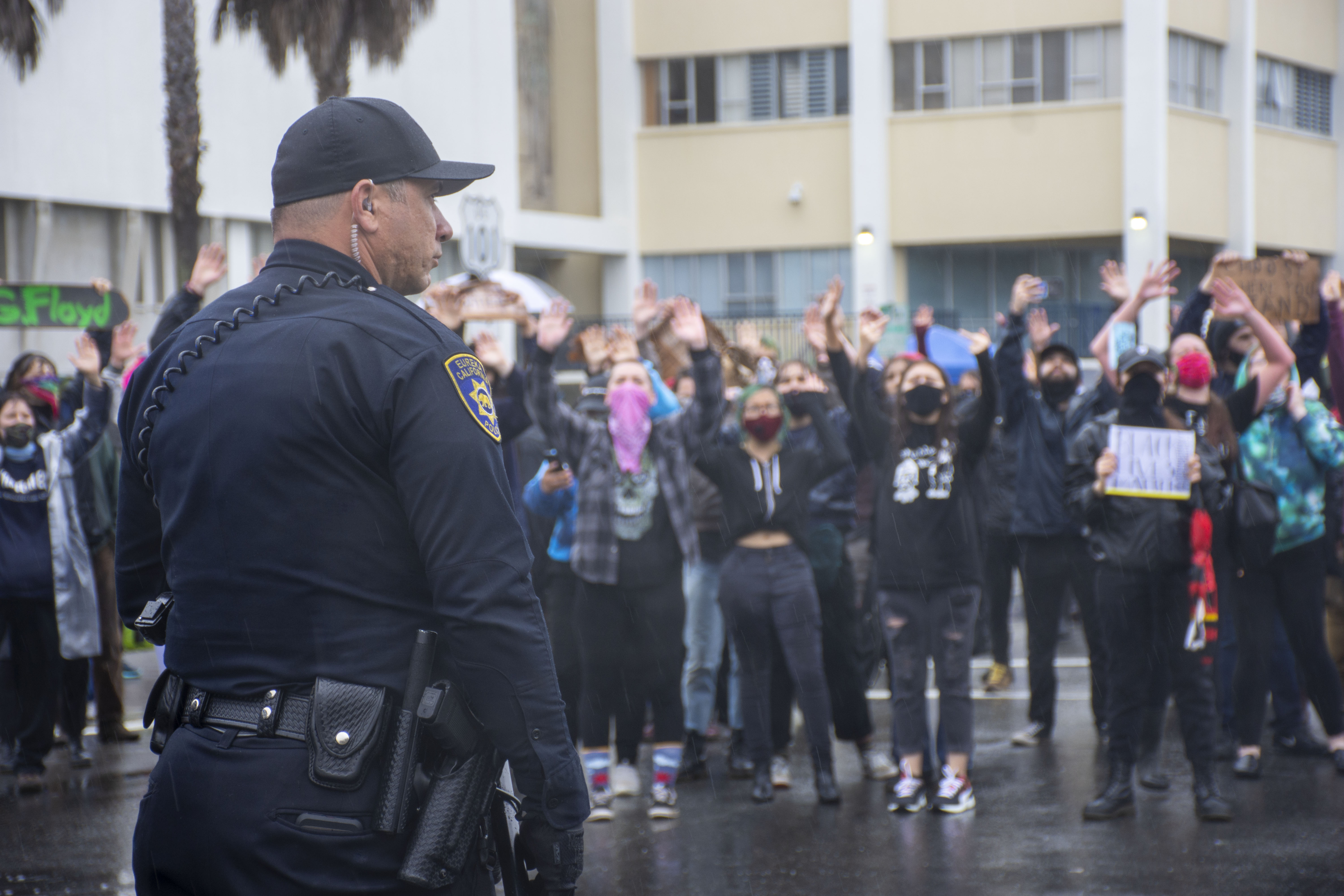
    As the group returned to the courthouse tensions flared at the sight of several police vehicles, which were soon removed from the scene. Eureka Police Chief Steve Watson was present at the protest and spoke with demonstrators as the crowd dispersed and headed away from the courthouse. These demonstrations in Humboldt are some of countless that have sprung up across the nation following Floyd’s murder.