While the rest of the planet suffers, what will become of the Redwood Forests?
While climate change continues to cause destruction around the globe, scientists are finding hope in a local tree: The Giant Redwood, or Sequoiadendron giganteum.
The trees are currently in the midst of a growth spurt, producing more wood in the past century than any other time in their lives, according to Save The Redwoods League, a nonprofit organization who protect and restore the California redwood forests. Researchers from Humboldt State University, UC Berkeley, Natureserve, United States Geological Survey and Colorado State University are working alongside Save The Redwoods League to understand the growing trees and how they will continue to respond to climate change.
The Save The Redwoods League and HSU published findings concerning the impact of climate change in the recent research paper Aboveground biomass dynamics and growth efficiency of Sequoia sempervirens forests. They found that within the redwood forests, there are massive amounts of carbon sequestration. “Sequoia forests may be the most effective to [sequester carbon], because they accumulate more above ground biomass than any other vegetation, sustain higher rates of productivity than any other forest, and protect biomass produced via superlative fire- and decay-resistance.”
Carbon sequestration is “the capture and secure storage of carbon that would otherwise be emitted to, or remain, in the atmosphere,” according to Encyclopedia of Energy, 2004. This means carbon is trapped in forests, soil, or oceans for long periods of time instead of entering the atmosphere. It can be done naturally or artificially, and is becoming a researched effort to delay global warming which is caused by increase of greenhouse gases, such as carbon dioxide.
This is why scientists are so interested in the natural carbon sequestration of the redwood forests. While this seems to be good news, there is still much research to be done.
NASA scientists have started to create a global map of where carbon is being stored, and how much carbon is being released through deforestation. The redwood forest is only a tiny part of that map.
Humboldt State University Professor Steve Sillett has worked on the research with Save the Redwoods League.
“Redwoods can do little to fight climate change as they occupy a TINY proportion of the landscape,” Sillett said in an email. “Even though they are impressive in many respects, too little of the landscape is covered by them to make much difference at the global scale.”
While the redwoods alone cannot create a global change, scientists are continuing to research the storage of carbon in forests and what this means for the future of the planet.
In spite of the successful campaign to phase out single-use water bottles, Humboldt State has yet to remove plastic bottled beverages from campus
Almost 10 years have come and gone since Humboldt State University took back the tap and did away with single-use water bottles on campus.
Overall HSU is known to lead the way in sustainability across the California State University system. In spite of being further ahead in the sustainability game than most campuses, HSU still offers a variety of beverages for sale packaged in single-use plastic.
HSU Dining Services Director Ron Rudebock said they have gotten a fair number of comments over the last couple of years regarding plastic products and on phasing out plastics completely.
“We have been working with vendors to obtain their products in a reusable or compostable or recyclable package and vendors are changing their package materials,” Rudebock said.
Four of the five campus responsibilities listed under the policy have set deadlines.
The first is the elimination of single-use plastic water bottles by Jan. 1, 2023. HSU met this requirement in 2011. The second is the elimination of plastic straws no later than Jan. 1, 2019. HSU eliminated plastic straws during the fall 2017 semester.
The third responsibility listed, also set for January of this year, was the elimination of single-use plastic carryout bags. HSU stopped using plastic bags back in March 2014. The fourth deadline, and last with a time requirement, was the elimination of single-use polystyrene (e.g. STYROFOAM™) food service items no later than Jan. 1, 2021. HSU eliminated Styrofoam to-go containers over 10 years ago and the campus is working to eliminate it in any pre-packaged items.
The final goal of replacing single-use plastic items with materials that are reusable, locally compostable and/or recyclable doesn’t list a specific deadline.
A variety of some of the single-use plastic bottled beverages offered. According to Rudebock, much of the decision to continue to sell single-use plastic drinks is because of consumer choice. | Photo by Megan Bender
Rudebock said this specific change is a challenge. The Depot, the College Creek Marketplace, the Cupboard and vending machines still offer plastic bottled beverages on campus.
“We would like to see a faster adaption but with this guideline having no deadline and with the current collapse in the recycling market I do not see this becoming feasible in the next year,” Rudebock said.
Dining services has made some efforts in providing more glass or aluminum options. The J, for example, has a beverage cooler that is all aluminum and glass, has eliminated single use plastic containers and has single-use packaging that is compostable or recyclable.
However, other locations haven’t been able to make the same change as effectively because of the demand for products that happen to also be in plastic bottles.
“We’ve been working with a lot of our vendors and pushing, trying to get more either glass or aluminum containers.” he said.
Rudebock said Dining Services also goes out of their way to order aluminum and glass alternatives whenever possible from specific companies and brands like Coke or Pepsi.
“It kind of comes down to consumer’s choice,” he said. “Consumers can help by purchasing products that are in reusable, compostable or recyclable packaging and not requesting products that are not in reusable, compostable or recyclable packaging.”
Students have pushed back against the university in the past, questioning its dedication to environmental responsibility over their business ties with PepsiCo.
As reported in the Lumberjack and the North Coast Journal, in 2017 HSU made efforts to meet student’s demands to closer align with its dedication to social, economic and environmental issues by re-evaluating a 40-year-long partnership with PepsiCo.
Under the contract PepsiCo funded HSU with around $58,000 worth of athletic scholarships in exchange for pouring rights. Pouring rights allowed PepsiCo to reserve 80% of HSU shelf space for their products.
Students also made the argument the set up was not fair to local businesses.
In spite of being in a budget deficit and the loss of scholarship funding, HSU did not renew the pouring rights contract and let it expire at the end of June 2017.
HSU was the first California public university and third national public university to phase out water bottles.
The University Center and Dining Services stepped into to help with some of the lost resources.
Rudebock said they managed to fund a majority of the lost scholarship money but leaves the decision of how the scholarships are dispersed up to the school. This way the UC and Dining Services are not directly funding athletics or any specific department.
The university still does business with PepsiCo but under different rebate-based agreements. Dining services also stopped carrying Aquafina water bottles, a brand owned by PepsiCo as a result of the nationally recognized Take Back the Tap campaign.
Under the Waste Reduction & Resource Awareness Program, students began efforts to Take Back the Tap at HSU starting in 2009. The student lead group and Dining Services worked to phase out the sale of single-use water bottles in 2011 as is the primary focus of the campaign.
As a result, HSU became the first California public university and third national public university to phase out water bottles. Dining Services initially explored an alternative by offering boxed water.
“At first we thought they were upset with the plastic water bottles, but they said ‘No no, just the water,’” Rudebock said. “It was more about the idea of selling packaged water.”
Before HSU removed water bottles on campus, TBTT calculated that HSU’s annual bottled water demand “required approximately 43 barrels of oil per academic year” and in turn was “releasing 35,000 pounds of carbon dioxide into the atmosphere.”
HSU now owns two Hydration Stations and has 16 water fill stations on campus.
Environmental Science & Management Professor James Graham and his geospatial students created an interactive map of HSU that includes where to find water fill stations on-campus as well as other resources.
The locations of all water stations on HSU’s campus according to the Sustainability project. These locations include the two Hydration Stations.
Sustainability Director Morgan King said Facilities Management worked with students help create the map.
“We worked with [Graham’s] students to develop layers for sustainability attributes,” King said. “Including water filling station locations, bike parking locations, recycling and compost bin locations.”
Anyone can access the map by visiting HSU’s sustainability website. The map key is listed in a drop down menu that offers different types of resources on campus. Under the sustainability option, users can check the box of the information they’re looking for.
Rudebock said Dining Services remains attentive to the needs of the students and the possibility of selling less plastic-bottled products.
“Every journey begins with a step,” Rudebock said. “The less plastic containers that students buy helps change the need for that product.”
The California State University system’s single-use plastic policy passed in December 2018 includes four policy changes that have deadlines, but the fifth and final goal of the policy doesn’t list a deadline.
Eliminate single-use plastic water bottles by January 1, 2023. HSU has already met this requirement as of 2011.
Eliminate plastic straws no later than January 1, 2019. HSU eliminated plastic straws during the fall 2017 semester.
Eliminate single-use plastic carryout bags no later than January 1, 2019. HSU eliminated plastic bags in March 2014.
Eliminate single-use polystyrene (e.g. STYROFOAM™) food service items no later than January 1, 2021. HSU eliminated Styrofoam to-go containers over 10 years ago and are working to eliminate it in any pre-packaged item
Replace single-use plastic items with materials that are reusable, locally compostable and/or recyclable.
To find out more about HSU’s Zero-Waste Initiatives, WRRAP and TBTT visit the WRRAP homepage.
With all the gear and gadgets, mountain biking isn’t as sustainable as it may seem
For a sport that usually occurs in natural settings, and whose participants generally value the ecosystem and the world around us, mountain biking has a serious sustainability problem.
Everything has an expiration date. No matter the maintenance, nothing is ever ‘for life,’ and nowhere is this truer than in the mountain bike industry. Chains stretch, tires bald or blow out, brake pads get worn down and bearings become crunchy and rough.
Issues arise when one attempts to revive or service a bike. Many of the functions are delicate and precise, requiring fresh parts to operate smoothly. This means something as simple as a tune-up often results in cables, housing, tubes and tires being thrown away.
Improper installation or use means that these parts break before they should and get replaced prematurely. Some people replace prematurely simply because they want improved performance.
It’s hard to process this waste on an individual level, but walk into your local bike shop and look in the trash cans. Often, they’re filled with very un-recyclable items that are used, removed and replaced.
Of course, the nature of the sport is that parts get worn down or broken and must be swapped. That so many of these parts get replaced prematurely or destroyed early due to user error is only part of the problem.
With the way our world is headed, mountain biking is due for a rude awakening on the ways that it creates unnecessary waste.
Other issues arise when we look at the bike industry and the way they market their high-end products. Often, these brands will swaddle their expensive parts in multiple layers of processed cardboard and plastics.
Recently, I purchased a new shifter for my bike. The shifter is a small plastic pod, about the size of a mandarin orange. It arrived in a box that I could’ve fit my shoes into.
Just because you can get away with selling drivetrain parts that cost as much as high-end electronics, doesn’t mean you need to package them like iPhones.
If these parts were packaged in plastic bags rather than bulky cardboard, you could fit 10 times the items in a similar space, drastically cutting down on shipping material and resources.
Usually, I give corporations a bit of lee-way with the way they package expensive items. It makes sense that they’d want to provide the customer with a sense of exclusivity for choosing to spend their hard-earned dollars on these parts. But with the news about our world’s climate becoming grimmer with every passing day, the mountain bike industry needs to step up and restructure their priorities to make the sport more sustainable.
I’ve never met a mountain biker who didn’t care about the environment and the future of our planet. Unfortunately, when something breaks usually the whole bike is unrideable until the issue is corrected. Most of us just accept the impact of our sport as there aren’t many other options.
With the way our world is headed, mountain biking is due for a rude awakening on the ways that it creates unnecessary waste.
Humboldt is experiencing the fastest rate of water elevation on the West Coast
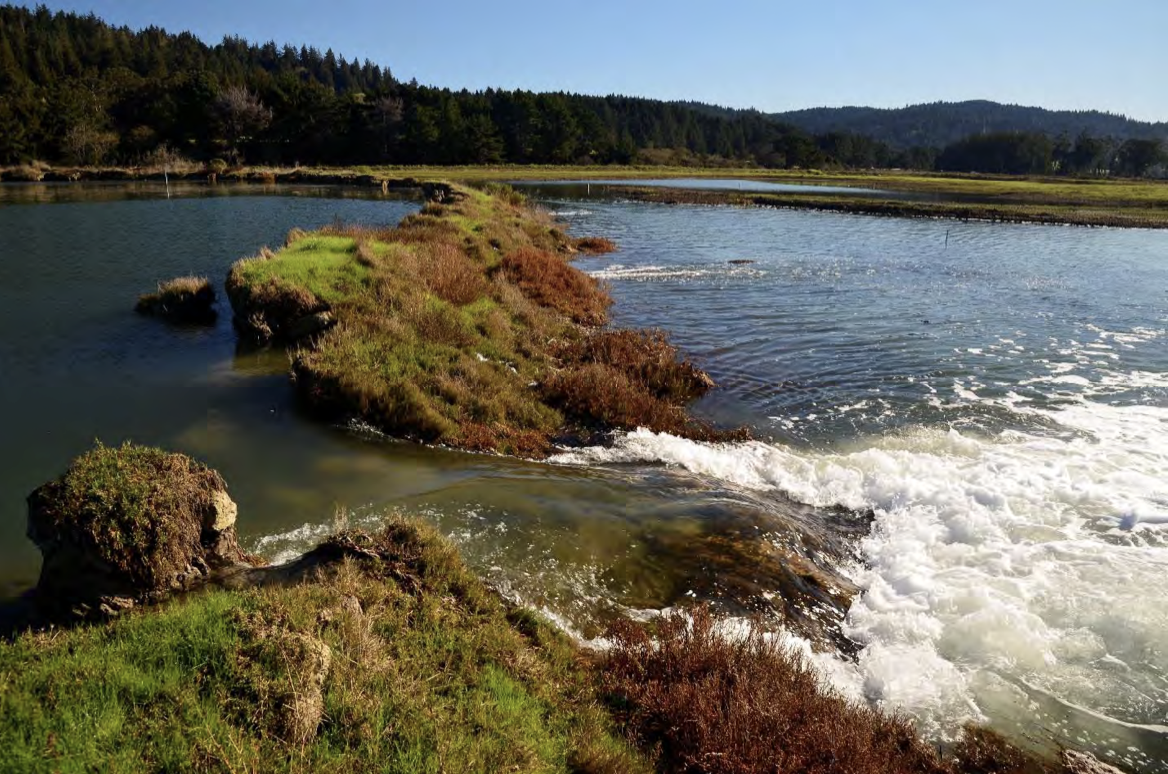
Humboldt Bay is ground zero for sea level rise. In the last 100 years, the sea level rose 18 inches. This the most rapid rate of sea level rise on the West Coast.
Humboldt County Environmental planner Aldaron Laird has 30 years of experience and spent ten years mapping and analyzing Humboldt Bay through a series of vulnerability assessments to help prepare our community for the inevitable impacts of sea level rise.
“All the damage is going to occur with two and three feet of sea level rise,” Laird said. “It doesn’t really matter when that’s going to occur. We basically have to prepare for that now.”
Laird reported that the rate of rise will continue to increase. A two or three foot increase in the average elevation of high water will breach the miles of diked shoreline as early as 2030.
“All the damage is going to occur with two and three feet of sea level rise. It doesn’t really matter when that’s going to occur. We basically have to prepare for that now.”
Aldaron Laird, Humboldt County Environmental Planner
“When we go from two feet to three feet of water elevation change, it’s the tipping point in Humboldt Bay,” Laird said. “The 23 diked hydro logic units that we have on the Bay, all of them will be over topped when we go from 2 to 3 feet. So everything behind that will be impacted.”
The land behind the dikes is privately owned agriculture, residential areas, business parks and industrial assets, not to mention municipal water lines, PG&E gas lines, waste-water treatment lines and electrical transmission towers. The threat is legitimate and significant.
“The major urban areas that are most at risk are King Salmon and Fields Landing,” Laird said. “They are at risk straight from sea level rise. Half a meter to a meter, and those areas will be underwater. They aren’t behind dikes.”
Linda Gill is the manager of Gill’s by the Bay, a restaurant located on the King Salmon waterfront. Gill said she hadn’t thought too much about the threat her restaurant faced as sea levels continue to rise.
Projected Inundation Area (Stillwater) on Humboldt Bay
for Mean Monthly Maximum Tide with 6.6 feet (2.0 meters) of Sea Level Rise. | Photo from Humboldt Bay Area Sea Level Rise Vulnerability Assessment
“Right now we are just going with the flow,” she said in a phone interview.
Wave energy had been diverted by the north and south jetties to an area called Booner Point, the site of an old PG&E nuclear power plant. There are still nuclear fuel rods stored there.
“They decommissioned it, and they stored all the nuclear fuel rods 115 feet back from the bluff on their property with all that wave energy focused on that bluff,” Laird said. “It’s experiencing the highest rate of erosion anywhere on Humboldt Bay, and those nuclear fuel rods are going to be there forever. It’s probably the stupidest place on Humboldt Bay to locate a nuclear fuel storage site.”
Jennifer Kalt, the director of Humboldt Baykeeper, said the county needs to be prioritizing protection rather than considering potential hazards.
“Instead of fighting, local governments and state agencies need to work together to make a plan,” Kalt said.
“Instead of fighting, local governments and state agencies need to work together to make a plan.”
Jennifer Kalt, Director of Humboldt Baykeeper
Kalt said the planning process seems to have reached a stalemate as local and state jurisdictions fail to agree on a comprehensive plan. The unique issue about Humboldt Bay is that the California Coastal Commission has first and final say on improvements to the shoreline.
“So we have this conundrum on Humboldt Bay that I think the Coastal Commission has really never faced anywhere else in California,” Laird said. “The entire shoreline of Humboldt Bay is in state jurisdiction. If the county said they wanted to rebuild all the dikes, they couldn’t. They would have to ask the Coastal Commission and the Coastal Commission could say no.”
Laird has submitted the final sea level vulnerability assessments. Now the individual actors need to come together in unison to take action and move beyond the planning phase and into the action phase.
“Anything that can be moved should be moved,” Laird said. “Anything that can be hardened, redone or redesigned so that it can accommodate being submerged in saltwater should happen.”
Die-in protest advocates for action on climate change
Motionless bodies lay in the Humboldt State University quad on Friday.
Junior wildlife major Olivia Brock joined a die-in protest put on by Extinction Rebellion with help from Earth First.
“We want to show them that if they’re gonna kill us, then they have to see us,” Brock said.
A variety of HSU students pretended to be dead on the ground, with many holding flowers in their hands and some wearing face paint.
HSU student Vanessa Argonza lying prone for a die-in climate protest in HSU’s quad on Sept. 27. | Photo by James Wilde
Signs at a die-in climate protest in HSU’s quad on Sept. 27. | Photo by James Wilde
John Powell (tie-dye), College of the Redwood agriculture student, and J.T. Abbott, HSU botany student, hugging on the ground for a die-in climate protest in HSU’s quad on Sept. 27. | Photo by James Wilde
Extinction Rebellion and Earth First advocate and protest for governmental action on climate change and environmental issues.
Junior forestry major Arvel Reeves joined the protest despite not knowing about it beforehand.
“Climate change is something I really worry about,” Reeves said. “It’s only going to get worse.”
Lily Price, HSU botany student, played a morose tune over the protesters’ bodies on a harmonium, an organ instrument that sounds similar to an accordion.
The protest came one week after a global climate strike that saw thousands of protests around the world, including one in Arcata.
Ellis Hanson, a junior wildlife biology major, wanted to help stand for the earth.
“I did this to do a demonstration,” Hanson said. “To make sure everyone remembers the crisis we’re in.”
Ellis Hanson, HSU wildlife biology junior, lying down for a die-in climate protest in HSU’s quad on Sept. 27. | Photo by James Wilde
Lily Price, HSU botany student, plays a somber song on a harmonium for a die-in climate protest in HSU’s quad on Sept. 27. | Photo by James Wilde
Protesters lying down for a die-in climate protest in HSU’s quad on Sept. 27. | Photo by James Wilde
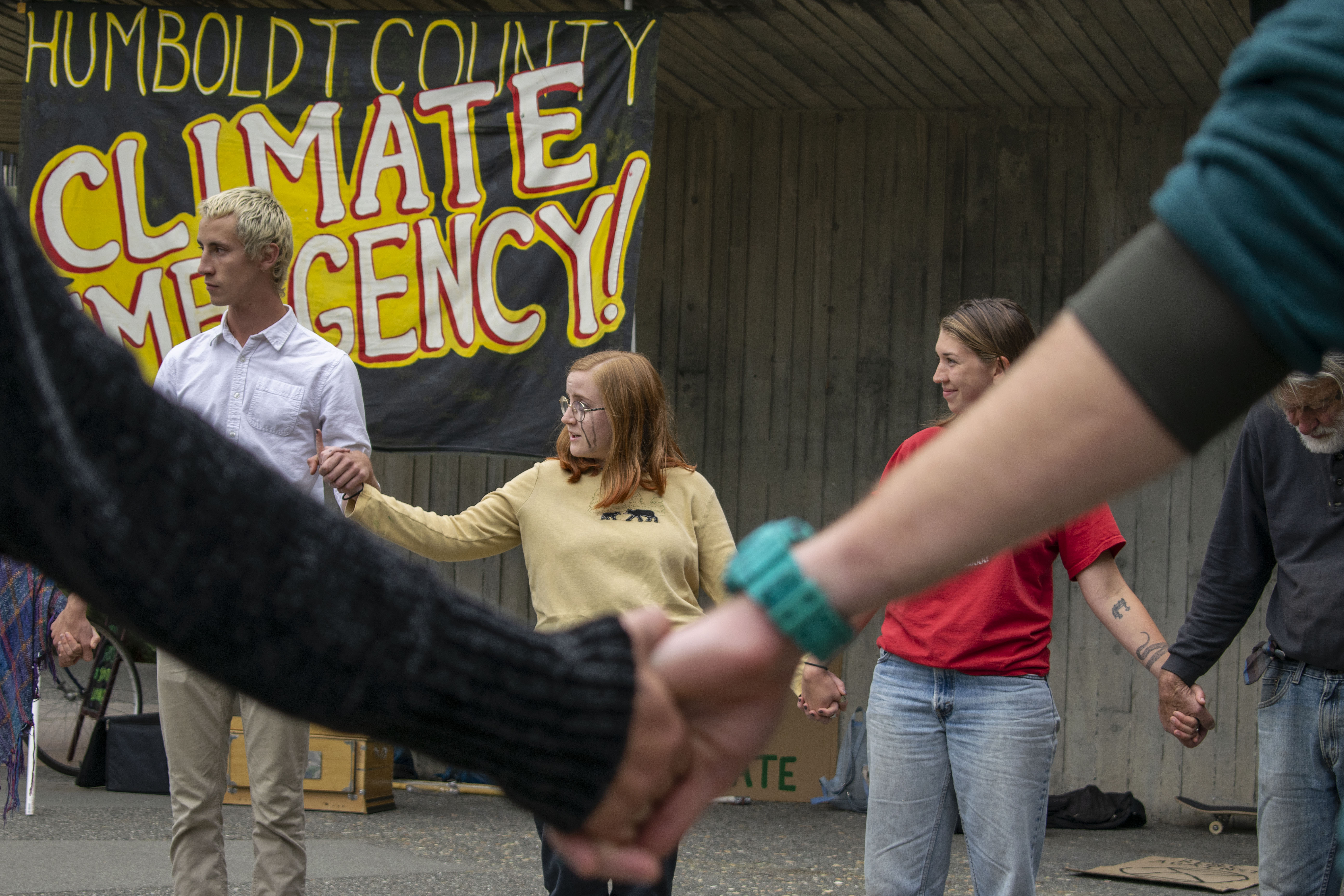
Protestors gathering in a circle after a die-in climate protest in HSU’s quad on Sept. 27. | Photo by James Wilde
Students passing by showed mixed reactions to the protesters. Some stopped and watched. Others took photos on their phones. Others scurried along without a second glance.
Brock hoped the visual nature of the protest would draw attention.
“We want to make the people of Humboldt County see the future we’re being handed,” Brock said.
Heri Hawthorn, a local activist, helped create some of the signs and banners for the protest. Hawthorn held a sign above the protesters while they lay still.
“There’s nothing else to do except support others and curb what’s happening,” Hawthorn said.
Early on, when a University Center employee took down an unpermitted protest banner. Brock took notice.
“Don’t you care about your children?” Brock asked the employee. “The earth is dying!”
Blu, HSU environmental studies senior, lies covered up for a die-in climate protest in HSU’s quad on Sept. 27. | Photo by James Wilde
Climate change affects the lives of birds, butterflies and bees
Pollinators matter! Right under our noses a huge community of ants, butterflies and bees are hard at work to make sure the world gets fed. The climate crisis is turning up the heat on these poor guys, and our many-legged friends are at risk. Here’s some information on how pollinators are still doing their best to help us out.
A solitary silver bee perches on a yellow flower to drink nectar. Notice the yellow pollen on its legs which it will bring to the next flower it drinks from. | Photo by Rand Rudland
Flowering plants and pollinators have a unique relationship with one another. Ecologists and biologists pay attention to special events in these organisms’ lives which mark growth and development. The science of studying life events is called phenology.
Ideally a pollinator will hatch from its egg or develop from its pupa and leave the hive around the same time its flower of choice blooms. The timing of these life events is important because if a bug emerges too early or late, it may miss a plant’s flowering completely. No flower equals no food, and that’s no good.
After emerging, the pollinator goes searching for nectar. The sweet liquid is energy-packed food for bugs. When a pollinator lands on a flower, it picks up pollen. As it continues to look for nectar, the pollen is shaken off and sticks to other flower’s pistils, the female organ of the plant. Pollen travels down a shaft to fertilize the ovary, which begins to go through mitosis and eventually produces fruit.
Tayloranne Finch and Melanie Honda are two farmers working on the Bayside Park Farm in Sunny Brae who get to interact with pollinators every day. Without pollinators, their farm would be a bunch of fruitless bushes.
Finch said the farm was working with the City of Arcata to build a permanent solution, a perennial native pollinator garden. The garden would have year-round plants that local pollinators prefer, supporting the local habitat organically.
Tayloranne Finch, left, and Melanie Honda, right, are farmers at Bayside Park Farm. They spent a sunny afternoon pollinating corn by walking through the rows, swaying their arms back and forth. Every week is a volunteer friday at Bayside Park Farm on Old Arcata Road in Arcata, CA 95521. | Photo by Collin Slavey
“We’re installing plants that will be there forever. It makes it easier for pollinators to establish themselves on the farm and it is mutually beneficial for us,” Finch said.
In the paper they investigate how temperature affects the phenology of the silky beach pea (Lathyrus littoralis) and its main pollinator, the ground-nesting solitary silver bee (Habropoda miserabilis).
“Temperature best predicted both flowering and bee activity, although soil moisture influenced the timing as well,” the paper said.
Their findings imply that in the face of the climate crisis, an average increase in temperature may cause the silky beach pea and the solitary silver bee to fall out of sync.
“Comparison of linear regression slopes of phenology against temperature suggests that bee nesting time is more sensitive to differences in seasonal maximum temperatures, and may advance more rapidly than flowering with temperature increases,” the paper said.
A bumblebee looking for lunch landed on this flower to get a drink of nectar. The bee will help pollinate nearby flowers as it continues on its flight. | Photo by Collin Slavey
Olliff-Yang and Mesler said that it’s important to understand what factors influence flowering and pollinator activity. Their investigation into the bee and the pea is just an example of a broader issue in the world.
Building habitat is invaluable to local animal communities, as shelter, food and water are critical needs for every living organism. The most simple thing to do is to plant native plants in the front yard, as this will attract local pollinators.
Local nurseries like Mad River Gardens will be more than happy to teach you about native plants and how you can attract and support our flying friends. As active members of the ecosystem, we all need to do our part.
The viral clean up challenge is going strong across the world
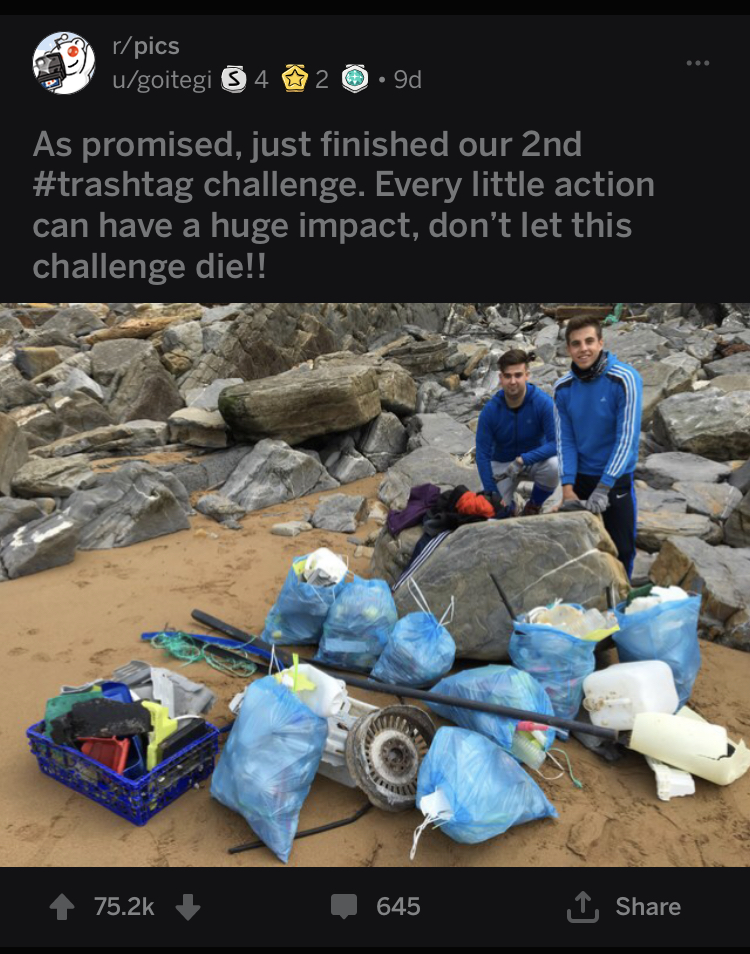
The viral challenge to pick up nasty littered areas hasn’t been tossed out. #Trashtag is still going!
In case you haven’t heard about the challenge, #trashtag challenge has a few simple steps. First, locate an area of your community covered in trash. Second, equip a team of people with gloves and trashbags. Third, bag it.
Be sure to take a before and after photo to show what a difference you made for your community and upload it on social media like Twitter or Reddit with the hashtag #trashtag.
The trashtag hashtag has been on the internet for some time now, the trend got popular in March 2019 after a guy named Byron Román made a post on Facebook about it. His post is a photo of a man in a littered area before and after he cleaned it up. Román challenged teens to do the same.
“Here is a new #challenge for all you bored teens,” Román wrote. “Take a photo of an area that needs some cleaning or maintenance, then take a photo after you have done something about it, and post it.”
Photo Courtesy of Jadarlin
Román made it viral. After more than 100,000 likes and shares on Facebook, #trashtag had it in the bag. The movement spread online like the pacific garbage patch has spread in the ocean.
All across the world from Bali to Brooklyn trashtaggers are cleaning up their backyards. Reddit user misoxx even submitted their #trashtag contributions from Nepal!
Littering has serious impacts on humans and the environment we live in. According to a study published by the Royal Society, fish may actively seek out and eat plastic waste because it smells and looks like food.
This kills fish. As humans, in turn, eat plastic filled fish the plastic accumulates in our bodies. This is “litter-ally” as dangerous as eating tide pods.
As far as viral internet memes go, #trashtag is probably the most wholesome one yet. It’s relevant, it’s productive and it encourages an awesome behavior, picking up trash.
The Story of Stuff, founded by Annie Leonard, an investigator who took the lid off of manufacturing in the world, teaches its viewers about where all this waste comes from.
Leonard explains how consumerism is all about that “buy buy buy” attitude. The problem with this attitude is the fact that we end up with way too much stuff. As soon as we realize that fact, anything we don’t need or want gets tossed. That’s one reason there is so much trash that ends up on our beaches, in our rivers and on our streets.
Photo Courtesy of misoxx
Litter is a serious issue in our modern age. Our society depends on cheap production and disposable items to make life convenient. Unfortunately, these behaviors “externalize” the real impacts of plastics, including litter.
Trash becomes a problem, real quick. Although our waste quickly piles up in landfills, at least it’s a heck of a lot better than it piling up on our beaches. #trashtag is a great reason to make sure nasty trash ends up where it belongs.
So let’s pick up a trash bag, put on a pair of gloves and start bagging that trash. Our communities will appreciate and out planet will appreciate it. Remember to take a picture and #trashtag.
Recycling is not as sustainable as you might think. It has become a wasteful movement that was beneficial during the early stages of the environmental movement. Now the cost outweighs the satisfaction we get out of recycling.
“Recycling has been relentlessly promoted as a goal in and of itself: an unalloyed public good and private virtue that is indoctrinated in students from kindergarten through college,” wrote John Tierney, journalist and self-described “contrarian” for the New York Times. “As a result, otherwise well-informed and educated people have no idea of the relative costs and benefits.”
To put it in another way, most recycling advocates are unaware of the cost of transportation, labor and production of renewable materials that ultimately defeats the purpose of saving the planet.
Recyclers are validated by the collective consciousness of fellow believers. They don’t realize the wastefulness that occurs after rolling the recycling bin to the curb. Why did things get worse? The short answer is the success of an ongoing marketing campaign that resonates with a growing population of millennials and aging liberals.
Since the advent of the “Reduce, Reuse, Recycle” idea, recycling received the most attention. Why? Because there’s barely any money in reducing or reusing. If you think about it, recycling starts its capitalistic cycle from our wallets to the bins or recycling centers, then to the manufacturing plants, the businesses and back to burning a hole in our pockets.
So, there you have it, reduce consumption and reuse your renewable materials. Buy used products and learn how to repair them if they break. Borrow, rent or share if you can. The point is to reduce the disadvantages of recycling that is practiced by too many people and apply smarter solutions to climate change. If enough of us consume less and reuse more, the act of recycling can reclaim its integrity. It’s all about balance.
Researchers at the International Monetary Fund and Georgetown University announced that more than 90 percent of all passenger vehicles in developed nations could be electric by 2040. Only two million out of more than one billion registered vehicles are electric today, with one million of those being in China. If this prediction proves true, it could reduce oil use by 21 million barrels a day and cut carbon dioxide emissions by 3.2 billion tons a year. That’s equivalent to 60 percent of total U.S. emissions today.
Source: National Geographic
Embed from Getty Images
As many as one in three parasite species may face extinction in the next century. Researchers from University of California, Berkeley found that global warming will raise the planet’s temperature causing many species to lose territory in which they can survive. Parasites make up the majority of biomass in many ecosystems, and can outweigh predators sharing the environment by 20 to 1. The extinction of parasites may affect entire food webs, which would drastically affect human health in turn. Colin J. Carlson, the lead author of the study, said that parasites control the amount of diseases in wildlife, which indirectly helps humans as well. The estimated extinction of as many as one third of all parasite species would have dire effects.
Source: New York Times
Embed from Getty Images
An oil tanker sank off the shore of Athens, Greece on Sunday, coating the entire bay in crude oil. Greek officials are calling it an environmental disaster as it’s turning the bay black and affecting the local wildlife. The spill is polluting the waters in a 1.5 km stretch around the island Salamis and will likely take four months to clean. Residents are outraged, coastal businesses have closed and fishermen have been advised to avoid the area. The captain and chief engineer of the oil tanker have been charged with negligence and released on bail. It’s still not clear exactly why the tanker sank.
Source: BBC
Beryllium hydride is now the largest molecule a quantum computer has simulated, generating new hope for future drug discoveries. According to Ryan Babbush, the researcher who led the hydrogen molecule simulation for Google, the accomplishment “represents solid progress towards an incredibly important goal.” For practical purposes, however, beryllium hydride is still a tiny molecule, so there is still much research to be done. Many scientists believe that revealing new drugs and materials will be the first significant application of future quantum computers, which are being developed at universities and companies around the world.
Source: Science Magazine
This website uses cookies to improve your experience. We'll assume you're ok with this, but you can opt-out if you wish. Cookie settingsACCEPT
Privacy & Cookies Policy
Privacy Overview
This website uses cookies to improve your experience while you navigate through the website. Out of these cookies, the cookies that are categorized as necessary are stored on your browser as they are essential for the working of basic functionalities of the website. We also use third-party cookies that help us analyze and understand how you use this website. These cookies will be stored in your browser only with your consent. You also have the option to opt-out of these cookies. But opting out of some of these cookies may have an effect on your browsing experience.
Necessary cookies are absolutely essential for the website to function properly. This category only includes cookies that ensures basic functionalities and security features of the website. These cookies do not store any personal information.
Any cookies that may not be particularly necessary for the website to function and is used specifically to collect user personal data via analytics, ads, other embedded contents are termed as non-necessary cookies. It is mandatory to procure user consent prior to running these cookies on your website.