The Lumberjack


Students Serving The Cal Poly Humboldt Campus and Community Since 1929

Tag: HSU budget cuts

  • HSU community petitions to Push Pause on projected cuts

    HSU community petitions to Push Pause on projected cuts

    The California Faculty Association has received more than 3,000 signatures pushing for Humboldt State to hold off on making budget cuts during the current pandemic. The petition has grabbed the attention of many among the greater HSU community. On Feb 18, a meeting organized by the HSU chapter of the CFA was held over Zoom to discuss the ramifications of the class and faculty job cuts including the impacts that they would have on both students and faculty.

    Nicola Walters, a lecturer in the politics department and the organizing chair of the Humboldt CFA, spoke on her experiences over the years as both a student and now a faculty member at HSU. Frightened by what she is witnessing all around her, she wants to fight for what is right.

    “I’ve also sat in countless department meetings and watched the people who taught me, who I look up to, who make this university a place worth attending left bewildered and broken by administrative agendas that herald shared governance, but instead demand cuts to programs, classes, and jobs,” Walters said. “I’ve listened to my colleagues describe feeling disposable, exhausted, terrified, and traumatized while we grapple with overhauls to our campus.”

    Walters remarked on the contrast of HSU receiving lots of federal funding as of late against HSU slashing jobs and classes.

    “Putting profit over people’s jobs doesn’t fit with our university or our community,” Walters said. “Our campus isn’t adverse to change, it’s adverse to practices that violate trust and perpetuate cuts against our campus community. Implementing changes while faculty are unable to protect their interests is an administrative strategy and is not the way forward.

    Another key speaker was Dr. Cutcha Risling Brady, an associate professor and department chair in the Native American Studies department. Brady talked about the impact that any additional cuts would have on students. More specifically, she introduced the idea that students are feeling out of control because they are already dealing with family deaths and other hardships during the pandemic but to see faculty and staff that they rely on for support is next level unacceptable.

    One of these students, senior communication major Anastasia Tejada, is concerned that one of the closest allies in her department, lecturer Leslie Rossman, could very well have her position cut in due time. Rossman helped Tejada get into a graduate school at the University of Nevada, Reno, and secure funding for it.

    “That would not have happened without her support and guidance,” Tejada said. “I would not know where to start and in all honesty, I probably wouldn’t be headed into higher education if it was not for her.”

    Tejada was not surprised that HSU president Tom Jackson was not in attendance for the Push Pause meeting and thinks it is reflective of his entourage as a collective.

    “He has been very silent this entire time he has been missing,” Tejada said. “From almost every important conversation, the fact that he couldn’t even show up to listen just proves the point that the administration does not care about its lectures or faculty.”

  • URPC Builds Budget, Seeks Student Feedback

    URPC Builds Budget, Seeks Student Feedback

    Only four students attended the first University Resources and Planning Committee’s public budget forum, according to Associated Students President Yadira Cruz.

    Around 50 faculty, staff and community members were in attendance as well, according to Art Education Assistant Professor and URPC Co-Chair James Woglom.

    Woglom said the URPC’s presentation, which can be found online at budget.humboldt.edu, focused on the URPC’s work toward creating a scalable budget model, or a budget that can be altered periodically to represent changing values.

    “It ends up bringing more people into the process of decision-making, and thus hopefully reflecting more people’s feeling of what we want this organism to do,” Woglom said of the URPC’s new model.

    James Woglom, art education assistant professor and University Resources and Planning Committee co-chair, checking his laptop in the Humboldt State Univeristy library on Nov. 14. Woglom said the URPC has created a new scalable budget model that allows for more flexibilty and input from the HSU community. | Photo by James Wilde

    URPC has been meeting over the course of the semester to form a three-year budget for Humboldt State. Woglom said the first step for deciding where to allocate funds is to clarify which values HSU should prioritize.

    Besides the forum, the URPC is taking feedback online through an online submission form, a Google survey designed to scale which campus values are most important and a pie chart budget simulator that allows proposals of how HSU should divide funds. Woglom said he’d also be happy to take suggestions through direct emails.

    While Cruz said she appreciated the existence of the online feedback forms, she said they can be obscure due to budgetary jargon.

    “Although it’s available, it might not be accessible in that way,” Cruz said.

    The Google survey, which is not yet released, lists a series of California State University values and asks the respondent to rate how much they agree with each one.

    “It’s not saying that we want to devalue any of them, but it’s trying to get a quantitative sense of where the University’s priorities are in terms of allocation of resources based across a series of ideas,” Woglom said. “And then hopefully with that quantification we can make decisions based on where we can make things happen.”

    The URPC’s current projections show a $5.4 million budget gap by the 2021-2022 school year, which reflects the impact of reduced tuition due to declining enrollment. According to the presentation, every 100 students generate about $560,000 in tuition.

    The University Resources and Planning Committee pointed to declining tuition numbers as the cause of HSU’s current projected $5.4 million budget gap.

    Joseph Reed, a political science and economics double major and a student representative on the URPC, said the key challenge has been ramping down the budget with the declining student body.

    “It’s kind of been hard to keep this budget for about 8,000 students when we don’t have 8,000 students anymore,” Reed said.

    Cruz said the budget should focus on the students HSU has now, and not the students it had in the past.

    “Being in that cutting mindset is potentially jarring for morale. I mean, you’re coming from a space where you’re like, ‘Alright, what do we have to not do this year?’”

    James Woglom

    “I think every campus goes through these sorts of financial challenges, but I think how we move forward is centering students,” Cruz said.

    Reed said the URPC has no plans to cut whole departments. Instead, Reed said cuts are more likely to be smaller and broader across the board.

    “Every department is being affected, but each one has its own budget, so each one has its own certain amount that it’s being reduced by,” Reed said.

    Over the past three years, URPC reduced the budget by $11.5 million. However, Woglom emphasized a difference between past and future cuts due to the new scalable budget model.

    “[In the past] we’ve cut what we’ve determined to be at the fringe of the project of the University—so maybe not in direct agreement with the strategic plan of the University or the general values of the University,” Woglom said. “Being in that cutting mindset is potentially jarring for morale. I mean, you’re coming from a space where you’re like, ‘Alright, what do we have to not do this year?’”

    The University Resources and Planning Committee showed three possible enrollment and budget scenarios in its Nov. 7 public forum presentation.

    With the new model, Woglom said HSU can start with a specific budget number and then distribute it to the things HSU values most. Woglom said the budget can be continually changed, which allows HSU to scale back up or down if monetary realities change.

    “We don’t want to make hurried and necessary decisions every year,” Woglom said.

    The URPC uses Financial Information Reporting Management System codes, which are used in higher education to categorize expenses by their function, to compare HSU’s spending to other CSUs.

    FIRMS codes break down HSU’s spending into five categories: instruction ($56.6 million in the current budget), institutional support ($21.6 million), operations and maintenance of plant ($16.3 million), academic support ($15.6 million) and student services ($12 million). Each of these categories represent a FIRMS program, and the budget determines what percent of the total amount of funding goes to each category.

    Using these categories, the URPC also compares HSU’s spending to other CSUs. According to the presentation, spending at HSU in comparison to similar-sized campuses for the 2017-2018 school year was 17% higher at HSU for instruction, 24% higher for academic support, 3% higher for student services, 10% higher for institutional support and 1% higher for operations and maintenance of plant.

    The presentation also showed three possible scenarios for the future of enrollment and its effects on the budget. The best case scenario, called the growth scenario, shows a leveling off of the enrollment decline and a budget gap in the $4 million range by the 2021-2022 school year.

    The current scenario, upon which URPC’s projections are based, shows a continued decline that leads to the budget gap of $5.4 million. The worst-case scenario shows further decline and a budget gap of up to $7 million by the 2021-2022 school year.

    The URPC’s current budget plans are based on the middle scenario of a $5.4 million gap.

    Woglom said the URPC still has to figure out how to allocate its funding to keep current programs intact.

    Budget projections from the University Resources and Planning Committee’s Nov. 7 public forum presentation show a $5.4 million budget gap by the 2021-2022 school year.

    “It raises interesting questions about where you can move within that,” Woglom said.

    Just one day after the URPC’s public forum, HSU released a campus announcement detailing the process for filling staff vacancies during the current enrollment decline and budget deficit. The announcement said that while current staff positions will not be eliminated, positions deemed “non-critical” by the vice president of the relevant division won’t be backfilled when a person leaves that position.

    Woglom confirmed that announcement.

    “The intention of the University at this point is to work to determine where attrition will happen and backfill positions in that manner,” Woglom said.

    This backfiring process does not apply to faculty, according to the announcement.

    The URPC’s next and final public forum is scheduled for Dec. 3 at 11:30 a.m. in the Goodwin Forum, during which the public can review the URPC’s draft plan before it is sent to the University president for review. Woglom urges everyone to give their input.

    “Any ideas that people have that they’d like to share with us, the better our decision-making process can be,” Woglom said.

    “I think [student input is] a challenge in itself,” Cruz said. “But I think that just because it’s challenging doesn’t mean it shouldn’t be pursued.”

    Yadira Cruz

    Reed and Cruz said they don’t think two public forums are enough to gather sufficient student input.

    “I think overall we should be making a stronger effort to connect with students and get their overall opinions,” Reed said.

    Reed suggested that the URPC should seek to get input not just from some students, but from the majority of students. Cruz agreed.

    “I think that’s a challenge in itself,” Cruz said. “But I think that just because it’s challenging doesn’t mean it shouldn’t be pursued.”

  • HSU’s Budgetary Future

    HSU’s Budgetary Future

    Humboldt State’s Budget Committee seeks best path forward

    Humboldt State University’s University Resources and Planning Committee met on Sept. 12 to begin planning a three-year university budget.

    Art Education Assistant Professor and Co-Chair of URPC James Woglom said URPC hopes for a budget that will allow HSU to be its best.

    “My hope is to have the best university we can be in the context of what we have,” Woglom said. “I think that is the hope of everybody involved.”

    URPC exists as part of the University Senate, with 14 members, including administration, faculty and students.

    URPC released an update on Sept. 16 in which it estimated a $5.4 million budget gap by the fiscal year of 2021 to 2022.

    HSU Budget Director Amber Blakeslee said HSU has already made over $10 million of budget reductions in the last few years. The $5.4 million projected gap comes from the continuing decline in student enrollment.

    Assistant Professor of Art Education and Co-Chair of the University Resources and Planning Committee James Woglom in the HSU library on Sept. 20. Woglom emphasized the need for imaginative thinking to create the best budget possible for HSU. | Photo by James Wilde

    “If there are less students on campus there’s less tuition coming in the door,” Blakeslee said. “So it’s not that all-of-the-sudden we’re spending more. It’s that there’s less revenue coming in to support the spending that we have.”

    HSU’s enrollment dropped from 7,774 to 6,763 students this year. Projections expect enrollment to continue to drop. HSU has yet to update its website, which still lists 7,774 students enrolled and advertises having over 8,000 students.

    HSU issued a press release on Tuesday, Sept. 24 detailing new efforts to increase enrollment, including a focus on local recruitment, improving student analytics and decreasing costs. 

    However, Blakeslee said that HSU’s plans to recover enrollment numbers will take time. Until then, the budget gap must be reconciled.

    Blakeslee hoped the budget cuts won’t have an impact on students, but Blakeslee acknowledged that any cuts will be difficult.

    “There’s not a single thing we do on this campus that doesn’t have strong, passionate people behind it,” Blakeslee said. “If you’re talking about cutting things, you’re talking about the difference between multiple good things.”

    “If there are less students on campus there’s less tuition coming in the door. So it’s not that all-of-the-sudden we’re spending more. It’s that there’s less revenue coming in to support the spending that we have.”

    Amber Blakeslee

    At this early stage, neither Blakeslee nor Woglom could rule out any specific cuts.

    “We do need to have everything on the table in terms of our discussion so that we can make the best decision,” Woglom said.

    Woglom emphasized multiple times that URPC will have to use its imagination to maintain HSU’s educational mission while cutting back financially.

    “We do need to be creative within the context of the resources that we do have,” Woglom said. “If a course is not offered, how do we make sure that the curricular needs of the students is met with what we do have?”

    Blakeslee said that while HSU is currently reducing expenditures, it is still trying to improve the student experience.

    “There is simultaneous new investment happening, so it’s not like we’re just in a reduction mindset purely” Blakeslee said.

    URPC expects to complete a plan by Dec. 6. Before then, both Blakeslee and Woglom emphasized the importance of seeking input from the HSU community.

    “As much stakeholder input as we can get, the better our decisions are going to be, and the more interpersonally-invested we’re going to be,” Woglom said.

    Blakeslee and Woglom said URPC will be holding public forums to discuss the budget, but no dates have been set.

    Once URPC finalizes its plan in December, the plan will go to University President Tom Jackson, Jr., who will have the final say over the plan.


    This article was updated Sept. 26 to include information from Humboldt State’s press release on the topic.

  • Struttin’ the walkway internationally

    Struttin’ the walkway internationally

    An international fashion show

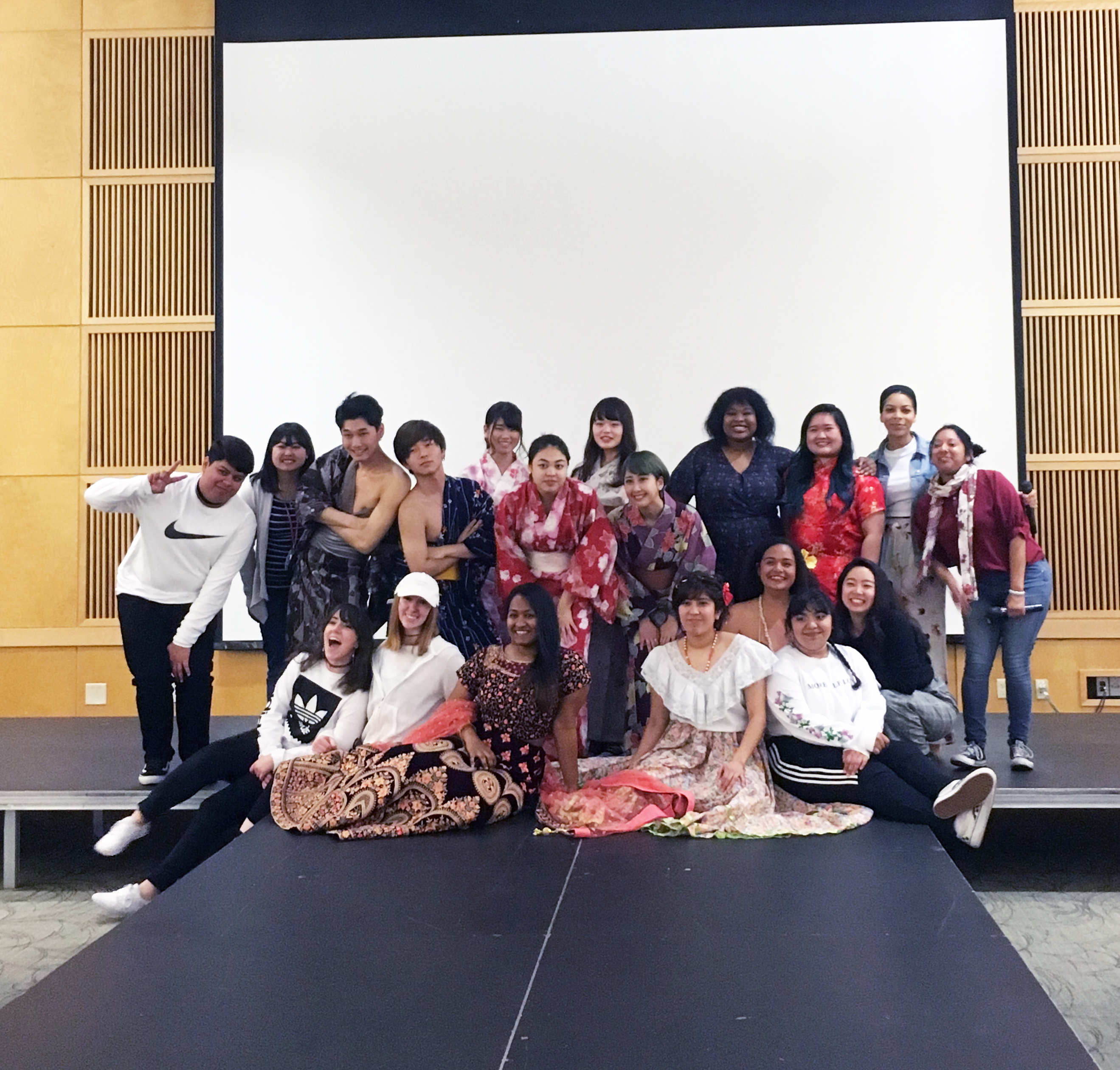
    Participants were invited to come dressed to represent their own cultural background or other cultures that interested them. Seven countries and cultures were represented with attire from China, India, Japan, Mexico, West Africa and Hawaii, as well as culturally significant and traditional dances from Mexico, Hawaii and Korea.

    Guests were greeted by Global Connections Club member and secretary Amanda Madden for the International Fashion Show at the Kate Buchanan Room on April 4. Her introductory speech highlighted the importance of inclusion and disregarding preconceived notions.

    “It is important that we sit here and keep in mind that this is a safe space,” Madden said. “We need to ignore cultural assumptions and preconceived notions regarding culture and tradition.”

    Representing her culture in dance and fashion was Humboldt State sophomore and Global Connections Club member Mikayla Kia, 20, dancing Hula ‘Aauna from Hawaii.

    “We just really wanted to put on another big event from the Global Connections Club for all the students involved, just before everyone leaves to go back home,” Kia said. “A lot of students are here with the IELI program from Japan, but it’s really sad because we just found out the program is getting cut after 30 years, and so this is the last group of students we get to host.”

    The IELI, or Intensive English Language Institute, was a foreign exchange program aimed to assist exchange students from 11 countries in acclimating to American culture and education, as well as becoming proficient in the English language. After HSU’s financial crisis was brought to light, the administration decided that defunding this program would help allocate funds to other exchange and international programs.

    “Even though it is really sad that this is the last group of IELI students, I feel like we are going out with a bang and they are all representing Japan today on the runway,” Kia said.

    Models on the runway strutted their stuff to the beat of legendary drag queen RuPaul’s hit single “Supermodel,” before stopping to talk about the cultural and familial significance behind their dress and presenting a brief powerpoint about the history.

    In addition to the fashion show, some models also took the opportunity to perform traditional or traditionally-inspired dances representative of their cultures.

    Anastina Steiber, Danny Flores, Caroline Mora and Dom Richards, members of the Global Connections Club, performed K-Pop-themed choreography to the song “As if It’s Your Last” by Korean girl group BLACKPINK. The group spent several weeks cultivating and rehearsing the choreography, which they debuted at HSU’s Lunar New Year celebration. They were inspired to do so by their love for dance and Korean culture.

    “We actually first performed this at this year’s Lunar New Year celebration on Feb. 16,” Steiber said, “and there weren’t too many people there so it wasn’t that intimidating, but today there were more people and the runway was pretty unnerving to dance on.”

    “I’m so sweaty, but that was awesome!” Richards said. “We all did so great, no obvious mistakes.”

    Mexico was also represented in dance by Daniel Gomez, 22, who performed an incredible rendition of the Jarabe in his fifth time at the International Fashion show.

    “I’ve been doing this since I’ve gotten here in 2013,” Gomez said. “I’m a dance minor here at Humboldt, and it’s pretty cool that Folklorico is taught here, but the program is definitely underfunded even though a lot of people are passionate about it.”

  • Humboldt State students are in need of ODEI

    Humboldt State students are in need of ODEI

    Humboldt State’s current budget crisis has been on everyone’s mind since the gravity of our school’s financial situation was brought to light. Besides the obvious, inevitable budget cuts and downsizing, our budget crisis has and will affect much more than our education.

    Humboldt State’s own Office of Diversity, Equity & Inclusion, or ODEI, was supposed to host a collaborative community roundtable in the Jolly Giant Common’s recreation room on March 21.

    This meeting was meant to prompt discussions among students as well as the local community regarding possible strategies to make our community safer and more welcoming for students of color.

    However, the event didn’t take place and hasn’t in some time.

    HSU sophomore Davina Hernandez, 20, attempted to attend the latest meeting. The previous two meetings have been canceled or poorly attended, forcing it to be rescheduled.

    “I went on a whim, but I was kind of disappointed when I showed up and literally only one other person was there,” Hernandez said. “It was literally just me, one other person and the person who was supposed to talk to us. I ended up leaving early.”

    The event Equity Arcata is listed on HSU’s event page every week. It’s supposed to be a conglomerate of local business and community members uniting with the student body and faculty. They discuss ways to ensure that the area surrounding the school, as well as the campus itself, become more inclusive and safe for our large population of students of color.

    HSU hired a new executive director of ODEI, Dr. Cheryl Johnson, to oversee the branch and coordinate for Title IX. This was the sole change to the department made by the school administration.

    ODEI was created in order to ensure that every marginalized student is represented and advocated for on campus.

    In lieu of our current political and societal climate, it seems that our school should prioritize the safety and well-being of our students of color by allocating more funds to ODEI. This is especially true following the death of HSU student David Josiah Lawson last April.

    Our school’s administration disproportionately benefits from the presence of students of color on campus. However, they are not prepared to support them, especially in such a rural and isolated area.

    ODEI student representative and HSU senior Elijah Chandler said it is clear that, while the passion and motivation to meet with students and advocate for our rights is there, the group lacks the funding and resources needed to meet the demands of our student body.

    “We’ve had three successful meetings with over 50 people showing up,” Chandler said. “As of right now, we only have a few people really working through the school, and our schedules don’t always work out.”

    Chandler has worked with ODEI since last October. He remarked on the importance of grassroots organizations such as ODEI.

    “There’s currently a tier or hierarchy for our collective right now” Chandler said. “With admin[s] being our organizational guides [and] student leaders getting the word out, we have been talking to other community leaders as well, like former senators, the mayor of Arcata and members of the local NAACP chapter.”

    It’s clear that, while our school may be in a dire financial crisis, our student body seems determined to not allow this situation to jeopardize their resources.

  • Lumberjack editors meet with Rossbacher, part I

    Lumberjack editors meet with Rossbacher, part I

    The Lumberjack editors met with the president of Humboldt State University, Lisa Rossbacher, on March 23. The Q&A was largely centered around budget cuts and social issues that impact the local community, especially HSU students.

    This is one of two transcriptions of the meeting that revolves around HSU budget cuts. The second half, which focuses on social issues, will be published on March 28.

    Matthew Hable (editor-in-chief): “What is a typical day like for you?”

    Rossbacher: “When I get to campus, I take a few minutes to check in with people – the provost office, the Vice President of Student Affairs office – checking in on where I know there have been issues.

    Then I usually have a series of meetings. They will often be back to back until six or seven o’clock. I guess what’s significant is what those meetings are about. I meet with all the vice presidents at least every other week, some of them every week. It’s a combination of them telling me what’s going on, getting advice or, in some cases, decisions [on], ‘What should we do about this?’ or ‘I haven’t a clue of what to do. What kind of advice do you have?’ We talk through it.

    Some of it is information, some of it is problem solving and some of it is decision making. And that goes in both directions, because I ask them for advice, too.

    Some of [the meetings] are with groups. Today, we had a three-hour meeting with the cabinet, which is the vice presidents [and] senior leadership at the university. Before that, I did a debrief with all the people involved in the logistics of having [WASC] here to see ‘How did that go? What worked? What didn’t work? Let’s take some notes for ourselves.’ So when they come back in three, five, eight or 10 years, we remember what worked or didn’t.”

    Lora Neshovska (managing editor): “Do you mind elaborating on what worked or didn’t work with WASC?”

    Rossbacher: “Yes. Some of the biggest issues were the communications with the person handling the logistics of the visiting team weren’t as strong as they could’ve been. So [they] assumed we knew some things we didn’t, like the team room was the conference room over at Siemens Hall. That was supposed to be the working room. We still had a lot of meetings in there, which was inappropriate because they had all of their confidential materials. They covered up the big conference table with notes, and it wasn’t appropriate to have a meeting with groups in there. So, we had to scramble.

    Similarly, they got here and said, ‘Did we mention to you that the chair of the visiting team needs to talk to the chancellor?’ No. The chancellor was in a meeting with the board of trustees. So we had to scramble around and find a few minutes for the chair to talk on the phone [with] the chancellor. So a lot of issues were just that kind of miscommunication. [WASC] took it all in stride. We dealt with it.

    We thought we had all the contingency plans in place to get them here, because they all heard about how difficult it can be to fly into Humboldt County. The closest ones were coming from the Bay Area, but there were people coming from Southern California, Arizona and Hawaii. Four of the six team members flew to get here. None of them arrived in the flight they were originally booked on. Two of them arrived in the later flights and the other two ended up driving from San Francisco. So one of the weird things about the exit meeting is that we knew that was an issue, but they didn’t believe it when we told them how difficult it would be. But by the time they got here, they understood that. They were all scheduled to fly out at 11 a.m. from Arcata today, but yesterday and the day before, that flight was cancelled. They were really worried about getting out. That’s why the meetings this morning were so early. Originally, the public meeting was going to be at eight, and they pushed it to 7:30 a.m. so that they could hit the road at eight [and] drop back to San Francisco. They didn’t want to take a chance.”

    Hable: “As you know, HSU students organized a walkout protesting the budget cuts on March 21. Students are having a hard time believing the ‘Students First‘ agenda. My two-part question for you is, where were you during the protest? How would you respond to not just students, but staff and faculty who are frustrated with this institution?”

    Rossbacher: “I was in a series of meetings, ranging from the theatre arts building, to the library, to the arts building [and] to the student services building.

    I understand the frustration people have for all of us to wrap our minds around the budget. This is something that did not happen overnight. It’s not because of misuse of funds. It built up over a number of years. The pieces of the budget problem come from spending more money than we have, basically, and [it] happening year after year. Historically, when we’ve overspent, we have had reserves. We can then get through the year.

    On the one hand, that’s a wonderful thing, because it meant that we can protect the areas being impacted by the budget reductions. But we’ve used up the reserves. We can’t keep doing that. For those of you who have been in the budget meetings, someone pointed out that the reserves is about $6.2 or $6.3 million. That’s less than one month of payroll, so we can’t keep spending it down.

    Let me mention one other reason. One of the reasons why we [shouldn’t] draw down reserves, [but] to build them up, is that a couple of years ago, the Cal State system was given the authority by the state legislature to issue bonds. That’s good news, because that means we don’t have to compete with other state agencies for building projects. The board of trustees can issue their own bonds. When they ordered for them to do that for a campus, the campus has to be able to come up with at least 10 percent of the cost of the project.

    If we want a new science building, we might have to come up with [up to] $10 million just to put in our piece of that to be able to get additional money for the project. So we’re motivated not just to have some reserves to protect us against overspending, but those reserves are what we need to be able to get new buildings on campus.”

    Hable: “Where do those reserves come from?”

    Rossbacher: “Internal funding. Money we don’t spend. Half of our money comes from our state allocation, which goes from the governor, to the state legislature, approved by the state governor, to the chancellor’s office [and] to the campuses in the Cal State system. Think of it as coming from the state allocation.

    Neshovska: “Where does the rest of the money come from? What can be done to build up those reserves?”

    Rossbacher: “The other half comes from tuition. Right now, in the [CSU] system, about half the operating dollars come from the state allocation and the bounty of the other half comes from tuition.

    Neshovska: “If you can’t increase funding from the state allocation, would the solution be to increase the tuition?”

    Rossbacher: “Or spend less.”

    Gabe Rivera (sports editor): “Scholarships of Humboldt State student athletes have been cancelled. Why were they taken away?”

    Rossbacher: “The scholarship money for student athletes primarily comes from fundraising – donors who give money specifically to athletics. Because athletics this year is running about a $900,000 deficit, [which] has to be picked up by the state, we’re trying to channel as much of the fundraised dollars toward the operational aspects of it rather than going directly into scholarships.

    Rivera: “Would the programs be cancelled if the scholarships stopped coming in?”

    Rossbacher: “I see how you make that connection, but I wouldn’t do it quite that way. It’s operational dollars that are really needed to continue to offer the athletics program. If you want to talk about athletics in general, we can do that.

    Rivera: “Were you aware of coach Rob Smith’s retirement before you made the decision to keep the football program? What affect would that have had in your decision?”

    Rossbacher: “I was not aware that he wasn’t thinking about that. I was surprised when I heard the announcement.”

    Ahmed Al-Sakkaf (news editor): “Associate Director of Housing Facilities Steve McKenzie also planned to retire, but his position was eliminated early. Dean of College of Natural Resources and Sciences Richard Boone resigned, effective June 30, but was let go early. Why was Boone’s resignation sped up?”

    Rossbacher: “When you resign, you can suggest a date, but you can’t always pick it.”

    Al-Sakkaf: “WASC pointed out how there’s a lot of interim positions in the university. Now you hired an interim dean to replace Boone.”

    Rossbacher: “One of the ways to look at this is, ‘Why are people in interim positions?’ In some cases, it’s because we’re in the middle of a search. For example, we have an Interim Vice President of Student and Administration. We’re in a search that we’ll come to a conclusion very soon. It’s just a transitional thing. The Vice President for Student Affairs, Brumfield, has ‘interim’ in the title, but he’s going to be here next year, too.

    Interim implies that we have a lot of turnover. When you look at every individual case, everyone makes sense and provides more stability than we would have otherwise.

    There are some other people right now who have ‘interim’ in their title, but it’s because we had a vacancy. We look around on campus and thought, ‘You know what, we have someone really good for this position right now.’ It’s a growth opportunity. We want to put that person in this job for now. We can’t just appoint someone without ‘interim’ in the title unless we do a full-scale search. It’s a matter of equity and fairness.

    We have some people who have ‘interim’ in their title, because we have confidence in them and that job right now. That’s a limit of two years. We can have people with ‘interim’ in their title before we do a search. Sometimes it’s because we got the right person. We want them doing that right now.”

    Kyra Skylark (science editor): “There are professors within the sciences who are retiring soon. Apparently, some of their positions are not going to be filled. What is happening to those classes after they retire? Also, you said that a new science building might be built in the near future. If there’s money being cut within the science department, why are we spending money to construct another building?”

    Rossbacher: “If you’re a science major, you know what the science buildings look like. No matter what, they need to be at least renovated, upgraded or preferably replaced. Whether we’re able to build an entirely new building or if it’s a matter of knocking one down is a separate set of questions. But the deans of all the departments have been charged with looking at the courses that we’re offering for next year, and taking a really hard look at what the courses are, students’ needs and making sure those are being offered in the most efficient way possible.

    There’s a wide range of ways that’s happened. Part of it is looking into DARS. That’s going to be a critical tool for being able to project what classes students need. It’s an incredibly important tool to match up student demand, students’ need for courses and what the departments offer. It’s looking at how many students are interested in a class and matching the size of the class with space available.

    Obviously, there’s a point beyond which it doesn’t make sense to grow, and you need to have multiple sections. [We need to make] sure we are being efficient [and] offering courses frequently as we need to for students to be able to get them. In some cases, that may mean we’re offering some of the required courses more frequently than some of the elective courses less frequently.”

    Skylark: “How are you deciding what classes are needed for the students?”

    Rossbacher: “I am not directly involved in that. It’s department chairs working with deans who are also working with the provost office.

    I want to be careful that we are not getting rid of courses, options or programs without doing a thoughtful analysis of what they are, what the student interest is in that. We have many years of data in enrollments and things like that.

    Over the next year, we are planning to do an assessment of every program at the university. That’s just not academic programs, that’s administrative programs, too. That’s my office, too. We have the data that helps us understand how effective they are, how well they’re meeting the needs of students and then we’ll be able to make some informed decisions about whether we need to consolidate, shrink or expand.

    One of the goals of the budget planning process [is] not just to cut the budget down to, ‘We’re only studying what we have.’ We’re also trying to put the university in a position where we can strategically invest in strong and new programs. It’s not just chopping to be able to maintain what we’ve got. It’s also making sure we have the resources to be able to invest in the future.

    I know that a number of years ago we went through what was called ‘program prioritization,’ which I think got a bad reputation. It’s a way of figuring out which programs need to be eliminated, decreased in size, maintain the way they are or invest in. I want to be sure that this university is a place where we can invest in new programs and growing the programs.”

    Skylark: “How are you able to do that with the budget cuts?”

    Rossbacher: “By continuing to be strategic about how we reduce in reallocating money. You’ve all been to the website of URPC? One of the things they look at is the strategic budget and strategic investments. In some cases, it’s a matter of finding efficiencies. It’s a matter of identifying ways to realize additional money. In some cases, it’s additional revenue and figuring out how to invest that into new programs.

    First, we have to balance the budget. As additional resources come in, you can start strategically thinking about where to invest them.”

    Neshovska: “So essentially the first step is trying to balance the budget from all these places in order to build it back up and increase revenue.”

    Rossbacher: “Yes, that would’ve been a better way for me to say it in the first place.

    You can think about it from your personal checkbook. If you’ve overspent, first you need to get the spending under control. But as you get your next paycheck, you got the basic needs covered. Then you have to think about what you’re going to do with that extra money, where you’re going to invest in it.”

    Neshovska: “Once we do balance the budget, where can we rely on external resources?”

    Hable: “Going off of that, I realize your salary is public records, but you approximately make half a million dollars per year, including benefits. The provost makes roughly a quarter of a million dollars per year. How much of that money do you invest into the university?”

    Rossbacher: “The salary is right. The other pay, I’m not sure where that number comes from. Some of it is housing allowance. Half the president in the Cal State system, houses are provided for them. I don’t get free housing, I get a supplement for that. But the benefits part, that’s my healthcare.

    Hable: “Your salary was part of the frustration at the protest. While you make that much a year, students are upset that they are walking away with a large debt.”

    Rossbacher: “One of the things that I think is real special about Humboldt State is the focus that we have here on environmental and social justice. Students at Humboldt State are committed to making a change in the world. Our graduates literally do that all over the world.

    I think that’s something really important that this university does something valuable for our graduates. I worry that we’re not following the continuum that gets us to effective change in the world. It begins with protest, and that form of activism. Being a change agent moves from that to dialogue, discussion, collaboration and collective problem solving for a collective impact. And that moves to the actual change.

    I worry that we’re not serving students well by having all of that change process stuck in the protest part. It’s something that concerns me about the protest that we had on Wednesday. It doesn’t move from the protest to the discussion, the collaboration, problem solving and then effective change.

    What I see, and what I think is important for this university, is to model how we follow that whole process.”

    Al-Sakkaf: “How do you feel about having ‘shame’ written across your face on a flyer and distributed around campus?”

    Rossbacher: “Disappointed and frustrated. At some level, I understand, but I’m not sure what the point of that is.”

    Al-Sakkaf: “The point is your paycheck.”

    Rossbacher: “So if I work for free, it doesn’t solve the university’s budget problem.”

    Hable: “Students walk away with $20,000 to $40,000 in debt. Personally, I am walking out of here with $22,000 in debt when I graduate in May. There are parts of this university where I feel frustrated, where I did not get my money’s worth.”

    Rossbacher: “Can you give me an example?”

    Hable: “I’m an example of a student where we have that knowledge of how much you get paid per year, but students are going into debt. People are getting fired, let go or what have you. That’s where the frustration comes from. I was at Siemens Hall on Wednesday. People were angry and there was a dialogue. It was a protest, but there was also a dialogue.

    Rossbacher: “There was?”

    Hable: “Yeah, but it was an angry dialogue. Students were pretty outraged. I know it’s not the most diplomatic way of handling it, but people feel that way. I think that’s where the ‘shame’ comes from.”

    Rossbacher: “I graduated from college with debt. I spent my first year after I graduated – I lived under $2,000 the whole year. [My parents said] we can help you some as an undergraduate, [but] not completely. When I graduated they gave me a backpack, a jackknife, a subscription to Science magazine and they said, ‘Good luck.’ I’ve been there, too. I understand.”

     

  • CNRS students want answers

    CNRS students want answers

    Humboldt State students from College of Natural Resources and Sciences, or CNRS, gathered for a talk on Thursday, March 8 to address the CNRS budget crisis. The talk was facilitated by Stephany Salgado, a biology major. Both the interim dean, Steve Smith, and associate dean of CNRS, Rick Zechman, attended the talk.

    “I want to make sure CNRS is getting the students involved,” Salgado said.

    The CNRS is facing $2 million in budget cuts and students are concerned their fall 2018 semester classes will be cut.

    Smith is filling the position that Richard Boone held until March 5. Smith was the dean of CNRS between 2010-2016. Being back from retirement for only two days prior to this talk, Smith revealed some ideas of possible solutions to the CNRS budget deficit. Smith mentioned possible changes, but would not go into any specific details.

    Smith explained how the department spending works and, how in the past, the reserve would take care of expenditures exceeding the budget. There is currently little reserve funds and the CNRS department spending is required to stay within the budget.

    “For a long time, the university has been deficit spending and we have to turn that around,” Smith said.

    Smith expressed the most important factor of all is to meet the students’ academic unit demand.

    “We are going to meet the academic demand for student courses. What might change is who is teaching the course,” Smith said.

    Smith did not go into details about allocating teaching modes.

    Smith assured the students the same courses will be available this fall, but he doesn’t know when or if he can solve all of the budget deficit problems.

    “This is the short version of a very complicated problem,” Smith said.

    A student asked Smith if professors could teach more and spend less time on research. Smith responded that it would be up to the tenure-line faculty.

    Smith also reminded students that professors belong to a labor union that directs their hours, and that tenure-line faculty are expected to do research.

    A student asked if graduate student programs will be adversely affected.

    “Graduate funding will increase, if anything,” Smith said.

    Another student asked about a fall class that is listed as unavailable. Smith assured the student that will change before registration. He also assured that all classes will appear on the schedule for registration.

    One student asked about reductions in programs. Smith didn’t think there would be reductions.

    “I don’t see anything along the lines of downsizing, probably elimination,” Smith said. “I don’t see that in the cards. Please don’t rush out and say we are going to cut programs.”

    Zechman pressed on the importance of having students’ degree audit reports, or DARS, planned out for three semesters ahead of time.

    “It is critically important to have your DARS planned out for three semesters ahead so CNRS knows how many seats it needs to offer for that class,” Zechman said.

    President Lisa Rossbacher reassures students the administration is working to guarantee them the classes they need to graduate.

    “We are doing everything possible to make sure students get the classes they need to make progress towards graduation and graduating on time,” Rossbacher said. “We still have one of the best science departments in the country with our natural resources and outdoor labs.”