The Lumberjack


Students Serving The Cal Poly Humboldt Campus and Community Since 1929

Tag: HSU

  • HSU Athletics Department left in dark about SJSU

    HSU Athletics Department left in dark about SJSU

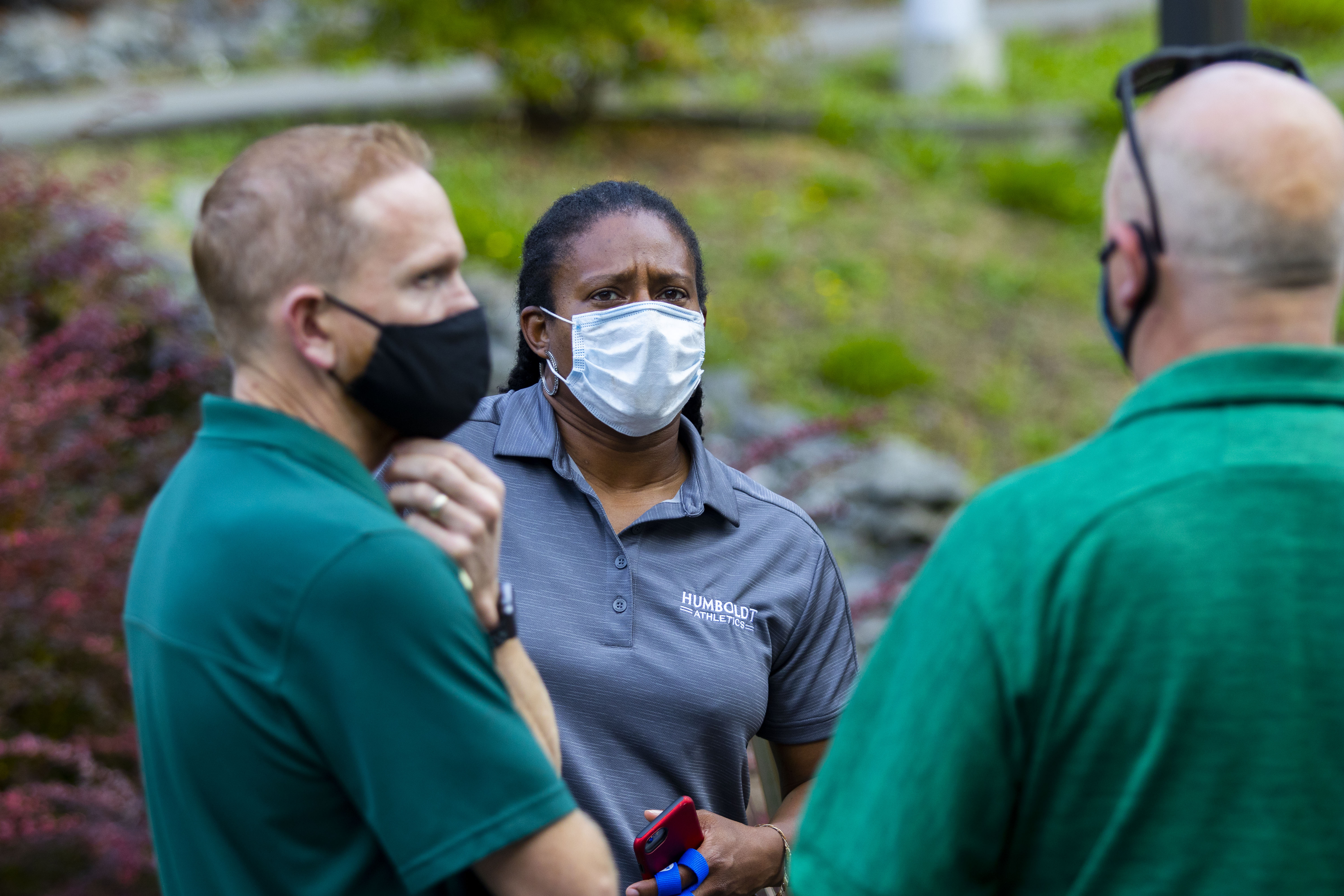
    Jane Teixeira addresses student concern over football program’s stay on campus

    ***Editor’s note: SJSU football program was tested in congruence with Mountain West conference guidelines***

    The Humboldt State Athletics Department was notified that the San Jose State football team was coming to HSU the same time the general student and staff population of campus were told. 

    With the notice coming late on Sept. 29, the first chance that the department had to discuss matters was the following day with the Spartans roughly 24 hours away. 

    “I got the same information at the same time that everybody else got the information on campus,” HSU Athletics Director Jane Teixeira said.

    SJSU anticipates spending $100,000 to $150,000 in total while at HSU. This includes meals, housing, use of Humboldt State’s facilities and round trip bus fare per San Jose State’s media relations. 

    It is currently unclear as to how much of this estimated budget belongs to Humboldt State or how that money will be distributed.

    On Tues. Oct. 13, Santa Clara County moved into the orange tier from the red tier, meaning that COVID-19 guidelines will be loosened. 

    According to San Jose State football social media and Humboldt State University,  the team will be leaving the HSU campus on Oct. 14 following the announcement that Santa Clara County will allow the Spartans to hold practices on their own campus once again. 

    According to an email sent out to HSU students on Tuesday Oct. 13 if conditions do get worse in Santa Clara County again. 

    “Should Santa Clara County return to the red tier, HSU will consult with Humboldt County Public Health and SJSU about the viability of the team’s return to HSU to proceed safely for practice and/or competition.” Humboldt State said in the email.  

    Teixeria explained that she has not been involved with any contract negotiations between HSU and SJSU, but believes the arrangement is similar to any rental of the Redwood Bowl. 

    “I believe that they are renting our facilities and paying for them like any other outside group would be able to do,” Teixeira said.

    Student concerns surrounding a large group of people coming onto campus was addressed by Emergency Management Coordinator Cris Jones Koczera. Koczera said that since the team arrived, the Athletics department has been working with local county health officials. 

    Koczera believes the chances of the SJSU bringing COVID-19 with them is very low considering the team is subject to mandatory testing once per week before the Mountain West season begins, and three times per week when competition starts. 

    “Because of the frequency of testing that was required both by the state and by local county public health, they are by far the most tested individuals, probably in our entire county right now,” Koczera said. 

    The Athletics Department became aware of frustration coming from the rec sports organizations on campus which prompted Teixeira to hold a meeting with members of those groups on Sept. 30. 

    For Division 1 athletes, there is immense pressure to perform well and do whatever they are told to do as part of their respective athletic programs. Teixeria pointed out that while the SJSU football team is on our campus, they did not directly make the decision to come here themselves as individuals. 

    “It’s really important to know that the student athletes and the coaches and the student workers and the people that are up here from San Jose State are just following the lead of their leadership,” Teixeira said. “Just like we’re just following the lead of our leadership and I think it’s important that our individuals or people who are out in the community understand that this is by no fault of their own.”

  • HSU students support science with Spanish

    HSU students support science with Spanish

    A bilingual HSU program encourages students to pursue the STEM field

    Ciencia Para Todos, known as “Science for All,” is a Humboldt State University program that hopes to bridge the gap between younger, grade-school students and Science, Technology, Engineering and Mathematics careers through teaching English and Spanish in conjunction with local elementary schools like Fuente Nueva Charter School.

    Christian Trujillo, a senior environmental science and management major, is the founder of Ciencia Para Todos. He strives to elevate youth whose first language is Spanish.

    “We’re trying to destigmatize that idea,” Trujillo said. “Be like, ‘We are people who are bilingual, we’re in STEM, we want you to do that when you grow older, and hopefully you could become a scientist and also use your abilities and cultural lens to really help the science community.’”

    Ciencia Para Todos came from a desire to create an environment for budding Latinx STEM students. Feeling ostracized from many of the spaces on campus, Trujillo and his fellow Latinx classmates communicate in Spanish as a means of escape.

    An already-established refuge named Indian Natural Resource Science and Engineering Program for marginalized science students on campus, inspired them to create a refuge of their own.

    “We need to make our own space on campus since no one else is really going to do it for us, so we have to do it for ourselves,” Trujillo said. “And we’re like, ‘Oh, now that we’re doing this for ourselves, why don’t we do it for our communities.’”

    Different cultural centers at HSU have gotten their budgets slashed, Trujillo worked to combat the problem with student retention.

    “The stuff we do I think is very important to keeping student retention,” Trujillo said. “Because I’m one of those students that stayed here because of the centers and if it wasn’t because of centers, I would have been gone.”

    Odalis Avalos is an environmental science and management major and senior. She works as the liaison for Ciencia Para Todos and conducts outreach. Avalos is glad to have a space where she can flourish alongside Latinx STEM students, an opportunity she didn’t have growing up.

    “I’m really grateful that there is a program out there that’s able to provide this resource specifically for sciences,” Avalos said. “It’s a very lax subject within the Latinx community, so it’s not really normalized to pursue these types of careers.”

    Building off that, Avalos is glad to be able to feel a sense of community not only with the students she teaches, but also with her colleagues like Trujillo.

    “It means a lot that they’ve created the sense of community for me,” Avalos said. “So we sit together and we come together and we collaborate and we have a common mission and even with that, we also have common experiences together.”

    Diana Martinez recently graduated from HSU but continues to work for Ciencia Para Todos. Responsible for translating entire lessons between English and Spanish and managing the Instagram account for the program, Martinez has become more confident and optimistic in her future endeavors.

    “And I used to do English and Spanish, but then when I go up in Humboldt, it was just English,” Martinez said. “So I almost feel like my Spanish was just blocked, and having met this group of people, it was just like ‘Oh, I could just talk in Spanglish or I could talk in English and in Spanish fifty-fifty.’”

    Martinez is inspired by the children she’s worked with for Ciencia Para Todos and feels accomplished with what she has done for them.

    “Once you see the kids, especially the native kids that only speak Spanish, when you speak in the same language, there’s a huge happy face in their face and it’s hard to describe,” Martinez said. “But knowing that they’re able to communicate just fine and the fact that you know that you’re helping them and supporting them and empowering them, that makes me feel great as an educator, too.”

  • WRRAP’s fifth annual Zero Waste Conference goes virtual

    WRRAP’s fifth annual Zero Waste Conference goes virtual

    HSU’s eco awareness program continues providing support to campus during the pandemic

    Humboldt State University’s Waste-Reduction and Resource Awareness Program team will be hosting seminars and workshops online, raising awareness of environmental justice, local resources, the zero-waste lifestyle and providing eco-friendly DIY techniques, like making your own deodorant.

    This year Oct. 19-23, WRRAP will be holding its annual Zero Waste Conference virtually.

    The virtual setting grants more accessibility for speakers to attend. Beyond the clothing swaps and physical demonstrations, WRRAP sacrificed the semester for the safety of students. The new policies come at the cost of student interaction.

    Amanda McDonald, WRRAP’s program manager, said the biggest obstacle in their path this semester is reaching students.

    “Typically, there’s multiple table events that we work throughout the semester that really get students engaged in waste reduction just by walking through the quad,” McDonald said. “That kind of interaction is so much harder with students being online.”

    The WRRAP staff is smaller this semester, they are still provide students on campus with resources through the Reusable Office Supply Exchange program, the Bicycle Learning Center and the campus compost project.

    The ROSE program simultaneously reduces waste and provides students with free access to school supplies donated by the community and former students.

    Sam Kelly, director of ROSE, said the program is operating as usual with extra precautions and shorter hours of operation.

    “We definitely have more stuff in here right now than past semesters,” Kelly said. “Just because we don’t have a lot of people coming in and taking it.”

    The BLC, located on the eastern end of the Redwood Bowl, is offering free bike repairs to students, staff and faculty. Service differences include wearing masks and social distancing during repairs.

    COVID-19 restrictions currently forbid the BLC from allowing volunteers, which has forced them to cut back their hours.

    Justin Delgado, a BLC instructor, said it has also made the days a lot longer without someone else in the shop.

    “Typically we get about one person, at least when I’m here, per day right now,” Delgado said. “It used to be prolly five or six.”

    The compost team continues providing campus with their weekly services, however with a fraction of the employees present, their load is significantly lighter.

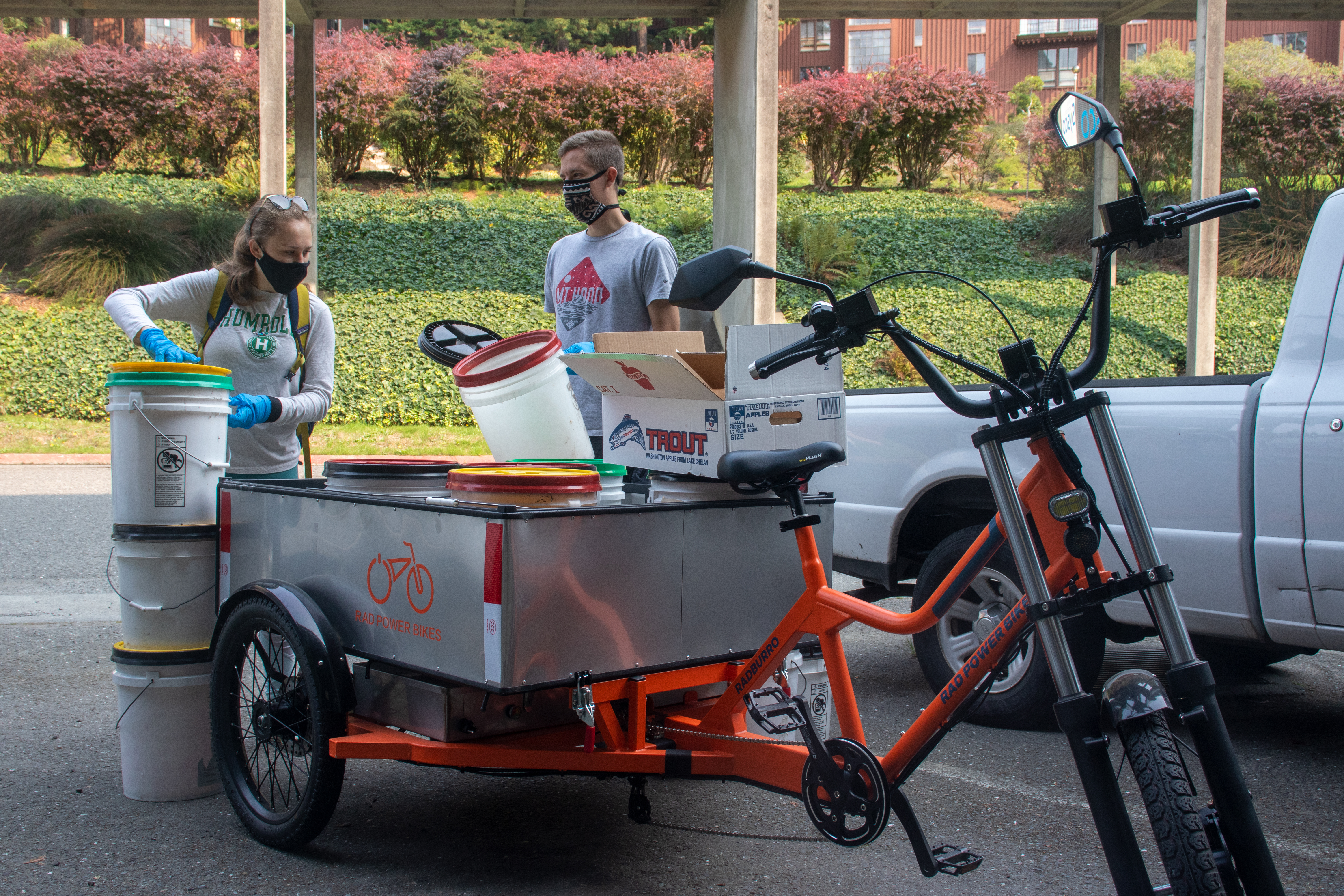
    The team recently made the switch to an electric mountain bike this semester for compost collections. While much more energy efficient than the electric facilities vehicles they used in the past, in its current state, the trailer they’re hauling behind the E-bike can only hold a fraction of the buckets.

    WRRAP’s compost collection process has switched over from electric facility vehicles to an electric mountain bike for energy efficiency. The downside to the switch, is the trailer the bike pulls behind it can only hold a fraction of the compost buckets.

    Krissi Fiebig, the director of the compost branch of WRRAP, said they intend to team up with the BLC and modify the trailer possibly into a tower to fit more buckets.

    “I don’t know how aerodynamic that would be,” Fiebig said. “But it would get the job done.”

    The compost team is beginning a new partnership with the Campus Center for Appropriate Technology, allowing students access to properly dispose of their food waste. Additionally, providing free fertilizer towards the end of the semester, to any students who show up.

    McDonald expresses concern in the programs future with several of the student staff members expecting to graduate in the spring. Finding replacements will be challenging given the virtual format that’s currently planned for the rest of the academic year.

    “I’m just nervous that it’s going to harm the integrity of the program,” McDonald said. “When we do hire new people, I want them to understand the history of this program and the legacy that they’re stepping into and carrying on.”

    Though they can’t currently accept casual volunteers, the WRRAP team currently has intern positions available and leadership positions opening soon for students interested in the future of our planet.

    “Being one of the people on the WRRAP branches really helps to remind me to reduce my own waste,” Fiebig said. “And just to be more conscious than I already was of the things I consume and what I do about my life.”

  • Humboldt State reconsiders spring break

    Humboldt State reconsiders spring break

    Proposal to move spring break to a later date generates controversy

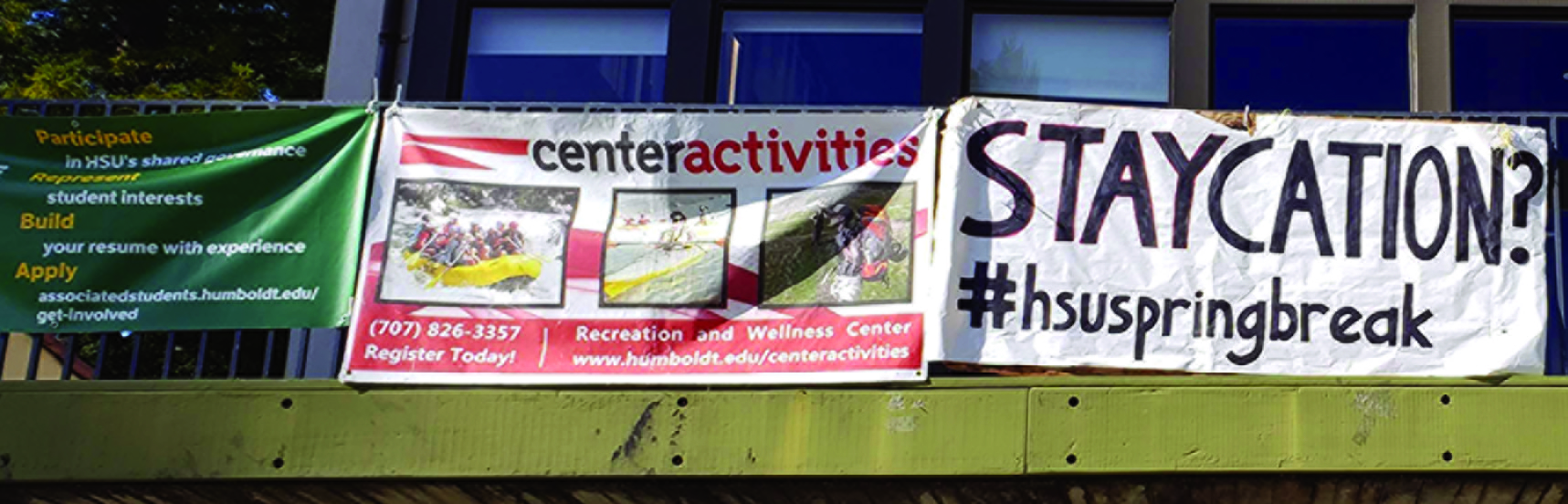
    On Sep. 29, Humboldt State University’s administration announced an idea to move spring break for this academic year from Mar. 15-19 to Apr. 5-9, 2021.

    In the meeting, Jen Capps, Provost and Vice President for Academic Affairs, explained the student and community health argument behind delaying spring break.

    “We face some challenges around making sure that our faculty, our students, staff, et cetera are safe, and how to bring folks from out of county into county, quarantine them, provide face-to-face instruction,” Capps said. “And then if they leave for spring break, what I’m hearing from facilities and different folks is they just don’t have the capacity to then require students to quarantine again.”

    A few suggestions for how to maneuver the situation were made by University Senate members including Cindy Moyer, an HSU music professor.

    Moyer pitched the idea to have break or rest days spread throughout the academic year to divert students from traveling and returning home.

    “Five carefully strategically spaced days off spread out over the weeks in the middle of the semester,” Moyer said. “So that students are getting some time off, but not getting enough time off that they will go home.”

    Monty Mola, HSU physics and astronomy professor, argued that spring break should begin a week later. The decision to move around spring break would have ripple effects on the greater HSU community.

    Giovanni Guerrero, a fourth-year environmental science management major, believes moving spring break to early April would be too much of an adjustment for students and faculty.

    “There’s a lot of stress on my back as a student, and I’m sure a lot of stress on the backs of teachers as well [as] our professors to meet deadlines and to carry out our rigorous university expectations,” Guerrero said.

    Guerrero added that the spring break would give everyone a chance to emerge from isolation and take a breather from responsibilities.

    “I think there’s a direct correlation with mental health. Right now we’re in a different sort of situation, virtual learning,” Guerrero said. “Sitting here at my desk inside my room for six hours a day, doing homework, attending classes and then doing my work with Associated Students. I have very little breathing room. Having a break, like a week break, where I don’t have to stay inside my room all day is super beneficial.”

    Rich Alvarez, the Diving and Safety Officer in the HSU Scuba Diving program, is less concerned about the psychological impacts of a later spring break and more concerned about the practical implications.

    For his diving certification program, Alvarez typically takes his students to Mendocino for open water dives where the diving conditions are more stable than anywhere in Humboldt. However with COVID-19 restrictions, he is only able to travel within the confines of the county.

    “Traditionally, Trinidad doesn’t really get to the point where we would feel safe taking students into the water there until April and sometimes even late April,” Alvarez said. “So if they shift spring break to the fifth through the 12th, the question becomes, can we meet with them after spring break? And it kind of sounds like a no.”

    If Alvarez can’t meet with his students after break to finish their diving certification, they will be unable to partake in open water dives.

    “That takes that whole month of April out of contention, and then we were looking at trying to, either way, putting students into water conditions that may not necessarily be safe for what we’re trying to do, or having to get people most of the way through their certification, but not able to do the open water dives.”

  • UC Board issued notice of termination

    UC Board issued notice of termination

    University Center Board Members address Humboldt State University President’s notice of termination

    The Oct. 8 University Center board meeting discussed a Sept. 24 email from Humboldt State President Tom Jackson issuing a 90-day notice of termination.

    The notice requires the board to fix problems like a $300,000 line of credit to the North Humboldt Recreation and Park District and refusing to participate in the President’s review of the UC programs.

    The NHRPD runs the Arcata Community Pool. According to Faculty Representative Mark Rizzardi, Ph.D., Humboldt State University has worked with the group since 1993.

    The UC group disputed these claims.

    Wendy Sotomayor, interim executive director, called the notice disheartening and unexpected. Sotomayor noted that the board is actively engaging in discussions on how to respond.

    Additionally, the group reached out to their legal counsel for advice and expects to have a draft of an initial response in the coming weeks.

    “It’s hard to imagine what would happen if the UC were to actually close,” Sotomayor said.

    Faculty Representative Steve Martin, Ph.D., pursued the idea. Martin responded directly during the board call addressing future concerns.

    “What would happen if we were to close permanently?” Martin said.

    Martin posed that the closure of the UC allows HSU to hire private organizations and groups for services without the need for approval from a board.

    Earlier this year HSU worked with Aladdin, a food catering company that provides meal services to universities across the country like Fairmount University and Purdue University Fort Wayne. The administration did not go forward with any contract or agreement with the Aladdin group.

    Further complicating the matter is the projected loss of 2.2 million dollars in the UC budget.

    Due to COVID-19 restrictions and regulations, operations that fall under the control of the UC Board have been temporarily closed or operating in a limited capacity. These include the campus information desk, The Jolly Giant, College Creek Marketplace and the campus bookstore.

    With reduced foot traffic due to shelter-in-place guidelines combined with the decrease of students on campus, dining services has taken an exceptionally hard toll. Even while operating at reduced capacity.

    Sotomayor estimated that there are 675 meal plans active on campus, a drastic decrease from previous years.

    “We would need 1200 meal plans to break even,” Sotomayor said during the Zoom call. “At 675 we are not even close.”

    While the future seemed unclear, Rizzardi noted that the next course of action needed to be made soon.

    “In order to cancel it within the 90 days, we would have to start now, and that’s not something we want to do,” Rizzardi said. “Get ready to drop things so that way if he says no we can act fast.”

    The board members noted that they had not been given any further clarification from the administration on how to tackle, refute or respond to the notice.

    During the meeting, members made a movement to formally ask for a representative from the President’s office to be present during the next session on Oct. 22.

    “It takes two to tango,” Martin said. “We need to some response from them, otherwise they can just ignore us for 90 days and then say it’s terminated.”

    The last day for the board to fix changes is Dec. 23. If unable to provide solutions, the UC board will be terminated on Dec. 24.

  • Humboldt State University’s women soccer team create bracelets in support of Black Lives Matter

    Humboldt State University’s women soccer team create bracelets in support of Black Lives Matter

    Proceeds go to the African American Center of Academic Excellence

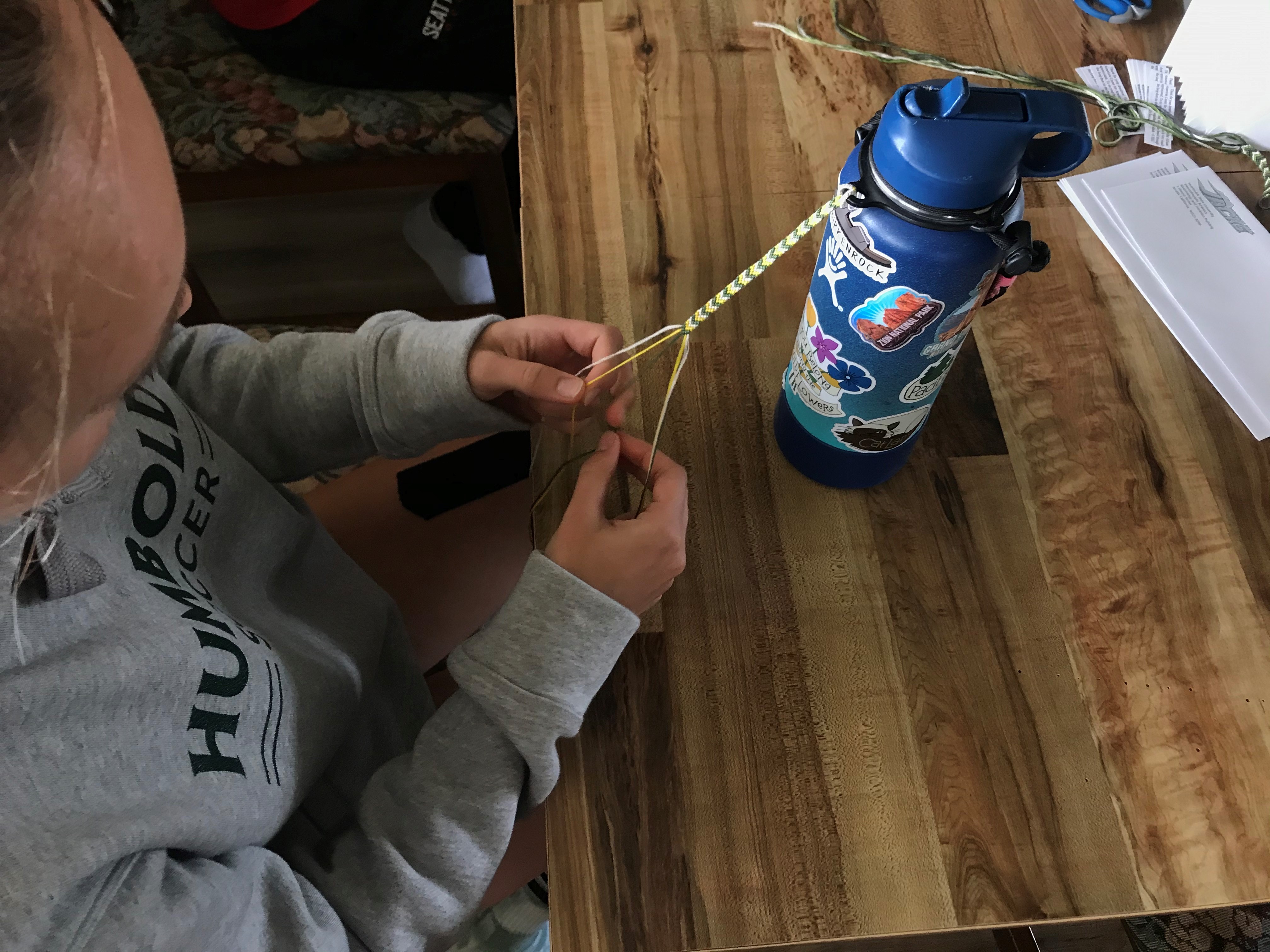
    The Humboldt State University women’s soccer team started a bracelets for change movement to show their support for the Black Lives Matter movement.

    Mary Swisher, a senior at HSU and soccer player throughout college, stated that the social injustice present within our country was infuriating and motivated the team to combat the issue.

    “While I cannot speak on the racist experiences that African Americans face, it hurts me to hear, see and learn about the effect that racism has on my peers in athletics, at school and the border community of color,” Swisher said. “My teammates and I have decided that we will continue to educate, advocate and work to support people of color in our community and our country.”

    Athletes are asking for donations for HSU’s African American Center of Academic Excellence. The team has handmade 30 bracelets out of the 70 that were ordered by friends, family and the community, totaling more than $700 dollars to the AACAE so far.

    The AACAE is a cultural and social hub on campus to support identifiable Black students and offer them a higher education. Douglas Smith the Organizer for HSU’s AACAE said he was shocked by the compassion demonstrated by the women’s soccer team.

    “Very grateful for multiple reasons. We didn’t reach out to them or ask to fundraise,” Smith said. “They did it on their own ambitions. I was grateful.”

    COVID-19 and budget cuts hit the AACAE hard. With the money being donated, they feel extremely grateful and thankful. Smith believes it’s time to confront racial injustices head on and create dialogue.

    “Times up. Honestly the time for conversation and talking about it and educating people about it, it’s kinda over,” Smith said. “If there isn’t action being taken place right now then move out of the way. My mood for your question is it’s time for action and talk is rhetoric.”

    Coach Grant Landy of the women’s basketball team stated that the athletes came up with the bracelet idea completely on their own and had the AACAE in mind.

    “I challenged the team to continue the conversation about racial injustice and they came up with the bracelet idea,” Landy said. “They wanted to help our campus community and chose the AACAE to help support.”

    The women’s basketball team choose to help support HSU’s own clubs and organizations. Landy applauds the team’s spirit and dedication to raising awareness for racial injustice.

    The Women’s Soccer Team is still accepting bracelet orders and is still taking donations to support HSU’s AACAE.

    Swisher stated that the women’s basketball team felt they needed to contribute more than conversation to the racial injustice movement.

    “As a team we were having conversations about the injustice against African Americans in our country,” Swisher said. “The conversations were productive and we were educating ourselves but we decided that talking about that problem was not enough.”

    The co-captain from the women’s soccer team, Sabine Postma, has experience doing similar fundraisers in her hometown in Washington. The team decided their impact would be most effective if they donated their proceeds to a local organization, like AACAE.

    “It’s an admirable organization on our Humboldt State campus that empowers, supports, and celebrates the Black lives in our community,” Postma said.

  • How to survive Among Us without being sus

    How to survive Among Us without being sus

    The best game about gaslighting your friends on a spaceship

    Among Us was released by InnerSloth in 2018, but remained in obscurity, averaging only about 30 players at any given time. This all changed in July, when it was picked up and thrust into the spotlight by Twitch streamers such as Sodapoppin.

    Today, Among Us boasts over 100 million downloads and 60 million daily players. Owing to its easy learning curve, low cost and social nature, the game took off. It’s deceptively simple but downright addictive.

    Among Us is a charmingly animated game with a distinctive visual style. Playing as colorful astronauts, players are divided into two teams: crewmates and imposters.

    Crewmates are charged with completing their tasks and investigating the imposter among them, while imposters must sabotage the ship and murder all of the crewmates before being discovered.

    The real action of the game occurs in the chat feature, where players bring out their best detective work to uncover the liars.

    As one of the 60 million Among Us players, the hype is real. I play as a lime green astronaut who wears a plastic flamingo on their head and it’s as delightful as it sounds. For crewmates and imposters alike, may I present: tips on not getting launched into the void of space.

    1. Always know where you are. Having an alibi is the best way to prove your innocence (or fake it). Be prepared to explain what you were doing and who you might have seen there.

    2. Know how to argue. Whether you’re accusing someone or defending yourself, have evidence. Did a crewmate see you do a visual task? Did you vote out the last imposter? Why were you following Red around the map? You have to be able to find reasons why people are or are not the imposter and persuade people that you know what you’re talking about. Which brings us to tip two and a half: Lying.

    3. Learn to lie convincingly. If you can convince just one or two crewmates that you’re trustworthy, that you couldn’t have been the killer, that you were in medbay the entire time, then you’ve just earned yourself another chance to strike. As in life, lying is a great way to eliminate your enemies with no repercussions.

    4. Find a buddy. If you’re a crewmate, you’ll have a friend who will witness and report your murderer, or simply stand by and protect you while you complete your tasks. If you’re an imposter, you either have an unsuspecting victim or a second imposter to team up with and lend an alibi to.

    5. Don’t be a cheater. If you’ve been murdered, don’t be that guy who calls their buddy and tells them who the imposter was. It’s a jerk move all around and ruins the fun of investigation.

    Good luck everyone, and don’t get murdered!

  • HSU offers housing to forest service firefighters

    HSU offers housing to forest service firefighters

    Firefighters who test positive for COVID-19 will be housed on campus to complete their quarantine period.

    Humboldt State University will provide quarantine housing to United States Forest Service firefighters in the event that someone on their teams tests positive for COVID-19. Housing will be for the individuals who were potentially exposed to positive COVID-19 individuals.

    HSU has set aside two dormitory buildings, Maple and Hemlock, which can house up to 20 firefighters each.

    Firefighters are expected to avoid the dining halls and not share spaces with students. The US Forest Service is requiring employees to adhere to quarantine orders, limiting them to individual rooms. Rooms are located in the same building, separate from housing residents.

    HSU has not been requested to provide meal delivery. The US Forest Service has contracts with vendors for meal delivery.

    All of the protocols were developed by the CDC, California Public Health and Humboldt County Public Health. Similar to the isolation rooms that have been set aside for HSU students who’ve tested positive, rooms will be sterilized prior to forest service stays and again after they’ve left.

    Aside from COVID-19, Forest Service firefighters have stayed overnight for transition housing during the fire season.

    Stephen St. Onge, associate vice president for student success at HSU, is impressed with the university’s speedy response towards CAL Fire’s request.

    “There was a group that was moving from one fire to another and couldn’t find a place to stay,” Onge said. “We mobilized and we’re able to support that, I am proud of HSU for being able to do that.”

    The group that stayed on campus slept for a few hours until transitioning to the next fire. None of the firefighters that stayed overnight were tested positive for COVID-19. A contract is currently in the works to see if CAL Fire needs more transition housing from HSU.

    Typically, fire agencies try to keep hotel rooms open for fire evacuees by finding alternative housing. During COVID-19, it is extremely important that they find non-congregate living for quarantine.

    As a state entity with lots of amenities in a rural region, HSU often partners with state, local, and federal agencies, nonprofit organizations and others to provide support.

  • Music of the Moment 6

    Music of the Moment 6

    21 Savage and Metro Boomin drop a classic with “Savage Mode II”

    April 23 came and went last semester without a 21 Savage concert at Humboldt State University. Thanks to the pandemic, students like myself felt cheated.

    The sequel to Savage and Metro Boomin’s 2016 EP “Savage Mode,” delivers and, is worth the six month delay from its initial release date.

    Fresh off of receiving the 2020 Grammy for best rap song with “A Lot,” featuring J. Cole, Savage is back with Boomin and unlikely narrator Morgan Freeman, whose alone is enough for anyone to give “Savage Mode II” a listen.

    Similar to Savage’s solo albums “Issa Album” and “i am > i was,” “Savage Mode II” was dropped without any promotional singles leading up the release. Instead, they promoted the album with a trailer. Narrated by Freeman, the trailer ends with only a brief snippet of “Many Men.” Referencing the classic 50 Cent track and sampling his original chorus near the end of the song. One of the strongest moments on the album.

    One of several narrations from Freeman, starts with speaking to a greatness that can only be accomplished when brilliant minds collide. Track two, “Runnin,” opens with Savage delivering a villainous laugh.

    From the first song, Savage has your attention with his signature Slaughter Gang style and the first of many creative, simple and especially catchy hooks. Sticking to a pattern of two verses and a chorus on each song, with occasional intros and outros, Savage never overstays his welcome on a track.

    The variety of vibes Savage is able to create on the new project is all made possible by the range Boomin displays on the production end. He boasts his artistic vision on tracks like “Slidin” where Boomin recreates the beat to the original project’s standout record “No Heart.” He does this again on “Said N Done,” recreating the beginning of “10 Freaky Girls” from his own album for the background of the chorus.

    Savage provides listeners with a collection of hits catering to a much larger chunk of the mainstream audience than with past projects. Savage does this without compromising the content his fans have come to expect from him.

    Don’t get it twisted, “Savage Mode II” is very much a sequel to the project that launched Savage and Boomin into the mainstream. Aside from a few tracks near the end of the album, including “My Dawg” and “No Opp Left Behind,” Savage reflects on his past, the overwhelming majority of Savage’s lyrics revolve around the topics of murder, money and meddling with monogomy.

    Regardless of your feelings towards the message of his music, Savage delivered the most enjoyable overall performance of his career. Supported by the most varied and arguably strongest release we’ve received from Boomin, “Savage Mode II” will no doubt go down as a classic.

  • Students experience extra stress without access to a classroom

    Students experience extra stress without access to a classroom

    Online learning amplifies student stress

    Spring semester that consisted of conference calls with teachers while relaxing at home crazed returning students overwhelmed by large lesson plans and a full workload.

    Nicole Matonak, a zoology major at Humboldt State University, manages a part-time job at the Marine Lab and five classes worth of homework.

    “There are times where I wish I wasn’t working so I could focus on school stuff,” Matonak said. “It feels like there is not enough hours in the day for everything I need to do.”

    Matonak’s methods of getting homework done on time revolve around scheduling out the week in advance. She’s made a habit of setting time aside to relax. Matonak is taking a yoga class this semester and has been trying to do other exercises to reduce stress.

    “Lately when I feel like I am zoning out,” Matonak said. “I try to stretch and practice headstands and I feel like it gets my blood flowing.”

    Matonak lives in Humboldt County and relies on surrounding outside nature to exercise or study without distractions.

    “Charging my iPad, my notebook and my computer and taking it to the beach and studying in my car,” Matonak said. “I think that’s been the best way for me to work and not have distractions.”

    Mikayla Nicholas is an art education major at HSU and is taking upper-level art courses.

    “I knew that some of the art classes would be high-end, project-wise,” Nicholas said. “But I didn’t really expect the level to still be this high online.”

    Being overwhelmed by the work in her classes and miscommunication with professors, Nicholas finds relaxation by baking bread.

    “I enjoy baking and cooking as something to do that’s easy and stress-free,” Nicholas said.

    For students overwhelmed by stress, Liza Auerbach Ph.D. has your back. Auerbach is a clinical psychologist with the HSU Counseling and Psychological Services program.

    Auerbach suggests students learn their rhythms of productivity and dedicate that time to accomplishing tasks.

    “I am a big believer in psychological inertia and momentum,” Auerbach said. “The longer that we are not doing something the harder it is to get started.”

    Auerbach also recommends students falling behind in classes contact professors and be forward with concerns, instead of struggling alone or giving up altogether.

    “If the stress of what’s going on in the world and in our own minds is interfering with our ability to perform,” Auerbach said. “Reach out and let them know.”

    Students struggling can also call CAPS during business hours to schedule a one on one therapy session, included in the cost of your student fees.

    CAPS is open by phone from 8:30 a.m – noon and 1:00 p.m-4:30 p.m.

    707-826-3236 or hsucaps@humboldt.edu

  • Sports Bubbling for controlling Coronavirus

    Sports Bubbling for controlling Coronavirus

    Science behind social bubbling casts doubt on the security behind implemented safety practices

    How many Superbowl parties have you been to? Drunk bodies stacked on top of each other. Frantic embraces. Hollering and crying. Sports, both play and spectation, is all about physical expression. And each one of those mass expression events carries the potential for an outbreak of COVID-19.

    According to the CDC, the virus is more likely to spread through close contact than through airborne transmission. Packing tightly into bars, gathering in stadiums, cheering and hugging are all likely to spread COVID-19. Early in the year, scientists linked a soccer game in Italy to a massive outbreak, with the true toll difficult to track.

    The danger doesn’t just come from the stadium, but also all the orbiting viewing locations. Simply social bubbling by quarantining the team, coaches, staff and media doesn’t cut it when major transmission events may happen as a result of independent viewings of sports broadcasts in addition to attendance of official events.

    Transmission through close contact may be more likely than airborne transmission. Contact sports may be more dangerous than sports with significant distance between players. Baseball has faced bumps in the road, with an outbreak in the Miami Marlins, but football requires more contact, and therefore more risk. The NFL recently suffered its first major outbreak in the Tennessee Titans, signaling a failure of their non-bubble model

    Realistically, models of disease spread must consider a wide range of variables. Changing numbers of susceptible individuals, changing likelihood that a susceptible person will encounter a sick person, increasing numbers of recovered individuals, the implementation of safety measures, and frequency of social gatherings like sporting events are all variables that matter when mapping disease transmission. But simple exponential growth is the basic reason why uncontrolled disease can overwhelm local healthcare at the beginning of an outbreak.

    One person has it, they give it to two people in a day. Those people give it to two more people each then next day. That’s four new people who can give it to two more people each. That’s eight new people and in a few weeks many more have it. It doesn’t realistically work that way on a large scale due to a wide range of important factors, but it’s a useful model for how outbreaks can begin in previously uninfected communities.

    Now say one person on a football the team contracts COVID-19. Then that one person gives it to 14 people through close physical contact. So, 15 people have it. They go out into the community and give it to 2 people each in a day. Our starting number is higher, so the growth is faster. Those 15 give it to 30 people, those 30 give it to 60, those 60 give it to 120, and so on.

    This clear danger is just one reason that hundreds of college teams have been cut due to the pandemic. These cuts impact athletes, athletic programs, schools and local economies. Specifically, Football often funds the rest of a school’s athletic program. If it goes, so might every other sport. Sports matter on a local level, not just as a national industry.

    That’s where the bubble solution comes in. The team and everyone who supports them cuts themselves off from the rest of a community. No one leaves, everyone gets tested constantly. It’s a bubble.

    In practice, it’s difficult. That’s hundreds of people quarantining together, with further levels of quarantine within the bubble. The people with the most contact, such as the players and coaches, must stay away from the other staff as much as possible, effectively forming bubbles within bubbles. Then the staff with the most contact to the players stays away from the staff undergoing the least risk.

    All of those bubbles on the edge of popping, delicate planning, and vigilant testing for only a chance to keep the team safe. There are severe consequences if all those measures fail. And none of those intense measures accounts for what happens outside. It can’t account for people huddling around their TV, packing into bars, or embracing when victory is declared.

  • HSU music department breaks national accreditation standards

    HSU music department breaks national accreditation standards

    Students majoring in music suffer from education standards

    According to the National Association of Schools of Music, the Humboldt State University music department is acting out of line with national accreditation standards.

    Section 8B of the NASM handbook requires that students are provided sufficient time on tasks. HSU music buildings are closed half of the week, leaving students without access to their instruments during allotted class-time.

    Cindy Moyer, music department chair, advocated for her students to have access to the building’s practice rooms.

    “I was able to assign every student to their own room that no one else would enter,” Moyer said. “Now more people are in a building at a given time and students are sharing rooms which isn’t nearly as safe.”

    Without access to the music buildings, percussion students can’t practice, which was a huge problem last spring. Buildings were simply shut down and students have no way to play.

    “When you stop learning, it’s not like you stop, you actually get worse,” Moyer said. “No matter how hard I begged or cried, they wouldn’t give percussion students access to the buildings.”

    Students should have access to practice spaces at least 110 days in a semester, though they get more if they stick around over breaks. This semester students get only 28 days.

    “Definitely not getting the education [music students] are paying for,” Moyer said.

    Eugene Novotney, a music professor at HSU, sees the closed facilities as an enormous obstacle for his students. HSU students rely on university instruments to practice because they can’t afford to purchase their own.

    “No student owns instruments like Timpani, Xylophones, Marimbas, Vibraphones, Steelpans, Grand Pianos,” Novotny said. “Very few own their own drum sets.”

    Seth Mattingly is a fourth-year student in the music program. A percussion student, Mattingly finds that it is challenging for him to improve his performance using his professor’s feedback.

    “Normally I would be trying to get three to four hours every day of the week,” Mattingly said.

    Mattingly pre-records his musical pieces and performance with the limited instruments at his home. He doesn’t feel like he has enough time to act or improve on the feedback his professor gives him.

    “I am not learning nearly as much as in a traditional semester,” Mattingly said.

    Music students need facility access for the final eight weeks of the semester in order to continue practicing and improving as musicians. During finals week, every student who is taking lessons has a jury, which is essentially a final exam.

    Each student performs the music they have been working on this semester for five to 15 minutes in front of a jury of faculty. This semester, juries will be done over Zoom or through recordings.

    At the end of the semester auditions are held for students who wish to move into the performance or music education tracks. Students must be able to practice consistently to prepare for the auditions.

    Heather Madar is a representative on the Fall Instructional Transition Team (FITT) which is in charge of operationalizing the campus. FITT runs logistics to see if a request can be made given the COVID-19 circumstances. Any information or requests get processed through Madar, it’s sort of a hierarchical type of communication.

    “Because of the pandemic environment, simple decisions have ramifications for safety and trigger different things,” Madar said.

    Logistics that need to be weighed may have to consider listening to guidelines imposed by the county, the chancellor’s office, sustaining academics for students, listening to safety people on campus and custodial and facilities on cleaning and sanitization. To make matters more complex, guidance standards have been changing along this.

    Jenn Capps is provost and vice president for academic affairs, the highest level of academic administrator at HSU. Capps is aware of the problem that the music department is facing with facility accessibility.

    “Unless we are supporting our custodial and facilities working 24/7, there comes a barrier with the number of folks to support and operate under the cleaning protocols,” Capp said.

    HSU doesn’t have the capacity or resources to bring enough custodians on campus and can be a difficult position to hire.

    “Word is getting out, folks are frustrated,” said Capp, “We are applauding the people that are making the stuff happen.”

  • SJSU Football team brings mixed reactions

    SJSU Football team brings mixed reactions

    Humboldt State University students unsure how to feel about visiting football team

    In a campus wide email sent out on Oct. 1, Humboldt State University informed the student body that the San Jose State University’s football team, the Spartans, would be staying on campus to train for their upcoming 2020 season.

    The Spartans are currently unable to practice at their own stadium due to a combination of stadium construction and COVID-19 regulations within Santa Clara County that prevent the practice of contact sports for reduced infection.

    The email stated that “approximately 141 players, coaches, and staff will stay in HSU residence halls that have previously been unused this semester. The halls are separate from anywhere that HSU students are currently living on campus,” with students on campus stating that they were staying at the Redwood Hall dorms.

    SJSU has pledged to cover the costs of the used athletic facilities, housing and testing for the team. HSU emphasized the separation of the team from students, stating that contact with students will be minimal.

    HSU students are still coming to terms with the news. Hours after the initial email, students are reacting with mixed opinions and fears of future California State University’s coming to Humboldt.

    Kezia Letzin, a zoology major, and Nastya Yudinova, an exercise science grad student, welcomed the news. Hoping the SJSU football team can bring a sense of community during these tough times.

    “Honestly, I don’t care,” Yudinova said. “If we’re not using the field, ‘why not help them?’ It’s nice to know that we are still a community.”

    Letzin also agreed, saying the field went largely unused due to the current pandemic and it made sense to allow another team to utilize it.

    Freddie Rosen, another zoology major, and Nicole Vazquez, a studio art major, and Melania Guillen, a film major, were less than pleased with the news. Rosen believes it was a terrible idea, already finding fault in HSU’s claim the football team would be held separately and away from students.

    “It isn’t fair that they are using facilities that we don’t even have access to,” Rosen said. “They said that they were going to be away from students, when they are in Redwood Hall, which is where everybody is.”

    For Velazquez, the main issue surrounded the lack of transparency from HSU administration, something she thought students should have had a say in.

    “It was sprung upon us so suddenly,” Velasquez said. “I know that it’s not our decision as students, but we paid money to go here and this wasn’t in the plan.”

    Guillen felt the administration is unfairly treating HSU students by prioritizing another school and their athletics before their students.

    “It’s kinda unfair,” said Guillen. “We are all up here doing our best, and it’s unfair to see another school come onto our campus and be prioritized in a way that we could.”

    HSU has stated that the initial plan is to host the team for one week, but without concrete certainty on a scheduled timeline, the team’s stay could be longer.

  • Humboldt State administration cash in at student expense

    Humboldt State administration cash in at student expense

    San Jose State’s football team steals on-campus resources from student body

    ***Editor’s note: SJSU football program was tested in congruence with Mountain West conference guidelines***

    Humboldt State University’s administration continues to ignore the health and well-being of paying students and surrounding community members by selfishly prioritizing university funding and money opportunities.

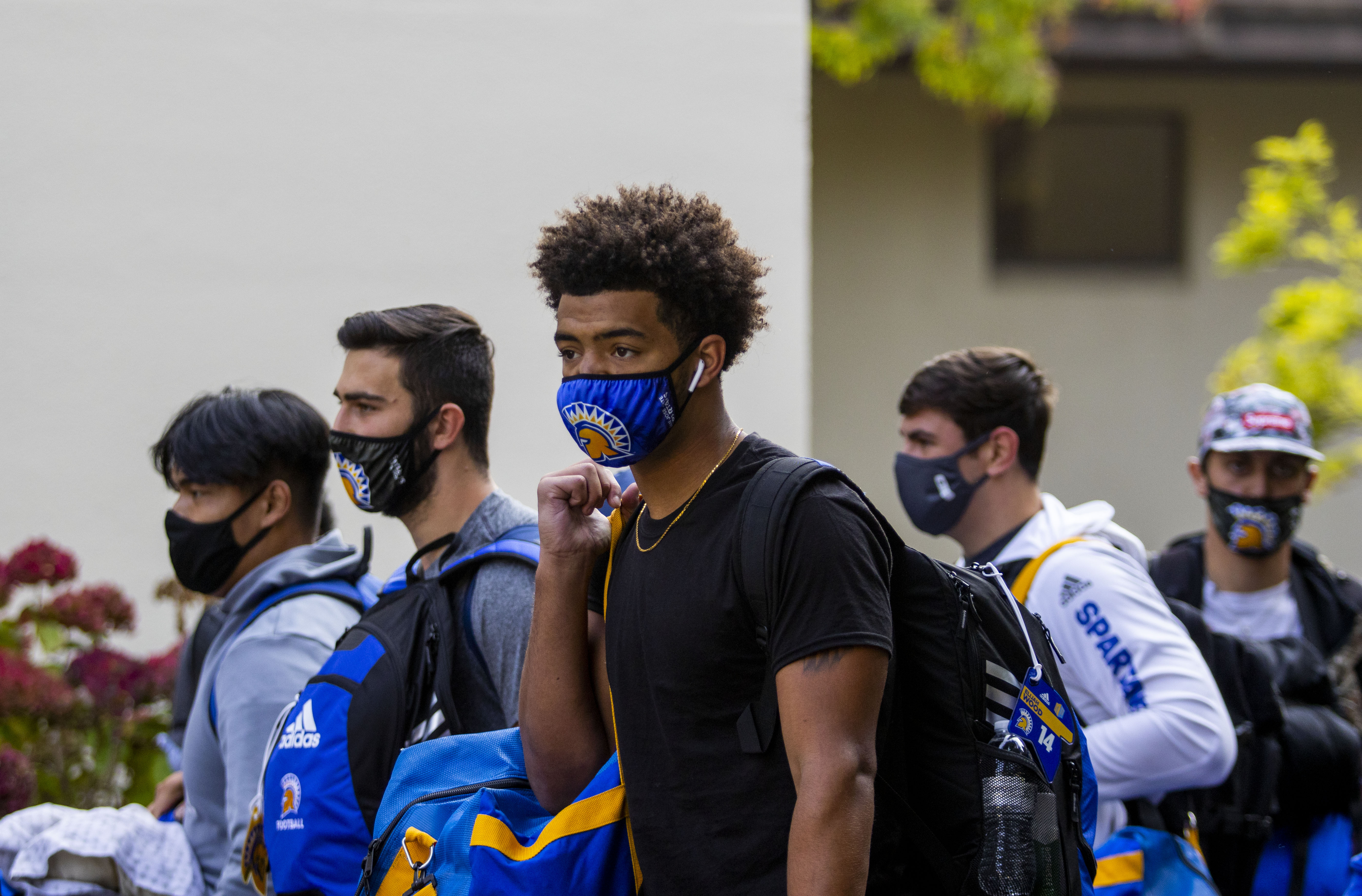
    On Oct. 2, San Jose State University’s football team arrived at HSU to utilize the field and training facilities. The team of 141 players, coaches and staff members are expected to social bubble, strictly quarantine with one another, on campus in Redwood Hall. Redwood Hall stands in the middle of campus, between the Student Health Center and the Depot, making it an unavoidable place for students on campus to pass by.

    In addition, HSU students were notified via school wide email of the university deal less than 24 hours prior to SJSU’s arrival.

    First and foremost, this deal did not involve the approval from either county’s public health officers. Since March, HSU has maintained a relatively low COVID-19 case count with only 11 confirmed cases. SJSU falls within Santa Clara County, and as of Oct. 6, has 50 confirmed cases.

    The team is expected to self-patrol and monitor their own health. They will be tested once a week throughout their stay at HSU, which directly violated SJSU’s athletic conference guidelines provided by Mountain West.

    The Mountain West Conference demands athletes be tested three times a week. If a test comes back positive, further testing is done to confirm the positivity. SJSU brought their own testing equipment, however, the heightened risk of contracting the virus extends beyond the student body and permeates into the town of Arcata.

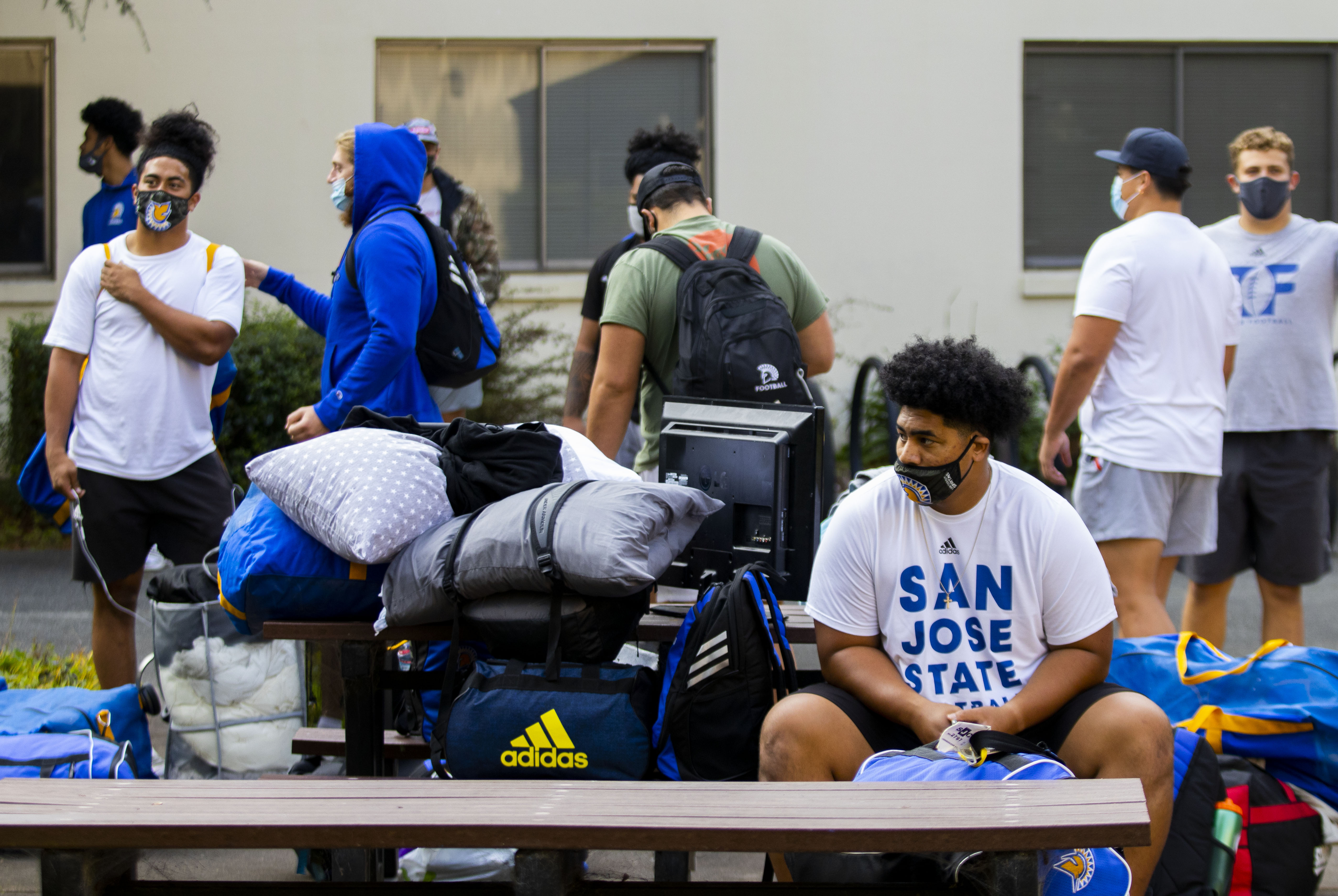
    There has been no confirmation of how long SJSU’s stay will be. Hearsay declares a week, but pictures of arriving Spartan football players holding flatscreen TV’s and luggages of equipment says otherwise.

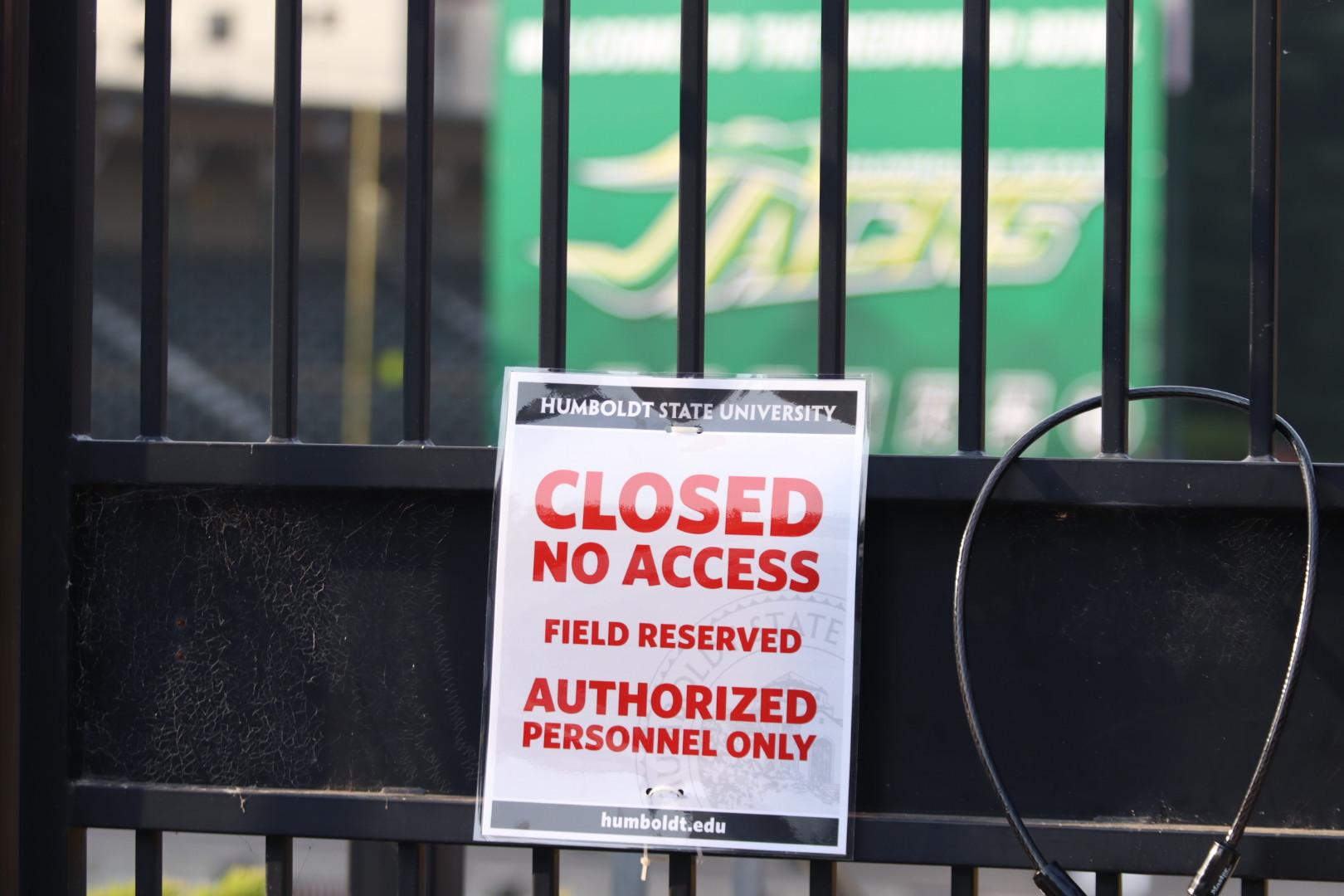
    Student facilities will cater to SJSU during their stay, closing off access to the Redwood Bowl from HSU athletes and students while also extending the Student Recreation Center hours beyond usual scheduling. A ‘no access’ sign currently hangs outside the gate entrance of the Redwood Bowl, HSU claims the sign is to contain SJSU’s football team and limit cross infection.

    HSU students have been repeatedly denied access to on-campus resources, classes, labs, studios and housing since the beginning of the pandemic. However, SJSU was able to rent out the Redwood bowl, SRC and on-campus housing facilities and resources immediately. HSU is renting out campus resources we either don’t have or refuse to offer to students.

    Administration stated that SJSU will be paying for all facilities, housing and resources being used during their stay. However, current resources occupied by SJSU at this time are paid for by student fees. Students believe the funds should be redistributed back to their accounts for a fair way to compensate for the loss of access.

    It’s clear that this decision to move SJSU to HSU was made last minute and without the permission or acknowledgement of HSU students. HSU administration has proven time and time again that the students’ safety isn’t a top priority. The motivation to cut out students from participating in their own university outweighs the value of students altogether.

    HSU continues to treat our campus like it’s closed or empty, forgetting an entire student body population of 6400 people.

  • Rugby captain frustrated with CSU’s hasty actions

    Rugby captain frustrated with CSU’s hasty actions

    Club sports member expresses disappointment in administration inviting SJSU to campus 

    You know there is a huge lack of communication between the Humboldt State University’s administration and its students when an email is sent only a day before the arrival of an entire football team from San Jose State University. 

    It’s very frustrating there is such a disconnect between our administration and it’s student body and community. As a member of club sports it is disappointing to see another team from another school practice on a field that I can not touch with my teammates. 

    From spending 14 hours a week all of last year, at the Redwood Bowl or College Creek field with my teammates building my skills to now, possibly suspended for even gathering with a small group of teammates is frustrating to say the least. All clubs such as Men’s Baseball and the Mountain biking club can not join together because of the guidelines given from HSU. 

    Last time I checked, you have to already be six feet away in order to shoot a baseball. Also I don’t know if anyone in the Humboldt administration has ever mountain biked, but normally bikers keep distance like cars in order to avoid an accident or sudden stop. 

    I will say that my sport, rugby, brings more challenges to social distancing. I still can not go to the field with non-house members of my team to kick or pass a ball and even train. 

    So this is where I find it ridiculous that a football team, a contact sport to say the least, consisting of 141 players and personnel are able to play on the same field we at club sports cannot. 

    I will not blame or send hate towards the players or coaches of SJSU because I respect them leaving their homes in order to possibly have a chance at playing at the next level. If I was in the same situation, I would do the same thing. 

    But I will turn all my blame and anger towards the administration of both universities and the Chancellor of the CSU system. 

    I do not understand how my rugby team cannot practice because of rules given by the Chancellor and the HSU administration but a large football team can travel across multiple county lines, probably making a stop or two, in order to practice for just a week. 

    To put a whole community at risk is baffling to me. The decision to allow another university to send their football team approximately 360 miles to us is terrible. 

  • HSU cancelling contract for University Center

    HSU cancelling contract for University Center

    Disagreements between the UC Board and HSU administration reaches a new point of contention

    Humboldt State University served a notice of termination to their contract with the University Center group, citing a series of breaches between the two organizations.

    In the campus wide email, President Tom Jackson states that the UC, which provides student facing services like the dining services and the Humboldt Bay Aquatic Center, has 90 days to correct the six breaches. With the notice sent on Sept. 24, the UC has until Dec. 24 to make the corrections.

    President Jackson stated in the email that the decision came after discussions with CSU Chancellor Timothy White, the university plans to take over some responsibilities “…ensuring students still have employment opportunities and that services supporting students are continued…” while the board attempts to make corrections.

    “The UC professional staff and student employees who work hard for our campus, community, and students each day are outstanding, and resolution of issues at the executive and fiduciary level should not disrupt them as they continue to serve and support HSU students,” Jackson said in the email.

    No word was given on what would happen to services run by the UC if the termination were to be finalized.

    Members of the UC Board were not told ahead of time of the termination and learned of the notice the same time the campus and media were told. 

    In a statement made by UC Faculty Representatives Steve Martin, Ph.D, Mark Rizzardi, Ph.D, and Armeda Reitzel, Ph.D, the board expressed their disapproval with the move.

    “Unfortunately, we find ourselves in an environment where authority seems to outweigh collaboration,” the statement said. “A memo was sent to the UC, at the same time as to the media and the public, of a termination of contract notice. We can’t help but wonder if there were ulterior reasons to motivate such a disproportionate response.”

    Of the six breaches that the notice brings forward, three of them included the business relationship between the North Humboldt Recreation and Park District, focusing in particular on the Arcata Community Pool.

    According to the notice, the UC Board opened a $300,000 line of credit for the NHRPD in Aug. of this year, as well as transferring $100,000 and $50,ooo to them in Feb. and July respectively. These actions, according to the president’s statement, violate Executive Order 1059 which states that  “Campus auxiliary organizations are . . . operated solely for the benefit of the campus.”

    In a separate email, Martin said “Everything the University Center did with respect to the line of credit we extended to the Arcata Community Pool was done above-board, in public, and even the University Controller recommended it and voted in favor of it, as did administrator Dean of Students Dr. Eboni Turnbow.

    “For the President to pull the termination trigger on our operating agreement is akin to using a nuclear bomb to respond to a mosquito bite,” Martin said.

    Dean Turnbow was also not one of the administrative team members mentioned in the notice of termination, which included Vice President for Administration & Finance Sherie Gordon and Vice President for Enrollment Management Jason Meriwether.

    Gracie Oliva, a student employee of the HBAC, expressed her concerns during a September interview about administration’s decisions, calling it a slap in the face to the entire student body.

    “I want students to know that if Center Activities or HBAC are affected, it would be a detrimental change,” Olivia said. “The Recreation Administration program is held up by these programs. Without them, I feel like it would crumble.”

  • Spartans arrive at HSU despite campus concerns

    Spartans arrive at HSU despite campus concerns

    ***Editor’s note: SJSU football program was tested in congruence with Mountain West conference guidelines***

    The Spartans have arrived and this time they’re not carrying spears or shields. Instead the San Jose State football team stepped onto the Humboldt State campus on Oct. 2 with bags full of clothes, televisions, gaming consoles and plenty of padding. As 141 players, coaches and trainers streamed out of the six buses into a school that hasn’t seen college football since 2018. 

    Humboldt State students received an email on Sept. 30 that the San Jose State football team would be arriving within the week. Initial reports suggested that the Spartan football program would be at HSU for one week per the Spartan Daily student newspaper from SJSU. The duration of their stay is not confirmed and could be longer. 

    According to the Humboldt State Athletics Department, the length of the Spartan football team’s stay at HSU depends on the regulations set forth by Santa Clara County where SJSU is located. 

    “It’s uncertain at this point as it depends on the needs of SJSU and how quickly they may be able to return to their campus to practice and play games,” the HSU Athletics Department said in an email. “They are working with Santa Clara County Health to get approval for that as soon as possible.”

    SJSU Head Coach Brent Brennan said in a press conference on Oct. 5 that the arrangement between San Jose State and HSU came quickly with the need to start full contact practices soon. 

    “I think it probably came together in about a week, maybe a little less than that,” Brennan said. “President Jackson here and their Athletic Director Jane Teixeira and our Athletic Director Marie Tuite, our CFO Charlie Faas, Dr. Papazian, it was just a mad dash that way.”

    As of Oct. 5, Santa Clara County has announced that they are moving into the third tier of COVID-19 classification after seeing an decrease in new cases each day. While there is still no official time set for the Spartan football team to be on the HSU campus, this development could mean that the team may return to San Jose sooner rather than later. 

    “It was a slap to the face on rec sports. Because we really didn’t know what the hell was going on. We thought it was Athletics. We were like ‘Athletics, what the heck?’ and then Humboldt County was like ‘Yo, what the heck?’ But it wasn’t really Athletics’ fault.” 

    Martin Gordillo

    While the team is on campus, they will be responsible for testing their athletes and personnel using their own testing resources. In an email sent out on Oct. 1, Humboldt State told students that will be tested once per week. This runs contrary to Mountain West conference protocol who state on their website that athletes will be tested three times each week. It is unclear whether this testing will apply to the preseason training that the Spartans are currently participating in. 

    While the Spartans are on campus, Humboldt State’s own NCAA teams will still have access to facilities during their scheduled times in order to continue their preparation for hopeful upcoming seasons.

    “HSU sport programs are still using Redwood Bowl during their regularly scheduled and reserved time periods,” HSU Athletics said in an email.

    Even as the San Jose State team was arriving on campus HSU students and athletes alike were confused and upset that more context had not been provided for the team’s arrival. One of the loudest voices that could be heard across social media was that of the club sports on campus that have been unable to hold practices since COVID-19 shut down the majority of sports. President of HSU Club Baseball Martin Gordillo was upset that the communication between the administration and recreational sports teams was not more clear. 

    “It was a slap to the face on rec sports,” Gordillo said. “Because we really didn’t know what the hell was going on. We thought it was Athletics. We were like ‘Athletics, what the heck?’ and then Humboldt County was like ‘Yo, what the heck?’ But it wasn’t really Athletics’ fault.” 

    According to Gordillo, there was a miscommunication between Athletics and recreational sports which was clarified in a meeting with several of the club sports and the Athletics Department.  

    “In reality it wasn’t Athletics,” Gordillo said. “It was mainly more towards the Chancellor’s Office who made that decision on whether or not to allow athletics to continue to practice but not rec sports.”

    Gordillo stressed that while he feels that communication can be improved between rec sports and athletics, there is a disconnect with how the Chancellor’s Office views rec sports in comparison to NCAA athletics. 

    “I believe the Chancellor’s Office has made it seem like they really don’t care about rec sports that much,” Gordillo said. “They don’t see us and [NCAA] Athletics as equal. Not Athletics in general. Athletics wants to work with us. They really want to have our voices heard.” 

  • Music of the Moment 5

    Music of the Moment 5

    After shooting Megan Thee Stallion, Tory Lanez cancels himself

    Back in June, rapper and R&B singer Tory Lanez was freshly released from his label and experiencing unprecedented success with the Quarantine Radio show he performed on Instagram Live, his career at an all time high. As quickly as he rose, he sunk exponentially, when what started as an unclear altercation evolved into an unthinkable assault.

    For over a month, the July 12 incident was left to mere speculation. Megan Thee Stallion, the other party involved, finally took to Instagram Live on Aug. 21, to explain her side of the story.

    “Tory shot me,” Stallion said.

    In the weeks leading up to her statement, Stallion was receiving a mix of sympathy and accusations, despite releasing the X-rays showing proof of the bullet wounds.

    Lanez remained silent on the matter until releasing the album “DAYSTAR,” Sept. 25, only two days after Breonna Taylor’s killers were let off without justice. On the project, he persistently denies any wrongdoing regarding the incident and outright accuses of lying.

    Lanez’s unabashed decision to capitalize from the situation, only providing his side of the story through a product, and his incessant claims of innocence ultimately detract from his credibility and have led many of his supporters to abandon him.

    Heavily feeding into the backlash of supposed friends, Lanez fires shots at several rappers, singers and most viciously, Los Angeles Lakers’ small forward J.R. Smith. While entertaining, the “Me Against the World” approach leaves a bad aftertaste. Given the opportunity, Lanez consistently takes the low road, rather than owning up to any of his mistakes or at least acknowledging the severity of the situation.

    Concerning the quality of “DAYSTAR,” the beat selection, various flows and word play are just as good as any other Tory Lanez album. The sonic range he displays between the two genres he occupies would normally be enough to satisfy the average listener, however, his fixation on the incident and the two-dimensional account he provides make it both agitating and boring to listen to entirely in one session.

    Lanez fails to deliver any form of apology or explanation on the album for whatever occurred on the night of July 12. Instead, he calls Stallion’s account into question and implies he’s the one due an apology, using good production to punctuate his empty argument.

    When it comes down to it, the album sounds quite good, so long as you’re not actually listening to the lyrics. Even then, the sting of the initial reaction wears with each play for those willing or perhaps careless enough to silently condone the behavior. Lanez challenges his haters, however, providing what would normally be received as a hit with “Just Got It Done” as well as an otherwise undeniable classic with “Care For You.”

    The question is, can a hit record or even a potential classic save Lanez from sinking out of the spotlight? Or is the wound simply too raw for him to survive a tasteless response like this?

  • Tragic, but not shocking, no justice for Breonna Taylor

    Tragic, but not shocking, no justice for Breonna Taylor

    Opinion Editor Mikayla Moore-Bastide speaks on nationwide injustice

    How do I explain Breonna Taylor to my future daughter?

    A Black woman, in her own home, was shot multiple times by police and it took six months for the officers to be charged with a crime. Only one officer was charged, but it wasn’t even for killing her, it was for endangering the neighbors.

    How do I even explain Atatiana Jefferson to them?

    She was playing video games with her nephew in her own home when the police shot and killed her through her window.

    How could I explain Botham Jean?

    He was watching TV on his couch when an off-duty officer burst through his door and shot him. The officer said she mixed up his apartment with her own.

    How do I explain my fear of the police bursting into my apartment because my neighbor called for a wellness check?

    How do I explain that walls got justice before Taylor did? Or how it took national pressure from social media to keep the city from sweeping this under the rug. Or how any bad thing from your past will be brought up in an attempt to justify your death. Or that women already have to face enough oppression, but adding melanin to the mix just makes our odds worse?

    How do I explain the terror every black person faces on a daily basis?

    The terror of becoming a statistic, a hashtag, or having their last breath recorded for all to see over and over and over again. Having our name and face plastered on a sign with the demonstrators chanting, “No Justice, No Peace.” Riots being named after us. How about the family not having time to grieve because they’re too busy making sure we get justice? Or the worst one, justice not being served because the system doesn’t care about black lives.

    How do I have “the talk” with my future kids?

    Usually, “the talk” is about sex, drugs, drinking, dating, or staying out late. My version of “the talk” was about how to talk to the police without looking like a threat. It was about why that one kid kept calling my little sister “brownie”. It was about avoiding certain cities,bars and malls because the people there have a certain mindset. It was about why I will get treated one way, but my white-passing friends will get treated another. It was about getting followed in stores because I looked suspicious.

    Of all the talks I’ve had, they would have never prepared me for not feeling safe in my own home or neighborhood.

    Our home is meant to be our relaxation spot, our comfort zone, and our safe space.

    Living while black, we don’t get that. We don’t get to go on innocent runs around the neighborhood, we don’t get to sleep, watch tv, or play video games in our home. Tamir Rice didn’t get to play in the park. Elijah McClain didn’t even make it home from the store. My sisters go to a school in a nice area, but they don’t even get to walk to McDonald’s after school without being questioned by police regarding their residency.

    How do I explain that we are not protected?

    Or that we were never protected?

    Breonna Taylor deserved better and the system just treated her life like it was disposable. Her life was not disposable. Black women are not disposable. Black people are not disposable.

    Say her name.

  • Cars collide with protestors at Breonna Taylor demonstration

    Cars collide with protestors at Breonna Taylor demonstration

    News Editor, Carlos Holguin recounts his experience at the Breonna Taylor protest in Eureka on Sept. 24.

    As I parked a block away from the the Humboldt County Courthouse on Sept. 24, watching community members gather with signs in hand, the name Breonna Taylor emblazoned on so many of them, I wondered just how the night would go.

    Over the past months, reports of violence occurring at Black Lives Matter protests from the likes of counter protesters, police and so-called vigilantes have grown, from cities large and small. I would be lying if I said I wasn’t nervous as I watched heads turn as I continued to snap photos.

    It’s hard to cover a protest, and even harder to cover one when trying to stay objective. When protestors ask you questions about your support and why you are there, it’s hard to create an answer that fits all needs and wants.

    No matter how many times the crowd calls for you to say her name, you’re told that replying is compromising to your ethics. God knows I wanted to chant and reply, but I held my tongue.

    Some people don’t want you there at all sometimes, afraid that you just pose another risk.

    As the march started, taking over street corners and sidewalks before advancing to entire lanes and intersections, the chants grew louder. People peaked out of business doorways, sat on apartment balconies and either silently watched or cheered as the crowd passed. Cars blared their horns behind the procession, only to be met with more cheers and protesters stopping to take in the anger and frustration.

    That’s what this was after all, focused and controlled anger at a system that failed not just them, but people like them. Anger at a system that left people in Louisville and around the nation demanding justice.

    The tension climbed higher as the sun set, the protestors circling back to the courthouse to pick up any late comers and grow in number, before continuing to take streets and hold traffic. Through it all I stood aside, camera in hand taking photos of the world around me, trying hard to be a fly on the wall. This is not my story, this is not something I needed to be a part of.

    When the first car drove through the crowd of protestors, I saw it coming. Both sides stood in a stalemate, with protesters refusing to give an inch to the Mustang as its engine stirred and horn deafened the chants.

    Through the lens of the camera I saw bodies get pushed aside and land hard on the concrete, but bounce back just as fast. The anger grew and the few scrapes and bruises

    were just fuel and this fire was not ready to die out.

    The second car, a large truck who’s black paint blended with the night, was more deliberate. It slowly crawled into and then lulled in the intersection, watching as more and more gathered around it. As I approached the truck, the car shifted into park and the tires turned in place, smoke bellowed from the burnout. It was an arrow notched and aimed.

    The car shifted into drive. A few feet in front of me, the car made contact with a protester. There was thud, then a scream.

    For a second I froze in place, watching the crowd rapidly part ways.

    And then I ran with everything I could for a moment after the truck. I needed a plate, a model, something to help. I watched it after a few minutes disappear on to the highway, before turning back. This was not longer something I could choose to remain objective as a journalist in.

    I cannot understand, nor do I want to understand, how hate can grow within a person to the point that they could justify actions like these. A person who willfully chooses to meet progress with aggression is not someone any person should associate with.

    Journalistic integrity be damned, I will not stand idly by.

    Injustice anywhere is still injustice everywhere.

    Breonna Taylor.

    Say her name.

  • Humboldt State athletes prepare for uncertain seasons

    Humboldt State athletes prepare for uncertain seasons

    Despite an uncertain future, athletes continue to train for their next season

    Normally fall sports would have begun their season at this time of year. For now, however, fall and spring student athletes must wait for the foreseeable future until they can touch the court or field as a team. For senior athletes the possibility of not having a season can weigh heavy on their mind. Fall athletes are ready for the season to start in the spring, but there is still no solid answer if it will happen.

    Tyler Guptill, a senior on the Humboldt State men’s soccer team, has had to deal with these problems. Guptill has also had to come to terms with the fact of not having a season in the fall.

    “Yeah there are a lot of difficulties during this time”, Guptill said. “However, we are very fortunate to be the only CSU able to train this fall.”

    Guptill and other athletes have been able to train for the upcoming season by using the HSU gym but they must follow all social distancing guidelines and stay in small groups.

    As for the possibility of not having a season, Guptill has had to keep his head high and voice his positivity to his teammates and coaches.

    “Whether we have a season in the spring or not I think it’s important to lead with being positive”, said Guptill. “We all love the game so much, the face masks and social distancing won’t distract us from working hard. It’s important to think about the young guys and do our best to make this time productive and most importantly memorable. It requires a lot of extra work but the guys have that fight in them, so I’m excited for whatever comes our way.”

    Fall athletes are not the only athletes who have to deal with the uncertainty of a season. Chris Louie, a senior on the Humboldt State rugby team, must deal with the possibility of not having a season in the Spring. Louie was a transfer from Sacramento City College last year.

    “It was my first year playing and now I have a different environment to train in”, Louie said. “ I don’t like how the season ended. Now I feel like I have to be more prepared for the oncoming season so we can win.”

    Louie has stayed in physical shape by running and going to the gym everyday since self-isolation has ended.

    “Physically I have actually been able to push myself but in a different mindset, not as a sports mindset but as a lifestyle choice.”, said Louie. “I’ve always had a coach or team to push me to go to the gym. But now with no season I have to push myself to go to the gym, setting me forward for the future. I have to better myself in life and not just the game.”

    Louie has always been able to look on the bright side. The possibility of having no season really proves this.

    “I’ve always had a positive mindset, I look at life like there are two sides.”, said Louie. “With every negative there are always positives surrounding it. For example I’ve been in college for 6 years. Even though I don’t have sports to play my senior year, I realize I have almost graduated and that is a positive to take away from no season.”

    The Athletics Department is starting to allow socially distanced practices this week. As for playing a season in the spring, the question still holds whether or not athletes will have one.

  • Obituary Of A Snake

    Obituary Of A Snake

    Goodbye, Cruel World

    I found you dead this morning. You had a tragic and undignified death. I only hope you were dead, or at least unconscious before being caught in a tire wheel and thrown back onto the road.

    I do not know if you had a name, or even if snakes understand the concept of names. I hope it’s alright if I call you Billy.

    From what the internet tells me, you were either a Northwestern garter snake or a red-sided garter snake. You had bold yellow stripes running down your tail/body/spine, and big, dead eyes that were empty of the spark of life that was so cruelly taken from you. You were a bit over 6 inches, not a big snake but you were not tiny.

    What were your accomplishments? We may never know. Did you eat a lot of slugs, or did you have a preference for amphibians? What was your favorite food, Billy? Did you prefer to coil and strike in defense, or slip into the creek?

    As I was staring into the eye sockets of my skeleton bobblehead, I was reminded that death can be a beautiful thing. Death is a transition into a new life. Mourning is a time to remember who you were, and who you can be in your next life.

    You lived and died in a college, arguably a modern-day Acropolis, much like your ancestor, the sacred snake of Athens. The sacred snake stood guard in Athena’s temple, receiving gifts of honey cakes until they sensed the Persians coming and fled as a warning.

    Are you warning us of something, Billy? That cars will be the death of us all, most certainly by climate change, but also by the crushing wheel of modern society?

    I resolve to make you mean something. Your life was meaningful, perhaps not by human standards. But as a snake, it was your job to consume plant-eating creatures, thus protecting the small plants that make Humboldt beautiful.

    The humans will laugh at my grief. You were a snake, and a large percentage of them feared you without cause. Though your bite was inconvenient at best, you were small, so small that I doubt you were fully grown. I grieve not only for the death of a wild animal but a newly-hatched one.

    You were not a bird, a rabbit, or a deer. You were not what is commonly considered “cute.” Yet, a live snake is exciting. How fast you used to move, how slick you must have felt! That power is gone now.

    Seeing you struck me with the irrelevance of human society. Why do humans drive cars, except for human reasons? Birds fly, rabbits hop, and snakes slither. That’s all the transport you need. Humans can’t make enough money unless they move beyond the capacity of legs. Money doesn’t make sense to anyone who isn’t human!

    Billy, I hope you find peace. But I know you most likely won’t. Cars may become completely electric, but the system that makes driving a daily occurrence continues.

  • HSU art students create their way through quarantine

    HSU art students create their way through quarantine

    Artists at HSU are experiencing somewhat smooth sailing this semester

    Factoring in all the tools, materials and space art students require to create, they more or less have access to everything they need at HSU.

    Studio art major at HSU, Nicole Velazquez, already does online sketching on her own time. With her recent courses, however, she’s been focusing a lot more on class related artwork.

    “I mostly do digital art right now, because of my classes,” Velazquez said. “It keeps me a little more occupied.”

    So far, Velazquez has experienced somewhat rudimentary quarantine classes, leaving her with more time to improve her artistic abilities and explore new art forms. Lately, this hasn’t involved traditional art.

    “I don’t really have time,” Velazquez said. “I’ll sketch like here and there.”

    Velazquez hasn’t had many issues with online art courses but she misses in-person instruction. When it comes to art, she often draws her creative inspiration from others.

    “I like getting criticism,” Velazquez said. “I just feel like, if I don’t have someone telling me something, I will personally bring my art piece down.”

    Brittany Sheldon is an instructor in the Art department whose main course revolves around art history. Sheldon is still adapting to the new normal of teaching.

    “It is all based on equity,” Sheldon said. “Just trying to be as equitable as possible and accessible as possible for my students, while also trying to recreate whatever I do in the classroom normally.”

    Sheldon’s classes this semester are mostly asynchronous. By allowing students to have more flexibility, Sheldon hopes this will make her classes more accessible for students.

    “I have Zoom office hours and I was doing weekly Zoom sessions that were optional,” said Sheldon. “Students didn’t get a grade for that – it was an opportunity for them to come and ask questions or talk to each other.”

    At this point, students enrolled in Sheldon’s courses this semester seem to be passing. Sheldon has relaxed deadlines for assignments and is doing her best to be helpful and understanding but it is hard to tell how her students are doing from a screen.

    “I field their emails and just respond with empathy,” said Sheldon. “I am just trying to be there for my students.”

    Alex Pickrell majors in child development at HSU and minors in studio art. They’re using their excess quarantine time to explore more art forms and experiment with current projects.

    “I’ve also started doing collages with my old pieces,” Pickrell said. “Which I’ve never done before.”

    Living off campus, Pickrell has more room to explore their creativity as well as different art forms. They have their own space to create and express themselves without distractions.

    “I’ve been living off campus for about three years, so I kind of turned my apartment into my own little art studio,” Pickrell said. “It makes it a really nice space to work.”

    Pickrell typically creates abstract artwork. They’re currently taking two art classes where they’re exploring entirely new styles.

    “I decided to do left hand vs. right-hand painting,” Pickrell said. “Just because I usually only paint with my right hand and I’ve only ever done a set of paintings once.”

    The struggles of quarantine are plentiful, but Pickrell figures, we can either wallow in our misfortune or we can rise to the occasion and make the best of a bad situation.

    “I’ve just been trying to get out of my comfort zone,” Pickrell said.