The Lumberjack


Students Serving The Cal Poly Humboldt Campus and Community Since 1929

Tag: Jerame saunders

  • New Grant Lends Helping Hand

    New Grant Lends Helping Hand

    Mental health grant seeks to address adverse childhood experiences in Humboldt

    A new $5 million grant from the U.S. Department of Education will be placing Masters of Social Work students at Humboldt State University in Eureka City Schools and Del Norte County schools as stipend workers.

    “The grants themselves are funding positions at Eureka City Schools and also the Del Norte Unified School District,” Director of Field Education at HSU’s Department of Social Work Yvonne Doble said. “It’s actually a full time benefited position that’s being brought on at the school side to support our students.”

    Announced Nov. 20, the funds will come from the U.S. Department of Education Mental Health Service Professional Development Program.

    Nearly $1 million of the grant will be going to Humboldt State to help support the students and get them prepared for applying for the Pupil Personnel Services Credential, which is necessary for social work students to be hired by schools.

    “A large portion of that is coming specifically for the stipends for the students,” Doble said. “We plan to offer a class for stipend recipients, where they will receive faculty guidance and support regarding school social work practice.”

    The grant will be placing Masters of Social Work students at HSU in varying levels of schools throughout Del Norte and Humboldt Counties.

    “It looks like we are going to have eight students this next fall, maybe more, and that will move up to 13 to 15 students by year four of the grant,” Doble said.

    Locally, students face higher than normal rates of Adverse Childhood Experiences in Humboldt and Del Norte.

    “Our region, for a number of reasons, has California’s highest ACEs rates in Humboldt and Del Norte County,” Jack Bareilles, the Northern Humboldt Union High School District grants administrator and an author of the grant, said. “You’re looking at approximately a third of all kids are being raised in families with four or more of the ten ACEs. So there is just a real need for that here, and I believe that’s one of the reasons we got funded.”

    ACEs can include things like alcohol and drug use or violence in the home, housing insecurity and food insecurity.

    “Locally, there is a real need for support for students and support for families,” Bareilles said. “Social workers are uniquely qualified to provide, and that being said, we actually have a real shortage of social workers in the schools. It’s just something that we haven’t had before.”

    Bareilles said the shortage comes from the lack of PPS credentials for students, and also because social workers, which are different from counselors and school psychiatrists, are mainly used in larger cities. Now, the PPS credential will be offered at HSU.

    “Kids and schools and families will be helped, and when push comes to shove, that is the most important thing.”

    Jack Bareilles

    “The role of school social workers is to really help address social and emotional needs of our students,” Doble said. “It’s not just about academic counseling. It’s about providing resources to children and families. It’s about providing opportunities to developers, opportunities to repair harm that’s occurred.”

    Bareilles said doing social work in school systems differs greatly from social work in other categories because the public schools operate under different processes than normal organizations.

    “Having these interns work two days a week for a whole year working in a high school or middle school or elementary school, they will emerge from their MSW program with a real sense of, ‘Oh this is how schools work,’” Bareilles said. “So whether or not they are employed as a school social worker or some other child-serving social worker, they will really have a better ability of connecting the dots and getting kids what they need.”

    Bareilles said the grant is a huge win for mental health support in Humboldt County and will help provide many troubled youths with the resources and personnel that they need.

    “Kids and schools and families will be helped, and when push comes to shove, that is the most important thing,” Bareilles said.

  • Spreading Warmth for Winter

    Spreading Warmth for Winter

    Many organizations around Humboldt County provide warm clothing for little or no cost

    With winter right around the corner, it’s important that less fortunate and displaced individuals have access to food, shelter and basic necessities.

    Humboldt County has among the highest rates of homelessness in the state. With the steep temperature decline of the winter, coats, socks and warm clothes become an extreme necessity.

    Robert Lohn, the founder of Coats for the Cold, one of the largest coat drives in the county, spoke on the need for warm clothes during the upcoming months.

    “There’s a flock of families, individuals and couples who go to food banks and can’t afford food,” Lohn said. “Let alone warm clothing.”

    Lohn started the movement 12 years ago with just 20 coats. Since then, the movement has gained major recognition from across the county to help collect, clean and store clothes that are redistributed to underprivileged children in schools. The amount of jackets received has greatly increased over the years, but Lohn still prioritizes spreading the word.

    “The big picture is to show other parts of the community what we do, how we did it and how the other areas could do it as well,” Lohn said.

    Coatsforthecold.org provides a lengthy list of drop-off locations ranging from McKinleyville to Garberville. Drop-off boxes are distributed at the beginning of December through to January.

    “If anybody is in desperate need of a pair of pants or some shoes, and we have it, we will get it to them.”

    Steven Thompson
    St. Vincent de Paul Employee

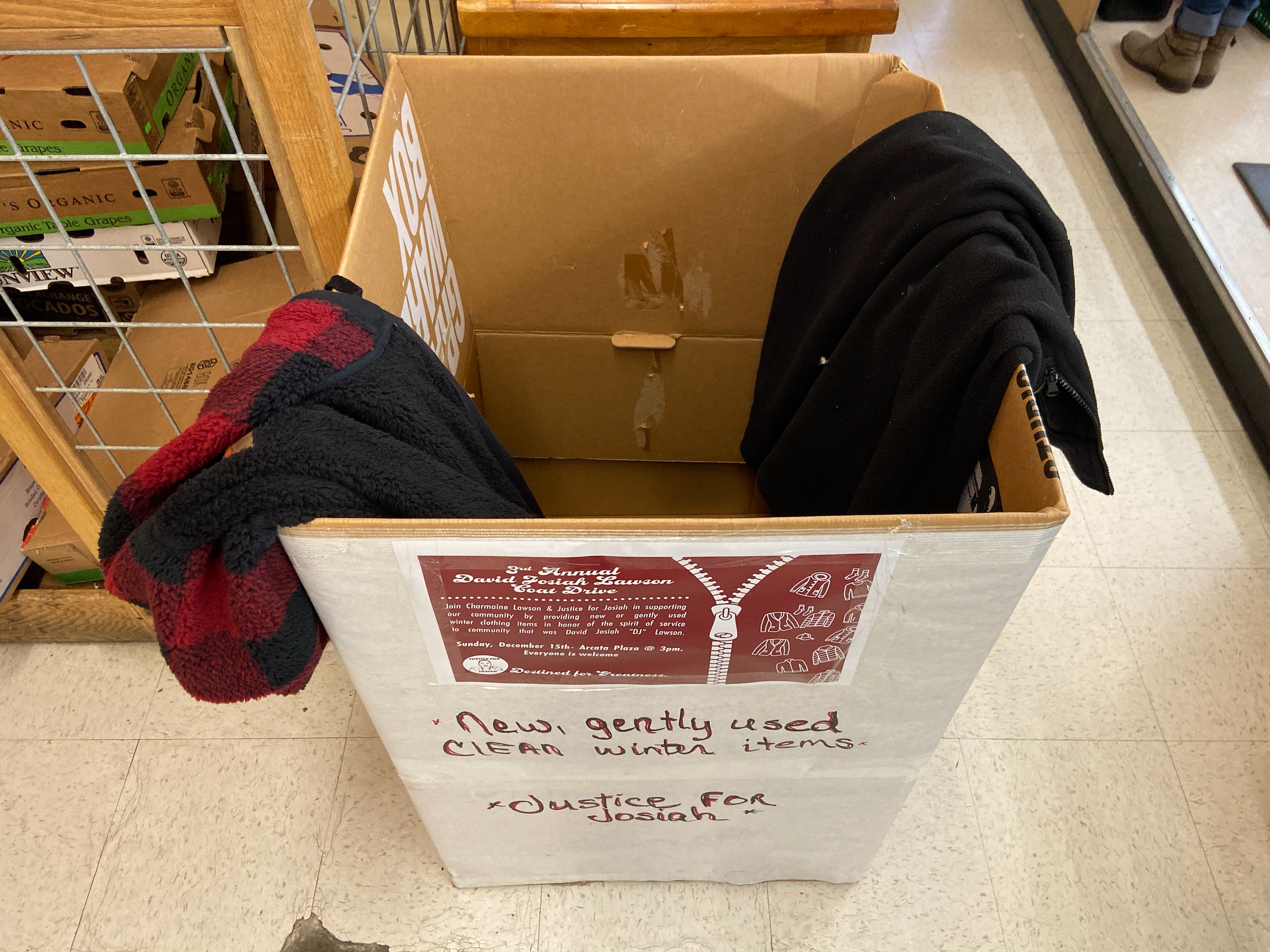
    A drop-off box for warm clothes was placed on the first floor of the Behavioral Social Sciences building on Monday, Dec. 2 and will remain there through January. Warm clothes to donate include: jackets, sweaters, pants, hats, blankets, socks and gloves. Backpacks are welcomed as well.

    Another place to donate is the at the Third Annual David Josiah Lawson Coat Drive, which takes place on Dec. 15 at 3 p.m. on the Arcata Plaza.

    The St. Vincent de Paul non-profit organization in Old Town Eureka is also a great resource for people who would like to donate, or are in need of daily necessities. They provide bag lunches and free clothing. They are open seven days a week, besides the first two weekends of the month.

    Steven Thompson, a worker at St. Vincent’s, says there is no specific criteria needed in order to receive the items that are offered.

    “If anybody is in desperate need of a pair of pants or some shoes, and we have it, we will get it to them,” Thompson said.

    Not only do shelter and coat drives work for donating, but Angel’s of Hope Thrift Store is another place where people can donate their warm clothes.

    According to employee Jasmine Oakshotte Angels of Hope is open every Tuesday, Wednesday and Friday, 11 a.m. to 4 p.m.

    Oakshotte says that they have plenty of warm clothing, but it is the process of getting it out to the public that makes it difficult.

    “It’s just about man power for us because we are a small group,” Oakshotte said. “There’s only four of us that price the stuff. So getting through it all, like we have bunches of it, it’s just that we have to get it out.”

    Volunteers are more than welcome and will receive store credit by volunteering for the thrift store. They also have deals throughout the week for enrolled HSU students, including receiving half-off clothing Wednesdays, Saturdays and Sundays.

    If you’re in need of warm clothes this winter, consider using the above organizations and stores around Humboldt County that provide them at either no cost or for very cheap.

  • Exploring Humboldt County’s Ghost Towns

    Exploring Humboldt County’s Ghost Towns

    Abandoned towns and villages pave the way for an informative adventure

    Humboldt County offers many unique features, including an abundance of ghost towns. A road trip through the green beauty of the northern county makes way for hidden spots.

    Gary Speck is an author and journalist that specializes in the study of ghost towns. Speck has written for Western and Eastern Treasures Magazine since his first column in 1978. Additionally, Speck is the author of two books on the study, definition and classification of ghost towns. Speck believes studying the remnants of past communities is valuable work.

    An abandoned building found in Samoa, California. | Photo courtesy Syshana Hocker

    “It is vitally important to remember that each one of these thousands of communities were once filled with people,” Speck said. “Just like us, they had high hopes, dreams and aspirations for the future.”

    Leaving southbound from Arcata, the first ghost town is in Samoa. Locals believe a haunting presence lives in the Eagle House, and the town’s atmosphere is eerie and abandoned buildings are prevalent. However, the town is still slightly active.

    Speck elaborates on the exact defining factors of a ghost town.

    “A ghost town is a town or community that at one time had a commercial or population center and is either wholly abandoned or faded greatly from its peak,” Speck said. “Now, just a shadow of its former self.”

    “It is vitally important to remember that each one of these thousands of communities were once filled with people. Just like us, they had high hopes, dreams and aspirations for the future.”

    Gary Speck

    Don Hofacker, a curator at the Humboldt Bay Maritime Museum, shares a story of when Samoa was a booming, prosperous town for importing goods into the county. One captain had his vessel stationed in Samoa’s port. The Eagle House was a brothel at the time and the captain went for a late night visit.

    According to Hofacker, the ship’s captain was supposed to wake up at four in the morning to set sail, but he was mysteriously murdered in his sleep. Hofacker says the captain can be heard around four in the morning leaving the Eagle House and searching for his ship to this day.

    Further south, the next ghost town is Rohnerville, located outside Fortuna. In the case of Rohnerville, new buildings have been built on top of the previously labeled ghost town and the area is slowly becoming more populous.

    One of the few abandoned houses that line the street of Bridgeville, California. | Photo courtesy Syshana Hocker

    Next is the town of Bridgeville. Named after the now abandoned bridge standing over the Van Duzen River, the town is tucked off Highway 36. Like many others along the Redwood Coast, Bridgeville began as a stopover for miners and loggers in the late 1800s.

    Though abandoned buildings make up almost half of the town’s infrastructure, a handful of residents still occupy the area.

    Bridgeville gained notoriety in 2002 when it became the first town in history to be auctioned on eBay. The town was purchased for $700,000, only to be sold again in 2006 for $1.25 million. According to a BBC News article from that year, the latter price included three cows, eight houses and a post office.

    “When the economic mainstay of the town collapsed, many times the towns were abandoned and those dreams were dashed,” Speck said. “It didn’t matter if you were a Scandinavian lumberjack, a Czech miner or an English storekeeper. Each person in these places held an important piece of the whole picture.”

  • Musician Feature: Ultramafic

    Musician Feature: Ultramafic

    HSU graduates form stoner metal band with a new ‘garage prog’ sound

    Tom Norman, Kaito Figeira and Russell Stroud make up the three piece instrumental rock band, Ultramafic. The inspiration for the name, which refers to a heavy igneous rock found in Earth’s mantle, stemmed from Norman and Figeira’s majors of art and geology.

    “We both graduated and we were like, let’s make an artsy-geological rock band,” Norman said. “Do something with our degrees a little bit.”

    In 2015, Norman and Figeira started the band. Norman plays the guitar, Figeira’s on the drums and Stroud plays the electric bass. Figeira and Norman have been in a relationship for eight years and share a home in Arcata that doubles as a space for band practice.

    Ultramafic performing a private song in their eclectic basement which doubles as jam room on Oct. 19. | Photo by Jerame Saunders

    After recording a small demo for fun, Norman and Figeira showed some friends. Under the impression the demo was from a band, they were asked to perform at a show in three weeks. Norman and Figeria agreed, but lacked a bass player. Russell Stroud was the man for the job.

    “Three weeks and a few blood blisters later we got our first gig,” Stroud said.

    Ever since, the band has acted as a cohesive unit. Producing music they call “garage prog,” it fits into the stoner and metal music categories. The added garage aspect represents their distorted, psychedelic sound accompanied by heavy, slow blues rhythms. The progressive nature of their rock is influenced by 70s and 80s progressive rock musicians such as Frank Zappa, Rush and Yes!

    “Most of our songs are five or six small songs crammed together, but there’s a flow through it and some themes,” Norman said. “We have kind of a lot of Pink Floyd and Black Sabbath comparisons.”

    Initially, the band struggled to find the right shows to play with artists that share similar music styles. But their success began in 2015; when the band found Humboldt they felt at home, becoming an immediate influence on Humboldt’s musical community.

    “We are small, but bands you would never expect to come through town, come here and play,” Figeira said. “It’s a really cool scene and it brings a lot of interesting people to this area.”

    Connections in the musical scene secured Ultramafic a six show tour across three states: Montana, Oregon and Washington.

    “Music is life man,” Stroud said. “I can’t live without music in my life. It needs to be there everyday and playing it is even better. Getting to be apart of the collective that is creating music and getting to be one of the people that not only has put in time to play, but is decent at it too.”

    The band released their newest album ‘Pyroclastic Flow’ on Oct. 31 and performed at the Siren’s Song on Nov. 2 with WitchRipper and Thundercloud.

  • CT Bombers Explode on Arcata’s Music Scene

    CT Bombers Explode on Arcata’s Music Scene

    Garage-band veterans rock Humboldt with their psychedelic sounds and brutally honest themes

    The CT Bombers are a local band consisting of best friends Wyatt Brenner, Willem Kernkamp, Delphin Browne and Quonton Waull. Brenner and Kernkamp play guitar while Browne and Waull play double drum sets.

    The band formed in July 2016 after finishing high school in Temecula, California, where they grew up together and played in numerous bands over a span of 10 years.

    After high school, some members of the band relocated to different states, but the separation was short lived. They all eventually ended up in Humboldt and reformed the CT Bombers. Since then, the band has consisted of alternating guitars, drums and vocals to create a garage and psychedelic rock influenced sound.

    “The common theme is just spending a lot of money really,” Browne said. “People want to say it’s not about the money, but it is. That’s just the blunt truth.”

    The band says the Arcata music scene has been overwhelmingly supportive. Even though the band travels to many different areas, Kernkap says they have yet to find a place as unique as Arcata to display their musical talents.

    “The Arcata scene is really, really good for live music,” Kernkap said. “People love to dance and people love new ideas. No one here is stuck up and everyone just wants to dance and everyone doesn’t care if you’re weird. I don’t know what it is, but you don’t get that anywhere else. At least not where I’ve been.”

    Brenner is the mastermind behind orchestrating their music and boasts his songwriting contribution.

    “I think we thrive more as a live band than as someone you find online. Our internet presence isn’t nearly as big as our chops on the scene.”

    Willem Kernkamp

    “I learned how to lucid dream, “Brenner said. “And would go into my lucid dreams and just write songs. It sort of all comes together when I bring it to them. They’re the glue, you know? We record, we mix, we master, we send the masters to a pressing plant. Then we make designs for album art.”

    They release their music as physical copies, but also on streaming services such as BandCamp, Youtube and Soundcloud.

    “I think we thrive more as a live band than as someone you find online,” Kernkamp said. “Our internet presence isn’t nearly as big as our chops on the scene.”

    CT Bombers played at Richard’s Goat on Oct. 18. The band will also be releasing their second project with a music video. The name couldn’t be released, but will consist of new material and will be released on most streaming platforms. In addition, they’ll make physical copies through a label created by Brenner.

    “We have a label thing that we release our stuff through, just ourselves,” Brenner said. “We call it DataRoomRecords. So we have a website and we will do cassette tapes.”

    Along with the release of new material, music videos and shows, the friends have experience touring alongside other bands.

    “We haven’t done CT Bombers yet, but we’ve been meaning too,” Brenner said. “I think we are going to plan something for the spring.”

    Overall, the band has been more than just shows and money to the four friends.

    “It’s nice to be in a real band that actually does stuff, and it’s really fun,” Waull said. “I used to think music was very straightforward and you got to get paid and instant gratification. But I’m learning with these guys, they are showing me that it’s more than that. It’s something we can all be around and do.”

    CT Bombers has their EP, “Tsar Bombas” on their BandCamp.

  • Sea Level Raises Risks in Humboldt Bay

    Sea Level Raises Risks in Humboldt Bay

    Humboldt is experiencing the fastest rate of water elevation on the West Coast

    Humboldt Bay is ground zero for sea level rise. In the last 100 years, the sea level rose 18 inches. This the most rapid rate of sea level rise on the West Coast.

    Humboldt County Environmental planner Aldaron Laird has 30 years of experience and spent ten years mapping and analyzing Humboldt Bay through a series of vulnerability assessments to help prepare our community for the inevitable impacts of sea level rise.

    “All the damage is going to occur with two and three feet of sea level rise,” Laird said. “It doesn’t really matter when that’s going to occur. We basically have to prepare for that now.”

    Laird reported that the rate of rise will continue to increase. A two or three foot increase in the average elevation of high water will breach the miles of diked shoreline as early as 2030.

    “All the damage is going to occur with two and three feet of sea level rise. It doesn’t really matter when that’s going to occur. We basically have to prepare for that now.”

    Aldaron Laird, Humboldt County Environmental Planner

    “When we go from two feet to three feet of water elevation change, it’s the tipping point in Humboldt Bay,” Laird said. “The 23 diked hydro logic units that we have on the Bay, all of them will be over topped when we go from 2 to 3 feet. So everything behind that will be impacted.”

    The land behind the dikes is privately owned agriculture, residential areas, business parks and industrial assets, not to mention municipal water lines, PG&E gas lines, waste-water treatment lines and electrical transmission towers. The threat is legitimate and significant.

    “The major urban areas that are most at risk are King Salmon and Fields Landing,” Laird said. “They are at risk straight from sea level rise. Half a meter to a meter, and those areas will be underwater. They aren’t behind dikes.”

    Linda Gill is the manager of Gill’s by the Bay, a restaurant located on the King Salmon waterfront. Gill said she hadn’t thought too much about the threat her restaurant faced as sea levels continue to rise.

    Projected Inundation Area (Stillwater) on Humboldt Bay for Mean Monthly Maximum Tide with 6.6 feet (2.0 meters) of Sea Level Rise. | Photo from Humboldt Bay Area Sea Level Rise Vulnerability Assessment

    “Right now we are just going with the flow,” she said in a phone interview.

    Wave energy had been diverted by the north and south jetties to an area called Booner Point, the site of an old PG&E nuclear power plant. There are still nuclear fuel rods stored there.

    “They decommissioned it, and they stored all the nuclear fuel rods 115 feet back from the bluff on their property with all that wave energy focused on that bluff,” Laird said. “It’s experiencing the highest rate of erosion anywhere on Humboldt Bay, and those nuclear fuel rods are going to be there forever. It’s probably the stupidest place on Humboldt Bay to locate a nuclear fuel storage site.”

    Jennifer Kalt, the director of Humboldt Baykeeper, said the county needs to be prioritizing protection rather than considering potential hazards.

    “Instead of fighting, local governments and state agencies need to work together to make a plan,” Kalt said.

    “Instead of fighting, local governments and state agencies need to work together to make a plan.”

    Jennifer Kalt, Director of Humboldt Baykeeper

    Kalt said the planning process seems to have reached a stalemate as local and state jurisdictions fail to agree on a comprehensive plan. The unique issue about Humboldt Bay is that the California Coastal Commission has first and final say on improvements to the shoreline.

    “So we have this conundrum on Humboldt Bay that I think the Coastal Commission has really never faced anywhere else in California,” Laird said. “The entire shoreline of Humboldt Bay is in state jurisdiction. If the county said they wanted to rebuild all the dikes, they couldn’t. They would have to ask the Coastal Commission and the Coastal Commission could say no.”

    Laird has submitted the final sea level vulnerability assessments. Now the individual actors need to come together in unison to take action and move beyond the planning phase and into the action phase.

    “Anything that can be moved should be moved,” Laird said. “Anything that can be hardened, redone or redesigned so that it can accommodate being submerged in saltwater should happen.”

  • Musician Feature: Preston Thibo

    Musician Feature: Preston Thibo

    A look at one of the key players in the underground Humboldt electronic scene

    Twenty-two-year-old Preston Thibo is a Humboldt State studio art major who mixes his own electronic music and throws underground parties, but that’s only a piece of what he envisions for the future of electronic music in Humboldt.

    Thibo’s music career sprouted from his passion for throwing “renegades,” a term used to describe underground electronic concerts showcasing lesser-known artists at secret locations. He began throwing renegades a year ago, and soon found himself mixing music for his own shows.

    “I wanted to give people a place to dance to electronic music instead of punk, which isn’t for everyone,” Thibo said. “And I didn’t see a scene up here so I created one.”

    Throwing renegades was spear-headed because electronic music shows in Humboldt aren’t exactly accessible for people under the legal drinking age of 21 because electronic music shows are often held at venues that serve alcohol.

    Thibo relaxing before heading to the stage for his set at The Jam on Sept. 22. | Photo by Jerame Saunders

    This drove Thibo to begin working on full-fledged concerts stationed in landmark Humboldt locations. Eventually, he was sucked into becoming one of the showcased artists.

    “I think I was on the forefront of making it happen,” Thibo said. “There are a lot of people up here who mix and who create, but there wasn’t really anywhere for them to perform.”

    After the first renegade in 2018, the support from the community and fellow artists was substantial enough for him to throw more, all while performing at shows on and off-campus.

    “The success in terms of money is not at all,” Thibo said. “Success in the terms of making people happy and giving people a good time, it’s been amazing.”

    Preston Thibo plays music with a partner for a small crowd at The Jam on Friday, Sep. 20. | Photo by Jerame Saunders

    Thibo was led to Humboldt to escape the urban trappings of Los Angeles and he quickly fell in love with the environment. However, there are still drawbacks to being an artist in such a unique area like Humboldt County.

    “Pros are that it’s such a small community that you get to know everyone in it,” Thibo said. “But that can lead to a con as well.”

    Thibo doesn’t necessarily consider his mixes as representative of the Humboldt electronic scene, which he describes as trippy, ambient and with deep bass.

    “For me, I like to play disco and house music, and what gets people moving on an upper level and not so much on a downer level,” Thibo said.

    “[Music] is everything to me. If I didn’t have a platform for me to share my music, I probably wouldn’t be as outgoing as I am today.”

    Preston Thibo

    According to Thibo, he is constantly striving to improve at making music, by accumulating better equipment and furthering his renegade brand called Esoteric Method with the name Kabbalah, his personal label as an artist. His other passions include stage design, making art installations and transporting people into the worlds he creates.

    “I guess my goal is to unite people with similar interests who have awesome nights where they don’t have to worry about work tomorrow, school or class,” Thibo said. “They come and are in the moment and in the now, having fun with people they might not know.”

    Thibo uses his creative outlets for social connection and to have a place where his music and art may impact the lives of others.

    “[Music] is everything to me. If I didn’t have a platform for me to share my music, I probably wouldn’t be as outgoing as I am today,” Thibo said. “I grew up very shy and to myself. But now being able to play music and express myself through what I listen to with other people, it just makes me content with my every day life.”

    To check out Thibo’s mixes, go to SoundCloud of MixCloud under the name “Monsieur.”

  • Musician Feature: Alex Rumbel

    Musician Feature: Alex Rumbel

    Multi-instrumentalist learns to play 10 instruments in 19 years

    Science can often disprove the idea of innate abilities found in humans at birth, but a discussion with Humboldt State botany major and multi-instrumentalist, Alex Rumbel, argues against this theory.

    Rumbel’s capacity for understanding instruments has brought her to play over 10 instruments during the span of her 19 years of life and be a vital part of countless bands including Loud Neighbors Brass Band, the World-Famous Crab Grass Band, Laser Bear and Humboldt’s own Marching Lumberjacks.

    Rumbel’s first memories of music date back to when she was five years old.

    Alex Rumbel plays the trumpet after a show with her band, The Loud Neighbors Brass Band, on Sept. 7 at Outer Space Arcata. | Photo by Jerame Saunders

    “My mom has always been a vocalist, and when I was a young kid, she performed in an a cappella group that sang at renaissance fairs,” Rumbel said. “I’d say the introduction to the rowdy bunch of people that come with a renaissance fair was good for preparing me to go to Humboldt State.”

    Rumbel’s early musical ambitions sprouted from vocals but moved to guitar when she began studying music outside of school. With the extra finger dexterity from playing at such a young age, moving to a stand-up bass in middle school was a logical first step in learning to play multiple instruments.

    “Instead of continuing in strings which could have been dead-end at some point,” Rumbel said. “I decided that I wanted to be a multi-instrumentalist.

    “Humboldt County is a DIY thing, and that’s one of the things I love about being a musician here; I feel like there is less pressure to be something you’re not.”

    Alex Rumbel

    Trombone was the first brass instrument she picked up before she moved up to bass drums for the high school marching band. Rumbel’s high school music career was a flurry of new instruments and new bands. She played electric guitar, electric bass and drums for small rock bands. She also played in the drumline for a marching band, electric guitar for the advanced jazz band, percussion for a band performing in concert and advanced wind ensemble. Then, just for fun, she learned the viola for orchestra.

    Rumbel broke her foot during her senior year of high school, which pushed her into social isolation. Because of this Rumbel started college with the mentality of not wanting to be a part of the social aspect of music creation.

    “When I came up here, I brought my guitar just to play by myself and I brought my drum pad and my sticks,” Rumbel said. “But I didn’t intend to play in any bands.”

    HSU student Alex Rumbel poses with her trumpet after a show with her band, The Loud Neighbors Brass Band, on Sept. 7 at Outer Space Arcata. | Photo by Jerame Saunders

    After living in the dorms for a short amount of time, Rumbel found herself in the middle of the Marching Lumberjack’s “dorm storming” where they play around campus to recruit new musicians. She came down from her dorm and quickly found herself dragged back into band performance, learning yet another new instrument.

    “I started playing trumpet,” Rumbel said. “That was the best decision I made after deciding to come to Humboldt State. When I first started playing the trumpet, it wasn’t as expressive, and it wasn’t as in tune with how I felt, but then it started becoming perfectly in tune with how I felt.”

    It wasn’t long before Rumbel found herself ingrained in the local music scene, mainly playing trumpet for local bands. Recently, she found time to start playing bass for the Laser Bears. The local music scene is described by her as a very tight-knit group of musicians willing to collaborate, great venues with open doors to small bands, and a Do-It-Yourself/Psychedelic thread that defines Humboldt.

    “Music has been my lifeline to everything else of meaning that I can imagine.”

    Alex Rumbel

    “Humboldt County is a D.I.Y. thing,” Rumbel said. “That’s one of the things I love about being a musician here; I feel like there is less pressure to be something you’re not.”

    Rumbel’s musical journey shows how something physical like an instrument can have an undefinable effect on the musician playing it. Music has the affect of rippling through the audience as it leaves a piece of each artist in the minds of each listener, and that is one of Rumbel’s greatest connections with the art.

    “Music has been my lifeline to everything else of meaning that I can imagine,” Rumbel said. “It has been my social connection for many years being in so many bands and interacting with so many people, but it’s also introspective in the same way, and I feel like, and I know it sounds cliché, I feel like I can actually express myself with music.”

  • JPEGMAFIA: All My Heroes Are Cornballs

    JPEGMAFIA: All My Heroes Are Cornballs

    JPEGMAFIA’s new album is a demented ride through the rappers mind

    JPEGMAFIA’s third studio album, “All My Heroes are Cornballs,” was released Sept. 14 and it perfectly embodies the production characteristics that define his music.

    JPEGMAFIA is the brainchild of music producer and rapper Barrington Hendricks. Hendricks gained interest in music by learning to sample while he was stationed in Japan with the United States Air Force.

    After being honorably discharged in 2016, Hendricks moved to Baltimore, Maryland and began working on producing his first studio album, “Black Ben Carson.” In 2018, he released his critically acclaimed album, “Veteran,” which was a healthy introduction into Hendricks’ twisted, gritty version of postmodern, experimental hip hop.

    The entirety of the “All My Heroes are Cornballs” album, from production to rapping, was done by Hendricks. Hendricks has yet to stray away from the things that define his music production. The choppy, industrial sounds that seem to harass your senses in the best possible way. The usual hi-hats, claps and kick sounds found in a generic rap beat are replaced with clicks, static and pre-2000s computer sounds which seem to invade your privacy. The framework for the bass and ASMR-like drum patterns are still prevalent, but this is what sets Hendricks apart from other producers in the genre.

    While applying his signature drum patterns, Hendricks adds sounds that have never been used in his beats before. There are softer, inviting motifs connected to every melody behind the drums. They usually consist of a few soft piano keys with audio effects added, a lightly strummed guitar or synths that are reminiscent of ’80s and ’90s video games. The sounds radiate nostalgia, spirituality and a sense of peace which largely contrast the rough, nail-biting sounds of “Veteran.”

    These sounds give a more introspective look into what makes Hendricks who he is rather than the persona he gives off in his music. The downside to the project has to do with the lyrics. He changes the flow of his raps on a regular basis but each time they still fall into a generic pattern. The lyrical content rarely strays away from the subjects of fighting internet haters with guns and being better than other artists. Most of the bars consist of Hendricks yelling one of his coined ad-libs. It’s hard to expect any different from a person who is labeled as an internet warrior with a track record of pissing off the alt-right. The lyrics become redundant and feel recycled from past albums.

    Hendricks ventures more into singing on this project and surprisingly, it is one of the best things about the album. Some of the stand out tracks on this album are “Jesus Forgive Me I Am A Thot,”Free The Frail,” “Thot Tactics” and ”BasicBitchTearGas.” He harnesses the energies of 90s R&B and it perfectly ties together the crunchy, psychedelic beats to produce one of his most personal projects.

    The production on this album is perfect. The chord progressions, song transitions and signature drum beats are completely on par with the JPEGMAFIA sound. The only thing lacking is lyrical variance, but the singing and melodies make up for it entirely. This can easily be one of the best experimental rap albums of the year.