The Lumberjack


Students Serving The Cal Poly Humboldt Campus and Community Since 1929

Tag: media

  • President Jackson’s absence concerns faculty, student leaders, and media

    President Jackson’s absence concerns faculty, student leaders, and media

    by Brad Butterfield

    Since President Jackson’s first three months in office, he has not interviewed with student or community media, he has never met with the California Faculty Association, he does not attend University Senate meetings and has been unable to retain a consistent cabinet during his tenure. CFA polling from May of this year shows dismal support for Jackson by faculty at Cal Poly Humboldt.

    This story all catalyzed in the first week of the fall semester with a curiosity on who President Jackson is as a leader, and an aim to land an interview with him to hear him in his own words. Anytime Jackson’s name is brought up on campus, it is usually followed up with a sentiment regarding his absence on campus, lack of leadership or unwillingness to meet with students, faculty and even administrators. However, it would seem strange that the CSU system would increase Jackson’s pay from $336,996 (+ $50,000 for housing) to $396,150 (+ $50,000 for housing) in 2023 if he wasn’t doing at least a few things really well. So, I began to request interviews with Jackson through the normal channel on campus, News and Information. 

    Weeks of that were unfruitful, so I began visiting his office weekly. Also, I began submitting public records requests with regularity and conducting interviews both on and off the record with anyone who had knowledge of Jackson in an attempt to gain an accurate understanding of Jackson without being able to meet the man myself. It seems obligatory to say that this article is not and has never been an attempt to misrepresent Jackson. In fact, until speaking with countless administrators, faculty and students about Jackson, I remained optimistic that he may be a fantastic, albeit private, leader. However, Jackson’s team and circle became increasingly difficult to deal with and often, outright rude. If Jackson is a great leader, why is he reluctant to boast his successes to the press? If he has nothing to hide, then why does Jackson play hide and seek every semester? 

    Jackson Leadership Style:

    In an article written by Meg Godlewski, published February 22, 2022 on flyingmag.com Jackson is quoted as saying, “‘Just as you must always keep flying the airplane, you must always keep leading in the business world.’ And that’s what education is, he says, a business charged with shaping the future.” Understanding this business prism through which Jackson views education makes understanding his strange leadership much easier. Rouhollah Aghasaleh, PhD, Assistant Professor, School of Education and University Senate Executive Member points out that Jackson’s business centered view of education is in line with the larger CSU system.

    “My understanding is that the role of a president is more the external affairs of the campus and the provost mostly attends the internal issues,” Aghasaleh said. “The way CSU defines the role of president, to my understanding, is more of a CEO.”

    In some ways, Jackson is a CEO. He is leading an institution through a period of (hopeful) growth and has nearly half a billion dollars to put towards creating a world class polytechnic university. In other ways, Jackson’s style of leadership more closely resembles that of an authoritarian, according to Tony Silvaggio, speaking as CFA vice president.

    “We don’t have shared governance,” Silvaggio said. “We have governance from an authoritarian ruler, basically. He doesn’t keep us informed. He’s failed to keep us informed about very important faculty issues, because he doesn’t meet with the faculty. I think he’s failed to build relationships, positive, meaningful relationships with the community of Arcata specifically. He’s failed miserably. He’s created enemies, nobody wants to deal with this guy. He won’t even respond to city councilors requests for just consultation. It feels like again the divine right of kings, where he’s just going to do what he wants, and he’s not going to ask anybody for permission. He’s really failed at creating sustainable, positive relationships with community partners.”

    As Silvaggio points out, Jackson’s unwillingness to speak with anyone about anything is becoming a prominent component of his legacy here on campus. It appears that Jackson has attempted to create a team around himself, for which students, faculty and community members are allowed to talk to. Then the message will be relayed to our President. 

     One of my first interview requests with President Jackson, garnered this response from Marketing and Communications. 

    “At this time, the President’s Office prefers to focus on the regular meetings that the Lumberjack has scheduled with campus leaders, including the Chief of Staff and a member of the News & Information team. We’re hopeful that this will be an effective way of building trusting relationships, sharing information, and discussing potential topics for coverage.”

    This barrier of communication has created frustration within the campus community. 

    “It’s not effective at all. It isn’t because you know what? Again, it’s like telephone, right? The game of telephone,” Silvaggio said. “But you don’t get the urgency of the issue if you’re getting it second hand, or third hand, right. I mean, you need to hear what’s going on once a year for crying out loud.”

    Even if Jackson’s game of telephone worked perfectly, it’d still be less than ideal. Unfortunately, much of the time, the call gets dropped completely.

    Worth mentioning is the high turnover rate of the President’s Cabinet.

    Jenn Capps, Provost & Vice President, Academic Affairs (hired Aug. 1, 2020)

    Mark Johnson, Chief of Staff (hired Aug. 21, 2023)

    Frank Whitlatch, Vice President, University Advancement (hired — to the President’s cabinet — May, 2019) 

    Carla Ho’a, Interim Vice President, Administration & Finance and CFO (hired Oct., 2023)

    Chrissy Holliday, Vice President, Enrollment Management & Student Success (hired Jan. 1, 2023)

    Adrienne Colegrove-Raymond, Special Assistant to the President for Tribal & Community Engagement (hired — to the president’s cabinet — Spring 2022)

    Nick Pettit, Director of Intercollegiate Athletics & Recreational Sports (hired June 8, 2023)

    A continual revolving cast of characters makes playing telephone with the president much more difficult, and also speaks to his inability to form a cohesive, committed team of leaders.

    “They got to stick around for at least a couple, three years for crying out loud right?” Silvaggio said. “This is unprecedented. And that indicates lack of leadership and a lack of vision if you can’t bring in people here that want to stay here and make this place great.” 

    Both students and faculty alike are tired of Jackson’s complete absence from the campus community.

    “I believe that Jackson has refused to make himself a part of the campus community, and that he sits up in his ivory tower and does not know the situation of the people,” Ethan LeVering said, Associated Students appointee to the University Senate.

    Shockingly, many faculty at Cal Poly Humboldt have never even met Jackson.

    “It’s like, ‘Where’s Waldo?’ Right? I mean, where’s this guy? No one knows. He’s never even introduced himself to any of us in my department that I know of. He refuses to meet with us when our leadership has attempted to talk to him about labor issues,” Silvaggio said.

    Exemplifying his lack of campus engagement, Jackson does not attend the University’s senate meetings.

    “During my term as a Senator, he’s never showed up to the Senate meetings. There has been times that we invited him to come and chat with us about a few issues, he’s never accepted. He’s officially on the roster for the Senate, but he always sends a proxy,” said Aghasaleh.

    Most importantly, Jackson’s absence does not just create frustration in the campus community, it has adverse effects on his ability to effectively steer the multi-million dollar ship that he is captain of.

    “As a result of his authoritarian style, what we see is he’s making mistake after mistake, after mistake because he does not consult with the people that make this place run,” said Silvaggio before adding, “We’ve dedicated decades of our life to this institution and this guy barks orders from his ivory tower.”

    What does Jackson do? What is his vision? How has he succeeded?

    In an April 4, 2022 article written by Jackson for Higher Ed Dive, Jackson wrote, “The re-energization of our campus allows us to demonstrate how public higher education, with public support, can quickly scale to meet what the state government has asked of us and needs. At Cal Poly Humboldt, the return on the investment will impact generations to come.” 

    As Jackson played a large part in Humboldt State becoming Cal Poly Humboldt it is understandable why he feels the pressure to deliver. Without speaking to Jackson, it’s impossible to pin down a reliable ethos which he abides and leads by. However, it seems clear that Jackson’s overall goals as president lie in growth. By that metric, one may say that Jackson has already succeeded.

    The state investment brought on by the polytechnic transition is $433 million in one-time funds with $25 million in ongoing funds to support Humboldts transition to become California’s third polytechnic university.

    Additionally, during Jackson’s tenure, the university achieved a balanced budget for the first time in over a decade and doubled gift commitments from donors. Also during Jackon’s tenure, two campus stores opened in downtown Arcata and Eureka. These big money moves deserve credit, but don’t constitute success in and of themselves. 

    “Certainly, he could bring money in credit. He could find some money from some company, right? That’s the neoliberal model. But it’s not about money. Right? It’s about relationship building. And you can’t just throw a bookstore on the corner, and all of a sudden a relationship emerges,” Silvaggio said. “He doesn’t respectfully engage with faculty, staff and students.” 

    Further, it bears mentioning that just because it happened during Jackson’s tenure, doesn’t mean it is his success to take sole ownership of.

    “I think the campus achievements are ours collectively. I don’t know if we can attribute any success to one individual,” Aghasaleh said. 

    In an effort to understand where Jackson spends his time on campus, I submitted a public records request for his daily schedule from the period August 17 to September 7. The request was denied by public records assistant, Joy Finney who wrote in an email, “As an exempt employee, President Jackson’s daily work schedule on behalf of the University is not specifically defined. His duties as President require his work and attention on days, nights, and weekends.” 

    In a semester marred by budget cuts, tuition increases, and faculty pay stagnation, Jackson’s salary of $396,150 and $50,000 for housing has become increasingly concerning.

    “I don’t think anybody making over $300,000 needs to get a housing stipend,” said Marisol Ruiz, CFA Humboldt Chapter President. “They’re [CSU] all about the market rate. This market is a public university and public universities should be cared for as a public good, not as a corporate good.” said Ruiz.

    Former CFA Humboldt Chapter President and current Faculty Rights Chair Loren Cannon echoed a similar sentiment.

    “All the presidents of the 23 [CSU] campuses make similar wages, and also have a housing and a car allowance, usually that I and they’re all making about the same as President Biden. just seems to me like a mal distribution of state resources.”

    President Jackson’s failures:

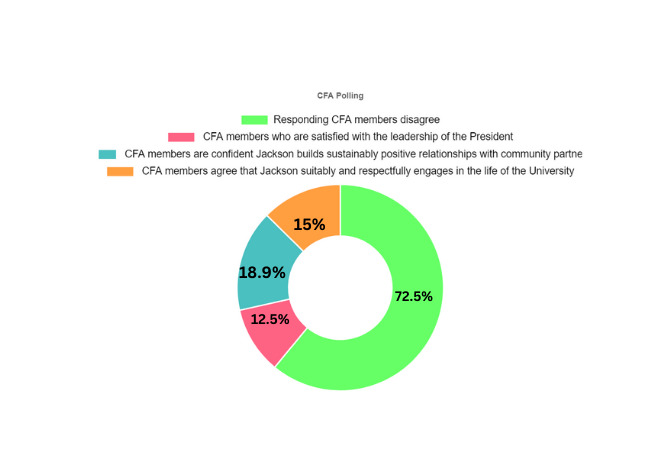
    CFA Polling from May of this year shows that 72.5% of responding CFA members disagree that “President Jackson keeps me well informed about important faculty issues.” Only 12.5% are satisfied with the leadership of the President. Only 18.9% have confidence that Jackson builds sustainably positive relationships with community partners. 15% agree that Jackson suitably and respectfully engages in the life of the University.

    Jackson still has yet to meet with the CFA in any capacity.

    “Every prior President has met with us. Prior presidents have come into our department to just introduce themselves,” said Silvaggio. “He’s continually failed in his role as a leader. Time and time again. Again, what kind of leader refuses to meet with his employees and his students?”

    Jackson’s unwillingness to meet with the CFA is representative of his complete absence of dialogue across the board. One of Jackson’s most important and sensitive considerations through the Polytechnic growth is the effect growth will have on the tight knit community of Arcata. Though, here again, apparently Jackson has decided to bury his head in the sand cut off communications.

    “He said to me that he has basically given up on working with the actual community of Arcata. There’s really no relationship between Cal Poly Humboldt and the town of Arcata,” said Sam Parker, Associated Students President. “The focus is more on other places like Eureka and stuff because he said that Arcata tends to have kind of that, ‘not in my backyard attitude,’ to the development. So he’s kind of given up on trying to form ties with them,” Parker said. “That’s somewhat of a recurring theme. Just kind of giving up on communication.

    Jackson’s unwillingness to speak extends to the media as well, and not just The Lumberjack – though this semester we have submitted more interview requests than any other local publication. The current tally of interview requests from The Lumberjack stands at 27. Jackson never responded in any capacity to my interview requests. The North Coast Journal has not interviewed Jackson since his very first days on the job. The same is true for the Lost Coast Outpost. The Times Standard provides Jackson a column every other week, but similarly does not have a reliable avenue for access to Jackson, according to Times Standard Managing Editor, Ruth Schneider.

    Among Jackson’s most glaring failures as a leader is the palpable fear that the campus community has in speaking out against him, in any capacity. In writing this story, many folks who I interviewed spoke of a fear of being reprimanded for voicing their concerns. 

    “Rather than think creatively, like a 21st century leader, he just decides to stick his head in the sand like authoritarian rulers do and just, you know, externalize the problems to the larger community. It’s frankly embarrassing,” said Silvaggio.


  • Consuming news safely

    Consuming news safely

    Sorting through the mainstream, and now local media

    When you turn on your local news TV station, you expect a solid mix of local and national news, and a variety of messages between stations.

    The news coverage from one area to the next will differ based on location.

    What you don’t expect is to be able to watch hundreds of news anchors, ironically reading the same script, on hundreds of different channels, about the importance of varied news sources and supported communities, like the companies owned by Sinclair Broadcast Group.

    Recognizing and understanding how to sort through the news, and have a well-rounded idea of what is happening, is important to processing the information you consume. Here are two important parts of journalism and fake news you should understand when consuming information.

    Understanding journalism objectivity

    Before diving into how to fact check and navigate the media, it is important to understand that objective journalism is incredibly hard, if not impossible, to achieve.

    People are inherently biased and influenced by the world around them. Journalists do their best, however, to inform the public, simply for the sake of the public.

    However, it is equally as important to understand that when it comes specifically to the news facet of journalism, journalists study, and are taught, to present the facts of a story from either side.

    This does not mean journalists agree with the information they have been given, but instead are presenting this information to the reader or viewer with as much objectivity as they can manage.

    The Society of Professional Journalists code of ethics is one of the most prominent professional ethics guidelines journalists follow, and sets the tone for what real journalism is supposed to be. These ethical principles exist to promote clear and concise reporting with four main facets: to seek the truth and report it, act independently, minimize harm and be accountable and transparent.

    For example, mainstream media outlets being owned by giant companies allows an argument to be made that these outlets are not independent, though they should work this way.

    Consider the case of Sinclair pushing right-based opinions and scripts to their newscasters across multiple local news stations. Sinclair also released a video in an attempted act of transparency, trying to inform the public why this script was given out. Deadspin, who released the compiled video footage of news anchors reading from their script, also provides this video in order to provide more detail to their story. This style of reporting leans toward writer bias, and is a little less formal than other outlets.

    In order to rise above the many messages media on all formats is designed to present to you, start with skepticism, and then some careful consideration. Make sure you’re digesting factual information, as opposed to fake news or misinformation.

    There are websites that specifically try to sort through political fact and fiction like the website Politifact.com. Politifact aims to provide fact-checking based journalism with principles based on “independence, transparency and fairness through reporting and clear writing.”

    Fake news in itself could be considered an oxymoron. News must be factual to be news. However, as the word of the year, and the biggest threat to our democracy today, knowing when you’re being fooled is vital.

    Skepticism and careful consideration

    As declared watchdogs of those in power, and also those who abuse their power, journalism is easily considered to be shady. The idea that journalists are out to dig up dirt and expose powerful or public figures for joy is an easy mistaken thought process to fall into.

    When you hear something on the news you find to be negative or shocking, understand there are news determinants that allow journalists to consider what is noteworthy and important for the general public to know.

    We take it upon ourselves as journalists to study these determinants seriously and with practiced objectivity. Knowing trust in the media is at an all time low, we encourage you to refer to other news sources when this happens.

    Use your skepticism of what you’ve heard reported and consider other articles or broadcasts on the same subject. Different reporting might present different facts. Even after studying a variety of sources, you as a reader or viewer may only have a small piece of the picture still. We as journalists have also considered multiple sources before presenting information so we are not failing our public by reporting on rumors or false information.

    Some websites exist to make this easier for you, such as Media Bias/Fact Check. This website lists specific sites and news sources that are either politically left-biased, centralized, right-biased or left-center and right-center-biased. You can find a list of questionable sources here as well. If you see a source on this list, they may not be the most trustworthy news outlet to refer to.

    Politifact, an outlet centered around fact checking, provides a truth-o-meter that follows the specific decisions and promises of politicians by following their actions and reporting back to inform the public whether their actions align with their words.

    The sources provided here are merely suggestions and are not an end all to fact-checking sources.

    Practicing the ability to step outside your own bias and recognize that of some media outlets to compare and contrast information is important to democracy.

    Always double check where your information is coming from and who might be influencing the message.

  • “Iron Fist” Review

    “Iron Fist” Review

    By Danny Dunn

    “Iron Fist” is a good show with interesting plotlines and characters throughout the season, but does suffer from some pacing and visual issues. “Iron Fist” is the latest Marvel show on Netflix, following the character Danny Rand (Finn Jones) otherwise known as The Iron Fist.

    “Iron Fist” is the fourth installment of Marvel television shows on Netflix along with “Daredevil”, “Jessica Jones”, and “Luke Cage.” “Iron Fist” is the last Marvel Netflix show before the big team up of the four heroes called “The Defenders”.

    “Iron Fist” is written by Scott Buck and directed by John Dahl. While neither have worked on a Marvel show before, they both have many years of experience in television, and have collaborated on the show “Dexter”.

    While on a trip to China, the Rand family plane goes down somewhere in the Himalayas. After seeing both of his parents die in the plane crash, young Danny Rand is found by some monks that reside in the mystical city of K’un-Lun, where he is trained in martial arts and eventually is granted the power to summon the Iron Fist.

    After being presumed dead for the last 15 years, Danny returns home to New York City. He goes to Rand Enterprises to have meeting with Harold Meachum (David Wenham), to try and reclaim his company, but to Danny’s surprise Harold had died shortly after the Rand plane went down 15 years ago.

    Now Harold’s children and Danny’s childhood friends Ward Meachum (Tom Pelphrey) and his sister Joy (Jessica Stroup) run Rand enterprises. They are understandably skeptical of Danny, and do not believe he is the real Danny Rand.

    Danny also finds out that members of his sworn enemies criminal organization, known as The Hand, are not only in New York but have infiltrated Rand Enterprises.

    So now Danny must force his way back into Rand enterprises, while also protecting the company and the city from ‘The Hand’.

    One of Danny’s allies in his quest is Colleen Wing (Jessica Henwick). Colleen owns her own martial arts dojo in New York City, and allows Danny to stay at her dojo when he has nowhere else to turn.

    There are some outside characters and references to other Marvel shows.

    For instance, The Hand plays a central role in both “Daredevil” and “Iron Fist”. The Hand is a criminal organization that manufactures and distributes drugs, along with having highly skilled assassins.

    Jeri Hogarth (Carrie-Anne Moss) or ‘J-Money’ is a lawyer, who has a recurring role in Jessica Jones. Before becoming a lawyer Hogarth interned at Rand Enterprises, where she met a young Danny Rand, which leads Danny to seek out Hogarth to help him get control of his company again.

    Former nurse Claire Temple (Rosario Dawson) has now made an appearance in each of the four Marvel shows. She was introduced in “Daredevil” as a nurse for an injured Matt Murdock. In “Jessica Jones” Claire is brought in by Jessica to help an injured Luke Cage. This leads to Claire making an appearance in “Luke Cage” as a love interest of Luke.

    In “Iron Fist” Claire joins Colleen Wing’s dojo to try and improve her martial arts skills. She also assists Danny and Colleen on a couple adventures throughout the season. Claire mentions to Danny that she knew somebody that had battled ‘The Hand’ in the past (Daredevil).

    Madame Gao (Wai Ching Ho) was also in Daredevil, as an associate of the crime boss Wilson Fisk. Gao has her own drug operation along with ties to ‘The Hand’ and presents a problem to Danny throughout the show.

    One of the main issues with the show is that some of the actual plot points took too much time to get going, and that it spends too much time dealing with Rand Enterprises issues and not Iron Fist action or superhero related issues.

    However, there are a lot of scenes in the first half of the series that have to do with Rand Enterprises, but they are presented in an interesting fashion. The struggle for Danny not only to prove that he is in fact Danny Rand, but also the struggle get back majority shareholder status in a company that his father created.

    There are a few times that a plotline was dragged out an episode or so longer than it needed to be. The scenes that were long were not terrible, they are just sometimes not really essential.

    There is also a need for more action throughout the show. There are only a handful of solid action scenes, but the overall story makes up for it. There are times that you can tell that it is not actually Finn Jones doing his own stunts.

    Speaking of Finn Jones (Danny), his acting is kind of bland throughout the season, it is hard to tell whether it is the writing or his acting.  For instance, there is a scene where Danny is supposed to be furious with Ward and Joy when they are still trying to keep him out of the company. Danny makes a scene and throws plates and glasses, but his overall demeanor did not seem angry at all.

    In scenes where he is not fighting, which is the majority of the show, he does not show enough charisma on screen, and that is something that is essential if there is not going to be a lot of action in the show. “Jessica Jones” is a perfect example of little action, but it is entertaining throughout, because the characters are interesting.

    That is not to say there is no interesting characters in “Iron Fist”. Jessica Henwick nails her role as Colleen Wing. She is easily the most likable character in the series, and when she is on screen she steals the scene. There are a few cage match fights she is in that are unrealistic, but that is not really her fault. It is not a stunt double issue, it is more of a six foot 300 pound guy getting his butt kicked by five and a half foot 115 pound Colleen. It is awesome to watch her fight scenes, a couple in particular in the back half of the season that really show how skilled she is in martial arts.

    Despite the show suffering from pacing and visual issues, it makes up for it with an interesting plotline and deep and well thought out characters throughout the season. “Iron Fist” is a solid show to watch for anyone out there looking for a nice binge on Netflix, and the show is a four out of five stars.

  •  Attempts at a ‘Fake’ out

     Attempts at a ‘Fake’ out

    The new administration feuds with the media

    By| Domanique Crawford 


    You know Larry, right?
    Larry is the man you decide to take a chance on even though his past is sketchy. Larry says he respects woman but cheats on every woman he’s had a relationship with. Larry says he’s not racist but all immigrants are criminals here to steal jobs from hard-working Americans. Larry professes to be one of those hardworking Americans, and yet he’s never worked a hard day in his life. You don’t believe Larry but he sings his own praises with such frequency that you compare his actions to his words and find him lacking. You begin to question Larry. So Larry decides to break it off and tell everyone that you are just a crazy ex-girlfriend.
    President Donald J. Trump is the news media’s Larry except, this Larry is the Head of State, chief executive, and the legislative leader. 

    Every president’s approach in how they try to handle the media is unique. However, there has never been such a determined effort from the white house to discredit news organizations.
    Delegitimizing the media doesn’t stop the watchers from watching. It just makes us more suspicious. The media is considered the watchdog of the government and a tool to keep the public informed. The new administration’s consistent and unwarranted assaults on the media just make journalist more motivated to fact check every accusation they make and encourages the people to be more vigilant in watching both the press and the white house alike. 
    The new administration’s ploy is to make the media outlets that don’t favor them just another crazy ex- girlfriend, to discredit them in having some kind of crazy conspiracy to sabotage the president. 

    The media outlets that don’t fall in line with promoting the new administration’s agenda is classified as fake. The Media’s job is to report fairly and accurately on the facts. 
    Fake news used to be defined as purposely distributing knowingly false information. However, with every appearance of the Trump administration the term “fake news” is any negative news coverage on the presidency and the new administration. 
    The term is thrown around casually in a deliberate attempt to confuse the public. However, it is not the word of the media that has to be constantly checked for propagating false information. 

    From day one with his proclamations of the biggest inauguration crowds ever, to Kellyanne Conway’s criticisms of poor reporting on the non-existent Bowling Green Massacre, Trump and his administration contradict themselves on a regular basis.
    Larry may be able to confuse his short circle of friends that is dazzled by his performance but he is not able to hide the facts- alternative or otherwise. 

  • Announcing the 89th Academy Awards

    Announcing the 89th Academy Awards

    The nominees for the 89th Academy Awards have been released. There are nine titles nominated for the Best Picture category.

    The Best Picture nominees are strong this year, including “Hacksaw Ridge”, a movie about a WWII US army medic, and “Hidden Figures”, a historic drama about the African American female mathematicians that put astronaut John Glenn into space. Other nominated films include “Moonlight”, a unique coming of age story, and there is possibility of a modern day musical, titled “La La Land”,  winning best picture.

    “La La Land” has 14 nominations, tying with “All About Eve” and “Titanic” for the record of the most Oscar nominations. It has two nominations in the category for Best Original Song.

    This year, “Arrival” and “Moonlight” both have eight nominations. Both are unique films in their own respect. “Arrival” is an intelligent sci-fi film about communicating, not fighting, with aliens. While “Moonlight” follows the journey of a young African American individual. The movie shows emotions with subtlety and compassion.

    A few of these oscar nominated films are still in theatres. You can catch them while they’re still playing. If you missed any of these films on the big screen, Richard’s Goat Tavern is featuring several nominated films in their miniplex.

  • Q&A with “Bread Talk’s” Sandwich Kid

    Q&A with “Bread Talk’s” Sandwich Kid

    By|Bryan Donoghue

    Albert Bernales in the studio to record a Bread Talk.

    Sandwiched between school and life, Albert Bernales makes time to record podcast’s on his talk show called “Bread Talk”. Topics range anywhere from  food to money, encompassing the word “bread”. Before the interview, Bernales, the host of Bread Talk, sat me down and made me a grilled cheese sandwich with my favorite type of bread, sweet Hawaiian rolls. Bernales made “Bread Talk” because he wanted to create a show of his own. Using it as a creative outlet, his voice now goes out to the Humboldt community.

    Q: To start us off, what’s your name and major?

    A: My name is Albert Bernales, my alias for Bread Talks is “Sandwich Kid”. I’m a business major with an economics minor.

    Q: What’s your favorite type of bread and why?

    A: It would probably be sourdough, because as you dip it in soups, it tastes really good. Not all things are going to be sweet, there will be some sour things that will happen. I think sourdough represents life.

    Q: So you could be the “Sourdough Sandwich Kid”. Why did you decide to make a podcast and call it “Bread Talk”?

    A: I decided to make a podcast just for fun. I was listening to people like Jimmy Fallon and all those late night talk shows. They kind of inspired me, because they’re just talking to somebody, but it’s still really fun and interesting. That’s one reason why, and as soon as I started listening to podcasts, I realized “this is pretty easy, I can do this”. I called it Bread Talks because it grabs your attention. I’m pretty interested in business, but it lets me talk about other things. I can just pull up some articles I’m interested in and talk about them.

    Q: What is Bread Talk? Do you talk about bread, money, or everything in between?

    A: Definitely about all things bread, like the physical bread we have here, this sweet Hawaiian bread. It also goes into money, that’s where the business aspect of this podcast comes in. A lot of rappers inspired me, like E-40. He said, “I choose to get money, I’m stuck to this bread,” in his song “Choices”. Definitely talk about the rap culture and community, since they tend to rap about money, and stuff, like bread. But there’s definitely another meaning, such as bread as in food, because I love food and cooking as well.

    Q: Food and money seem to be two universally appreciated topics. Everyone wants to talk about,  and listen into both of these subjects. In your fifth podcast, one topic you were talking about was the change in iPhone headphones from the iPhone 6 to the iPhone 7, and how that’s affecting people today. Which subject does that fall under?

    A: That’s pretty business related. They took a risk in their products, and I think people need to take more bold risks. It’s really appreciated for when they take those risks. It takes a lot of guts to do that.

    Q: Where do you record?

    A: First time we recorded in an actual studio in Gist Hall, but for the second and third time we got a headphone microphone that comes with the iPhone and put it on top of an empty water bottle, and spoke into the bottle. We literally had no options for episode 2-4. You can hear the difference on Soundcloud, it’s either really loud and clear, or not.

    Q: Is Soundcloud the main media outlet you use to put out your podcasts?

    A: Yeah, definitely, it’s the first thing that popped up to me, and it’s a great way to get your voice out there.

    Q: And Bread Talk is a continuing series. You have your own following of listeners.

    A: Definitely always shout out to the listeners, we love them. We at Bread Talk definitely have come a long way, from a recording standpoint, from iPhone microphones, to studio microphones, and I now record on the library microphone. So, shout out to the digital media lab too. They have all the snowball microphones I use. I can just plug it into the computer and record a podcast whenever I need to.

    Q: When does the new Bread Talk come out?

    A: It was originally supposed to come out every single week, but we were really busy, so it eventually became every month. Then every month became every couple of months. But I have extra podcasts stored on my laptop, I just have to add the intro music and I’ll be able to upload it. For the show, I made the intro music Entertainment Tonight, but on a keyboard.

    Q: You still have a few episodes in a storage vault, but they’re ready to come out?

    A: We have number 2, but that’s a lost episode, since we don’t know where to find it. It was on my friends flash drive but I didn’t get the file. But since it’s a lost episode, let the idea of it marinate in your mind for how good it’s going to be. This is a comedy type of show, you know. It is super spontaneous, you don’t know what’s going to happen. I don’t even know what’s going to happen in the next Bread Talk.

    Q: It’s really interesting that you decided to take that approach.

    A: I have an article here to highlight the next Bread Talk actually. Here’s the teaser, it’s about a “master pickle tester.” Basically, there’s a person who eats pickles for a living to determine the quality. That’s the article that I chose to talk about in the next podcast.

    Q: You have plenty of guests on your show, but in terms of subject matter, is it just being spontaneous? How do you prepare before for what questions you’d want to ask?

    A: Definitely, in my head, I find an interesting topic. So I go on the internet, and find a couple of articles that are interesting. We’ll talk about it, and do an analysis on that article. For the questions that I ask, they’re typically solid but typically the same through every episode. And at the end, I have quick fire questions, where it’s like fill in the blank. I switch those up every single episode.

    Q: I noticed you have your Bread Talks listed by number, but some are also categorized by words, how do you come up with these?

    A: They are the focus, and central theme of each episode. Like the one that’s under “ninja—no income, no job”, that originated from a friend of mine who works on these with me. He had a finance class, and ninja was a term they discussed. So I asked if he just wanted to leave it as Bread Talk Number 5, and he said to add ninja.

    Q: Ninjas and economics together, that’s an unusual combination. Do you know what ninja means?

    A: Ninja pretty much means no job, or no assets. So pretty much if you don’t have any money, you won’t have a job or anything valuable. And vise versa.

    Q: You have a sandwich, or just any meal that involves bread with your guests before or during an interview. For my last question, a spontaneous one on my part, why do you eat with your guests along with the bread talk?

    A: Well I try to always have bread. This is Bread Talk after all. You’re going to want some bread, and eat it with your guests. That’s a true Bread Talk.

  • Jacked up

    Jacked up

    Losing Headphones and the Headphone Jack

    By | Liam Olson

    Graphic by Joe DeVoogd

    Headphones are an essential for every college student, and it is the worst when you lose them. Without them, you would not be able to listen to music while doing your homework or watch a video without annoying the people next to you.

    You could leave them at home to only forget where they are or leave them at the library on accident.

    But you’re not alone, many others lose their headphones all the time.

    Library Circulation and Student Assistant Sineva Hosea, is an environmental science major in her junior year. She finds lost objects all the time around the library while she is working, but headphones seem to be the most common.

    Earlier in the week, she even found a pair of earbuds along with the iphone that they were attached to. Luckily, the owner was able to retrieve their phone and earbuds from the lost and found. But others are not so lucky and have to go buy a new pair of earbuds. “Some don’t get returned, but when I do my rounds, I mostly find earphones,” said Hosea.

    In the near future, wired earbuds and headphones could be a thing of the past. Apple removed the standard 3.5mm headphone jack on the iPhone 7 and soon other companies, such as Samsung, may follow this model.

    This change forces customers to switch to small, wireless earbuds. The new design could lead to more earbuds getting lost since there are no wires to keep it from slipping out of your pocket.

    When asked about this new design, students are not fond of the idea that would have to change to wireless earbuds and headphones.

    Brittany Heller, an international studies major in her senior year, is used to the normal wired earbuds. She finds that it is easier to keep track of wired earbuds over wireless earbuds since the wires help her hold on to her earbuds so she would not lose them.

    “I wouldn’t know where to put them,” she said.

    Amber Norwood, a zoology major in her junior year, keeps track of her earbuds, but her friends seem to lose theirs often. She says they have to go buy new a new pair about every month. She thinks that  wireless earbuds would be easier to lose with their small design. It would also become expensive to replace them often.

    The thought of having two separate earbuds makes you appreciate how they have always been connected by a wire, so that one earbud is never lost. “It would suck to lose one and still have the other,” Norwood said.

  • A “Taboo” to talk about

    A “Taboo” to talk about

    By | Liam Olson

    First impressions are important when it comes to a new television series. “Taboo” is a new program produced by FX and BBC One that gives a great first impressions in their first episode, “Shovels and Keys.” The episode is an introduction to different portions of the plot and the characters give the viewer many reasons to keep watching.

    The first episode of “Taboo” aired on FX on Tuesday, Jan. 10. Kristoffer Nyholm directed “Shovels and Keys” and Steven Knight wrote the script for the show. Knight worked with actor Tom Hardy and his father, Edward “Chips” Hardy, to create the script.

    Right from the start of the show, there is an eerie and dark tone. The show opens with James Delaney, played by Tom Hardy, riding in on a horse through the rain in order to bury an object in the middle of nowhere. This is just the start to the mysteries this show contains.

    The plot of the episode is complex with the various parts of the overall story being introduced. However, the base of the story is that James Delaney returns to London in 1814 after the death of his father, who left him a piece of land called the Nootka Sound. James had been presumed dead for more than 10 years but was actually in Africa for unknown reasons. James must navigate through the cutthroat business world of London to run his father’s shipping company and protect the Nootka Sound from his half-sister’s husband and the East India Company.

    The snippets of each part of the story is what makes the viewer even more enticed to find out answers to the questions this episode creates. What did James do in Africa for 10 years that gave him supernatural abilities? What is the importance of the Nootka Sound? To what extent will the East India Company go to take Nootka Sound from James? These are just some of the questions created by “Skulls and Keys.”

    One major point of the show worth mentioning is the relationships that James Delaney has with other characters. Throughout the episode, James finds himself face-to-face with old friends and acquaintances, as well as enemies old and new.

    With characters such as the loyal family servant, Brace, played by David Hyman; James’s half-sister Zilphia, played by Oona Chaplin; and the ruthless East India Company Chairman, Sir Stuart Strange, played by Jonathan Price; this diverse cast of characters will play essential parts in the story of James Delaney.

    Since a majority of the first episode was introductions, there was not enough screen time  to give a fair review of the actors’ performances, except for Tom Hardy. Hardy gave an excellent performance as James Delaney. He perfectly captured the brutal, composed and mentally unstable characterization of James. With his portrayal, he effortlessly went through scenes as though he was the character himself.

    “Shovels and Keys” is a slow but great start to “Taboo,” with the introductions out of the way. Viewers will want to dig deeper into the many mysteries and characters “Taboo” has to offer.

  • Why Netflix Might Just Edge Out Hulu with their New Original Series

    Why Netflix Might Just Edge Out Hulu with their New Original Series

    By: Erin Chessin

    It is a combination of mystery, adventure and that ‘80s nostalgia all in one – we’ve never seen anything quite like “Stranger Things.” Netflix is rising to the top as a contender for who can make the most addictive original series. It is impossible to not get hooked on at least one of the many original series they have spit out recently. I would call “Stranger Things” a mix between Stephen King and Steven Spielberg; you get that perfection combination of ‘80s sci-fi and horror.

    The story starts off with a missing boy named Will Byers, and the audience thinks, “oh great another cheesy ‘80s horror series.” But then you have Byers’ mother, brother, three best friends and the police chief involved, who end up discovering more than they wanted to know about what is out there in the world. You fear the head of the Hawkins Laboratory, who is conducting inhumane practices in efforts to stop the horrific monster they allowed to exist.

    There are unexplainable tragic events, people going missing, lights flickering and dark elements – it’s quite the adventure three little kids go on. We have Dustin, nicknamed Toothless, who strikes his audience as geeky and innocent. Mike might have to be everyone’s favorite, just because he is probably the most compassionate of all the characters on the show. Lucas has to be that voice of caution, warning his friends of the dangers they could be accidentally getting involved in.

    In their small town of Hawkins, Ind., everyone knows everyone. It is a matter of all the characters figuring out how all the strange things that have occurred are connected; and better yet, why they are even happening.

    There is no doubt that I give this new television series a glowing review; I mean, it has to be one of the most compelling series that Netflix has created. However, those who have never seen “The Shining” or are simply not into entertainment that haunts you, the storyline might not be as intriguing to you as it is to that sci-fi/horror genre fanatic. “Stranger Things” is perfect for those popcorn and warm blanket nights. It is enough to give you a scare and provoke that sense of fear in you that you haven’t grasped since you last watched “The Shining.”

  • A good start to “A Series of Unfortunate Events”

    A good start to “A Series of Unfortunate Events”

    By: Liam Olson

    “A Series of Unfortunate Events, The Bad Beginning: Parts 1 and 2” are definitely a good start to the new Netflix series. From the wide variety of different characters to the beautiful sets of these episodes, “The Bad Beginning” definitely will make the viewer not want to look away from the rest of the season.

    The first season of the show was added to Netflix on Friday, Jan. 13. Barry Sonnenfeld directs “The Bad Beginning” and Daniel Handler (who plays Lemony Snicket) adapted the books for television.

    The adaptation stays true to the book, however, some plot points that make the book more dramatic are replaced for comical scenes. To a person who read the book series, this may be disappointing, but for those who have not, it is enjoyable.

    In order to make the show more lighthearted, comical tropes were added such as defining vocabulary words to explaining the difference between literally and figuratively. Although these pauses are fun, they become more excessively used as the show goes on and create unnecessary pauses in the plot.

    Most of the plot follows the books with the Baudelaire children, played by Malina Weissman (Violet), Louis Hynes (Klaus) and Presley Smith (Sunny), escaping the grasps of Count Olaf, played by Neil Patrick Harris, who wants their parents’ fortune.

    With the extra time the show had due to each books being split up into two parts, plot that was never mentioned by the books is explained in the show, making it more interesting for fans of the book series.

    As far as the acting goes, a majority of the actors do well. Patrick Warburton gives an amazing performance as the solemn narrator, Lemony Snicket, for the story of the Baudelaire children. K. Todd Freeman’s performance as Mr. Poe seems to be the weakest of the main characters. Much of his acting makes the character feel fake and unbelievable, and the coughing gag for Mr. Poe becomes excessive over time.

    Weissman and Hynes do well as Violet and Klaus Baudelaire; they perfectly capture the clever and sincere personalities of the characters. However, they do sometimes fall flat in their interactions with Neil Patrick Harris’s Count Olaf often looking lost on how to respond to him. Harris’s performance as Count Olaf gives a humorous take on the character compared to Jim Carrey’s darker version of Olaf in the 2004 film. Although Harris’s Count Olaf is not very intimidating as a villain, he does make up for it in his outrageous and entertaining antics on screen, though they sometimes drown out the other characters who struggle to react to his strong personality and actions.

    One of the most prominent elements worth mentioning in the show are the set designs. There is a wide variety of set designs from the dark and dreary mansion of Count Olaf, to the peaceful and colorful house and library of Justice Strauss. All the different locations in the show add to the overall atmosphere to the scenes.

    “The Bad Beginning: Parts 1 and 2” are good starting points for “A Series of Unfortunate Events.” While there were a few issues with the first two episodes, the series shows promise. Viewers will want to keeping looking to see what happens next in “A Series of Unfortunate Events.”