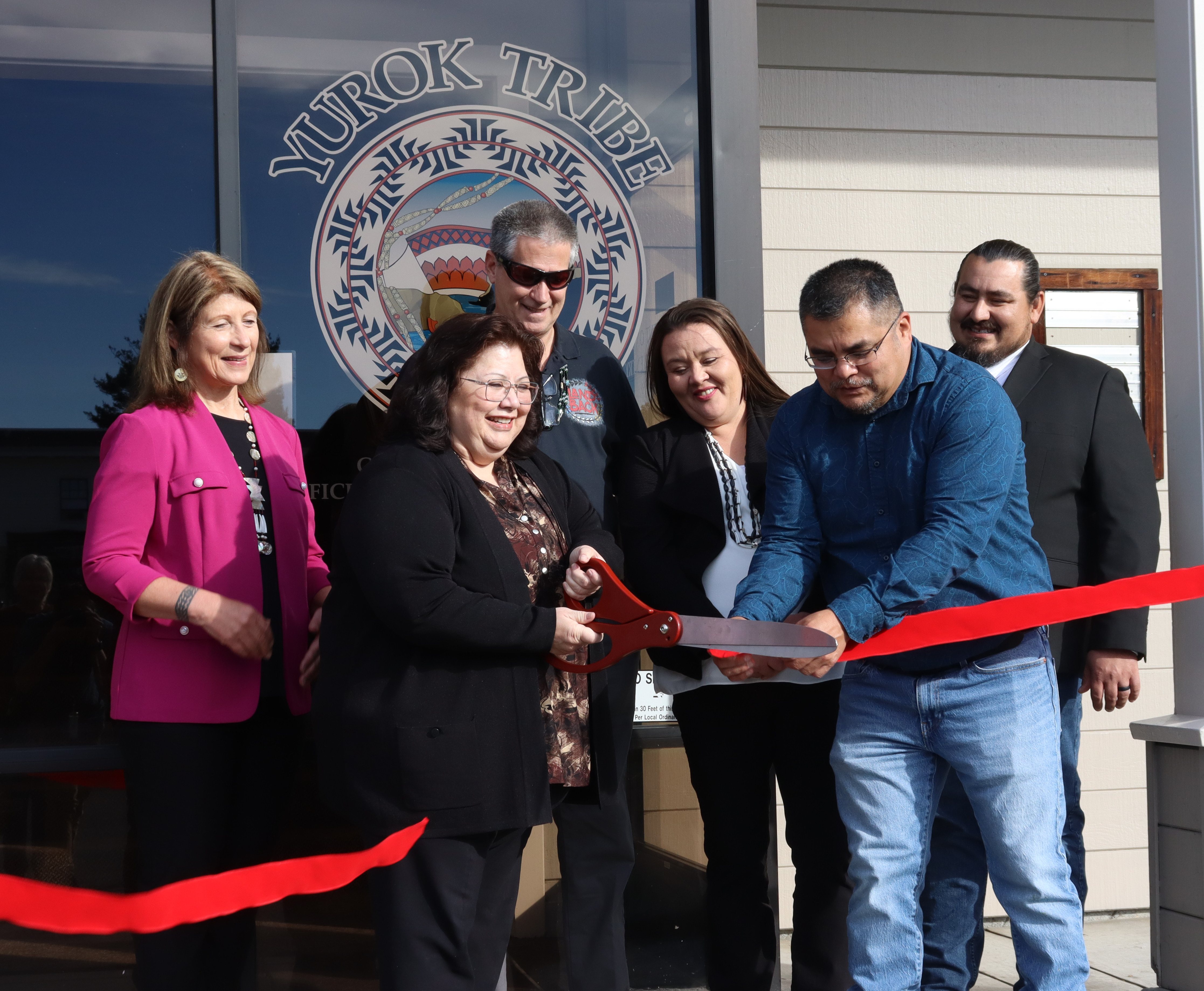
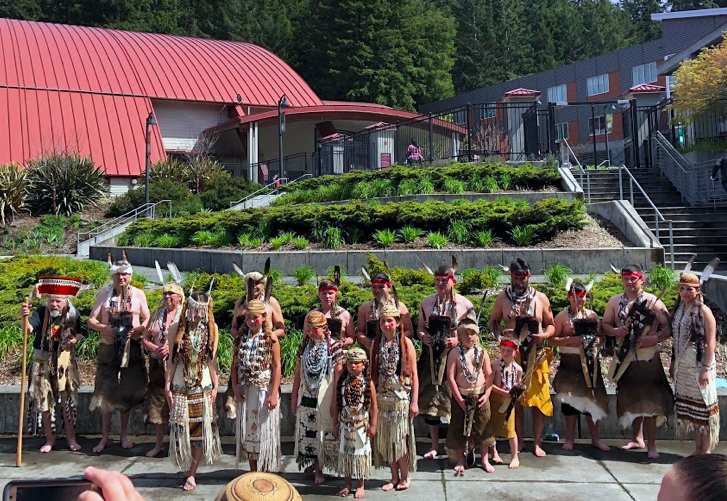
On the first day of November on a pleasantly warm sunny afternoon at the edges of Old Town in Eureka, members of the Yurok Tribal Council gathered in front of their office building at 930 Third Street, Eureka. The council smiled as they cut the big red ribbon to signify the grand opening of their new office space for the Yurok’s court services. The new building houses a meeting place for the council within the South District. Eureka is located in what is known as the South District for the Yurok tribe.
Among other duties, the council is responsible for managing the ancestral lands of the Yurok that they are in direct control of, as well as managing the salaries of tribal personnel.
Lana McCovey is the council member of ten years who oversees the South District (and held the large scissors to cut the ribbon). McCovey was ecstatic about the opening of the space as now employees and residents can be closer to court services.
“What we found is that there’s a large amount of employees and members down in this area,” McCovey said. “We found it necessary to accommodate them. People from [the South District], to do normal, everyday business, would have to drive to [Klamath] to get that done. So we want to be able to offer [tribal court services in Eureka] also.”
This is the second office that the Yurok holds in Eureka; however, the 930 Third Street address focuses on court services. One service that the office will provide are diversion programs Court services that the Yurok offer in the space focus on supporting at-risk youth and elders, supporting victims of crimes such as domestic violence, probationary services, visitation services, foster services, and more. Space for council operations and an office for the tribal prosecutor also reside at the new address.
The Yurok staff that occupy the new building have found the space to increase their productivity in a number of ways. Besides the new office being able to support individuals in Yurok’s South District, Court Director at the Yurok Tribe Jessica Carter notes the building is only blocks away from Humboldt County’s courthouse.
“We can walk and get coffee and food,” said Carter, “And we can go to the jail if we have to file something or go visit our clients. Definitely accessible.”
COVID-19 played an important role in the development of the office building, as it was paid for thanks to the CARES Act during the pandemic. The tribe acquired the building in 2020. After renovations, the court services began to steadily move their court services away from their previous location, the Aawok Bonnie Green Site. The former site was located at Worthington Elementary School, and the office there was a portable classroom. The Yurok are now able to house many of the employees hired during COVID, who now need an in-person desk to work at.
“You can hire all the people you want for the job,” said McCovey, “but if you don’t have the space for them, then what’s the point?”
The new office space is much larger than the previous location. Now that many of the court services within the Yurok court system have their own suite within the office space, communication has become more efficient. The Yurok Tribal Child Support Services (YTCSS) staff enjoy the opportunities for more efficient and safe communication with each other now that each program has its own suite to chat amongst themselves.
The YTCSS staff is happier now that each court program has their own defined space within the new building. Each department has increased confidentiality thanks to the privacy and are able to speak to each other about cases rather than needing to communicate through emails.
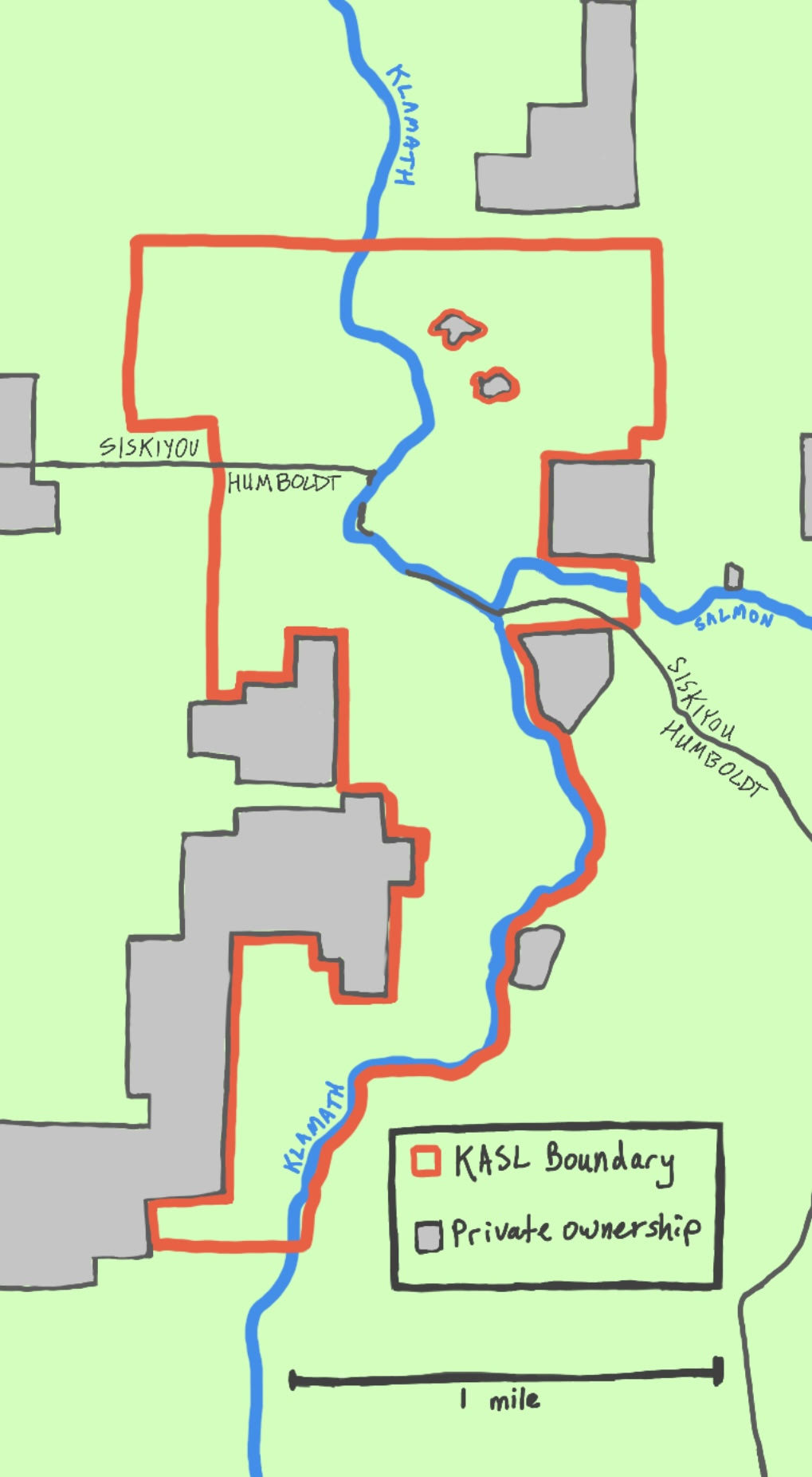
On Thursday, Jan. 5 the Karuk Tribe’s Katimiîn and Ameekyáaraam Sacred Lands (KASL) Act was signed into law, reestablishing the Karuk Tribe as the steward of about 1,000 acres of public land in Humboldt and Siskiyou counties.
The Karuk Tribe’s ancestral lands encompass over 1.48 million acres of Northern California and Southern Oregon. Currently, 95 percent of this territory is occupied by the United States Forest Service. This has resulted in the curtailing of Karuk cultural practices and traditions. Until now, Karuk people have had to request access through a Special Use Permit to perform ceremonies on their sacred lands. Even so, their private ceremonies have been interrupted by individuals passing through the sacred areas on days of listed closure. Under the new legislation, the Karuk Tribe will have uninterrupted land access to hold their ceremonies.
The land returned Jan. 5 includes many sacred sites. Á’uuyich, a mountain at the confluence of the Salmon and Klamath rivers, is the center of the world for the Karuk people. The Act’s namesakes, Katimiîn and Ameekyáaraam, are also sites of celebration and worship. The historic village of Katimiîn is the site of the Tribe’s world renewal ceremony, and Ameekyáaraam is where multiple sacred dances continue to be performed as they have been for time immemorial.
“We never again have to fight federal and state agencies for the right to hold our sacred ceremonies without disturbance at Katimiîn and Ameekyáaraam,” Karuk Executive Director Josh Saxon said in a Jan. 6 press release. “Returning our center of the world protects our inherent responsibility to pass Karuk culture and customs down to the next generation.”
A great, warm sense of community filled the Eureka Theater during the Da’Luk Native Film Showcase on Saturday. Native American youth, their families and community members gathered to watch short films on Indigenous life in Humboldt, produced by participants in the Voices From the Center and Weaving Culture into Wellness short film projects. These set out to document Native American people’s experiences and ways they found meaning and health by giving them the tools and assistance to set them to video.
The critically-acclaimed 2022 short documentary “Long Line of Ladies” was also shown. It follows one Humboldt County family’s revitalization of the Karuk Ihuk ceremony, a traditional rite of passage for young women that had not been practiced in generations.
Da’Luk Youth Program Coordinator Vincent Feliz opened the event with information about how the program serves Indigenous youth. This division of the Northern California Indian Development Council (NCIDC) focuses on engaging youth with culturally rooted lessons and activities in Humboldt and Del Norte counties.
Da’Luk means ‘words and talking’ in Wiyot, a meaning that Feliz feels speaks to the ultimate purpose of the program: to connect youth to each other and ready them to participate in their community.
The NCIDC offers mental health, anti-discrimination, and educational support to Indigenous youth, and has recently completed several mural projects in Eureka and Arcata.
At the film showcase, community member Julian Lang also spoke about how language can build community.
“Look for your language, that’s really important to understanding who you are as a human being; who you are as a tribe, a group, a village,” Lang said. “Not to heal but to reconnect your brain…your soul to where it’s supposed to be connected.”
Lang then performed an opening song/prayer for the event, which he encouraged others to sing along to if they knew the words. The final descending note rang off the high ceilings with many voices.
The Voices from the Center film project focused on native youth and elders as the subjects, consisting of many short films ranging from one minute to around five.
One film documented the experience of building a Yurok plank house, including the healing experience of residing in a traditional Indigenous space. A brief film taught viewers to count to ten in Karuck, using acorns as visuals, while another film explored one woman’s passion for making and wearing regalia, such as bark skirts and deer-skin dresses.
COVID-19 isolation gave one of the filmmakers, Celinda Gonzales, more time to engage in traditional practices such as beadwork. Her film compares the strength and resilience of her community with how new plants grow out of the burn scar of wildfires.
“You see these flowers, the trees coming back, the grasses coming back, you see beauty in the midst of that,” said Gonzales. “With COVID, even though we were all separated out, there was still beauty in that…I had more time at home, I was weaving more, talking to family more.”
Robbie Lara’s film was about her connection with the plants in the garden she cultivates, and her realization that plants have souls like any other creature. She spoke of her gratitude to the plants for nourishing her and encouraged the audience to keep gardens.
“It came to me that while I’m passing by all these trees and all this greenery, why can’t I give that my attention,” Lara said. “What I hope that the video does is help you have a relationship with the plant world.”
A second collection of short films was shown, produced by the United Indian Health Services’ Weaving Culture into Wellness project. Facilitator Jude Marshall said he started the project after traditional cultural practices improved his health. It was made possible with funding from UIHS and from the Rural Indian Health Board’s program to reduce chronic diseases in Native communities.
Ernie Albers Jr. starred in a film about the gym that he runs, Lifted Arcata. He described his ‘human-specific’ approach to working out. This means incorporating postures and motions which he said mirror those used in traditional lifestyles.
Another film in this collection focused on food sovereignty. Liz Lewis shows the process of making salmon head soup, and speaks on the role of food in reclaiming one’s culture. She uses salmon fished locally by Native people and peppers from the UIHS’ Potawot Community Garden.
“Not everyone may be able to do all the practices that we used to do, but cooking is a great way to be connected [to your culture,]” Lewis said.
In Willard Carlson’s film, he recounts his experiences fighting for river access and fishing rights in the 70s.
“We never ever want to give up our cultural identity and where we came from,” Carlson said. “I feel good, optimistic about our future…coming into this inheritance is very special.”
These documentaries eloquently showed how deeply supportive and connected the community around their production was through food, song, and stories.
Daniel Aipa, the Native Hawaiian producer of the Weaving Culture into Wellness films, believes in the power of spreading Indigenous stories.
“When you tell one story …it becomes 50 or 100 different stories, depending on what you take from it,” Aipa said. “And that’s Native culture. Our oral history is everything to us.”
“Long Line of Ladies” was shown next, following the Allen family, their spiritual family, and their preparations for Ahtyirahm “Ahty” Allen’s Ihuk coming of age ceremony. The Ihuk is performed for Karuk young women once they have their first period, and was revived in 1995 after a long dormancy.
“There’s points [in life] where we all come together, and that’s something that Native people have lost,” said Pimm Tripp-Allen. “This is the kind of thing that we’re supposed to be doing for our young people.”
The family lives in McKinleyville, and many scenes are set in familiar Humboldt locations, such as the walking path across the Mad River trestle bridge. The documentary has been shown at Sundance, SXSW, and other film festivals. It is available to stream through the end of November on New York Times Op Docs, a platform for independent short films.
The family felt at ease among the home crowd attendees, and opened up about funny and personal experiences they’d had during production.
“We’re talking to you guys a little different than we talk to other communities,” said Alme Allen. “Because we’re back home, and you’re our people.”
Over a century ago, two young women hid in the vegetation alongside the bay waters surrounding the small island of Tuluwat. Lying just off the coast of Eureka, Tuluwat is also known as Jaroujiji in Soulatluk, the language of the Wiyot Tribe. Those women’s English names were Matilda James and Nancy Spear. They were two of the few survivors of the Feb. 26, 1860 Wiyot Massacre. The massacre took place the night of the tribe’s most sacred of holy days, the World Renewal ceremony. Over 200 Wiyot people died that night at the hands of white Humboldt settlers. Nancy Spear and her sister Matilda James are my ancestors. I am a descendant of the Wiyot people, and yet I’m also white and thus experience white privilege.
When my mother was little, my grandpa would often take her to the local powwows here in Humboldt. My grandpa is a registered member of the Wiyot Tribe and carries within him the history of our family’s struggles – a long history of generational trauma, mental illness, and alcoholism.
My grandma, a non-Native person, was embarrassed to go to these events and cultural celebrations. She felt that because neither her husband nor children looked Native enough, they didn’t belong in that space. My mother and I grew up completely separated from that part of our family. Even today we are reluctant to reach back out to the tribe, not because we want government benefits or even full membership, but because we wish to gain what our family has lost – culture, history, heritage.
Eddie Carpenter, a fellow reporter at the Lumberjack and registered member of the Hoopa Tribe, has had similar difficulties as a white-assumed Native person. Carpenter prefers not to be labeled as white-passing due to the term’s colonial history.
“Despite being a tribal member I get mistaken a lot for being a white person,” Carpenter said. “As a child I kind of got bullied a little bit for being mistaken for that identity. Most of it was little microaggressions such as, ‘you don’t look native to me.’”
We do differ in some experiences, though. Unlike Carpenter, my grandpa and his sister are the only members of my family who still make the federal minimum “blood quantum.” Also unlike Carpenter, I didn’t get the opportunity to be raised within my culture.
“White-passing is an outdated term,” Carpenter said. “Because it is based on the ‘one drop rule’ of the Black/white binary categories within U.S. politics.”
There is a lot of debate within Native American communities on the usefulness of blood quantum minimums. Some believe it helps to deter white people with minimal Native ancestry from taking government benefits that they often don’t need, while others, like Carpenter and I, believe that it is a harmful colonial system that has historically erased – and continues to erase – the existence and power of Native people. However, there is no doubt that Carpenter and I experience significant privilege due to our perceived whiteness. This is a truth we do not deny, and one that we try to actively be aware of when in Native spaces.
“I do not self identify by colonial tools from imposed social structures that were used to conquer and divide my people from the inside out,” Carpenter said.
I don’t wish to take up space that is not mine to take. But I don’t wish to deny a history that my family has nor reject a people, the Wiyot people, that are part of me.
The experiences and connection that the Wiyot people have to this land is represented within my family. We are still healing from our generational trauma and we are still deeply in love with the land we now call Humboldt. In the years to come, my hope is to bring my family back into the community and to use my resources, connections and skills to give back to the tribe that gave me my mother, my grandfather, my great grandmother, and my life.
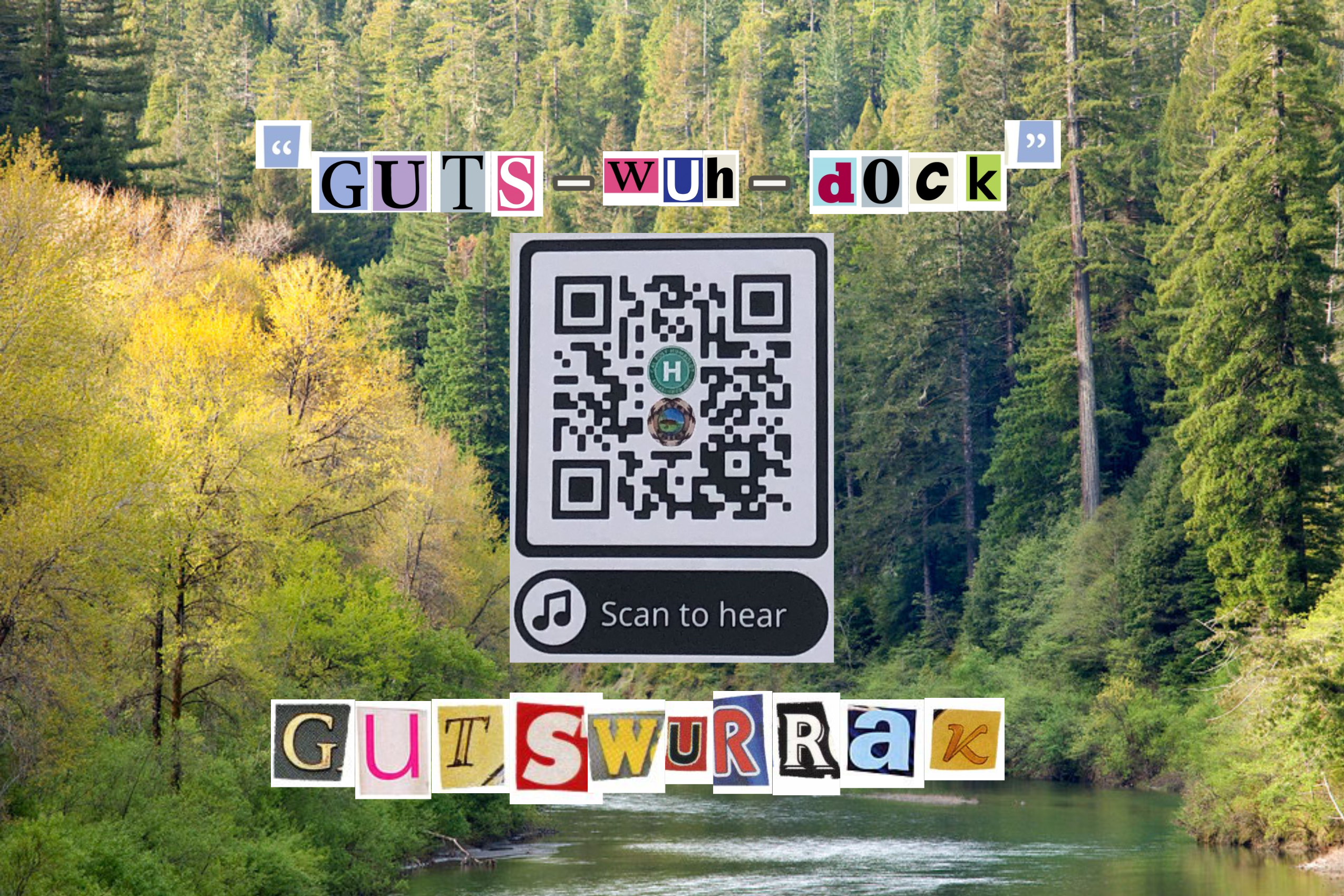
On Wednesday, April 20th, the University officially renamed the Student Activities Center to the Gutswurrak Student Activities Center in a ceremony at the building located by the UC quad. Pronounced “guts-wuh-dock”, it is the Wiyot word for “many people gather”. The name for the student union was originally suggested by the Wiyot Tribe, led by Wiyot Tribal Chair Ted Hernandez. He was also a guest speaker at the event, and he expressed his gratitude to the University and to the students, who pushed the renaming effort.
The event started right at noon, with opening remarks from Wendy Sotomayor, director of the SAC, and Micheal Moore Jr., associate director of the SAC, and the two read Humboldt’s new formal land acknowledgment. Working with the College of the Redwoods, Humboldt has developed the following land acknowledgment:
“We acknowledge that the land on which Cal Poly Humboldt is located in the unceded territory of the Wiyot people who continue to live and thrive today. It is surrounded by the traditional, ancestral, and present homelands of several indigenous nations including the Hupa, Karuk, Mattole, Tolowa, Wailaki, and Yurok that make up Humboldt County.”
Following the land acknowledgment, Vice President Jason Meriwether spoke about coming together with the local Native tribes, and on the importance of a name.
Ted Hernandez gave his remarks after Meriwether’s speech and welcomed students and staff members alike into his home. He offered his blessings to the building, not just to the students who came to the ceremony, but for all students in the future.
Adrianne Colegrove-Raymond, special assistant to President Jackson, unveiled a new special feature of the building, which is a QR code on the wall that links to a recording of Wiyot youth and adults pronouncing “gutswurrak”. Anyone who visits the SAC can now scan the QR code with their phone and hear the recording of the Wiyot word.
It was a relatively small ceremony, although, despite the small size of attendees in the SAC, the speakers definitely filled the room with their presence. The event was originally set to be held in the SAC quad, which might have increased the number of students that attended, but was moved indoors to the SAC West Lounge due to the rain. The ceremony only ran until about 12:30, as the speakers were done giving their presentations at that time. Students filtered through the small crowd like minnows, darting from space to space to grab a complimentary t-shirt and a handful of free food on their way out.
The renaming effort is part of Humboldt’s effort to bring Native histories to the forefront of the University, which has not been the case in the past. The University is attempting to build new bridges and improve their relationship with Native communities through community activities like the SAC renaming.
On a bright sunny Saturday morning, students, faculty, and local tribal peoples came together to celebrate the Rou Dalagurr Food Sovereignty Lab & Cultural Workspace at the Indigenous Foods Festival. The event was held on the Cal Poly Humboldt campus on April 16 and was part of a month-long Food Summit that is focused on educating students, staff, and the public about food sovereignty. The event featured special featured films, keynote speaker presentations, and numerous outdoor volunteer opportunities working with plants and learning thoughtful ways to gather that respects Indigenous self-determination of land.
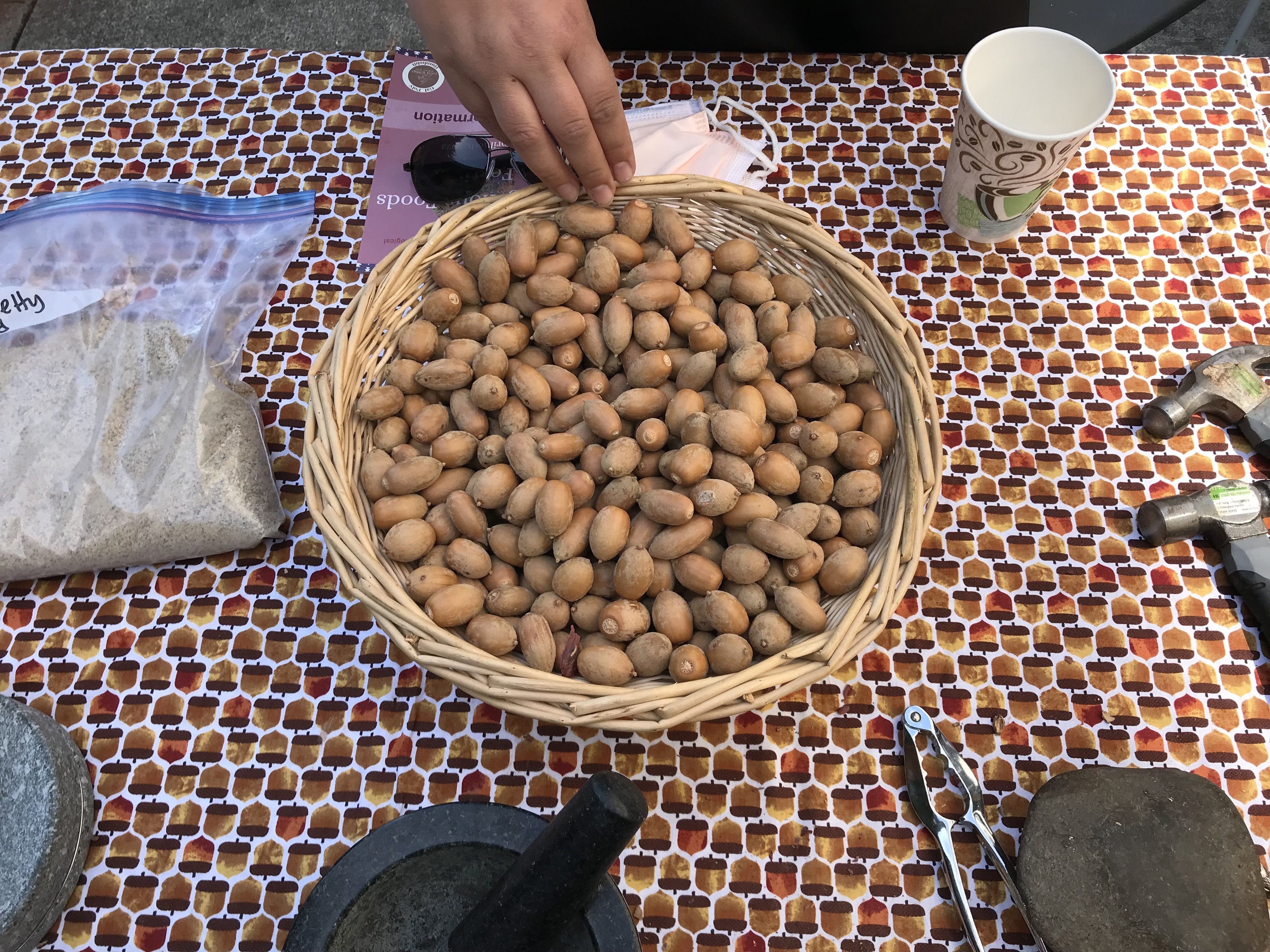
Several speakers presented in the Native American Forum, each giving information about their respective organizations and how they are practicing food sovereignty. One event hosted by the California Indian Museum & Cultural Center was incredibly informative. Executive Director Nicole Myers-Lim led the presentation and discussed the projects their native youth are working on as part of the museum’s Tribal Youth Ambassadors program. One of those projects was creating acorn bites, which was an idea that came from one of the youths, and was being sold during the event. I must add that they were extremely delicious!
During the presentation, Myers-Lim reminded the audience that in order to practice food sovereignty, there are several elements to consider such as land access, settler laws and regulations within park systems, as well as handling public harassment and racism when gathering on public lands. Additionally, the monetization and over-harvesting of natural foods such as abalone have prevented their tribe— the Pomo Tribe— from utilizing this natural resource, which is a large part of their culture.
“Our Pomo food that we love is abalone…we can’t eat abalone right now but when abalone was harvested, it was overharvested,” said Myers-Lim. “We’re really trying to educate non-native communities that this is our cultural resource; we need it for the continuity of our culture. It doesn’t have to be sold for $70 dollars on a plate at Oma’s in San Francisco.”
Another aspect that Myers-Lim highlighted was how native youth had gradually lost interest in gathering natural foods and resources due to being subjected to harassment by the public. At one point the racism and harassment became so severe that the youth feared practicing their traditional gathering activities at local parks on local trails. To help mitigate this issue, the Native Youth Program created an educational card pamphlet called the ‘Culture Card: Tribal Member Educational Handout’ to give to park visitors who questioned, disturbed, and accused them of harming the environment while they were gathering. The culture cards discuss the cultural significance of traditional harvesting and gathering as well as explaining how and why gathering is a healthy activity. It also highlights gathering and harvesting permits.
“We’re out there praying and giving gratitude to the plants that are sustaining us and so to be accused of abuse is ironic,” said Myers-Lim. “After hundreds of years of the abuse that’s happened through the Gold Rush, the wildfires and the dams and everything else.”
If that wasn’t harmful enough, the program also has to obtain special 24-hour permits before gathering which is just another hoop to jump through.
“We have to work with them to have ancestral gathering rights that are recognized throughout the state,” said Myers-Lim. “As tribes we need to advocate for that through our consultation policies and try to change that on those levels.”
Past Cal Poly Humboldt chemistry major, Sunny Rojas (Yurok/Karuk/Apache) stated that his people were not equipped to consume processed foods, and doing so has caused much damage to the health of his community.
“It has a devastating effect on Americans and my people…we never ate like that in the past and our bodies are not quite equipped to deal with a lot of things that are surprisingly allowed in our food,” said Rojas.
He expressed that one of his goals as a chemistry major was to learn more about the components of the earth, people, and the contents of America’s food.
“I wanted to try and find some way to help this poisoned food system we have in America right now,” said Rojas.
With life disrupted, lecturer Kerri Malloy perseveres with flexibility and humor
A professor noticed students often left Kerri Malloy’s class laughing. One day the professor asked what he was teaching.
“Oh, that’s my genocide class,” Malloy said.
Malloy teaches courses in the Humboldt State Native American studies department on colonialism and genocide. With such somber subjects, Malloy relies on humor and honesty to engage students. Now that classes have gone online during the pandemic, Malloy has employed those traits, alongside plenty of flexibility, to keep students connected.
“The hurdle is going to be maintaining that connection with the students,” he said.
He created class blogs for students to post what they want—questions, memes, dog or cat or reptile pictures. Glance through Malloy’s Instagram, Twitter or Snapchat accounts, and you’ll find lots of memes, like one he posted April 3 on Instagram:
“The year 2020. Brought to you by the letters W, T & F.”
“I think you have to walk into it—at least my plan is to walk into it—with an incredible amount of flexibility.”
Kerri Malloy
“I love a good meme,” he said in one of two Zoom interviews. He sat in his home office. Behind him, family photos and a Star Wars Yoda action figure topped a bookshelf. He wore glasses and a button-up shirt.
Memes dominate Malloy’s social media accounts, but there’s more to the accounts than humor. They make him accessible to students. He receives messages on those accounts about class, and he replies happily.
“There are times where I’m like, ‘Why am I doing this?’” he said. “And then I realize, I’m getting to see a different side of students, and my colleagues, too.”
Malloy also emphasized the importance of flexibility.
“I think you have to walk into it—at least my plan is to walk into it—with an incredible amount of flexibility,” he said. “And let them—let the students—help guide where we’re going to go.”
Yurok and Karuk by heritage, Malloy was born on the Oglala Lakota Reservation in South Dakota, but he grew up on the Quinault Indian Nation Reservation in Washington.
Marlon Sherman, chair of the HSU NAS department, knew Malloy from working together for the Yurok tribe. Sherman and Malloy have a family connection, as Sherman grew up on the Oglala Lakota Reservation where Malloy was born.
“If it wasn’t for Kerri, there might not be a NAS department right now.”
Marlon Sherman, chair of the Native American studies department at Humboldt State
After working together for the Yurok tribe, Sherman and Malloy parted. About six years ago, Sherman asked Malloy to come to HSU to teach two courses for a semester.
Shortly after Malloy came on board, Sherman had to take time off. He had cancer. Sherman returned in about a year, but Malloy became program leader and helped steer the department. Sherman said Malloy basically did all the work and helped the department hire two professors.
“If it wasn’t for Kerri, there might not be a NAS department right now,” Sherman said over the phone.
Malloy said Sherman was too generous, but there’s no doubt that Malloy works, a lot—so much so that Sherman joked it might be illegal.
Malloy wakes up around 4:30 a.m. every day. He gets up so early partly because he finds those early hours productive, and partly because his back is built on metal rods and pins that make lying flat for too long unbearable. He’s not exactly sure how he damaged his back—maybe a car accident—but he had to have surgery that put him out of commission for three years.
He estimated he’s on eight to 10 HSU committees, from the University Resources Planning Committee to the Diversity, Equity and Inclusion Committee. Malloy does this while teaching multiple classes as a lecturer—a position with an uncertain future amid HSU’s projected enrollment decline and budget cuts. He joked when asked how he has the time.
“People usually don’t like my answer,” he said. “How do I have the time? A calendar.”
Kumi Watanabe-Schock, a 23-year HSU employee, works in public programming and as the library media coordinator. She first met Malloy when he was an HSU student getting degrees in economics and Native American studies.
Since then, Watanabe-Schock has worked with Malloy on committees and for classes. Every time she talks to Malloy, he seems to be attending workshops or giving talks around the world. She praised his willingness to help out.
“He’s not good at saying, ‘No,’” she said over the phone. “I don’t know if he’s that way with everybody, but when you ask him to do a favor he always follows through and he always says, ‘Yes.’ So I really am appreciative, yeah. He’s a good person.”
When not working, Malloy is more private. He has a husband and three dogs. He has two sisters and 14 nieces and nephews he tries to see every year. Around 8 p.m. every night, he tries to unwind. Maybe he’ll watch some TV, or maybe he’ll read a book about genocide. Fun.
While COVID-19 has pushed teaching online, Malloy has found his courses as relevant as ever.
A key concept in Native American studies is survivance, a portmanteau of survival and resistance. Survivance is about the living of Native American lives in the present tense. By surviving, Natives resist, and by resisting, Natives survive.
Malloy said people must fight right now to have their voices heard, like many Natives must do at all times. He said individual voices humanize current events and prevent people from kicking the ball of reality down the road.
On that note, Malloy told a story. Last summer, he taught Native history in a program that spent two days in Auschwitz I, the main site of the Nazi concentration camp. One day he stopped and looked out a window. The bizarreness of the situation dawned on him. Here they were, decades later, standing in a place of horror and trying to learn from it.
A window at Auschwitz I, the main site of the Nazi concentration camp on August 20, 2019. | Photo courtesy Kerri Malloy
Later that night he received an email from then-HSU President Lisa Rossbacher. She was checking in, so he wrote back.
“If we can educate in such a place of incredible horror and death, we have the ability to change the world,” he remembered writing. “We really do. If we can actually go into these places and find this incredible darkness and turn it into something that allows us to reach out to other human beings and get us to talk to each other and push the things that really don’t matter aside, I think we can do this.”
To get people to talk, Malloy uses humor, which he said can get us past anything—and Malloy does seem capable of getting past anything. It seems strange to call research on genocide a passion, but Malloy approved the descriptor.
“Passion’s a good word for it, actually,” he said. “You’ll find that for those of that this is what we do, it is a passion.”
Every student interviewed for this story agreed on a few descriptions of Malloy. He’s open and funny, they said, and he can be brutally honest. They warned against getting into an argument with him.
“If you’re gonna have an argument with him, you better have good stats and have all your ducks in a row, because you’re not gonna win Kerri in an argument—I’ve tried,” HSU biology major Michelle Navarette said over the phone.
“And he told me, like, ‘You can’t let the system fuck you up and throw you down.’”
Michelle Navarette, Humboldt State biology major
Navarette, a senior, first had Malloy for a 9 a.m. general education course. Once she got to know him, she tried not to miss his class. Since that first course, she’s tried to have a course with him every semester.
Navarette’s appreciation of Malloy goes beyond the classroom. She said she was losing her job last semester due to discrimination from her boss. She didn’t know what to do, so she went to Malloy.
“He sat me down and was like, ‘You know what, this is just a portion of how life is,’” she said. “’You’re gonna have these obstacles all the time.’ And he told me, like, ‘You can’t let the system fuck you up and throw you down.’”
When she thinks of Malloy, she remembers his honesty.
“I think he was like the first person to tell me, ‘This shit is going to be hard.’”
As a lecturer of general education courses, he usually has to work for the attention of students. He goes into his courses hoping for students to leave with more questions than answers. Students have told him he gives too many assignments, but no interviewed students said Malloy graded harshly.
“My philosophy,” he said, “is if I can get one brain cell to function per student on an assignment, we’ve succeeded.”
Malloy once had a student he didn’t think he had triggered any brain cells in. Malloy said the student believed everyone should be committed to a single belief. Malloy respected the devotion, but he worried about the implications.
About a year after the student left his class, Malloy received a message on one of his social media accounts. The student wanted to know if a site he shopped on looked like a hate group.
“I went and checked the site out and went, ‘Yeah, this is definitely an organization that supports anti-Islam—very Islamophobic,’” he said.
The student thanked him and decided to shop elsewhere. Malloy remembered that as a success.
“It’s when you see those little things, you’re like OK,” he said. “Even at some small level, we were able to plant some idea, some seed that is getting people to think differently, or at least question.”
Like many of Malloy’s students, Joshua Overington, an HSU environmental science senior, only took Malloy’s introductory Native American studies course for a general education requirement.
The class was so good Overington signed up for more. He eventually worked with Malloy on the Northwest Genocide Project, an online archive Malloy manages.
Overington also worked with Malloy on a research project on Tuluwat Island for HSU’s IdeaFest, which led into a research paper Overington is now finishing.
“He is incredibly passionate in what he does and he is uncompromising in his views,” Overington said over the phone. ”If Kerri feels something or has an opinion, he always speaks his mind and really, he’s always the one who’s honest and puts himself out there. And that’s not something I see at all in other teachers.”
“If we can make those connections on that level, this is much more understandable. And then we get to be more willing to go, ‘Alright, maybe I need to look in the mirror.’”
Kerri Malloy
Malloy likes to tell people teaching about genocide is fun. People usually give him a blank stare and change the subject. But if asked, Malloy will elaborate.
“And what it means is not fun as in, ‘Yay, happy stuff.’ It means that it’s fundamental,” he said. “Atrocity is a fundamental part of the human existence. Peace is a fundamental part of the human experience. It’s understandable—we can understand why it happened, how it happened, what needs to be done to prevent it. And it’s necessary.”
Malloy knows most people don’t want to talk about atrocities all day. To get past that, Malloy said we have to be willing to look at ourselves.
Malloy tries to relate concepts directly to his students. He sometimes asks if students curate their social media profiles—do they post every photo they take? They admit they do some curating, and he suggested history books do the same.
“If we can make those connections on that level, this is much more understandable,” he said. “And then we get to be more willing to go, ‘Alright, maybe I need to look in the mirror.’”
Malloy teaches because he believes we’re all here to learn. He admits his own ignorance and encourages others to do the same. That openness to learning is perhaps what makes Malloy love his job. His willingness to let students guide his classes is perhaps what makes students love him.
“I tell my students this directly: ‘This is not my class,’” he said. “’This is yours. You guys are the ones who are paying for it. I am just the tour guide on this expedition.’”
Malloy always ends each of his classes—each chapter of the expedition—with the same message.
“Go out and learn something,” he tells his students. “Go out and breathe.”
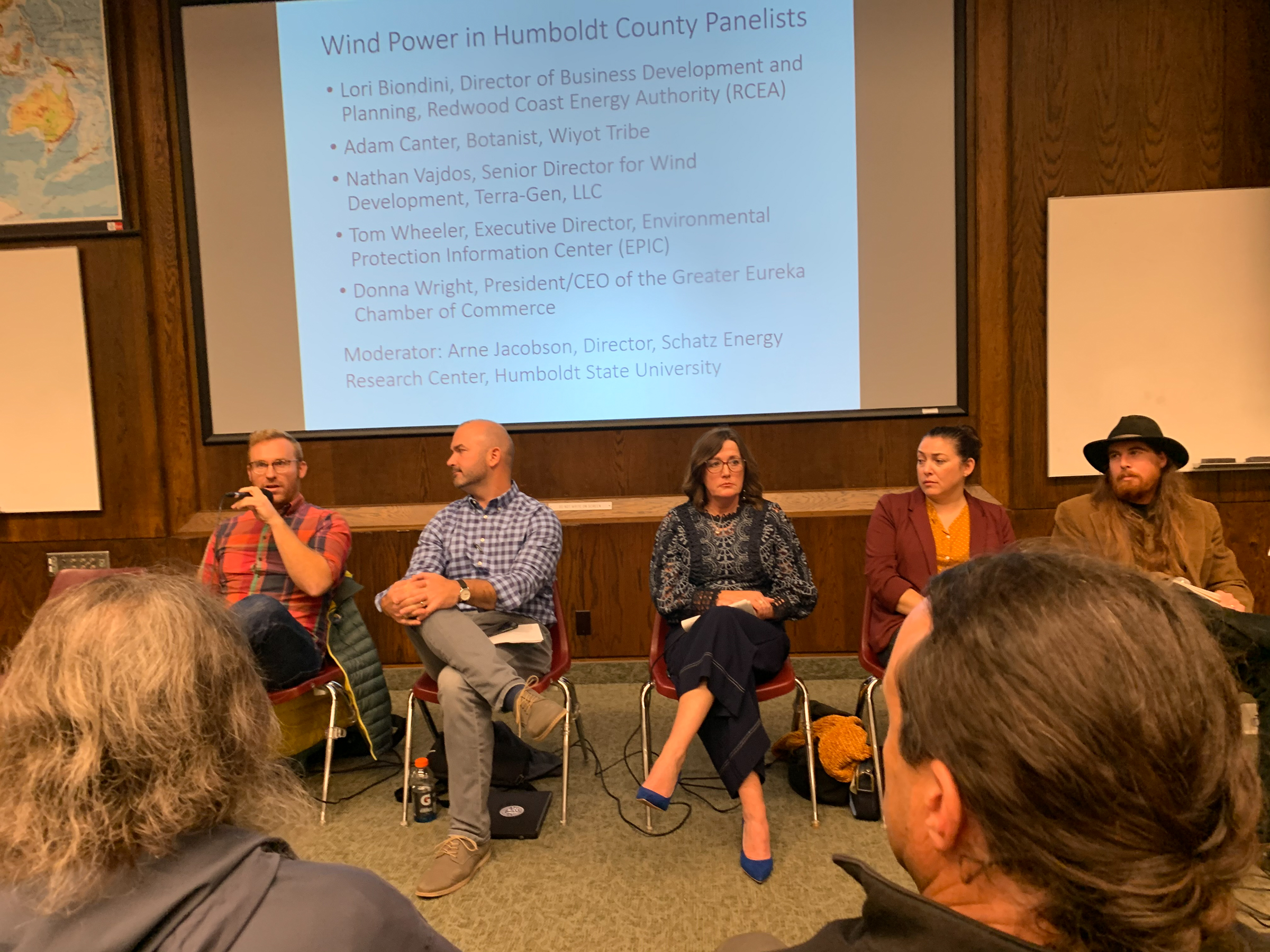
A panel at Humboldt State University’s Sustainable Speakers Series weigh the pros and cons of the Humboldt Wind Energy Project
As the global concern to act against climate change increases, Humboldt County is in a position to capitalize on an opportunity to establish a significant renewable resource.
On Thursday, the Humboldt County Planning Commission votes on the wind energy farm developed by Terra-Gen. Terra-Gen, a Manhattan-based energy company, has proposed a wind farm to be built near Bear River, on Monument Ridge, above the city of Scotia.
The Terra-Gen wind farm carries controversy for numerous reasons. The project will help achieve carbon emission-reduction goals and provide two million dollars in annual tax revenue for the county, but will impact wildlife, forest ecosystems and the Wiyot prayer site Tsakiyuwit.
Arne Jacobson, director for Shatz Energy Research Center, said the proposed turbines will produce about 100 times less CO2 than burning fossil fuels.
“From a climate change perspective, wind looks pretty good,” Jacobson said. “Whatever perspective we have on this particular project, I think one question we should be asking ourselves is what we want to do with that opportunity, because I think it’s there and I think we have the local ethic and the local talent to make that happen.”
Lori Biondini, director of Redwood Coast Energy Authority, said the Terra-Gen wind project could be part of a solution to address RCEA’s goal of 100% renewable electricity in Humboldt County by 2025.
“The Terra-Gen project is part of one scenario to reach our goals,” Biondini. “If it doesn’t get built, then we will come up with another scenario.”
RCEA administers the community choice energy program, a program which allows communities to decide where their electricity comes from. It prioritizes local energy generation and generally more clean energy.
“I think that one of the promises of community choice energy is that we get to make choices that are good to our entire community.” Biondini said. “Not further marginalize those that might not otherwise have had a seat at the table.”
A crowd waits for Sustainable Speakers panel to begin. | Photo by Michael Weber
Adam Canter, a botanist and representative of the Wiyot tribal council, defended the preservation of the land and disapproved of the Terra-Gen project. Canter cites ethnobotanical resources and culturally significant sites as reasons not to move forward with this project.
“When we first heard about this project, there was this big pit that just kind of fell into our stomachs,” Canter said. “We thought when Shell came 10 years ago that no other company would come back and try to build a project here. But we were wrong.”
Canter pointed out the cultural resource report for the site bound in a green, four-inch binder.
“The representation of cultural diversity on this ridge is pretty magnificent,” Canter said. “We’re seeing evidence of Athabaskan peoples and the Wiyot-Algonquin peoples and really it should be listed on the National Register of Historic Places.”
According to Canter, the area is also a high prayer site; a place where a large expanse of Wiyot ancestral territory is visible. Like the turbines obscuring the view, the Wiyot cultural heritage could be obscured too.
Tom Wheeler, director for the Environmental Protection Information Center, said the proposed site is a questionable area to build a wind farm.
“The representation of cultural diversity on this ridge is pretty magnificent. We’re seeing evidence of Athabaskan peoples and the Wiyot-Algonquin peoples and really it should be listed on the National Register of Historic Places.”
Adam Canter
According to guidelines set by the California Energy Commission and the California Department of Fish and Wildlife, the proposed site is “pristine.” Wheeler said the site has several rare and endangered species, including the rare Horay bat.
Wheeler is still hopeful to keep the project, and said there is technology that can reduce some of the wildlife impacts. This, however, is only one mitigation measure to the several unavoidable cultural, environmental and wildlife impacts of the project.
“I want this to be a better project and it’s not there,” Wheeler said. “At least not yet.”
On Thursday, the final vote by Humboldt County’s Planning Commission will weigh impacts to Native American culture and environmental quality to the people’s interest in local, reliable energy.
Aside from the benefit of reducing carbon emissions, allowing Terra-Gen to build the wind farm also comes with an economic and infrastructure benefit.
Senior Director in Wind Development for Terra-Gen Nathan Vajdos said the company would be the second-largest taxpayer in the county, and could fund $14 million to Humboldt’s reliability network upgrades, with $1.3 million to the Humboldt substation.
“As we charge our iPhones, we fill up our cars with gas, we’re having impacts.” Vajdos said. “Whether this project is built or not, we are having an impact in this room.”
After nearly 160 years in the hands of Eureka, Tuluwat, briefly known as Indian Island, returns to its rightful owners
Wiyot Tribal members and Eureka community members were joyful, yet solemn, at the Eureka City Council meeting to officially return Tuluwat Island to the Wiyot people.
Wiyot tribal elder Cheryl A. Seidner blessed the room in a prayer of welcome. In the prayer, Seidner welcomed people from the East and from all directions as she turned in a circle, speaking in her native language. The crowd was silent and respectful, and tribal members let out emotional “ho’s.” Seidner thanked everybody in the audience and asked them to rise.
Wiyot tribal elder Cheryl A. Seidner speaks during the public comment section of the city meeting to return Tuluwat Island to the Wiyot Tribe while she is surrounded by supporters and tribe members at the Adorni Center in Eureka on Oct. 21. | Photo by Thomas Lal
“This is something I’ve always wanted since I was a kid,” Seidner said. “I thought the island was always ours, not anybody else’s. So we came together and said, ‘Let’s do this, let’s make it ours.’ So I decided to be bold and ask the new mayor to give us the island they owned.”
In 2004, 40 acres of Tuluwat were returned to the Wiyot Tribe. Oct. 21 marked the return of the remaining 202 acres. The tribe has been working with the City of Eureka for the last five years to make this happen, and this action marks the first step to repairing the damage caused to the tribe that began 100 years ago.
Cutcha Risling Baldy, Ph.D, the Native American Studies department chair at Humboldt State University, delivered one of many moving speeches to the hundreds of assembled community members. Baldy talked about the future of the Wiyot people and how she knew, one day, they would come back.
“I realized that native people were always making plans for our future and that we never gave up on our land or where we came from,” Baldy said. “That is the story I want people to know. I know that the story of Tuluwat, which people often refer to as Indian Island, has been one of a massacre for most people, but for me it has only been a place for world renewal.”
Baldy once read a book about stories gathered from people about Tuluwat. One particular story was about a woman who was stuck in the mud after the violence on the island. While it may be a story of sadness, Baldy said it was a moment of strength and hope. The woman sang a mourning song because she knew she had to send her tribe off properly. Her strength showed she knew her kin would one day return to Tuluwat.
Wiyot Tribal Chairman Ted Hernandez performs a traditional dance with members from the local tribes at the Oct. 21 Eureka City Council meeting to return Tulutwat Island to the Wiyot. | Photo by Thomas Lal
Jene L. McCovey sings a song during the Eureka City Council meeting to officially return Tuluwat Island to the Wiyot Tribe at the Adorni Center on Oct. 21.
A child stands with other tribal members at the Oct. 21 meeting to return Tuluwat Island to the Wiyot people. | Photo by Thomas Lal
HSU anthropology professor Gordon Ulmer acknowledged the significance of the day. Ulmer said the day should be a celebration of time immemorial, and that it displayed the vibrancy of the Wiyot tribe, despite the dark history.
“What we see here is a very vibrant thriving community that lives in the shadow of genocide,” Ulmer said. “People remember the genocide, but what is rarely acknowledged -or at least to a much lesser extent- is that people are still here, the Wiyot are thriving. There’s a lot to celebrate here.”
Eureka Mayor Susan Seaman began official proceedings by declaring the day as a moment in time that should forge strong bonds going into the future to create a long sought-after vision. Seaman prepared to take a vote from the council people while tension in the air grew as the crowd waited.
“I move to authorize the transfer of Tuluwat Island to the Wiyot Tribe and I authorize the vote,” Seaman said.
Leona Wilkinson sits and watches as the Eureka City Council meets to officially return Tuluwat Island to the Wiyot tribe at the Adroni Center in Eureka on October 21.
Members of the local Native American tribes perform traditional dances and songs during the Eureka City Council meeting for the return of Tuluwat Island to the Wiyot tribe at the Adorni Center on October 21.
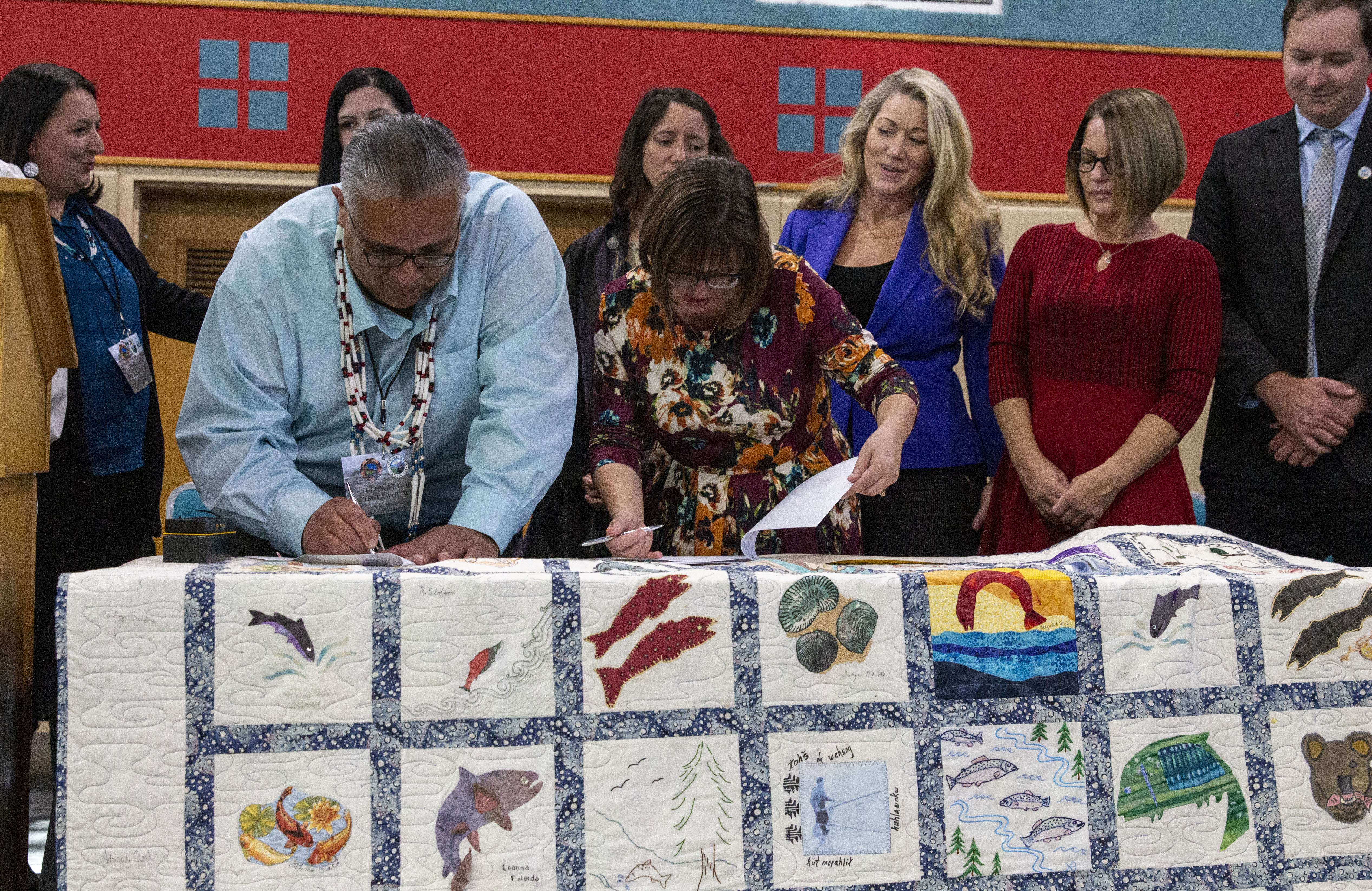
Hilanea Wilkinson holds up a quilt designed to honor those who can now return to Tuluwat Island at the Eureka City Council meeting at the Adorni Center on October 21.
The Eureka City Council spoke on behalf of the motion, each member contributing a unique perspective to the magnanimity of the event. HSU Lecturer and Eureka City Council Member Natalie Arroyo wasn’t physically present, but she FaceTimed in and a representative shared a letter penned by her about Tuluwat.
“This is the first known transfer of land from a city to a tribe of this kind,” Arroyo said. “We are all responsible to do what we can to actively participate in healing. I will be so bold to say under current conditions Eureka owns the land, but it was never truly ours.”
The tension began to ease as Seaman’s voice fell over the crowd.
“The vote to return the Tuluwat island to the Wiyot Tribe was unanimous and the motion passed,” Seaman said.
A sea of people applaud the Eureka City Council during their meeting to return Tuluwat Island to the Wiyot tribe at the Adorni Center in Eureka on Oct. 21. | Photo by Thomas Lal
The signed documents with the signature of Wiyot Tribal Chairman Ted Hernandez after the Eureka City Council Meeting to return Tuluwat Island to the Wiyot tribe at the Adorni Center on Oct. 21. | Photo by Thomas Lal
Cheryl A. Seidner sings “Coming Home” at the end of the Eureka City Council meeting to return Tuluwat Island to the Wiyot tribe at the Adorni Center on Oct. 21. | Photo by Thomas Lal
Applause erupted from the audience. The crowd stood on their feet to clap and shout in joy.
Seidner invited her family to the front of the auditorium to sing a song to the people gathered in the room. Seidner welcomed everyone in the audience and invited them to sing the song “Coming Home.”
“I know that our ancestors knew this day would come,” Baldy said. “I think that we need to consider it an opportunity to think about our next steps in the future. People stand up and ask me, ‘What can I do?’ And I have one answer for them: you can start by giving all the land back. And now we know it’s possible.”
The signing of the deed marked the end of the meeting. Seidner placed a quilt representing all who could not be present on the table, and the council people huddled around to officially return Tuluwat to its ancient owners.
Wiyot Tribal Chairman Ted Hernandez and Eureka Mayor Susan Seaman embrace after signing the papers to officially return Tuluwat Island to the Wiyot Tribe at the Adorni Center on Oct. 21. | Photo by Thomas Lal
Baldy concluded her address with honest praise. With the Wiyot land reparation, the people in the room could now envision a radical future.
“A future with no dams, a future with salmon that are healthy, a future with our children that are singing, a future where we are dancing all the time,” Baldy said. “I know we’ve seen it and I know we’ve felt it, and I look forward to how amazing that is going to be. And I know that we can do it, and I look forward to how everyone in this room is going to make that happen.”
‘From Wounded Knee to Standing Rock’ offers insight into 71-day rebellion
As Indigenous Peoples’ Week came to an end, one of the last events was an airing of the documentary, “From Wounded Knee To Standing Rock: A Reporter’s Journey” at the Eureka Theatre.
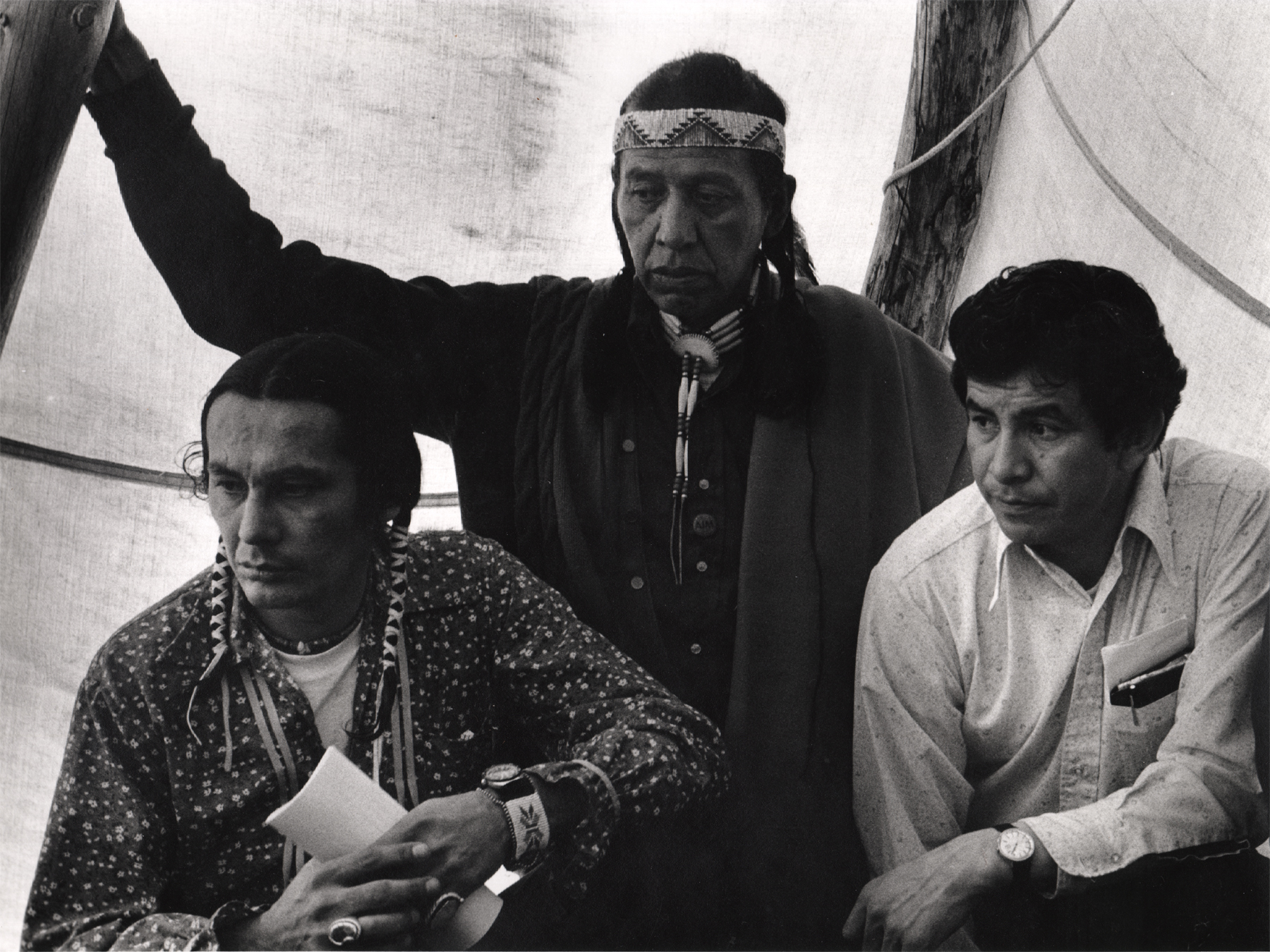
This story followed rookie reporter Kevin McKiernan and his experiences recording the events of the 71-day seizure and occupation of the town of Wounded Knee, South Dakota on the Pine Ridge Indian Reservation from Feb. 27 to May 8, 1973.
Photo courtesy Kevin McKiernan
Photo courtesy Kevin McKiernan
Photo courtesy Kevin McKiernan
Richard A. “Dick” Wilson was chairman of the Oglala Lakota Sioux of the Pine Ridge Indian Reservation. Protests started in response to failures of impeachment. Wilson had accusations ranging from giving jobs to friends and family, to suppressing his political opponents with his private militia, the Guardians of the Oglala Nation.
In addition, there were protests of the United States Government’s failure to uphold treaties with Native Americans. This was concerning since there was a history of abuse and neglect from American police and government. Cases such as State v. Bad Heart Bull served as a catalyst for the occupation.
As a result of the GOON squads’ weaponized militia, the American Indian Movement was brought in to assist the protesters. Wilson also received help from the American Government in the forms of U.S. Marshals Service and the FBI.
Photo courtesy Kevin McKiernan
AIM started as a grassroots movement in Minneapolis, Minnesota, to address police brutality towards Native Americans; and grew to represent all indigenous tribes and help them with the issues they have faced since European colonialism, as well as helping people reconnect with their heritage. Many people lost their history once Americans forced native youth assimilate into Euro-American society.
Acclimation to the colonizers’ lifestyles included forcibly removing Native people from their families, as well as preventing them from practicing their traditional customs. By accepting the different values as their own, such as Christianity, private property and material wealth, people became disconnected from their roots. AIM was a way for people to reconnect to their ancestors’ ways of life.
During the time of this occupation, the U.S. Government prevented media personal from entering the reservation or recording any discussions between them and the rebel leaders, such as Dennis Banks and Russell Means. They also implemented roadblocks to prevent aid for the natives.
McKiernan snuck in with the help of some rebels and slept on the floors of a church. While inside he recorded conversations with multiple members of the rebellion, shootouts with the FBI and USMS, took pictures of the aftermath of the altercations and recorded meetings with U.S. officials. Conflict escalated to the point of the USMS and FBI using helicopters, armored vehicles, snipers and automatic weapons.
Photo courtesy Kevin McKiernan
U.S. Marshal Lloyd Grimm was shot in the conflict and suffered paralysis from the waist down and Cherokee activist Frank Clearwater was shot in the head April 17, within 24 hours of his arrival, during a fire fight with federal forces.
Shootings were just one reason for keeping the media in the dark, by preventing coverage of the measures that the government took against the AIM and Sioux. At one point during the winter, Department of Justice appointee Kent Frizell, to manage the government’s response, cut off water, electricity and food supplies to Wounded Knee in an attempt to starve them out. They also made attempts to stir up distrust in the local factions, which lead to some activists being killed by their own allies, for fear they were government plants.
The final blow came in late April, when Lawrence “Buddy” Lamont, a local Oglala Lakota, was shot by a government sniper and killed. Soon after, both sides would come to an agreement to disarm. This led to the eventual end of the 71-day standoff between the Wounded Knee activists and AIM, and the United States assisted tribalists, serving as but one example of the Native American’s struggles since European Colonization.
Home Away From Home potluck kicks off Indigenous Peoples’ Week
Arcata is home to the Wiyot Tribe and Humboldt State University sits on Wiyot land. The Home Away From Home Potluck is one example of the community’s attempt to welcome all members to interact and is a fun, inclusive way to start Indigenous Peoples’ Week.
The second Monday of October has become an opportunity to counter-protest Columbus Day. Along with a celebration of Native Americans, their history on this land and their culture, Indigenous Peoples’ Week highlights the customs of indigenous peoples and acknowledges the years suffering.
Arcata Mayor Brett Watson spoke on some of the actions the city has taken in order to support local Native Americans. Watson spoke of a proclamation from 2016 where Arcata officially recognized Indigenous Peoples’ Day.
“The university is our lifeblood and we see the diversity of the student body as a positive. We welcome students of all backgrounds.”
Wesley Chesbro
“Just on October 2, we did a resolution affirming our support for a United Nations resolution,” Watson said. “Acknowledging the rights of Indigenous people around the world.”
The inclusion and acceptance of Native Americans’ history is one way that the community is attempting to reach out to students of all ethnicities. Wesley Chesbro, local volunteer and HSU alumnus, believes the potluck is inviting and feels like home for students.
“What we hope happens is students will sit down with community members and develop relationships,” Chesbro said. “The university is our lifeblood and we see the diversity of the student body as a positive. We welcome students of all backgrounds.”
The Home Away from Home potluck is more than it’s food, it’s about a sense of welcome. The goal, according to Equitable Arcata’s Communications Chair Cati Gallardo, is racial equity.
“The Home Away From Home potluck started as a way to let students know they’re loved by the community,” Gallardo said. “We love our students and some of the feedback we received stated how we need to make a change in Arcata. Folks were feeling it wasn’t a racially equitable community and we wanted to change that.”
Skits from based off the 1490s were performed by a Native American comedy group. The potluck consists of community members coming together to donate food and local businesses offer gifts for raffle prizes as well as warm winter clothing donated by locals for students who may need them.
Other events for Indigenous Peoples’ Week include highlights of HSU’s Native American programs. The Native Forum provided guests with a geographical exposure to local tribes on Monday. Professor Rain Archambeau-Marshall is hosting a showing of Dodging Bullets followed by a post-film discussion on Wed., Oct. 16. The Native American Center will also hold an open house Friday, Oct. 18, where they will play Cards for Decolonization. To find out more information go to humboldt.edu or itepp.humboldt.edu.
The Indian Tribal and Educational Personnel Program (ITEPP) hosted their 11th Annual California Indian Big Time and Social Gathering event on April 7.
Hundreds of people gathered from across California to celebrate and express their cultural heritage inside Humboldt State University’s West Gym.
Out of those hundreds of people, in particular, were a lot of youth in attendance.
One of the youth who attended the event was Harmony Taylor. Taylor is 8 years old, and has been dancing for four years.
Taylor looks forward to attending Big Time every year.
“I like to dance with the girls I grew up with,” Taylor said. “I only get to see those friends about two or three times a year.”
Harmony Taylor smiles near the West gym at Humboldt State on April 7. Photo by Garrett Goodnight.
Cutcha Risling Baldy, Ph.D. is an assistant professor of Native American Studies at HSU, and discussed how Big Time helps inform and empower the youth.
“It is important because we get to show our next generations that their culture is real and a part of their everyday lives,” Risling Baldy said.
Arya Mettier, Ph.D., Risling Baldy’s daughter, was also in attendance, and partook in the Women’s Coming of Age demonstration that her mom and many others have been working to revitalize.
“There’s a lot of people, and you can get a lot of stuff,” Mettier said. “I get to see a lot of different cultures.”
Sammy and Jon Luke Gensaw are two brothers who have also been inspired by this event ever since they can remember.
“When I was younger, this was a go-to thing,” Jon Luke said. “I would see people that I haven’t seen all year.”
The Gensaw brothers created their own non-profit organization, the Ancestral Guard. Through the Ancestral Guard, the Gensaw brothers are able to make direct action on a local and global scale. They recently returned from visiting and speaking at Yale University.
There were over 60 vendors in attendance along with live demonstrations, a food stand and a catering food truck Los Giles.
One of the highlights was by far the food. The popular choices were fry bread and Indian tacos, with a line wrapping around the building all day long.
A restorative vendor at the event was the Indigenous California Language Survival booth. One of the organizers of this booth was HSU assistant professor in Native American Studies, Kayla Begay, Ph.D.
At this booth, kids were encouraged to share a word in a native language to win a prize.
“Even if you’ve never heard a native language before, we encourage the children to learn today,” Begay said.
Humboldt State ITEPP alum Briannon Fraley explained that Big Time gives her children the opportunity to see other cultural representations.
“Living in a multicultural society, your identity gets lost, and it’s hard to engage,” Fraley said. “This event instills pride and promotes cultural identity.”
This website uses cookies to improve your experience. We'll assume you're ok with this, but you can opt-out if you wish. Cookie settingsACCEPT
Privacy & Cookies Policy
Privacy Overview
This website uses cookies to improve your experience while you navigate through the website. Out of these cookies, the cookies that are categorized as necessary are stored on your browser as they are essential for the working of basic functionalities of the website. We also use third-party cookies that help us analyze and understand how you use this website. These cookies will be stored in your browser only with your consent. You also have the option to opt-out of these cookies. But opting out of some of these cookies may have an effect on your browsing experience.
Necessary cookies are absolutely essential for the website to function properly. This category only includes cookies that ensures basic functionalities and security features of the website. These cookies do not store any personal information.
Any cookies that may not be particularly necessary for the website to function and is used specifically to collect user personal data via analytics, ads, other embedded contents are termed as non-necessary cookies. It is mandatory to procure user consent prior to running these cookies on your website.