The Lumberjack


Students Serving The Cal Poly Humboldt Campus and Community Since 1929

Tag: oh snap hsu

  • Tackling incarceration with education

    Tackling incarceration with education

    Project Rebound, seeks to help students on campus who have experienced incarceration

    Project Rebound was founded by John Erwin, Ph.D in 1967 at San Francisco State University, before it began to branch out to other campuses in the state. Erwin’s goal was to help students who were formerly incarcerated achieve educational success. This year, HSU joins the list of California State University’s to officially integrate the program.

    For Program Coordinator Tony Wallin, the work done by the group is personal. Wallin, who recently graduated from HSU, came to the campus after his own run-ins with the law. When he arrived at HSU, Wallin said he didn’t feel entirely like he belonged.

    “For a year, it was essentially just me, working by myself,” Wallin said.

    After almost giving up his first year here, Wallin would go on to create the Formerly Incarcerated Students Club at HSU with encouragement and help from others.

    Kory Lambert, office coordinator for Project Rebound, said he felt the same out of place feeling Wallin felt when he first arrived at HSU.

    “When I first came to HSU, I don’t know if it was self imposed, but it took me a whole semester to learn about Oh SNAP!,” Lambert said. “I think people take it for granted, they know these programs are there but they don’t really think about them.”

    Lambert is an environmental science major focusing on social justice with a minor in scientific diving. He is looking to study how disasters and natural events disproportionally affect marginalized communities.

    Lambert had just turned 18 when he was arrested in 2013. The arrest lead to him being kicked out of his community college and off the football team.

    “That set me on a way different path,” Lambert said. “It’s kind of a different experience from people who just never went through that.”

    Project Rebound tackled these problems by working on programs that focus on education and prevention. Their motto “From G.E.D. to PhD” reinforces the idea of an inclusive education.

    According to the official statement provided by HSU, Project Rebound has a “…95% graduation rate while the CSU system as a whole has a 25% rate who finish within four years and 61% within six.”

    For many, getting a degree is the first step in being respected and taken seriously when trying to reintegrate into society.

    “A degree is a piece of paper,” said Wallin. “But if you’ve been formerly incarcerated it makes people go ‘okay, I’ll listen to you.’”

    Project Rebound has spent the summer writing to current Pelican Bay State Prison occupants who are interested in pursuing their education inside and outside of its walls.

    According to Lambert, interest expressed by prisoners surround the possibility of voting and getting involved in politics. Proposition 17 on the California ballot would reinstate the voting rights of many formerly incarcerated individuals if passed.

    Due to COVID-19 regulations, the group has not been able to visit the supermax prison in Crescent City in-person, but hope to host workshops on things like tuition and classes in the future.

    Currently the group hosts regular Zoom meetings to discuss future events in addition to check-ins, and listening to anyone in need who has past incarceration history.

    “It doesn’t matter if you’ve spent a day in jail or 30 days in prison,” Wallin said. “We don’t discriminate.”

  • HSU Student Resources to Get Through the Pandemic

    HSU Student Resources to Get Through the Pandemic

    Student resources for school, finances, food, housing and counseling

    Here is a list of resources Humboldt State is offering for students. Click here for a student-created site of community resources. Click here for the site in Spanish.

    Educational advice:

    Enoch Hale is the director of the Center for Teaching and Learning at Humboldt State University. He provided five tips to help students with online learning during the shelter in place order. His tips revolved around being kind and flexible.

    “Kindness is having the patience and the benefit of the doubt to know that everyone else is struggling,” Hale said. “Be flexible—no one signed up for this and we are going to have to be agile in our expectations in the changing patterns.”

    Five tips to help with online school from Hale:

    1. Don’t ignore feelings—reflect on them so they don’t manage us.
    2. Communicate with professors more, not less.
    3. Log on more frequently. Check your emails and canvas more often. Not all courses will be on Zoom.
    4. Set a schedule, use a study calendar and stick to a routine.
    5. Check the Keep Learning website.

    Finances:

    HSU Coordinator of Student Services for the financial aid office Morgan McBroom provided financial advice to students. McBroom suggested students in a crisis contact the financial aid office.

    For students who are hard-pressed for money, there is a student emergency loan that ranges from $500 to $1000. It is a short-term loan and can come within a few days. Financial services will work to help students pay it back. Students who have not used all of their student loans from the previous semester may also still have access to them.

    Due to the COVID-19 crisis, students’ loan interests are being waived, but the estimated date that it will stop is in June. As of now, the end date hasn’t been established. If you are an HSU graduate, you can have your loans waived for a year with no interest.

    Contact: finaid@humboldt.edu or (707) 826-4321.

    Housing:

    In addition to her advice on financial matters, McBroom also provided housing advice. There is emergency housing available on campus. The off-campus liaison is a resource if you’re struggling with rent.

    Contact: housingliaison@humboldt.edu

    Food:

    1. The recreation room on the first floor of the Jolly Giant Commons offers pre-made bags with food items. This happens twice a week on Wednesday from 10 a.m. until 12 p.m. and Thursday from 1 to 3 p.m. Vegan and vegetarian meal bags are also available.

    If you cannot make those times due to isolation or quarantine, contact mira@humboldt.edu and she can set up a delivery time.

    2. Oh SNAP! can also help you load your student ID card with J points. You need to express a financial need for food support. If you have over $40 in J points, you need to wait until your card is under $40. You can receive $60 every four weeks, but this is subject to change. If there is an increase of funds there could be an increase in the amount given to students. You can also donate your J points to help students in need.

    Contact: ravin.craig@humboldt.edu.

    3. For extra help, try applying for CalFresh, a state-funded program to help pay for food. Students not working 20 hours a week can apply for CalFresh, except for students in the Educational Opportunity Program program, students with specialized grants and work-study students. You can qualify for up to $200 a month for groceries.

    Contact ravin.craig@humboldt.edu if you need help with the application process or would like to see if you qualify.

    Counseling:

    Mira B. Friedman is the lead for health education and clinic support services. She provided information about counseling for students.

    HSU Counseling and Psychological Services is offering virtual appointments.

    Students can call (707) 826-3236 to make an appointment. There’s also a 24/7 hotline for immediate crisis outreach for students to speak with a therapist by phone at (707) 826-3236.

  • Only One Location at Humboldt State Accepts EBT

    Only One Location at Humboldt State Accepts EBT

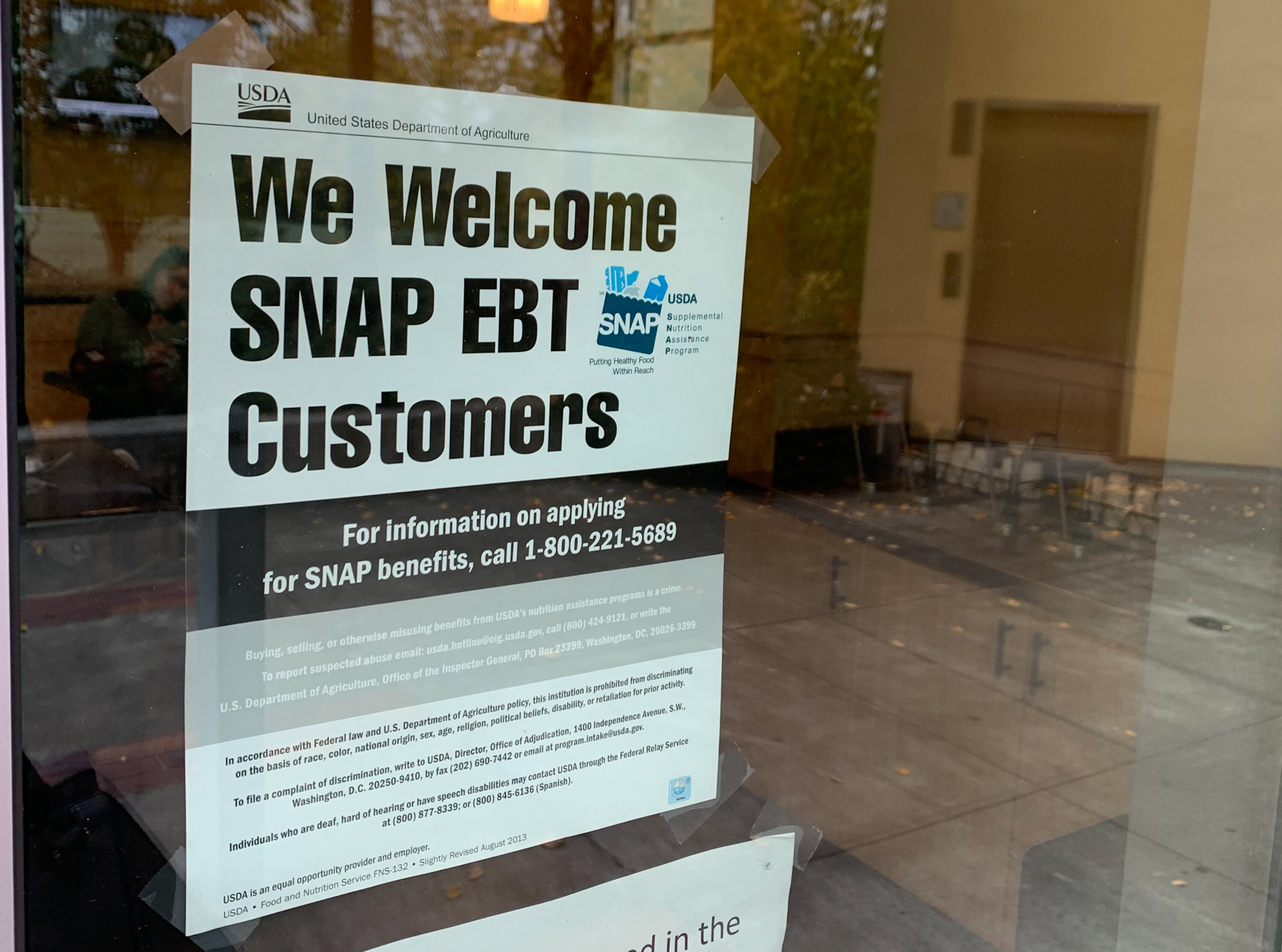
    College Creek Marketplace is the only location on campus that accepts CalFresh food benefits

    Humboldt State University is one of the first universities to accept Electronic Benefit Transfer cards.

    According to Iran Ortiz, a 5th year student and Oh SNAP! employee, options on campus are limited to where students can spend their food stamps.

    “The only place on campus that accepts food stamps, or CalFresh benefits, is the Marketplace,” Ortiz said.

    CalFresh, previously called food stamps and federally known as the Supplemental Nutrition Assistance Program, is a U.S. Department of Agriculture run program that provides eligible households with an EBT card that works like a debit card.

    According to CalFresh’s website, EBT cards can be used at most grocery stores and farmers markets, but benefits are meant to be supplemental and not intended to meet a family’s entire food need.

    The process to sign up for CalFresh can be tricky if doing it by yourself. But Oh SNAP! is student-driven with a mission is to increase HSU students access to food and they can help with the process of signing up for EBT.

    “Although we are not eligibility workers, so we can not determine benefits or how much you get, we can help you out throughout the whole process of CalFresh. We’ve been trained by CalFresh workers to know the whole process and all of that.”

    Iran Ortiz

    Ortiz explains how her and other Oh SNAP! employees can help students sign up.

    “The process for students is different because they abide by student eligibility requirements,” Ortiz said. “Although we are not eligibility workers, so we can not determine benefits or how much you get, we can help you out throughout the whole process of CalFresh. We’ve been trained by CalFresh workers to know the whole process and all of that.”

    Sara Olsen is a third year with previous experience with Oh SNAP! who remembers some of the requirements of signing up for EBT benefits through Oh SNAP!

    “The people who help, volunteer and work for Oh SNAP! are very helpful and will give you paperwork to fill out,” Olsen said. “Which they will then fax in office if you’re ready.”

    Olsen explains that after submitted the paperwork, CalFresh will call and set up a phone interview. After deemed eligible for the program, an EBT card is sent in the mail.

    Alexandre Sicaud is the manager of the College Creek Marketplace and doesn’t know the exact reasoning behind the Marketplace being the only place to accept EBT on campus.

    “We used to only have one EBT scanner, then we upgraded to two,” said Sicaud. “But as for why we’re the only place on campus, it might have to do with the fact that we’re the largest grocery operation.”

    CalFresh benefits are provided to help pay for groceries. In fact, hot foods can not be purchased with an EBT card in an effort to promote healthy and nutritious alternatives.

    If you need help filling out CalFresh paperwork, head to the Oh SNAP! office located in the Recreation Wellness Center, room 122.