The Lumberjack


Students Serving The Cal Poly Humboldt Campus and Community Since 1929

Tag: parking

  • Proposed state assembly bill gives van lifers hope

    Proposed state assembly bill gives van lifers hope

    By Eli Farrington

    On Oct. 25, 2023, Cal Poly Humboldt sent out an email to the entire student body detailing a list of new parking regulations that were going to be enforced effective immediately. However, none of the new regulations actually pertained to the majority of the on-campus community, but rather to a much smaller and more vulnerable one: the van lifers. 

    Jan. 11, 2024, Assembly member Corey Jackson introduced bill AB 1818 into the state legislature. If passed, all California State Universities and California Community Colleges would be required, and all UC campuses requested, to allow students that live in their vehicles to park on campus overnight as long as they possess a valid parking pass issued from their institution. 

    A humble community of vehicle-dwelling college students, the van lifers lived comfortably and peacefully in the parking lots of Cal Poly Humboldt for many years before the university finally decided to crack down on them. After the university claimed that their presence in the parking lots created ‘unsafe and unsanitary conditions,’ the van lifers were forced to leave the campus and look for overnight parking elsewhere. 

    Caleb Chen, a first-year Cal Poly Humboldt masters student in the public sociology program, was one of the students who were forced to leave. At the time, he was living in his vehicle, and the uncertainty of not knowing where he was going to sleep that night took its toll on him. 

    “In November, when we all had to move, it scattered us all to different places, and some of us ended up at the Arcata Community Center,” Chen said. “It definitely felt less safe there. It caused a lot of [stress] at the end of the semester that got in the way of schoolwork and the research assistantship that I’d come to this school for. Cops locking the gate to the community center at night meant if I needed to drive off all of a sudden in the middle of the night due to a break-in attempt, I’d be stuck in that parking lot. That wasn’t ever a concern at the school parking lot.” 

    At the beginning of 2024, Chen’s vehicle broke down. He couldn’t afford to fix it, so he ditched the van life and moved into an apartment with his significant other. Regardless of his new living situation, Chen was still impressed with the opportune timing of AB 1818’s proposal. 

    “It’s very timely, and whoever introduced it must have had their finger to the pulse, because this isn’t only happening at Cal Poly Humboldt,” Chen said. “It just speaks to the widespreadness of this and the fact that students at Humboldt are really just a drop in the pond, so to speak, of people that are affected by this situation.”

    In contrast to Chen, junior Hannah Barrett and sophomore Joshua Tarman left their overpriced one bedroom apartment at the beginning of the new year and moved into a camper together for a more favorable living situation. Barrett is a psychology major, while Tarman attends College of the Redwoods with a focus on early childhood education. 

    The couple originally planned to park their camper on Cal Poly Humboldt’s campus overnight, but when the Oct. 25 email was sent out they were forced to make other arrangements, including parking in areas of Samoa and Manila Dunes. 

    “I think that secure parking is something that should be a given for students,” Tarman said. “[Students are] paying to be in an environment where they’re supposed to learn, and so if a school wants to be able to provide all the facets for students to learn, they should definitely have a priority over their safety and their emotions. Students can’t learn when they’re just figuring out how to live in the first place.”

    While Barrett and Tarman are doing well enough with their vehicle parked off campus, they would definitely prefer the safety and security of an on-campus parking spot if AB 1818 were to pass. 

    “I just think that if you’re able to park here overnight with a parking pass, it is a little silly that you just can’t physically be inside your vehicle,” Barrett said. “It’s like at that point, [the university] is just trying to make it more difficult for people, because there’s [nobody] – at least I didn’t see – being unsanitary or dumping anything.” 

    The unsafe and unsanitary accusations have rubbed many of the van lifers the wrong way, including junior and mechanical engineering major, Derek Beatty. 

    “That was a smear campaign,” said Beatty. “It was, I guess, the only way that they could find to try to make other students feel like, ‘Oh I guess that’s why they’re getting kicked out.’ It was like they needed to give some reason so that there wasn’t as much outrage, but obviously, I don’t think many people believed those claims, and I think that even made people a little more upset on our behalf. But yeah… it’s kinda bullshit that they said that and then didn’t have any evidence to back it up other than a picture of a rainwater collection bucket.”

    The Lumberjacks request for complaints against van life students resulted in a total of two back-to-back complaints made by two anonymous people. Otherwise, no complaints were found. 

    Beatty is hopeful that AB 1818 will pass soon, so that he and others can park on campus again. He misses the safety net and the sense of community that on-campus parking provided for the van lifers, and having to park off-campus every night has taken that away. 

    One of the primary benefits of on-campus overnight parking is consistency. Having a dependable place to call home, even if it’s just a place to park a van or camper, can make all the difference in the world to the van lifers, one of Cal Poly Humboldt’s most at-risk communities. 

    “I spend all my time in this same parking spot,” Beatty said. “It’s just now for some reason I have to not be here from 10:00 p.m. to 7:00 a.m., when I could just stay parked here, not have to move all the time, and just have a consistent spot.”

    Carrie White, a Cal Poly Humboldt senior and biology major, lived on campus in her camper starting in 2021, but it recently broke down and has been stuck at a mechanic shop for several weeks. Since then, White’s living situation has been volatile, sleeping sometimes with friends, and at other times on the floor at one of her places of work. She hopes that AB 1818 will pass, to give low-income, displaced, immigrant students like herself a safe and secure location for alternative living. 

    “I think that passing the California Assembly Bill AB 1818 is the bare minimum a multi-million dollar institution affiliated with the CSU organization owes to its students,” White said. “In general, folks living in their vehicles are amongst the most vulnerable students. We know from thousands of studies that homelessness is a risk factor for mental and physical health pathologies, increased loneliness and isolation, decreased academic performance, decreased quality of life, and suicide. Passing a bill allowing homeless students to stay on-campus, in their vehicles, with a valid permit shouldn’t be a discussion – it should be a glaringly obvious choice. This is a social crisis, a public health crisis, a humanitarian crisis – and it is here, on our campus.”

    Student homelessness is a problem that plagues practically every college campus in California, and Cal Poly Humboldt is no exception. Cal Poly Humboldt students are still prohibited from sleeping in their vehicles on campus, but if AB 1818 passes, they can come back and the van life community can rebuild in a safe environment. 

    “I felt safer staying on-campus up until I was forced to leave,” White said. “In the act that I believe was an attempt to shame homeless students off campus – cue gross Cal Poly Humboldt email accusing homeless students of being ‘unsafe and unsanitary’ – the trust I have in this institution is null and void. Having said this, I would absolutely move back to campus if Bill AB 1818 passed; proud, in a state of activism, and don’t worry – safe and most definitely sanitary.”
  • Cal Poly Humboldt issues parking citations to students living in vehicles

    Cal Poly Humboldt issues parking citations to students living in vehicles

    by Jillian Wells

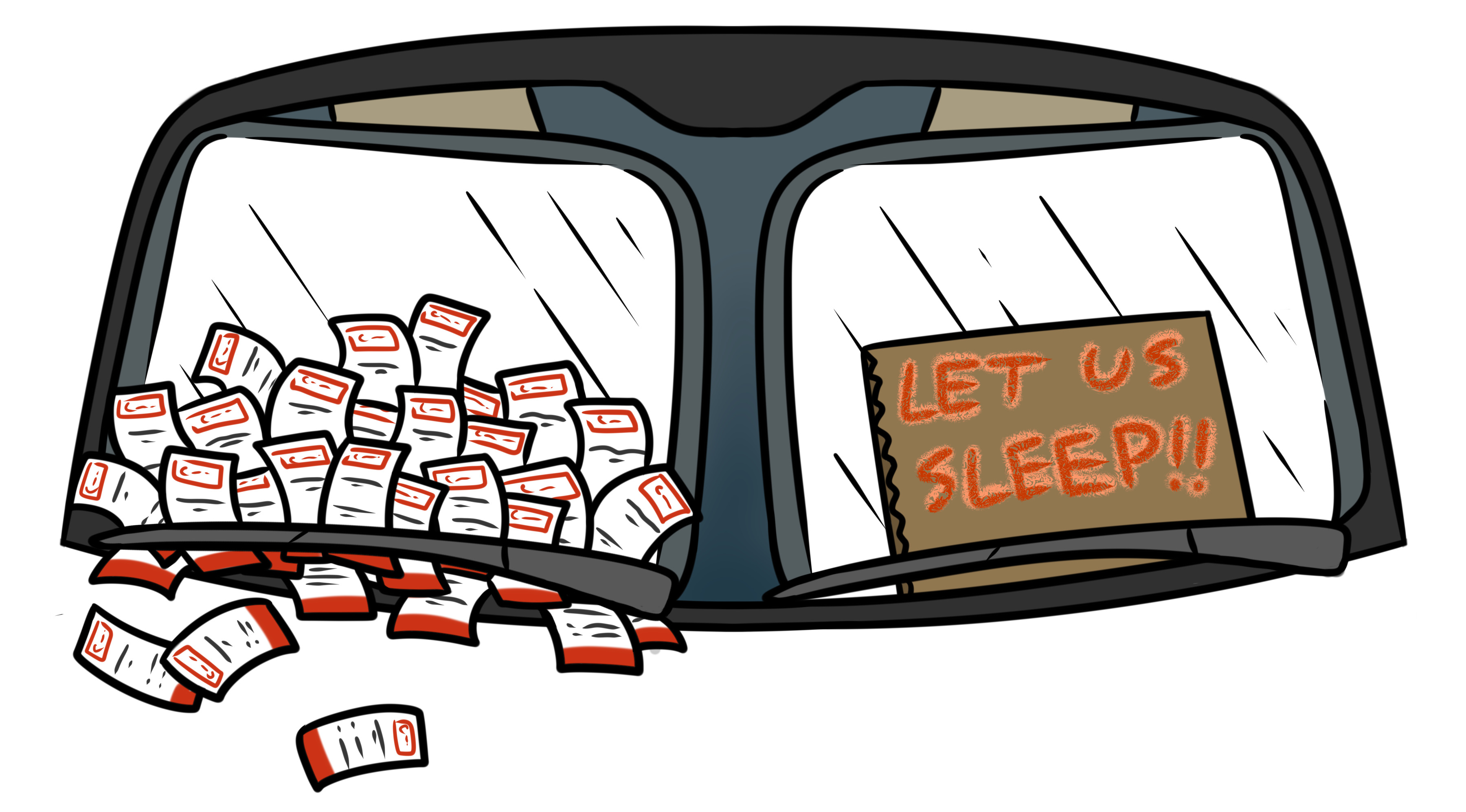
    On the morning of Nov. 13, students living in alternative housing such as vans, RVs, campers and motorhomes on campus awoke to parking tickets on their vehicles. The parking tickets each cost between $40-$53, with some students receiving multiple citations. 

    The enforcement of parking regulations came 19 days after the university sent out an initial email, notifying students that they would be enforcing a previously overlooked policy that prohibits overnight camping.

     This decision to enforce this policy sparked community backlash and has gained national attention, as there was a Los Angeles Times reporter interviewing students this week. 

    The citations issued to students outlined various violations, including “No Use of Vehicle for Living/Overnight” and “Beyond Designated Lanes.” Additionally, comments on the tickets highlighted specific infractions such as “windows being covered.”

    Cris Koczera, the Interim Director of Risk Management & Safety, did not respond to requests about further clarification about the criteria for determining if a student is sleeping in a vehicle by press time.

    Student Derek Batty lived in a vehicle on campus, but made the decision to move into temporary housing to avoid receiving a citation.

    “I feel more homeless in this place [temporary housing] than I did before,” Batty said. “I’m grateful for it for sure, but I wish we just didn’t get kicked out.”

    Batty also said that despite moving into temporary housing, he received a parking ticket on the morning of Nov. 13 because his windows were covered up. 

    “They can’t prove that we’re sleeping in the vehicle based on having [the windows] covered,” said Brad Butterfield, vice president of the Alternative Living Club, in an impromptu meeting on Nov. 13.

     They expressed frustration and asserted that just because their windows are covered up isn’t evidence that they are sleeping in their vehicles. 

    Ethan LeVering, an Associated Students (A.S.) delegate for the University Senate, pointed out a lack of consideration in the enforcement process.

    “They did not knock on the vehicles, they did nothing to check if anyone was in there,” LeVering said. “They simply left the little ticket and ran off.”

    The University Police Department (UPD) declined to comment. LeVering also criticized the university’s approach.  

    “These students have not been given a presumption of innocence, which is outright un-American,” LeVering said.

    Carrie White, a student who lives in their vehicle, emphasized the economic ramifications of the parking citations.

    “That’s what they’re [Cal Poly Humboldt] working on, the economic punishment,” White said. “They know we don’t have any money, so they’re going to ticket us until we have no choice. They’ll break the bank before they break our will.”

    Caleb Chen, another impacted student, expressed his concerns about the timing of the ticketing. He believes that the university is starting the citation process just before fall break to limit potential media coverage and keep the ticketing discreet.

    “They could tow us at the beginning of fall break… to remove the vehicles silently while all the students were gone,” Chen said.

    Chen added that while he appreciates the option of temporary housing, he’s not interested.

    “At this point, it’s about making sure there’s a solution for future students and all their [Cal Poly Humboldt’s] solutions only go until December 18.”

    Brad Butterfield is a member of The Lumberjack. He did not help write or edit this article.

  • Green solution to Humboldt’s parking issue

    Green solution to Humboldt’s parking issue

    by Jake Hyslop

    It’s no secret that transportation is a big issue here at Cal Poly Humboldt. With almost 6,000 students currently enrolled and only 2,137 parking spaces, parking is the least fun game of musical chairs played daily by students. Despite past assurances of more parking spaces in the future, students are left to maneuver the measly parking available until then. Some students will graduate long before additional parking is finalized. 

    Morgan King, chair of the Sustainable Transportation Committee and a Climate Action Analyst in the Office of Sustainability, has been working on programs and initiatives to provide a variety of transportation options to, from and around campus. At a time when parking is a limited commodity, King is striving to offer students equitable options. 

    “Our focus is on transportation equity,” King said. “We really need to look at how we can ensure that everyone has access to the same levels of service, regardless if they’re taking a bus, walking or riding a bike.” 

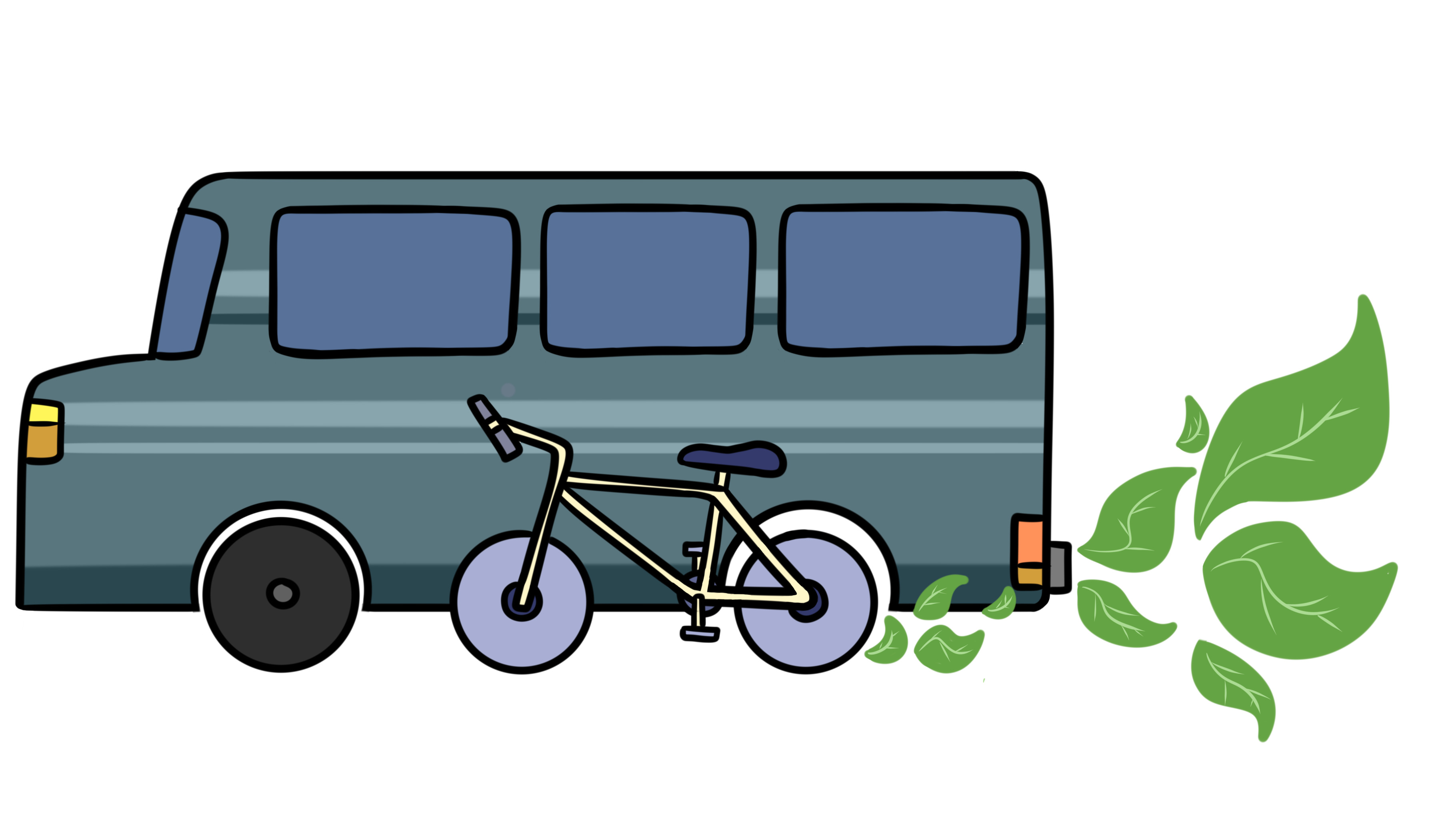
    Not only does sustainable transportation operate to provide non-single occupancy vehicle (SOV) alternatives, they also focus on making these methods of transportation as sustainable as possible. Cal Poly Humboldt has established a reputation as an eco-friendly university, releasing two Climate Action Plans (CAP) since 2017. These plans are drafted with the intent of reducing emissions across campus and achieving carbon neutrality by 2045, essentially rendering the school free of fossil fuel use and conceivably running on sustainable, clean energy. 

    Vehicle commuting accounts for 16.9% of greenhouse gas emissions at Cal Poly Humboldt, measuring at 2,323 metric tons of carbon dioxide equivalent emissions. According to the most recent CAP, SOV trips account for the largest part of commuter emissions. 

    “[Administrators] are saying that they want to be a green campus,” said Zachary Meyer, student Transportation Specialist in the Office of Sustainability. “Well, one of the biggest sources of emissions is transportation emissions.” 

    Ranging from a Ride Share program that matches up students to carpool with guaranteed preferential parking to the simple but effective Jack Pass that provides unlimited free bus rides during the semester, there are a myriad of options available to students. King urged students to take advantage of the Jack Pass in particular, as the pricing is already built into the tuition students are paying. One service to take note of is the Lumberjack Express, which launched in early October. The new bus system offers free rides to students and is designed specifically to get around campus, only stopping at campus and campus-adjacent locations. 

    A large portion of sustainable transportation focuses on biking. Options offered to students include the Bike Share program, which provides low-cost bicycle rentals for conveniently getting around campus, as well as the Bicycle Learning Center (BLC), a student-run bicycle shop located under the West Gym stairwell by the Recreation and Wellness Center. The BLC offers free bicycle maintenance and bike parts, plus it raffles away free bikes on its Instagram. Unfortunately, bike theft remains a persistent problem for cyclists on campus. 

    “The immediate thing I’d suggest is registering your bike with the UPD because they can get you a free new lock,” said Adam Wood, student co-director for the BLC. “The free lock is a much better option than the more common braided steel cable lock, which can be cut through real quick.” 

    Luckily, through a student proposal approved by the Humboldt Energy Independence Fund (HEIF) and awarded $120K in 2021, there is a secure, weatherproof bike structure currently being designed for on-campus use in the near future. 

    Some issues impeding progress include funding and outreach for visibility to students. King mentioned that students often aren’t aware of the options available to them. Often, news and events are relegated to the end of department newsletters. The annual transportation fair used to be mandatory for new students as part of orientation, but King said they’ve lost administrative support for that. 

    “It needs to be constantly communicated,” King said. “It can’t only come out of my office. We’re trying to work on that, but there’s a lot of work to be done.” 

    “I think there could definitely be more funding towards [sustainable transportation],” Meyer said. “I personally don’t know what my budget is, what I can do fiscally. I’ve switched my approach this semester to do more education and event organizing to increase awareness and outreach.” 

    Meyer and King both also noted how hard it can be to push sustainable means of transportation when cars are so central to society. 

    “We live in a car-centric paradigm where people have grown up always respecting the car,” Meyer said. “The thing in your pocket to identify yourself is your driver’s license. That’s how ingrained driving is in our culture.” 

    Because of the need for the campus to become more sustainable, King said additional parking structures are not the priority. 

    There’s no telling whether the university would be able to substantially ease parking difficulties, including the pricey permits, at any point in the future, as the school aims to reach an estimated enrollment of 11,000 students by 2028. This sentiment was echoed at a mid-October meeting for the Sustainable Transportation Committee. 

    “Building more parking is just going to make parking cost more,” said Hank Kaplan, Transportation Analyst for the CSU system.

    Major changes are being proposed for the university. One proposal considered is for a shuttle system designed to transport students from school to offsite parking located away from the campus. Another such change is to “pedestrianize” the streets, closing the core of the campus off to cars, thereby making it safer for pedestrians and more encouraging for non-SOV transportation. 

    “I’d like to see no cars in the center of campus,” Meyer said. “We have people getting hit by cars, and it’s pretty unsafe to walk and bike around that.”

    Most of these radical changes are some years off, so in the meantime, King encourages students to make use of the alternative means of transportation available to them. 

    “It costs a lot of money to own, gas up and park a car – money that many of our students do not have,” King said. “And the single occupant vehicle is a major contributor to the global climate crisis affecting us all. But riding the bus with JackPass is free! Walking is free! Riding a bike is healthy and non-polluting! Carpooling is a great way to meet new people and save on gas and parking! So, if you are only driving alone to campus, try to walk, roll or bus one day a week.”

  • Cal Poly Humboldt rakes in over $1 million in parking revenue

    Cal Poly Humboldt rakes in over $1 million in parking revenue

    by Brad Butterfield

    Total revenue for Cal Poly Humboldt’s parking services stands at $942,513.09 in parking permit fees and $236,564.81 in parking fines and forfeitures for the Fall 2022- Spring 2023 semesters, thus far. A grand total of 2,137 parking spaces with nearly 6,000 students enrolled this fall, makes parking on campus a carefully coordinated charade for students commuting to campus. With a negligible number of additional students enrolled this fall compared to last fall, and a thousands less than the university’s enrollment number of nearly 9,000 in 2015, parking on campus is not a new issue. Pending infrastructure projects, funded by the university’s recent transition to become California’s third polytechnic university, promise more parking spaces in the near future. However, the current parking problem persists as a daily frustration for many Lumberjacks.

    Students are fed up with the lack of parking options, particularly after spending $157.50 per semester for a parking pass.

    “It’s a mess. I feel like I’ve spent a lot of money on my parking pass to not be verified. And I’m always late to class trying to find a parking spot. So it’s kind of frustrating,” said Jada Willis, a third year psychology major.

    Likewise, third year art major Somerset Dwyer is annoyed with the daily scrimmage for a parking spot.

    “I think it’s really silly,” Dwyer said. “I have a parking pass but half the time I can’t find parking on campus and then have to pay for a meter.” 

    The lack of parking on campus directly affects students’ ability to succeed academically. 

    “My first year here, I had a parking permit and half the time if I couldn’t find parking.” Dwyer said. “I would just skip class because it was super frustrating to find it.”

    Importantly, parking on campus is not always an issue. It comes down to timing. Essentially, any weekday between 8:00am and 5:00pm, you’re unlikely to have an easy go of locating an available spot. Still, one always has the option to enjoy less pillow time and leave earlier, as computer science major Jaztin Marasigan pointed out.

    “It’s really hard to find parking within certain hours,” Marasigan said. “But if you come early, like if you can get an early class, get morning classes, you’re definitely finding a spot.

    Everybody has something here at noon. That’s when you’re gonna have difficulty parking.

    It’s a skill issue. You know what I mean? Like, okay… come early.”

    While an early departure is an option for some, it is inconvenient and undesirable for most.

    “I skipped a shower two mornings in a row just to get parking here,” said senior Tim Skaggs.

    In the near future, multiple, multi-million dollar infrastructure projects promise to bring more parking spaces to Cal Poly Humboldt. The Library Circle Student Housing, Health Center, Dining and Parking Facility (total project budget $175 million, planned opening August 2026) is slated to add 500 parking spots. The Campus Apartments Housing and Parking Facility (total project budget $110m, planned opening Summer 2027) should add 500 new parking spots.

    Assuming there are no construction delays, Cal Poly Humboldt will have 1000 new parking spots by Summer 2027. 

    It remains to be seen whether these new spaces will be enough to ease parking difficulties at Cal Poly Humboldt. With the school aiming to increase enrollment to 7,000 by the fall semester of 2024, it’s difficult to imagine that parking on campus will be an effortless endeavor anytime soon.

    Importantly, there will be some casualties along the road to more parking on-campus. The new infrastructure projects are set to be built where the ceramics and sculpture labs, Bret Harte House, Campus Apartments, Warren House and ‘Building 20’ currently stand. Regarding the planned relocations of the to-be-torn-down labs, the university states on their ‘Future Infrastructure Projects’ webpage that: “Ceramic and Sculpture Labs will need to be addressed in long term planning. The Feasibility study for this project has yet to begin. And general scope is still being developed.” 

    A statement released from the university’s director of news & information, Aileen Yoo, on Sept. 19 reads “With significant infrastructure projects such as these, plans are often fluid. Based on the completed feasibility study for this project, the Ceramics and Sculpture labs will be relocated to Jenkins Hall, which is also being remodeled.”

    The same press release details potential plans for an off-campus parking lot, or ‘surface parking’ for ‘about 1000 stalls’ in lieu of an on campus parking facility. 

    “Parking structures are extremely expensive and such an investment should only be considered when all other cost-effective and sustainable transportation options have been implemented,” Yoo said via press release.

    The off-campus location for said parking lot is still undecided, but is planned to include bike parking and a shuttle service.

    Cal Poly Humboldt’s transportation and parking services department declined to interview regarding the current parking situation and future parking options.
    Future, grandiose structures – or surface structures – yet unbuilt and/or unpaved, the reality remains that students pay $157.50 per semester for a parking pass that doesn’t ensure a parking spot. 

    “I feel like it should be kind of guaranteed parking. But, it seems like, you know, even if you pay for that you don’t really you don’t get the full benefits of the amount you’re paying for just because you don’t always get the parking that you need,” said wildlife conservation major Justin Salazar. 

    The planned infrastructure projects promise additional parking space but will also lead to the demolition of some of the school’s oldest buildings.

     “I’m taking sculpture right now, and I know that they’re tearing down the sculpture and ceramics studios to build parking lots and more buildings,” said Dwyer before adding. “That doesn’t seem like a solution either. It’s taking away lots of resources from the school and from the students. But obviously, more parking is needed.”

  • Parking problems perpetuated by parking pass sales

    Parking problems perpetuated by parking pass sales

    by Nina Hufman and Cash Rion

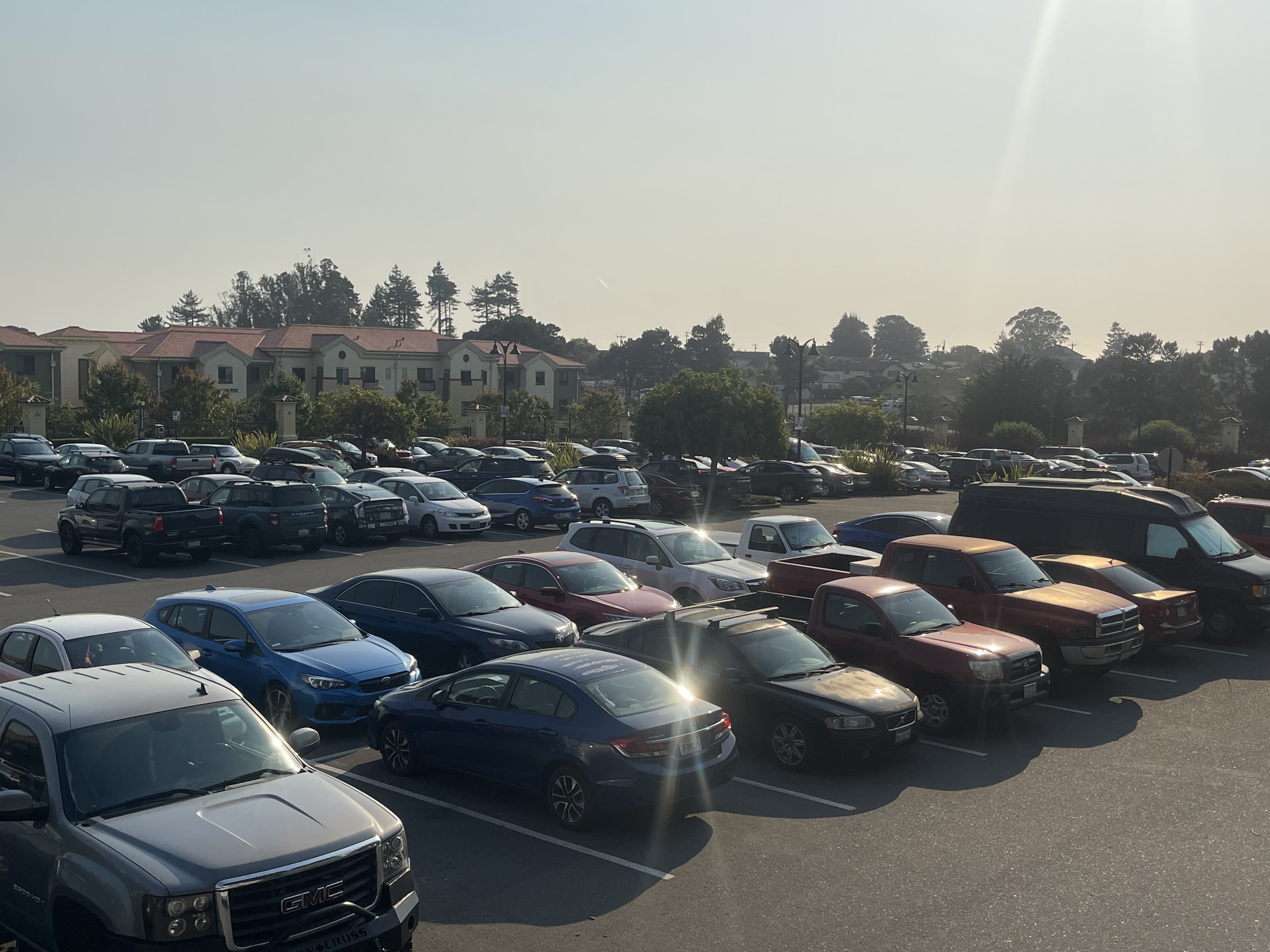
    Every day, Cal Poly Humboldt students drive through full parking lots past rows and rows of parked cars as they desperately and often fruitlessly search for the rare and elusive open parking spot. This is the result of the university selling an excess of both general and residential parking passes in tandem with an increase in students due to the school’s new polytechnic status. There are more active passes than there are permitted parking spaces on campus, with active passes including both semester and year-long parking passes.

    “I’ve heard from a lot of students that don’t live on campus that it can be hard to find parking unless you get here really early,” said Evan Vieira, a wildlife and conservation major. “I’ve known students who have gotten here only as late as 9 or 10 am and have not found parking.”  

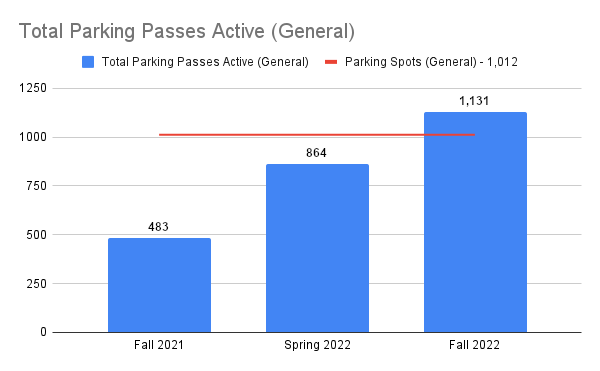
    A public records request revealed that, this semester, Cal Poly Humboldt oversold parking passes for both general and residential parking. As shown in the graphs, overselling parking is a growing trend across semesters, with 119 more general passes sold than there were parking spots, and 431 excess residential passes.

    “It sucks total ass,” said art education major Mikayla Nicholas. “I don’t personally drive but I have friends who do and it takes them at least 20-40 minutes [to find parking.] They sell way too many parking passes than they have spaces.” 

    The number of general parking passes sold has increased from last year. The number of active general parking passes increased by 79% from fall 2021 to spring 2022. The number of active general parking passes for fall 2022 has more than doubled since fall 2021, but the number of general parking spaces has remained the same. 

    Total active residential parking passes

    Meanwhile, sales of residential parking permits have stayed relatively consistent, being oversold each semester. In fall 2021 and fall 2022, 431 more passes were sold than there were spots for, and in spring 2021 the number rose to 579 oversold. Anyone with a residential permit that cannot find a space in resident-specific lots overflows into general parking lots. This further contributes to the lack of general parking.

    “I think it’s alright most of the time if you live on campus,” Vieira said. “I live in campus apartments so my car doesn’t move that often, so I’m typically in a parking spot.”

    While those who live on campus can generally find parking, students who drive to campus are becoming increasingly upset at the lack of available parking.

    “Horrible, absolutely horrible,” said Harrison McDonald, a wildlife management and conservation major. “Since I have an 8 am, I get pretty lucky, but when I don’t, it takes me anywhere from 10 to sometimes even 40 minutes if I can even find parking.”

    Many students are frustrated that they pay for general parking passes, only to have to pay for metered parking or to be unable to park on campus.

    “Humboldt for the year, you pay over 300 dollars for [a parking pass] and you’re not guaranteed a spot and you still have to pay for parking meters,” McDonald said. 

    Other students are frustrated by the message that they feel overselling parking passes sends. The university profits from parking pass sales, but has nowhere to put the extra vehicles. 

    “I did not know that [parking was oversold],” Vieira said. “I feel like that’s not great because then you’re kind of saying to a lot of students, ‘you can all park here,’ but then not actually having the spaces to give them parking.”

  • Here Are the Refunds Students Can Expect from HSU

    Here Are the Refunds Students Can Expect from HSU

    Refunds for various fees are available for Humboldt State students in the midst of the COVID-19 outbreak

    With closures and cancellations occurring left and right, many Humboldt State University students are wondering what kinds of refunds they can receive from the university. Here’s a list of them.

    Tuition and Fees:

    • Tuition and campus-based fees will continue on as normal for students that are taking courses from their professors to receive grades that factor into graduation.
    • If a student wants to withdraw from all spring semester courses, they must act by April 5 to be eligible for a prorated refund of tuition and fees.
    • Classes that students with financial aid are withdrawing from will be looked over and potentially adjusted based on the amount of days enrolled.

    Housing and Parking:

    • If students leave on-campus housing, they will get prorated refunds for both housing and dining fees once they check out.
    • Student parking permits will be automatically refunded back to student accounts to the tune of $78.75, 25% of the initial permit cost.

    Commencement:

    • Automatic refunds will be doled out to students graduating in spring or summer 2020. For more information, email HSU-cash@humboldt.edu
    • For unopened and unused regalia, refunds will be issued using the same method the order was placed with.
    • For the Graduation Writing Proficiency Exams on March 28 at 9 and 11 a.m. and April 11 at 9 and 11 a.m., all charges will be returned to the students’ accounts and refunds will follow if the student doesn’t have outstanding charges. Keep in mind that the GWPE is still required to graduate, and will be held online for the time being.
  • Parking Pisses Me Off

    Parking Pisses Me Off

    The trials and tribulations of finding parking on campus

    Parking on campus sucks. And I’m not the only one that thinks so.

    I try my best to walk or take the bus whenever I can. Sometimes I’m just too slow in the morning and have to drive to avoid being late. The problem is that between the hours of 9 a.m. and 3 p.m. it’s ridiculously hard to find an open parking spot on campus.

    Usually I end up parking on a residential street nearby. To put that into perspective, my apartment is a 21-minute walk from campus according to Google Maps. From where I usually end up parking, it’s an 11-minute walk to get to class. When I add the four minutes it takes to drive there, I only end up getting to class six minutes faster. Sometimes, that’s exactly what I need to make it to class on time.

    “If people have to pay even more for parking permits there HAVE TO BE SPOTS AVAILABLE FOR THEM TO PARK IN.”

    Parking Survey Response

    A 2018 study by Walker Consultants included an anonymous survey on the state of parking on campus. The full results of this study are available, and boy, a lot of people were mad about parking.

    “Prices as they are, are already ridiculous. One should not have to pay $315 a year to only find parking between 7:00-8:00 a.m and after 5:00 p.m.,” one person wrote.

    The survey had multiple respondents to the parking issue.

    “If people have to pay even more for parking permits there HAVE TO BE SPOTS AVAILABLE FOR THEM TO PARK IN,” another person wrote.

    In addition to the sentiments behind these two comments, a large number of the comments suggested building both on-campus parking structures and off-campus parking with shuttles to campus.

    One question on the survey struck a nerve with many respondents when it suggested the cost of parking passes may have to be raised in order to meet the demand. Many of the answers to this question were filled with colorful language.

    “What in the world do you do with all the money that you are unable to sustain the program without raising prices again?” one of the less expletive-prone respondents wrote.

    Another respondent offered to try and get the extra funds themselves.

    “Perhaps we can lobby the state for funds? I’ll go to talk to Jerry on behalf of HSU. Dunno if he’ll see me, but I’ll go,” wrote the hopeful respondent.

    Unfortunately, Jerry Brown is no longer our governor, so if this respondent had it in with Jerry Brown, that won’t work anymore. Even more unfortunate is that this is an issue that is going to take a lot of work from the school if it’s going to be fixed. It’s also likely that even if it is fixed, it’ll take longer than many of our students will be here. In the meantime, it’s still a great excuse for being late to class.

  • Arcata Committee Hears Parking Complaints

    Arcata Committee Hears Parking Complaints

    It’s not just Humboldt State that has a parking issue

    Arcata’s Transportation Safety Committee held its monthly meeting on Tuesday, in which they opened up for public comment on city parking restrictions.

    Netra Khatri, staff liaison of the committee and Arcata assistant city engineer, thanked the small crowd of about ten locals gathered in the City Council Chamber of Arcata City Hall.

    “We decided to make this meeting annual three years ago, where we can take public comments and hopefully make changes from input,” Khatri said.

    After discussing minutes from a previous meeting, the committee of eleven opened the meeting for public comment.

    The comments varied in severity and scale, but revolved around one central theme: the city of Arcata lacks sufficient parking.

    Arcata resident Vernon Price proposed a plan to allow some Arcata citizens to park their cars freely from dusk til dawn. Price said he was unhoused for 15 years, and wanted the committee to keep the homeless in their hearts and minds.

    “There are people who have lost their homes, and their only tangible property is their homes—and they live in those,” Price said.

    parking_map-avenza12-10-2015

    The committee noted Price’s suggestion and promised to look into designating overnight parking spaces.

    Arcata resident Collin Wingfield brought to attention a parking overflow resulting from the recent construction of the 142-apartment Sunset Terrace complex located between Sunset and Foster Avenues.

    Wingfield, who said he lives on Wilson St., just off of Sunset, has noticed an influx of Sunset Terrace residents parking their vehicles along Sunset Ave. and even on his street.

    Even though Sunset Terrace residents are allotted one parking space in their complex, Wingfield said residents often park their cars along Sunset Ave., leaving other homes with insufficient parking.

    “They will leave their cars parked for weeks at a time,” Wingfield said.

    The committee sympathized with Wingfield and discussed possibly issuing parking permits for Sunset Ave. residents.

    Arcata Library Branch Manager Susan Parsons brought to attention a lack of parking for library visitors. Parsons said parents with children often have to walk through a lot marked by uneven terrain and frequent drug users.

    “Parking for visitors of the library is an issue of safety,” Parsons said.

    In response, the committee suggested designating specific parking spots for the library or enforcing time limits on the spaces outside of the library to prevent them from filling with non-library visitors.

    Tisha Farrer, an employee of the North Coast Co-Op, urged the committee to get rid of parking meters and two-hour spaces. The Co-Op, Farrrer said, reserves its lot for customers only and employees often have to park far away.

    “I just want them to feel safe and have parking where they work,” Farrer said.

    The committee noted Farrer’s concerns while making clear that Arcata’s parking shortage comes at a tricky time as the city tries to encourage the reduction of personal vehicular use to reduce greenhouse gas emissions.

    TSC will now take the public comments and bring their recommendations to the Arcata City Council on Oct. 16. TSC meets the third Tuesday of every month at the City Council Chamber.

  • Parking & Commuter Services offer solutions to the parking problem

    Parking & Commuter Services offer solutions to the parking problem

    Students, faculty and staff are once again irritated with parking, even with the dip in enrollment this semester. Students who purchased the semester permit for $157.50 or the fall and spring permit for $315.00 are particularly vexed when they can’t make use of it consistently. The fact is Parking and Commuter Services oversells permits. TallChief Comet, Administrator of Parking & Commuter Services, says that when one flow of users hop into their vehicles and vacate space, the next flow of users compete for parking. In other words, the ratio of permits sold balances out with the inevitable schedule turnarounds. Additionally, the chances of developing more parking lots in the future are close to zero. In light of this recurring issue, Parking & Commuter Services encourages alternative modes of transportation to not only lower costs and reduce stress, but to reduce the carbon footprint. Alternatives include the JackPass, which offers free access on the Redwood Transit System, Eureka Transit System and Arcata and Mad River Transit System buses during the fall and spring semesters. Parking and Commuter Services are working with the City of Arcata to implement bike sharing-service Zagster next fall. Also, reconstruction of the G14 and G15 parking lots below the Behavioral and Social Sciences building will slightly increase the number of parking spaces and incorporate “smart” parking technologies to name a few improvements. The smart technology will involve space sensors that will allow permit owners to monitor parking space availability. Reconstruction is expected to start next summer and end before the subsequent fall semester. Vehicle owners who commute to the university within a mile or two of their residence should consider walking to school or taking advantage of said alternative modes of transportation. Participate and reap the rewards of sustainable practices in no time, including the cost of gas. Parking is likely to be an issue for years to come so students, faculty and staff must accept it for what it is and learn to work with the system until further changes can be enforced. In the meantime, there are underused programs available and other sustainable ways to get around town. Use the resources that are available to you. Visit parking.humboldt.edu for more details. Ride on.