The Lumberjack


Students Serving The Cal Poly Humboldt Campus and Community Since 1929

Tag: Play

  • The Life of Galileo delivers a spunky opening night

    The Life of Galileo delivers a spunky opening night

    by Alana Hackman

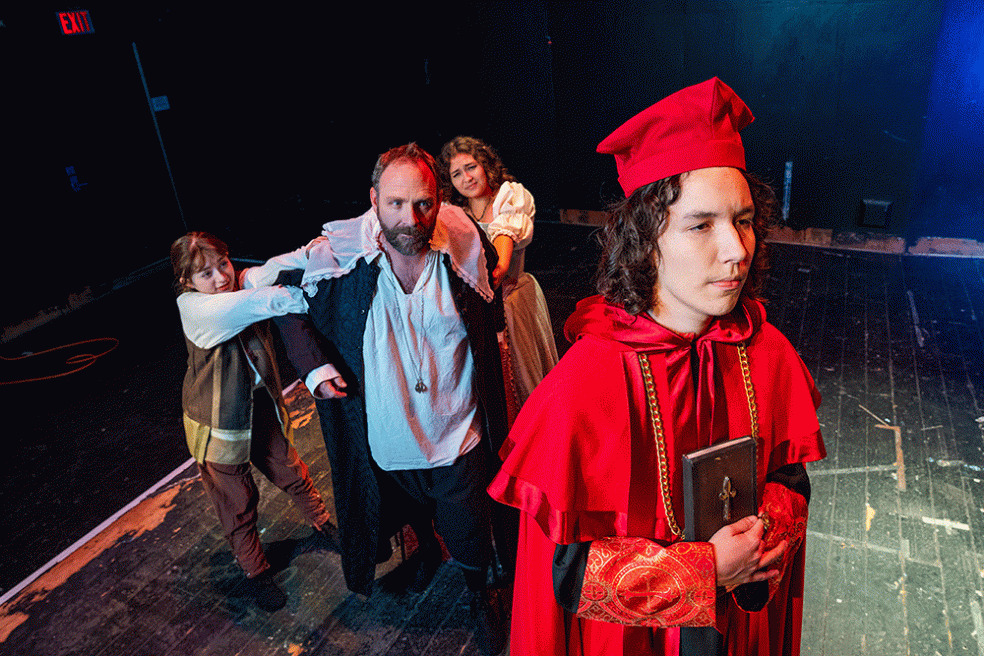
    It was a full house for the nearly two hour long production and helped feed into the performers liveliness. Cal Poly Humboldt’s Theatre Arts Department presented their fall semester play, “The Life of Galileo,” Nov. 3 in the Gist Hall black box theater.

    I had yet to attend a play at the black box in my time at Humboldt State, and I believe it has to be my favorite location so far. The stage was smaller and a lot more intimate. It was also a lot easier to hear the actors more clearly. 

    Immediately, the prop and set design caught my eyes. Working with such a small space, they were able to create multi-purpose prop designs to be used throughout the entire production, and create separate rooms and energies on such a limited stage. Bookshelves of Galileo’s scriptures and studies that doubled as Roman columns — and even circus tents when flipped around — were genius to me.

    The use of projections and other media really brought the whole production together. Like a silent film, they projected title cards on the castle walls to set the scene, which was a really creative way to occupy the crowd while stagehands moved props for the following scene.

    Even the stagehands added to the artfulness of the play. They were adorned in plague masks and cloaks to blend into the scenes, which kept things interesting during an otherwise liminal transition.

    Everything involved with props and set design was very thorough. Hanging planetary orbs and stars above the theater to back the play’s theme was gorgeous, as well as the creative use of such a small stage. A large brick castle with a spiraling staircase was tucked away in the background, and the use of hidden tables and raised platforms allowed for Galileo to easily bop around the stage. The production had no mics and was fully reliant on the actors belting capabilities, which proved successful. 

    Graphic by Griffin Mancuso.

    The cast seemed much larger than what I have seen in other productions put on by the theater department. The play itself was more comedic than I expected it to be, through youthful banter and sassy characters like Galileo’s pupil, Andrea, played by Jenny Campos. 

    Although I will say the humor does seem a bit dry and for a specific audience, which I myself was not a part of. The one-liners seemed reliant on historical knowledge and for more of an older audience.  One audience member continuously giggled throughout scenes in the first act while the rest of us remained silent, it felt I was missing something, or maybe we all were. 

    It wasn’t until the second act that I fully grasped the commentary of the play itself, a humorous meditation on the historical battle between religion and science, following Galileo returning from his near death experience after his scientific discovery that Earth was not the center of the universe. 

    The lead Galileo (Troy Lescher) had many asides within the show that seemed necessary for witty comments, but I feel they did fall a bit flat. 

    Although it took a bit for me to get into the play, the second act’s circus scene was fantastic. Actress Penny Dellapelle carried three roles in the production and was phenomenal. Her line delivery was hilarious and she really proved to be a firecracker on stage. Especially in her roles as the ballad crier in the circus performance and the snarky philosopher turning down Galileo’s scientific discoveries. The audience’s giggles also seem to reflect my opinion.

    Lake Terre’s playing of the Bursar of the University of Padua was also quite animated and entertaining to watch on stage, especially during his scenes where he was trying to avoid interaction with Galileo. Although, I will say some of his scenes with Galileo kind of skewed the curtain of acting and reality for me. 

    The acting of all cast members was quality work in nearly all of the scenes. Some of the more busy scenes really shifted the veil of reality and performance for me. Watching a group of callow, college-age actors surrounding the obviously decade-older lead threw me off a little bit, and made the production feel more juvenile and high school-esque than I was prepared for. 

    All of the characters within the play were seemingly near the same age, so watching a baby-faced Bursar or philosopher scold Galileo, an obviously older actor, made me snap out of the entertaining theater-goer energy quickly. 

    The production brought a modern commentary on the history versus religion theme. Projections of Elon Musk, Mark Zuckerberg and Bill Gates to describe “elite Italian families of the 1500s” was extremely comical. Also projecting images of COVID-19 deniers when discussing the relationship of science with the priest was super timely and the cherry on top of the production. 

    Overall, the Theatre Arts Department put on a spectacular production and really killed it with The Life of Galileo. Opening night brought lots of energy from the performers and a packed audience. The technical aspects really tightened the show up completely. The production’s ability to play off the recent historical events of science-deniers really lightened the mood in such historically dense productions. 

  • Radium Girls spins gold out of straw

    Radium Girls spins gold out of straw

    by Alana Hackman

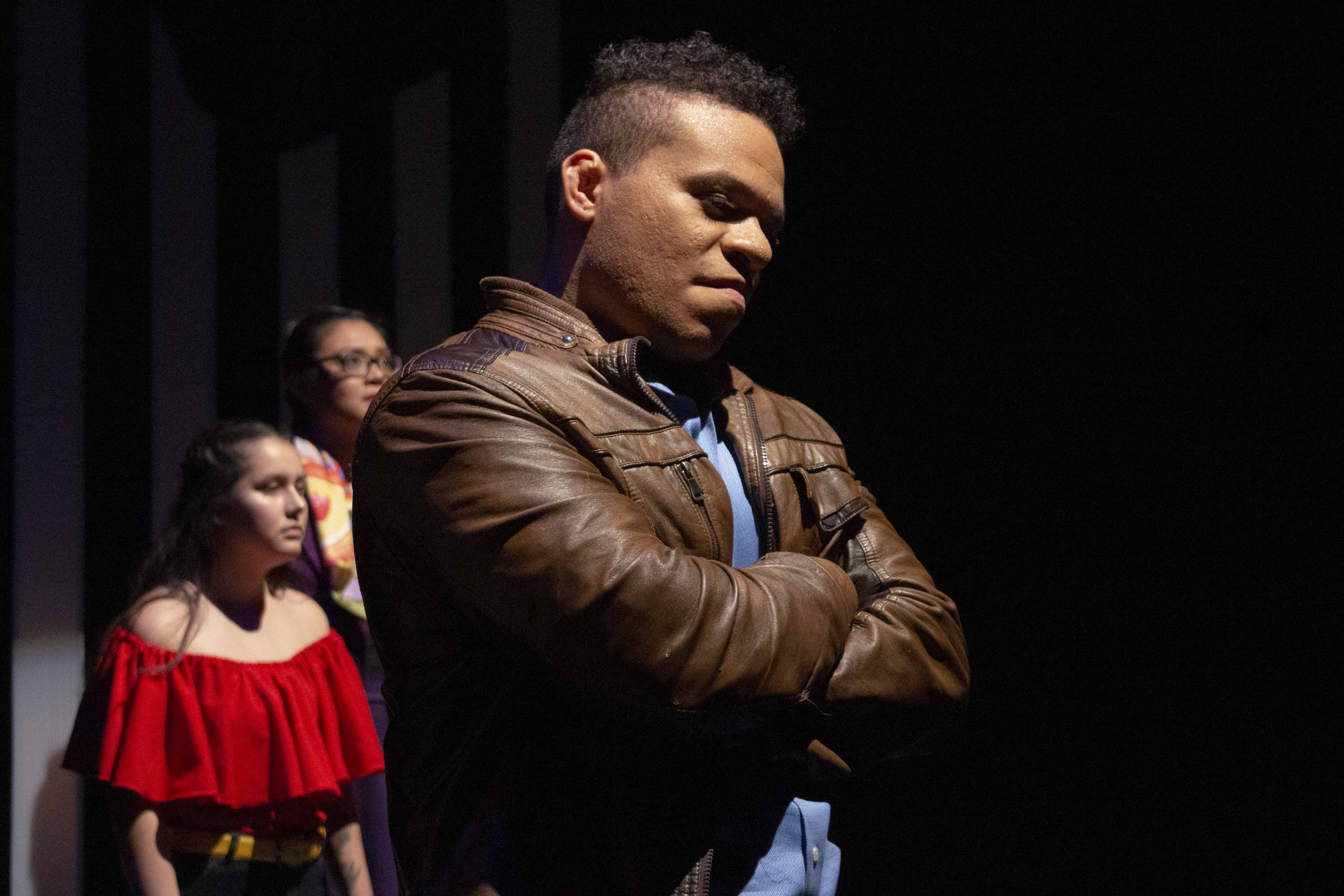
    When I discovered that the spring play would be Radium Girls, I was ecstatic. I had previous historical knowledge of the event and the TV show, but was unaware there was a play. The play was a meaty one at nearly three hours, but had impressive delivery by the all-student cast for such an emotionally charged story.

    The Theatre Department put on quite a well-organized performance, considering the main cast was only eight people. Each actor aside from the main protagonist, Grace, (played by Sophia Escudero) were playing up to four characters each. 

    One could look at the small cast, lack of props and scene changes as a dealbreaker for the production, but it only impressed me more. Cast members being involved in all of the moving parts is what really made Radium Girls so charming and applaudable. A majority of the scene changes were led by the cast members immediately after delivering lines. 

    There were no closed curtains and very few techies were spotted on the wings or stage throughout the show. The lack of props on the stage during most of the scenes really forced the audience to focus their attention on the actors’ performance. It seemed to me the cast and crew were able to work with what they had and still deliver a killer performance. 

    Krystie Obiso and Izzy Waring stood out to me the most with their performances. 

    With Obiso playing the parts of Irene, Miss Wiley, Board Member #2, and Mrs. Michaels, she put a firecracker spirit into every character portrayed. From her impressive transatlantic accents and strong emotional outbursts, she really had an enchanting stage presence even when playing side characters. 

    Waring also played a handful of characters including Mrs. Roeder, Madame Curie, Customer, and Board Member #3. Her performance as Mrs. Roeder is what wowed me the most; Waring’s ability to deliver such emotional anguish and distress of a wife discovering her husband’s negligence following the truth of radium’s negative health effects was not something I expected to see in a college play. 

    Obiso and Waring’s delivery really set the emotional ambiance of each scene and of Radium Girls as a whole. They really pushed the theme of women’s pain and truth being overlooked throughout history. 

    The set design was also very professional and clean looking. It had a lot of technical parts to really get an emotional reaction out of the audience, but was still simple. From the city skyline physically “closing in” to symbolize the truth about radium, as well as the white screen used as screen to play with light and impose the feeling of ‘time running out’ throughout the show. 

    I will say the one critique I had during my time as an audience member was the lack of microphones. I wasn’t able to tell if any of the actors were wearing mic packs and had a hard time hearing some of the dialogue, especially during what seemed to be vital conversations within the storyline, like the scenes between Grace and her mother. Same with stage blocking; sometimes a cast member would turn their back and be completely muffled out from the audience. This made following some of the intense dialogue on stage a bit harder, especially when accents came into play.

    When it comes to such a detailed and long play, I do wish the actors were mic’d up to make it a bit easier to follow. I can assume that the cast and crew were working with a tighter budget for this production, but it didn’t stop them from executing a successful opening night.

  • Dreams in Between

    Dreams in Between

    Cast and crew of “Dreamers: Aquí y Allá” shed light on complexities of immigration

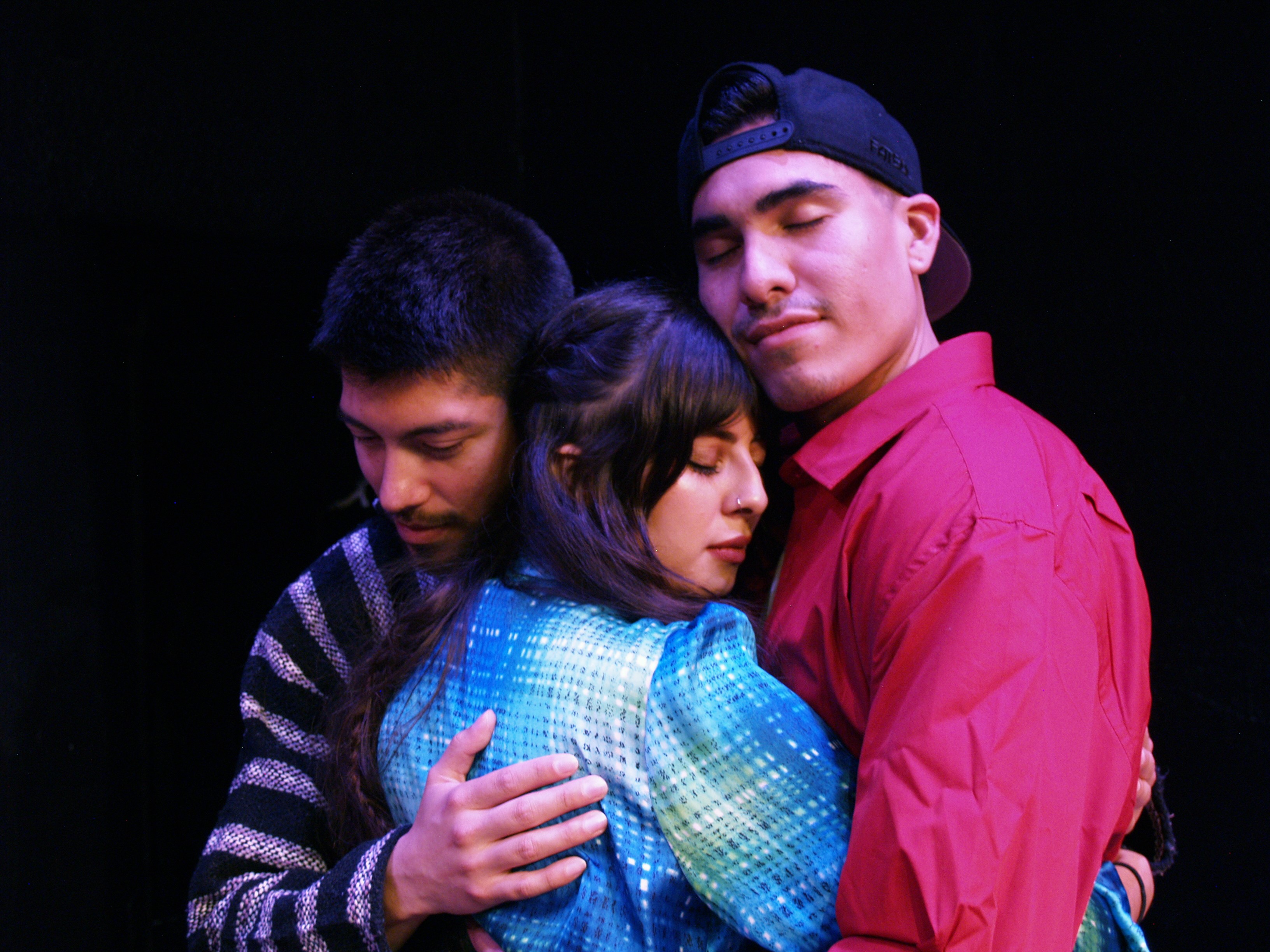
    The story starts in the blue and red lights that bathe a replica-sized model of a wall. Not just any wall, but The Wall, the most southern one that separates country from country, family from family and the hopes of migrants for better opportunities and life.

    In that obscurity, bodies shift and take steps until they’re center stage and in full view. They face you, you face them and under the spotlight, the stories of immigrants and Deferred Action for Childhood Arrival recipients begins.

    “Some of these scenes will break your heart because they show so much humanity,” Co-Director Andrea Carrillo said. “Humanity is such a great big theme within this story. You can’t help but connect and feel compassion for these individuals.”

    The Humboldt State University Theater Arts, Film and Dance Department presents “Dreamers: Aquí y Allá.” The script was written by Andrea Caban, her students, and a collaboration from source material provided by Armando Vazquez-Ramos and the California-Mexican Studies Center.

    Students in the California-Mexico Dreamers Study Abroad Program, DACA recipients and immigrant community members gave testimonials and interviews for the script.

    Troy Lescher, co-director and HSU associate professor, came upon the script in spring 2018 when Caban emailed the script to all 18 California State Universities in hopes they would produce the show.

    “I was blown away by the humanity of the story,” Lescher said. “As soon as I read it I said to myself, ‘We have to do this show at HSU.’ I mean, because of our social justice mission, commitment to minority voices on stage, how timely this issue is and this play had HSU written all over it.”

    The play follows the memories and lived experiences of immigrants and DACA recipients who then obtained advance parole, which gave them opportunity to travel to Mexico and reconnect with their culture and families.

    Carrillo said that they go through time jumps and include the audience as they break the fourth wall in various scenes from start to finish.

    However, circumstances prevented the play from happening until fall 2019. Lescher reached out to theater arts graduate students Carrillo and Amy Beltrán via email. They said that they were overjoyed about directing the play.

    “For me the biggest thing was to evoke empathy within the community because a lot of the community, as well as in Humboldt County, can be either on the middle ground or can be very conservative,” Carillo said. “These are human beings with their own experiences, their own love, their own families, and that was a big thing for me to show that to them.”

    But just as the directors were compelled to tell this story, so too were the actors.

    Business marketing major and theater arts minor Victor Parra, who plays Mateo, said he knew it was important for him to get involved when he heard about the script.

    “As an actor and artist this is the kind of stuff that catches my attention,” Parra said. “This is the kind of work that I want to do personally.”

    Parra said it’s important to remember that the play is a cumulation of many stories, real stories, and that these are real people who struggle everyday. These were stories close to him because he experienced similar struggles back home.

    “We have to keep working to give spaces for minority voices to be heard, especially voices that aren’t heard very often.”

    Troy Lescher
    Co-director

    “I brought a lot of personal past into this and it was my own decision,” Parra said. “Nobody asked it of me, but because I relate to this.”

    Parra plays Mateo, who in the play fears being deported and leaving his child and mother behind. He said that is what happened to him when one of his parents was deported not too long ago, and he brought those feelings into the production.

    “I envision my own family,” Parra said. “That’s what I just had to bring to the table because it’s so important. We need to say this. We need for our voices to be heard and something needs to happen.”

    Lescher knew that he wanted to encourage and open the production to more students, so he reached out to El Centro Académico Cultural Coordinator Fernando Paz, Interim Executive Director of the Office of Diversity, Equity and Inclusion Edelmira Reynoso and Multicultural Center Coordinator Frank Herrera.

    The result was that out of 11 cast members, six of them were non-theater majors and four of them performed for the first time.

    “This story hits differently,” Carrillo said. “It resonates differently with people. It’s such an immediate connection with a lot of Latinx people and people of color. It made sense that we had so many new faces in the theater.”

    Lescher said that the challenges DACA recipients struggle with is a big part of the conversation, because their voices are often unheard or aren’t highlighted in the news.

    “We have to keep working to give spaces for minority voices to be heard, especially voices that aren’t heard very often,” Lescher said.

  • ‘Dreamers: Aquí y Allá’ Preview

    ‘Dreamers: Aquí y Allá’ Preview

    Theater Arts Department presents a production that transcends borders

    The room is dark, the audience silent. On stage, right before your eyes, a story begins to unfold. Actors stride onto the set, and within seconds, they transport their audience into a world that deals with fears of family separation, job loss and deportation.

    But that world is reality, as the actors break the fourth wall and address issues for immigrants and Deferred Action for Childhood Arrivals recipients.

    “I read the script and I thought, ‘Wow, this needs to be told,’” Co-Director Andrea Carrillo said. “I know that there’s a good portion of undocumented people living in Humboldt County as well. It’s a great way to show the community that we see you, we hear you and we want to do what we can to share your experiences and your voices on stage.”

    Humboldt State University’s Theater Arts Department will premiere a production of “Dreamers: Aquí y Allá” this weekend and next. The show features testimonials and interviews from students in the California-Mexico Dreamers Study Abroad Program, DACA recipients and community members.

    “I’d say for people who have heard the story and don’t necessarily connect with the politics, I’d say, stay open minded about it. You never know what you might experience or learn. You might surprise yourself as an individual.”

    Andrea Carrillo

    The production is co-directed by theater art graduate students Amy Beltrán and Carrillo along with Assistant Professor Troy Lescher. “Aquí y Allá,” first produced at California State University, Long Beach, was written by Andrea Caban and presented as a collaboration between Caban, her students, material provided by Professor Armando Vazquez-Ramos and the California-Mexico Studies Center.

    “This is a story that needs to be heard. You need to be here and sit with it and listen intently and openly as well,” Carrillo said. “I’d say for people who have heard the story and don’t necessarily connect with the politics, I’d say, stay open minded about it. You never know what you might experience or learn. You might surprise yourself as an individual.”

    “Aquí y Allá” opens Dec. 6 in Gist Hall Theatre and continues Dec. 7, 12, 13 and 14 at 7:30 p.m. There will be a matinee at 2 p.m. on Dec. 15. Tickets are $10 for general admission and $8 for student and seniors. For tickets, visit the Center Arts website or call 707-826-3928.

    After the show on Dec. 6, representatives from HSU’s Scholars Without Borders and Centro Del Pueblo will present on DACA initiatives. Following the shows from Dec. 12 through 14, Professor Vazques-Ramos will present a 30-minute lecture called “Dreamers 2020: What’s Next?” followed by a Q&A.