The Lumberjack


Students Serving The Cal Poly Humboldt Campus and Community Since 1929

Tag: Police

  • Cal Poly Humboldt faculty criticize administration for policing pro-Palestine protest

    Cal Poly Humboldt faculty criticize administration for policing pro-Palestine protest

    by Alana Hackman

    Cal Poly Humboldt students, faculty, and community members joined a virtual University Senate meeting on Tuesday, April 23. 

    “There is considerable interest in engaging with the open forum today. More than is likely to be possible, given due to time constraints,” meeting leader James Woglom said. “Given that, we’re going to prioritize guests. If you are a senator and we are unable to get to you today, I do apologize.”  

    Woglom then continued to introduce senators present in the meeting that evening, including Provost Jenn Capps and Chief of Staff, Mark Johnson, who would be present on behalf of the university president, Tom Jackson.

    Senator and graduate coordinator of the sociology department Mary Virnoche proposed the upcoming agenda be edited. Virnoche proposed a discussion item to be inserted into the agenda to receive an update on the campus response to the current protestors occupying Siemens Hall. No senate members objected. 

    Woglom began the discussion by citing their own experience observing the protest last night. They mentioned speaking with other individuals earlier in the day to discuss how they can make progress to meet the needs and demands of those occupying Siemens Hall. 

    Woglom then called for any member of the campus faculty or community to share any up-to-date information they may have regarding the current occupation. Each speaker was allocated a three-minute time limit.

    “I had a meeting with [Chrissy Holliday] right before this and it seems the current concern is that there [are] confidential documents in Siemens Hall,” Parker said. “So far, no one has made an attempt to reach those. If that continues, it sounds like they’ll be fairly hands off.”

    The open forum discussing the current state of the Siemen Hall occupation continued with Jamela Hashim, a social work student who was currently joining from a smartphone with other senate meeting attendees, Gabi Kirk of the geology department, and Janet Winston of the English department. All mentioned they were currently outside of Siemens Hall.

    Hashim urged meeting attendees that it was vital to address that internet services have been cut off within Siemens Hall so nobody inside would be able to comment. 

    “That seems like a bias that should be addressed in some way,” Hashim said. 

    Wolgom acknowledged the statement and encouraged protestors inside of the hall should text outside sources information they would like to be relayed during the meeting. 

    The proposed discussion by Virnoche lasted until about 4:12 p.m., until it was cut off to discuss the UPRC budget, CR/NC deadline, and Faculty Awards. 

    As the discussion unfolded many faculty, students, and community members spoke up about supporting the student protestors’ requested demands and urging for a ceasefire. 

    “Here at Cal Poly Humboldt, we pride ourselves on being student-centered and guiding our students’ academic journeys towards careers that will usher in a brighter and more empathetic world grounded in values of justice, diversity, equity, and inclusion,” said Kelly Fortner, Community-based learning faculty. “If we want to hold true to those values, as a university and campus community, we need to meet the demands of our students and make a stand against genocide.” 

    On the frontlines of the sit-in, Kirk and Winston used their three-minute speech slots to read a three-page letter collectively written by faculty deploring the University administration for the use of police force, and standing in solidarity with student protestors. As of now, the letter has 164 signatures from staff, students, and community members. 

    “We call on Cal Poly Humboldt to reflect on the real harm this crackdown on free speech inflicts,” the letter states. “And the message it sends to current and future students, their parents, faculty, and staff, and our communities within and beyond Humboldt”

    Following that, Chief of Staff Mark Johnson made a statement on behalf of the university and President Tom Jackson. Johnson encouraged meeting attendees to share possible ways they can move forward from the current events of possibly 40 to 60 protestors currently occupying Siemen Hall.

    Johnson explained that the students inside Siemens Hall were offered on several occasions to exit the building and protest in the quad or somewhere else suitable for them. He then explains that their denial to do so then equates to trespassing on public property. 

    “They refused that offer and insisted on occupying and effectively shutting down the nerve center of the campus,” Johnson said. “I think all of you understand what happened yesterday as we went through actions to try to remove those protestors who were effectively trespassing in the building.” 

    Johnson also commented that the police force was removed after the realization it was inflaming the situation rather than aiding it. Johnson mentions there are planning efforts moving forward to communicate with the protestors inside the building and provide a more peaceful and secure environment to the other students on campus. Johnson then opened the floor for constructive criticism on how to move forward with current events after reiterating that the police force involved was once again a result of the students refusing to protest in a content-neutral way. 

    “The president’s administrative team and President Jackson are making operational decisions based on real-time information about what is happening around voting and on campus,” Johnson said.

    California Faculty Association (CFA) president Marisol Ruiz laid out recommendations for moving forward on behalf of the CFA. Her requests included not prosecuting anyone involved, showing support for students’ organized efforts for Gaza, and rejecting the use of force and policing. Ruiz also called for a statement from Tom Jackson and Jenn Capps. 

    “The lesson should not be in the sacrifices that have to be made for advocacy but about the possibilities we find there for solutions,” Ruiz said.

    Geology professor Jim Graham followed Ruiz’s statement with a request for possible outside sourcing of an arbitrator to speak to the current protestors. Graham also reflected on the student sit-in in 2015 in regards to Native American Studies professor, Jacquelyn Bowman’s termination. Giving student protestors credit for their organizational abilities and dedication during that event.  

    Another attendee, Katie Koscielak the sustainability analyst at Cal Poly Humboldt then questioned if any of the student protestors’ demands were being met. A list of the demands had been circulating around social media. 

    Woglom spoke before Johnson stating that they are currently working with the students to make their demands more concise. Woglom and Johnson mentioned specifying the investments within the demands of the university can make them more achievable. 

    “The investments at the system level, at the state level, are not under our control in any way shape, or form,” Johnson said. “We do have some investments as part of the endowment and to add to James’ point we are looking into those investments, those portfolios to make certain that we understand what if, if any, percentage of those investments are already in better, broad terms, defense contractors.” 

    Johnson continued to state that President Jackson would not be making any statements in support of or against any political opinions or subjects. 

    “With regard to having a war or causing a ceasefire, causing the United States to divest in broader terms, those are things really outside of the control of anybody here on campus, and therefore are not actionable or realistic for the university to consider as demands to be met,” Johnson said. 

    After Johnson’s final comment, concerned community members shared their thoughts on the University’s handling of the student protestors. Concerns were made surrounding words used to villainize the protestors, hygiene following campus closures, and the overall prioritization of property safety over people. 

    One community member Genevieve Ameduri shared a strong message of disdain of the university’s call for policing the student protestors. Ameduri explained that she and her husband have recently moved to Arcata and adopted three Palestinian children who are hopeful to attend Cal Poly Humboldt in the future. She explains seeing a student hit over the head by police in riot gear in the first fifteen minutes of attending the protest was extremely upsetting and made her question the University’s priorities. 

    “Our children have the decency and the heart to stand up and we put them in violent outcomes, it’s unacceptable,” Ameduri said. “I am ashamed of all of you who have not spoken up and stood with them.” 

  • Local manhunt for homicide suspect ends with arrest

    by Sophia Escudero

    After one week at large, the suspect in a Kneeland homicide was taken into custody on April 10. Austin Michael Medeiros, 27, of Rhode Island, had been the subject of a search involving the Humboldt County Sheriff’s Office, California Highway Patrol, Arcata Police, and University Police following the suspicious death of a Kneeland woman, 28-year-old Emily Rose May Lobba, on April 3. Medeiros was apprehended in Santa Cruz attempting to steal a boat and was transferred to the Santa Cruz Police Department. SCPD officers found a stolen loaded gun and psychedelic mushrooms in Medeiros’ possession during a search.

    Official mugshot of Austin Michael Medeiros take April 10.

    On April 3, a caretaker arrived at Lobba’s residence and was denied entrance by Medeiros, leading to an argument. According to the caretaker, Medeiros and Lobba knew each other and had been spending time together the time prior to the incident. Medeiros assaulted the caretaker and fled the scene in Lobba’s vehicle, and the caretaker found Lobba deceased inside the home and contacted the authorities. A car chase between Medeiros and law enforcement ensued, ultimately resulting in Medeiros fleeing on foot into the Arcata Community Forest.

    Poppy Cartledge, a journalism student, witnessed the chase, driving to a sporting event with her partner when she heard police sirens and pulled over.

    “This van came right at us and swerved into our lane, and at first I thought it was a civilian driving, like, ‘ah, I gotta get out of the way real fast,’ but I realized they weren’t gonna stop, and then they ran the stop sign, and at that point I realized, this was a chase,” Cartledge said. “At that time, I thought it was just something with drugs, but it was crazy to find out it was a murder.”

    This case is particularly close to the campus community after an alert to the student body informing them of a search in the Arcata Community Forest, followed by an update just two hours later saying that the search had ceased. Still, the suspect had not been found.

    According to interim chief of University Police Peter Cress, the Sheriff’s Office had handled the majority of the search.

    “We had one unit on duty that day, one officer, and when the pursuit finished up on Fickle Hill Road and it was reported that the subject had fled into the woods, our officer on duty, Sergeant Carpenter, went up to Redwood Park and asked folks to stay out of the park,” Cress said. “Obviously, if the suspect had run through the park, he would have detained him or gone after him, but he was mostly there just to keep people out of the park at that time.”

    The search was conducted from about 11 a.m. to 3 p.m and involved multiple ground crews, ATVs, and K-9 units. Officials called off the search when the suspect could not be found. According to Sheriff’s Office public information specialist Samantha Karges, it is believed that the suspect had fled the area soon after escaping the chase.

    “It’s my impression that he got out pretty quickly,” Karges said. “A lot of the time people won’t hang around where they escaped. They know it’s a hot area, people are going to be looking for them, and they want to get out of town.”

    It’s believed that Medeiros escaped to Santa Cruz by hitchhiking. No related violent incidents or injuries were reported during Medeiros’ time as a fugitive. Still, Karges urges members of the campus community always to be careful.

    “You could be a victim of a crime at any time,” Karges said. “It’s really important that we are aware of our surroundings, who we’re hanging out with, where we’re going, what we’re doing, those sorts of things. I know in university, we meet a lot of people, we make risky decisions when we’re young, so really think through who you’re getting in a car with, whose house or room you’re going to. Be cautious of new people, and get to know them before you invite them where you live or get into a car with them. Just use an abundance of caution.”

    Medeiros is currently being held in the Santa Cruz County Jail on charges of grand theft, carrying a loaded stolen firearm, and possession of a controlled substance. He ispending extradition to Humboldt County on charges of murder, evading an officer, assault and battery, and possession of a controlled substance. The bail is at $1 million.

  • Troubled police recruitment at Cal Poly Humboldt

    by Carlos Pedraza

    The Cal Poly Police Department has a total of eight vacant spots in its organizations: two administrative, three dispatchers, one officer, and two sergeants. The CPD has enough staff to work all necessary operations, but this significant gap in positions and recruitments is now common throughout the nation.

    Sergeant Chance Carpenter has noticed fewer people willing to become officers. The College of the Redwood police academy has also had lower recruitment.

    “When I went to an academy in 2006, approximately 27-28 graduated from that police academy,” Carpenter said. He explained how the current number of graduates has dropped to only twelve at an academy that once graduated over double the members yearly. Carpenter added most law enforcement is having staffing issues, not just the ones in Humboldt. Speaking of his feelings, Carpenter feels some portion of society is less supportive of law enforcement.

    Black Lives Matter protests and reaction to police violence changed the public opinion on policing. A recent Black History Month protest in the Arcata Plaza articulated community concerns regarding police officers.

    “I think society should always be critical of professionals that offer services,” said Carpenter in response to questions about the change in the public view of police. Carpenter explained in his view that law enforcement should be invested in their communities and positive changes in policing should be supportive.

    There is still a disconnect between students and the CPD despite Carpenter’s hopeful sentiment. Cal Poly Humboldt freshman Elaina Wargala expressed her feelings about law enforcement.

    “I think that a portion of society may be less appreciative of the work law enforcement does,” said Wargala. She expressed her own discomfort with law enforcement in general.

    “I think a lot of people take advantage of their position,” Wargala said.

    The disconnect between campus law enforcement and the student body makes it difficult to maintain staff and even harder to hire new staff. Despite the high number of vacant positions, the CPD has still been able to maintain operations successfully.

  • Hunt for new police chief continues despite adversity

    by Carlos Pedraza

    Cal Poly Humboldt is struggling to find a new police chief in the wake of yet another resignation

    For the last two years, Cal Poly Humboldt’s University Police Department has been plagued with resignations at the very top of their hierarchy. Anthony Morgan, the most recent chief, resigned early in Jan. 2022 after a year in the position.

    UPD is still in the early stages of searching for a new chief.

    “Cal Poly Humboldt has not yet made the public announcement for accepting applications,” said Grant Scott-Goforth, a communication specialist in the CPH’s News and Info department.

    The search for UPD’s next leader will be nationwide. Representatives from different university sources will be involved in the decision, including students, faculty, and university police department staff.

    “The University aims for a July 1, or sooner, start of the new permanent chief,” said Scott.

    Morgan was only the latest chief of the campus police to resign. Cal Poly Humboldt’s current acting chief of police is Peter Cress, a 25-year police veteran. He started his career at what was then Humboldt State before moving to Sacramento, and eventually returning to UPD in 2021. Cress stated he will likely apply to become the permanent chief of police.

    Even if the position is filled, the UPD has barely enough officers to be fully staffed. With a more critical eye on police nationwide, the UPD is struggling to maintain leadership and swear in new officers.

    “A lot of people have just said no, they are not interested in living under that kind of criticism,” said Cress.

    For students interested in giving their input for the hiring process or for UPD, the police conduct bi-weekly phone calls with students. The university directory also provides all officers’ contact information, and the general UPD contact number is 825-55-55.

  • It’s not just the Capitol Police

    It’s not just the Capitol Police

    As the world watched from their televisions on January 6, we witnessed scenes unfold before our eyes that were, to many, unimaginable: supporters of President Trump swarmed the steps of the U.S. Capitol Building, then proceeded to break in and advance as far as the Senate Chamber. 

    In the build up to the attack, Trump and his allies delivered speeches near the White House reaffirming his baseless claim that the election was fraudulent and that they must fight to overturn the election results.

    As rioters made their way past the barricades and through the doors, one thing was clear: at the time of the attack, there were few attempts made by police to stop the rioters. This comes as a sharp contrast to the Black Lives Matter protests that took place just this past summer, in which peaceful protestors were frequently met with violent police intervention.

    According to The Armed Conflict Location & Event Data Project that took place May 1 to November 28, 2020, Black Lives Matter protesters were significantly more peaceful than right wing groups, but law enforcement resorted to using force in 51% of Black Lives Matters demonstrations they engaged with, while only restoring to using force in 34% of right wing demonstrations they interacted with during the same period. 

    These statistics confirm what many activists already knew. The Lumberjack has documented the Eureka Police Department using more force against protesters in Eureka this past summer than the capitol police used when an attack was made against the capitol. The police use more force against journalists documenting protests than when right wing groups raided the capitol building. 

    On January 6, it took the National Guard four hours to deploy from the D.C. Armory from the time that the mob began making their way from where Trump was speaking. In contrast, in June at the height of the Black Lives Matters protests, there were about 1,700 National Guard members from Washington D.C. alone who were mobilized to respond to the demonstrators. 

    The feeble response from authorities in Washington D.C. to the attack on the Nation’s Capital is another undeniable example of racial biases that remain alive and thriving in this country. Our police protect white domestic terrorists and continue to endanger the lives of Black protesters advocating to have their voices heard and their equality recognized. 

    It is a message to all of the activists who choose to speak out against police brutality and all the journalists who cover the efforts of activists. Even here in Humboldt County activists face police brutality for daring to ask for an end to police brutality. Meanwhile, police open the gates across the country for violent extremists. The department might be different, but the institution is the same.

    It will take a dramatic institutional change in how the country approaches law and law enforcement to begin to dismantle the structure of white supremacy. The attack on the capitol showed the world that the institutions of law in D.C. need to change, but we have the same institutions here at home. Humboldt needs to change, too.

  • Eureka Protests Erupt After George Floyd Murder

    Eureka Protests Erupt After George Floyd Murder

    Eureka protesters gathered in front of the Humboldt County Courthouse

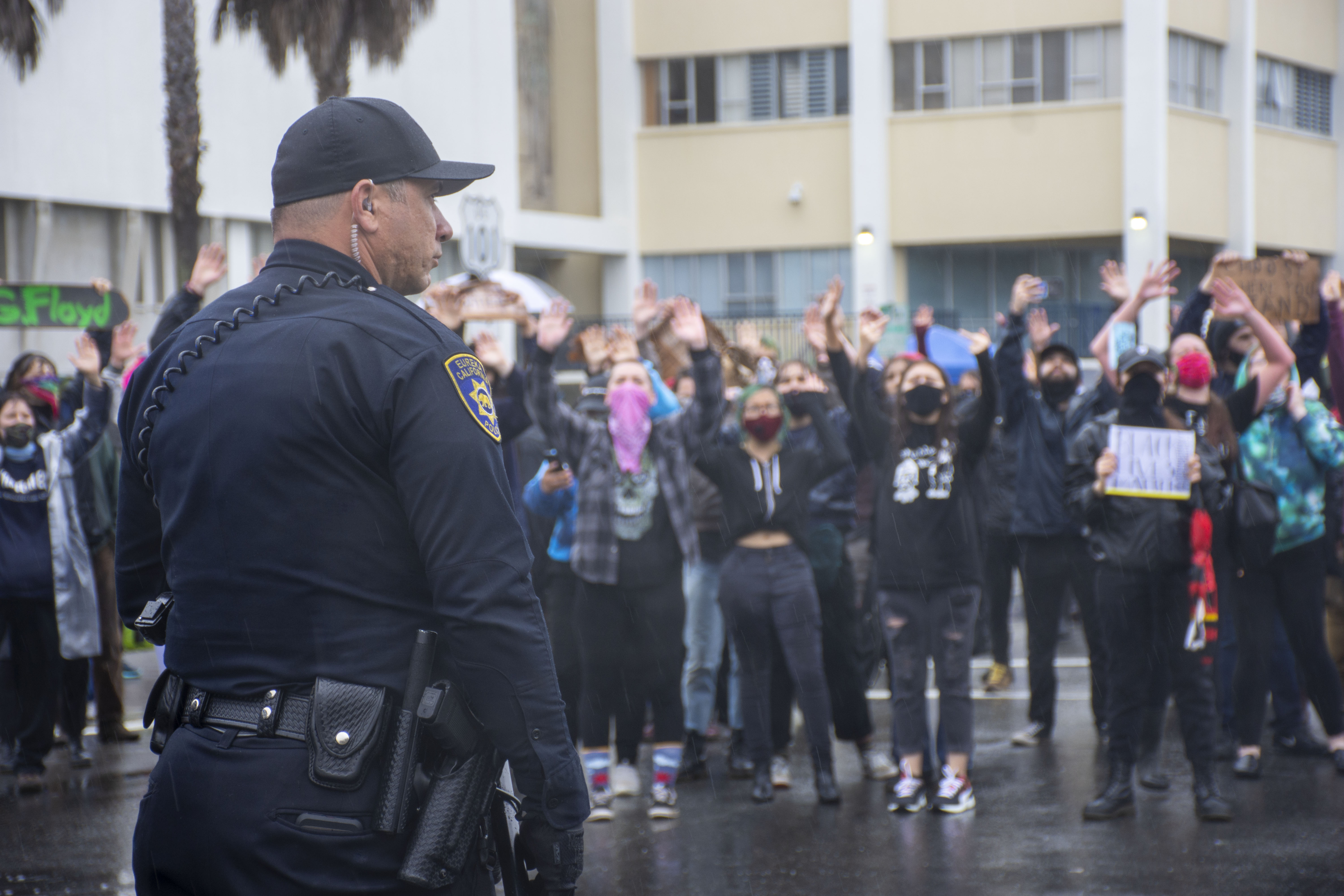
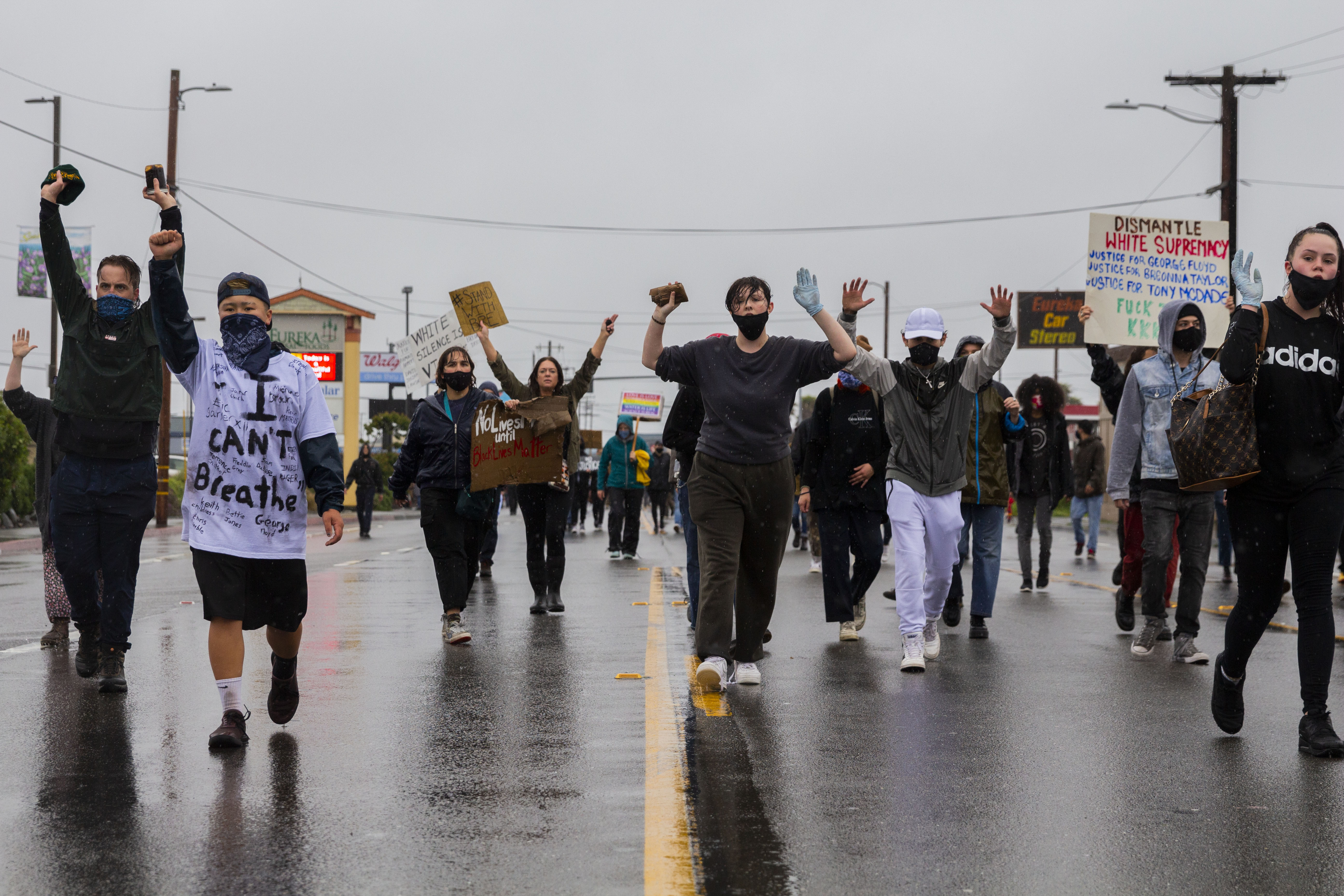
    Hundreds of community members gathered in the rain outside of the Humboldt County Courthouse, Sat. May 30, to protest the death of George Floyd who was murdered while in police custody in Minneapolis, MN. From 3 to 10:30 p.m. demonstrators marched through Eureka up to the Slough Bridge, back through town and then down Broadway. Law enforcement was largely cooperative with demonstrators, blocking intersections as people made their way through traffic. Chants could be heard the entire way even as groups split up and went to various parts of the city. 

    As the group returned to the courthouse tensions flared at the sight of several police vehicles, which were soon removed from the scene. Eureka Police Chief Steve Watson was present at the protest and spoke with demonstrators as the crowd dispersed and headed away from the courthouse. These demonstrations in Humboldt are some of countless that have sprung up across the nation following Floyd’s murder. 

  • UPD Sergeant Speaks Out

    UPD Sergeant Speaks Out

    Officer John Packer recounts racist remarks from UPD Chief Donn Peterson

    In August, nine of 10 University Police Department officers made votes of “no confidence” in Chief Donn Peterson. Now, UPD Sergeant John Packer has released a statement detailing some of the racist remarks made by Peterson to Packer.

    In one instance, Packer was in an evaluation meeting with Peterson and UPD Lieutenant Melissa Hanson. Hanson told Packer that she and him weren’t friends and never would be. Packer didn’t know what that had to do with the evaluation, but he agreed.

    Then Peterson escalated the situation, according to Packer.

    “It went right from the first statement of me saying ‘I agree’ to him saying, ‘You know, John, you’re obligated to work as a slave unto his master,’” Packer said. “’And I’m like, in my head, ‘What the heck?’”

    Packer said the next morning, Peterson made another comment to him while walking in the hallway.

    “He says to me, ‘Hey John, I can say that because we both read the Bible,’” Packer said. “And now I’m speechless. So now you’re justifying what you said last night?”

    John Packer shows his Sergeant’s badge. Packer has been a police officer for 26 years. 16 of which have been with UPD. | Photo by Deija Zavala

    Earlier this month, Packer, who is the only African American officer on Peterson’s staff, wrote a statement distributed by the Statewide University Police Association detailing Peterson’s remarks.

    However, Packer said before he released his statement, Peterson purposefully moved him to graveyard shift. According to Packer, sergeants have priority pick of shifts, but on Aug. 28 Packer was moved to graveyard under the guise of a Personal Improvement Plan.

    Packer told the Lumberjack that the PIP listed two reasons for the shift change: compliance with university procedures and documentation, and maintaining a professional and equitable relationship with all members of the UPD team.

    According to Packer, Peterson wrote on the paperwork that he suspected Packer’s “inability to perform” in the first reason was closely tied to the indifference Packer demonstrated in the second.

    Packer, an HSU graduate, has lived in Humboldt for nearly 40 years. He served with the Arcata Police Department for 10 years before coming to UPD. He has been with UPD for 16 years.

    After serving under seven police chiefs during his 26 years as an officer, Packer said that although he has faced racist comments from people in the workplace and some he has arrested, he has never faced such consistent racism from a superior.

    Packer’s statement was released in response to statements made by Peterson in interviews with the North Coast Journal and the Times Standard. According to Packer, Peterson’s claims of misinterpretation of his statements are insulting and do not excuse his actions.

    Although he has faced racist comments from people in the workplace and some he has arrested, Packer said he has never faced such consistent racism from a superior.

    Packer said six to nine months after the first incident, Peterson, while frustrated, made another comment.

    “He said, ‘John, you’re like dealing with the North versus the South,’” Packer said. “And I’m like, okay, I have no idea what you mean by that. I’m not going to get into that.”

    Packer wrote that such remarks have only become worse over time.

    “Chief Peterson has become more emboldened over the past four years, and moved from making private remarks in our meetings, to demonstrating obvious displays of racism and contempt towards me in whatever audience is available,” Packer wrote.

    SUPA’s press release came almost a month after the nearly unanimous vote of no confidence, and Packer’s statement came soon after.

    In the statement, UPD Officer Billy Kijsriopas accused Peterson of frequent absenteeism, manipulation of crime statistics and the creation of a hostile work environment that included racial slurs.

    The statement also noted that Peterson left his previous job with Florida’s Broward County Sheriff’s Department “amid scandal.”

    “Chief Peterson has become more emboldened over the past four years, and moved from making private remarks in our meetings, to demonstrating obvious displays of racism and contempt towards me in whatever audience is available.”

    UPD Sergeant John Packer

    According to a 2015 article from a Florida news channel, Peterson was involved in a scandal in which multiple department officials used impounded vehicles to avoid toll fees. The Broward Sheriff’s Office was eventually assigned to investigate itself and no arrests appear to have been made.

    Peterson denied the recent UPD allegations last month over the phone, but said he supported the investigation as he wanted to strive for transparency.

    Peterson declined to comment for this story, and instead referred The Lumberjack to HSU Director of News and Information Aileen Yoo, who then forwarded an email from Vice President for Administration and Finance Douglas Dawes.

    In the email, Dawes said HSU has retained the Office of Independent Review, an independent law enforcement firm, to investigate the allegations.

    “Out of respect for the process, which could take several months, I have asked Chief Peterson not to comment further until the investigation has concluded,” Dawes said.

    SUPA President Jeffrey Solomon said over the phone that it wouldn’t be fair for him to comment on the investigation either, as he called it a local matter. However, Solomon acknowledged what he called “an overwhelming amount of information” that has come forward.

    “I have no reason not to believe those officers and their allegations,” Solomon said.

    The SUPA Facebook page shared articles from the Times Standard and Lost Coast Outpost on Friday, Nov. 8, about the vote of no confidence and the retention of the OIR.

    A Humboldt State University University Police Department vehicle on Nov. 10. UPD Chief Donn Peterson is curently under investigation for the use of racist slurs, frequent absenteeism and the manipulation of crime statistics. | Photo by James Wilde

    Despite the events of the last two months, Packer said the UPD office environment does not feel awkward or uncomfortable, as the department already made a vote of no confidence before Packer shared his experiences.

    “It’s not awkward right now amongst the officers and dispatchers because we already knew that we had a consensus before I released my statement,” Packer said.

    Packer returned to the office, and normal day shifts, after several days off on Nov. 7. It was Packer’s first time since the release of his statement.

    Thus far, Packer said no words have been exchanged between him and Peterson.

    “I got a nod, and you know, that’s fine,” Packer said. “But no conversations so far. Nothing negative happened.”

    Packer said Peterson has always been very professional in public. However, Packer said he has begun to be critiqued through department emails.

    “Included in that email will be, you know, ‘We still have divisiveness in the department and you’re still at the center of that and I need you to own the fact that you’re the center of that,’” Packer said.

    Packer said Peterson has also berated him to other officers behind his back.

    Packer said interviews with the OIR are coming up in a few weeks, and he hopes the investigation will examine and validate the allegations and bring them to HSU.

    “They will put together a packet for the University—I assume that will go to the vice president,” Packer said. “These are the things that are inherently prohibiting this police department from functioning professionally.”


    Full Statement from Sgt. John Packer:

    My name is John Packer and I have served under seven Chiefs during my 26 years as a police officer in this community and currently serve as a sergeant at the University Police Department (UPD). I am the senior police officer in the department and have served under Chief Donn Peterson for approximately five years. I am the only American of African descent serving at University Police Department under Chief Peterson.

    I am compelled to share my experiences after reading Chief Peterson’s statements in the October 11, 2019 online issue of the North Coast Journal and the October 14, 2019 online issue of the Times Standard. Chief Peterson claimed that “Anyone who knows me knows I don’t talk politics or religion in a professional setting or during work.”

    Chief Peterson’s claim is not true. Chief Peterson claimed that “The racist remarks never happened in the way the officers say.” Chief Peterson’s claim is not true.

    I firmly believe that the color of one’s skin, as with all immutable characteristics, is not a predictor of behavior or intelligence or ability, etc. While I have experienced incidents of racism and bigotry during my life, it has been my practice to disregard the ignorance expressed by the person and not carry an angry sentiment with me. I do however clearly remember the times when I have been targeted by racist and bigoted intolerance related to my race and beliefs.

    I clearly remember being at a scheduled evaluation meeting with Chief Peterson and Lt Hansen. During that meeting in the Chief’s office, Chief Peterson was extremely upset to the point of using profanity directed at me. The Chief’s frustration and anger stemmed from his opinion that I did not respect Lt Hansen, that I created division at the Department and that I fail as a leader because I am not a “follower.” At the end of the meeting, Lt Hansen stated to me, “We’re not friends and we never will be, admit it.” I agreed with her statement. Chief Peterson followed with, “John you know you’re obligated to work as a slave unto his master.”

    At the beginning of my next shift Chief Peterson approached me in the hallway outside the dispatch center and stated, in reference to the slavery comment he made in our meeting, “John I can say that because we both read the Bible.” I was speechless and walked away without responding to the Chief.

    Over time Chief Peterson has made additional derogatory statements to me such as, “John you’re like dealing with the North verses the South,” and he excuses himself with follow up statements such as, “I’m just trying to find analogies that work with you.”

    Chief Peterson has become more emboldened over the past four years, and moved from making private remarks in our meetings, to demonstrating obvious displays of racism and contempt towards me in whatever audience is available. What once only occurred behind closed doors, has now progressed to belittling statements in department meetings, and to outright derogatory statements at sergeant’s meetings.

    Any claim that Chief Peterson’s analogies, historical quotes, nuances or his intent were misinterpreted by me or other officers is insulting and does not excuse the impact or justify Chief Peterson’s actions.

    John Packer


    Full Statement from Vice President for Administration and Finance Douglas Dawes:

    As communicated to the campus community in October, the University has retained the OIR Group (Office of Independent Review) to review the allegations and complaints against Chief Peterson.

    The OIR is an independent and respected law enforcement assessment firm. The University has been working with the OIR by providing information the firm needs to conduct a thorough and rigorous investigation. Out of respect for the process, which could take several months, I have asked Chief Peterson not to comment further until the investigation has concluded.

  • KHSU shutdown, plans moving forward vague at best

    KHSU shutdown, plans moving forward vague at best

    KHSU, 90.5 FM, has been abruptly shut down this morning with little to no notice given to the employees and volunteers. Currently University Police are inside the station and only granting access to individuals with the explicit approval of Craig Wruck, Vice President for University Advancement and Executive Director of the HSU Advancement Foundation. Ryan Lee, a station volunteer and radio host since 1990, was standing in the rain outside of the station confused and upset about the abrupt closure.

    Michael Fennell, who volunteered for KHSU, carries out a basket of CD’s from Feuerwerker House where the station has been on Humboldt State campus on April 11. | Photo by Thomas Lal

    “The station is shut down, everybody is fired, all the volunteers have been let go,” Lee said. “All accounts for current staff have been locked. We have been denied access to Wagner House without an escort. We have no plans for programming. There may be nothing.”

    Lee said that he came to the station this morning at 8 a.m. and his keycard worked at the time but when he tried hours nothing happened. 

    “Jeff Demark noted that [KHSU] just had a pledge drive and that everybody that pledged their money should be refunded,” Lee said. “Maybe because it was gotten under false pretenses. We all knew that there was something coming down the pipe, but nobody knew it was going to be like this.”

    David Montoya, Associate Vice President of Human Resources, answered the door at the KHSU headquarters but declined to comment on the situation. 

    The press release reads as follows:

    Humboldt State University is reorganizing and streamlining operations at its public radio station, KHSU, with the goal of preserving quality programming for the North Coast.
    The changes are intended to address operational challenges at KHSU, prevent further negative impact to the University’s budget, and better align HSU’s financial support with its mission and with opportunities for students. 
    Station employees were told of the changes earlier today. Because the reorganization and budget reductions include the elimination of positions, a number of individuals will no longer be employed at HSU. The University is working to provide clear information to them, and to ensure they receive any benefits they are entitled to.
    The steps taken today include:
    Elimination of HSU’s direct payroll support, including the General Manager position and Chief Engineer position, saving the University more than $250,000 annually.
    Elimination of five other staff positions, generating significant savings in the portion of KHSU’s budget that comes from government support, underwriting, and listener contributions.
    Appointment of an Interim Station Director, to be supported through non-HSU funding.
    Consolidating all KHSU operations in Feuerwerker House, reducing the inefficiency of having two separate spaces.
    Indefinite suspension of volunteer-run programs. The University will evaluate how students can return to a more substantial on-air role at KHSU.
    Actively pursuing collaboration with other public radio stations and seeking CPB funding to support this effort.
    The decision to realign the station reflects a comprehensive assessment. Factors included the station’s increasing cost to the University; KHSU’s limited capacity for additional fundraising and underwriting; challenges identified by the CSU Office of Audit and Advisory Services; feedback from listeners and volunteers; the University’s commitment to public service; and the appropriate role of student involvement in station operations and programming. 
    The report from the CSU Office of Audit and Advisory Services (pdf), which was recently received by HSU, includes an in-depth program review of the station that identified a number of issues with operations and administration. It was initiated at the request of HSU President Lisa Rossbacher, and she shared it yesterday with KHSU’s Community Advisory Board.
    In addition to issues identified in the report, there are serious budget issues at the station. KHSU is heavily subsidized by the HSU general fund, and the station’s budget deficits have continued to worsen. At the end of the 2017-18 year, HSU had to cover a budget deficit of nearly $135,000 beyond its regular subsidy, and this year’s projected budget deficit is even larger.
    KHSU’s budget challenge largely reflects increases in payroll costs. In addition, community support has been flat or declining, with underwriting revenue down approximately 14 percent for the year and listener support down approximately 17 percent. And while volunteers create a great deal of local programming, their efforts also come at a cost, requiring significant support by paid staff. 
    The budget challenges at KHSU come as HSU has been working to address an overall structural deficit as well as funding declines related to an enrollment drop. The University has reduced its spending by $9 million over the last two years, and is making nearly $1 million in additional reductions for the coming year.
    For context, over the last year HSU has funded nearly half the cost of KHSU. Listener support provided about 22 percent, corporate underwriting 17 percent, and government grants 12 percent. HSU directly paid more than $265,000 in salary, covered at least $250,000 for space and utilities, and spent at least $80,000 receiving and processing contributions to the station.
    Even with the changes at KHSU, listeners will continue to have access to high-quality national programming and news. The most recent audience data reaffirm this is, by far, the station’s most popular programming.

    This story is ongoing and has been updated here.

  • We still don’t feel safe

    We still don’t feel safe

    Racial discrimination on campus is rampant

    I, Skye Kimya, believe I was detained on Feb. 14 over a $40 on-campus parking ticket because of the color of my skin.

    Around 8 a.m. that morning, I walked out of a building on the northeast side of campus to find two parking officers giving me a ticket for where my car was parked.

    After getting into a small verbal altercation with these parking officers, I realized it wasn’t worth the argument. I asked them to give me the ticket and let me go about my day.

    The parking officers were not happy with me driving off while they were still giving me my ticket, and before I knew it, Humboldt State police Chief Donn G. Peterson was pulling me over in an undercover vehicle.

    Within minutes, another University Police Department vehicle arrived to the scene. I was interrogated for approximately 10 minutes by two officers on each side of my car about the incident that had just occurred. After the officers spoke with each other for a few minutes, another cop car pulled up, and UPD officer Delmar Tompkins made his way to my driver side.

    “Please step out of your vehicle and put your hands behind your back,” Tompkins said.

    “Excuse me? I don’t understand,” I said.

    I was told I was being detained under suspicion of assault with law enforcement. After questioning this accusation, I was told I was a threat at that time and needed to be detained for the safety of the officers because they did not know the full story yet.

    Confused and scared, I got out of the car, did what Tompkins asked me to do and began to cry like a baby as he placed me in the back of his cop car.

    Imagine being detained and told you are a threat, under suspicion of assault, by a white officer twice your size. Imagine feeling confused and alone. Imagine questioning what could possibly happen next.

    When you grow up trying to understand the purpose behind discrimination, you begin to notice how common it is and wonder if it will ever go away.

    At times, you lose hope for your children’s generation. Yet other times, you want to become the greatest activist that has ever walked this planet, in order to actually make things right for those future generations.

    Students at HSU don’t feel at home. We don’t feel as though there are people by our side, and we don’t see the amount of people of color around campus that the HSU pamphlets and website photos presented to us when we were deciding which university to attend.

    According to HSU’s “fast facts,” the incoming class of fall 2016 consisted of 549 Hispanic/Latino students, 51 African American students, 31 Asian students, 11 American Indian students and four Pacific Islander students.

    Additionally, the entire fall 2016 student body consisted of 2,869 Hispanic/Latino students, 271 African American students, 279 Asian students, 89 American Indian students and 20 Pacific Islander students.

    With a student body total of 8,503, you can imagine what it is like to see only 270 other faces similar to yours on one side, and only 88 other faces similar to yours on the other side.

    Hispanic and Latino students made up almost 35 percent of the entire student body that same year. Seems like a reasonable amount, right?

    HSU actually receives funds from the U.S Department of Education ever since they became a Hispanic-Serving Institution at the start of the fall 2013 semester.

    To become a Hispanic-Serving Institution, the university has to have an undergraduate full-time equivalent enrollment of at least 25 percent Hispanic students, and HSU was at 26.6 percent for the fall 2013 semester.

    HSU continues to flaunt a great amount of diversity that it does not have. These incoming students, like many of us who were once in their shoes, attend HSU and slowly begin to witness and experience how diverse this campus and community is truly NOT.

    Just the other day, the NAACP Eureka Branch called out HSU and asked them to stop recruiting students from minority-majority neighborhoods until changes are made around campus and within the community.

    A majority of the students of color who have attended HSU for at least two academic years have experienced some type of discrimination, whether it was verbal, physical or emotional.

    In 2013, Tompkins had a civil lawsuit filed against him by a Fieldbrook man who alleged he was the victim of a brutal assault back in January 2012. It turns out the Fieldbrook man wasn’t lying and the Cal State University system paid him $135,000 to keep him quiet.

    As students of color at this university, how are we supposed to feel safe if our own UPD officers don’t do things the right way and have our back?

    Cases like the murders of HSU African American students Corey Clark (2001) and David Josiah Lawson (2017) are still unsolved to this day, and we as students have not seen enough action taken by our president, UPD and even the Arcata Police Department.

    Students of color do not feel safe, nor protected here. The NAACP Eureka Branch is right and something has to change before HSU tries to drag more students of color to this campus.

  • Trust in police weakens as Chapman resigns

    Trust in police weakens as Chapman resigns

    As students, we have reasonable expectations of safety so we can focus on academic success without fear. This is not the reality for Humboldt State University students of color, both on campus and in the community. Both the Arcata Police Department and HSU have a long way to go to gain the trust of students of color.

    The recent resignation of APD police chief Tom Chapman only worsens public confidence in local law enforcement.

    A good deal of community members, including HSU students, are aware that 19-year-old HSU student David Josiah Lawson was murdered at an off-campus party in Arcata on April 15, 2017.

    McKinleyville resident Kyle Zoellner was arrested at the scene of the crime, but released on May 5, 2017, due to lack of evidence connecting him to the murder.

    There is a clear and serious disconnect within our community regarding racial diversity. Because Lawson is black and Zoellner is white, racial tensions tightened in the community. And as one group tries to engage with the community about race and public safety, others view such meetings as a way to promote white guilt.

    To this day, no one is in custody of Lawson’s open homicide case.

    Former FBI agent Tom Parker, who offered his investigative services on the Lawson case for free, resigned on April 9. According to the North Coast Journal, Parker said a lack of trust and cooperation by the APD led to his decision to resign.

    “It was clear they were holding back things and not telling me the truth,” Parker said. “They had things going on and they wouldn’t tell me what they were.”

    Chapman announced his resignation the following day without reason.

    Following a press release by the City of Arcata announcing Chapman’s resignation, Arcata City manager Karen Diemer followed up with local media concerning both departures.

    “[Chapman’s] decision does not stem from any one single thing,” Diemer said. “It is a combination of personal reasons and professional judgement on what he believes is best for the department and himself.”

    In regards to the Lawson case, Diemer said the APD continues the investigation without Chapman.

    “The investigative team for the David Josiah Lawson case is solidified with members of both the Arcata Police Department and District Attorney Investigators office,” Diemer said. “This team will stay in place and focused on the case through its completion.”

    Parker’s claim that the APD withheld information raises major concerns. While it’s reasonable to conceal information from the public during an open investigation, why wasn’t the APD willing to cooperate with Parker?

    Also suspicious is the timing of Chapman’s resignation. Why did Chapman resign the day after Parker terminated his contract with the APD and just five days before the one-year mark of Lawson’s death? Coincidence would be an unbelievable excuse.

    While there’s only so much we can do in a case like this, we can demand more from from our law enforcement and other officials. Check with the City of Arcata, the Arcata Police Department and the Division of Student Affairs at HSU about the investigation. Don’t just do it once, but follow up as well.

    We must stand in solidarity of not just the Lawson case, but for students of color. By remaining quiet, local law enforcement will prioritize less pressing issues and no progress will be made. We need to stand up for ourselves because the ones who should protect and serve us are stepping down.

  • Arcata Plaza shooting suspect identified

    ArcataShooting_Web
    Arcata Plaza | Photo by Don Forthuber

    By | Robert Brown

    While investigating a report of a fight in downtown Arcata, Saturday morning at 1:27 a.m., officers from Arcata police and Humboldt State University police approached 26-year-old Erwin Eugene Sweat, Jr., who was sitting in a nearby car.

    A dash camera recorded Sweat getting out of the car and firing two shots at the officers, one hitting University police officer Louis Altic in the right leg. Both officers Altic and Arcata police officer Matthew O’Donovan shot back, firing nine rounds, hitting Sweat.

    Officer’s immediately performed CPR on Sweat, Arcata ambulance took him to Mad River hospital where he died of his wounds. Officer Altic was taken to Mad River Hospital, was treated and released. Both officers have been placed on administrative leave, which is the protocol for officer involved shootings.

    A multi-agency team of local law enforcement agencies known as the Humboldt County Critical Incident Response Team (CIRT) is leading the investigation.

    Anyone with any information about this case, please call the Arcata Police Department at (707) 822-2426.

  • Attempted murder on the plaza

    Attempted murder on the plaza

    On April 3, at approximately 5:30 p.m. a man attacked another man in the Arcata Plaza.

    The attacker, Nicholas Inskip Kistler, ran up and hit another man over the head with a hammer.

    Photo by Claire Roth

    The attacker was caught on camera running away from the scene by passerby, Terry Finigan.

    “I always have my camera ready,” Finigan said, “I saw all these people screaming and yelling, so I just followed him for a while.”

    Kistler was chased by a group of observers towards Safeway, where he hid under a house. Arcata Police Department’s K-9 unit arrived on scene and apprehended Kistler.

    “With the aid of K-9 ‘Baron’, officers were able to locate the suspect hiding under an occupied residence,” An APD press release said. “After refusing numerous commands to come out from under the residence, the K9 was deployed and the assault suspect was quickly taken into custody.”

    Kistler, a Eureka resident, was already on court ordered probation.

  • Do you know your rights?

    Do you know your rights?

    By Geneva Peppars

    On Feb. 21, the Department of Homeland Security released a memo concerning the executive order “Enhancing Public Safety in the Interior of the U.S” which outlined many policies from the new Trump administration. The policies are meant to strengthen the execution of immigration laws in this country including hiring more Immigration and Customs Enforcement agents.

    The actions taken by the Trump administration may lead to increased presence of U.S immigration enforcement in communities. This has led to a hot debate on the role of state and local law enforcement in matters of immigration.

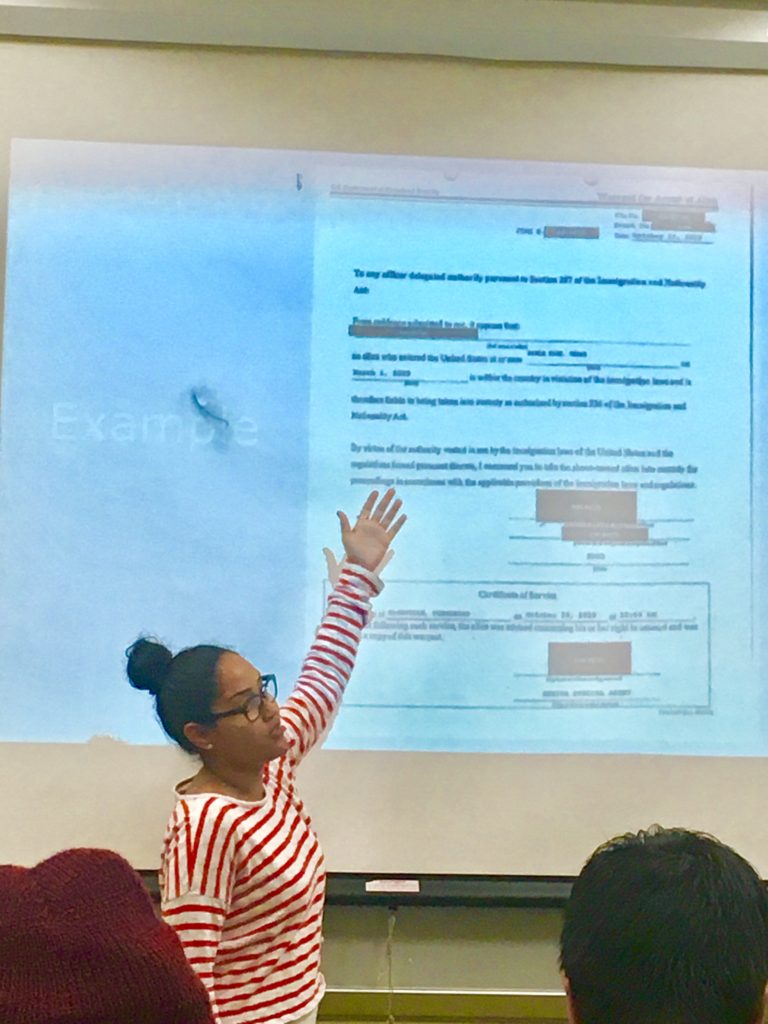
    On March 9, students packed into room 106 in the Harry Griffith Hall to learn about their rights and how to exercise them in the presence of both the police and U.S Immigration and Customs Enforcement agents, also known as ICE. The American Civil Liberties Union’s “Know Your Rights” training was hosted by Jessica Carmona, an HSU student , accompanied by Grecia Rojas, the Interim Multicultural Center Coordinator, who acted as a translator.

    The training discussed legal rights and how to properly document police and ICE interactions. It also debunked common myths regarding undocumented people’s rights, such as the notion that non-citizens don’t have rights.  

    Carmona said to the audience that counties can exercise their local power by not offering resources to ICE agents.

    “We understand that we can’t tell the federal government what to do, but, for example, if they [Ice Agents] do come to our county jail, our county Sheriff can say they can’t even use a pencil,”Carmona said. “We do know we have the power locally to say they can’t use our resources.”

    The Humboldt County Sheriff’s Office released a statement on their stance on immigration enforcement in our community a few weeks after the Department of Homeland Security memo, on March 14. Sheriff Mike Downey said in the press release that he acknowledges the need of public safety for all of Humboldt’s residents and that he will be leaving the enforcement of immigration laws to federal agents.

    “Enforcement of immigration laws is not the job of the Sheriff and my office does not and will not conduct proactive or reactive immigration enforcement duties in this community,” Sheriff Downey said. “My office would like to encourage the community to continue to report crimes and to seek protection and assistance from the Sheriff’s Office, regardless of their immigration status.”

    According to the American Civil Liberties Union, there are many things to do within our rights to keep ourselves and our community members safe. If you are stopped by police and wish not to speak, you must vocalize your wish to not talk. If you are asked about your immigration status, you do not have to answer. If you witness an ICE raid, you can film from a safe distance to document the encounter and to keep the ICE agents accountable. There is an app called Mobile Justice- California, which you can use to record the police and it automatically uploads after you stop recording, to prevent it from being deleted. On the ACLU website, there are many resources that are easy to access and can be printed on little cards to keep in your wallet.

    The information provided at the ACLU training was not intended as legal advice.If you are seeking legal advice pertaining to immigration, Centro del Pueblo will be holding their first legal clinic on April 8 from 9 a.m. to 12 p.m. at Eureka’s First Congressional Church.

  • Arcata National Women’s Day rally ends early as man is taken into custody by police

    Arcata National Women’s Day rally ends early as man is taken into custody by police

    By  Alex Hasenstab

    Additional reporting by Curran Daly

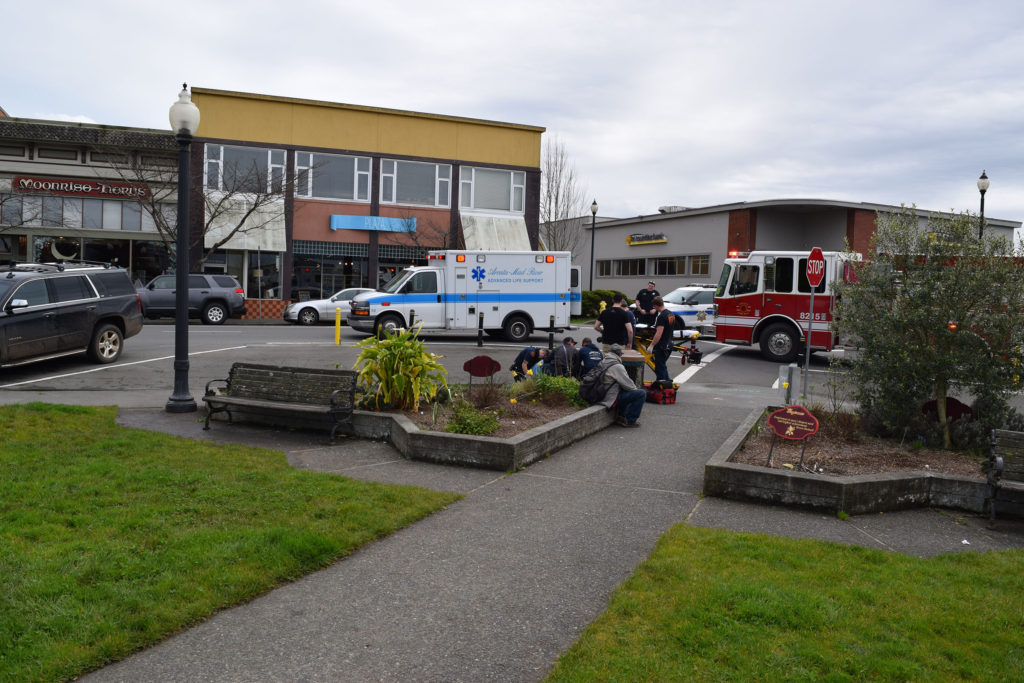
    Earlier today several dozen women gathered on the plaza dressed in red and pink to celebrate National Women’s Day. The rally began at approximately noon, however, less than an hour later the celebration was interrupted by loud sirens.

    Cat Koshkin holding a sign at Arcata women’s rally | Curran Daly

    A man who appeared to be around 50 years of age became disruptive during the onset of the event and later collapsed to the ground. He initially walked up to rally participant, Cat Koshkin, and put his hand on her shoulder.

    “Please stop him please,” the man said.

    “What happened?” Koshkin said .  

    “I can’t catch up with him,” the man replied.

    The man then collapsed and began shaking. A nearby parking enforcement officer had the man sit down. After the officer was unable to get any clear response from the man he called an ambulance.  

    Man arrested by APD | Alex Hassenstab

    The Arcata Fire Department, Mad River Hospital ambulance and the Arcata Police Department arrived at the scene shortly after the call was made. The man refused medical attention and after screaming and showing aggression towards medical workers he was taken into custody by the Arcata Police Department.
    The Lumberjack will provide additional updates as more information becomes available