The Lumberjack


Students Serving The Cal Poly Humboldt Campus and Community Since 1929

Tag: post-capitalism conference

  • Building the Solidarity Economy: A Post Capitalism Conference

    Building the Solidarity Economy: A Post Capitalism Conference

    By: Nerissa Moran

    Workshops on permaculture, public banking systems and the opposition of big corporations gave students optimism for the future after attending the Post Capitalism Solidarity Economy Conference, held in Humboldt State’s Kate Buchanan Room last weekend.

    More than 250 people including students, professors, activists and community leaders attended a range of workshops sponsored by Cooperation Humboldt on the nuts and bolts of building a more just, sustainable society.

    Presentations displayed work that is currently going on in Humboldt, like building a public bank, using permaculture to turn lawns into gardens, cooperative housing solutions and more.

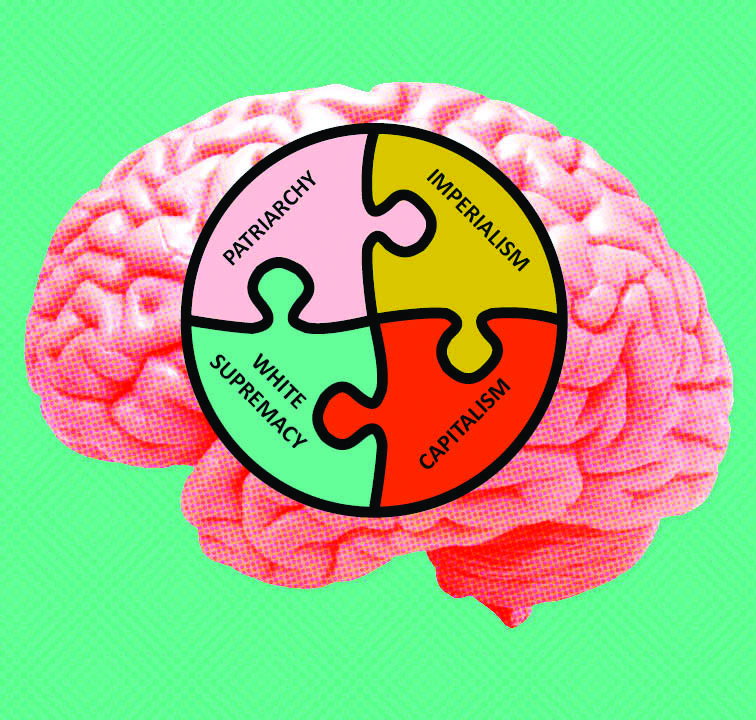
    HSU student Oscar Mogollon said people were openly optimistic and happy they attended, because they could see a transition in Humboldt that’s already happening. Mogollon said the conference enabled him to see the pieces of the puzzle coming together.

    “It is very powerful to know that there is support for the change to happen,” Mogollon said. “We need that change now because climate breakdown will be on our soil, on our coastline, in the next 12 to 15 years.”

    Political science and philosophy double major Johnny Ferdon was always interested in developing community outside of capitalism. He got more than he expected from the conference.

    “I found tons of people making a world outside of capitalism, more than I expected to meet at the conference,” Ferdon said. “The Plenary Session was super awesome. It laid the general framework for the workshops.”

    Ferdon was personally excited about the Permaculture workshop with local expert Marlon Gil, and Own Yourself: Worker-Owned Co-ops, led by Cooperation Humboldt Member Caroline Griffith and Edge Caliber Owner Danny Kelley.

    Ferdon reserved words of deep praise for the workshop led by Kali Akuno of Cooperation Jackson, a deep dive into building a solidarity economy in Mississippi.

    “It is possible to become paralyzed by having a government not favorable to what we want to do,” Ferdon said. “Akuno shared the experience of building Cooperation Jackson while being surrounded by hostile forces. He gave us examples of how much work can be done and examples that teach us not to rely on the state.”

    HSU student Emily Mossman Smiley was also happy that she attended the workshops. She was especially inspired by the idea of a public bank.

    “The only state-owned public bank in the country, the Bank of North Dakota, was the only bank during the 2008 crash that was able to maintain stability while the rest of the banks needed to be bailed out,” Mossman said.

    Mossman said the presentation was so informative, “It was enough to light a fire under my ass to push for public banking in California.”

    “While public banking is not a silver bullet, it will enable the citizens of California to keep capital within their communities and make it serve the community as opposed to serving the big corporations that are crushing us,” Mossman said.

    Cooperation Humboldt Co-founder David Cobb said the conference brought together movement through leaders who shared best practices for creating a new world within the exterior of the old.

    I am grateful for them, and for the members of the community who came together to learn from and inspire each other to actually build that world,” Cobb said.
  • Post Capitalism Conference

    Post Capitalism Conference

    Cooperation Humboldt throws event that creates dialogue with community on the perils of capitalism

    The Post Capitalism Conference gives students the opportunity to discuss issues that plague the United States’capitalist-centric mindset and the exploitation of nature and humans.

    The event was created by Cooperation Humboldt and began Friday April 26 with workshops addressing how to live outside of a capitalist model.

    Julian Parra studies wildlife science at Humboldt State University and questions the safety of his generation’s future.

    “My professor once had us take an assignment,“ Parra said. “He asked us, ‘Would surviving the end of the world be easier, or surviving the end of capitalism?’”

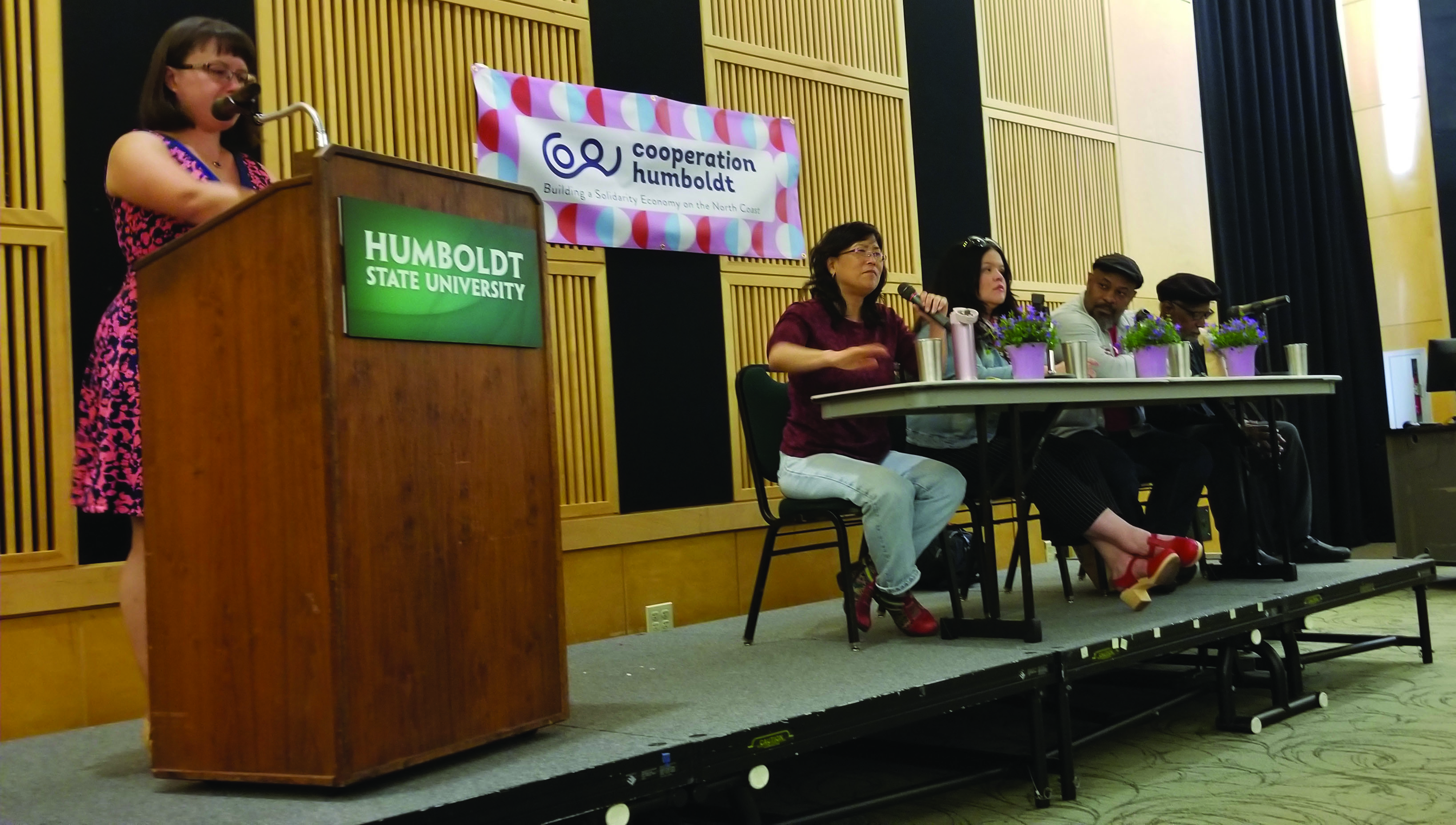
    Parra attended the conference held at the Kate Buchanan room to help answer his questions. Tamera McFarland co-founded Cooperation Humboldt and serves as a board member. During Friday night’s conference she acted as a moderator by introducing the special guest speakers and asking them questions.

    “The takeaway from this event should be that a different way of life is possible,” McFarland said. “Prioritize human need over blind growth and profit.”

    20190426_195603.jpg
    From left to right, Emily Kawano, Cutcha Risling Baldy, Kali Akuno, and Jarome Scott on stage at the night of Cooperation Humboldt. | Photo by Luis Lopez

    The special guest speakers consisted of Emily Kawano of Solidarity Economy Network, Kali Akuno of Cooperation Jackson, Jarome Scott of the US Social Forum, and Cutcha Risling Baldy, professor of Native American Studies at HSU.

    The group tackled many issues, from capitalism reform to giving back land that belongs to Native Americans.

    Baldy criticized people like Jeff Bezos for his actions during the conference, while also criticizing his defenders.

    [perfectpullquote align=”right” bordertop=”false” cite=”Oscar Mogollon” link=”” color=”” class=”” size=”16″]“We have this notion that the older generation doesn’t want to hear out the younger generation. The turnover of this group disproves that, there are older generations that don’t want to leave the world worse than they already left it.”[/perfectpullquote]

    “The system is set up to say you must be good if you make a lot of money,” Baldy said. “They’re not that smart.”

    Attendees of the conference were a mix of younger generation students, older faculty and community members. During the conference there were five minutes allocated to the attendees to discuss with what the guest speakers presented.

    Oscar Mogollon, a psychology business major and communication minor, was grateful with the turnover of diverse age groups attending.

    “We have this notion that the older generation doesn’t want to hear out the younger generation,” Mogollon said. “The turnover of this group disproves that, there are older generations that don’t want to leave the world worse than they already left it.”

    Many of the attendees were passionate in speaking their mind on the topics discussed in the conference.

    Baldy was happy with how the night turned out and had hope that those who attended learned something new and important.

    “There’s a lot of overwhelming work that needs to be done,” Baldy said. “But if we work together, it would be a more fruitful effort.”

  • Building the solidarity economy: a post-capitalism conference

    Building the solidarity economy: a post-capitalism conference

    HSU Sociology Department invites Kali Akuno, Jerome Scott and Emily Kawano to post-capitalism conference

    By: Nerissa Moran

    Cooperation Humboldt has teamed up with the HSU Sociology Department to invite Kali Akuno, Executive Director of Cooperation Jackson, along with Jerome Scott of the US Social Forum, and Emily Kawano of the Solidarity Economy Network to sponsor the first-ever Post-Capitalism Conference in Humboldt: Building the Solidarity Economy.

    What is a solidarity economy? It has been broadly defined as an economy based on cooperation rather than exploitation, and that prioritizes the welfare of people and planet over profits and blind growth.

    Cooperation Humboldt is making food more accessible and our food system more local. They’re planting fruit trees and setting up little free pantries throughout the Eureka area. As part of the national Food Not Lawns effort, they’ve begun transforming front yards, growing food instead of grass.

    Tamara McFarland is the co-founder of Cooperation Humboldt.

    We believe that food is a fundamental human right, and our food projects aim to put that belief into practice in very tangible ways,” McFarland said.

    Now the group is on track to set up several worker-owned cooperatives to further the goal of building a solidarity economy on California’s North Coast – the idea is to meet our needs in harmony with nature without exploiting anyone.

    As they say in their mission statement, the group puts “people and planet over profit by prioritizing collaboration over competition and cooperation over domination.”

    Cooperation Humboldt is modeled on the solidarity economy principles established by Cooperation Jackson, the pioneer in building community from the economic roots up to the political and cultural branches, and the epicenter of social and economic change in the U.S.

    They are building a solidarity economy in Jackson, Mississippi, anchored by a network of cooperatives and worker-owned, democratically self-managed enterprises.

    Jerome Scott of the U.S. Social Forum will be talking about the process of how we get from where we are today to a post-capitalist, solidarity economy. First, he explained that the technology has already set the basis for a new economy.

    “The transition is mainly a technological revolution,” Scott said. “And that technology has set the stage for the end of capitalism. But only human beings can make the transition to socialism and within that process, race and gender play a role.”

    Scott said his objective is to demystify the process. His description of the process of social change ties in directly with the building of worker cooperatives. While the technological revolution is upon us, we must use it to envision that another world is possible. Emily Kawano of the Solidarity Economy Network can explain what that world is beginning to look like inside the co-ops being built.

    The conference will be held on campus April 26 and 27, with the opening plenary session taking place on Friday, April 26, at 7 pm in the Kate Buchanan Room.

    This session will be followed on Saturday, April 27, by a wide array of workshops (in Siemans Hall at HSU). This will allow us to gain the specific knowledge that comes from the experience of several of the minds and organizers transforming today’s economy while protecting the environment nationwide.

    The topics include ‘Solidarity Economy 101,’ ‘Introduction to Permaculture,’ ‘Democratizing Money: Public Banking,’ ‘Imagining a Post-Whiteness Society,’ ‘Humboldt County – Land of the Free,’ and many more. The full schedule will be posted on Cooperation Humboldt’s website.

    “We’re so thrilled to be able to bring these experts together to share their wealth of wisdom and experience with those of us on the North Coast working to shift our economy away from exploitation and towards a more cooperative model,” McFarland said. “We know this conference will inspire those in attendance to broaden their conception of what alternative systems can be created.”

    David Cobb is also a co-founder of Cooperation Humboldt.

    “In addition to the conference, here in Humboldt we are incubating three worker-owned cooperatives, creating a local food forest and advancing public banking and participatory budgeting,” Cobb said.