The Lumberjack


Students Serving The Cal Poly Humboldt Campus and Community Since 1929

Tag: protest

  • Student protestors barricade themselves inside Siemens Hall, demand end to war in Gaza

    Student protestors barricade themselves inside Siemens Hall, demand end to war in Gaza

    by Dezmond Remington

    Dozens of students barricaded themselves in Siemens Hall and hundreds more swarmed the UC quad to protest the war in Gaza and to demand Humboldt stop associating with Israeli organizations.

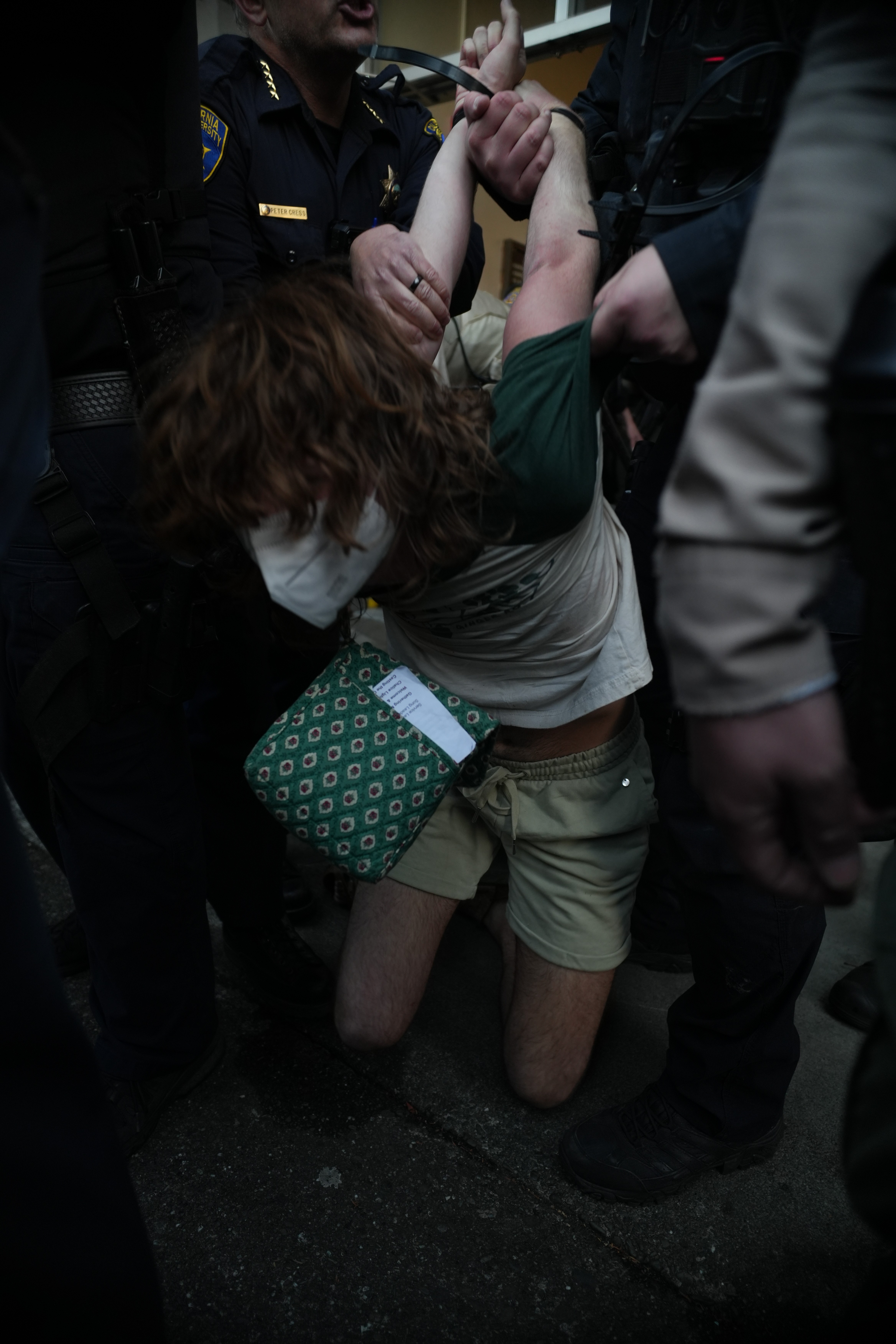
    At least one person, local teacher Alice Rose Finen, was arrested by the University Police Department. She was released on Monday night. 

    The protest started at around 5 p.m. on April 22, when a few protestors showed up to Siemens Hall. They piled chairs and tables up in front of entrances. The five classes being taught in Siemens were evacuated. Police arrived soon after, as did a California Highway Patrol helicopter.

    As of publication, the protest is still ongoing. Dozens of students occupy Siemens, and doors have mounds of office furniture blocking them. Though there’s no consensus, they plan on staying until their demands are met or they are forcibly removed. Several occupiers broke into university president Tom Jackson’s office by shattering the window on the door. Siemens Hall is covered in graffiti, as is the outside of the Van Duzer theatre. The American and Californian flags were taken off of the flagpole in front of the library by a man with climbing gear. 

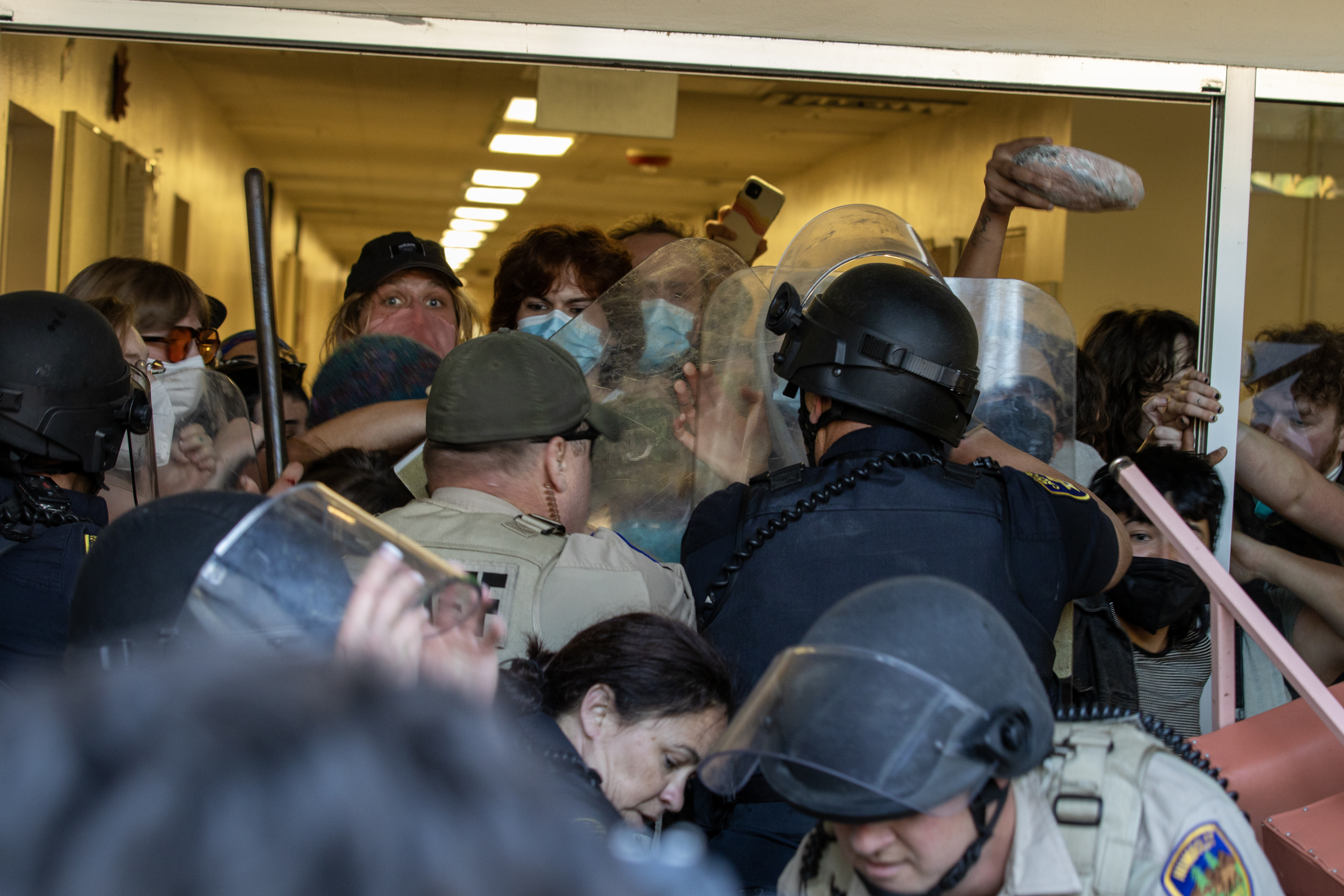
    For hours, student activists inside Siemens Hall were only a few feet away from the police on the other side of the main entrance on the second floor. Cops showed up from all over Humboldt, including the California Highway Patrol, Humboldt County Sheriff’s Office, and even some officers from as far away as Rio Dell. At one point, police scanner traffic indicated riot control police from Redding were coming to campus, but they never showed up.

    Police left at 11 p.m. on April 22, and those inside tore the barricades down. Over 100 students entered the top floor, walked to the end of the hallway, turned around, and left. After that, the protest dwindled to less than 100 people, most of them outside. People played music and barbecued. 

    The occupation had been generally peaceful, but violence broke out at around 7 p.m. when police tore down the barricade and entered Siemens Hall. A line of law enforcement with riot shields and a crowd of activists crushed together, and a protester inside hit an officer with an empty water jug. At least one officer retaliated by bludgeoning a protester with a baton. Other reports of students being batoned are circulating, but unconfirmed. 

    The main demands of the protestors are: to end the war in Palestine, for the university to disclose any dealings with Israeli companies or the Israeli government (and end those relationships if they exist), cut all ties with Israeli universities, and for the university to end prosecution of student activists. Many of the same demands student activists all over the nation are demanding at universities such as Columbia and UC Berkeley.

    “We’re doing this out of principle and righteous rage for our comrades,” said Casey, one of the protestors who was inside the building before the police left. “We want to make this happen at other universities across the nation.”

    Another one of the protestors, who asked to be identified as “Bum,” was one of the first to blockade inside the hall. They decided they would join their friends the day before the protest was planned. 

    “When the homies started talking, I was like, ‘Yeah, dog,’” Bum said. “It’s time to fight genocide in general. It’s time to stand up with our Indigenous homies. [We’re occupying the building because] trying to dialogue with the oppressors doesn’t work well.”

    Cal Poly Humboldt has not responded to a request for comment on its ties to Israeli institutions.

    Some of the people at the protest weren’t there to demonstrate. Students thronged the balconies of the Student Activities Center and crowded around the main cluster of activists in front of Siemens Hall to watch the action, many of them on their way home from class. The helicopter hovering overhead attracted many sightseers.

    “Nothing ever happens in Arcata,” said Shawn Rogan, a curious student. “It’s novel for a small campus, and [the war in Gaza] is a cause worth protesting.”

    One of the biggest concerns the protestors had was the heavy police presence. Before they left, those barricaded inside the building said they would negotiate once the police were gone. One protester blockaded inside who asked that he only be identified as “Joe” said he would stay there until he was fought off by law enforcement.

    “I’m going to resist,” Joe said. “If they beat me, they beat me.”

    Protestors chanted anti-police slogans at law enforcement to try to get them to leave, and many of them tried to talk some officers into leaving. Communications professor Aaron Donaldson argued with Rio Dell’s Chief of Police Greg Allen and two other officers outside of Siemens Hall for over half an hour. Donaldson attempted to make the case that they could decide to leave. Allen disagreed. 

    Cal Poly Humboldt has made it clear they want protestors to leave Siemens Hall and to return home. As of April 23, graduation is still planned to happen on May 11.

    “The University supports free speech through open dialogue that is respectful and constructive, but will not tolerate endangering people, destroying property, and disrupting campus,” read an alert published on April 23. “As a community, we are committed to keeping our students, staff, and faculty safe and fostering a learning and working environment where the campus community can feel safe, included, and respected.” 
  • Behind the Barricades: Inside Siemens Hall

    Behind the Barricades: Inside Siemens Hall

    by Andres Felix Romero and Jasmin Shirazian

    Due to potential ramifications, some individuals interviewed for this article are only identified with pseudonyms.

    By the afternoon of April 23, President Tom Jackson’s personal porcelain throne was up for free use by the pro-Palestine protesters occupying Siemens Hall after a broken window allowed occupants access to the presidential suite.

    After the police had withdrawn from the entrances of Siemens Hall around 11 p.m. on April 22, the protestors opened the doors and barricades to embrace their compatriots outside. Once the students committed to staying the night, they got to work building barricades around the building entrances. Despite the action not being organized by a specific individual or organization within 24 hours, protesters such as Naomi Chambers felt compelled to act in support of Palestine.

    “[This action] was loosely organized,” Chambers said. “This has been six months of boiling rage. [This action is run by] like-minded youth that want to see Palestine liberated.”
    With law enforcement gone, the protestors got to work around Siemens hall to secure themselves inside out of fear of another clash with police. Protestors sealed the doors with chains, locks, and fire hoses. The occupants then gathered chairs and desks throughout the building and barricaded each of the entrances. Doors were removed from hinges and bulletin boards from walls to be recruited into the barricades. The staircases leading to the second floor of the hall was barricaded as well. 

    What was meant to be a sit-in protest had turned into a full-on occupation of Siemens hall following the clash between protestors inside the hall and the multi-departmental police force including agencies from Arcata, Eureka, Ferndale, Fortuna, California Highway Patrol, and Cal Fire. Students who clashed with the police, such as Friend UU, felt frustrated about the police’s action during a prayer circle led by an indigenous student. According to UU, it was officers in tan uniforms at the front lines against the protesters in Siemens Hall.

    “We were just chanting and [law enforcement] weren’t doing anything,” UU said. “But then, the second Indigenous students [began to pray], that was the moment they started pushing. I mean, how evil is that?”

    Meanwhile, protestors outside of Siemens Hall erected barricades at the entrances. Some also slept or stood guard outside of the hall, behind the outdoor barricades. 

    Jasmine Jolly, a child development and family relations major, was one of the student protesters outside. 

    “I’m really showing up as support,” Jolly said. “I have been trying my best to hold it down outside so that people inside know they are supported and that they have allies backing them up, and if necessary, blocking the entrances.”

    Jolly was at the protest from 8:30 p.m. on April 22 to 3:00 p.m. April 23. They carried a black megaphone that amplified their voice for the crowd. 

    “I was leading some chants last night, but I was not the only one by a longshot,” Jolly said. “It was very organic. When someone’s voice started to give in, another person’s voice would take over. It was like a community.”

    According to Jolly, the community came together to ensure the safety of protestors. There was not a single leader, but rather a collection of voices.  

    “This is a group of people really working together to try to get voices heard,” Jolly said. “This was a community showing up in support of those inside, and even people inside, there’s not a ‘single’ leadership.”

    After the building was secured, the occupiers settled in. Supporters outside of the building found ways to smuggle supplies such as food, water, medicine, hygiene products, and blankets into the building. 

    Students slept where they could. The occupants set up a sleeping area by the elevator, and a few students were able to erect tents in the hallways outside of the provost’s office. Some students chose to lay out sleeping bags in the hallway, while others found rest on the floors of empty classrooms left open. 

    The protesters began to create posters to hang on the windows as well as scrawled messages on the hallways throughout the building. One poster was created using bloodied bandages from an injured protestor. Messages in support of Gaza as well as condemning the police’s actions were scrawled on hallways, done with marker or spray paint. One protestor, Casey O’Connor, drew a mural depicting police striking their friend who was also protesting. 

    “I felt the need to convey what happened in a visual medium,” O’Connor said. “So that admin can not ignore the fact that students were bloodied in this building.”

    By the end of Siemens Hall rearrangement, the building felt surreal and almost out of a war zone. Doors were boarded up and students were camping underneath their written messages surrounded by supplies.

    The first night was spent resting, taking shifts watching the barricades for other potential law enforcement action, and strategizing next moves. There was a mix of emotions amongst the group such as anxiety, uncertainty, and exhaustion. However, the more prevailing emotions were a sense of pride and community. The protestors knew the odds may not be perfect, but they were emboldened by law enforcement withdrawing. 

    “I feel exhilarated,” Chambers said. “Everything in this world tells us [resistance] is impossible.”

    As the sun rose after the first night, some activists took more drastic measures to get a point across to campus leadership. At some point in the afternoon on April 23, an unknown individual gained access to Tom Jackson’s presidential suite through a door window and protesters entered the suite.

    Jackson’s suite had files looked through, wine taken, his desk left a mess, and as with the hallways, messages were written on the walls. Some of them noted the disgust they felt in their writings.

    “DO YOU CARE?” One message wrote. “Seeing this office made me sick. Students, Palestinians, so many people are in pain and struggling, while you have an empty office full of amenities. DO BETTER.”

    The protestors have vowed to remain occupying Siemens Hall until demands have been met. Despite the chaotic and stressful possibilities with this protest, the occupants are hopeful that the situation will be peaceful with its ending.

    “I was expecting to get arrested.” Chambers said. “I was prepared for everything to go wrong, but I was also prepared for everything to go right for us. I’m determined to hold onto that [hope].”

  • Full charge mentality

    Full charge mentality

    by Dezmond Remington

    Luke Kennedy’s katana is heavy. He busts it out for parties, which he and his roommate Miles Conte throw every weekend. Except when there’s not supposed to be class on a Tuesday. Then, Mondays are prey too.

    “We were trying to pick a date that would stand us out from the crowd,” Conte said. “We were just trying to start off the extension of winter break off with a bang.”

    With the CFA strike eliminating class on Monday, Jan. 22 for college students all over California, Kennedy and Conte decided to host a bonus party at their place, a dayger that started at 3 p.m. 40 people showed up to party in their house. Though some people left when everyone got the news that the strike was off, most stayed until about midnight or so. 

    “When we [got the news] it was evening time,” Kennedy said. “It’s the height of the party. I’m walking around with the beer bong and loading it up with [left-over beers] and loading people up. And then [someone] said, ‘Hey, I think we have classes tomorrow!’ Everyone’s pulling up the email. And so there was this whole conversation — ‘Oh, what’s going on?’ And honestly, everyone was like, ‘Fuck it, I’m not going to class’… But I think, party or not, most people would have probably ditched that Tuesday.”

    Conte said it was more fun when they realized the strike was off.

    “The party vibe became immaculate when we learned we had class tomorrow,” Conte said. 

    He turned to Kennedy for a moment.

    “What do you think?” Conte said. “Is ‘Immaculate’ a good word to use in this situation? Or not?”

    Conte did skip class the next day; Kennedy attended.

    “[When the strike only lasted one day], I was initially rebellious,” Conte said. “Because I am not going to my classes.”

    Both Conte and Kennedy said if the strike had continued as planned, they likely would have thrown at least two more parties throughout the week. Any more than that likely would have been overkill. Conte laughed at the idea while he rolled a cigarette with gas station tobacco.

    “We just party, all day, every day,” Conte said. “No sleeping allowed. That would have been hilarious. Like, yeah, ‘We’re going to have a continuous party for five days straight.’”

    Freshman Bryn Urdi had a good time at the strike party. She was glad that she was in bed by the time she got the news that the strike was off. Urdi said she would definitely have attended again if given the opportunity, but the best part was seeing all of her friends again.

    “It was really nice to come back from break and see all of my friends again,” Urdi said. “It was great just to be with them for a while.”

    Kennedy believes that the parties he and Conte throw offer an important service to students they can’t get anywhere else.

    “I think that the parties make students more excited to go to class because they get to see their classmates,” Kennedy said. “[Campus] feels like a zoo environment, in that it can become a goal, clocking in and out of class every day. You don’t really know anyone there. I feel like the mark [the parties make] makes the school a thing, versus just something you clock in.”

    “We bring a full-charge mentality to partying,” Conte said. “We’re passionate about making people happy and having a good time.”

    Despite the attitude, Kennedy isn’t just about drinking and getting rowdy.

    “I respect somebody’s performance,” Kennedy said. “I look at somebody; are they a degenerate? Do they get good grades? Are they healthy? I don’t want to encourage students to just drink and party. There’s tuition. I think it’s important that students remember that they’re here to get a degree, hopefully learn something and become a better person.”

  • Students March on the Quad for Palestine

    Students March on the Quad for Palestine

    by Andres Felix

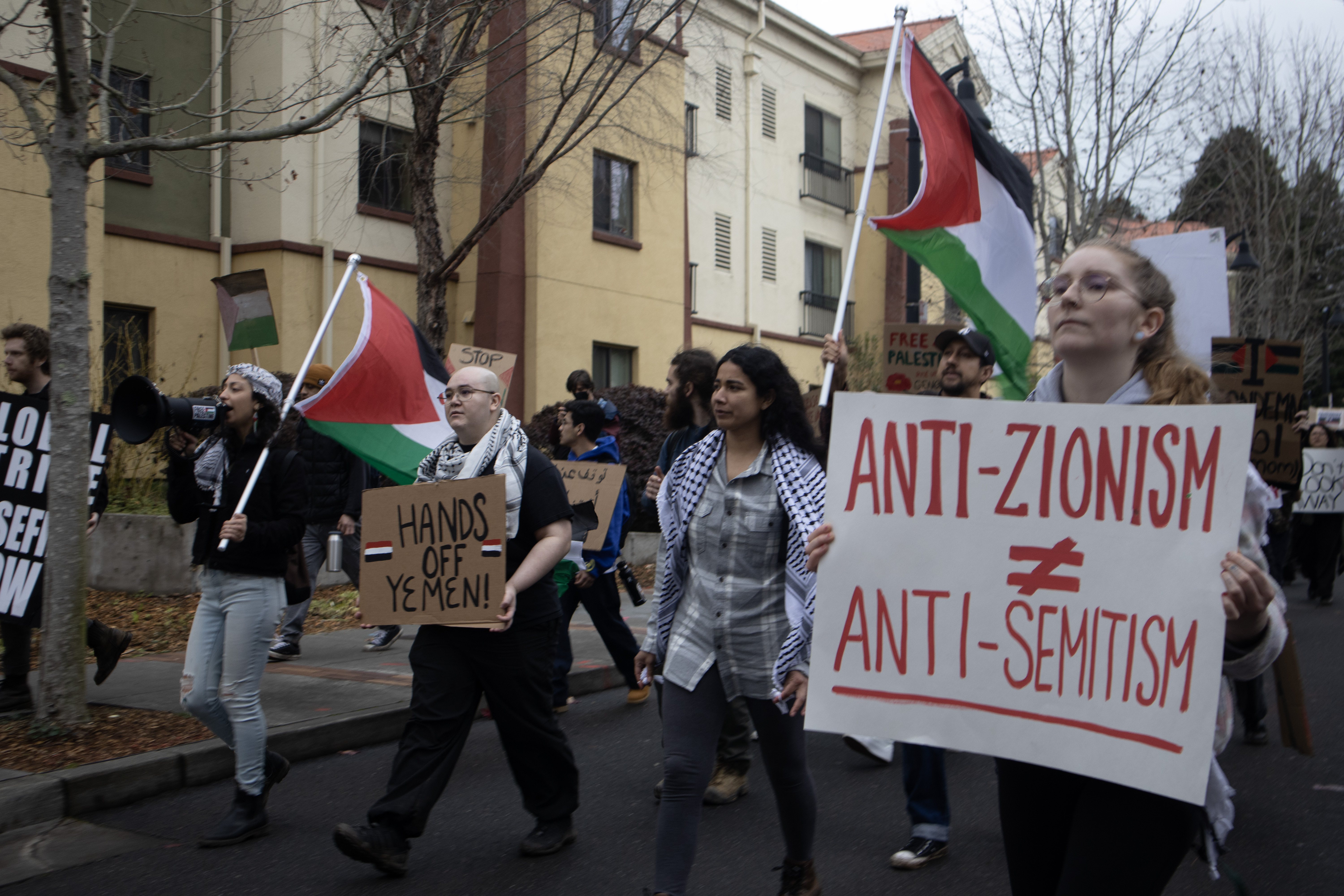
    On the morning of Wednesday, Jan. 24, students and faculty in and around the Gutswurrak Student Activity Center (SAC) stopped their activities and looked towards the quad. They could hear the chants and the drums long before the roughly two dozen demonstrators marched into the quad after beginning their demonstration at the Cal Poly Humboldt’s Children’s Center.

    The action was organized in part by Humboldt for Palestine, a collective of individuals from the community to support Palestine and protest apartheid. The demonstrators waved Palestinian flags, held their fists in the air, and held signs reading, “Resistance is not equal to terrorism,” “Don’t look away” and “Mourn the dead, fight like hell for the living.” Alongside this, the crowd chanted led by a demonstrator wielding a microphone.

    “Ceasefire now!” The demonstrators chanted. “Free, free Palestine! Gaza, Gaza can’t you see? Palestine will be free! No peace on stolen land!”

    After about 15 minutes, the demonstrators continued their march, passing by the library and chanting all the way.

    “Let. Gaza. Live!” They chanted to the drums. “No peace on stolen land!”

    The demonstrators eventually marched off campus, heading towards Wildberries. Maria Fragoso Calzada, a student who marched in the demonstration, feels that there are many parallels between her struggles growing up in Mexico and the struggles of the Palestinians in Gaza.

    “[I want] everyone to be liberated and supported,” Fragoso Calzada said. “[We need to] keep educating, because education is power and it’s liberation.”

  • Students protest at donor event hosted by Cal Poly Humboldt president Tom Jackson

    Students protest at donor event hosted by Cal Poly Humboldt president Tom Jackson

    by Savana Robinson

    The doors were locked. The windows were covered up with cardboard. Cal Poly Humboldt President Tom Jackson was set to host a donor event on Jan. 23 at the Reese Bullen Gallery, but a couple dozen protestors gathered outside the gallery to condemn Jackson and his absence from campus, as well as the CSU tuition increase and the addition of the recent housing application fee.

    Rick Toledo, a member of the Students for a Democratic Society, spoke at the rally.

    “The goal was to finally get a hold of Tom Jackson, because he’s never in his office,” Toledo said. “He’s never on campus.”

    One student who preferred to remain unnamed, rather going by Doe, said that they want to bring advocacy to the tuition hike.

    “That is going to hurt students in the coming fall of 2024,” Doe said. “[Jackson] only cares about getting more students and then fucking them over by making us pay more tuition, more in housing.”

  • Policy, protest, and pirates: students protest against campus evictions

    Policy, protest, and pirates: students protest against campus evictions

    by Jillian Wells

    Other contributors: Alex Anderson and Dezmond Remington

    In a powerful show of unity, students and faculty members gathered in the rain at Cal Poly Humboldt to protest the recent decision to evict students living in vehicles on campus. The protest, which took place on Thursday, Nov. 2, highlighted the larger problem of homelessness in Humboldt County. 

    The protest started at 11 a.m. in the G11 parking lot and lasted throughout the night. At 12 p.m., protestors marched to the quad in the rain chanting, “Hey, ho, hey, ho student eviction has got to go!”

    Photo by Cedrik Vonbriel. A sign at the protest.

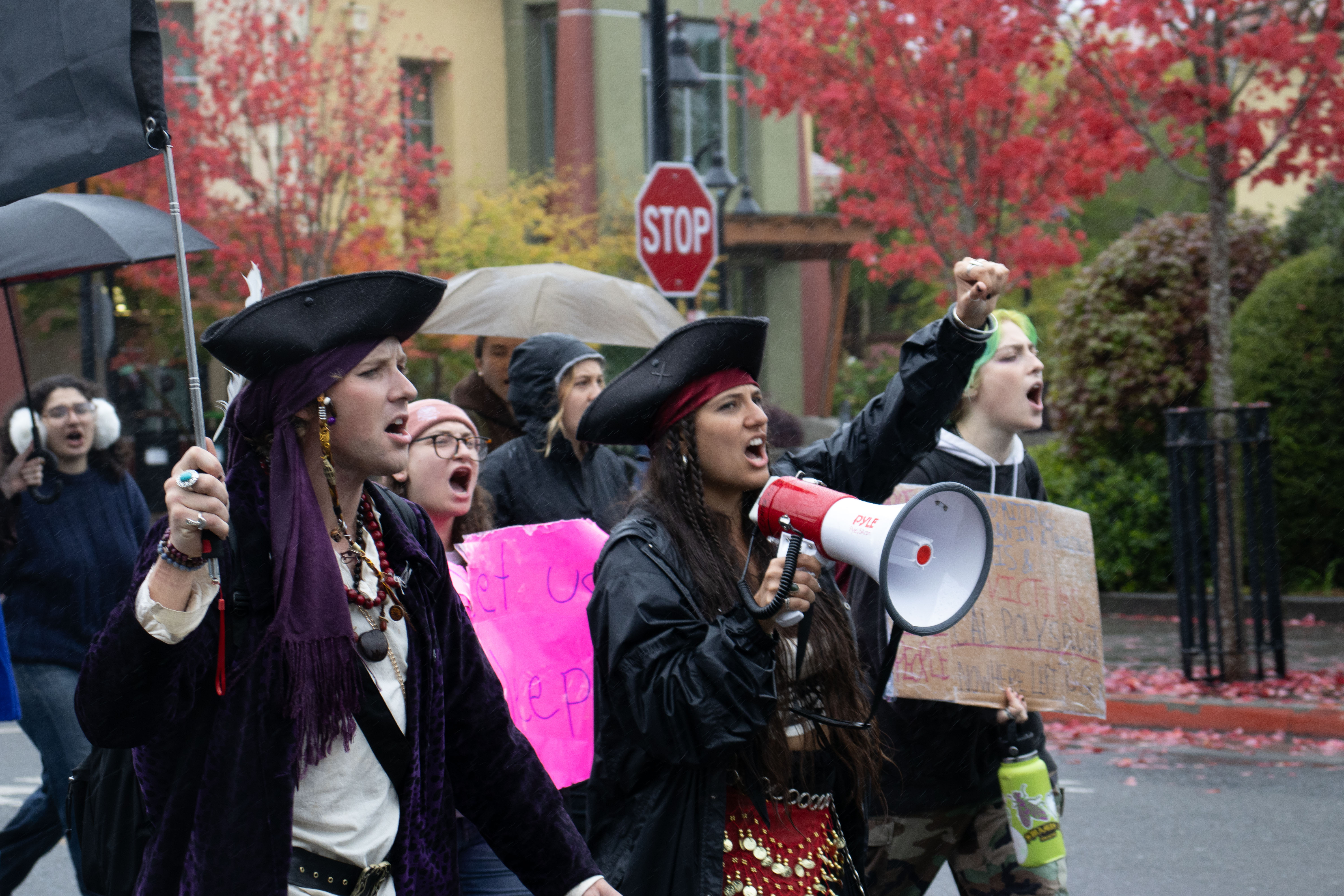
    The protest was led by Maddy Montiel and Brad Butterfield, the president and vice president of the Alternative Living Club, who were dressed as pirates because of a long-running joke of them being “land pirates” and their RV’s being ships on wheels. Furthermore, the initial eviction email occurred during Halloween week, and since then Montiel and Butterfield have been solely focused on securing safe housing, but didn’t want the situation to take celebrating Halloween from them. 

    “The university took a lot from us last week,” Montiel said. “We decided we wanted to keep one thing for ourselves and still dress as pirates and give our outfits a chance to see the light of day.”

    Photo by Cedrik Vonbriel. A sign at the protest.

    The protest also featured an open discussion, where Montiel and Butterfield stated their list of demands from the university. 

    Their demands included the university allowing overnight camping or sleeping in vehicles through the end of the fall semester, at least, a formal apology for the dehumanizing language in the initial eviction email, the establishment of a committee for long-term solutions, more transparency in defining camping and its implementation, and evidence of the “unsafe and unsanitary conditions” that was stated in the email.

    At the protest, Butterfield stated students living in their vehicles are open to finding a solution that works for them and the university, but that the university hasn’t been willing to negotiate. For the students living in their vehicles, protesting was a last resort. 

    “For the school to assume that they can just get rid of us and push us out onto the streets and we’re going to go away quietly, is wrong,” Butterfield said.

    On Tuesday, Nov. 7, the University Senate passed a resolution that would pause the enforcement until the end of the 2023-2024 academic year; this resolution was sent to President Jackson’s office. It awaits a decision. Mark Johnson, the President’s Chief of Staff, who attended the meeting on behalf of Jackson, declined to answer any of The Lumberjack’s questions, as did Dean of Students Mitch Mitchell.

    During the protest, various speakers articulated their concerns, frustrations, and demands, emphasizing the need for understanding and fair solutions. The protest featured many voices and perspectives within the community, stressing the importance of addressing the issue with attainable solutions and compassion.

    Photo by Cedrik Vonbriel. A sign at the protest.

    Rouhollah Aghasaleh, an assistant professor in the School of Education, attended the protest and said that he sympathizes with the students who are being evicted.

    “Living in a [vehicle] doesn’t make you less human.” Aghasaleh said.

    Meheret Vasquez-Suomala, a religious studies major, expressed disappointment in the administration and hopes that they will listen and work with students, not evict them. 

    “You [Cal Poly Humboldt] are deliberately misplacing lower-income students and that’s what’s frustrating.” 

    Raymond Haeckel, another one of the speakers at the protest, questioned the accusations made by the university and stated that without proof of the unsafe and unsanitary conditions. Haeckel will continue to believe this is an effort to force these students into on-campus housing and collect housing fees.

    “This is motivated by money and money alone,” Haeckel said.

    Jules Tatum, another student at the protest, condemned the university’s decision to evict students.

    “To say that these people are unsanitary, unsafe, dangerous individuals is just a slap in the face. The only dangerous conditions are being created by the institution,” Tatum stated.

    Ultimately, the protest highlighted the need for realistic and attainable solutions that work with students, not evicting one of the most vulnerable student populations. 

    If you’re interested in learning more about this on-going issue, the Alternative Living Club is meeting on Friday, Nov. 10, at 3:30 in front of the library. 

    Disclaimer: Brad Butterfield is a member of the Lumberjack. He did not help write or edit this article.

  • Students and faculty rally against tuition hike 

    Students and faculty rally against tuition hike 

    by Jake Hyslop

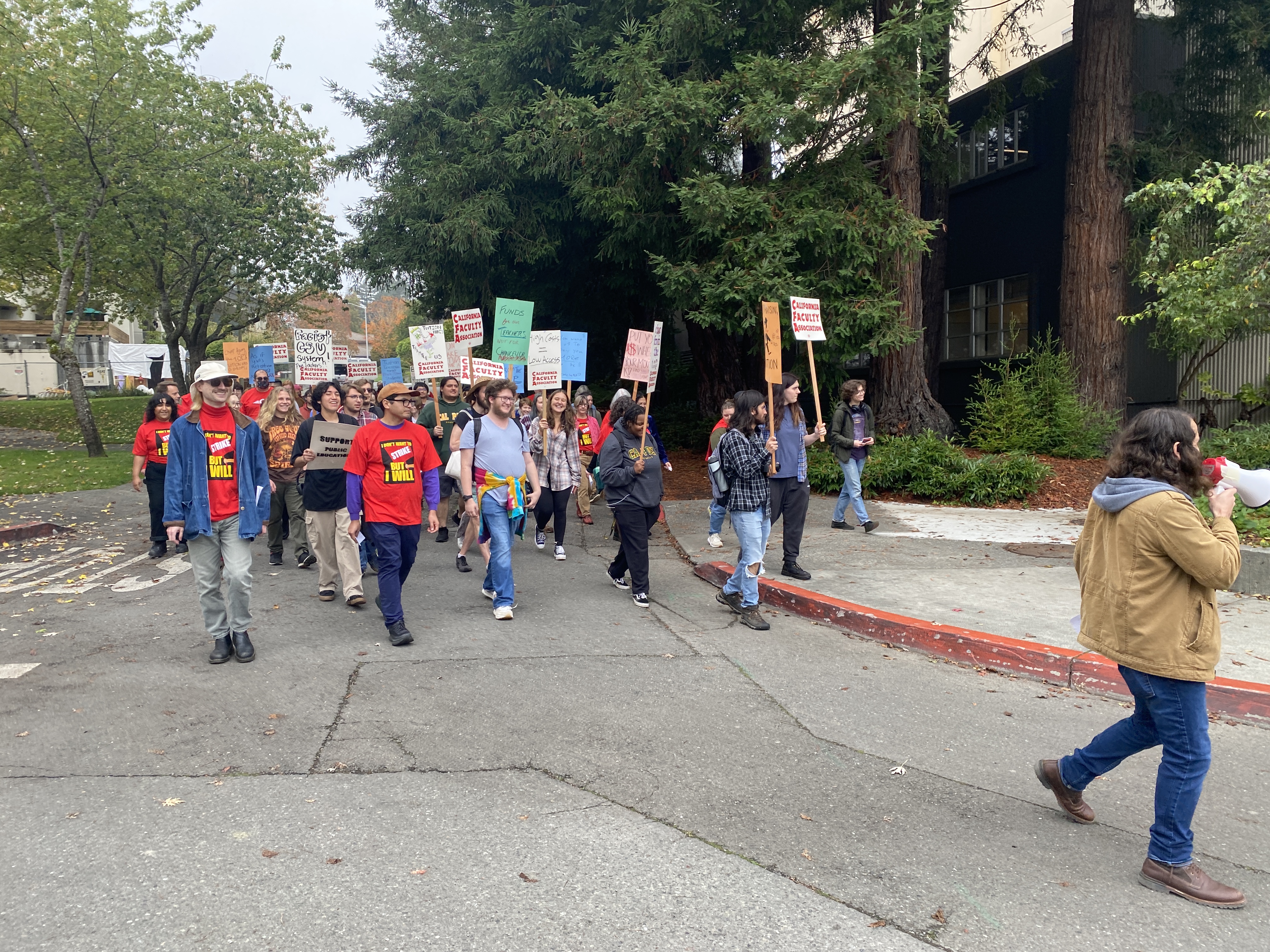
    On an otherwise unremarkable foggy Thursday morning, students and faculty alike met on the main Quad at Cal Poly Humboldt in order to protest the vote to raise tuition by the CSU Board of Trustees. Signs adorned with, “don’t make students your ATM” and “stop targeting education,” were taped to walls and held by protesters. 

    As the weather began to heat up, so too did the rally. Cries of, “chop from the top” and “education is a right,” rang out across the campus. 

    The event was organized by the Students for Quality Education (SQE) and the California Faculty Association (CFA), as well as by the Students for a Democratic Society (SDS). Other groups showed up to speak, including the Critical Race, Gender, and Sexuality (CRGS) Club and the CSU Employees Union (CSUEU). 

    The rally was held in response to the Sept. 13 vote by the Board of Trustees to raise tuition 6% every year for the next five years. CSU defended the vote by pointing to inflation increases and a relative lack of tuition rate increases; the Board of Trustees deemed it a necessity. 

    “We know [administration] can pull from their own salaries and they have reserves they can pull from,” Zoe Reed, a third-year CRGS student and intern for SQE said. “But instead, they’re putting that on us, the people who work here and are learning here, who can’t afford that.” 

    Many speakers at the protest, including Mary Mangubat, a third-year environmental studies student and SQE intern, called for the CSU to rely on the reserve money they have to account for inflation and rising costs rather than taking it out of the students’ pockets. 

    “The CSU has $8.8 billion in reserves that they do not want to touch because they said that they only pull out that money when there’s financial uncertainty in time,” Mangubat said. “What the hell are we in right now?” 

    Mangubat cited the pandemic and the student organizations struggling under the recent Associated Students budget cuts due to low enrollment numbers as criteria befitting a time of uncertainty. 

    Another common complaint was the amount of money CSU administrators were paid relative to the income and costs suffered by students and faculty. President of the CFA Humboldt Chapter Marisol Ruiz weighed in and called for the current Board of Trustees to be fired. 

    “I think it’s just terrible that we have faculty here that make as much as someone’s housing and car allowances,” Ruiz said. “We need equity, and we need people that are responsible to the people to be part of the Board of Trustees.”

    Rick Toledo, an environmental science major and one of the main organizers of the event as a representative of SDS, led many of the chants at the rally before providing a speech of his own. 

    “Think about the weight of a billion dollars,” Toledo said. “They have over 12 of those in their budget. Yet they can’t pay faculty and staff? Yet they have to use students as their ATM? I call BS.” 

    Toledo explained how the administration has sewn a narrative of discord between faculty and students, pitting them against each other to cover for themselves. He went on to say that the CSU is lying in their reasoning for not using the reserves available to them. 

    “In reality, the reserves have been built up to boost their credit so they can borrow more money for more capital investments on projects,” Toledo said. “They’re basically turning the entire thing into a hedge fund with education as the front.” 

    Some students expressed skepticism over the success of holding a rally. Gavin Martin, a theater arts student, questioned how successful a protest against administration sanctioned by administration can be. He likened it to the housing protests during the Spring 2023 semester. 

    “After the protest, we all went to look for homes individually,” Martin said. “We were supposed to be in this together.”

    Mangubat announced the rally’s list of demands for the CSU through a megaphone. The first was to end the tuition hike and take money from the reserves. The second was for the administration to stop relying on students to fund student programs. The third demand called for higher wages for faculty, staff and student workers. The fourth demand called for funding for programs that provide resources for basic needs such as housing, food and mental health resources. Sufficient funding for cultural centers for marginalized communities was the final demand. 

    ‘If we are not heard, we will continue making noise,” Toledo said. “We will continue to be loud until we are heard.”

  • CFA gets the word out on the quad, announces rally

    CFA gets the word out on the quad, announces rally

    by Hank Wicklund

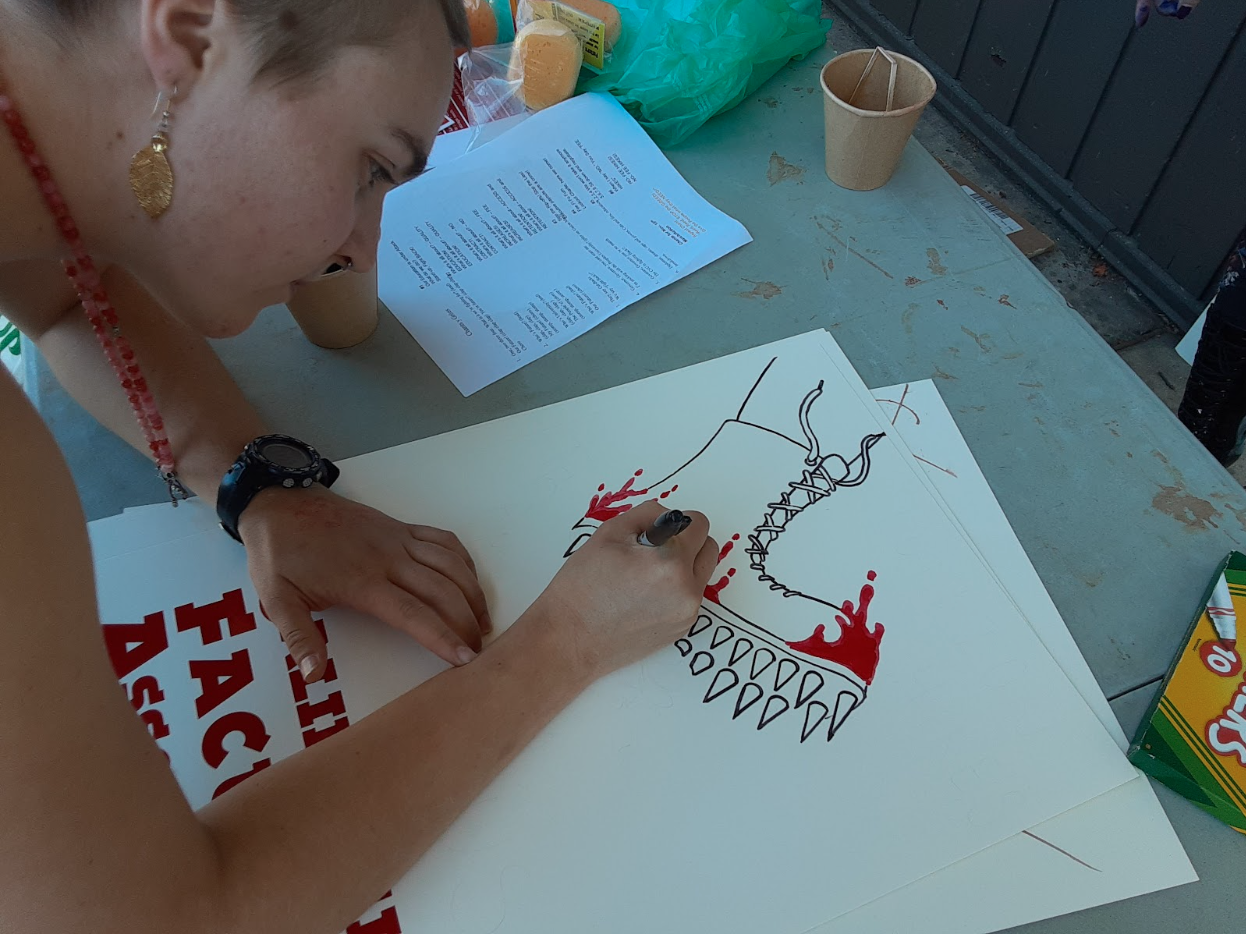
    At midday on Thursday Oct. 5, a student hunched over a table, drawing a spiked boot splattered with blood, the front of Art B plastered with posters behind her. Phrases like, “Don’t make students your ATM,” and “Shame on you, CSU,” stood in stark contrast with the dark wall. A clear voice rang across the quad below, calling out to passersby. The air buzzed with the day’s unusual heat, becoming charged with urgent words and the smell of free coffee, drawing the eyes and noses of students to three folding tables, specifically the people behind them. 

    These were organizers from the California Faculty Association – the labor union for CSU faculty –  and the Students for Quality Education, a student-led organization for education rights across the CSU system. They were there in response to the CSU Board of Trustees’ vote to raise tuition. This demonstration was also intended to promote the CFA’s upcoming rally on Oct. 19, where they plan to protest further. People were encouraged to enjoy refreshments, grab union merch and help make posters. Among the organizers present was Humboldt CFA President Marisol Ruiz.

    “We’re forgetting that this is a public university, publicly funded. It’s not a private institution and we need to stop treating it like a private institution,” said Ruiz.

    Ruiz explained that the CFA’s goals are a halt on tuition hikes as well as better pay and working conditions for faculty. This protest comes on the heels of long-standing grievances regarding what the CFA says is inequitable pay for faculty. According to Ruiz, the CSU has the money to fund education and pay its employees fairly without the need for tuition hikes, yet has strayed from the path of education as a public good. 

    A board bearing the words, “How Much Do You Owe?” was propped up against a planter in front of the tables. Students had scrawled their answers, the numbers going as high as $100,000.

    Also present behind the tables was SQE chapter head Mary Mangubat. According to Mangubat, outreach by the SQE has been quite successful this semester at getting people engaged, because the tuition hike affects not only students but the entire CSU ecosystem.

    “When they hear our admin makes a million a year, but students are in 100k debt,” said Mangubat. “They’re gonna want to be involved.”

    SQE was founded in 2008 as part of the CFA and holds weekly meetings Fridays at 4 p.m. in Nelson Hall. Mangubat described them as fighting for an equitable, accessible education that is free from discrimination and debt.

    Making a poster at one of the tables was Erika Ospenson, an environmental science and management major. Ospenson only found out about the outcome of the Board’s vote that morning from a friend in SQE and is now left with doubts about the cost of her education. She plans on attending the rally on Oct. 19 and is interested in getting more involved with SQE.

    “Something I learned today is that I will get halfway through a degree and then not know if I can actually finish it because of the tuition hikes,” said Ospenson. “I’m already barely making ends meet and [only] able to pay my rent in a rent-controlled situation.”

    The tuition hike has rattled the CSU system here and across California, but chapter president Ruiz believes that students and faculty are in this together.

    “Working conditions equal better student conditions, student conditions equal better working conditions,” Ruiz said.

  • Wildberries shoplifting incident triggers protest and backlash

    Wildberries shoplifting incident triggers protest and backlash

    by Dezmond Remington and Jasmin Shirazian

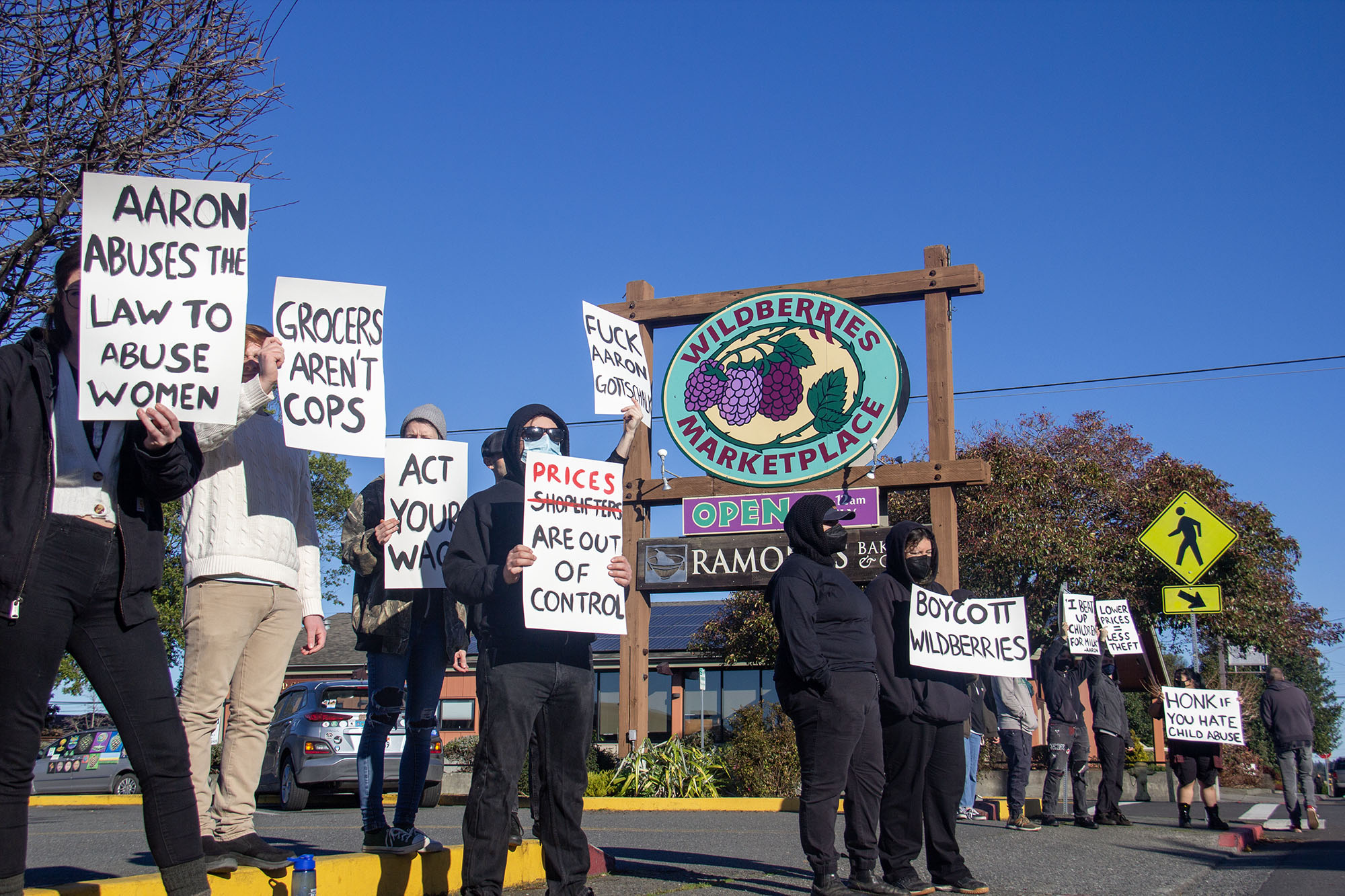
    Allegations of assault, worker mistreatment, and profiling have been leveled at Wildberries Marketplace in Arcata in response to a video showing an altercation between a customer and store manager Aaron Gottschalk.

    The video, posted on the r/Humboldt subreddit by an anonymous user, was originally shot on Sept. 30. It shows Gottschalk grabbing a young girl’s wrists and pulling her into shopping carts and eventually onto the ground by her backpack straps.

    A protest on Jan. 21 at Wildberries was attended by several dozen people, and former and current Wildberries employees spoke out against perceived mistreatment and profiling by Gottshalk (who declined a request for an interview).

    Tatum Keller, a former Wildberries employee, said managers including Gottschalk profiled customers they considered to be a high theft risk, asking employees to pay special attention to certain customers. 

    “It was always usually motherfuckers who were in hoodies or looked homeless… or just not white,” Keller said. “It was never a fucking white man. Anyone under the visible age of 30… any person of color they’d be like, ‘hey, watch out for this person.’”

    In a statement from Phil Ricord, the owner and president of Wildberries, Ricord said shoplifting was a serious problem at Wildberries and other stores in the area. Ricord said that Wildberries decided not to press charges, but was still placing the blame on the girl. 

    “Unfortunately, shoplifting and its prevention at times leads to unintended consequences,” Ricord said. “Had the individual involved responded to numerous verbal demands to stop no further action would have been necessary. Instead, they decided to ignore those demands and continue their exit from the store and were forcibly restrained until law enforcement arrived.”

    Ricord also said that due to the incident, store shoplifting policies have been revised to eliminate physical confrontations between the accused and the staff. 

    However, Keller was not optimistic. 

    “It was probably every single day, if not every other day, someone was chased out whether they had something or not,” said Keller. “Definitely not surprising. It happened before I worked there, it happened during the time I worked there and it’s going to continue to happen still.”

    Despite the purported changes in store policy, Ricord was also not too optimistic about how shoplifting would be handled in the future at Wildberries. 

    “Shoplifting has unpredictable and unfortunate consequences,” Ricord said in an email. “The incident, taken in its entirety is proof of that.”

  • Protestors seek to defund HSUPD

    Protestors seek to defund HSUPD

    Two local, activist organizations work together to stage a sit-in against Humboldt State’s police department.

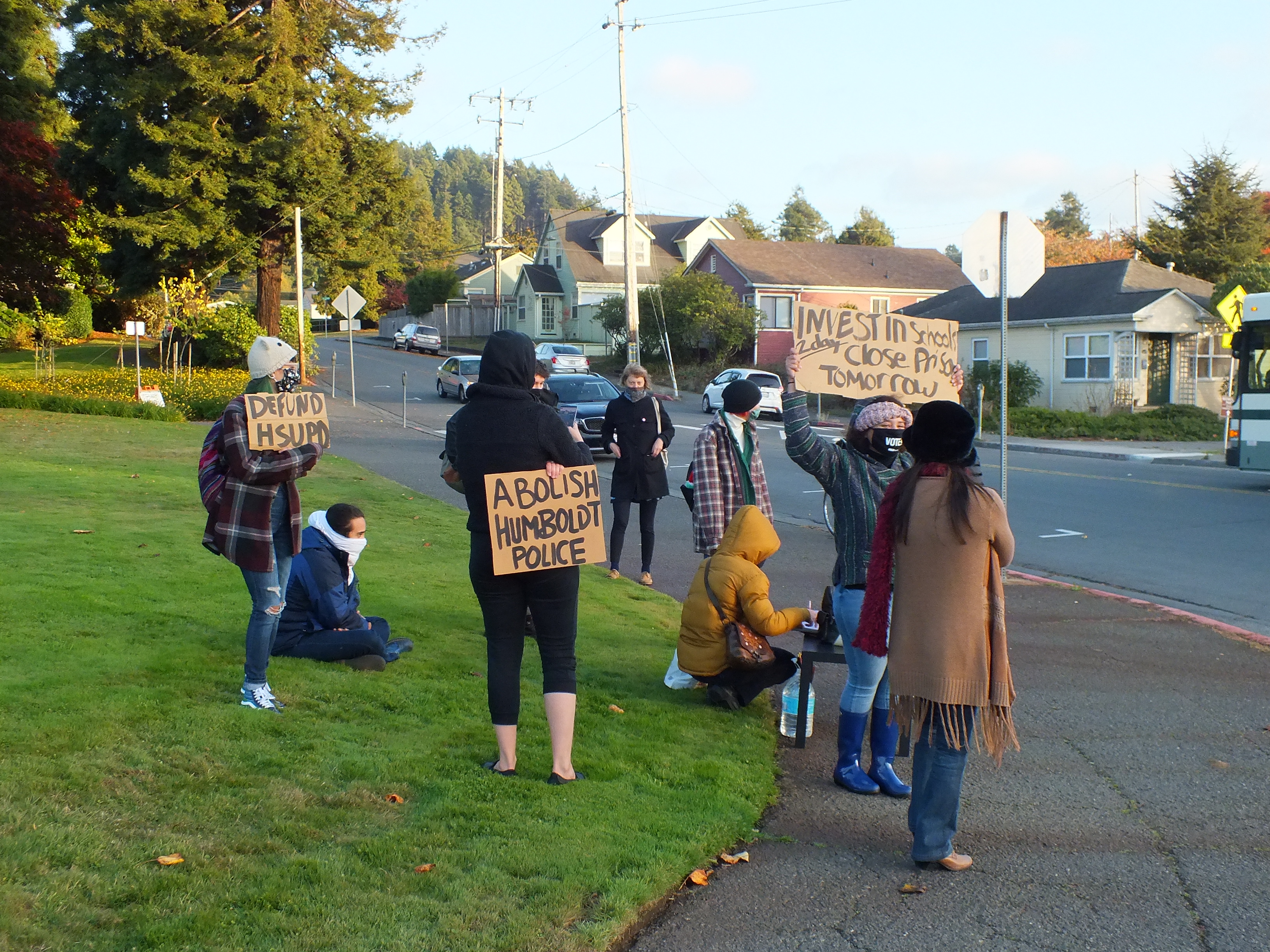
    A small group of concerned students and community members gathered outside Humboldt State University on Nov. 7 to protest the University Police Department.

    The two day protest was organized by Abolish Humboldt Police and Students for Quality Education groups. The two labeled it online as an information sharing session regarding the history of the UPD and Interim Chief of Police Scott VanScoy. VanScoy is the second interim chief that HSU has had this year.

    The UPD Chief position has not been permanently filled since the retirement of former chief Donn Peterson, who retired in May of this year. Peterson faced allegations from his fellow officers of creating a hostile work environment and making racially motivated statements. A independent investigation concluded that there was not enough evidence to either exonerate Peterson or to sustain the complaint.

    Two candidates for the position were recently turned down, with a campus wide email stating that both “…did not demonstrate the leadership needed for our campus.”

    A leader of the Abolish Humboldt Police group, who wish to only identify themselves as an alumni of the school for their safety, said that they seek change in all departments within the county but chose UPD as a jumping off point due to events within the past year.

    “They are adding more psychological load and heaviness to [students] trying to go to class and learn,” the Abolish Humboldt Police organizer said. “That is what the police do in order to keep you from learning, and we do not want that on our campus.”

    Irritation within HSUPD further imploded in the earlier parts of the year when Black Lives Matter protests exposed police brutality specifically targeted on the Black community. Campuses across the nation started questioning the need for campus law enforcement.

    “They have been going on for too long and they have damaged too many people’s lives,” the organizer said. “I didn’t like seeing them as a student here, I don’t like seeing them as an alumni.”

    On the Instagram page for the activist group, the SQE listed the demands they wish to be met if UPD were to be defunded. The demands included the removal of firearms from campus, establishing “a student and faculty run, mutual aid based, program for the emergency/blue lights,” and the creation of a system to address virtual harassment.

    Outside of UPD reform, the group seeks better funding for BIPOC organizations on campus and better protection for LGBTQ+ members of the community.

    Kei Chow was an incoming freshman when they heard about the investigation. Chow was proud to see groups like Abolish Humboldt Police and SQE in the area, sharing the discontent for UPD.

    “I saw their Instagram page when I first came here and I didn’t realize that the school had a defund the police movement,” Chow said. “I think that’s really important, especially since I’ve seen what the campus police spend their time doing.”

    Jasmine Martin, a marine biology major, helped organize the Abolish Humboldt Police event after being directed by other activist organizations in the area.

    “Being white, I have a lot more safety and privilege than a lot of other people do to speak my mind,” Martin said. “I felt it was important to use my privilege to hep the BIPOC members of the group feel safe and encourage other white allies to show up and listen.”

    As cars drove by, some honked their horns in support or gave a thumbs up as the protestors held up signs calling for the abolition or defunding of UPD. At one point a driver expressed their support for the protest by dropping off a carload full of coffee.

    For Chow, the decision to join the Saturday night protest came after witnessing an impactful and resonating event of officers flashing their dominative power.

    “Seeing a group of six squad cars pull up to my residence hall and have a picnic,” Chow said. “They were all in their uniforms and they were in their squad cars. It’s one thing to do it when they’re not on duty and having a lunch, but to do it on campus in their uniform with their cars, I don’t think that is right.”

    While they have plans for future protests on their social media, members of both Abolish Humboldt Police and SQE at the protest said they plan to continue to voice their demands and concerns against HSUPD.

  • KHSU protest in the plaza

    KHSU protest in the plaza

    The last remaining KSHU staff members resign, join a peaceful gathering of a few dozen held during weekly farmers market

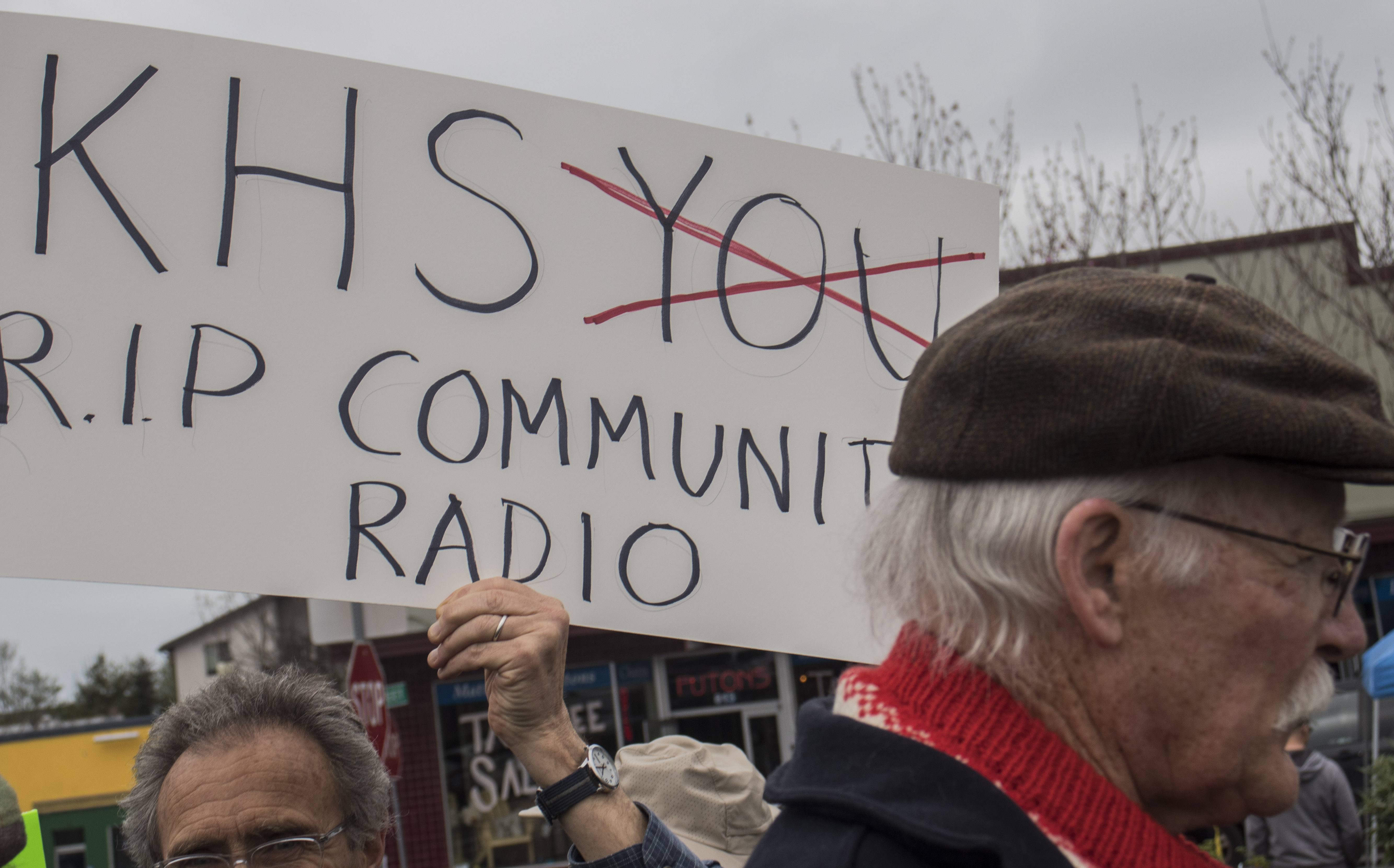
    Forty-eight hours after the artery of the community was severed, a few dozen KHSU supporters took to the plaza in protest during the weekly farmers market.

    Natalya Estrada resigned her position this afternoon as the last remaining paid staff member of KHSU. Estrada’s resignation came after administrators at Humboldt State University decided to fire all volunteers and terminate all but two paid positions at KHSU on April 11. David Reed was the second of the two remaining employees but resigned on Friday, April 12.

    Estrada was at the protest to show support and said staying in the position would not only compromise her career in journalism but affect her overall health.

    “There comes a time in life when you need to make a decision in life and I made that decision,” Estrada said. “I knew what I was going to do but I needed to know how and when.”

    IMG_0041.jpg
    Local artist Lisa Enge holds a sign in support for KHSU during a peaceful protest at the weekly Arcata plaza farmer’s market on Saturday April 13. | Photo by T.William Wallin

    After Reed resigned Estrada was the last staff member running the station. Estrada said when the California Report came on she put on Caroline King and cried at her desk.

    “It was very lonely being the last person left,” Estrada said. “It felt like 48 hours on the 405 during rush hour traffic.”

    Tom Cairns was one of the volunteers to be let go during the dismantling of KHSU, but he isn’t just any volunteer. Cairns has been with KHSU for 47 years, making him the longest running volunteer at the station.

    IMG_0046.jpg
    Community member, Carrie Slack, and former host of Jazz with a Groove, Rob Enge, hold signs in support for KHSU during a peaceful protest at the weekly Arcata plaza farmer’s market on Saturday April 13. | Photo by T.William Wallin

    Cairns was at the protest because he felt the way everyone was fired was wicked and shameful. Cairns felt the audit report done on KHSU was just an excuse for firing everybody and HSU administrators were planning this even before then.

    “The way they handled it was bold face lies,” Cairns said. “They had checks written out already even before the meeting. They had it all planned.”

    In the 47 years as a volunteer Cairns has seen KHSU have its ups and downs but “it’s always continued and was never shut off the air.” Cairns said the unfortunate thing about the station now is it has become a typical NPR station with all news and very little music.

    “Basically it’s just another McDonald’s public radio station,” Cairns said.

    IMG_0066.jpg
    Public citizens, Mark Mueller and Lisa Hockaday, hold signs in support for KHSU during a peaceful protest at the weekly Arcata plaza farmer’s market on Saturday April 13. | Photo by T.William Wallin

    When asked what he felt the biggest loss was Cairns said the community of the station. Cairns said those that work with KHSU are very active in the larger northwest community and engaged in the arts, food, and news.

    “The music, public affairs, and local programming is what made KHSU unique and a viable source for the community,” Cairns said.

    IMG_0074.jpg
    A few dozen protesters gathered with signs during the Saturday farmer’s market at Arcata Plaza to show support for KHSU on April 13. | Photo by T.William Wallin

    Rob Enge, former host of Jazz with a Groove, was a member and sustainer with KHSU for 25 years and agreed with Cairns. Enge said this has been a loss of a community forum where connection was made.

    “This was a good place for people to put their energy,” Enge said.

    Enge moved to Humboldt in 1992 and the first thing he did was get connected with the local radio station. Enge was an avid listener of KPFK in southern California and said public radio stations are an important way in getting connected with community.

    “This has been an erosion of community,” Enge said. “This isn’t social media from out of the community, this is real people talking locally and when we lose that its a shame.”

    IMG_0048.jpg
    Community members show support for KHSU during a peaceful protest at the weekly Arcata plaza farmer’s market on Saturday April 13. | Photo by T.William Wallin

    Local artist Lisa Enge has also been a supporter of KHSU since 1992 and felt the loss of KHSU was like losing a friend. She said KHSU was a treasure in the community and it was a cruel way that it was cut.

    “Cutting volunteer and staff is unconscionable, shameful really,” Lisa Enge said.

    IMG_0069.jpg
    Jax Stuber (left) has been listening to KHSU everyday for the last six years and said she will miss all the music and diverse programming. | Photo by T.William Wallin

    Lisa Enge said once general manager Peter Fretwell fired KHSU program director, Katie Whiteside, the love for KHSU waned. She said as an artist the radio kept her company while she worked and she didn’t feel so lonely.

    “The people, DJs, and programmers became friends,” Lisa Enge said. “It’s like losing a friend, or a family member really.”

  • Power of protest in pursuit of peace

    Power of protest in pursuit of peace

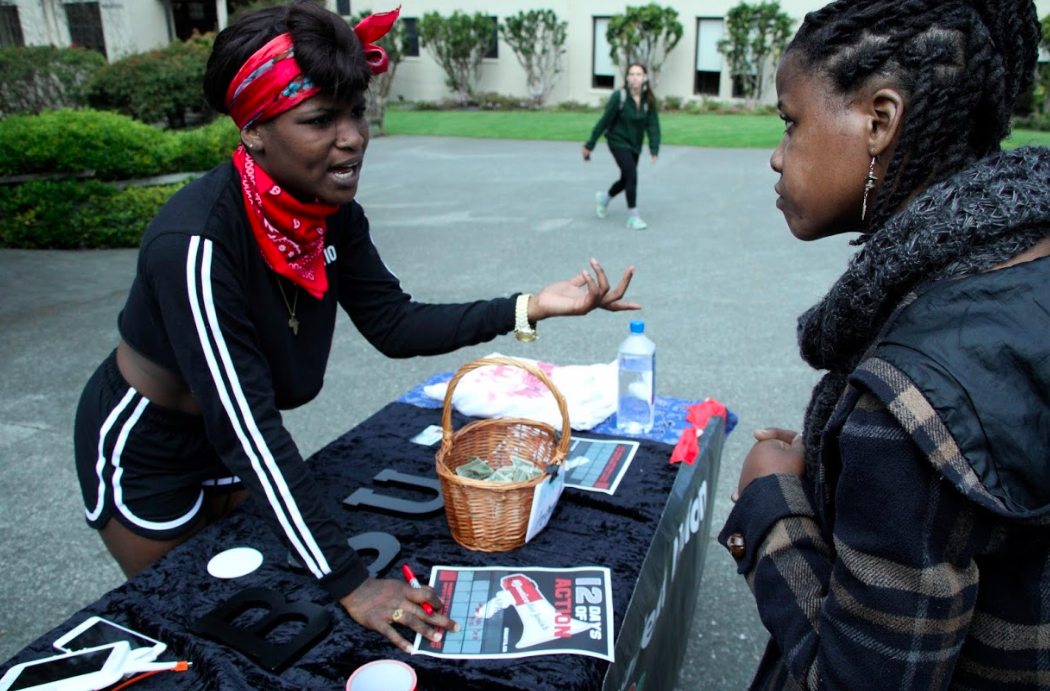
    With the song, “JUSTICE FOR JOSIAH (RIP)” by Oboy Flocka playing in the background, sophomore criminology student Barbara Singleton stood near the front of Siemens Hall with pamphlets, spreading awareness on the events planned for the following 12 Days of Action.

    “The university needs to commemorate the death of Josiah so we can get a mural or a plaque with his face,” Singleton said. “We’re asking the university to put up a legal fund to help out his mom.”

    Humboldt State University students are organizing a 12-day plan of action to gain national attention and investigative help to assist the process of bringing justice for the murder of 19-year-old, David Josiah Lawson.

    As the one-year anniversary of Lawson’s death approaches, students, family and friends continue to grieve over the lack of acknowledgment and support from surrounding members of the community, and most importantly the university.

    Humboldt State students stand together to bring awareness to the case of David Josiah Lawson on April 4, 2018. 
    Video by Garrett Goodnight. 

    Do not confuse the university’s scripted statements with signs of actual progress.

    The lack of support and desirability to create change within the university’s setting reflects the mere comfort within the administration and presidential office. The lack of motivation to bring awareness to Lawson’s case demonstrates that the university may not actually support the students’ movement at all.

    Current race relations surrounding our campus environment is met with “optional” racial awareness training for students.

    By making this type of training optional, the campus is refusing to take responsibility for the perpetuation of racist behavior, and by refusing to mandate this training in every department.

    The ability to brush over racial tensions on and around our campus, staging it as an optional training, makes it easy for the university to trap new students of color in its institution, making them believe that our campus is a perfect, safe-haven for incoming freshmen and transfer students.

    Even though the campus may claim that the university is inclusive, they do not inform students about the murder of Lawson before recruiting them here.

    Freshman student, Marianna Baines, was frustrated with the university. She was not informed about the murder of Lawson before she transferred to HSU.

    “I wasn’t told the truth,” Baines said. “If I knew about this, it would have given me more clarity.”

    When it comes to voicing their opinions, students do not shy away from expressing their true feelings about the institution and what it is lacking.

    Student organizer, Vanessa Cota explained that protests are extremely powerful in the sense that they are inspirational movements.

    “It matters that people get their voice out there,” Cota said. “Protests can mobilize people, that’s where the power of protest is!”

  • Gaining ground: marching for human rights

    Gaining ground: marching for human rights

    Video by Michelle Meyers.

    Protesters lined the streets of downtown Eureka on Jan. 21 to be part of the worldwide Women’s March.

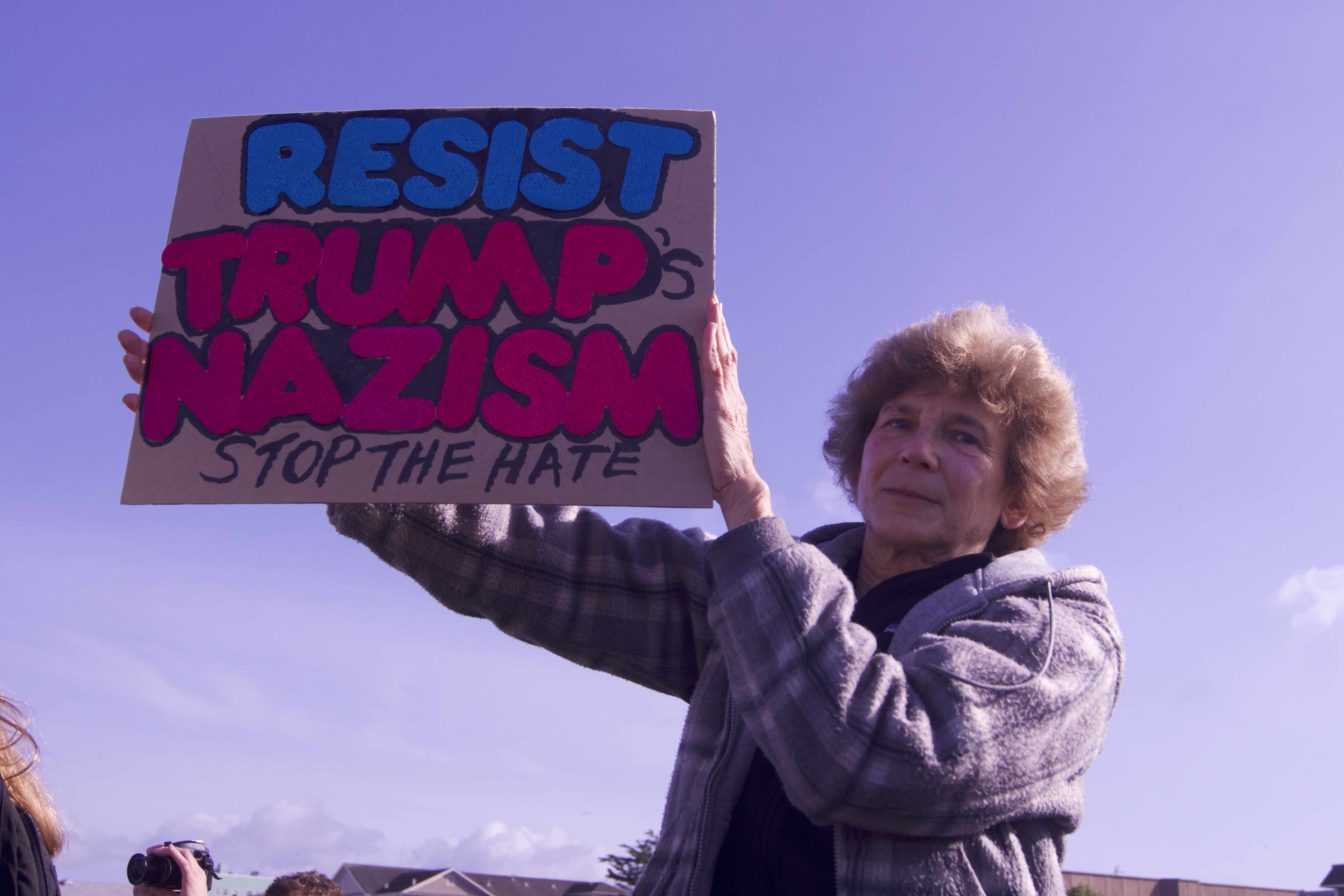
    This year’s Women’s March occurred on the one-year anniversary of Donald Trump’s inauguration. It is now considered to be the largest single-day protest in U.S. history.

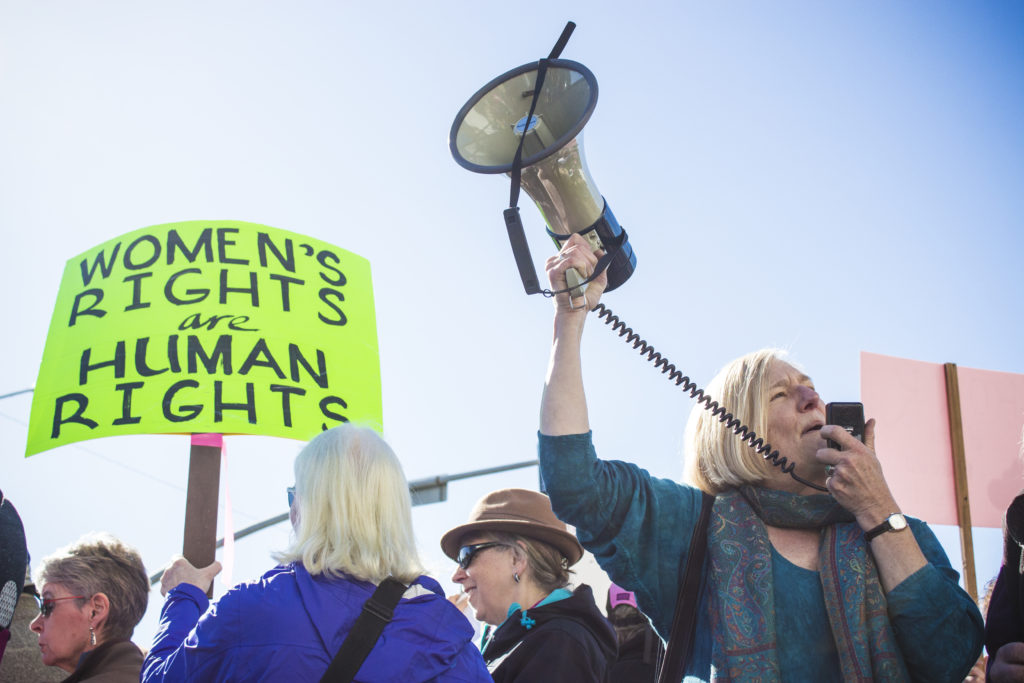
    The march in Eureka was part of the larger Women’s March movement that took place not only here, but around the globe. The intention of this movement is to protest the attitudes put forth about women by Trump and to promote women’s rights as human rights.

    The initial rally began at 1 p.m. on C Street Market Square.

    Speakers representing an array of local organizations, including the North Coast Rape Crisis Team, Centro Del Pueblo, Move to Amend and Seventh Generation Fund for Indigenous Rights, took to the stage to address their local and global communities.

    Organizers concluded the rally with an inspiring performance by The Raging Grannies, a local women’s music group that sings about social justice issues.

    The march began around 2 p.m.

    Protesters beared signs that read statements like, “together we rise,” “don’t mourn, organize” and “anything you can do, I can do bleeding” around the streets of downtown Eureka.

    A protester holds a sign at the Women’s March in Eureka on Saturday,  Jan. 21, 2018. Photo by Michelle Meyers.

    They chanted statements that rang through the crowded streets, such as “me too,” which is in reference to the prevalent #MeToo movement.

    “No Trump, no KKK, no fascist U.S.A.” and “I am a woman, hear me roar!” were also heard amongst the crowd.

    This all plays in part of starting a conversation that “just gets brushed under the rug,” protester Loganberry Fernandez said. “Human rights is something that shouldn’t be ignored.”

    Conversation is merely the first step.

    Many protesters lined the streets of downtown Eureka and around the globe to express one purpose: “To be here for women,” protester Athena Gore said.

    HSU students stand by a light post in downtown Eureka, located near the Women’s March on Saturday,  Jan. 21, 2018. Yomayra Mora (left), Myranda Dominguez (top left), Noel DiBenedetto (top right), Sydney Long (right) and Rowan McClelland-Bishop (center) protest with their signs. Photo by Garrett Goodnight.

    “Whether it’s immigrants, Native Americans or people of color, what will forward the movement is unifying voices and hearing other groups talk about advocating in strength and in numbers,” protester Raquel Lee said.

    For Brenda Perez, a voice for Centro Del Pueblo, this is her first time participating in the Women’s March.

    “[The Women’s March] represents the recognition of our neighbors as workers, as students,” Perez said. “For me, saying that we are here isn’t just a statement. We are here.”

    Perez is joined by Yojana Miraya, a fellow voice for Centro Del Pueblo from the Andes of Peru.

    “If injustice happens, women and men come together in Latin America, especially in indigenous communities,” Miraya said.

    When asked if she was afraid of what the future holds for her, as well as for women everywhere, Perez said, “We are going to do it. We have to do it.”

    So in the name of human rights, they will march.

    Number of marches: 673

    Number of marchers: 4,956,422

  • WOTS: How do you feel about Trump’s comments on NFL players kneeling?

    WOTS: How do you feel about Trump’s comments on NFL players kneeling?

    By | Bryan Donoghue

    WOTS_Web_--2

    Abraham Neri, Freshman philosophy major.

    “They should have the right to any freedom of expression. I understand where the players are coming from, and I respect what they’re doing. As far as his Presidency, it goes to show how a white man with power and money by instigating oppression and diminishing the value of our first amendment.”

    WOTS_Web_--4

    Noah Gladstone Brookman, Kinesiology/Spanish, Senior

    “F*ck Donald Trump. F*ck the national anthem. I think the players need to be treated better in terms of equality. It comes down to the fact its not about football, it’s about politics and race. There’s other sh*t going on. I think the national anthem is overused, I don’t think it should be as big a deal as it is. There’s definitely a division and it’s creating more division between the population.”

    WOTS_Web_--3

    Emily Lopez, Anthropology, Freshman

    “Because it was a black person who went against him, Trump reacted. People didn’t care about that. It was a black man kneeling, if they were white, who knows? They felt like their people were being oppressed, they weren’t going against him.”

    WOTS_Web_-

    Angel Orellana, Criminology, Junior

    “Trump is a piece of shit, first of all. At the same time, I don’t feel those people sitting down goes against patriots. When they sit down for the national anthem, I don’t see it as disrespect. I feel they’re trying to bring to light the issues in America right now.”

  • Arcata National Women’s Day rally ends early as man is taken into custody by police

    Arcata National Women’s Day rally ends early as man is taken into custody by police

    By  Alex Hasenstab

    Additional reporting by Curran Daly

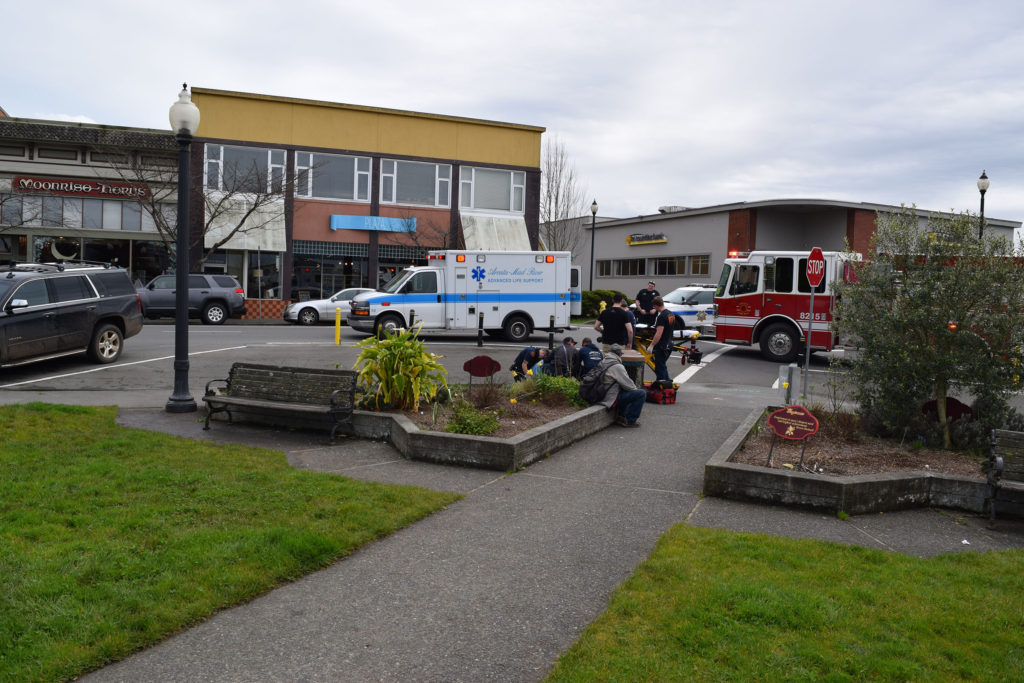
    Earlier today several dozen women gathered on the plaza dressed in red and pink to celebrate National Women’s Day. The rally began at approximately noon, however, less than an hour later the celebration was interrupted by loud sirens.

    Cat Koshkin holding a sign at Arcata women’s rally | Curran Daly

    A man who appeared to be around 50 years of age became disruptive during the onset of the event and later collapsed to the ground. He initially walked up to rally participant, Cat Koshkin, and put his hand on her shoulder.

    “Please stop him please,” the man said.

    “What happened?” Koshkin said .  

    “I can’t catch up with him,” the man replied.

    The man then collapsed and began shaking. A nearby parking enforcement officer had the man sit down. After the officer was unable to get any clear response from the man he called an ambulance.  

    Man arrested by APD | Alex Hassenstab

    The Arcata Fire Department, Mad River Hospital ambulance and the Arcata Police Department arrived at the scene shortly after the call was made. The man refused medical attention and after screaming and showing aggression towards medical workers he was taken into custody by the Arcata Police Department.
    The Lumberjack will provide additional updates as more information becomes available

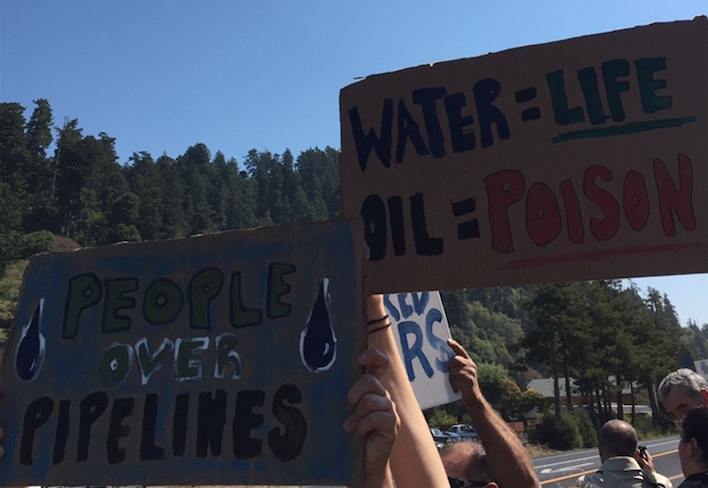
  • Potential pipeline meets resistance

    Potential pipeline meets resistance

    Story by | Emily Owen

    Since the 1970s, a Canadian-based energy company called Veresen Incorporated has been working on a plan to build a pipeline to carry natural gas through Southern Oregon, just 200 miles north of Arcata. After being repeatedly turned down, documents are currently being prepared to be re-submitted with the expectation of eventual approval. 

    According to Veresen Incorporated’s website, the Pacific Connector Gas Pipeline is proposed to be 232 miles long, cross under five major rivers and result in the clear-cutting of up to 30 miles of forest. At $7.5 billion, the project is worth twice as much as the Dakota Access Pipeline and is being praised for its potential in economic benefit.

    When Leonard Perry heard about the Pacific Connector Gas Pipeline and that sections were going to pass through the Klamath River, he readied himself for the fight he knew was coming. Perry, an 18-year-old student attending College of the Redwoods, is a founding member of a group known as Humboldt Water Protectors. The group, now called Sacred Seeds, has made it their main goal to protect the abundance of natural resources in and around Humboldt County.

    “We see what’s happening to the world, what’s happening in our own backyard, and people are waking up,” Perry said. “We all drink water. This isn’t a party issue, we need to start looking out for our brothers and sisters. The minute we start coming together there’s change.”

    Mouth of the Klamath River in the fall. Photo by Emily Owen.

    The HSU Environment and Community Club is organizing an on-campus event titled Water is Life: The Standing Rock-Klamath Connection to publicize and spread awareness of the potential Pacific Connector Gas Pipeline. The event will happen on March 4 in the Kate Buchanan Room from 12 to 6p.m. and will shed light on interconnectivity behind the movement for clean and safe water.

    Francesca Gallardo and Yojana Miraya, both graduate students in the environment and community program, are coordinating outreach for the event. Gallardo sees the potential to unite these communities and cross boundaries through building coalitions.

    “These movements are for everyone,” Gallardo said. “We are fighting the biggest fight of our lives. It is time for everybody and anybody to step up.”

    Miraya is from an indigenous tribe in Peru and recognizes the parallels in the global struggle to protect natural resources. 

    “Leaders aren’t working for the communities” Miraya said. “Educating people will bring consciousness and the parts of society that are marginalized can come together.”

    Cutcha Risling-Baldy professor of Native American studies at HSU, is Karuk, Yurok and an enrolled member of the Hoopa Valley Tribe, thinks of pipelines as last resort efforts from the nonrenewable energy industry to stay relevant in a world relying on a failing system.

    “There’s a Gold Rush mentality of wanting to make as much money as possible no matter what the consequences are,” Risling-Baldy said. “That’s why we need to always include an indigenous perspective. Native people consult with the land and we see those connections. You can’t account for the way nature plays with your best plans.”

    Risling-Baldy stressed the importance of divesting from companies and organizations that fund nonrenewable infrastructure. 

    “We’re finding out that people think with their money,” Risling-Baldy said. “The government is actively working against the people so you need to speak with your money. Take it out.”

    Michael Hinrichs, Director of Communication for the Pacific Connector Gas Pipeline, acknowledges the opposition that is growing and wants to assure people that the project is meeting all environmental standards set by the federal government.

    “We’re trying to avoid the impacts that people are worried about,” Hinrichs said. “I would encourage people with concerns to make them known.”

  • Planned Parenthood supporters gather outside Humboldt County Courthouse

    Planned Parenthood supporters gather outside Humboldt County Courthouse

    By | Ali Osgood

    Hundreds of people rally on the steps of the Humboldt County Superior Courthouse on Saturday afternoon to support Planned Parenthood. Women, men, children and dogs clutch signs with Planned Parenthood logos and personal statements as they encourage honks from the cars passing by Fifth Street.

    Rallies erupted across the United States on Saturday in opposition to defund Planned Parenthood. Member of the former Six Rivers Planned Parenthood Board, Carolyn Hino-Bourassa, helped organize the local event in just under a week.

    “Hearing that they were targeting our own clinic in Eureka, we wanted to draw attention away from that,” Hino-Bourassa said.

    #PPprotest, an organization that opposes abortion rights, helped organize 225 demonstrations in 45 states according to its website. They are urging for government defunding of Planned Parenthood. The Eureka clinic was not on the list of the 42 demonstrations scheduled in California.

    Johnathan Desoto stands with his friend as they encourage drivers to honk in support of Planned Parenthood on Saturday afternoon. Photo by Ali Osgood.

    The nationwide rallies prompted counter protests across the United States. Many in the local humboldt community felt it was important to stand in solidarity with the non-profit organization.

    Johnathan Desoto was one of the supporters in the crowd in Eureka. Desoto has volunteered with Planned Parenthood as a registered nurse.

    “I believe [Planned] Parenthood is an integral part to not just women’s health but community health in general,” Desoto said. “Health education is something that really works. Planned Parenthood is really something I believe in.”

    The event organizers estimated up to 300 supporters on Saturday. Carolyn Hino-Bourassa was one of the event organizers.

    “[I feel] overwhelmed, to say the least, for putting it together in under a week. It’s amazing,” Hino-Bourassa said. “One of the goals today was to make more connections and be very good at mobilizing several people very quickly, and I think we’ve proven we can do it.”

    Abortion services account for less than 3 percent of Planned Parenthood’s services nationwide according to their annual report from Oct. 1, 2013 to Sept. 30, 2014. 45 percent of its services go toward testing and treating sexually transmitted diseases with 31 percent going toward contraceptive services.

    Their largest single source of money comes from the federal government which makes up for nearly half of the organization’s funds.  The other half comes from private contributions and other nongovernment sources.

    Republican lawmakers across the United States are working to propose bills that cut public funding to all organizations that offer abortions. According to ABC News, House Speaker Paul Ryan has pledged “that Republicans will complete legislation to repeal and replace the Affordable Care Act this year and that he expected legislation to defund Planned Parenthood would be included.”

    Dave Turner attended the Saturday rally in Eureka in support for Planned Parenthood. Turner is on the Board of Advocates as well as the Northern California Planned Parenthood Board of Directors. He is prepared to work hard to protect the local clinic and the organization.

    “Many of our efforts are going to be focussed on working with our local government officials both at the state and federal level, because the funding of Planned Parenthood is a critical issue for us.” Turner said. “We are trying to appeal for some common sense in keeping Planned Parenthood funded and operating.”

    Over 25o Planned Parenthood supporters hold up signs as cars beckon honks of support. The organizers were please with the attendance on Saturday. Photo by Ali Osgood.