Resolute hope mixed with a tinge of fear and anxiety have been the dominant emotions today on Humboldt’s campus after officials sent an email saying protestors participating in the ongoing Siemens Hall occupation should leave before 5 p.m. to avoid being arrested.
Though only a few people have been arrested, many more than that have received interim suspensions today.
Administration set up a “check out” booth next to the library circle, where activists who got a suspension could make a case that they didn’t deserve one and attempt to get it wiped.
According to Dean of Students Mitch Mitchell, the decision was made by an emergency operation committee with over 30 people on the board. They thought it was the best way for students to vacate without being physically harmed. Mitchell believed it was highly likely that many people would take the opportunity to leave.
“This is not a person’s normal dwelling,” Mitchell said. “Students walk out, same way they walked in.”
Most of the activists are staying, and won’t leave until the university meets their demands. Many of them say it’s worth getting arrested.
“A lot of us have known that the university has problems caring about students,” one protestor who asked to remain anonymous said. “This just confirmed what I suspected.”
Another protestor, who gave the pseudonym “Rosie”, thought the check out booth and insinuation that everyone else who didn’t use it could be arrested was an unnecessary scare tactic. To leave, Rosie said the CSU would have to commit to a system-wide divestment policy to stop investing in Israeli interests, a statement a lot of protestors echoed.
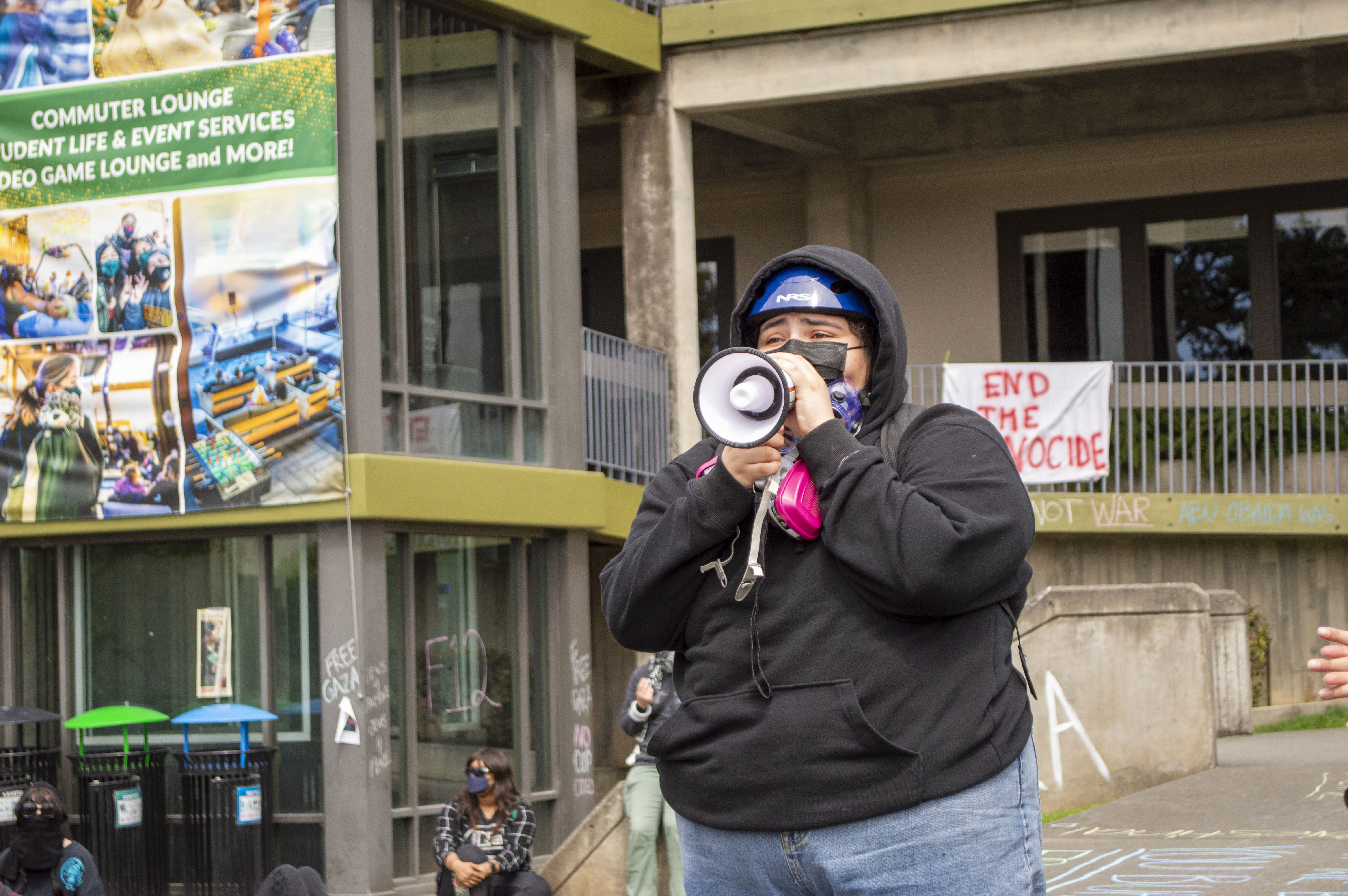
“If we stay here long enough, we can get the CSU to divest,” said one speaker in the UC quad with a megaphone. “We can be a thorn in the side of Genocide Joe [Biden] as long as it takes.”
Although the vast majority of protestors have decided to stay, at least one who asked to go by “Tord” left because of the threat of violence. Tord had been staying on campus since Monday, and could not condone the possibility of physical harm coming from either law enforcement or protestors.
“I’m leaving for my own safety,” Tord said. “I want to be 100% peaceful and I won’t associate with violence. I just wanted community.”
Humboldt County Sheriff William Honsal showed up to campus at around 4 p.m. to try and work with activists to devise a plan to get everyone to leave campus. He also said the sheriff’s office had no plans to breach the barricades and enter the occupied portion of campus, but only if the police and protestors could come to some agreements.
“The last thing we want is violence,” Honsal said. “If we continue down this road, that [could] happen.”
The occupation continues to disrupt campus life as in-person classes have been shut down for the rest of the semester. Many of the activists have little sympathy for students who are mad at the developments. One alumni said the protests are “land-based learning.”
“If our demands are not met and if all we’ve done is show hope, I am happy,” one speaker said. “To those who have said this was a waste of time, or unproductive, or just a lot of needless destruction of property, I say we inspired hope.”
Dean Mitchell doesn’t agree.
“I think there’s been a lot of light shed on the situation [the war in Palestine],” Mitchell said. “My focus is the student body. What about the other students? There is no access to the cultural centers or study halls. How are we showing support for all of our campus? How do we restore our campus? I believe in disruption, not destruction. Don’t take it [destruction] home.”
Protesters have been moved to Nelson Hall while university officials currently survey the damage in Siemens Hall.
There’s a group of about 20 students parked outside of the Reese Bullen Gallery screaming their best chants at the university administrators and jet-setting donors who are supposedly inside. None of the protestors have seen them in the hours they’ve been there, and the windows are covered in cardboard anyway.
At the top of 12 stone stairs facing the buildings opposite stand a few people with a megaphone speaking to those down below — and across the quad, and across the street, too. Their megaphone is crackly, but effective.
“All he cares about is getting more students and then fucking them over by making us pay more tuition and more in housing!” Mary Mangubat said, clad in a blue surgical mask and an undone black zip-up hoodie. The protestors nod, as does student Richard Toledo, who is holding the megaphone for her.
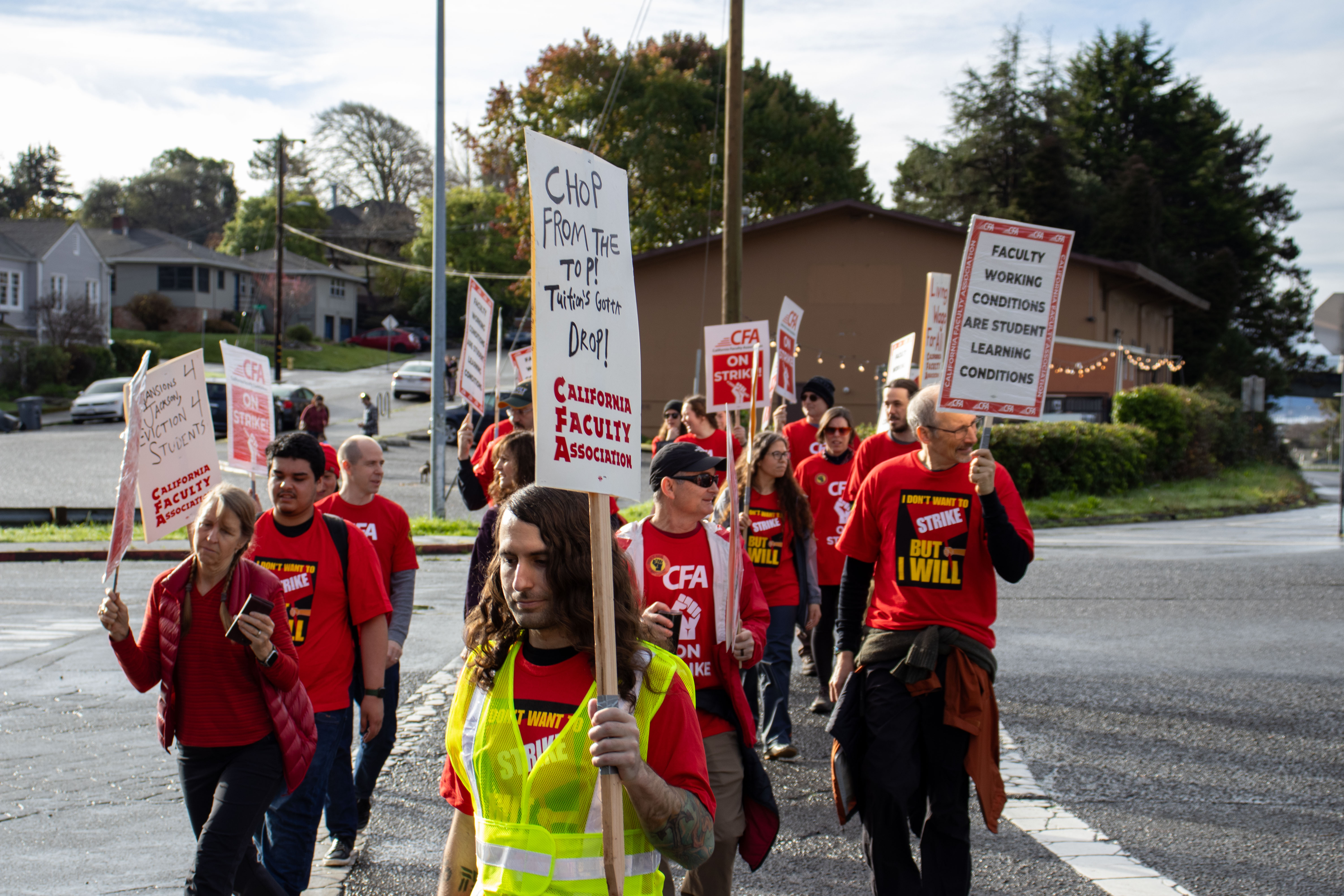
Mangubat and Toledo are constant presences at protests in and around campus. They’ve supported everything from Palestinians in Gaza to professors striking this semester. Mangubat even got a protest in her honor when the megaphone usage and other violations of the university’s Time, Place, and Manner restrictions on free speech at the Reese Bullen Gallery on Jan. 23 got her and Toledo yanked into a meeting with Dean of Students Mitch Mitchell and handed a “deferred probation”— in other words, a slap on the wrist. The next time one of them breaks the rules, they may face measures such as expulsion. As it was, they had to write a reflection essay on how to be a better organizer.
Signs from the student protest on Feb 8 prompted by Toledo and Mangubat’s deffered probation following a violation of the university’s Time, Place, and Manner restrictions. Photo by Griffin Mancuso.
Though many of the things people see Mangubat and Toledo do are similar, such as leading protests and showing up to meetings, how they approach those actions contrast heavily.
Mangubat, 20, started protesting when she was attending high school in San Francisco’s SoMa district, where she said there were issues with things like outdoors accessibility. Mangubat, a Filipina, said she had an early awareness of concepts like intersectionality when she noticed the other students working to raise awareness of those issues were richer and went to private schools.
She occupies many roles on campus. She’s the environmental educator at the Women’s Resource Center. She interns for the Student for Quality Education chapter at Cal Poly Humboldt. She works for the Environmental Science and Management department on their Justice Equity Diversity Inclusion committee. All of these titles add up, but at the end of it, Mangubat sees herself as a coordinator, setting people up with resources they need.
Toledo, 32, defines his role on campus similarly. However, the route he took to get to Humboldt was vastly different than Mangubat’s.
He developed an early sense of the unfairness in the world after watching his mom struggle to afford to house them while he was growing up. When Toledo was 18, he tore his ACL skateboarding a few days after his insurance provider dropped him and got thousands of dollars worth of debt when he couldn’t afford to pay it all. He hopes others can avoid that fate.
“I find purpose in anything that I can tell is making a difference of some kind,” Toledo said. “That’s why I want to work in restoration science as well. I think that being on the ground and watching those seeds literally grow – not even just metaphorically, but watching the seeds that I’ve planted grow, the things that I’ve done, develop. That makes me happy. Seeing an actual difference from my actions is something I really enjoy.”
Now in his third semester at Humboldt, Toledo is in his second go-round through a university. He got a multimedia production degree from CSU Northridge in 2020, but after a few years of working as a web developer, he decided to quit and get a degree in environmental studies.
“It turned out that I was pretty good at coding and there was a lot of money in it,” Toledo said. “So, I just kind of fell into it, and I ended up despising it. Something about just how tedious the work was, and seeing the news everyday, and watching what was happening outside of my bubble at work, and wanting to do something about it as well and not just be sitting behind the computer. After a certain point, you see enough climate headlines that the pay doesn’t really matter anymore, and you just want to do something good.”
Toledo, a self-described “de-colonial Marxist,” is deeply into studying leftist theory, and idolizes people such as Marxist revolutionary Thomas Sankara and Black Panther Fred Hampton. He’s currently working on organizing a chapter of the Students for a Democratic Society. His earliest memory at a protest was during the Occupy protests back in 2012, when he was 20 years old. Toledo met everyone from garden-variety Democratic Socialists, to anarchists, to socialists to full-blooded commies. The experience left a large impact on him. Now, he has too many books to store them all on the dorm bookshelves and leaves them in piles on his floor.
Mangubat’s style tends to be more accessible, not founded on turgid leftist musings or obscure revolutionaries. Though these self-appointed guardians of campus operate on distinct levels, what does make them come to the forefront of every anti-something shindig on campus is a love of disruption.
It’s what Toledo and Mangubat use to explain college students protesting events happening both half the globe away and close to home. Student activists get a lot of flak from the general student body because of the perceived irrelevance and disconnect from Arcata to places like Gaza or Washington D.C. They argue that that’s part of the point.
“The only avenue that people have is disruption,” Toledo said. “And if you disrupt as many things as possible, even if they may not be wholly related, it’s going to cause more problems for the people at the top. They’re going to take notice of that. If you have whole businesses shut down, if you have schools that are shut down on certain days, if you have more and more people that are sympathetic to the cause and getting out there in the streets, making noise and demanding things on the local level, that reaches up to the top. They realize that and they start to change their narrative, and they might even start to change things.”
Both Mangubat and Toledo feel the Time, Place, and Manner (TPM) restrictions they violated are excessive and defeat the point of protesting and organizing. One of the TPM restrictions requires organizers to make it clear to administration when and where they plan to protest, a rule Mangubat hates.
“The rule of protesting is that you’re disrupting systems,” Mangubat said. “You’re disrupting the place and the people who are oppressing you, so it’s not productive or efficient to just be like ‘Hey, here’s everything I’m doing,’ and then, admin will be like, ‘OK, now we know what they’re saying…’ They have every step to prepare to cover their own asses if they had to.”
Both Toledo and Mangubat do not have mixed feelings when it comes to Cal Poly Humboldt’s administration, which they characterize as aloof from campus and not held accountable often enough for things like last semester’s eviction of the van lifers. At the Jan. 23 protest, Dean of Students Mitch Mitchell called the university police department on them — something campus employees are supposed to do when there’s a protest on campus. It wasn’t a move that went over well with the students that were there, especially after he talked to some of the protestors there in a way many of them thought was overly confrontational. Mitchell left when protestors booed him and chanted the word “Shame” at him over and over again. Mangubat feels that outburst was reasonable because of his position as an administrator.
“From my perspective, I think it’s justified because every step that they had taken since my disciplinary notice to the students trying to put on this protest, they had been escalating everything …” Mangubat said. “So, I think in some way, it was needed for admin to see what students are capable of doing. Not in a harmful way, but in a human way, like a human response type of way … it’s a complicated situation because, you know, at the end of the day, people are human, they have feelings, but your hierarchy stands out so much more. And you’re acting in that position.”
“I’m proud of what we set out to try to do to try to get the attention of Tom Jackson,” Toledo said. “I’m not proud of exactly how it turned out.”
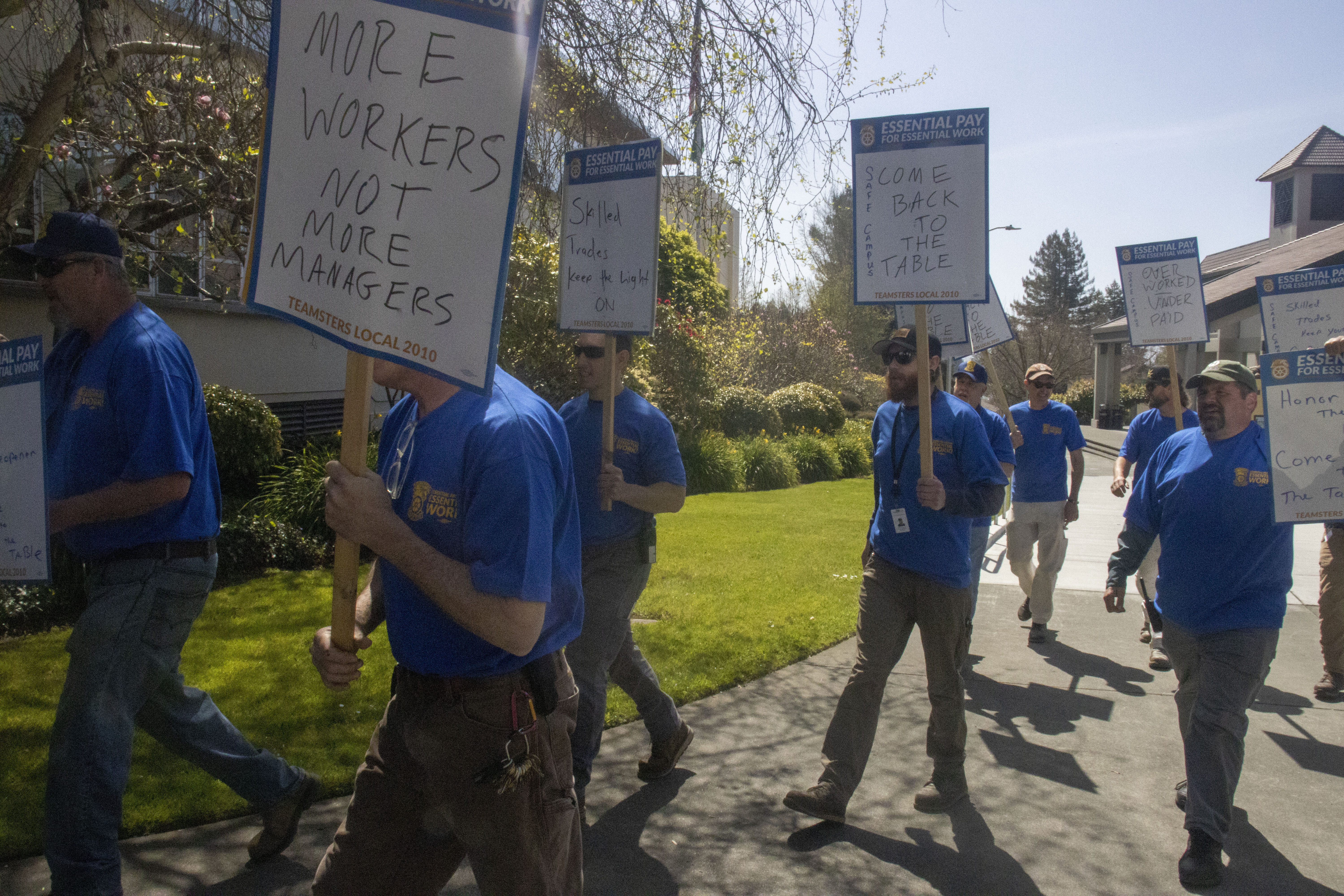
The Teamsters union marched across campus on Thursday, April 6 demonstrating against the California State University system offer, during union contract negotiations. The Teamsters union represents the service and maintenance workers in the CSU.
The demonstration began at the administration building at the quad. The demonstrators marched around the campus shouting slogans and demands. They ended their march in the quad where they continued to chant slogans until music was played from the stage in the quad.
During the pandemic, the union made an agreement with the CSU administration to avoid layoffs. The union will not renegotiate its contract with the CSU. Union member and housing maintenance worker Brian Wheeler spoke out on the issue.
“We asked for 15%, 5% for 2020, 5% for 2021, and 5% going forward,” Wheeler said. “They offered us 3%.”
He feels that with inflation increasing and the sacrifice the workers made during the COVID years, they deserve a higher wage increase.
There were other teamster demonstrations across other California university campuses. The Teamster Local 2010 held demonstrations on the UC Berkeley campus, San Francisco State University, and Chico state campuses demanding the same contract renegotiation that the Cal Poly Humboldt workers are demonstrating for.
When asked about the current negotiations, CSU spokesperson Kelly Hazel made it clear that the CSU organization is currently negotiating with union representatives.
“The CSU values its employees and is committed to providing appropriate levels of compensation. We continue to meet at the bargaining table with the teamster representative,” said Hazel. She continued, explaining that the CSU’s main goal is a balanced budget and that the CSU will work towards this in the negotiations.
The negotiations between the CSU and Teamsters are still ongoing, with the CSU offering a 4% wage increase for 2021-2022 but no wage increase for 2020.
Photo by Carlos Pedraza | Union demonstrators end their march at the university quad.
News Editor, Carlos Holguin recounts his experience at the Breonna Taylor protest in Eureka on Sept. 24.
As I parked a block away from the the Humboldt County Courthouse on Sept. 24, watching community members gather with signs in hand, the name Breonna Taylor emblazoned on so many of them, I wondered just how the night would go.
Over the past months, reports of violence occurring at Black Lives Matter protests from the likes of counter protesters, police and so-called vigilantes have grown, from cities large and small. I would be lying if I said I wasn’t nervous as I watched heads turn as I continued to snap photos.
It’s hard to cover a protest, and even harder to cover one when trying to stay objective. When protestors ask you questions about your support and why you are there, it’s hard to create an answer that fits all needs and wants.
No matter how many times the crowd calls for you to say her name, you’re told that replying is compromising to your ethics. God knows I wanted to chant and reply, but I held my tongue.
Some people don’t want you there at all sometimes, afraid that you just pose another risk.
As the march started, taking over street corners and sidewalks before advancing to entire lanes and intersections, the chants grew louder. People peaked out of business doorways, sat on apartment balconies and either silently watched or cheered as the crowd passed. Cars blared their horns behind the procession, only to be met with more cheers and protesters stopping to take in the anger and frustration.
That’s what this was after all, focused and controlled anger at a system that failed not just them, but people like them. Anger at a system that left people in Louisville and around the nation demanding justice.
The tension climbed higher as the sun set, the protestors circling back to the courthouse to pick up any late comers and grow in number, before continuing to take streets and hold traffic. Through it all I stood aside, camera in hand taking photos of the world around me, trying hard to be a fly on the wall. This is not my story, this is not something I needed to be a part of.
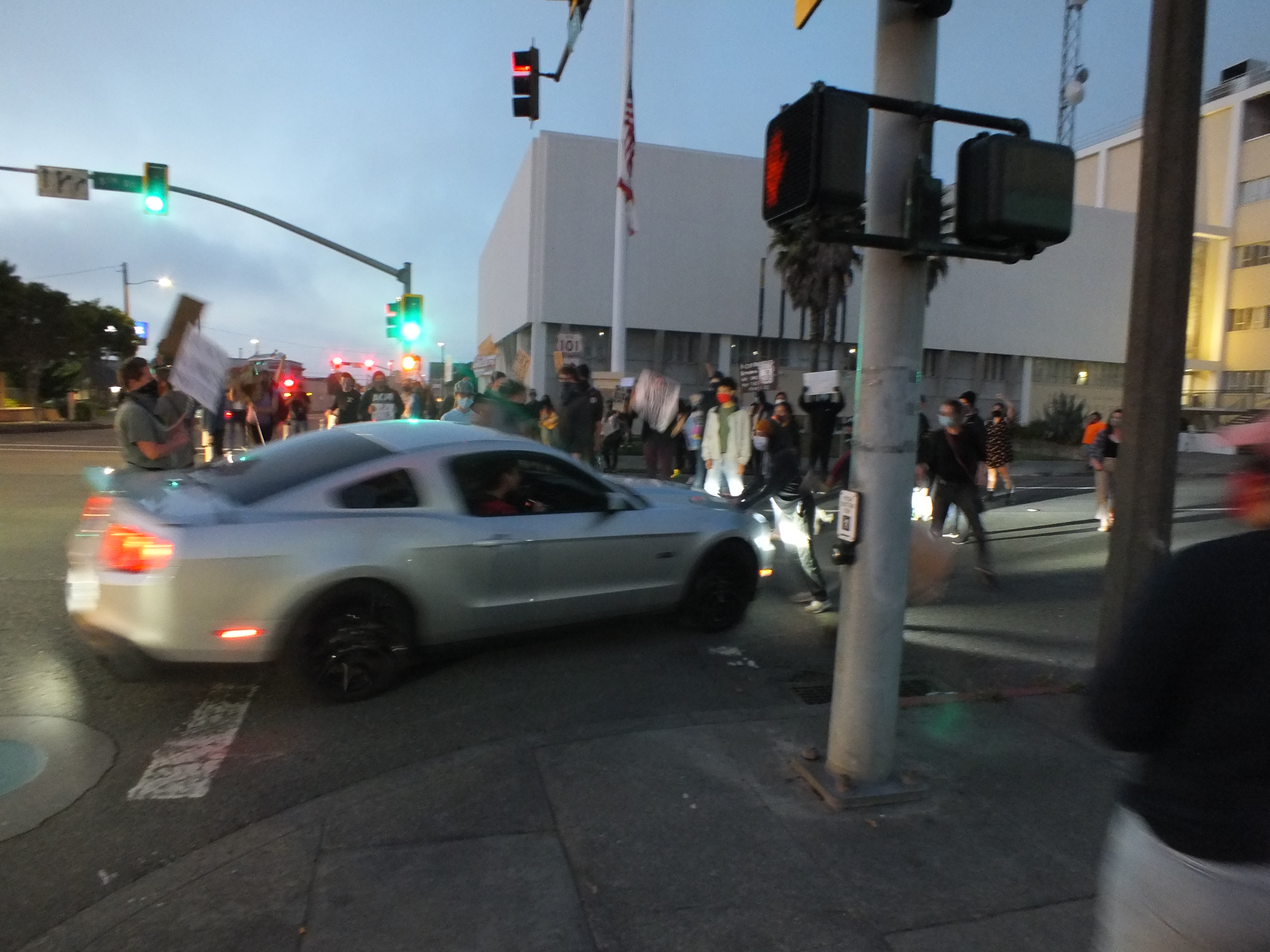
When the first car drove through the crowd of protestors, I saw it coming. Both sides stood in a stalemate, with protesters refusing to give an inch to the Mustang as its engine stirred and horn deafened the chants.
Through the lens of the camera I saw bodies get pushed aside and land hard on the concrete, but bounce back just as fast. The anger grew and the few scrapes and bruises
were just fuel and this fire was not ready to die out.
The second car, a large truck who’s black paint blended with the night, was more deliberate. It slowly crawled into and then lulled in the intersection, watching as more and more gathered around it. As I approached the truck, the car shifted into park and the tires turned in place, smoke bellowed from the burnout. It was an arrow notched and aimed.
The car shifted into drive. A few feet in front of me, the car made contact with a protester. There was thud, then a scream.
For a second I froze in place, watching the crowd rapidly part ways.
And then I ran with everything I could for a moment after the truck. I needed a plate, a model, something to help. I watched it after a few minutes disappear on to the highway, before turning back. This was not longer something I could choose to remain objective as a journalist in.
I cannot understand, nor do I want to understand, how hate can grow within a person to the point that they could justify actions like these. A person who willfully chooses to meet progress with aggression is not someone any person should associate with.
Journalistic integrity be damned, I will not stand idly by.
Protestors injured by non-lethal weapons in Eureka following protests against police brutality.
On May 31 in Eureka a protest against police injustice ended late into the night with officers using pepper-spray projectiles to assist in the arrest of an individual suspected of vandalism. An additional protestor was arrested for attempting to prevent the first arrest.
Several protestors attempted to pull the individual out of police custody. This resulted in police firing on the rest of the crowd. Capt Brian Stevens of Eureka PD addressed the incident to the public in a video posted to Lost Coast Outpost.
“Given the escalating circumstances and the safety risks to the officers … They began firing [pepperball projectiles] into the ground in and around the crowd trying to back the crowd off,” Stevens said.
Sam Papavasilliou, a 22-year-old Humboldt State University student and former Lumberjack writer, was in attendance that night and was among 30 or so protestors fired on by police. Papavasiliou described how the crowd was cut off in the front and back by several police vehicles while passing by Dutch Bros on the north side of Eureka.
Officers first addressed the crowd to tell them they would be attempting to arrest an individual suspected of vandalism. At 10:33 p.m. this attempted arrest was met with resistance from several protestors.
“One protestor got shot in the ear with [a pepperball]. They were bleeding and they were really yelling at the officer that they didn’t do shit and they said ‘I can’t hear right now,’” Papavasiliou said.
Pepperball rounds are amongst a large host of “non-lethal” weapons used to disperse crowds deemed riotous. Pepperball rounds are designed to explode on impact leaving a cloud of OC (oleoresin capsicum), the same ingredient used in pepper spray. It is advised that they are not aimed at the eyes, face, throat, or spine as death has occured when these inappropriate areas have been fired on.
Rubber bullets are another method of crowd control that fall under a classification of “non-lethal” weapons known as KIPs (Kinetic Impact Projectiles) along with bean bag rounds, pellet rounds, and sponge rounds. In their assessment of “non-lethal” weapons and their safety The Physicians for Human Rights organization argues that “At close ranges, levels of lethality and patterns of injury of some KIPS become similar to those of live ammunition. At longer ranges, KIPs are inaccurate and indiscriminate. Some KIPs are lethal in close range and ineffective at longer distances which make safe use difficult.”
The problem really comes down to KIPs being too inaccurate at longer ranges to correctly target individuals and areas of the body they are aiming for, and that the injuries sustained at close range can penetrate the skin, break bones, fracture the skull and explode the eyeball.
Police also rely on chemical irritants (CIs) for crowd dispersal, namely tear gas and pepper spray. Pepper spray is made of a chemical derived from peppers that inflames the afflicted area on contact causing the burning sensation.
“Officers and deputies were on scene with more or less paintball guns that shoot a paintball projectile that is filled with a powdered OC,” Stevens said.
Symptoms after exposure to these agents include temporary blindness, respiratory inflammation, increase in heart rate and blood pressure. People with respiratory or heart conditions are at an increased risk of more serious injury or death.
Other “non-lethal” weapons include pepper spray, bean bag rounds, tear gas and flash bangs just to name a few. When used correctly, these weapons are a less dangerous alternative to shooting people with actual guns, but mistakes in their applications can leave victims with wide ranges of injury.
Actions are being taken to bring about change in a country dominated by racism and police brutality
Fueled by the Josiah Lawson case and the George Floyd murder, Humboldt State University students are taking to the internet and the streets in protest of systemic racism. Students and community members alike are actively displaying their pent-up anger and fear surrounding being marginalized.
Kiara Mixon, a fourth-year psychology student, has been trying to educate herself and those around her about what’s going on. Namely, she has been sharing different resources with people who are unaware of the Black Lives Matter movement and watching documentaries about racism to get a deeper insight into it.
While she hasn’t really been going out in the streets and protesting, she has still seen both sides of the movement.
“I see people who are of color protesting and, truthfully, it means a lot that those people are standing up when it’s an issue for them as well,” Mixon said. “But I’ve also had people who aren’t really speaking up or haven’t said anything or don’t really have a personal opinion on the matter and that makes me a little bit uncomfortable because you never know where they’re standing.”
Senior psychology major Edwin Rosales has become more outspoken and animated in the wake of the revamped BLM movement. He lives with his mother’s side of the family and has gone back and forth with them about everything going on.
“After talking with them, it’s kind of difficult to talk to them about it because they’re very, you know, still in the olden ways and are very ignorant about it,” Rosales said. “So, I’ve had to be outspoken about it and be like ‘You know what? You’re not understanding the cause’ or having to explain to them what it is.”
Rosales has carried his new-found, forthright persona around racism into the land of social media as well.
“I never really posted about that stuff,” Rosales said. “I’m not helping if I don’t say anything, and so if I am posting about something, maybe someone will read it and maybe someone will help in some way.”
Julianne Blandford is a senior majoring in child development. She is feeling a lot of mixed emotions in the midst of the string of racist events that have occurred from the George Floyd murder to the leaked video of three HSU students making racist taunts toward Black people. She is attending protests and doing everything she can to move the conversation about racism along.
“It is my time to sit down and listen and also stand up for those who can’t speak,” Blandford said.
Blandford recognizes her own status but also wants to work with those who are being suppressed.
“I’m seeing it as an opportunity to continue to create change, create a more peaceful place to live, create new systems that aren’t founded upon racism, and a world where no-one has to live in fear,” Blandford said.
“We need to redistribute resources and really build communities.”
Dr. Ramona J.J. Bell
Dr. Ramona J.J. Bell, a critical race and gender studies professor, believes that there are a number of factors to look at that are feeding into a racist America.
“We’re a country where we put so much money into our military, but there’s people without health care, so we concentrate on, you know, defending the country,” Bell said. “But we have to reconfigure and reimagine what that really means to defend the country, to defend America.”
Bell emphasized the importance of unifying communities in a country where the opposite is happening at the hands of the police.
“We need to redistribute resources and really build communities,” Bell said. “When you are killing black folks in communities and the police are killing us, that’s not building our community — that’s killing our community. So we have to look at ways in which we can build America because our country was built off the backs of Black people, particularly during the Holocaust of enslavement.”
Bell recognized a need for change in America when it comes to race and embraced the protests that have spawned from it.
“We have to revisit America’s notion of belonging and we have to revisit race in America,” Bell said. “There’s never been a real conversation about race and racism in America. And I think the protests going on all over the country, all over the world are telling us something’s wrong and it needs to be fixed.”
More than anything, Bell emphasized that we are all in this fight together, no matter the color of your skin.
“That’s part of the fight. That’s part of the struggle to get people to understand that Black lives matter,” Bell said. “It’s about letting us be free to live lives like America has promised.”
A photo essay of the Arcata protests: fists high and voices raised
An activist addresses the crowd at the Arcata Plaza during a Black Lives Matter demonstration on Monday, June 1. The demonstration is one of hundreds to occur nationwide after the killing of African American man George Floyd by a white police officer on May 25. | Photo by Elliott Portillo
A protester holds up a sign that states “Black Lives Matter” during a demonstration held at the Arcata Plaza on June 1. The demonstration is one of thousands held to protest the killing of African American man George Floyd by a white police officer in Minneapolis on May 25. | Photo by Elliott Portillo
An activist addresses the crowd at the Arcata Plaza during a Black Lives Matter demonstration on Monday, June 1. The demonstration is one of hundreds to occur nationwide after the killing of African American man George Floyd by a white police officer on May 25. | Photo by Elliott Portillo
A protester looks on during a Black Lives Matter demonstration held at the Arcata Plaza on June 1. The demonstration is one of thousands held nationwide to protest the killing of African American man George Floyd by a white police officer in Minneapolis on May 25. | Photo by Elliott Portillo
An activist addresses the crowd at the Arcata Plaza during a Black Lives Matter demonstration on Monday, June 1. The demonstration is one of hundreds to occur nationwide after the killing of African American man George Floyd by a white police officer on May 25. | Photo by Elliott Portillo
Protesters gather and raise their fists in solidarity in the Arcata Plaza during a Black Lives Matter demonstration on Monday, June 1 in Arcata CA. Nationwide protests have occurred since the killing of African American man George Floyd by a white police officer in Minneapolis on May 25. | Photo by Elliott Portillo
Demonstrators stand and sit outside of Arcata City Hall in protest of police brutality and racism on June 1 following the death of George Floyd while in custody of Minneapolis police. | Photo by Thomas Lal
Demonstrators listen to community members speak at the Arcata Plaza while protesting against police brutality and racism on June 1 following the death of George Floyd in Minneapolis police custody. | Photo by Thomas Lal
A demonstrator takes a moment to reflect while listening to speakers from the community at the Arcata Plaza protesting against police brutality and racism on June 1 following the death of George Floyd in Minneapolis police custody. | Photo by Thomas Lal
Demonstrators listen to community members speak at the Arcata Plaza while protesting against police brutality and racism on June 1 following the death of George Floyd in Minneapolis police custody. | Photo by Thomas Lal
Demonstrators sit and stand in front of Arcata City Hall while protesting against police brutality and racism on June 1 following the death of George Floyd in Minneapolis police custody. | Photo by Thomas Lal
Signs calling for an end to police brutality and racism sit are carried by demonstrators outside of Arcata City Hall on June 1 following the death of George Floyd in Minneapolis police custody. | Photo by Thomas Lal
Protesters gathered at Arcata City Hall and the plaza to speak out against police brutality and racism
Peaceful protesters gathered in Arcata on June 1 to continue their demonstrations against police brutality and racism across the nation. People gathered around Arcata City Hall, bringing signs and wearing facemasks while listening to members of the community speak.
Demonstrators spilled off of the lawn and into the streets, taking a moment of silence in remembrance of George Floyd and Black lives that have been unfairly and unjustly taken in police custody.
A moment of silence for George Floyd outside Arcata City Hall on June 1 | Video by Thomas Lal
As demonstrators marched toward the plaza, they chanted in unison, “no justice, no peace,” which quickly became a rallying cry across the country.
Protesters marching to the Plaza, chanting “No Justice. No Peace” on June 1 | Video by Thomas Lal
There was no police present at the gathering which encouraged community members to stand up and share their stories in the center of the plaza where the President McKinley statue used to be. Community members rallied together and demanded for better education on racial issues and systemic injustices. Allies were called upon to do more than simply showing up to rallies and to exercise their rights to reinforce just advocacy.
Eureka protesters gathered in front of the Humboldt County Courthouse
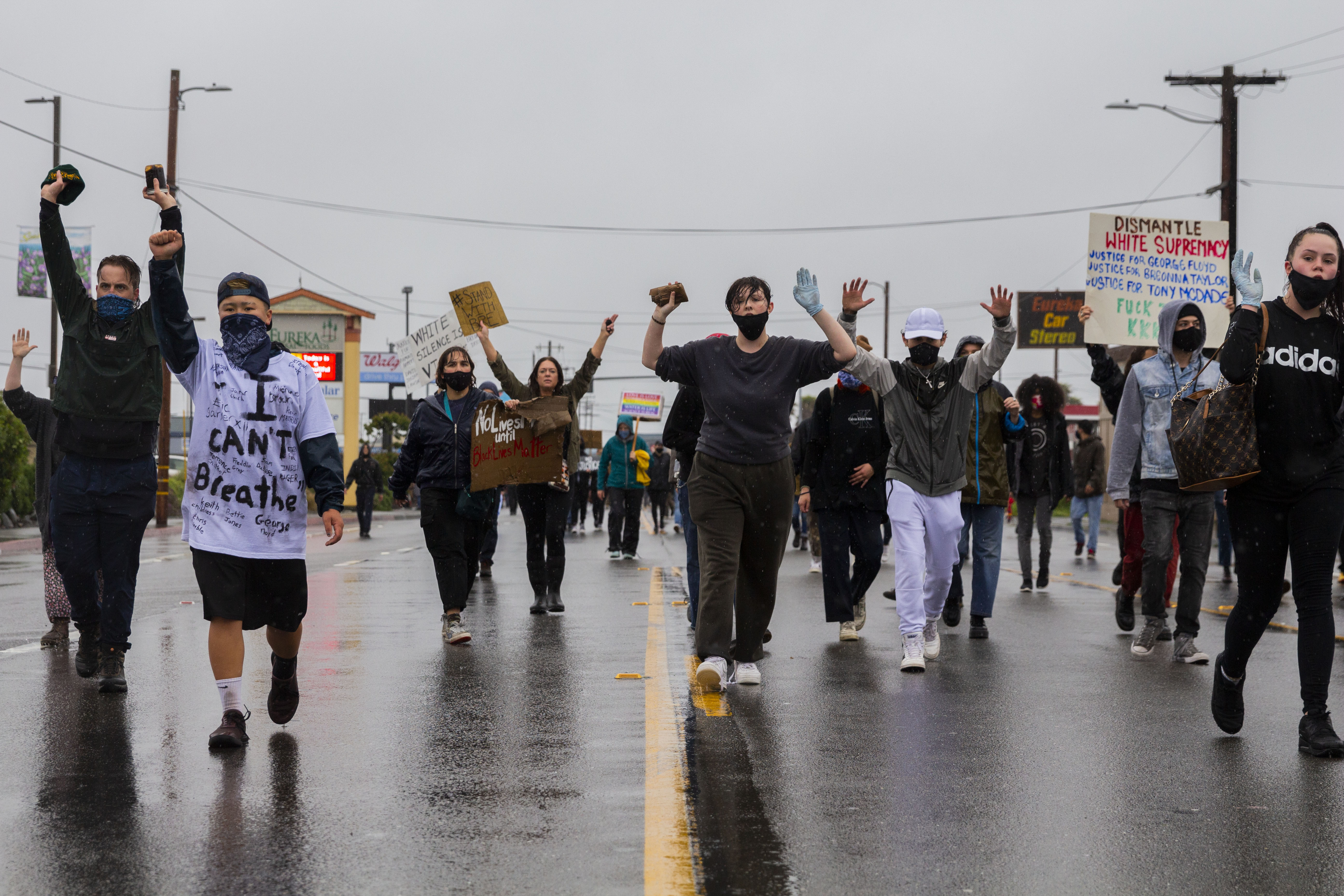
Hundreds of community members gathered in the rain outside of the Humboldt County Courthouse, Sat. May 30, to protest the death of George Floyd who was murdered while in police custody in Minneapolis, MN. From 3 to 10:30 p.m. demonstrators marched through Eureka up to the Slough Bridge, back through town and then down Broadway. Law enforcement was largely cooperative with demonstrators, blocking intersections as people made their way through traffic. Chants could be heard the entire way even as groups split up and went to various parts of the city.
Demonstrators walkin front of the Humboldt County Courthouse to protest police brutality and racism in Eureka, CA on May 30 following the death of George Floyd in police custody in Minneapolis.
A demonstrator walks thorugh the street to protest police brutality and racism in Eureka, CA on May, 30 following the death of George Floyd in police custody in Minneapolis.
Demonstrators walk past the post office though the street to protest police brutality and racism in Eureka, CA on May 30 following the death of George Floyd in police custody in Minneapolis.
A demonstrator holds up a rose above the crowd as they confornt Eureka Police Department officers in front of the Humboldt County Courthouse to protest police brutality and racism in Eureka, CA on May 30 following the death of George Floyd in police custody in Minneapolis.
Demonstrators walk down Broadway to protest police brutality and racism in Eureka, CA on May 30 following the death of George Floyd in police custody in Minneapolis.
As the group returned to the courthouse tensions flared at the sight of several police vehicles, which were soon removed from the scene. Eureka Police Chief Steve Watson was present at the protest and spoke with demonstrators as the crowd dispersed and headed away from the courthouse. These demonstrations in Humboldt are some of countless that have sprung up across the nation following Floyd’s murder.
Demonstrators stop a police vehicle at an intersection as they make their way thorugh Eureka down to Boroadway to protest police brutality and racism in Eureka, CA on May 30 following the death of George Floyd in police custody in Minneapolis. The vehicle attempted to make it’s way slowly though the gathered people and left with a broken back window.
Demonstrators confront Eureka Police Department officers in front of the Humboldt County Courthouse to protest police brutality and racism in Eureka, CA on May 30 following the death of George Floyd in police custody in Minneapolis.
Demonstrators push back against a police vehicle as it attempts to move past the gathered crowd as they protest police brutality and racism in Eureka, CA on May 30 following the death of George Floyd in police custody in Minneapolis.
Demonstrators walk thorugh the street through the rain to protest police brutality and racism in Eureka, CA on May 30 following the death of George Floyd in police custody in Minneapolis.
Demonstrators confront Eureka Police Department officers in front of the Humboldt County Courthouse to protest police brutality and racism in Eureka, CA on May 30 following the death of George Floyd in police custody in Minneapolis.
This website uses cookies to improve your experience. We'll assume you're ok with this, but you can opt-out if you wish. Cookie settingsACCEPT
Privacy & Cookies Policy
Privacy Overview
This website uses cookies to improve your experience while you navigate through the website. Out of these cookies, the cookies that are categorized as necessary are stored on your browser as they are essential for the working of basic functionalities of the website. We also use third-party cookies that help us analyze and understand how you use this website. These cookies will be stored in your browser only with your consent. You also have the option to opt-out of these cookies. But opting out of some of these cookies may have an effect on your browsing experience.
Necessary cookies are absolutely essential for the website to function properly. This category only includes cookies that ensures basic functionalities and security features of the website. These cookies do not store any personal information.
Any cookies that may not be particularly necessary for the website to function and is used specifically to collect user personal data via analytics, ads, other embedded contents are termed as non-necessary cookies. It is mandatory to procure user consent prior to running these cookies on your website.