The Lumberjack


Students Serving The Cal Poly Humboldt Campus and Community Since 1929

Tag: scholarships

  • Charmaine Lawson and the Eureka NAACP announce the third annual David Josiah Lawson Memorial Scholarship

    Charmaine Lawson and the Eureka NAACP announce the third annual David Josiah Lawson Memorial Scholarship

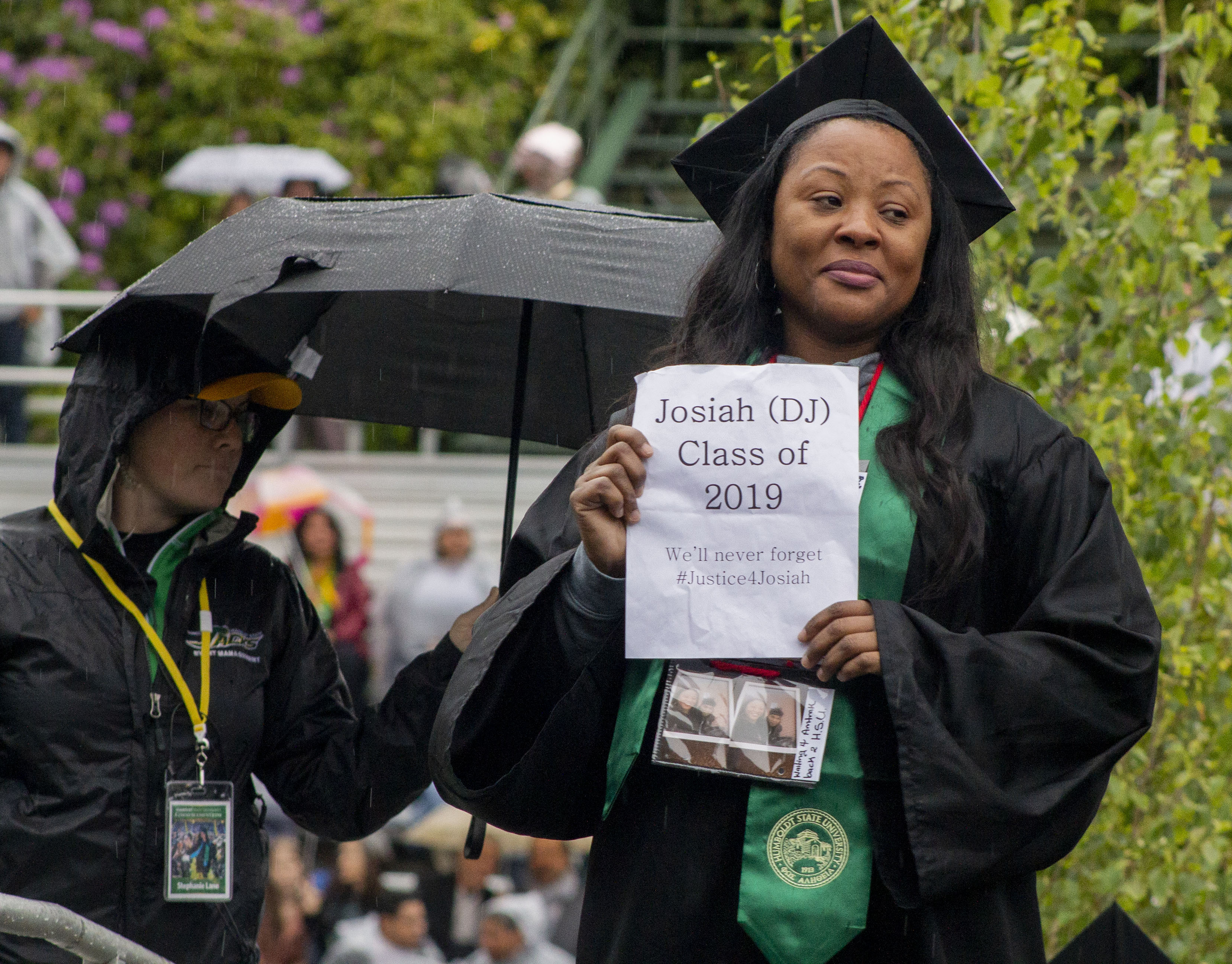
    As we approach the third anniversary of the death of David Josiah Lawson, his mother encouraged Humboldt County’s Black, Brown and Indigenous college-bound seniors to apply for his honorary memorial scholarship.

    “Students and parents, I know that this year was tremendously difficult with the pandemic,” Charmaine Lawson said through a video posted on the Justice for David Josiah Lawson Facebook page on Feb. 8. “But, I know for the students it was even more difficult.”

    Charmaine Lawson said how grateful she felt for the Eureka NAACP continually working to provide opportunities for students through the memory of her son, David Josiah Lawson.

    After the morning of April 15, 2017 when Josiah Lawson was fatally stabbed during an altercation at an off-campus house party, his mother has worked tirelessly to hold those involved accountable. Charmaine Lawson continues to travel from her hometown of Perris, CA to Humboldt County where she speaks with crowds of hundreds of people, demanding justice for her son.

    The Eureka NAACP first announced the scholarship at a Martin Luther King Jr. holiday celebration in January 2018. The scholarship is available for Black, Brown and Indigenous high school seniors in Humboldt County.

    Three scholarships are awarded each year. Two are awarded to students planning to attend a four-year university and the other one is awarded to a student planning to attend a two-year community college. Each scholarship is a one-time award of $500.

    “Both of my children, DJ and Anthony, received several scholarships throughout their high school years,” Charmaine Lawson said in a press release by Eureka NAACP that announced the first set of scholarship recipient winners back in 2019. “They felt very honored and blessed to receive financial assistance from different organizations.”

    It is through the David Josiah Lawson scholarship, vigils, food and coat drives, along with many other charitable acts, that Charmaine Lawson finds ways to honor her son.

    Last June, hundreds of people congregated on the Humboldt County Courthouse steps for the 38-month vigil for Josiah Lawson. The wound of the racial injustice that Josiah has suffered felt fresh to those in attendance.

    Mireille Román is a student at HSU, majoring in English writing practices and critical race, gender, and sexuality studies with an emphasis in ethnic studies. She spoke at the vigil about her frustrations regarding HSU’s response to the death of Josiah Lawson, questioning what the university has even done to honor their former student through the injustice that he has and continues to receive.

    “There’s not a building or area dedicated to Josiah that says, ‘We see you,’” Román said as she stood in solidarity with the Lawson family.

    Anthony Lawson, brother of Josiah Lawson, has consistently been alongside his mother in their fight to bring justice to their family. He has valued the obstacles that him and his family have had to endure, pushing himself to persevere and succeed.

    The CSU Board of Trustees honored him as the 2020 winner of the Chancellor Emeritus Charles B. and Catherine Reed Scholarship for his University, CSUN. It was there where Anthony Lawson honored his brother and reflected on all the ways that he and his family have accomplished over the past couple of years.

    Although Charmaine Lawson is inevitably compounded by grief through the failures of Humboldt’s judicial system, she feels like keeping his name alive by helping others is what best reflects the kind of character that was Josiah Lawson.

    “It’s scholarships like the one that my mom started at Humboldt that benefit other students who are struggling financially and we just want to show them that we aren’t just there for our family, we are there for the entire Humboldt community,” Anthony Lawson said to the CSU board of trustees.

    More details on the scholarship: https://acc2b65b-de53-412f-afe1-dfb07c852025.filesusr.com/ugd/62031f_af9fd1c39e6d48bfa201a1f2cd986aa8.pdf

  • Update: Road to Recruitment and Retention

    Update: Road to Recruitment and Retention

    HSU opts for local scholarships over new residence hall

    Humboldt State University originally had plans to build a new residence hall, but with enrollment declining, Vice President of Enrollment Management Jason Meriwether decided to invest in scholarships for students living on campus instead.

    “With enrollment down, we are not in a position to build a new building anytime soon using the traditional path,” Meriwether said in an email. “So, instead of sitting on the money, I wanted to reinvest the funds in our students.”

    Over the last five years, HSU housing has been saving to put a 10% down payment on a new residence hall, according to Meriwether.

    Instead, Meriwether reallocated the savings to the $1,000 a year, four-year scholarships for all HSU students that live on campus, beginning fall 2020. Announced Nov. 3, the scholarship is one part of HSU’s plans to improve enrollment and retention.

    In the last month, HSU has announced three different scholarships. Two of them will be funded by donors, while the housing scholarships will be funded with the housing reserves.

    “Within the limits and scope of how we may use housing dollars, the best and most strategic and student-first option was to create these scholarships,” Meriwether said.


    This is an update for our article “Road to Recruitment and Retention.” For the original story, click here.

  • Road to Recruitment and Retention

    Road to Recruitment and Retention

    Scholarships mark first steps toward tackling enrollment decline

    Humboldt State University’s battle against declining enrollment continues.

    In the last month, HSU announced three four-year, $1,000-a-year scholarships for local students (‘Humboldt First’), for Fortuna High graduates and for students living on campus.

    “‘Humboldt First’ reflects a direct investment in our local service area,” Interim Vice President of Enrollment Management Jason Meriwether said. “As part of our strategy to grow enrollment, we need to dramatically increase the number of students from our local area. In fact, our goal is to triple the number of local students in the next four years.”

    The Humboldt First scholarship will be provided to all new HSU students graduating from high schools in Humboldt, Del Norte, Mendocino and Trinity counties. The Dan and Cindy Phillips Fortuna Scholarship will be available to all Fortuna High graduates, even those transferring from the College of the Redwoods. HSU’s scholarship for on-campus residents will be awarded to students as long as they live on campus, up to four years.

    All three scholarships begin in Fall 2020.

    Meriwether said HSU is in the process of implementing multiple strategies to recruit local students, including educating locals about the programs offered at HSU and introducing ceremonies for Humboldt-area high school students who qualify to attend HSU.

    “We sincerely want to compete for students who want to leave Humboldt or don’t want to go to college,” Meriwether said. “So we are working harder to make sure they know that HSU is a real option for them.”

    Interim Vice President of Enrollment Jason Meriwether in his office on Oct. 25. Meriwether said the Humboldt First scholarship is one effort among many by HSU to attract more local students. | Photo by James Wilde

    Paul Hilton, an HSU political science major, journalism minor and McKinleyville High School graduate, said he liked the sound of the scholarship.

    “Contrary to what maybe a lot of people think, there is a want—there is a desire—to go straight to HSU from some of the local schools,” Hilton said.

    Hilton went to College of the Redwoods after graduating high school to avoid the higher costs of HSU. Hilton said he probably would’ve gone straight to HSU had the scholarship existed previously.

    However, Hilton acknowledged that many local students don’t want to go to HSU regardless of cost.

    “I think a lot of it just has to do with opportunities,” Hilton said. “A lot of locals dislike growing up here, and a large part of that is because of a lack of opportunities. But there are a lot of locals, myself included, who love Humboldt but still hate the lack of opportunities.”

    After CR, Hilton nearly attended Southern Oregon University, where he thought he saw more certainty in finding a future career path. Yet, in the end, he opted for HSU.

    “I came here because of proximity,” Hilton said. “Some people might just call that laziness, but because of the costs and everything I just decided that it would be easiest for me to stay here.”

    Hilton attributed HSU’s enrollment decline mainly to a lack of opportunities in the area, but he also noted a lack of support for minorities.

    “I think the main common factor between years and semesters has been opportunity in the area,” Hilton said. “But now it’s even more and maybe even a little overlapped by the lack of sense of security for minorities.”

    Meriwether said he believes HSU does offer opportunities, but the university doesn’t do enough to let people know they exist.

    “I think local students think they know Humboldt, but I don’t think we’ve done the job we need to do of reintroducing them to Humboldt,” Meriwether said.

    Eureka High School Principal Jennifer Johnson shared Meriwether’s excitement for the new scholarships. Johnson said she has already seen four to five times the usual number of EHS students going to HSU’s preview day. Johnson said only one EHS student went to HSU in 2018. For context, EHS has 1,230 enrolled students this year.

    “We have to also re-recruit our current students. We can’t just take for granted that they’re going to be here. We also have to give them a positive campus experience.”

    Jason Meriwether

    “We only had one last year,” Johnson said over the phone. “I think it was a real wake-up call for HSU administration when they actually ran the numbers on our school.”

    Johnson said local students that want to stay in Humboldt often opt for CR instead of HSU due to the costs—although Johnson said she thinks many students and parents just don’t understand how cheap HSU can be with financial aid.

    As for the local students that want to leave Humboldt, Johnson echoed Meriwether by saying that HSU is not like the rest of Humboldt.

    “I tell them, ‘Move to Arcata, it’s a whole different world,’” Johnson said.

    Meriwether said HSU is currently restructuring its recruitment strategies to include more social media targeting along with more visits to schools. Meriwether also pointed to recent recruitment improvements such as an increase in available tour times and the elimination of tour fees.

    Meriwether added that HSU has to not only improve recruitment, but also retention.

    “We have to also re-recruit our current students,” Meriwether said. “We can’t just take for granted that they’re going to be here. We also have to give them a positive campus experience.”

    Ultimately, Meriwether hopes HSU can begin telling a new story for itself that will attract and retain more students.

    “History is important,” Meriwether said. “But we also have to share that there’s a different approach to leadership, there’s a different approach to response and if things happen on campus it’s because we are trying to create a student-first experience. That’s what it’s all about.”

  • Editorial: College Athletes Deserve Compensation

    Editorial: College Athletes Deserve Compensation

    Playing collegiate sports and taking a full-time schedule is the equivalent of having two full-time jobs

    During an online-only episode of “The Shop,” California Governor Gavin Newsom signed Senate Bill 206, or the Fair Pay to Play Act on Sept. 30.

    Along with several other former college athletes, Newsom believes college athletes, especially Division I athletes, deserve compensation for their hard work and dedication to the game that makes their “bosses” rich.

    “Colleges reap billions from student athletes but block them from earning a single dollar,” Newsom tweeted. “That’s a bankrupt model.”

    Despite Humboldt State being a NCAA Division II program, we still agree that our athletes deserve some type of compensation based on the amount of revenue our athletic program brings in.

    “The Shop” is a HBO talk show owned under the digital sports media company Uninterpreted. During the episode, Newsom was accompanied by NBA star LeBron James and they both shared the news on Twitter by posting a video snippet.

    In a world that is so divided, sports can bring people together. Whether an athlete plays for a professional team or a college team, the support and compassion they receive from fans remains loyal.

    In professional sports, athletes sign contracts with a team or an organization. When they sign, they are agreeing to the specific payment details they were offered or that they negotiated with their organization. For collegiate sports, college athletes are offered a scholarship breakdown and have the decision of accepting it or not.

    However, anyone who is up to date with our budget crisis around campus knows that our athletic program probably receives close to no money to provide to our athletes. Especially considering that we still have athletes attending HSU out of pocket to participate in an intercollegiate sports.

    HSU may not seem like a great example when pushing the idea that college athletes deserve compensation, but the Fair Pay to Play Act doesn’t allow athletes to be paid by their university, it just gives them the leeway to find sponsorship and make money off their hard work.

    When we consider professional athletes, endorsement deals are contracted regularly. These deals allow companies to use athletes’ names, numbers and any other marketing facet that’s agreed upon, in exchange for money paid to the athlete. College athletes do not receive endorsement offers, but they still partake in similar marketing techniques that bring in revenue for their college and coaches.

    The counterargument to this case states that college athletes are provided a scholarship that pays their tuition and resources that help them get through the academic portion of school.

    Although this is true, many fail to realize the dedication and time commitment it takes to be a successful student-athlete. Being a student-athlete is essentially equivalent to holding two full-time jobs: studying and playing. This doesn’t leave time for a job off-campus to provide a steady source of income.

    The fact that colleges and head coaches make money off their players’ successes is ludicrous, especially when the players themselves aren’t receiving any portion of that revenue. It is this exact argument that Newsom brought to light.

    The proposed bill allows college athletes to receive a portion of the revenue that their college receives and sign endorsement deals like the pro athletes they aspire to be. Although the NCAA fought against the signing of this bill, Newsom stuck to his belief. He proposed providing the NCAA with a grace period to narrow down rules and regulations in hopes of making the transition smooth and effective. Therefore, the bill does not play any effect on college sports in California until Jan. 1, 2023.