The Lumberjack


Students Serving The Cal Poly Humboldt Campus and Community Since 1929

Tag: social distancing

  • The mental toll of COVID-19 isolation

    The mental toll of COVID-19 isolation

    Increased periods of isolation can lead to depression, and how to combat it

    March signaled the beginning of quarantine in the United States, with various states asking residents to refrain from unnecessary social contact with shelter-in-place orders.

    For those staying with family and friends, the burden of staying at home for the last nine months was reduced by the ability to talk to and interact with others.

    According to Paula Nedelcoff, a psychotherapist and community outreach coordinator for Humboldt State University’s Counseling and Psychological Services department, the task is significantly more taxing. Changes in living organization, such as online instruction, brings unwanted physical and mental changes.

    “Long term social isolation for most people is very difficult,” Nedelcoff said in an email interview.

    COVID-19 restricts face-to-face interaction, prohibiting the ability for people to physically and socially interact with each other. This prolonged isolation intensifies with time.

    “Humans are social animals and we count on interactions with others. When we do not have someone to bounce off ideas and feelings with we can move within and isolate even more,” Nedelcoff said. “While during this virus we have a virtual world, we humans need contact with each other, we need and thrive with touch.”

    A 2016 study published in the European Journal of Clinical Microbiology & Infectious Diseases suggested that isolation precautions may lead to anxiety. A group of doctors and professors looked at the ways social isolation affected patients who were recovering from various bacterial infections. These infections (like scabies, measles or tuberculosis) often required patients to reside in single rooms to minimize the exposure to other patients.

    A separate 2016 twin study the journal of Social Psychiatry and Psychiatric Epidemiology suggested that social isolation could trigger an increase in mental stress. The data found that depression was significantly correlated with both social isolation and loneliness.

    For those living alone, combined with a lack of available social interactions, the association with depression is even greater.

    A 2011 research article in the International of Geriatric Psychiatry found that social connections were factors in determining depression.

    “Living alone and living with at least one child (no spouse), and weak social networks were associated with higher depressive symptom scores in both genders,” the study stated. “Men living alone with weak social networks outside the household had higher depressive symptom scores than those with strong networks.”

    In order to combat these feeling, Nedelcoff recommended finding ways to reach out to others within your social circle, in addition to seeking professional help.

    “I encourage all folks to stay engaged with life via on line groups and virtual happenings,” Nedelcoff said. “This can be a great time to try therapy or a therapy group. Going to counseling does not mean there is something wrong with you. Think of it like having a copilot while looking more deeply into your life and the meaning of it.”

    She suggested finding ways to properly vent emotions and feelings so that individuals may not feel like they are cooped up physically and mentally.

    “Learn and become aware of what works for you,” Nedelcoff said. “What might work for me may not work for my friend. Some people meditate, some people use music to calm them or ease their soul, while others may journal or get into a book. Often times we are not sure or don’t know what works for us.”

    Most of all, Nedelcoff encouraged students to continue trying to find ways of expression in any positive way.

    “COVID-19 and sheltering in place has taught us how little control we have over so many things,” Nedelcoff said. “This can be scary but we do have control of how we respond.”

  • Face coverings are vital to preventing spread of COVID-19

    Face coverings are vital to preventing spread of COVID-19

    Humboldt State University taking necessary first step by requiring students and faculty to wear face coverings on campus.

    Humboldt State University, after being closed since March, has reopened six months after the COVID-19 outbreak in the United States. HSU was approved by the California State University system to offer “limited face-to-face courses this fall,” according to the HSU website. Considering the circumstances, HSU is taking the right precautions to keep both the students and faculty safe.

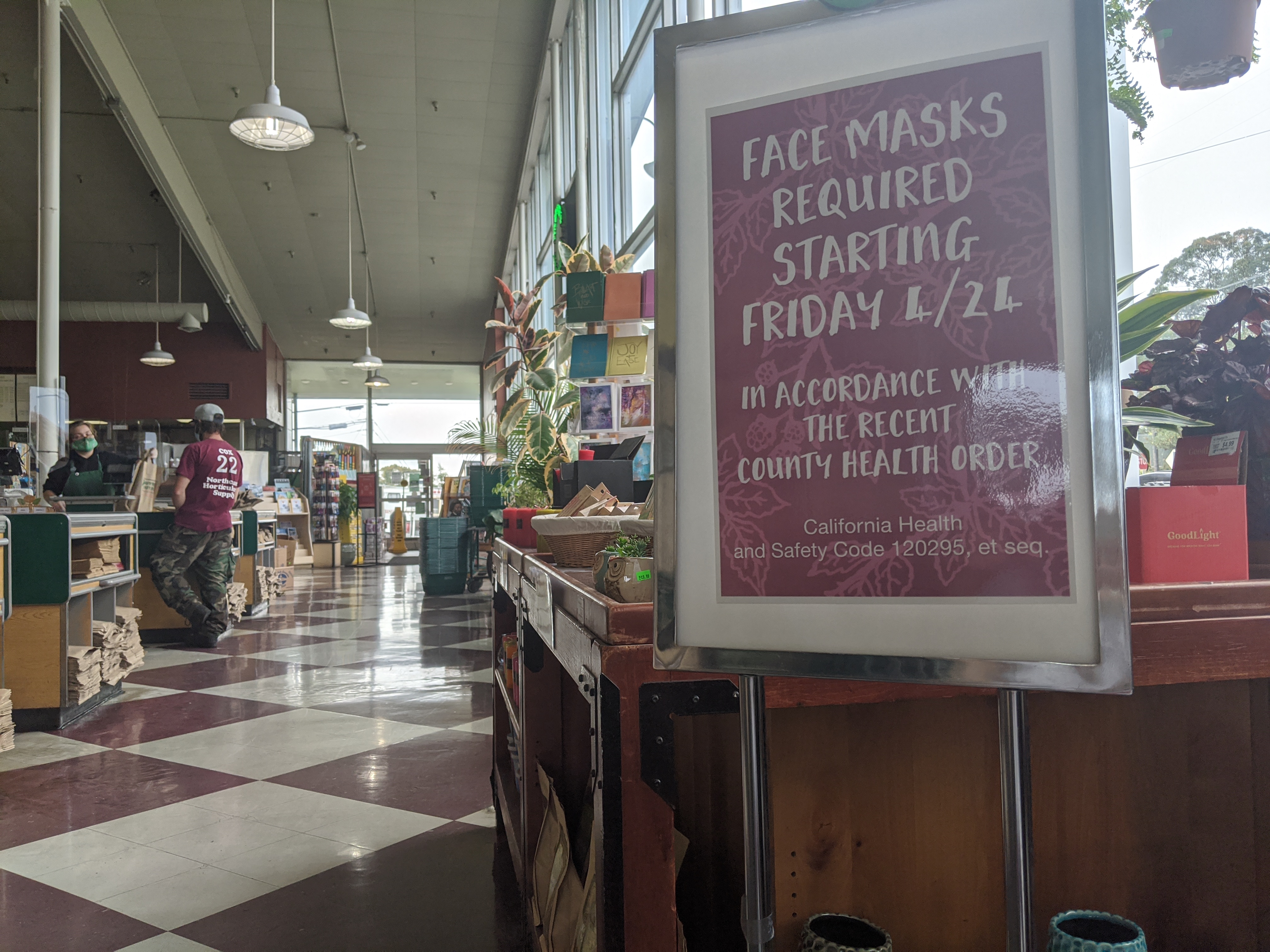
    The university announced safety precautions on Aug. 4, which includes wearing face coverings with at least two layers of 100% cotton. These are required on campus at all times, both indoors and outdoors. HSU will provide students with face coverings at the campus Police Department, the first floor of Student and Business Services building, Jolly Giant Commons, College Creek Market and the Parking Kiosk.

    Other precautions include practicing social distancing of six feet at all times when possible, refraining from gathering in groups, staying away from crowds, frequent washing of hands with soap and water and using hand sanitizer when soap and water are not available. The commitment to the precautions established by HSU represents a social responsibility that keeps us safe, as long as we follow them.

    Although wearing masks is uncomfortable, research has shown that they prevent transmission of coronavirus when worn correctly. The Centers for Disease Control and Prevention states that the spread of COVID-19 mainly results from settings where people are in close contact with each other, so the use of masks are especially effective in environments such as universities.

    Different kinds of masks “block [the] virus to a different degree, but they all block the virus from getting in,” said Dr. Monica Gandhi, an infectious disease physician at the University of California, San Francisco, to The New York Times. No matter what type of face coverings people wear, it is still much more protective than not wearing one at all.

    It’s also important to wear masks correctly, covering both one’s mouth and nose at all times. They need to be secured to the face without being too loose or too tight, making sure people are still able to breathe. They also need to be worn hands-free. Working at a grocery store during this pandemic, I’ve seen multiple people’s masks fall to their necks and they try to hold it up to their face, which leads to the spread of particles. Touching masks is unsanitary, so washing hands with soap and water is critical. The risk of spreading respiratory particles is much higher if the mask is not worn correctly.

    Masks are only one of many protocols HSU has enforced. Students were instructed to follow safety protocols on Aug. 15 when over 200 of the 800 students moved into on-campus housing. All students were expected to self-quarantine for 14 days following their move-in day. Considering the risks of the spread of COVID-19, the university made the correct decision to reduce the number of students allowed to live in on-campus housing. It was also decided to make all rooms single occupancy.

    Following health protocols is crucial, especially during a global pandemic. Wearing masks on campus has been mandated for all students and faculty members, and will be a major part in limiting the transmission of COVID-19. It will be especially important this fall when some students and faculty will be taking part in hybrid learning, which includes limited face-to-face contact.

  • Birthday Celebrations during Social Distancing

    Birthday Celebrations during Social Distancing

    The pandemic forces people to re-imagine their birthday plans

    When it comes to a birthday, you’d expect a party, a night out, a small get together with friends and family, or maybe a chill day at home. Unfortunately, with social distancing still in order, celebrating alone is the closest option to a party.

    Because social distancing is still in order, many have had to accept the fact that their big birthday plans aren’t going to happen anytime soon. Without the streamers and drinking games, people have found ways to remain somewhat festive on their special day. While some have taken to Zoom for video chat parties, others have spent their day with their fellow quarantine pals.

    Tracy French’s, a Humboldt State University alumna from the geology department, birthday was on April 30. French celebrated it with her two good friends, who are also alumni, and have birthdays that same week.

    “My birthday was on April 30,” French said. “It’s one day after a friend’s birthday, and the day before another friend’s birthday.”

    The three had originally planned for a big get together, and reserved the Arcata Common Hall for a huge party. With entertainment and plenty of drinks to go around, it would’ve been one heck of a birthday bash.

    “We were planning on getting a live band called ‘Old Dog’ at the Arcata Common Hall,” French said. “I went to Facebook and invited over 150 people, but that got cancelled.”

    Instead, French spent her day enjoying the warm sun in her backyard along with her friends.

    HSU psychology major, Shelley Magallanes, was hoping to have a night full of fun back home in Los Angeles for their 21st birthday. With social distancing likely to be in order, Magallanes had to cancel their original plans.

    “Because I’m turning 21 I was planning to have a big thing with friends,” Magallanes said. “We’d go into LA and go clubbing.”

    “I had plans to go to the bar with some pals on my 21st to see what it was all about. I had planned to have 30+ people invited to my birthday.”

    Bryan Gambrel

    Magallanes plans to return home around June, but with their big plans ruined by COVID-19 they’re preparing for the second best thing, spending it with the people they love most.

    “I’ll probably end up spending it with my family,” Magallanes said. “Maybe go swimming and eat some cake.”

    Bryan Gambrel, a junior at HSU, originally planned his celebration to be like any other 21st birthday, going out for a drink — legally.

    “I had plans to go to the bar with some pals on my 21st to see what it was all about,” Gambrel said. “I had planned to have 30+ people invited to my birthday.”

    Because of social distancing, going out was a no-go. Regardless, he was happy to celebrate his birthday with a small gathering of close friends and some quality-time with his mother.

    “The most memorable thing was having my mom and I build a garden bed out of spare wood palettes I’ve collected. It was a fun, crafty project,” Gambrel said. “While it was much smaller than I was hoping for, it was very memorable.”

    For those celebrating birthdays during this time, something as simple as a phone call or a video-chat can make all the difference. Drinking with roommates and creating fun games, or even sitting out on a nice sunny day can make this year’s birthday a bit more pleasant. No matter how you decide to celebrate, stay safe and it will definitely be a birthday to remember.

  • A Brief Breakdown of COVID-19 Misconceptions

    A Brief Breakdown of COVID-19 Misconceptions

    Four things you or your relatives might misunderstand about COVID-19

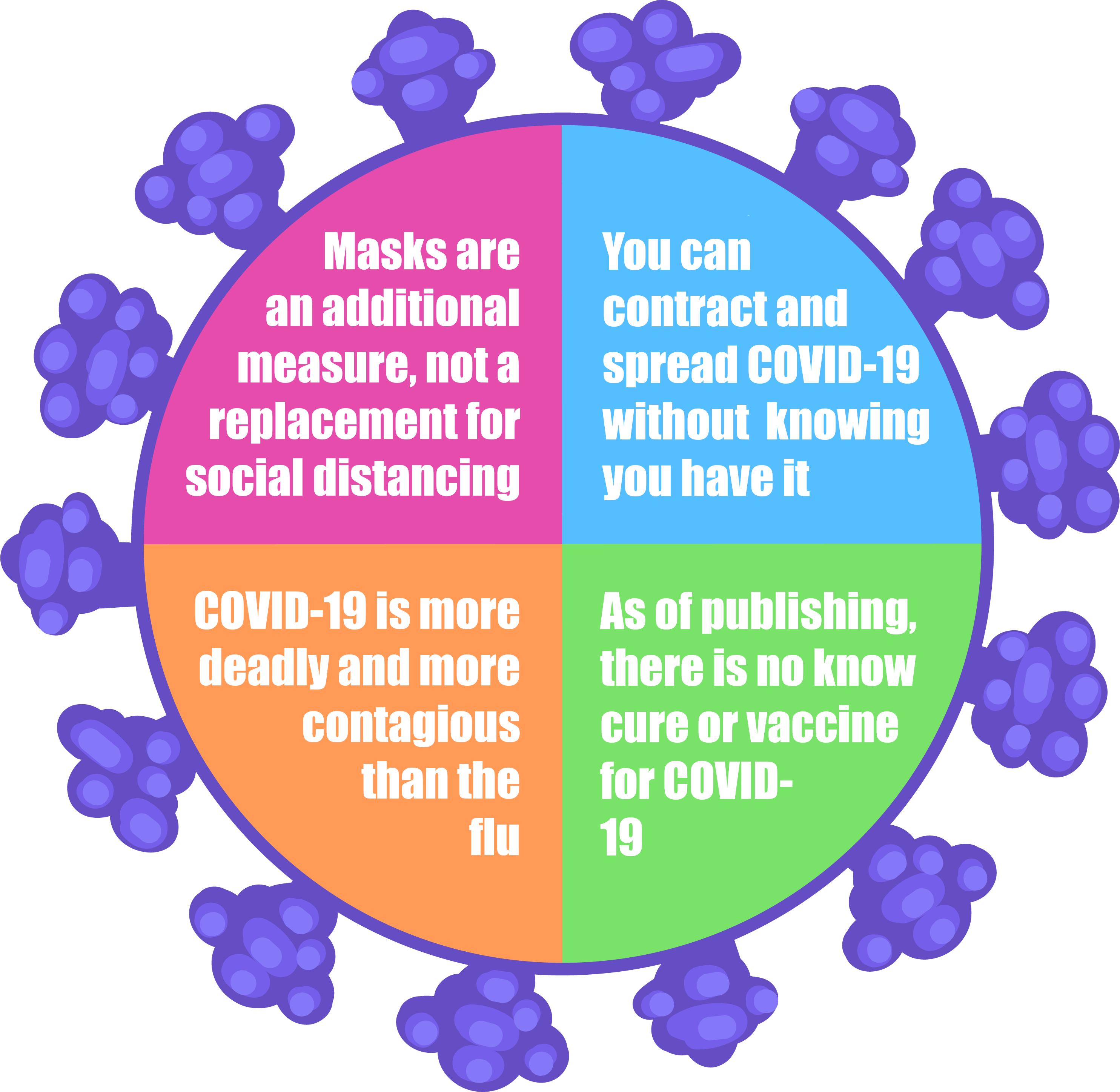
    Misconception: The fatality rate of COVID-19 is only 2-3%. That sounds low, so it isn’t worth worrying about.

    Reality: Any fatality rate estimate can be misleading. It’s possible that many more people contract COVID-19 than receive a test. Numbers from the World Health Organization put the fatality rate of confirmed cases globally at around 6%, but those numbers are only based on people who have been tested or had severe symptoms. That number can also be misleading because the fatality rate varies by region, age group and other risk factors.

    Though the actual fatality rate is unknown, it is much higher than past pandemics such as H1N1 (swine flu). Even if it was low, a small percentage of the total global population is still a staggering amount of people.

    Misconception: I don’t have symptoms like fever, cough or difficulty breathing, so I must not have it and I can’t spread it.

    Reality: In South Korea, COVID-19 testing was widespread and early testing results showed that many people in their 20s and 30s had the virus, but were completely unaware that they could be spreading it. Since it’s possible that many more people have COVID-19 than get a test, people who feel healthy and demonstrate no symptoms could spread it.

    Misconception: If I wear a mask, I don’t have to practice social distancing.

    Reality: Simple masks for people without symptoms and people not in high-risk groups are recommended by the Centers for Disease Control and Prevention more to protect others from you while in public. Since many cases are asymptomatic, it may help prevent people unaware of their own infection from spreading it. Masks are an additional measure, not a replacement measure. The CDC recommend social distancing along with a mask.

    Misconception: There is a cure for COVID-19.

    Reality: As of April 2020, there is no specific medicine or cure for COVID-19. Antibiotics are not effective against the viral illness, and there is no evidence of any effective home remedy. There are ongoing trials and possible vaccines being considered, so that may change soon.

  • Even if You’re Sick of Them, Don’t Take Your Partner for Granted

    Even if You’re Sick of Them, Don’t Take Your Partner for Granted

    Social distancing has strained my relationship, so be grateful if you’re still with your partner

    Social distancing life isn’t much different from my usual life. I’m not physically going to school or work anymore, but I’m doing my assignments in bed like I normally would. My free time before quarantine would consist of doing homework, eating, watching movies with my roommate and spending time with my partner. There’s only one of those things that I can’t do anymore—spending time with my partner—and it’s the one that hurts the most.

    Life was busy before the days of sheltering in place, and I hadn’t seen my partner much. We vowed after spring break we would spend more time together since I was going to be leaving after graduation and they will be staying up here. But now it looks like our long-distance relationship has started a lot sooner.

    If you find yourself being in quarantine with your partner, but want to get away from them, there are little things you can do for some space.

    Some of my friends have said they were tired of being quarantined with their partner because they were getting on their nerves and they just needed space. When social distancing started, there were a lot of memes going around about how women trapped their partners in their houses with them so that they can talk about their issues and the partners can’t go anywhere. That’s funny, but you shouldn’t need a quarantine to finally talk about your issues. You should be able to do that all the time.

    China reported a spike in the divorce rate and the same is expected for the United States. Due to the quarantine, people’s daily lives have changed and they aren’t used to being stuck with their partners all day. Which is understandable, but also sad. I would love to be stuck inside with my partner during this quarantine. We’ve talked a lot more which is nice, but actually having them under the same roof as me would hit differently.

    If you find yourself being in quarantine with your partner, but want to get away from them, there are little things you can do for some space. Maybe put yourself in another room if you have another room—but if you don’t, maybe take a nice long shower.

    Instead of both of you going to the grocery store together, make a list and have only one of you go. I would hope that you wouldn’t need to distance yourselves and that this time would be enjoyable for you two, but maybe that’s just because I wish I could be watching movies or getting creative with my partner.

    If you’re stuck with your partner and are getting annoyed with the way they do the dishes or something small like that, well, get over it. Either tell them it bothers you or take over the task. There are so many people out there, like myself, that would rather be stuck in a room with their partner no matter how much they annoy them, not to mention all the single people that wish they had a partner to be quarantined with.

  • HSU Health Center Remains Open

    HSU Health Center Remains Open

    Students on campus can still reach out to medical services

    The Humboldt State University campus is closed to the public, but the Student Health Center expects to remain open for the remainder of the semester to help any students remaining on campus. The health center is limiting face-to-face contact as much as possible, but is still helping students without physical appointments when possible.

    “We’re doing everything we can to help minimize the risk of exposure for students and Student Health and Counseling staff by limiting as much face-to-face contact as possible,” HSU Director of News and Information Aileen Yoo said. “For emotional support, for instance, students can talk to a CAPS counselor over the phone and, in most cases, if preferred, Zoom.”

    The Health Center is still offering other essential services like prescription refills and COVID-19 testing.

    “For those who are sick or suspect they have COVID-19, we have urged them to call before visiting the health center,” Yoo said. “When it comes to COVID-19, our main focus is assessing the student and collecting swab samples if we think that’s necessary.”

    “It is normal to have ebbs and flows with your mood and productivity levels but if you get “stuck” in a dark space for an uncomfortably long time, consider reaching out to get help such as from a counselor at CAPS.”

    Jennifer Sanford, director of Counseling and Psychological Services and associate director of student health and wellbeing

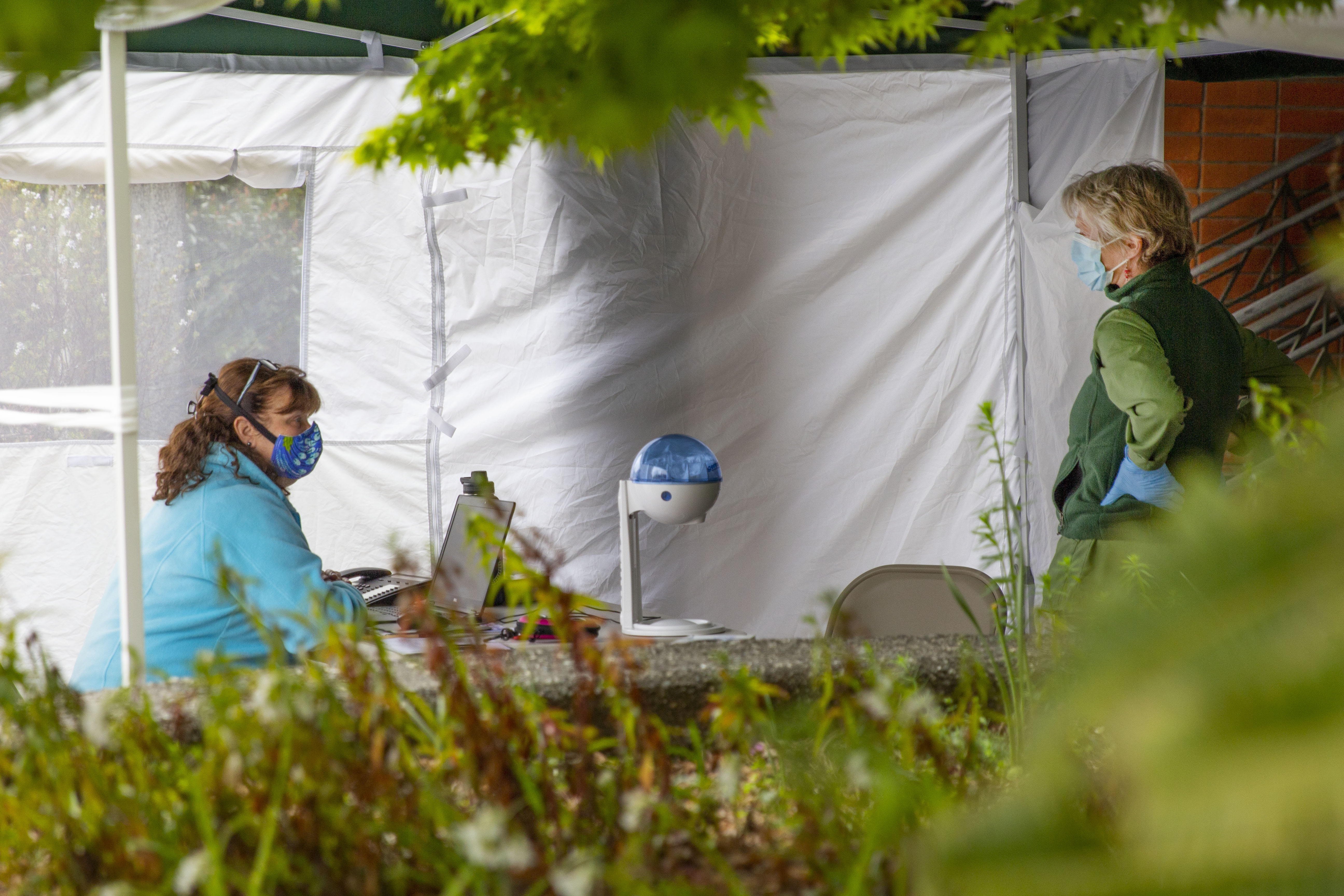
    The Health Center set up white triage tents in front of the building to help students check in and get assessed. If a student tests positive for COVID-19, the Health Center will work with county health services to make sure the student gets the treatment they need.

    During a pandemic, the disease itself isn’t the only medical problem facing students. The Center for Disease Control warns the stress of a pandemic can cause or worsen mental health problems, and recommends calling a health care provider if symptoms persist.

    The Director of Counseling and Psychological Services and Associate Director of Student Health and Wellbeing Jennifer Sanford asked students to consider reaching out to Counseling and Psychological Services if they feel their mental health is deteriorating.

    “Pay attention to how your thoughts and attitudes in any given moment are impacting your mood and overall wellbeing,” Sanford said. “Talk with others, connect. It is normal to have ebbs and flows with your mood and productivity levels but if you get “stuck” in a dark space for an uncomfortably long time, consider reaching out to get help such as from a counselor at CAPS.”

    Sanford said that this can be an uncertain time, but it’s important to see social distancing as community care.

    “The reality is that in our physical distancing, we are displaying compassion and care for our elderly and medically compromised,” Sanford said. “We are allowing our healthcare system to better manage the flow and care of patients, and we are caring for ourselves by lessening our own risk.”

  • Happy Thoughts and Hot Liquids Won’t Save Us

    Happy Thoughts and Hot Liquids Won’t Save Us

    A reminder of the few things we know that help prevent the spread of COVID-19

    I received a text from a housemate recently recommending we all drink hot liquids and think happy thoughts to get us through the COVID-19 pandemic. Sadly, happy thoughts and hot liquids won’t save us.

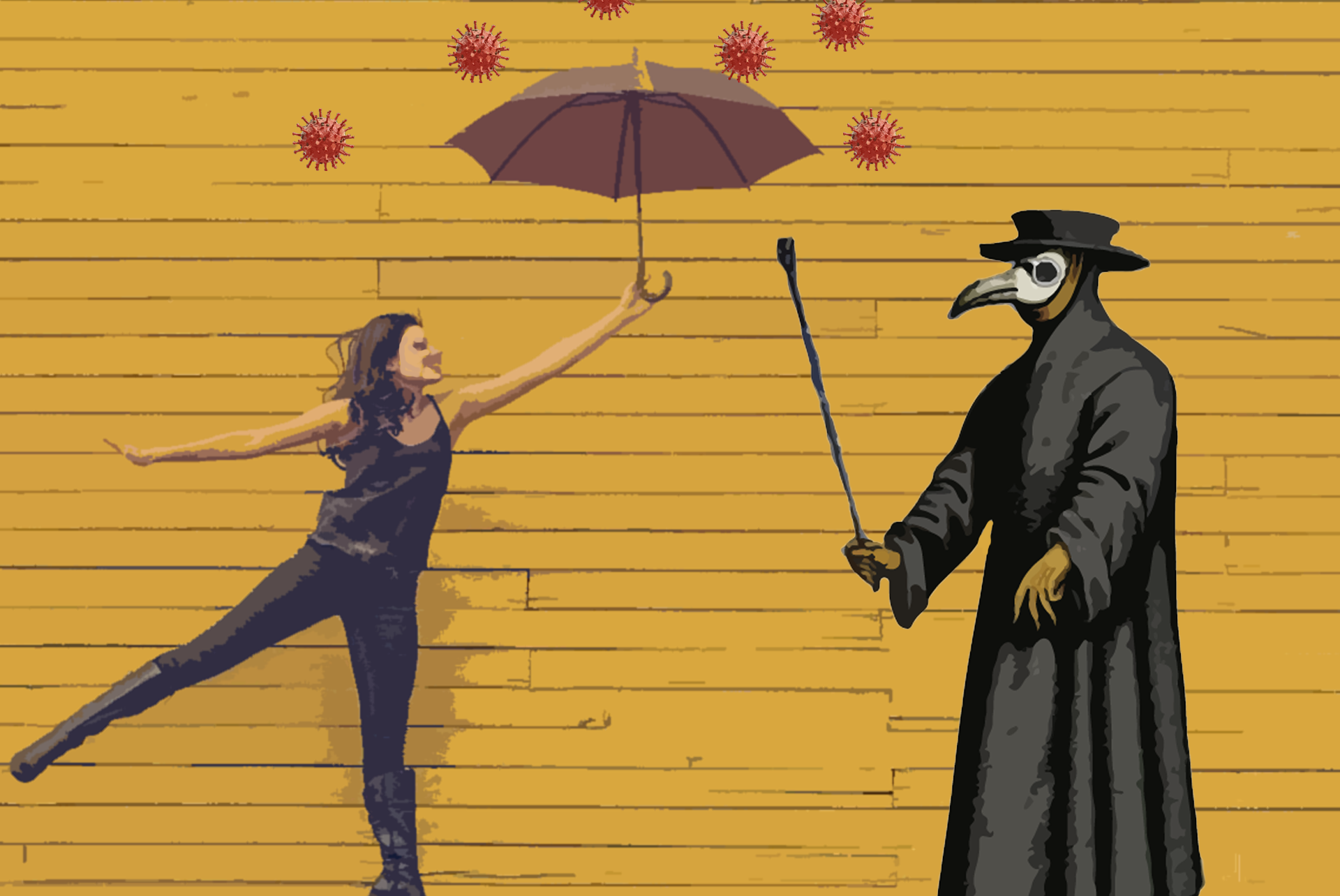
    In the midst of a pandemic, it makes sense that people will seek home remedies—they can give you actionable measures to take to try to inoculate yourself against COVID-19. But peddling bunk medicine like a medieval plague doctor only makes things worse.

    Random herbs, hot liquids and happy thoughts do nothing against COVID-19 (neither does weed). What can help stop the spread of COVID-19 are these much less sexy things you’ve probably already heard, adapted from the Centers for Disease Control and Prevention:

    • Social distancing. Hang out with yourself for a while. The crushing introspection may seem scary, but who knows, maybe you could learn something about yourself. The CDC gives suggestions on how to cope in this stressful time.
    • Frequent hygiene. Wash your hands with soap and water for at least 20 seconds. Sanitize doorknobs in your home. Sanitize your debit or credit card if you’re grocery shopping. You might even go so far as to ask to scan your own groceries at the checkout stand.
    • Don’t touch your face. According to disease expert Michael Osterholm, the virus behind COVID-19 chills out in the throat and lungs, and it likes to get in your body through your eyes, nose and mouth. Your hands provide an Uber ride for the virus straight into your system.
    • Also, cover your face. The CDC have shifted course and now recommend people cover their face with a cloth mask in public, especially in high-risk areas like grocery stores or pharmacies. If you have a sewing machine, here’s how to make your own mask. If you don’t have a sewing machine, the CDC provides a video on its site on how to make a mask out of any old cloth and a couple rubber bands.
    • Keep your body healthy. Eating a well-balanced diet, getting enough sleep and exercising all maintain a healthy immune system.
    • Find a new hobby. Don’t allow depression to set in from all the time spent indoors. Netflix is nice, but it’s not a hobby. Try reading, painting, knot-tying or bread-making. Blogger Matt Gilligan compiled a list of 19 inexpensive hobbies for self-quarantining.
    • Connect with your friends and family. Don’t gather with people in person. (No group hugs.) Instead, take advantage of your phone and call up your friends and family. For a more socially stimulating experience, use FaceTime or Zoom to have a video chat. Invite all your pals and make it a virtual party. If you happen to be posted up in a house with a friend, try to hang out with them rather than hiding away in your room.

    We have no cure for COVID-19. A vaccine, by all accounts, remains a long way off. If you end up with the coronavirus, we only have treatments that can relieve symptoms as suggested by the Mayo Clinic, like Tylenol, cough syrups, rest and fluid intake.

    I’m no stranger to distrusting authority or being suspicious of science—I grew up in Southern Humboldt and wasn’t vaccinated until I was a teenager. But for the sake of yourself and the rest of the world, put your suspicions aside and have a little faith in the only proven measures we know against COVID-19.

  • 5 Dystopian Films to Watch Now That You Now Live in One

    5 Dystopian Films to Watch Now That You Now Live in One

    Lock yourself indoors and pretend these films are strictly fiction

    With a deplorable excuse of a federal administration lying through their teeth about having the situation under control, it’s starting to feel like the world is descending into the plot of an apocalyptic or dystopian film. Fortunately, there are quite a few films to compare with the current state of the world.

    1. Equilibrium (2002)

    “Equilibrium” is a brilliant 2002 futuristic thriller starring Christian Bale in a fascist police state mandates daily medication that eliminates all feelings. “Sense offenders” that refuse their medication are rounded up and disposed of in ovens, and books and other forms of media that might inspire emotion are burned. Subtlety is not this film’s forte, but that’s to be expected when it also boasts brilliantly-staged action sequences where Christian Bale uses his guns as all-purpose weapons. It’s “The Giver” meets “1984” meets “The Matrix.” The fighting style is referred to as “gun-kata,” and its efficiency and balance reflects the tightness of the film’s storytelling.

    2. Snowpiercer (2013)

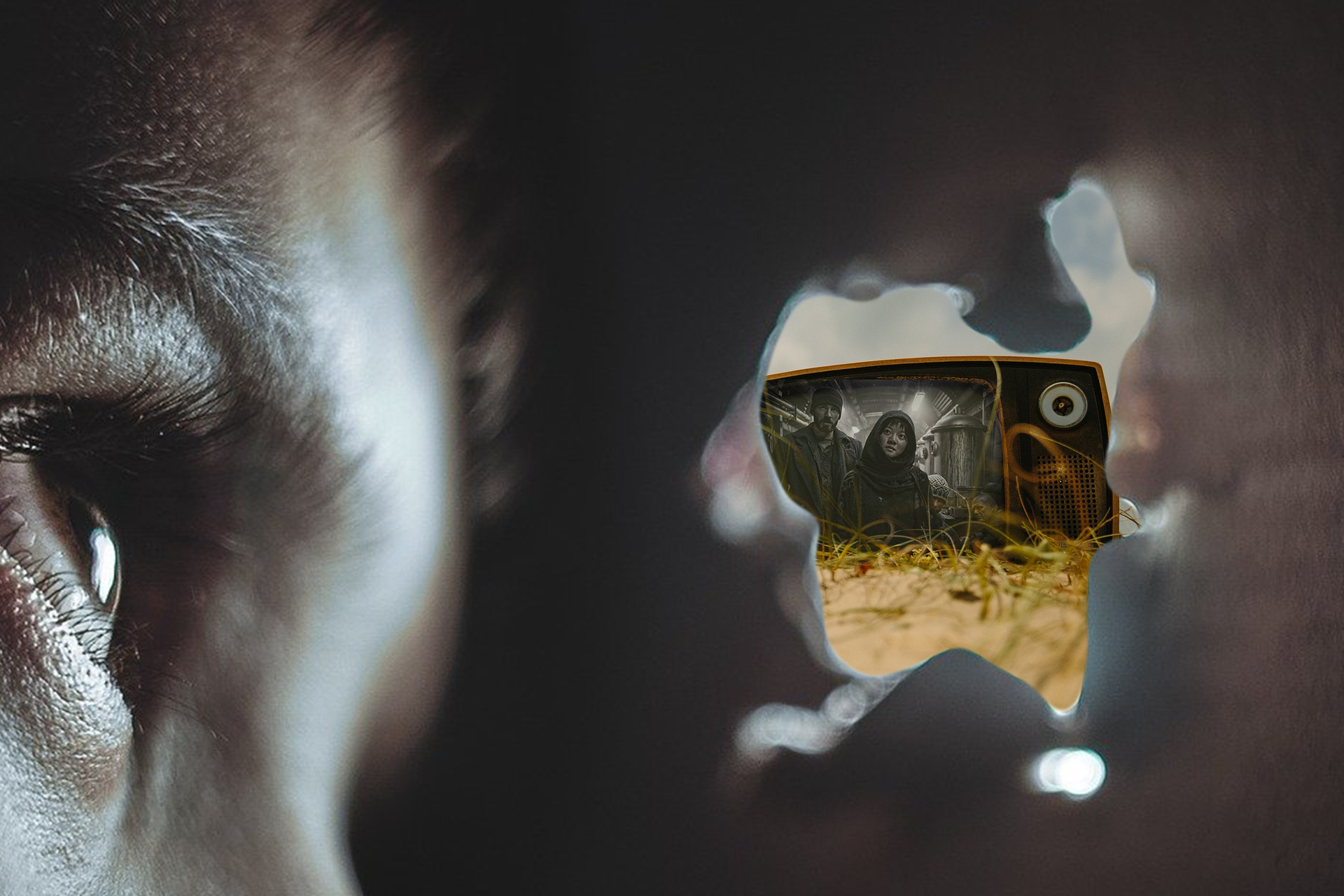
    Did you like Bong Joon-ho’s Oscar-winning “Parasite” from 2019? If so, you might enjoy one of his previous masterpieces. In “Snowpiercer,” Earth is in the midst of a new ice age, leaving humanity to survive within the confines of a train that runs on a perpetual track. The train spins its wheels around the icy remains of the former metropolitan homes of the billionaires responsible for the crisis in the first place. An extreme contrast in quality of life lingers on the train, which continues to spin its wheels until a rebellion begins. “Snowpiercer” is another brilliant deconstruction of the class divide and inequity that reminds us that we all live in a capitalist country.

    3. Looper (2012)

    From Rian Johnson, director of the best Star Wars film, comes an exciting thriller in which time travel is possible, but outlawed. Gangsters send victims back in time to be killed by a hit man until he becomes the target. Unlike most time travel films, this one accepts and plays around with many of the potential paradoxes of time travel and stages scenes only possible in films with time travel. It takes great advantage of the strengths of its cast, as all Rian Johnson films do, and is a whole lot of fun, as all Rian Johnson films are. All of them.

    4. Kingsman: The Golden Circle (2017)

    OK, this one takes place at the time that it was made, and isn’t particularly dystopian, but to be fair, it’s about a group of rich vigilantes, who already killed the entire Obama administration in the previous “Kingsman” film, “The Secret Service.” Thus, they are indirectly responsible for the Trump presidency, which is a major part of the plot of this film. Now investigating a foreign cartel with a monopoly on drug trade, they discover the cartel’s plan to poison cannabis users and hold the planet hostage so that drugs will be legalized. In the real world, this would just mean that Big Pharma takes a huge share of the market and kills their business. But in the Kingsman world, it means a healthy helping of flashy action helped out by an Elton John appearance.

    5. Planet of the Apes (1968)

    Before the Andy Serkis trilogy and the underwhelming Tim Burton effort was the original 1968 classic, “Planet of the Apes.” It watches more as an extended “Twilight Zone” episode than a futuristic adventure film, and it is superbly well-crafted, with intricate and detailed sets. The chemistry between the humans and the apes is a wonderful tone balancing act that offers plenty of ideas on race relations. And its brilliant twist ending goes down as an all-time classic.

  • Students Stressed and Frustrated Going into Somber Spring Break

    Students Stressed and Frustrated Going into Somber Spring Break

    Students react to in-person class cancellations due to global pandemic

    As spring break arrived and the COVID-19 pandemic continued its tear across the globe, many Humboldt State University students wondered what to do as HSU canceled face-to-face instruction until at least April 17. Some students stuck around while others went home. The pandemic, directly or not, has affected all students.

    “I feel like it’s a very serious outbreak and people need to take it seriously. I do think it’s getting blown out of proportion in some ways and people are panicking before they need to, but it’s just something I’m kind of trying to roll with, essentially.”

    Ashley Bailey, molecular biology major

    Ashley Bailey, a junior molecular biology major, planned to travel home. She admitted feeling stressed.

    “I feel like it’s a very serious outbreak and people need to take it seriously,” Bailey said. “I do think it’s getting blown out of proportion in some ways and people are panicking before they need to, but it’s just something I’m kind of trying to roll with, essentially.”

    Kiera Price, a junior journalism major, also said she would travel home. She thought both academic and national leaders should be more vigilant.

    “I feel like instead of limiting social interaction, they should do more to prepare for it,” Price said. “Like, for example, the fact that there isn’t more of a stricter way to limit survivors from coming in.”

    Price recognized there isn’t a lot to be done, but still expressed a longing for something more.

    Tim Arceneaux, a senior English major, looked forward to staying in Humboldt. With a sigh, Arceneaux said he understood the measures taken by HSU.

    “I think the precautions that the University is taking here and all around the country make sense, but at the same time, I find them to be really frustrating,” Arceneaux said. “I hope that this issue will bring the global community together and allow people to realize the importance of universal healthcare.”

    Arceneaux said there was one key thing HSU could do to mitigate the spread of the novel coronavirus.

    “They could try to alert students more about the health resources on campus,” Arceneaux said. “Because I feel like at this point, it’s almost an inevitability that someone is going to contract the coronavirus, and I’m not sure exactly what health resources are going to be available to students that contract the disease.”

    Norbert Rodriguez, a junior film major, had planned to travel to Southern California to visit family, but decided to stick around once the coronavirus broke out. He said he thought HSU took too long to respond to the pandemic compared to other universities.

    “At the moment, there aren’t any test kits [in Humboldt], so there’s really no way of knowing that there are any confirmed cases,” Rodriguez said. “I feel like it should’ve been a bit more proactive.”

    Editor’s note: St. Joseph and Redwood Memorial Hospitals have set up screening tents for patients with COVID-19 symptoms.