The Lumberjack


Students Serving The Cal Poly Humboldt Campus and Community Since 1929

Tag: Social Justice

  • Cal Poly Humboldt campus hosts Food Summit

    Cal Poly Humboldt campus hosts Food Summit

    by Angel Barker

    A three-week-long Food Summit is on campus, and you’re invited. On-campus organizations El Centro, HEIF, Umoja Center, the Food Sovereignty Lab, Oh Snap!, WRAPP, and La Comida Nos Une all collaborated to make this event happen.

    Liszet Burgueno, Developmental Manager for the Humboldt Energy Independence Fund (HEIF) and environmental resource engineering major, talked about the nature of the event.

    “The Food Summit is a collaborative event where multiple campus organizations came together to start conversations about food justice, food sovereignty, and to give people food,” Burgueno said.

    The first week was about the general topics to introduce people to the issues of food sustainability and justice. This week is about jobs and exploration in the food industry, and next week is about environmental justice and social justice.

    HEIF is funding the Food Summit according to Katie Koscielak, Cal Poly Humboldt’s sustainability analyst and advisor for the event.

    “The campus has done other food summits, but not in several years, and this is the first one funded by HEIF,” Koscielak said.

    Photo by Angel Barker | Katie Koscielak, sustainability analyst for the campus, and Liset Burgueno, development manager for HEIF and environmental resource engineering major at the table for HEIF at the food summit on April 6.

    HEIF funds sustainability projects on campus through instructionally related activities fees that students pay for each semester. Past projects have included water refilling stations, compost bins, lots of lighting upgrades throughout campus, hand dryers, and many more. These projects take effect when students submit proposals to the organization.

    “Last semester, El Centro came to HEIF and submitted an idea paper, where they wanted to get reusable utensils,” Burgueno said.

    Darin Torres, criminology and journalism major, pitched the idea this semester for a food summit. Torres spearheaded the ideas and planning, and after months of collaborating with many campus groups and local organizations, the event planning has been successful.

    “I am really proud of what we’ve done so far,” Torres said. “Education is power.”

    This event is not only to educate, but to get students involved with interactive events to help make the planet a better place. This event is really important to Torres, as food insecurity is a huge part of the greater Humboldt community.

    “We have issues with indigenous cultures’ food not being respected,” Torres said. “Food is a major insecurity in Humboldt County, we have students who face hunger and homelessness so much. So we just wanted to incorporate it all into the food summit.”

    “We have regenerated, and hopefully it will continue,” said Fernando Paz, coordinator for El Centro.

    According to Paz, the event itself is, a way to really reflect on our carbon impact in terms of food that we use.

    This Thursday, April 14, there will be a film screening of Gather hosted on Zoom, and on Friday there is a plant tour on campus and an opportunity to volunteer at Bayside Farm. Many more events are also scheduled throughout the week. To find the whole event schedule, go to https://lcae.humboldt.edu/food-summit.

    “This event is made for you in mind, it was made for students, by students,” Torres said.

  • Students show out in solidarity for El Salvador

    Students show out in solidarity for El Salvador

    by Alana Hackman and Carlos Pedraza

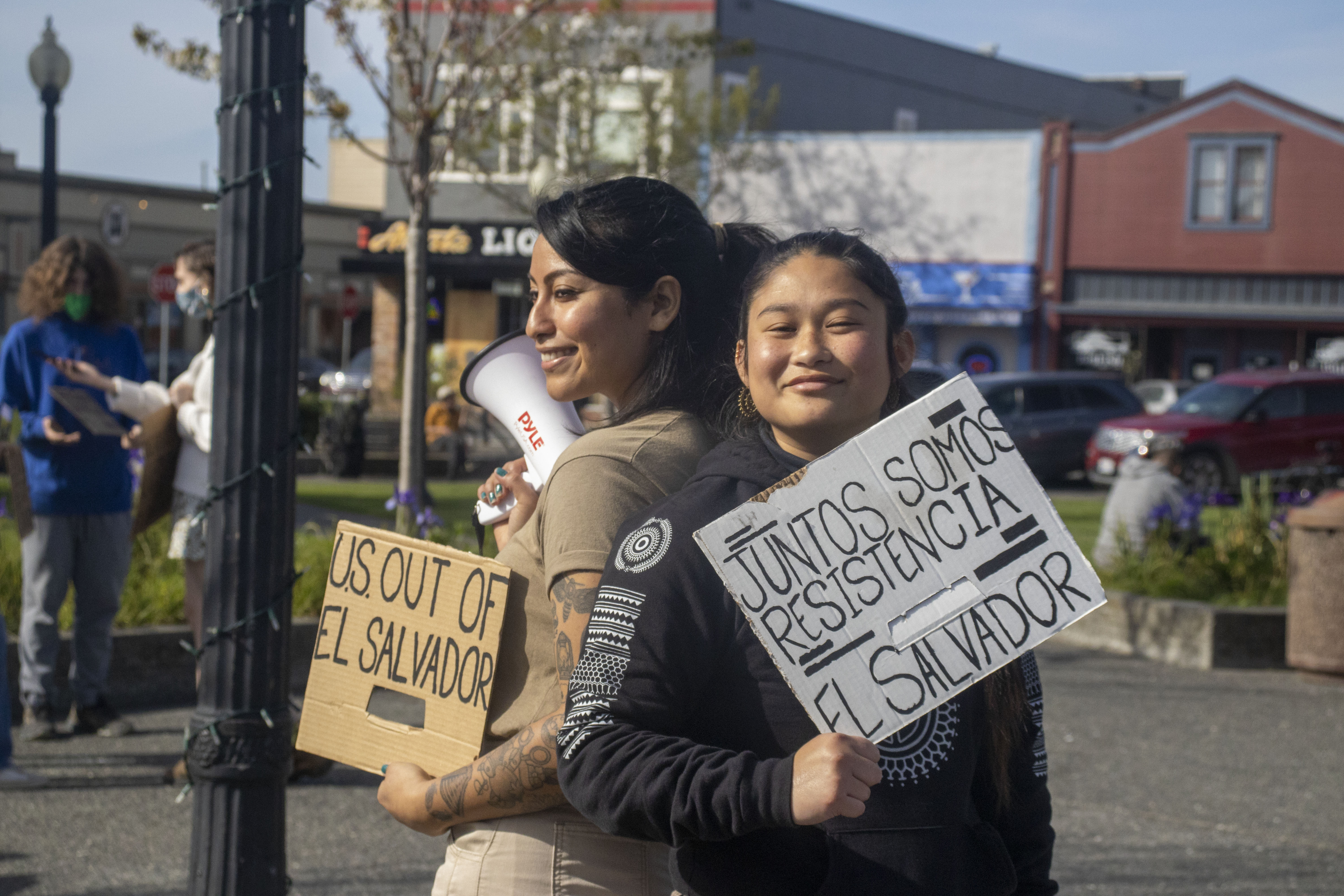
    Cal Poly Humboldt students and Arcata residents gathered around the plaza Thursday, April 7 in solidarity with El Salvador. The event was led by Klara Hernandez, a senior environmental studies student at Cal Poly Humboldt. Hernandez organized the event through her senior project and organization Eko Social Justice. Hernandez was also joined by Centro de Pueblo, an immigrant rights organization for Southern Indigenous communities also joined the event.

    Photo by Carlos Pedraza | Gathered crowd looks on during the speech at the Arcata Plaza on April 7.
    Photo by Carlos Pedraza | Gathered crowd looks on during the speech at the Arcata Plaza on April 7.

    The protest began at 4 p.m. and carried on into the evening around 6 p.m. Hernandez walked to the center of the plaza megaphone in hand and began her speech with a land acknowledgment and thoughtful address to her family who fled to the U.S. from El Salvador. Hernandez called for solidarity with the people of El Salvador and pointed out problems of racial discrimination against Indigenous and Afro-Salvadorian citizens as they are forced to adopt Spanish culture.

    Hernandez also addressed abortion laws in El Salvador and the rising violence and femicide rates in the country.

    “They imprison [women] even if it’s not your fault the baby didn’t make it,” Hernandez said.

    She continued to speak against many problems, including corporations privatizing and contaminating water, Bitcoin being adopted as their main currency is hurting those who don’t have access to it, and the LGBTQ+ community facing discrimination and violence in the country.

    An attendee of the protest was Alice Turk who heard of the protest from social media. The women’s rights issues spoke to her most and she feels people need to stand in solidarity with women everywhere.

    “I think the fact it’s a crime to have [an] abortion is something that needs to change, it’s a problem that is happening all over the place,” Turk said.

    Cal Poly Humboldt students Ben Cross and Evina Romero came out to the event also after being sent the social media post by friend and Cal Poly Humboldt psychology major Cheyanne Elam. Elam found out about the event through a class and was attending to learn more about what she can do for the people of El Salvador. All agreed it was important to use their privilege to be at this event and show their support for the citizens of El Salvador.

    “Immigrants from El Salvador and all over South America are being turned away at our borders, and the U.S. really has the ability to rectify these things,” said Cross.

    Photo by Carlos Pedraza | Klara Hernandez gives her speech to crowd while standing in the center of the plaza at the Arcata Plaza on April 7.

    Hernandez ended her initial speech with a call to action toward environmental justice and immigration rights for all. The crowd wavered cheers and screams from around the plaza flashing cardboard signs reading, “U.S. out of El Salvador,” “Women’s rights in El Salvador,” and “Indigenous sovereignty in El Salvador.” The signs were written in both English and Spanish. Hernandez mentioned her organization, Eko Social Justice, and that this event is an effort to use her voice for good and represent her home country of El Salvador in Humboldt County before her graduation and departure to Los Angeles this May.

    “The [Salvadorian] community is so tiny here that these things don’t get addressed. It’s like we’re invisible in this area so I wanna speak it out,” Hernandez said.

    Hernandez will be holding an art show at Brainwash Thrift Thursday, April 21 in solidarity with El Salvador. The event will be held from 2 p.m. to 6 p.m. and will include Hernandez’s own photography and art.

  • The 28th annual Social Justice Summit concluded with paddle-boarding to Big Lagoon.

    The 28th annual Social Justice Summit concluded with paddle-boarding to Big Lagoon.

    by Kris Nagel

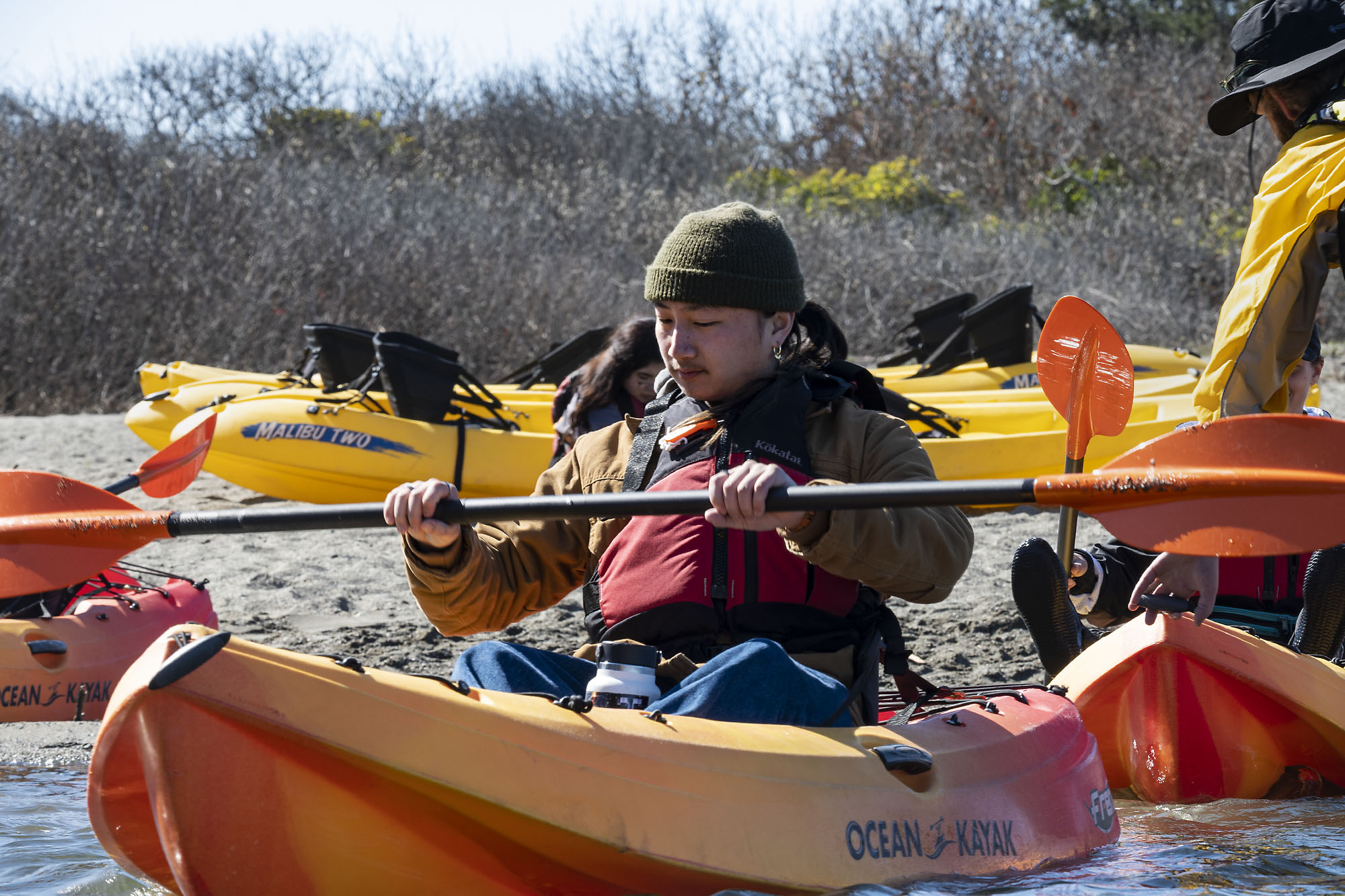
    An almost-spring chill in the wind convinced almost all of the attendees present to wriggle into one of the wetsuits piled on the warm sand. The Social Justice, Equity and Inclusion Center (SJEIC), in tandem with Center Activities, hosted a kayaking and paddleboarding trip to Big Lagoon for students on March 6.

    Photo by Kris Nagel | Attendees of the 2022 Social Justice Summit trip to Big Lagoon suited up with life preservers and splash guard gather on the beach on March 6, 2022.

    The event capped off a week of activities as part of the 2022 Social Justice Summit, which was themed around climate justice and intersectionality. Part of a 28-year tradition, the annual Social Justice Summit is a place for students to get directly involved in making our community more inclusive. Frank Herrera, the SJEIC coordinator, helped oversee the student leaders who put together the week’s schedule with accessibility in mind.

    “Big Lagoon is a cool spot. I would imagine that it’s probably going to be transformational for some,” Herrera said. “Hopefully in a positive way.”

    The summit was one of the first programs to be offered in person now that COVID-19 restrictions are starting to be lifted. Herrera said this year drew a smaller crowd than it had before the pandemic hit, with around a hundred students attending events over the week.

    About 16 people went to Big Lagoon on Sunday. In part, the limited itinerary was due to this year lacking a credit program for student organizers of the summit. Normally, a class credit is offered through the Critical Race, Gender and Sexuality Studies (CRGS) department. However, Herrera’s request for the program was denied this year.

    Photo by Kris Nagel | Aelis Hanson, a guide with Cal Poly’s Center Activities, walks a program participant through their launch at Big Lagoon on a paddleboard March 6, 2022.

    The summit was a work in progress for months prior to the first speaker taking the stage at the end of February. However, some accommodations took on-the-ground problem solving by the event coordinators.

    One student registered for the Big Lagoon trip had requested additional assistance in transporting their mobility aid before arriving at the pickup location. Not having planned for the additional cargo, organizers scrambled for an additional vehicle. Fortunately, another van was available that morning and the student was able to join shortly after the first kayaks launched.

    Photo by Kris Nagel | Center Activies’ Mairead Sardina educates program participants on water safety, showing how a tight life vest helps keep the head above water March 6, 2022.

    Mairead Sardina works for Cal Poly Humboldt’s Center Activities and helped plan the outdoor programming of the summit. Sardina hoped that the trip would help re-establish a sense of normalcy on campus, now that activities are held in person again.

    “It gets them out and engaged with the local environment which helps with student retention, makes them feel safer, makes them want to get out and care about protecting the environment and see what a beautiful place Humboldt is to live,” Sardina said, promoting the Center Activities center where students can rent outdoor gear at low or no cost.

    Cal Poly Humboldt student Tatiana Gamboa joined the journey out to Big Lagoon. A second-semester student, Gamboa was drawn to the school behind the redwood curtain because of its emphasis on the local environment.

    “It encourages [students] to come out and do something different, without having the funds to rent gear and the previous knowledge of how to paddleboard and kayak.” Gamboa said. “So it kind of gives that gate to students exploring something they might like and I think that’s pretty special.”

  • Justice for Josiah

    Anyone with information regarding the David Josiah Lawson case is encouraged to call the APD’s 24-hour confidential tip-line at (707) 825-2590 or the APD Dispatch Center at (707) 822-2424

    On April 15, 2017, Humboldt student David Josiah Lawson was fatally stabbed at an Arcata house party around 3 am. McKinleyville resident Kyle Zoellner, 23, was taken into custody relating to the incident. After five days of the preliminary hearing, the judge ruled that there was not sufficient evidence to hold Zoellner and the suspect was released despite witness testimonies.

    Since this day, David Josiah Lawson’s mother, Charmaine Lawson, has fought endlessly to bring justice to her son. There have still been no arrests made and Charmaine Lawson pleads for those in the community who know something about what happened to come forward.

    Over the past four years, approaching five, there has been a documentary made about the injustice of David Josiah Lawson and the case has attracted the attention of a number of murder mystery channels.

    Danielle Hallan is a true crime YouTuber who investigates unresolved cases through news outlets, speculations of investigators, journalists and family members. Charmaine Lawson encouraged the video that was made by Hallan about the Lawson case to be shared to the Humboldt community to keep the case alive with hope that justice will be served.

  • Local Bilingual Charter School Teaches Children and Community About MLK’s Message

    Local Bilingual Charter School Teaches Children and Community About MLK’s Message

    The 5th grade students of Fuente Nueva lead the one mile march for Peace & Justice in Arcata on Friday, Jan 14th. Photo by Morgan Hancock.

    “So often MLK is portrayed in a very white-washed and sanitized way. I think he was portrayed in a very true way here today.” said Marche Hines, a mother of two children who currently attend Fuente Nueva Charter School. 

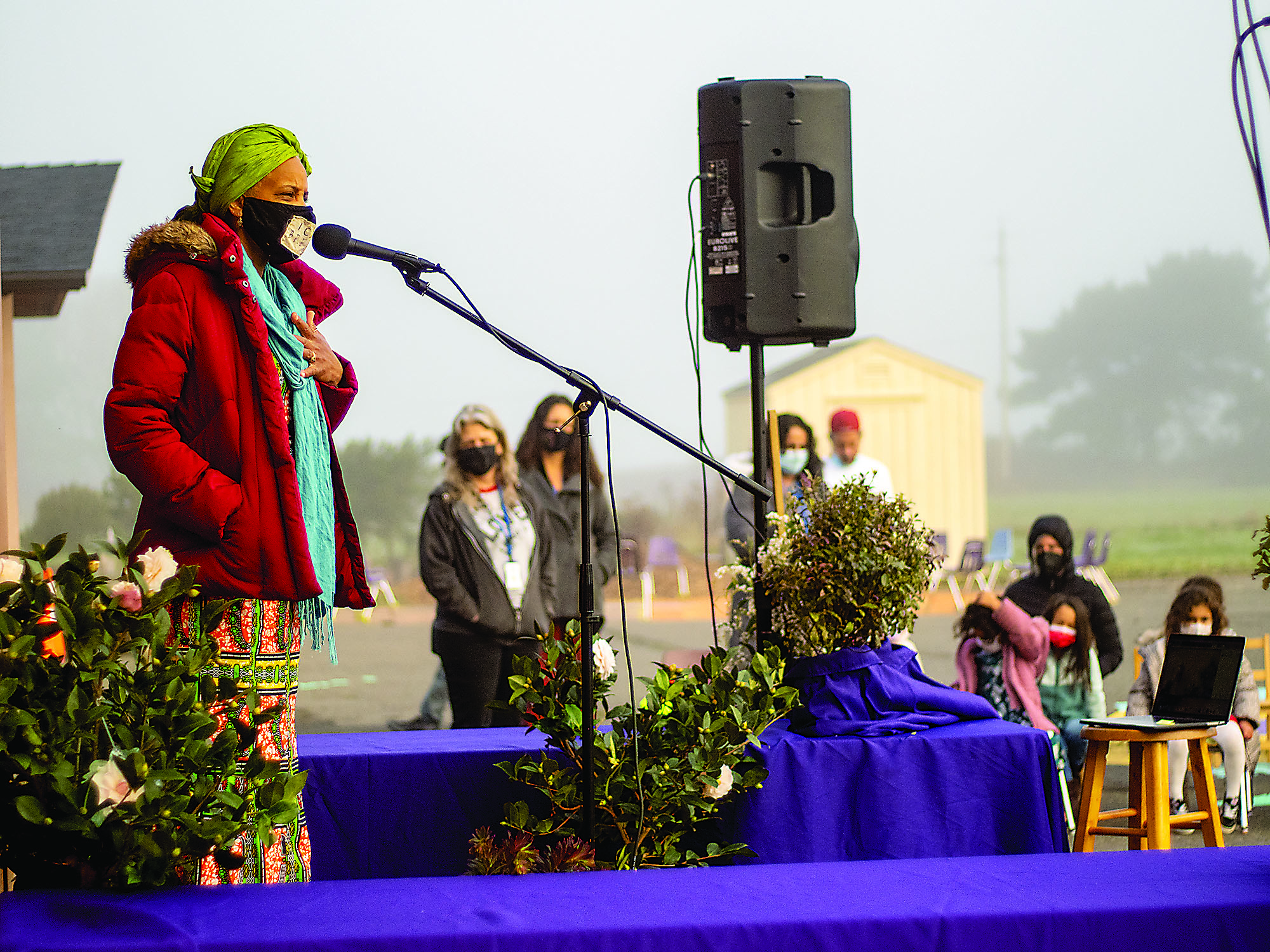
    On Friday, January 14th, three days prior to the upcoming national holiday of revered civil rights leader Dr. Martin Luther King Jr, bilingual charter school Fuente Neuva hosted an event entitled “Dreams Coming Alive” in his honor. Students, parents, and community members alike were invited to come and participate and to hear the voices and words of many important black community members and organizations from around the county. 

    One such speaker was James Braggs, an active member of Black Male Empowerment Network (B.MEN) and Black Humboldt, who opened the outdoor event at 8:30 am with a short land acknowledgement and prayer. Braggs expressed in both portions of his speech the importance of remembering history and learning from it. Reflecting on where we have grown, and being grateful, and reflecting on where we can improve, and changing it. 

    “Remembrance is critical,” Braggs said later that day during a personal one-on-one interview with the Lumberjack. “It’s important to acknowledge the history.”

    “King existed due to the work of thousands of ordinary people,” Braggs said as well, explaining how we often fail to see the bigger picture behind MLK’s events and actions. “[It] wasn’t just super smart politicians and leaders. It was mothers, fathers, brothers and sisters.”

    After Braggs opening prayer, president of the Humboldt county’s NAACP, Sharrone Blanck, stepped up to the stage, greeted by the children in the front and adults in the back. Blanck’s speech revolved around the ideas such as the importance of diversity in groups and the freedom for everyone to live life as their full selves.

    “We exist here as individuals and we have the privilege to be a part of groups,” Blanck’s said. “Who we are connects us to other people. I’m a black woman, I’m a Jewish woman, I’m a mom and a wife, I’m a friend, and all those parts of me I bring wherever I go.”

    April Koepke, attendee and parent of two students, noted this particular speech as being her favorite. 

    “[It’s] important for young people to know the values of working together and the equality of all.” she said, hoping that this speech will become an inspiration to her own children over the years.

    Students, staff, and community members participant in a short yoga session before the start of the march. Photo by Morgan Hancock.

    Other important speakers included Dr. Kintay Johnson, current director of CR’s Multicultural Center, Lorenza Simmons, youth coordinator at HC Black Music & Arts, and Mo Desir, co-founder of Black Humboldt. Each telling their own unique story of how they empowered themselves and the people around them in Humboldt county in the struggle to have their voices as black people be heard. Never being afraid to point out the changes that still need to be made and the injustice still faced by their community everyday, in a way that not only adults could understand but the children as well.

    “[The event] let students of color know [that] they’re heard,” Hines said

    Cybele Porpee, another attendee and mother of a student, found the event inspiring.

    “It helped me review my own goals, hopes for the future, and engagement towards the community,” Porpoise said.

    “Diversity, multiculturalism, acceptance, everything he taught is important,” she added.

    The event hit its peak at 10:30, when students, staff, parents, and attendees alike were asked to participate in a mile march around the school, a moment to show students MLK’s often used tactic of righteous civil disobedience in practice and for both young and old alike to walk in the footsteps of not only him but of his many fellow protestors too.

    Fifth graders led the march through the school’s neighborhood. Each carefully held the main banner heralding the beginning of the protest. Towards the caboose of the group were the younger first grade students, carrying their own posters with messages for peace and equality. Each student along with their parents, staff, and attendees stepped in sync crying out for the peace and equality of all, and the respect, dignity, and right to life of every black and brown person locally and nationally.

  • Dr. Asao Inoue Looks to Lead Academic Revolution

    Dr. Asao Inoue Looks to Lead Academic Revolution

    Inoue confronts the supremacist ideas within American academia

    From unkind flyers to nasty messages written on bathroom walls, Humboldt State University has dealt with its fair share of acts of hatred and racism.

    Asao B. Inoue, a professor and associate dean at Arizona State University, studies student writing assessment, race and racism. In a Social Justice Summit talk and an exclusive interview with The Lumberjack, Inoue pondered how a university can be anti-racist and address white supremacy.

    “I was asked to come here and give a talk at a workshop, and I love doing that—it feels like an important part of the public work that I do in the academy,” Inoue said. “I help teachers think about ways to do social justice projects in their class, particularly around literacy classrooms and the grading evaluation and feedback of student literacy projects or writing.”

    Inoue’s objective is to change the ways professors think about language and white language supremacy, and to start a revolution within the American grading system.

    “My scholarship and research is in writing assessment and racism studies and the intersection of those two things,” Inoue said. “This [workshop] is an extension of that by trying to engage with writing faculty, English faculty and the curriculum.”

    Inoue described white supremacy as a condition in which a particular group’s dialogue dominates others.

    Inoue said white supremacists are often middle to upper-class people from the East Coast that attended an elite school. Inoue said these conditions collectively make up the identities of white supremacist perpetrators.

    “It’s rarely, if ever, anybody else but that group of people from their particular material conditions in life that produce a certain language, which we tend to call standard or proper English,” Inoue said.

    Inoue called out academia for actively perpetuating racist standards. He said the American grading system reaffirms racist ideals and practices through assigned curriculum.

    Inoue said proper English can be especially problematic in academic settings.

    “There’s lots of research that shows that we don’t actually agree about what that standard looks like,” Inoue said. “But I’m talking about when the rubber meets the road and you have to grade a paper based off of this, or decide whether something is consumable for the public. That’s where we start to have a lot of disagreements.”

    Inoue called out academia for actively perpetuating racist standards. He said the American grading system reaffirms racist ideals and practices through assigned curriculum.

    “I don’t want one to confuse me calling the system racist, with me calling people racist,” Inoue said. “[Professors] are thinking about the disciplines they have to teach and they’re not always thinking about, ‘How do I teach this?’”

    One of the structural flaws within the educational system that Inoue noted was that professors fail to question the academic system and how it reaffirms practices of white language supremacy.

    “It’s difficult to be critical of a system that has really benefited you,” Inoue said. “It seems like everything is working.”

    Inoue said the façade of the education system being equally supportive can be convincing enough that people don’t see the flaws. Inoue said many professors inherit the practices that were inflicted upon them, and because those practices worked for them, they assume they work for others.

    “It’s a fairly narrow economic and social bandwidth of people, so that means that all those practices are fairly narrow and the language practices are fairly narrow,” Inoue said. “So it doesn’t really leave a lot of room for considering differences or changes or being critical about those things.”

  • Lumberjack editors meet with Rossbacher, part II

    Lumberjack editors meet with Rossbacher, part II

    The Lumberjack editors met with the president of Humboldt State University, Lisa Rossbacher, on March 23. The Q&A was largely centered around budget cuts and social issues that impact the local community, especially HSU students.

    This is part II of the meeting which mostly concerns social issues. Part I, which focuses on HSU budget cuts, can be found HERE.

    On social issues:

    Lora Neshovska (managing editor): “There are students facing homelessness and discrimination. How can we address social justice issues of students beyond our financial worries?”

    Rossbacher: “I think there are a number of things the university is doing to help with those basic needs that are really the underpinning to ensure student success. There’s a whole program happening here, many of them under the umbrella of Oh SNAP! Things like the food pantry that we have [or] students having access to EBT.

    We were one of the first campuses in the country to provide that kind of access. That started in late 2016 [and] over seven million tons of food have been redistributed on campus that would otherwise have gone to waste, so that helps. Some of the community meals that are being prepared – that I know Wayne Brumfield always cooks for – that sort of thing, being able to redirect J-points that are left over to help other people. Those are some examples in terms of food security. We just got some money from the chancellor’s office that will help us do more in terms of just food security on campus.

    In terms of housing, it’s a real issue because [of] where we’re located, the limited houses in stock that we have here. We’re doing some things with that, too. One of them is, I’m sure you know, Chante Catt has been hired as a homeless student advocate. She was involved in that organization of homeless student advocates, but she’s now officially working so that students who are in need of housing can contact her. I know right after she started doing that, immediately she placed four people. So that helps, too.

    We’re looking at the possibility of building new student housing. The university is looking at new residence halls off campus, and then there’s this outside developer who’s looking at The Village. Whatever it takes to get affordable, safe [and] not-too-far-away housing for students is a good thing.

    There’s also a program that we’re starting up in conjunction with some agencies within the area. I think it might be called the ‘nest program’ or ‘silver nest program,’ where there are seniors in the community who have a bedroom [and] extra space who would really like for company, for safety [and] a little bit of help around the house, who are willing to rent those spaces to students. That becomes a real collaboration with the larger community in a way that addresses multiple needs.

    I know it’s incredibly frustrating. I mean, I’m incredibly frustrated by seeing all the basic needs that we have here at Humboldt that are not being met. It’s sort of good news and bad news that we’re ahead of the curve of the system. We get pointed to as a place where we’re doing a really good job of trying to address those needs, which is good that we’re being proactive about it and making change. But if we’re among the leaders, we look at our frustration and the problems we still have, it makes you worry about other campuses.”

    Stella Stokes (life and arts editor): “I am an ITEPP student and my parents, who are HSU alumni, were also ITEPP students. There was an article about you in the Lost Coast Outpost on Feb. 7 that said ‘Rossbacher has been appointed to lead an initiative to increase the number of students from Tribal Nations who enroll and graduate from the California State University system.’ Why were you appointed over someone who is indigenous?”

    Rossbacher: “That roll is for president in the Cal State system. In fact, some people saw that and said, ‘Wait a minute, we thought Leo Canez was doing this, because he’s our new Native Recruiter.’ This is part of an initiative that was an across-the-sea issue, and it has representatives from more than half of the campuses. Adrienne Colegrove-Raymond has been a representative at HSU to this group. I convene the meetings, but I’m not responsible for this alone. It’s with a whole group of people.

    This statewide group will be meeting here on campus on April 4. The people can come to that. [People] from all over the state will be able to participate in the California Indian Conference, which is also here on campus [on April 5 and 6]. What we really hope is they stay until [April 7], which is when Big Time is. We actually have four days of Native American events happening.

    Back to your question of why I was appointed. Ultimately, when the chancellor asked me to do that, it came down to the two presidents at the campuses that have the largest Native [American] communities around them. It was Humboldt State and San Marcus. Humboldt State has the highest percentage of Native American students of any campus in the system. It’s not the largest absolute number, but we have the highest percentage. We have strong connections with the Native [American] community. It came down to the two of us who were presidents of those two campuses. We talked together and both us said to the other, ‘If you want to do, I’ll be happy to help you.’ We were trying not to step on each other’s toes. She said, ‘I’m really overcommitted right now. I will be glad to help you, but I’d appreciate it if you would do it.’ I said, ‘Of course.’

    Also, I didn’t know this before, but Rollin Richmond, who was the president before me, was in the same role for a number of years. So there’s a history of Humboldt State being in this role.”

    Ahmed Al-Sakkaf (news editor): “Rumor has it you live in Kansas. For the record, where do you live?”

    Rossbacher: “I live in McKinleyville.”

    Megan Bender (opinion editor): “Around 2016, you had issued a statement that was taken badly by the HSU community. You also issued an apology statement afterward. How can we address that to [David Josiah Lawson‘s] situation. People are frustrated by the inadequate support of the community, as well as HSU. What are you doing to create change in the right direction, as far as racism is concerned?”

    Rossbacher: “Let me back up just a minute to talk about when Josiah was killed. The university did everything we could to support his friends [and] his family. We worked closely with the police department to be sure that they were having access to witnesses or anyone who could help solve this murder. We’ve all been frustrated by what feels like a lack of progress.

    I ask, and I know I’m not the only one, the people in the city of Arcata about what’s going on, where are we and is there anything we can do to help? It’s a terrible tragedy. It’s something that affects so many of us, myself included every day. I think about wishing there was something we could do. I sat through every preliminary hearing.

    Ultimately, right now, it’s [on] law enforcement. It’s a criminal justice case. It’s something we can’t actually do anything about. It’s not in our hands. I asked as recently as last Friday, ‘When are we going to know something?’ It’s hung up in the process. You have as much information as I do. It’s highest priority for us. It’s not necessarily highest priority for the state to process the evidence, because there’s no one being held waiting for a trial. That’s what gives other cases a higher priority. We’re living with it every day. It’s just the way the process works.

    I want to make another point. I believe deeply in justice for Josiah. I think about it in two different ways. Actually, it’s two forms of the same way.

    One of them is resolving the case, figuring out what happened and just getting closure on that. Until that happens, it’s so hard for the community, for his family and for his friends. So there’s that aspect of justice. But I look at it from a bigger picture, too. I think what justice for Josiah should also mean to us is making sure that we have, as a larger community, a situation that is equitable, just and fair. [A situation that is] devoid of any discrimination – racial, ethnic, gender inequities or injustices. I think a piece of that, which is something I’ve been committed to involves some aspect of working with people on campus or in the city of Arcata. I see that as a long-term, systemic solution to the question of, ‘Where is the justice for Josiah?’

    If we could create a just, equitable [and] fair community in this region together, that would be a fitting tribute to Josiah and what he would’ve done with his life. I see justice for Josiah in a couple of dimensions, but I think there’s a big picture where the world will continue well beyond when the case is actually resolved.”

    Neshovska: “Do you think there’s racism in Humboldt County?”

    Rossbacher: “I think that in any environment where we have such different demographics, it’s inevitable. No, it’s not. I take that back. It’s not inevitable. Yes, and I have seen evidence of that myself. Demographics of the student population of Humboldt mirrors the state of California. The student population of Humboldt is similar to the demographics of this state. The demographics of Arcata and Humboldt County are very different.”

    Neshovska: “Isn’t there more than three percent of black people in California though? There’s only three percent here.”

    Rossbacher: “I know, yes.”

    Neshovska: “So it doesn’t exactly mirror the state of California.”

    Rossbacher: “Yes, I take your point.”

    Stokes: “One of the main problems about Josiah’s death is that students of color fear for their own lives or feel uncomfortable. They stop going to parties, some are just scared. How do you keep students of color safe?”

    Kyra Skylark (science editor): “To add on to that question, you said that affordable and safe housing is one of your main goals. I personally know friends who went to that party [where Josiah was murdered] and left the school afterward. People don’t feel safe, specifically students of color, which is why they fought for the Arcata council meetings to talk about why they don’t feel safe. What do you think we should be doing as Humboldt State to better address this issue? Why haven’t you gone to more of those meetings to hear students?”

    Matthew Hable (editor-in-chief): “The one-year vigil for Josiah is next month. Do you plan on attending?”

    Rossbacher: “Yes. There are two parts – there’s on campus and off campus. What I hear is that students are more likely to feel safe on campus than they do off campus.”

    Skylark: “Personally, as someone who has lived on campus during the last election, I got to hear ‘kill the fags’ and ‘reinstate Jim Crow.’ I did not feel safe on campus.”

    Rossbacher: “I understand. And yet, we’re a campus where we have to protect free speech. You all know that more than most. One of the aspects of creating safer spaces has to do with lighting. I know Wayne Brumfield has been doing walks around campus to identify places that need better lighting. We installed some of those over the winter break. There’s an interesting conversation with the City of Arcata about that, because they have ordinances about – it’s a dark city – as a way to not create light pollution. But the negative affect of that means we have less lighting, therefore areas that feel less safe. The city is working through that.

    There’s also an interesting set of conversations about surveillance cameras. There are a couple of dimensions to that. One of them is that if the police do it, particularly in Arcata, they have to maintain some of that tape for five years. And a lot of the businesses around the plaza, they particularly like to have surveillance cameras. The city sees real value in having the individual businesses, having their own cameras, because they can control them. They only have to keep them for a week or something. That’s enough time for the police to say, ‘We want to see what happened last night or even last week without having to keep the data for five years.’

    Meanwhile, the staff on this campus do not want security cameras, because they think – and this is the unions – they think the surveillance footage is going to be used to see if they’re actually doing their jobs, [as a way] to spy on them. [We have] all of these different dynamics working. That’s not the only solution, but it’s an example of the kind of complexities we get into. That doesn’t fully answer your question?”

    Skylark: “I don’t think that fully answers my question. There are issues on a social level that are making people feel unsafe. What is the school doing to make people feel safe on a social level? What are you doing to create change on an educational level?”

    Hable: “Are you saying there’s a lack of engagement right now?”

    Skylark: “Yeah.”

    Rossbacher: “We’ve had some events that addressed that. We had a day-long session last summer that really got into many of those issues.

    Skylark: “But no one is here during the summer. Those events are missed by the majority of the people.”

    Neshovska: “I think it’s also important to note that, not only as a president of our university, as a university as a whole, how do you make yourself available to these people who genuinely fear for their lives and want to be heard by somebody of power? They want somebody like you to hear them out and for you to say, ‘I’m here for you and I understand.”

    Rossbacher: “I seek out those stories. I listen to them carefully. I’ve been doing a lot of reading. I can share my recent readings with you, both books and articles on it.

    I made sure back in January, the leadership of the university went through micro-aggression workshops. It’s about awareness, how to counteract and keep that from happening. It started out [by] asking faculty and staff. I knew the way to bring credibility to that is to not only say that ‘I’ve done it,’ but that the senior leadership team, vice presidents and all the deans went through that. It was taught by Christine Mata and Roger Wang. It touched on micro-aggressions and white fragility. So I, as Lisa Rossbacher, also participate in the community dialogue on race. I learned a lot from those opportunities, too. I make it a point of going to sessions I know are going to make me feel uncomfortable. They say you should do it at least three times a week. You put yourself in uncomfortable situations.

    In a larger context, we are a place that’s about education. One of the things I value most about the opportunity to work in the university is the chance to learn. I’m around smart people who have a lot to teach me. There’s a lot I can learn. If I’m not putting myself in the kind of position that you as students, where you’re being asked to put stuff out there and being evaluated on it – that’s why I write as much as I do. You write, you’re putting it out there and people are going to criticize it. It’s just a reminder of what students do every day. I’m a student, too.”

    Bender: “Is there anything you think we missed that you would like to share with us?”

    Rossbacher: “We have spent literally years building up to the visit that we had this week.”

    Bender: “So that exit interview is a summary and they’ll be giving you another report later?”

    Rossbacher: “It was an oral summary. They said we’ve got some things we want to – [they provided] accommodations and recommendations. There are some things we’re doing really well and some things that we need to work on. Diversity was one of those [things we need to work on].

    Al-Sakkaf: “People were banging on the door at Siemens Hall during the WASC meeting. How did they feel about that?”

    Rossbacher: “They were a little worried. They are all experienced people, and they work on campuses where student feel strongly about issues as well. They said, ‘We were surprised, but we weren’t surprised.’ They took it in stride.”

    Bender: “Do you think some budget suggestions will come out of this report?”

    Rossbacher: “I think what they will say is the university needs to have a sustainable budget. We need to balance our budget and figure out how we’re going to move forward. I’m sure they’re going to say that.

    Neshovska: “How long can we go with this budget deficit? What happens if we don’t solve the budget?”

    Rossbacher: “We will solve it.”

    Gabe Rivera (sports editor): “Is there a person you normally contact to inquire about Josiah’s case? Who is that person?”

    Rossbacher: “I talk to lots of people. I talk to Tom Chapman, the chief of police of Arcata.”

    Neshovska: “In 20 years, is my degree going to be useless? What’s going to happen if the budgets cuts aren’t resolved?”

    Rossbacher: “We’re going to solve this problem. One of the things we haven’t talked about is the need to increase enrollment. That’s not going to solve all of our problems. It’s going to help with a lot of them. I want to assure you that this is not a limited growth. I’ve done an analysis that’s still being worked on, that’s still very much a draft. I want to know what the carrying capacity is for the campus for enrollment, taking a lot of different dimensions. In the big picture, what that tells us is 8,000 is probably about the right number, [which] is a little bit more than what we have now. Our goal is to grow back up that size, but not way beyond that. The goal is to have 15,000 students, and that is not the case.”

    Neshovska: “That sounds complex. We want to increase enrollment, but we don’t have student housing. We need more money to increase safe and affordable housing, but we need to increase enrollment to solve the budget crisis.”

    Rossbacher: “Increasing retention rate is probably the most important thing you can do for enrollment right now. Partly, it’s bringing in new students. Even more important is keeping the students who are here.”
  • Mental Health Week

    Mental Health Week

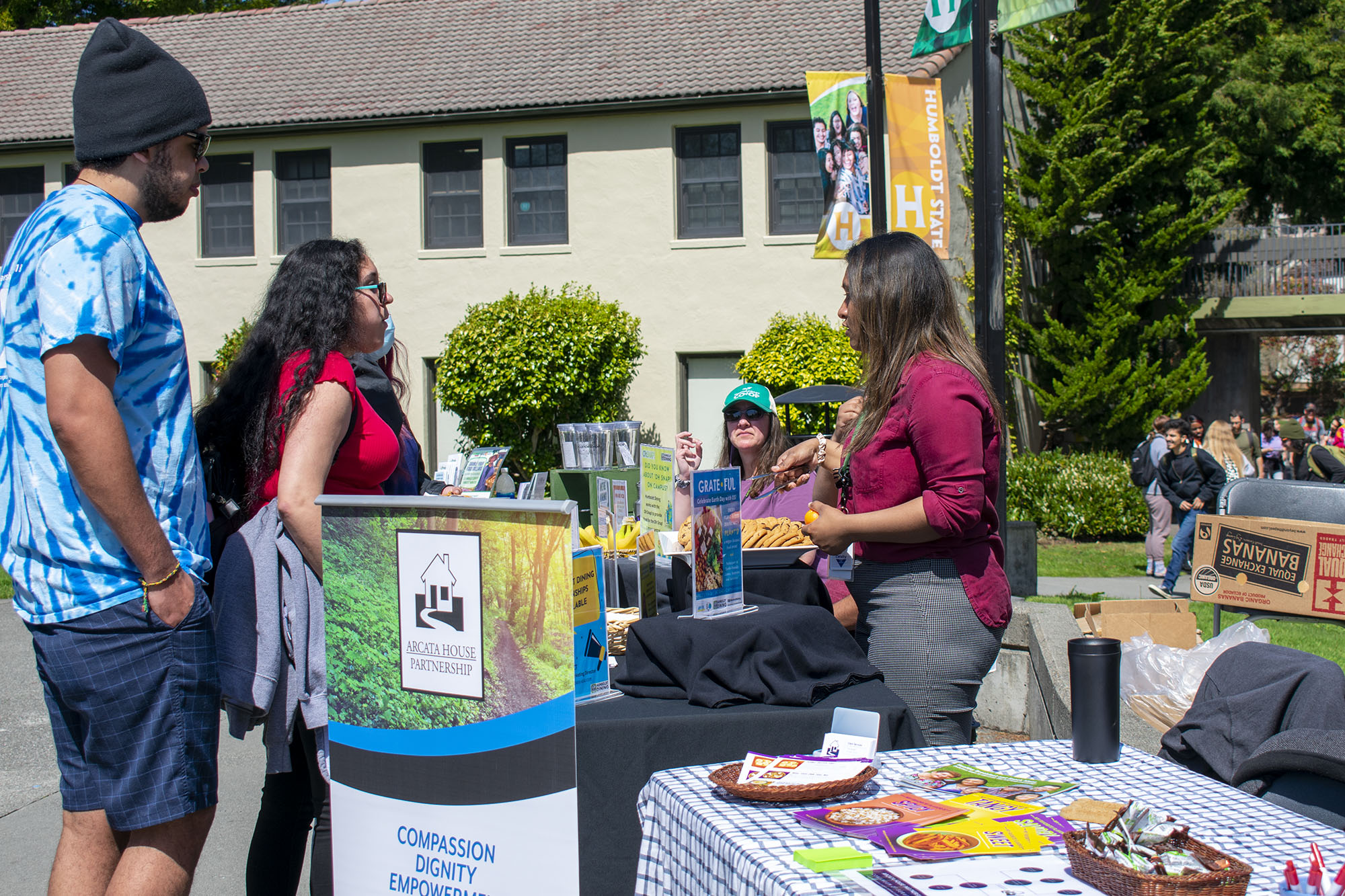
    The Peer Health Educators are hosting various workshops around HSU campus during Mental Health Week from May 1-5. They’ve finalized all the workshops for the students to enjoy, including yoga lessons, massages and how to make bath bombs. Lizzie Alvarez, the coordinator of Mental Health Week, believes people forget to care for themselves because they’re so focused on homework and papers.

    “Self care is increasingly important,” Alvarez said.

    Christina Cole adds that it’s not only finals that students stress about. With the news of David Josiah Lawson’s death and other personal factors, the semester can be draining to students.

    “It makes times like this more important to check in,” Cole said.

    Alvarez and Ani Glenn suggest studying in parts, not cramming everything in at once to ease the strain of finals. Late night study sessions are not mentally or physically healthy because lack of sleep can affect your grade. Planning what to study and organizing time can be overall helpful and beneficial.

    Peer Health Educators are a social justice focused program consisting of students who educate fellow students on mental, physical and sexual health. For more information on Peer Health Educators, visit their office in RWC 127, open 9 a.m.-5 p.m. Monday-Friday. For disability accommodations, email ravin@humboldt.edu.