Luke Kennedy’s katana is heavy. He busts it out for parties, which he and his roommate Miles Conte throw every weekend. Except when there’s not supposed to be class on a Tuesday. Then, Mondays are prey too.
“We were trying to pick a date that would stand us out from the crowd,” Conte said. “We were just trying to start off the extension of winter break off with a bang.”
With the CFA strike eliminating class on Monday, Jan. 22 for college students all over California, Kennedy and Conte decided to host a bonus party at their place, a dayger that started at 3 p.m. 40 people showed up to party in their house. Though some people left when everyone got the news that the strike was off, most stayed until about midnight or so.
“When we [got the news] it was evening time,” Kennedy said. “It’s the height of the party. I’m walking around with the beer bong and loading it up with [left-over beers] and loading people up. And then [someone] said, ‘Hey, I think we have classes tomorrow!’ Everyone’s pulling up the email. And so there was this whole conversation — ‘Oh, what’s going on?’ And honestly, everyone was like, ‘Fuck it, I’m not going to class’… But I think, party or not, most people would have probably ditched that Tuesday.”
Conte said it was more fun when they realized the strike was off.
“The party vibe became immaculate when we learned we had class tomorrow,” Conte said.
He turned to Kennedy for a moment.
“What do you think?” Conte said. “Is ‘Immaculate’ a good word to use in this situation? Or not?”
Conte did skip class the next day; Kennedy attended.
“[When the strike only lasted one day], I was initially rebellious,” Conte said. “Because I am not going to my classes.”
Both Conte and Kennedy said if the strike had continued as planned, they likely would have thrown at least two more parties throughout the week. Any more than that likely would have been overkill. Conte laughed at the idea while he rolled a cigarette with gas station tobacco.
“We just party, all day, every day,” Conte said. “No sleeping allowed. That would have been hilarious. Like, yeah, ‘We’re going to have a continuous party for five days straight.’”
Freshman Bryn Urdi had a good time at the strike party. She was glad that she was in bed by the time she got the news that the strike was off. Urdi said she would definitely have attended again if given the opportunity, but the best part was seeing all of her friends again.
“It was really nice to come back from break and see all of my friends again,” Urdi said. “It was great just to be with them for a while.”
Kennedy believes that the parties he and Conte throw offer an important service to students they can’t get anywhere else.
“I think that the parties make students more excited to go to class because they get to see their classmates,” Kennedy said. “[Campus] feels like a zoo environment, in that it can become a goal, clocking in and out of class every day. You don’t really know anyone there. I feel like the mark [the parties make] makes the school a thing, versus just something you clock in.”
“We bring a full-charge mentality to partying,” Conte said. “We’re passionate about making people happy and having a good time.”
Despite the attitude, Kennedy isn’t just about drinking and getting rowdy.
“I respect somebody’s performance,” Kennedy said. “I look at somebody; are they a degenerate? Do they get good grades? Are they healthy? I don’t want to encourage students to just drink and party. There’s tuition. I think it’s important that students remember that they’re here to get a degree, hopefully learn something and become a better person.”
This Monday marked the beginning of what was projected to be a week-long statewide strike throughout California State University (CSU) campuses, with professors and faculty from every CSU engaging in protest for better pay and working conditions. However, some professors at the Cal Poly Humboldt campus chose to refrain from participating despite a request from the California Faculty Association (CFA) for all faculty members to strike.
According to the CFA website, the union had a better chance of success if every faculty member in the CSU system participated in a strike. However, any faculty member who chose to participate could not be fired, dismissed or punished in any way by the administration. So, why did some professors choose notto strike?
Economics professor Beth Wilson is not in the CFA union, having canceled her membership in Dec. 2023 during several strikes across other CSU campuses.
“I think that the union is absolutely wrong,” Wilson said. “The university does not have a bunch of extra money; they have alreadycut several programs, and they’re going to cut more.The Chancellor’s office has come out with a list that is from a data perspective, and it’s the same metric for all CSUs regardless of size. We’re a smaller campus, so we have more programs [in danger of being cut] on this list.”
According to Wilson, the Chancellor’s office has used this list for program elimination, and worries that Cal Poly Humboldt would look very different in the future if the union priced themselves out of the market by demanding a 12% raise rather than accepting the CSU’s original offer of 5%. She is wary about the impact this could have on her department and her students in the coming years, and wants to prioritize their education over her own financial gain.
“A 12% increase is ridiculous,” Wilson said. “It is waytoo high. A 5% increase is reasonable, and it is not a pay cut. We have not had annual inflation of 5% and we’ve had prices that have come back down again, so the idea that we need 12% to keep pace with inflation is factually incorrect.”
Many professors and faculty viewed the CSU’s 5% offer as offensively inadequate considering the $12 billion dollars that the chancellor and management have been stockpiling as reserves, according to the CFA’s strike FAQ page.
Despite Wilson’s insistence that a 12% increase was an unreasonably large demand for the union to make, an independent report on CSU finance titled, “Financial Analysis of the California State University System,” by Howard Bunsis, Professor of Accounting at Eastern Michigan University, found that the CFA’s request could be fulfilled using existing annual surpluses withoutdipping into the CSU system’s reserve funds. It also explains how a 12% raise was an acceptable amount given current and predicted California inflation rates, as well as statewide raises in tuition and cost of living.
According to the CFA, CSU management recently voted in favor of a 34% tuition increase over the course of the next five years and imposed a $2 monthly parking fee increase on faculty. All the while Cal Poly Humboldt created a $100 on-campus housing application fee for new students. Coincidentally, campus presidents saw an increase in pay of up to 29%. According to the CalMatters website, CSU Chancellor Mildred Garcia herself received a 27% pay increase July of 2023, upped to a $795,000 base salary, along with monthly allowances for automobiles and housing.
A professor, who chose to go by John Doe, for personal safety reasons stated that they were in favor of the strike and the CFA’s demands, but chose not to participate because of the timing and impact on student success.
“My reason for not striking is, that with the classes I have, it’s too much of an impact on the students,” Doe said. “The timing is very poor for the scheduling that I have for my classes, and so it’s not fair to the students to force everyone to stop for a week and then play catch-up all the way through to the final.”
This professor made the decision to continue teaching despite supporting the strike, but they still had many problems with the way the campus is managed.
“I believe the workloads are excessive relative to other universities that I’ve taught at,” Doe said. “There’s a lot of chaos and instability that’s introduced when you have a system where a lot of non-full time instructors are brought on to fill in holes in the schedule. It creates chaos for the departments and the individuals, so I’m fully in support of additional wages and an increase to a living wage.”
Many professors without a PhD and a full-time contract are struggling to afford the cost of living and make ends meet. With salary adjustments that don’t match the current inflation rates, they worry about their ability to afford adequate healthcare and save for retirement.
Another faculty member who refrained from striking was Dr. Cynthia M. Le Doux-Bloom, a Cal Poly Humboldt Fisheries Biology & Oceanography lecturer. She is not currently a CFA member, but she strongly supported all of her union member colleagues in their right to strike and believes that CSU instructors, librarians, coaches and other faculty are truly underpaid. She felt conflicted on whether or not she should join the strike, but ultimately chose against it and backed up her decision with two main reasons in an email.
“First of all, I am not a CFA union member, nor have I ever been during my five years here at CPH [Cal Poly Humboldt] because, until very recently, I was not teaching every semester; hence, joining a union that I may or may not be a member of every 15 weeks seemed highly unusual,” Le Doux-Bloom said. “I was a member of the California Association of Professional Scientists (CAPS) union for over two decades. I support unions and may join CFA now that I seem to be teaching year-round. Secondly, our students (or their parents or someone else) are paying [around] $15,000/semester to attend CPH [Cal Poly Humboldt]. Semesters include 15 weeks of instruction, which equates to paying $1,000/week or $250/day.”
Le Doux-Bloom hoped that her colleagues could appreciate and respect her path even if they disagreed with it. She loves being an instructor and truly wants what’s best for her students.
“I cannot stomach penalizing my students’ learning (which they prepaid prior to knowing about the strike) to increase my income,” Le Doux-Bloom said. “Each of our students paid $1,000 this week to support the strike, but were given no choice about their loss of instructional time. This is on top of the ongoing tuition increases, larger classes, reduced services, dilapidated facilities and antiquated equipment. My beef is not with my students, it’s with CSU’s top-heavy administration and administrator salaries.”
Then, they came for our alternative housing students.
Now, they are coming for our professors.
When is this going to end?
At this time, it is easier than ever to develop an ‘us versus them’ mentality. However, we need to remember that students and professors are all in this together. When we stood up for the right to basic housing last year, professors stood with us. When students living in their vehicles were, for heaven’s sake, cruelly kicked out of the school parking lots, professors stood with us. Professors have always been our allies in a world that seems to be squeezing us tighter and tighter.
Let’s make this clear: the world is becoming a harsher and harsher place to live, and universities, unfortunately, are not exempt from this. Students can still struggle throughout their college experience for all kinds of reasons. Despite the university attempting to make it easy for students to access mental health resources and disability accommodations, accessing those services can still be hard for people. We need them now more than ever.
I personally cannot justify the university only giving staff a month of parental leave. How can anyone justify leaving a new baby without their parent at daycare after only a month? Professors should have a semester of parental leave, at least. That should just be common sense, and I don’t understand how that isn’t the law of the land. I also cannot believe that some of the lecturers who are so willing to share their expertise with the students are not making liveable wages. This is unconscionable. I believe that college professors and lecturers deserve the greatest respect because they pass down important knowledge and educate the new generation. This respect should extend to transgender and non-binary staff. It is basic common sense that there should be access to gender-neutral bathrooms for faculty. Students these days claim to care about trans rights, yet fail to advocate for their leadership’s rights to these same facilities. Universities claim to be bastions of progressive ideals yet they pay lip service to trans students, while simultaneously neglecting their own faculty. Speaking of faculty, my former faculty advisor was swamped with work that was completely unrelated to teaching last semester and I know that he is not alone. My advisor has had to do more administrative work lately with less time to focus on her passion for teaching. From my point of view, that’s pretty crazy – and not in a good way.
When we protested, our teachers stood with us. It’s time for us to stand with them.
Across the California State University system, thousands of students expected a pause in classes, thousands of faculty expected to trade in their pens and markers for picket signs and thousands of skilled laborers were prepared to drop their tools for the week of Jan. 22-26 to strike.
However, the Teamsters 2010 announced Friday, Jan. 19 they reached an agreement with the Chancellor’s Office. After one day of a weeklong planned strike, it was announced by the California Faculty Association (CFA) the night of Jan. 22 that they and the Chancellor’s office had settled with a tentative agreement as well. Campus operations are set to return to full swing by the end of this week.
Teamster’s Agreement Highlights
The Teamsters were able to secure an immediate 5% pay increase, with back pay retroactive to July 1, 2023. They were also able to establish a step-pay system, meaning that skilled laborers within the CSU system will have a pay increase each year. Teamsters were also able to maintain their pension, medical benefits, and their emergency pay.
With the Teamsters able to get back to work and have an agreement for a solid contract in order with better pay, skilled laborers on the Humboldt Campus such as locksmith Phillip Bradley felt a sense of relief.
“Obviously [having an agreement in place] just takes a lot of stress off,” Bradley said. “Uncertainty creates a lot of anxiety.”
Librarian Carly Marino drums while crossing 14th St. | Photo by Griffin Mancuso
CFA Agreements Highlights
The CFA also secured a 5% increase in pay retroactive to July 1, 2023. There is planned to be another 5% increase on July 1, 2024, effectively giving faculty a roughly 10% increase in pay. However, the 2024 increase is contingent on the state not cutting CSU funding. There will also be more protections in place for faculty dealing with police, and improved access to gender-inclusive restrooms and lactation spaces. Also for faculty that are new parents, paid parental leave has increased from six to 10 weeks.
Faculty, such as English professor Sarah Ben-Zvi, had to find ways to balance parenthood with work. Despite the support of her department to make her maternity leave as smooth as possible, she still felt some struggle. She felt that the increase in time for maternity leave was appreciated, but it may not be enough.
“It’s definitely a step in the right direction, but I still don’t think it’s enough time,” Ben-Zvi said. “I feel like it was not until maybe three months after my kid was born, that I started to feel almost human again… and able to give my students what they deserve, which is a great teacher who is on her game.”
Another mother and professor with a newborn is English professor Tessa Head, who was on the picket line with her 14-month-old child. Head feels that a paid semester of parental leave would be beneficial for not just parents but the students as well.
“[A semester of parental leave] would give you time to bond with your babies and take care of them, to form that secure attachment,” Head said. “And for students, I think it would provide better learning conditions because they would have a faculty member who is present for the whole semester.”
CFA faculty rights chair Loren Cannon was present on the picket line striking his drum and leading strikers. He shared his thoughts on the outcome of the tentative agreement.
“We really did make some gains,” Cannon said. “I guess [the Chancellor’s Office] didn’t expect us to actually pull off a strike or something, because we only struck for one day [then came to a tentative agreement with the Chancellor’s Office].”
Richard Toledo leads faculty and students across 14th St. holding signs on the picket line. | Photo by Griffin Mancuso
Student Reactions
With notice being given by faculty not to expect classes this week, some students made plans for work or travel. Students like Criminology and Social Justice Major Jocelyn Douglas faced some struggles when they scheduled extra shifts at work this week, only to be told that class would be back in session. The short notice has left students such as Douglas feeling disorganized.
“I took this opportunity of thinking that I had a week off of school to work 60 hours with both jobs that I work at, to be able to catch up on bills,” Douglas said. “Being a full-time student and working full-time, sometimes conflicts with each other. And with less than a 24-hour notice that we do have to attend school, and with my classes being mandatory for attendance, I’m kind of conflicted about [choosing] between work and school. Thank God the teachers are being pretty lenient so far.”
Scene of Strike
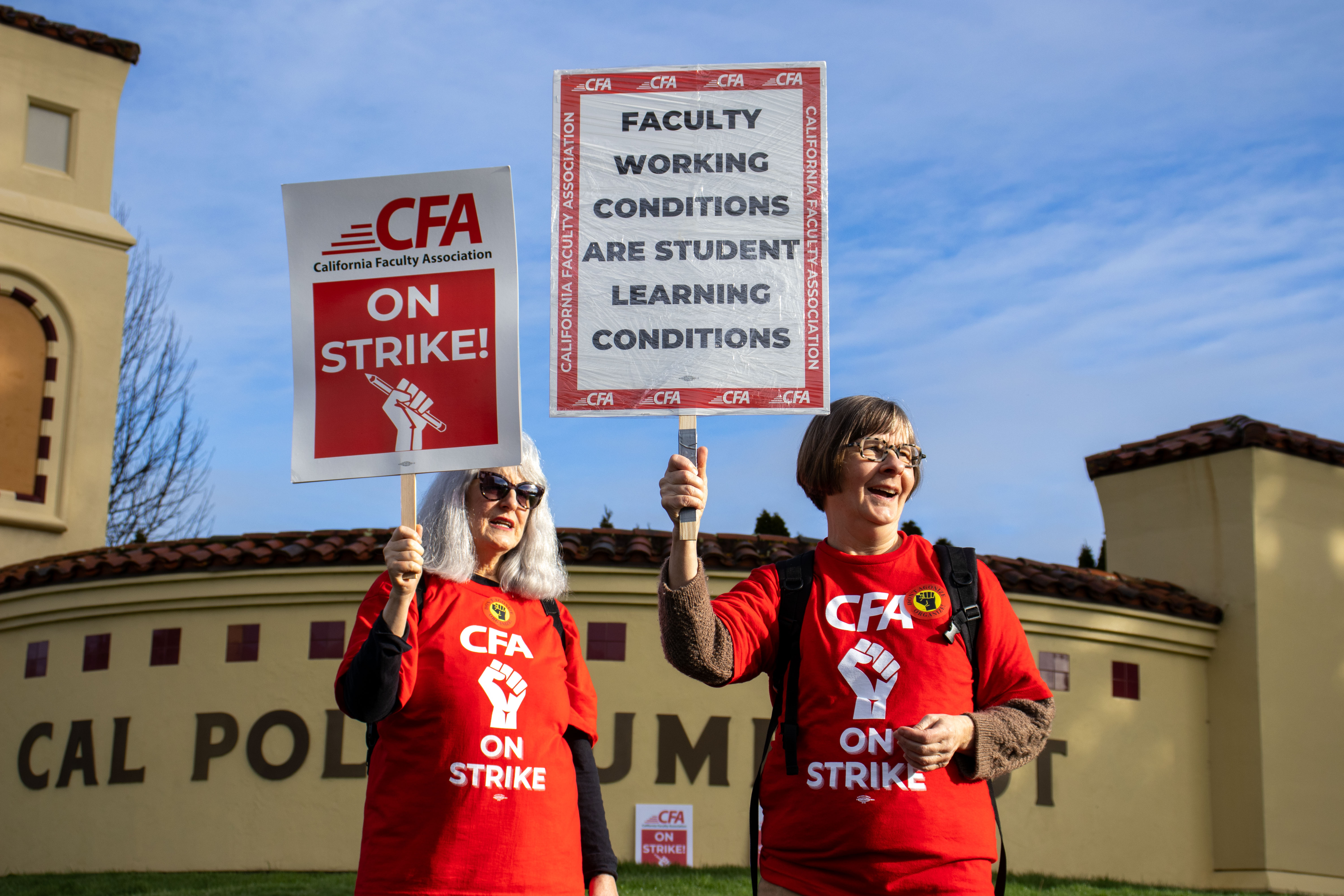
As for the strike itself, dozens of faculty and their supporters were on the picket line. They danced with their signs to the passing cars that honked their support, all the while they moved to energizing music blaring over speakers. Some signs read, “5% don’t pay the rent,” “California Strike University” and “You can’t put students first if you put faculty last.”
Students were present on the line to support their faculty. Students such as accounting major Lealu Freedom felt an obligation to support their professors due to the past support they have given to her.
“[If faculty have better conditions they] can devote more time to their students, and create a more enjoyable experience versus focusing so much on trying to get their needs met,” Freedom said. “It’s kind of like a student. You know, if the student’s struggling with housing, they’re not gonna be able to learn. Same thing with a teacher, if they’re struggling with basic needs, they are not gonna be able to teach.”
What’s Next
Language for the contracts will be rewritten based on the tentative agreement, and the CFA is expected to vote on whether or not to officially ratify the contract within the coming weeks to months.
Although the CFA and Teamsters unions made gains in this situation, CFA President Marisol Ruiz acknowledges that there is still work to be done.
“When we are striking, we’re striking for better working conditions for all,” Ruiz said. “For all the faculty and the students, we should all be supportive and in unison working together to fight. There’s still a 6% increase of tuition hikes, and that’s a fight that needs to continue to happen.”
After over a year of negotiations with the California State University (CSU) Chancellor’s Office, the California Faculty Association (CFA), which represents lecturers, professors, counselors, coaches and librarians, and Teamsters Local 2010, which represents skilled laborers such as locksmiths, plumbers, painters, etc., have decided to strike during the second week of classes Jan. 22-26.
This will be the second strike for the Teamsters following their day-long strike across the CSU system on November 14, 2023. As for the CFA, this is their second strike as well, following their series of strikes across select CSU campuses in December 2023.
Goals for Strike
Teamsters such as Housing Locksmith Phillip Bradley and the CFA hope that the combined strike will bring the CSU back to the bargaining table.
“If you don’t have classes, you’re not going to have students-and if you don’t have students, you don’t have much of a university,” Bradley said. “So honestly, we’re hoping that the threat of [a week without classes] will get us back to the negotiating table, but the ultimate goal of this is to get some fair labor contracts.”
The CFA in particular is fighting for better aspects in their contracts, such as paid leave for parents, lactation rooms, safer bathroom options and as CFA President Marisol Ruiz highlights as the most important, a wage increase that can compete with the recent 8% increase in inflation.
“The end goal for us is to get our 12% [wage increase] that we deserve,” Ruiz said. “[The 5% wage increase that the Chancellor’s office is offering] is behind inflation and would mean that we’re getting a pay cut. Are you seeing the gas prices? Have you seen the PG&E bill? Have you seen the food prices? [The Chancellor’s Office] is cutting our salary because it doesn’t keep up with inflation, so we’re doing the same work for less pay.”
The CSU has previously stated that they lack the funds to accommodate the 12% pay increase. However, Ruiz questions that the CSU lacks the funds, as evidenced by the salaries of the CSU presidents and chancellors, as well as pay increases they receive.
“If [the CSU system] didn’t have the money, why did the Board of Trustees allow [new CSU Chancellor] Mildred Garcia to [receive] almost a million dollars for her salary?” Ruiz said. “For me, [the Board of Trustees are] not making good decisions. They’re using our taxpayer dollars, our student’s money, to give the rich more, and it’s not trickling down to us, the workers – the ones on the front lines with the students.”
Potential Impact of the CFA-Teamster Strike on Campus
Besides classes being canceled, there are more potential and expected impacts on the campus community at large. CFA Faculty Rights Chair and member of the state-wide bargaining team for the CFA, Loren Cannon, explains the extent of the strike for faculty besides lecturers temporarily trading their markers for picket signs.
“We cannot do any other work,” Cannon said. “There’s no halfway to strike. If somebody said, ‘Hey, I’m not going to teach my classes, but I’m going to answer my students’ emails,’ – we can’t do that. We can be reprimanded. We can be disciplined. We can lose our jobs. So, the laws about striking, it’s gotta be an all-or-nothing.”
During the week of the strike, the Teamsters and the CFA will be picketing across campus, notably on LK Wood and 14th Street. Ruiz encourages students to support by joining the line throughout the week and hopes that the actions can be a teaching moment.
“[The CFA and Teamsters are] modeling,” Ruiz said. “We don’t know what industry [the students are] going to be in, but in any industry, they’re going to have to join a union to protect their wages.”
Bradley wants to make it clear that the Teamsters’ strike isn’t to attack Humboldt but to send a message to the CSU at large.
“This strike is not about protesting Humboldt,” Bradley said. “All this is about our collective bargaining with the Chancellor’s Office and the CSU system as a whole. We’ve got good managers and supervisors at Humboldt who have been very respectful and very supportive, and have been going above and beyond.”
With the Teamsters on strike, there will likely be much deeper impacts on the campus. Bradley explains that the university will likely need to hire outside contractors to keep the basic functions of the campus moving.
“We have to assume [the university is] arranging to bring in contractors or [other skilled laborers] that cover for leaks or [other repairs],” Bradley said. “But, we all have to go through extensive background checks before we’re hired because, you know, we work around students. And contractors cost more, outsourcing rarely results in long-term savings.”
On top of the CSU Teamsters being on strike, other Teamsters belonging to other companies and groups will not be crossing the picket line out of solidarity.
“It’s a good strike because it’s a [Teamster] sanctioned strike,” Bradley said. “That means all of the other Teamsters won’t cross that line. Food deliveries won’t happen [such as Sysco Foods, which delivers much of the campus dining food]. UPS also won’t deliver. Any other Teamster-related service won’t cross that line. It will probably halt or delay construction on the new buildings [as those Teamsters are also affiliated with those projects.]”
Despite Sysco Foods not delivering for the campus next week, Assistant Retail Director Carlos Castillo assures that Dining services has prepared for the strike and there will be no expected food shortages.
“All units are ordering heavy this week in order to get through all of next week,” Castillo said. “So that way, there are no food shortages for the week.” What About Those That Can’t Afford to Strike?
As much as some faculty members would like to strike alongside their colleagues, some simply aren’t able to, as the financial hit of losing pay while on strike would be too much for them. Child Development Professor Larisa Callaway-Cole is trying to find a balance between supporting the action and meeting the needs of her family.
“I have spent significant time thinking about my position with the strike and have come to the following decision for myself,” Callaway-Cole wrote in an email to her students. “I cannot afford to strike. I am a new single mom, which has come with a significant increase in costs that I am learning to balance. If I were to strike for a whole week, I would not be able to pay all of my bills. That being said, I would like to show solidarity with my union, and will be striking on Friday, January 26.”
Why Strike Now?
Cannon clarifies that he feels the strike could have been avoided if the Chancellor’s Office were negotiating fairly.
“We weren’t getting anywhere at the negotiation table,” Cannon said. “From my perspective, it just seemed like they weren’t ready to negotiate with us at all. The strike could have been called off if they had brought us something that made sense that we could work with, but I think they just want to act like there’s no union here at all. We said, ‘All right, then the strike is going on.’ This may be the largest strike in the history of higher education.”
Cannon highlights the importance of the unions standing in solidarity together and taking action towards the CSU system.
“The CSU does not work without faculty. The CSU does not work without the Teamsters,” Cannon said. “If we don’t make a stand, it’s just going to get worse. It’s going to get worse for faculty members, and it’s going to get worse for students.”
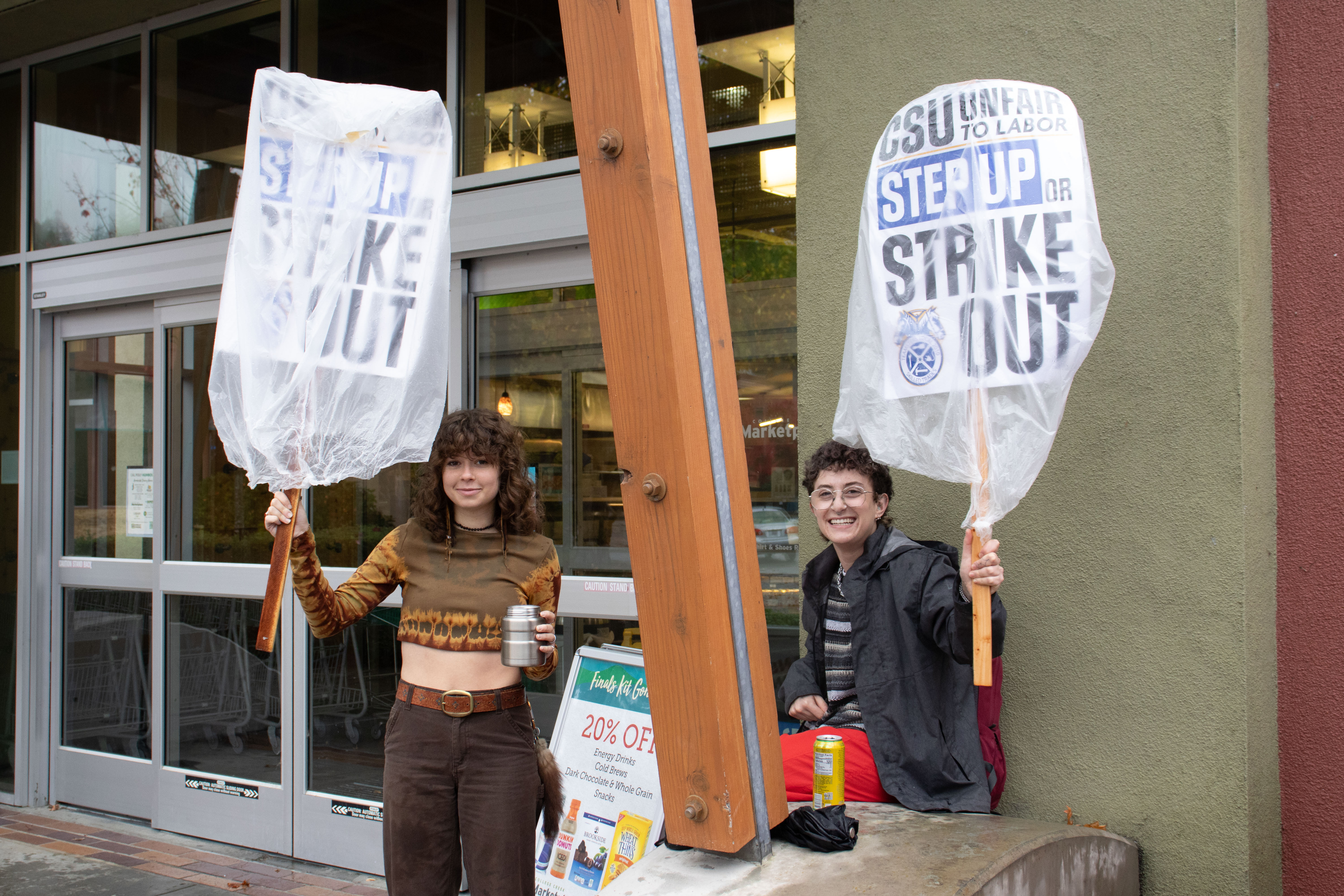
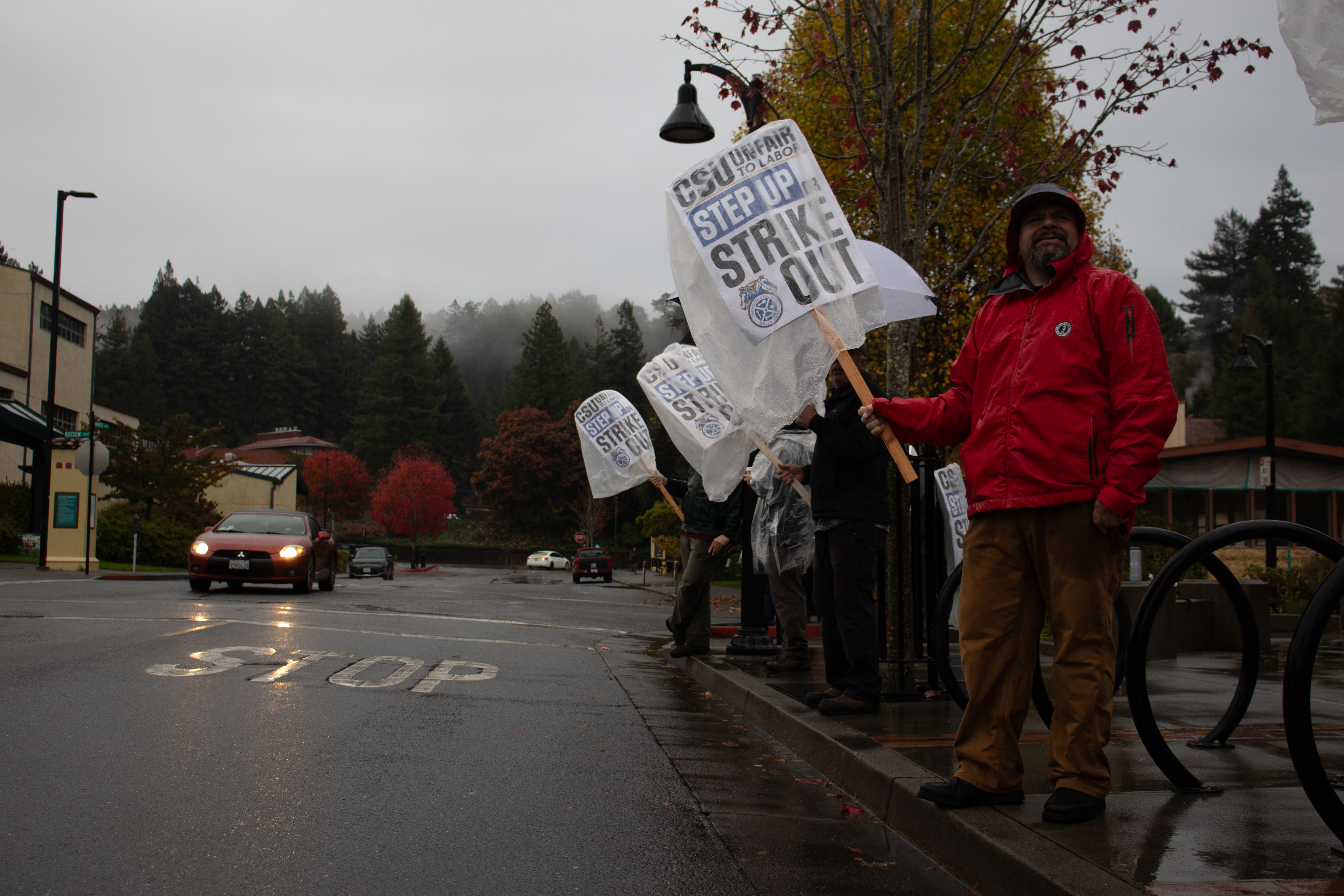
Beginning at 5:30 a.m. in the cold rain on Nov. 14, members of Teamsters 2010 began their one day strike picketing outside of the College Creek Marketplace, the Library Circle and the parking lot of the J. It was the first official strike by any California State University union for the first time in 28 years, and the one day demonstration was performed by the other Teamster 2010 chapters across all 23 CSU campuses. The union members adapted to the weather by bundling up, sporting Teamster 2010 rain ponchos and covering their picket signs with plastic coverings.
The union’s picket line had two main goals. One, to establish that the unions are ready and willing to strike. Locksmith for Housing and Teamster member, Phil Bradley, said that the Teamsters are ready for more strikes.
“The one day strike today is to show the CSU we are serious about this, and to come to the table and bargain with us,” Bradley said. “It’s to show that we have the resolve to do this if that’s what it comes down to. If they don’t show up and start working with us, we’re gonna have to do a longer strike.”
Teamsters 2010 represent skilled trade laborers across the CSU system such as plumbers, painters, mechanics and electricians. Campus painter Jeff Robinson shared his thoughts on how campus will be impacted if the Teamsters decide to strike for a longer period of time in the future.
“Say you have a rainy day,” Robinson said. “You have old buildings on campus, so you’re getting leaky calls that aren’t getting attended to. [You’ll get] clogged toilets, lights that are out, or the heat’s not working.”
The second goal is for the Teamsters to draw attention to unfair labor practices.
“[We want] to bring awareness that the CSU has been conducting unfair labor practices,” Bradley said. “There’s rules on what the [CSU] can and can’t do such as, retaliation, delaying, and bargaining in bad faith.”
Maintenance lead Daniel Bouchard crosses the street in the rain in front of the Jolly Giant Commons parking lot. Photo by Griffin Mancuso.
The Teamsters have expressed frustration at what they feel are continued practices of bad-faith bargaining by the CSU Chancellor’s office.
“[The bargaining team for the Chancellor’s office] show up to meetings completely unprepared, and they keep canceling negotiating sessions,” Bradley said. “They’re basically just doing whatever they can to delay and obstruct.”
Although the primary focus of the strike wasn’t financial, some on the picket line highlighted their grievances with a lack of an adequate wage-increase structure. Campus Building Service Engineer Steve Brands felt lucky that he was able to receive some increase in wages during his time employed with the CSU, but he feels frustrated that his colleagues haven’t had the same opportunity.
“We used to have a very defined step-structure,” Brands said. “As long as you were getting good evaluations and things were going well, you got the raises until you moved to the top of the range. And now, nobody really moves through the range.”
Teamsters such as campus automotive mechanic Ryan Moore explained how they have struggled with a lack of increase in wages, especially as inflation continues to rise
“I live out towards Willow Creek and I have kids to commute to school and sports,” Moore said. “Fuel and [groceries] goes through the roof just trying to raise a family. I never thought I’d actually be out on the picket line here at the college.”
On Nov. 9, Cal Poly Humboldt released a statement addressing the Nov. 14 strike. The message clarified to the campus community that the Humboldt and other CSU campuses have contingencies in case of an event such as a strike. As promised in the email, the Humboldt campus remained open and operational on the day of the strike. The email also promised to not pay any of the employees who participate in the strike. The email also asks the campus community to remain patient as the Chancellor’s office continues the bargaining process with the Teamsters 2010 and the other CSU unions.
The Teamsters weren’t the only union on the picket line that day. Members of California State University Employees Union (CSUEU) were there with picket signs and chanting alongside the Teamsters. The California Faculty Association (CFA) also showed solidarity that day. Some members joined the picket line and some faculty even refused to host class. CFA Faculty Rights Chair and philosophy lecturer Loren Cannon is excited to work alongside other lecturers.
“CFA is fully in solidarity with the teamsters right now, and with our other sister unions,” Cannon said. “We’re all in this together. Without the teamsters doing their work, without teachers doing their work, without staff doing their work, this place can’t run. And so we are together, supporting each other’s rights to a fair contract to make sure that we don’t have unfair labor practices.”
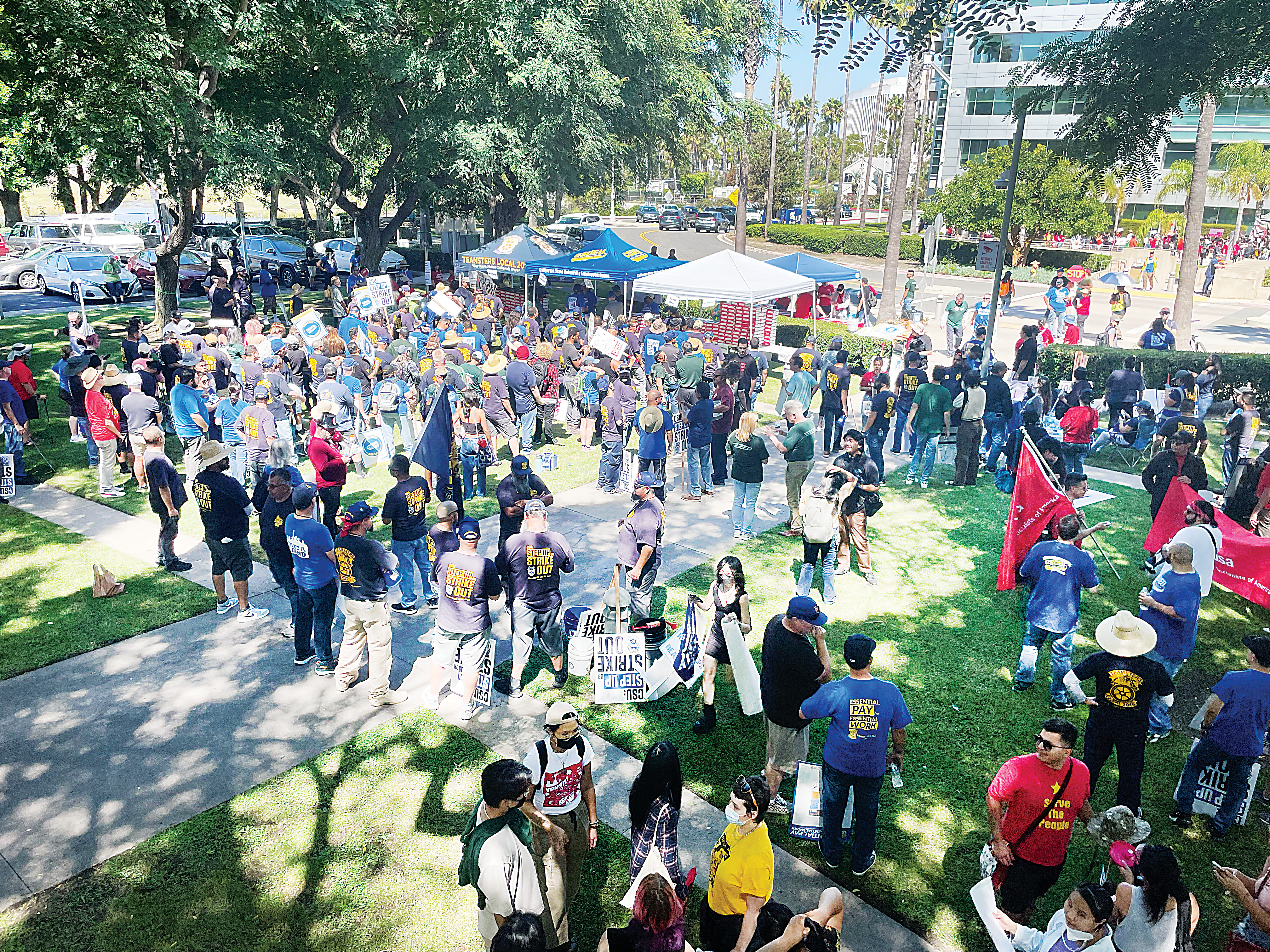
Hundreds of miles from Humboldt county in Long Beach, dozens of people are rallying against the decisions of the Chancellor’s and the Board of Trustees that hold the fate of our communities’ future outside of the headquarters of the California State University (CSU).
What the CFA is fighting for
The California Faculty Association (CFA) is one of six CSU Unions present across the 23 campuses. The CFA focuses their support on staff that work directly with students such as lecturers, coaches, and counselors.
The other unions are the CSU Employees Union (CSUEU) who support staff that provide essential services to students such as those in admin, the Union of American Physicians and Dentists, Teamsters Local 2010 that supports skilled trade workers such as painters and carpenters, the student union UAW 4123 and finally, the Academic Professionals of California (APC) which provides support to campus staff that work with students outside of the classroom such as financial aid and residence life.
Currently, the unions are collectively bargaining, and they are fighting for many of the same things. The CFA is campaigning on two main fronts, better wages and financial compensation, as well as better workloads and support to faculty
Wages
The CFA is asking for a 12% general salary increase. Cal Poly Pomona CFA member and associate professor of Political Science Marc Scarcelli reasons that although a 12% increase may seem like a lot, it’s essential to keep wages fair as the inflation rates increased 8% since the last bargaining session between the CFA and the CSU.
“If your wage increases don’t keep up with inflation, your wages are actually going down,” said Scarcelli, “and so if you think about it, we have to threaten the strike just to break even if we’re not actually fighting for more. We’re fighting just to break even. We [got a 3% pay raise] at a time when inflation was over 8%. What we got is effectively a pay cut.”
The CFA is also hoping to raise the salary floor for lecturers. Chief Steward of the Humboldt APC Chapter Tania Marin-Zeldin feels that this proposal is needed to help faculty with their standard of living.
“To hear that some of our members have two jobs because they can’t afford to have a decent living and provide for their families, that’s the sad part,” Said Marin-Zeldin. “We shouldn’t have to have two jobs. We shouldn’t have to be barely living, paycheck to paycheck.”
Freshman Evaluator and Union Representative of the APC Sierra Farmer hopes that having more competitive wages could help with retention of workers within the CSU system. She explains that because of what feels like unfair wages, many CSU workers, including alumni, leave because they can’t live comfortably with the wages provided.
“We lose good employees in the Cal State system,” Said Farmer. “We have lower wages than the UC’s and the community colleges. So we lose really good people to the other systems all the time because they don’t make a living wage.”
Another financial goal to increase fair wages and combat inflation resulting in pay cuts, is the unions fighting for yearly step-raises within the CSU system.
Better support for staff and faculty
To also help with retention rates for faculty and staff, especially counselors, Professor and CFA President of the Humboldt Chapter Marisol Ruiz notes that better policies surrounding tenure and more long-term contracts can help with the feeling of stability for employees.
“We want [counselors] to get three year contracts,” said Ruiz. “When you’re in a [year-long contract], you’re in a precarious situation. You don’t know if you’re getting your job back or not, so people sometimes don’t want to stay. We’ve had a hard time getting good counselors to stay. We need to offer them better [contracts], where they will be more likely to stay due to better conditions.”
On top of contracts, the unions want there to be more fair workloads for faculty, as well as better ratios between students and faculty. Ruiz remarks on the importance of a healthy ratio between students and faculty.
“We want to give [students] more attention,” said Ruiz. “We want to lower class sizes, and focus on [student’s work]. But the [CSU] just wants to cram everybody in. The more care that we have for our students, the better they will do in their classes and the more effective they will be as [learners] and we want that. ”
Beyond workloads and wages, the unions are also wanting to ensure more gender equity on campuses by providing bathrooms and changing facilities that people can feel safe with no matter their gender. They also want better paid parental leave and more lactation stations for parents across campuses.
Process of Union Bargaining and Current State of Negotiations
Every few years, each of the unions on the CSU campuses reopen their contracts with the CSU to bargain. This year’s cycle is unique as it was delayed due to COVID, and instead of bargaining in a staggered way, every union is negotiating their contracts at once. As of the writing of this article, every union aside from the CFA is still at the bargaining table. The CFA has declared an impasse with the CSU since they did not come anywhere close to an agreement, and has moved onto the fact-finding stage. Faculty Rights Chair for the CFA Humboldt Chapter and Lecturer in the Philosophy Department Loren Cannon explains the process
“Fact finding is where [the CFA] and [the CSU] produce information and argumentation as to why our proposals are good. [The CSU] will probably try to produce information that says, ‘Oh, we just can’t afford it.’ [The CFA] will produce information that says, ‘well, actually, you can.’ We could go back to bargaining somewhere in the middle here, but if we don’t have any agreement at that point, there might be collective action.”
If the mediation following the fact finding stage again fails, the union can then vote on to take action, such as a strike. If the CFA does decide to strike, it will likely be in early November as of the time of writing this article. Scarcelli notes that a few within the CFA are looking forward to a chance to strike.
“In terms of willingness to strike, I talked to a lot of my colleagues and honestly, they’re not just willing, they’re eager,” said Scarcelli. “Colleagues all over the place are chomping at the bit like, ‘when do we get to strike,’ because they’re pissed. They’re just furious. You know, when our incomes are effectively going down. And then we keep seeing that they give appalling raises to university presidents and the Chancellor.”
CSU Response
In a video message and written statement from interim Chancellor Jolene Koester, she affirmed that the CSU is committed to fair pay and compensation for faculty and staff. The CSU has proposed a salary step structure for faculty and staff in the CSU’s to reach 12% over three years, however the increase will be 5% in the first year. The CFA has rejected this and declared impasse following the offer. The CSU leadership say they will be challenged to meet the proposals of the CFA and other unions throughout the CSU.
CFA flyer
Why Faculty are Fighting
With the CSU rejecting some of the union’s requests, many within the union are becoming more frustrated, especially with the wages that the CSU higher-ups and presidents are making. Ruiz notes that on average, after the average CSU president’s salary and allowances for their car and housing, they generate more income than the governor of California.
“I do not think it is acceptable for us to have a housing allowance for anybody who’s making $300,000. it’s not right, when our students are homeless and are living in cars, and we don’t even pay a living wage to lecturers,” said Ruiz. “ How [is the CSU] getting all this money for car allowances? How are you getting a housing allowance? How are [CSU presidents] being provided for? And our students are not? Your job is not as important as the governor of California, let’s put back the money where it needs to go.”
Farmer also notes that her yearly wage barely compares to Humboldt President Jacskon’s yearly housing allowance
Overall, the unions and their members such as Scarcelli are working towards better compensation and working environments to continue supporting students in their journey of creating a better future for themselves.
“We do what we do because we love education,” said Scarcelli. “We love our students. It would pain me to skip classes, but I will, and I find most students are very receptive to our cause.”
This website uses cookies to improve your experience. We'll assume you're ok with this, but you can opt-out if you wish. Cookie settingsACCEPT
Privacy & Cookies Policy
Privacy Overview
This website uses cookies to improve your experience while you navigate through the website. Out of these cookies, the cookies that are categorized as necessary are stored on your browser as they are essential for the working of basic functionalities of the website. We also use third-party cookies that help us analyze and understand how you use this website. These cookies will be stored in your browser only with your consent. You also have the option to opt-out of these cookies. But opting out of some of these cookies may have an effect on your browsing experience.
Necessary cookies are absolutely essential for the website to function properly. This category only includes cookies that ensures basic functionalities and security features of the website. These cookies do not store any personal information.
Any cookies that may not be particularly necessary for the website to function and is used specifically to collect user personal data via analytics, ads, other embedded contents are termed as non-necessary cookies. It is mandatory to procure user consent prior to running these cookies on your website.