The Lumberjack


Students Serving The Cal Poly Humboldt Campus and Community Since 1929

Tag: Student Life

  • Navigating the Pressures of the First-Generation Student Experience

    Navigating the Pressures of the First-Generation Student Experience

    First-generation students must look outside family for support

    Usually, students talk with parents, siblings or friends who have attended college in the past to gather information and paint a picture about college classes, professors and the overall college experience. For first-generation students like myself, that’s not an option.

    Being a first-generation student means you are the first person in your family to go to college. Your family members have no prior knowledge about college, the application and selection process, or what’s going to happen in the months prior to attending.

    First-generation students feel the pressure of learning to balance living on your own, being successful in college and working a job all at the same time. For Destiny Aguilera, a second-year theatre major, the help they needed was provided by a high school instructor.

    College is a time of self discovery.

    “My greatest struggle has definitely been finding myself,” Aguilera said. “College is a time for learning, experimenting and growing as a person. As a first-generation student, it is also a time to work multiple jobs and try to support oneself as best as possible, with as little help from family as they can provide.”

    The pressure to be successful and independent to avoid burdening parents financially heightens the expectations of the college experience.

    “Having that pressure of taking care of oneself added to the mix makes it difficult to take time to breathe and learn more about who I am and who I want to be,” Aguilera said. “That being said, it’s not impossible. Just within recent months I’ve been able to discover that I identify as nonbinary and use they/them pronouns. I have college and allies to thank for that.”

    College is a time of self discovery.

    Natyvidad Landeros, a third-year biology major, got help with applying to colleges through a high school class created to help students prepare for college.

    “I took it junior and senior year,” Landeros said. “They helped me with the process of applying. If it wasn’t for them I don’t know if I would have got into college.”

    Javier Hernandez, a political science major at HSU, also prioritized resources outside his family to pick the school that fit his needs.

    “I joined these college programs which helped other first-generation students like me to guide me through the process,” Hernandez said. “To take me to other college campuses and learn about the recruitment process and all the details that I needed to know applying to colleges.”

    College is a time of change and immense amount of pressure. This pre-college experience is only heightened for first-generation students who have to navigate blindly and on their own. High school classes or staff, friends and independent interests can be helpful guides.


  • Great hall becomes prospective renter center

    Great hall becomes prospective renter center

    By Curran Daly

    Todd Larsen, associate director of Housing and Residence admits there is not enough housing on campus for every student who wants to live on campus.

    “This year we have a record number of returners and transfers,” Larsen said. “We had 800 returners apply for the 600 spots we have.”

    The housing office is trying to take some of the stress off of students looking for off campus housing. The housing office has held four events now to help students find housing.

    Their final event held on April 24, gave students an opportunity to meet with real estate management groups. Kimberly Morris was at the event with Kramer Investment Corporation talking with students about renting apartments for them next semester.

    “We try to make it as easy as possible for first time renter,” Morris said. “We try to get the parents involved to help students through the process.”

    Sol Dinay, a freshman physics major, attended the event held by housing. He has already seen about a dozen houses and is hoping to secure his housing for next semester soon.

    “It’s just a matter of getting an app that gets approved,” Dinay said. “I’m not that worried cause I know we’ll eventually get a place.”

    Dinay tried to get an early start looking for houses and has some advice for people just barely starting out.

    “Try getting started on Craigslist because the application process is just an email,” Dinay said. “Apply to as many places as you can cause most will get denied.”

    Levi Mazza a freshman business major already lives off campus. Mazza found a house last May when he came up with his friend and current roommate. For him the hardest part of finding housing was getting his calls returned.

    “Everyone is extremely flaky up here,” Mazza said. “If you find a property, annoy the property manager by phone and in person.”

    He believes that by constantly contacting the manager you have a better chance to get a face to face meeting. It is in this first meeting that impressions are made that can determine whether or not you get the house.

    “When you do meet them in person be well dressed, make eye contact,” Mazza said, “and shake there hand multiple times.”

  • Shelling out extra cash for shoes

    Shelling out extra cash for shoes

    By Chelsea Medlock

    Broke college student are three words that comfortably go together. However, students still spend money they do not have on things they do not need. Sometimes these items are expensive, making students have to work hard in order to afford them.

    Shoe Story
    Illustration | Joe DeVoogd

    One of these expensive items that students are willing to spend large amounts of money on, are shoes. Each student has a reason for why they shell out extra cash for shoes they may be able to buy for a cheaper price.

    Some students like to buy shoes for the style and brand names. They want to look good walking around in their expensive shoes. Business administration major Paul Chavarria bought a pair of Jordan shoes for $300 as a reward for all of his hard work.

    Chavarria worked hard to earn the money for his shoes having worked two jobs prior to getting his busser job that allowed him to be able to afford his shoes.

    “I bought my first pair of expensive shoes back in 2011 through my job as a full-time busser,” Chavarria said. “I got my second check and wanted black and red Jordan 11’s from Footlocker.”

    However, for some students, shoes are a necessity for the sports they participate in. Some sports such as baseball and soccer require special expensive shoes in order to play. Kinesiology major Jimmy Bautista had to buy expensive wrestling shoes in order to wrestle in high school. In order to buy the necessary shoes, Bautista had to spend money he earned from his part-time job.

    “Most expensive shoes I bought were $120 for wrestling in high school,” Bautista said. “I no longer wrestle but can still fit a size 10 shoe.”

    Sometimes students spend extra money on shoes in order to get better quality shoes that will last longer. By spending extra money, students would not have to constantly buy shoes since shoes of better quality last longer. Environmental engineering major Aaron Page bought an expensive pair of leather shoes for fire fighting. Page worked as a bartender for an entire year before saving enough money to be able to purchase his shoes.

    “I bought $300 leather boots for fire fighting during the summer,” Page said.

    More than a year after his initial purchase of his leather shoes, Page still wears them even while not working for the fire department. The quality of the shoes and the investment of the shoes make the purchase worth the while.

  • Student Strategies: Research

    Student Strategies: Research

    By Liam Olson

    Research is necessary for almost any academic thing you do. Whether it is a research paper, project, or sometimes even a forum post, they all require some sort of background information.

    For junior psychology major Liz Espinoza, research is important for academic work. She uses some of the library databases on the library’s website that are specific to her major to help her get the right information for her work. Not only that but she said that Google Scholar is helpful for sifting through research as well.

    “It’s [research] the only way to test a hypothesis,” Espinoza said.

    Senior zoology major Nicole Gutierrez has a few tips as well for navigating the large amount of research out there. She said that while looking at normal articles on the web, it is important to look at the website source and make sure it is a credible publication. It is also important to look at the author of the source to make sure that they have background on the subject area they are talking about.

    Gutierrez uses the large selection of library databases to more easily find credible research. One tip she has for students who need help figuring out if an article is peer reviewed is to click on the peer reviewed option in the search criteria of the research databases.

    “Stick to research databases so you know you’re getting credible information,” Gutierrez said.

    However, the library website is the not the only place to find resources for research. The library also offers in person research help with a librarian at the Library Research Help desk. Special Collections Librarian Carly Marino, is one of the librarians that helps students at the help desk. She said that the Research Help desk offers students help with developing research topics, learning how to search the library databases, and making citations.

    “It’s a one stop shop for research needs,” said Marino.

    One of the tips Marino gives students is to keep searches down to keywords to get the most relevant search results. She also recommends to look at subject specific research guides put together by the Humboldt State librarians. These guides help students get a starting point for beginning research in the subject they are writing about.

    Special Collections Librarian Carly Marino is one of the librarians that helps students at the research help desk | Photo by Liam Olson

    According to Marino, the library also has various SkillShops available for free to students. Some of these upcoming SkillShops teach students how to make citations and bibliographies which are an essential skills to learn for research papers and projects. The upcoming SkillShops can be found on the HSU library website.

    With these tips and tricks as well as the large amount of resources available, you’ll easily be able to get an A on that final paper.

  • No car, no problem

    No car, no problem

    HSU’s JackPass offers students unlimited city bus access

    By Alexandria Hasenstab

    Humboldt State student Miami Liscano was having an enjoyable spring break until their car broke down. They knew they would need to find a new means of transportation. Luckily, Liscano already knew about the JackPass, a program that allows students access to the city buses with just a swipe of their student I.D. card.

    “I used to use the bus a lot my freshman year,” Liscano said. “If I didn’t have the bus, I would have never left campus.”

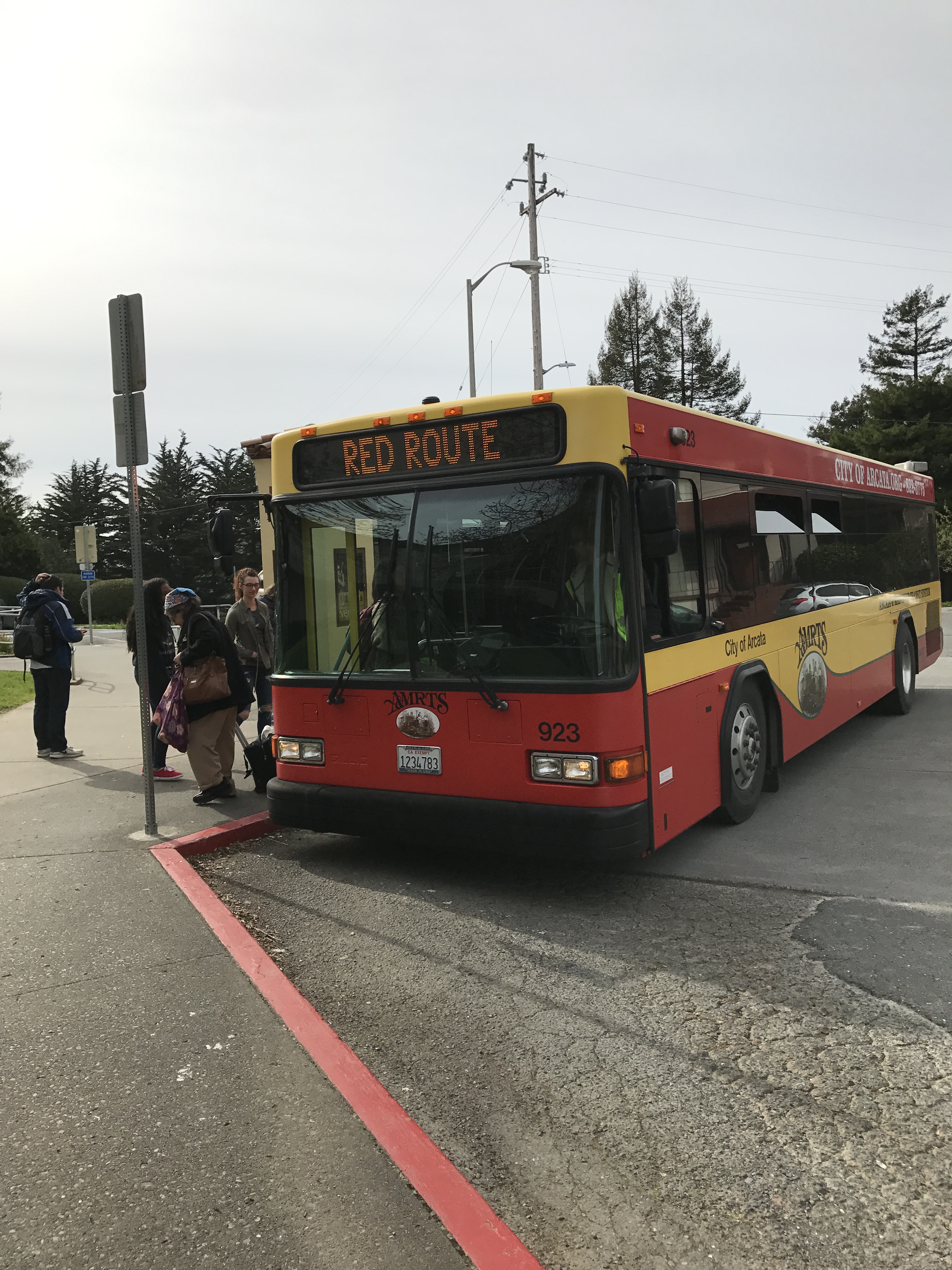
    An Arcata-Mad River Transit bus driving down H Street. | Photo by Robert Perez

    Liscano is now a sophomore and, like many other students, takes the bus due to a lack of a personal vehicle. But JackPass is not only for students without cars. It’s an effort to reduce the number of students who drive to school as well as reducing HSU’s carbon footprint.

    According to the 2016-2017 catalog, the JackPass offers students unlimited free rides on the Arcata & Mad River Transit System, the Redwood Transit System, and the Eureka Transit System. This means students can take the bus all the way from Scotia to Trinidad and even to Willow Creek for a day at the river.

    However, the JackPass is not free. Every student pays for it whether they use the bus or not. A portion of HSU registration fees, amounting to $29.02 a semester, is used to fund the JackPass according to Humboldt State’s financial services webpage.

    For students who live out of town like senior Noah Dunkley, the JackPass is a necessity.  

    “I totally agree it’s worth paying for the bus pass in our tuition,” Dunkley said.

    Dunkley lives in Eureka. In order to get to school and back home he has to take the Redwood Transit System. A monthly pass for the RTS is $60 according to their website. This means that a student would pay twice as much for a one-month RTS pass as they do for a 5-month JackPass.

    Charles Burdick is the public transit manager for the Arcata-Mad River Transit. According to Burdick, over 70 percent of bus riders for the Arcata-Mad River Transit are HSU students. He believes that the JackPass is beneficial because it lessens the number of students parking on campus and increases the use of the city bus.

    “There’s a lack of parking there [at HSU],” Burdick said. “They would rather students not take their cars to campus.”

    Humboldt State has been notorious for inadequate parking spaces. According to HSU’s parking and commuter services website, a parking pass for the fall and spring semesters is $315. The parking pass does not ensure students will find a spot.

    JackPass is a great deal for HSU students, but students who use the local transit do experience some flaws.

    “The bus will come either really late or really early,” Liscano said.

    To avoid missing the bus Liscano uses an app called Transit that offers accurate, real-time predictions for public transit arrival times.

    Dunkley has also experience some flaws on the RTS including sagging bus seats and fights breaking out on the bus, but he feels like these flaws are ignorable.

    “Overall it’s a pleasant experience,” Dunkley said. 

    KBBus
    Graphic by Kelly Bessem