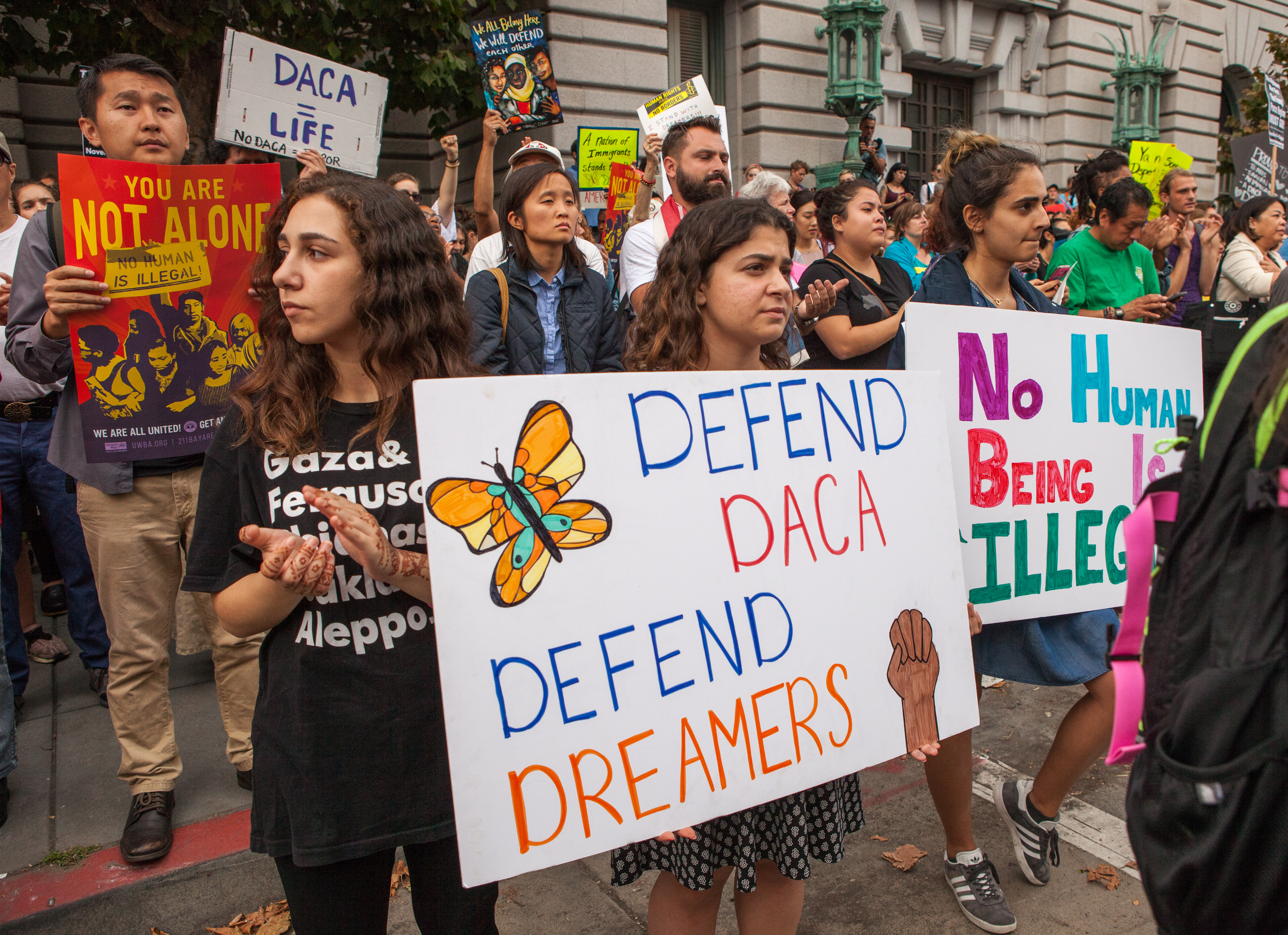
Supreme Court set to determine future of over 700,000 people
The Supreme Court of the United States heard oral arguments on Nov. 12 that will determine the future of more than 700,000 immigrants brought to the United States by their parents as children.
The Court’s decision isn’t expected until sometime next year, possibly as early January or as late as the summer. The majority decision will likely depend on Chief Justice John Roberts’ decision, as the remaining four liberal justices and four conservative justices are expected to vote in support of and in opposition to DACA, respectively.
Eighty minutes of oral arguments sustained a packed courtroom on the legality of the rescission of the Deferred Action for Childhood Arrivals policy. Three to four million immigrants that live in the United States arrived illegally as children. DACA protects about 700,000 of those immigrants from deportation and makes them eligible for work permits.
The DACA program, which requires that recipients renew their status every two years, is currently only accepting renewals, not new applications.
Seiri Aragon, a 27-year-old DACA recipient, advises first generation, low-income students for Academic Talent Search at Sonoma State University. Aragon, who was born in Oaxaca de Juárez, México and came to the United States in 1997 at age five, said in a phone interview that she has no choice but to pay close attention to the news surrounding DACA.
“It’s kind of hard not to pay attention,” Aragon said. “Because it’s a real, big part of my life, and so anything that could jeopardize my life here definitely should be of some importance to me.”

Seiri Aragon’s first grade school photo. After Aragon moved to the U.S., she began her first grade year in Petaluma, Calif. 
Seiri Aragon, a 27-year-old DACA recipient moved to the United States at five-years-old. | Photo by Deija Zavala
Aragon went to high school in Petaluma before completing undergraduate programs at Santa Rosa Junior College and SSU. She then went to the University of Texas to complete a master’s program.
Aragon signed up for DACA when it first came to be in 2012. While Aragon has doubts about the logistics of how a mass deportation could take place in the event of DACA’s rescission, she acknowledges that individual DACA recipients could easily be targeted and deported.
“For a really long time I thought that because we were kids, we would be given a chance,” Aragon said. “But I feel like both Republicans and Democrats in government pretty much just use students like me, kids like me or folks like me as pawns in their political game. As soon as you realize that, you just get so discouraged that at some point you’re just like, ‘Well, if they want to throw me out, they’ll throw me out.’”
Solicitor General Noel Francisco argued in support of DACA’s rescission in the courtroom. Francisco said DACA “maintained in perpetuity a program that actively facilitated violations of the law by hundreds of thousands of individuals.”
“For a really long time I thought that because we were kids, we would be given a chance.”
Seiri Aragon
Francisco suggested that an executive action ordering the government not to enforce the law had questionable legality. Francisco also reminded the Court that DACA was never intended to be permanent.
“DACA was always meant to be a temporary stopgap measure that could be rescinded at any time, which is why it was only granted in two-year increments,” Francisco said. “So I don’t think anybody could have reasonably assumed that DACA was going to remain in effect in perpetuity.”
Francisco argued that a ruling on DACA’s actual legality would be unnecessary. Instead, Francisco believed that President Donald Trump’s attempted rescission of DACA in 2017 was legal and should be allowed to go forward—thus eliminating any need to rule on DACA itself.
Attorney Theodore Olson argued against the rescission of DACA. Olson said such an impactful rescission necessitated a review by the Court.
“The decision overturned a five-year enforcement policy of deferred action that had enabled DACA recipients under other unchallenged laws and regulations to apply for employment authorization, seek driver’s licenses and other benefits,” Olson said.
While Justice Neil Gorusch acknowledged what he called “sympathetic facts,” Gorsuch and Justice Brett Kavanaugh questioned Olson’s stance.
“What’s the legal limiting principle you’d have this Court adopt?” Gorsuch asked.
Olson returned to his initial point on the significance of DACA.
“All we’re saying is that it should be subject to review in the context of the big picture,” Olson said.
When asked if Olson believed that the executive had the power to rescind DACA, Olson said “yes.” Thus, Olson’s argument rested on doubts of the explanation behind the rescission.
President Barack Obama put DACA in place in 2012 as an executive action after Congress failed to pass the Development, Relief and Education for Alien Minors Act. The DREAM Act offered a path to citizenship for some immigrants brought to the United States as children.
With DACA, Obama intended to give Congress time to come up with permanent immigration legislation. No such legislation has come to fruition, and in 2017, President Donald Trump attempted to rescind DACA.
The Trump administration has called DACA illegal and unconstitutional, but lower courts have disagreed. In June, the Supreme Court agreed to hear the case to determine if the rescission of DACA was legal.
About 11 million total undocumented immigrants lived in the United States in 2017, according to the Pew Research Center, and about 100 undocumented students currently attend Humboldt State University, according to an August press release.
HSU released a statement Nov. 21 detailing its commitment to DACA and undocumented students. The release noted HSU’s resources available for undocumented students, including a clinic scheduled for Dec. 6 and 7 in which the Coalition for Humane Immigrant Rights will cover the DACA renewal fee for the first 20 renewals.
“We would like to firmly reassert our commitment to being an inclusive campus which provides access and support for all students, staff, and faculty members within our HSU community,” the release said.
The future for DACA recipients if the policy is rescinded is uncertain. The Department of Homeland Security website has a list of frequently asked questions regarding DACA’s rescission.
“Current law does not grant any legal status for the class of individuals who are current recipients of DACA,” the site says. “Recipients of DACA are currently unlawfully present in the U.S. with their removal deferred. When their period of deferred action expires or is terminated, their removal will no longer be deferred and they will no longer be eligible for lawful employment.”
The site says that once a DACA recipient’s status expires, their case will not be “proactively” provided to Immigrations and Customs Enforcement unless they receive a notice to appear in immigrations court. According to the site, this policy may change at any time without notice.
In an analysis conducted following Trump’s move to rescind DACA in 2017, the bipartisan political organization FWD.us estimated that removing DACA recipients from the workforce would cost $460 billion in gross domestic product over a decade.
When asked what she will do if DACA gets rescinded, Aragon paused.
“I don’t know,” Aragon said. “I really don’t know. I’m just looking out for allies at this point.”
Aragon said that while having DACA is a privilege compared to other undocumented immigrants, she, like Olson, pointed out that a large part of the program is providing basic citizen privileges like being able to file taxes or apply for driver’s licenses.
“The privilege is to bring equity to essentially what we are, which is American,” Aragon said.
For the next few months, DACA recipients across the United States, including Aragon, will await the word of the nine justices. Aragon said she hopes for DACA’s reinstatement, at the very least.
“I feel like I’m asking for crumbs,” Aragon said. “Because at this point, I’m so disappointed that I’m like, ‘Can you just, one, not take away the program, and two, maybe reopen it to people who qualify?’ That’s it, that’s all I want.”