The Lumberjack


Students Serving The Cal Poly Humboldt Campus and Community Since 1929

Tag: technology

  • Cal Poly Humboldt embraces ChatGPT

    by Carlina Grillo

    In recent years, ChatGPT and other generative artificial intelligence (AI) models have become mainstream, with many people having begun to wonder if this is something to fear, or something to embrace. Students and faculty at Cal Poly Humboldt have been testing the waters and, despite mixed reviews, it is apparent ChatGPT is here to stay. 

    “I do think that there is a role for ChatGPT and gen AI models in the classroom. However, I think my recommendation for its use varies according to the level of the student,” said associate professor of computer science and software engineering program lead, Dr. Sherrene Bogle. “As higher educators, we have a responsibility to teach our students how to use the technology effectively.”

    “ChatGPT is a tool applied in academia for diverse research like linguistics, psychology and computer science. It aids in hypothesis generation, language analysis and ethical exploration. Used in education and interdisciplinary studies, it’s showcased in conferences, with further advancements documented in recent academic publications,” according to ChatGPT itself.

    Bogle first heard about ChatGPT last year and, although reserved at first, has since embraced it. Cal Poly Humboldt students studying computer science were offered an elective course this semester that focuses on AI, CS 480, taught by Bogle. One exercise she instructed in the lab was to use a selection of AI technology such as ChatGPT, Bard or Claude and find examples of where the programs hallucinate. 

     Noah Zerbe, a professor in the department of politics, defined what the term ‘hallucinate’ means for generative AI programs.

     “Sometimes [generative AI] will just make things up for you,” said Zerbe. “Often, one of the problems a lot of people have noted is that it makes up citations. So, it’ll say that a quote comes from this source, or something like that, and that source may not even exist. Or, it can go down a rabbit hole of factually incorrect information.” 

    One mainstream example of ChatGPT ‘hallucinating’ is apparent in an incident where Colorado lawyer, Zachariah Crabill, was fired from Baker Law Group for using ChatGPT, and got caught when the program created fake scenarios in legal documents.

    Another example of a generative AI model ‘hallucinating’ took place in the Cal Poly Humboldt AI class. According to Bogle, two students were able to convince an AI chatbot that they had lunch with Michael Jackson and Tupac. 

    “They just said a few things, changed the prompt, and the technology apologized for saying that these people were dead and wanted to hear more about their conversation and was basically adding that to its database,” said Bogle.

    As an advocate for programs like ChatGPT in academia, Zerbe encourages students to explore the program, but introduces generative AI models into the classroom with a warning.

    “My approach to it is really centered on teaching students how to use it effectively,” said Zerbe. “It’s providing you feedback on your paper, trust it as much as you would trust feedback that you got from a friend down the hallway.”

    Professors aren’t the only ones exploring this new territory with caution. Maddie Haus, a junior at Cal Poly Humboldt majoring in environmental studies, was suspicious at first. 

    “I was stoked because it helped me so much, but I also found it scary because it seemed too good to be true,” said Haus. “I think it can be useful for achieving academic success. I do think there’s a thin line between doing the work yourself and just having ChatGPT do the work for you. Overall though, I think it’s a useful tool.”

    Mikey Crispin, a Cal Poly Humboldt graduate who now works for the PBLC and the university as a scheduling and support analyst, has used ChatGPT on and off. 

    “I didn’t really use AI for school because it didn’t explode until last November,” Crispin said. “By that time I was only taking the upper level computer science classes and could get all the info from professors.”

    Now that he’s graduated, Crispin uses ChatGPT mainly for troubleshooting while writing software. 

    “GPT doesn’t always know what you’re trying to do, but from a basic coding perspective, if you’re giving it info just to cover some gaps you might have, then it is a great assistant that can help you gain a better understanding of how something might work,” Crispin said. “I have no experience asking GPT for help for anything outside of a technological viewpoint. It did write a really good email for me once in the style of a Cat in the Hat book, so that was cool.”

    All in all, ChatGPT, along with other generative AI programs, seem to be the future of education, but using AI as a crutch is inevitably harmful. 

     Bogle illustrates her perspective towards generative AI.

     “If you think about it, we don’t want our elementary school students and kindergarten students to be using a calculator, because we want them to learn to count, to carry their hundreds, tens, and ones, etc., to be able to do long division,” Bogle said. “But, after they have mastered being able to do their basic arithmetic with pencil and paper, we’re comfortable with them using the calculator. So, it’s similar with gen AI, which is why I said I think students need to master honing the particular skill first, before they become reliant on gen AI. That way, I think we have the best of both worlds.”
  • Luddites aren’t who you think they are

    by Carlos Pedraza

    The Luddites emerged in the early 1800s, claiming to follow craftsman and folk hero Ned Ludd in expressing the rage of craftsmen and other workers who felt threatened by industrialization. Today, Luddite is used as an insult for technophobes, but the real Luddites didn’t hate technology. They wanted to protect their livelihoods and get better working conditions.

    Automation has always been a threat to workers. Unlike humans, machines don’t demand higher wages and can work 24/7. The Luddites would go to factories and smash machines with anything they could find. In 2013, delivery drivers smashed and stabbed robots in a modern display of Luddism, not technophobia.

    While new technologies can lessen work time, they usually are used by businesses and governments for control. Think of the algorithms that Amazon uses to manage their workers’ work time and breaks. I used to work as a service worker stocking shelves. I would get up at six in the morning and work till noon, with only two 15 minute breaks. If I knew that a machine was tracking me to keep me working and not take an extra five minutes, then I would be the first to stab it.

    In working jobs where I had no autonomy, I would be forced to smile at all times and repeat the same mindless boring tasks over and over again. The greatest disappointment was when I saw my paycheck, feeling robbed by how little it was. A higher wage or longer breaks would have made me feel less angry, but a machine doesn’t care about breaks or paying rent.

    Even if automation didn’t make me lose my job, then it would still cut my hours and thus my pay. I’m a Luddite not because I hate technology or want everything to be the same. I like progress and embrace change, but if automation is going to happen then it must be for the workers to decide when and how to do it, and to distribute the benefits among the people.

    Until then, if I see a machine control my time or push me out of a job, I will keep shouting, “down with all kings but King Ludd.”

  • Free iPads pop up at HSU

    Free iPads pop up at HSU

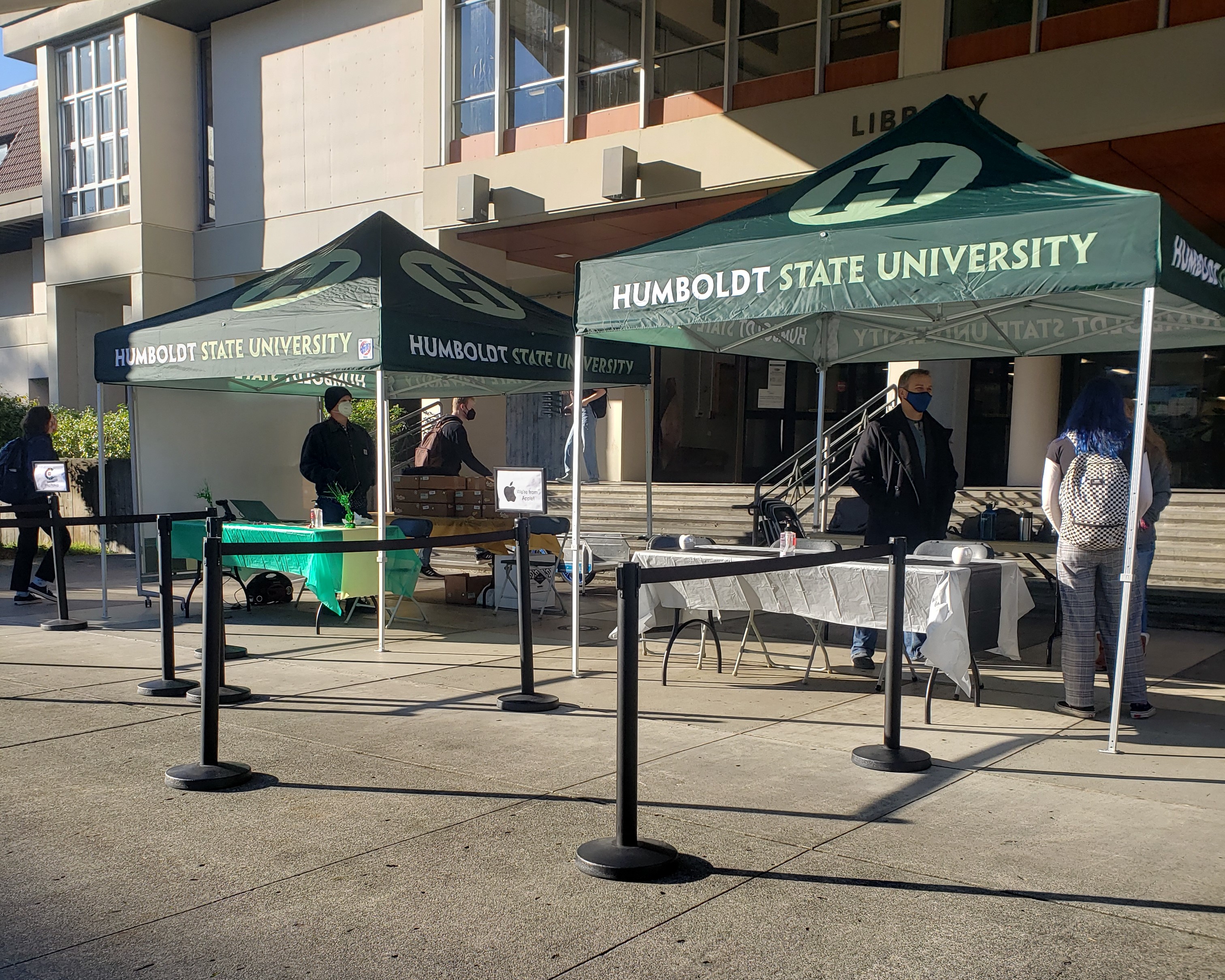
    Humboldt State University set up tents in front of the library and gave out free iPads to incoming freshman and transfer students on Jan. 19.

    The iPads were provided by the California State University Connectivity Contributing to Equity and Student Success (CSUCCESS) Initiative. CSUCCESS was created by the CSU in partnership with Apple. It debuted at HSU’s campus last fall and returned this semester.

    Oceanography junior and transfer student Angelina Mayo got an iPad from CSUCCESS. She just transferred from Shasta College, where she worked as a tutor while attending school. A student that she tutored during the time used an iPad to take notes.

    “I think it was just an incentive, and I wanted to try it because I saw a student at Shasta College use it and help keep her organized,” Mayo said. “She was more prepared for our tutoring sessions than some of my other students because of keeping her files together.”

    HSU Library Student Assistants adorned the cardboard iPad boxes with HSU stickers. Stickers that are free for the taking at the Information Technology Services desk on the first floor of the library. Mayo stuck a green ‘H’ sticker on the h-button of her keyboard.

    Photo by Alexis Valtenbergs | Apple Senior Account Manager Jenni Beck (back) helps transfer student Angelina Mayo (front) set up her free iPad outside the library on Jan. 19.

    “I signed up for EOPS and got ‘swag,’ that’s what they called it,” Mayo said as she typed in her HSU ID and password on her new iPad. “And amenities.”

    One of the amenities that Mayo opted for was the free iPad.

    The goal of the CSUCCESS Initiative is to make technology more accessible to higher education students in the CSU system, especially in the backdrop of the ongoing COVID-19 pandemic that relegated students and faculty alike to remote Zoom classes.

    “The biggest reason for that is to ensure equity and access,” Apple Higher Education Senior Account Manager Shawn Vandergriff said. “To provide the same level of technology to every student.”

    According to Vandergriff, HSU has provided iPads to approximately 700 HSU students since CSUCCESS came to campus last semester. His goal is to bridge what he referred to as the ‘digital divide’ in higher education, which is often overlooked.

    Eligible HSU students get to keep their free iPad throughout the duration of their academic career at HSU. Apple Care insurance will cover up to two instances of breakage, according to Vandergriff.

    The CSUCCESS program is expected to return to HSU again in the fall.

    “As long as we have a budget to do that, I can see it happening into the future,” HSU Customer Care IT Consultant Andy Pierce said.

    To learn more about CSUCCESS at HSU, visit its.humboldt.edu/csuccess.

  • Screens are losing their novelty

    Screens are losing their novelty

    Life and Arts editor, Dakota Cox, speaks on his shifting perspective towards technology.

    2020 has tainted the relationship between humans and screens.

    When I was a child, my favorite thing in the world was my Gameboy. I was only allowed to play on long car trips or the rare occasions when a friend spent the night. My favorite game was Pokémon, of course. I remember the satisfaction I felt after beating the game for the first time. Those were the days before YouTube tutorials when discovery in games meant something.

    When I grew older, I replaced my Gameboy with an out of commission iPhone I found one day in a crack of the couch in our family room. It served me well as an iPod for years until it finally refused to accept a charge and became replaced by my first official iPhone.

    That phone met a violent end far before its time. It wasn’t missed. The replacement that sits in my pocket today has aged noticeably over the years having been through more than most. It will also not be missed.

    Over the years, whether it be a computer, a television or a phone, there’s always been a screen at the center of my life. Though they may not always have received the majority of my time, the ideas attached to screens have almost certainly played a dominant role in my decisions since they were introduced to my life.

    All it took was a taste and I was hooked, now I understand why my mom warned me about drugs. I only wish she’d known the damage a single screen can cause.

    When I was 10 years old and my brother Yoshi was born, my mother more or less granted me the trust to make my own decisions. For me, this meant staying up till 5 a.m. watching Netflix, playing Skyrim and sleeping in until 2 p.m. Those were the days.

    When I started living away from home, I began spending more time than ever in front of screens. They were no longer just an optional escape, they’d also become a regular part of my college education.

    Now with the pandemic and online learning, the time spent in front of screens has crossed the threshold to a place of dread.

    The once exciting prospect of a notification arriving on my phone is ruined by the endless nagging of unfulfilled responsibilities and classes I spend hard-earned money on to attend.

    The little quality time I get to spend with family in the pandemic has become corrupted by the constant presence of screens.

    Aside from hiking, almost every moment I was with Yoshi over the summer was spent playing the latest video games and half-paying attention to the shows playing in the background.

    When I have time to spend the weekends with my Mother, I wake up before 7 a.m. for work and don’t get back until 5 p.m. By then, I’m exhausted and I’ve got a pile of stories to edit, if I don’t have to write one myself, along with whatever homework I couldn’t finish during the week.

    My mom is mostly glued to her phone and outside of an occasional board game or family movie, we retire to our respective rooms. Is this what life has come to?

    Screens can be used to accomplish great achievements as tools or produce great joy as toys, however anything over-used can become unhealthy. So, give your poor brains a break, I know mine needs one!

  • Microgrid is in the works

    Microgrid is in the works

    Schatz Energy Research Center at Humboldt State was awarded a $5 million grant. The money is going to be used to build a microgrid at the Arcata-Eureka Airport in Mckinleyville. Peter Lehman, director of Schatz, said he was overjoyed when the good news broke.

    “Everybody was high-fiving and hugging,” Lehman said. “It is a big deal for us, and a big win.”

    Lehman spent about three months working on a proposal for the grant with his colleagues.

    “It was really competitive,” Lehman said. “The California Energy Commission only funded one proposal out of ten. There was a lot of universities that didn’t get funded, and we did.”

    The microgrid will be composed of a 2.3-megawatt photovoltaic array, or solar power system, and cover nine acres.

    “It is one thing to have an idea, but it’s gotta be based in reality,” Lehman said. “First you have to conceive the idea, flesh out the idea and decide what partners need to be assembled. It’s not easy.”

    Redwood Coast Energy Authority, or RCEA, partnered with Schatz, matching $6 million in funds to help the project. Executive director of the RCEA Matthew Marshall is optimistic about the project.

    “We were waiting to hear back from the Schatz Center to see if they received the grant before submitting the application for the loan, but it’s now in the works,” Marshall said. “I’m optimistic.”

    The RCEA is financing the upfront costs of the project with a low-interest loan from the United States Department of Agriculture’s Rural Utilities Service.

    “We’ve got a goal to support the development of local solar projects,” Marshall said. “The project is pushing the envelope. It’s exciting being on the forefront.”

    In addition to generating green electricity, the microgrid will create jobs for locals.

    “Somebody has to pour the concrete, drive the post into the ground to mount solar panels and run the wires,” Lehman said.

    In an emergency situation, the airports and United States Coast Guard could run for hours off energy gained from the microgrid .

    “The airport and the Coast Guard are really important,” Lehman said. “The Coast Guard can’t fly if the airport doesn’t have electricity.”

    RCEA owns the solar array and PG&E owns the wires, but who gets paid what for the electricity produced? How do customers get charged for that?

    “It’s all new, its never come up before,” Lehman said. “We are going to be plowing some new ground trying to figure that out.”

    The project is expected to begin this summer. PG&E will do a number of tests after the completion of the first multi-customer microgrid.

    “PG&E is careful about what goes on their grid,” Lehman said. “There are a number of tests we will have to pass with them, looking over our shoulder to make sure that is it safe.”

    PG&E communications representative Ari Vanrenen said PG&E is committed to clean energy.

    “We are a community partner dedicated to building a better, more sustainable future for all Californians,” Vanrenen said. “This includes understanding and responding to the different needs of our customers and communities.”

    Once the microgrid is established, the Schatz Center will spend a year writing reports on how it works and share their findings.

    “Lessons we learn are going to be valuable for other people. That’s how progress happens in technology,” Lehman said . “You do things and try something. You tell people about it. The next time you build it, you are a little smarter and you do a better job.”

  • Diversity and inclusion through STEM

    Diversity and inclusion through STEM

    Humboldt State University was one of 24 institutions nationwide to be selected for a $1 million STEM grant by the Howard Hughes Medical Institute.

    The grant is part of HHMI’s program, Inclusive Excellence, which is designed to cultivate inclusion and diversity within the STEM community.

    By funding STEM programs throughout the nation, HHMI Inclusive Excellence strives to enable science education capacity in four-year institutions to provide opportunities for all students to succeed in the field.

    At HSU, this means developing better ways to serve incoming STEM students.

    Matt Johnson, Ph.D. and Wildlife professor said this includes development of student involvement programs, as well as faculty training.

    Johnson, along with Biology professor Amy Sprowles founded an integrative, place-based learning community called “Klamath Connection.” The direct field experience is one of the two current STEM place-based learning communities.

    Through these diverse programs, STEM students are integrated into the field through hands-on learning in the local environment.

    “These feelings help students feel a sense of belonging and community.” Johnson said. “With an approximate 6 percent of HSU students coming from Humboldt County, it is important to introduce incoming students to their new geographical, environmental and cultural environment.”

    Additionally, the grant will allow university faculty to participate in workshops and training opportunities to learn and utilize how to create a culturally inclusive environment.

    David Asai, senior director for science education at HHMI, says it is important to acknowledge that good ideas can originate anywhere. Asai said that often, a person’s success in science been a reflection of where they come from, not where they want to go, causing growing disparities in science education.

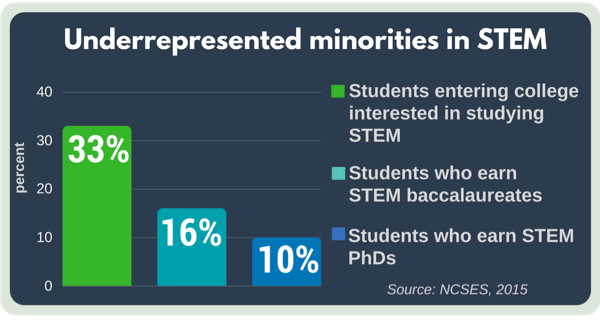
    Underrepresented incoming STEM scholars have significantly lower retention rates than their Caucasian or Asian counterparts.

    According to a 2015 report by the National Center for Science and Engineering Statistics, the percentage of students who receive STEM bachelor’s degrees is nearly half of the students who initially enrolled in science higher education.

    STEMgrantinfo.png


    Laura Carlos, a 22-year-old senior studying Zoology, said she did not feel prepared and included when she first started her science education at HSU. Carlos said that not all students are given the same opportunities in high school, which makes it difficult for students to have the same starting point in college.

    “Without proper resources and tools, underrepresented students can only dream of what it’s actually like to be a STEM student.” Carlos said.

  • Out of the clouds into the box

    Out of the clouds into the box


    By Charlotte Rutigliano

    After spending the summer testing different data cloud services such as Dropbox, Box.com, Microsoft Onedrive, and Google Drive, Chief Information Officer for Information Technology Services Anna Kircher has said the university has selected Box.com.

    According to Kircher, the university wanted to have this new system completely rolled out by the Fall 2017 semester. However, while they were conducting pilot tests over the summer, they found they still had questions with Box.com.

    “We still had some questions, like how long would it take students to upload/download files when they’re in a large class,” Kircher said. “Also how will it look for students to access the files from Canvas.”

    This fall, ITS and the university will be doing more pilot tests with Box.com to see if the new system will have functionality in the classroom.

    Kircher said that around 12 classes and five hundred students will participate in this fall’s pilot tests.

    “There will be two basic groups for the fall pilots, geospatial (GSP) courses and courses that will require large video and audio files,” Kircher said,

    Most student concerns surrounded security and storage limitations.

    Students currently have 200 megabytes available to them on the user drive provided by the university, and around 15 gigabytes within their Google accounts, which includes Gmail, Google Drive and Google Photos.

    According to Kircher, security is one of Box.com’s biggest concerns, because they often work with clients who require high levels of security.

    “One thing students won’t have to worry about with Box.com is space, using Box will give students unlimited space for files,” Kircher said.

    Kircher said the university’s new goal for rolling out Box.com school wide is the spring semester of 2018, which will improve file storage for all students.

  • This week in science (April 26 – May 3)

    This week in science (April 26 – May 3)

    By Bryan Donoghue

    Graphic | Joe DeVoogd

    Technology – Bioprinted Cartilage

    Researchers at Sahlgrenska Academy in Sweden have managed to generate cartilage tissue by bioprinting stem cells using a 3D bioprinter. Researchers found a procedure that ensured cell survival from printing so they could multiply. This allowed researchers to develop a protocol that causes the cells to differentiate to form cartilage. The bioprinted tissue is not only able to repair cartilage damage, but can be used to treat osteoarthritis, a condition where joint cartilage degenerates and breaks down.

    Source: medicalxpress.com


    Graphic | Joe DeVoogd

    Technology – Artificial Womb

    A team of researchers at the Children’s Hospital of Philadelphia in Philadelphia, Pennsylvania have engineered a fluid-filled “biobag” that allows premature lambs to develop in an artificial womb. Alan Flake, a pediatric surgeon and the head of the research team said his goal is to help premature infants with this artificial womb. It may be a while before it’s implemented in hospitals. Flake estimates that human testing is at least three years off.

    Source: sciencemag.org


    Graphic | Joe DeVoogd


    Space – Cassini to go through Saturn’s Rings

    The Cassini spacecraft, which has been circling Saturn for the past 13 years, skimmed over the planet’s largest moon, Titan, last Saturday. Titan’s gravity will pull Cassini into the narrow gap between Saturn and its innermost ring, a place where no man made satellite has gone before. The spacecraft will enter that gap about once a week until Sept. 15, when it will crash into Saturn and be destroyed.

    Source: nytimes.com


    Graphic | Joe DeVoogd

    Paleontology – Ancient Humans in California

    An archeological research team headed by study leader and paleontologist at the San Diego Natural History Museum, Tom Deméré, said they’ve found signs of ancient humans in California between 120,000 and 140,000 years ago. This is more than one hundred thousand years before humans were thought to exist in the Americas. If the research team’s findings are correct, their findings at the Cerutti mastodon site could rewrite the history of humankind.

    Source: nationalgeographic.com