The Lumberjack


Students Serving The Cal Poly Humboldt Campus and Community Since 1929

Tag: Theater Arts Department

  • Radium Girls spins gold out of straw

    Radium Girls spins gold out of straw

    by Alana Hackman

    When I discovered that the spring play would be Radium Girls, I was ecstatic. I had previous historical knowledge of the event and the TV show, but was unaware there was a play. The play was a meaty one at nearly three hours, but had impressive delivery by the all-student cast for such an emotionally charged story.

    The Theatre Department put on quite a well-organized performance, considering the main cast was only eight people. Each actor aside from the main protagonist, Grace, (played by Sophia Escudero) were playing up to four characters each. 

    One could look at the small cast, lack of props and scene changes as a dealbreaker for the production, but it only impressed me more. Cast members being involved in all of the moving parts is what really made Radium Girls so charming and applaudable. A majority of the scene changes were led by the cast members immediately after delivering lines. 

    There were no closed curtains and very few techies were spotted on the wings or stage throughout the show. The lack of props on the stage during most of the scenes really forced the audience to focus their attention on the actors’ performance. It seemed to me the cast and crew were able to work with what they had and still deliver a killer performance. 

    Krystie Obiso and Izzy Waring stood out to me the most with their performances. 

    With Obiso playing the parts of Irene, Miss Wiley, Board Member #2, and Mrs. Michaels, she put a firecracker spirit into every character portrayed. From her impressive transatlantic accents and strong emotional outbursts, she really had an enchanting stage presence even when playing side characters. 

    Waring also played a handful of characters including Mrs. Roeder, Madame Curie, Customer, and Board Member #3. Her performance as Mrs. Roeder is what wowed me the most; Waring’s ability to deliver such emotional anguish and distress of a wife discovering her husband’s negligence following the truth of radium’s negative health effects was not something I expected to see in a college play. 

    Obiso and Waring’s delivery really set the emotional ambiance of each scene and of Radium Girls as a whole. They really pushed the theme of women’s pain and truth being overlooked throughout history. 

    The set design was also very professional and clean looking. It had a lot of technical parts to really get an emotional reaction out of the audience, but was still simple. From the city skyline physically “closing in” to symbolize the truth about radium, as well as the white screen used as screen to play with light and impose the feeling of ‘time running out’ throughout the show. 

    I will say the one critique I had during my time as an audience member was the lack of microphones. I wasn’t able to tell if any of the actors were wearing mic packs and had a hard time hearing some of the dialogue, especially during what seemed to be vital conversations within the storyline, like the scenes between Grace and her mother. Same with stage blocking; sometimes a cast member would turn their back and be completely muffled out from the audience. This made following some of the intense dialogue on stage a bit harder, especially when accents came into play.

    When it comes to such a detailed and long play, I do wish the actors were mic’d up to make it a bit easier to follow. I can assume that the cast and crew were working with a tighter budget for this production, but it didn’t stop them from executing a successful opening night.
  • Cal Poly Humboldt Theatre presents the return of the 24 hour play festival

    by Sophia Escudero

    Putting on a play is traditionally no quick process. It takes months to take a script, design the set, costumes, and lights, cast actors, direct it, and have something polished enough to perform. The 24 hour play festival, however, turns that notion on its head. From 7 p.m. Friday night to the same time Saturday, a group of theater students wrote scripts and presented them as a series of short plays before an audience.

    The event was entirely student run and organized, and was produced by Cal Poly Humboldt students Austin Maisler and David Fisher.

    Maisler served as a producer, director, light designer, and stage manager. He had heard about the 24 hour play festival in his first year at Cal Poly Humboldt, but nothing came of it due to the COVID-19 pandemic. When campus reopened, the idea for the festival returned.

    “Spring came along and our department chair, Dr. Troy [Lescher] brought it up, like, ‘hey, does anybody want to run this?’” Maisler said. “I didn’t want to run it, I wanted to act in it, but nobody came forward so I talked to David. David and I decided to step forward and run this thing.”

    The process of organizing the festival was, by its nature, chaotic. Scripts were written overnight, and given to directors at 7 a.m. the next morning. The actors were cast less than twelve hours before they had to be off-book and ready to present the scene, and rehearsals were intermittently interrupted by costume fittings and discussions of the script. Lighting was finalized shortly before the house opened, and many people found themselves taking on roles that they had not previously had experience in.

    “This is the first show I’ve ever designed lights for,” Maisler said. “I’m actually in the lighting class this semester, so I just stepped forward, like, I kind of know how to do this, so I’ll just do it.”

    The four scenes, each about ten minutes long, took on themes of college-aged ennui, failing romance, finding meaning in absurdity, and impending doom. Of the four playwrights, two also participated as actors, and one as a director.

    Actor and writer Ben Wimer had not been involved in a 24 hour play festival before in either capacity. He found writing for a 24 hour play festival to pose a unique challenge. As the script is to be presented less than a day after its completion, certain factors had to be considered.

    “I wanted to write something that was simple, but had an authenticity to it, and had dialogue that was easy for the actors to memorize⁠— hopefully, it was easy to memorize⁠— but still gave them a lot to play around with,” Wimer said.

    Mollie Donaldson had participated in a previous 24 hour play festival at Cal Poly Humboldt in early 2020 as an actor, a role she repeated two years later. She considers the festival to be intense, but rewarding.

    “It’s definitely stressful,” Donaldson said. “You’re handed a script at 8 a.m. and told at 7 p.m. that you’re supposed to perform it and block it and have everything memorized. It’s a stressful thing, but one of my favorite things is kind of shocking myself with how quickly I can memorize things.”

  • Something Rotten! opens at Cal Poly Humboldt

    Something Rotten! opens at Cal Poly Humboldt

    by Nina Hufman

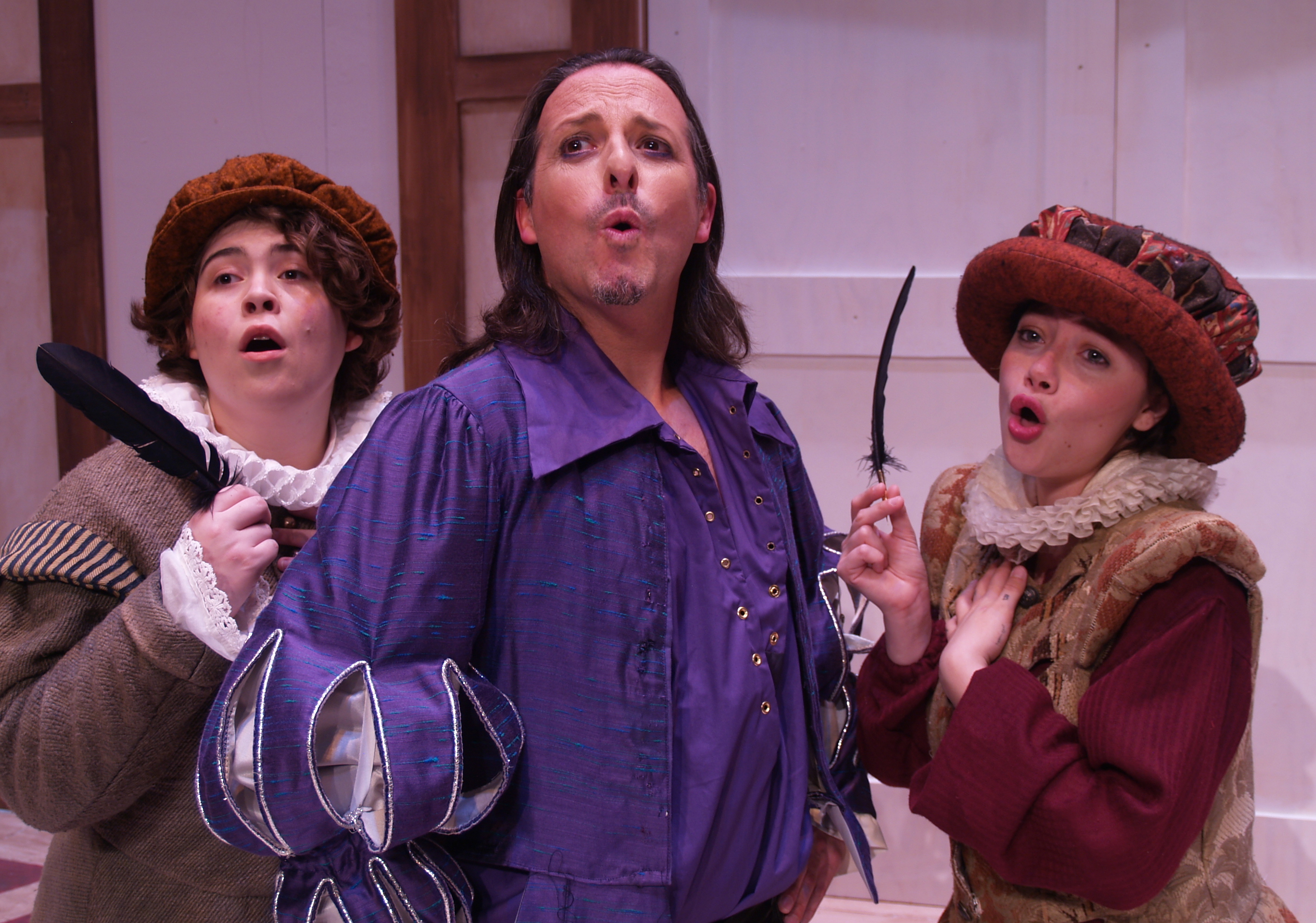
    The Cal Poly Humboldt School of Theater’s production of Something Rotten! was entertaining, energetic, and full of innuendo. On opening night last Friday, March 25, patrons filled the Van Duzer Theater to see the comedy, set in the 16th century.

    From the opening song, ‘Welcome to the Renaissance,’ the cast dazzled in beautiful costumes on a stunning set. All of the actors are extremely talented singers and performers. It was clear that they all put in a lot of work and are proud of what they have accomplished. Jeremy Stolp, an English Education major who played one of the lead roles, Nick Bottom, feels that being in theater is a rewarding experience.

    Photo by Michael Thomas | Jeremy Stolp (left) and Miah Carter (right) star as power couple Nick and Bea Bottom.

    “Theater is such a privilege and so much fun to do,” Stolp said. “If you ever have the opportunity, I suggest you try it.”

    The musical was incredibly entertaining. Some of my favorite scenes included Shakespeare’s John Cena-esque entrances, Bea’s hope for a gender-equal future, and the show’s lampooning of religion. One of the best songs was “Will Power,” featuring a leather pants-clad William Shakespeare (Jaese Lecuyer) and his crowd of adoring fans. I also enjoyed “A Musical,” a comic number during which fortune-telling Nostradamus (Sammi Pietanza) tells Nick Bottom that the next big thing in the theater will be musicals, all while wearing a hat that I am convinced was a paid actor. Many of the jokes are meant to be ironic, making fun of musicals and the theater. The way that this is incorporated into the story is very clever.

    The cast was rightfully proud of what they accomplished and are looking forward to adding to each performance in future shows.

    “I don’t think that they (the cast) expected the reaction that they got so when they did it was just this moment of awe,” said Katie Lem, a member of the ensemble. “Everybody standing up at the end was such a beautiful moment for everybody.”

    Photo by Michael Thomas | Zoë Saylor performs an upbeat musical number about the bubonic plague.

    One of the most compelling performances was Miah Carter as Bea, Nick’s wife. Throughout the play, Bea disguises herself as a man to maintain several different jobs and help her husband financially and push for gender equality. Carter’s performance showcased her talents as an actor and singer, particularly in her solo “Right Hand Man.”

    “This is my first ever lead, so this was a good step up for me,” Carter said.

    Carter says that theater is a great community to be a part of and that they are all incredibly supportive of one another.

    “All of us were so proud of what we pulled through,” Carter said. “I love everyone in this cast.”

    The cast and crew are looking forward to continuing to develop this musical as they perform it more.

    “I’m excited for the depth and complexity that we kind of add into it every single show,” Lem said. “Not every night is the same.”

    The musical is running this weekend on Friday and Saturday at 7:30 p.m and on Sunday at 2 p.m. The musical will have you loving to hate William Shakespeare right along with the Bottom brothers.

    Photo by Michael Thomas | From left to right: Zoë Saylor, Sophia Escudero, Jeremy Stolp, Jaese Lecuyer, Jake Hyslop, Michael Jaye, and Miah Carter pose on set of Something Rotten!
  • “Something Rotten” is happening this spring

    “Something Rotten” is happening this spring

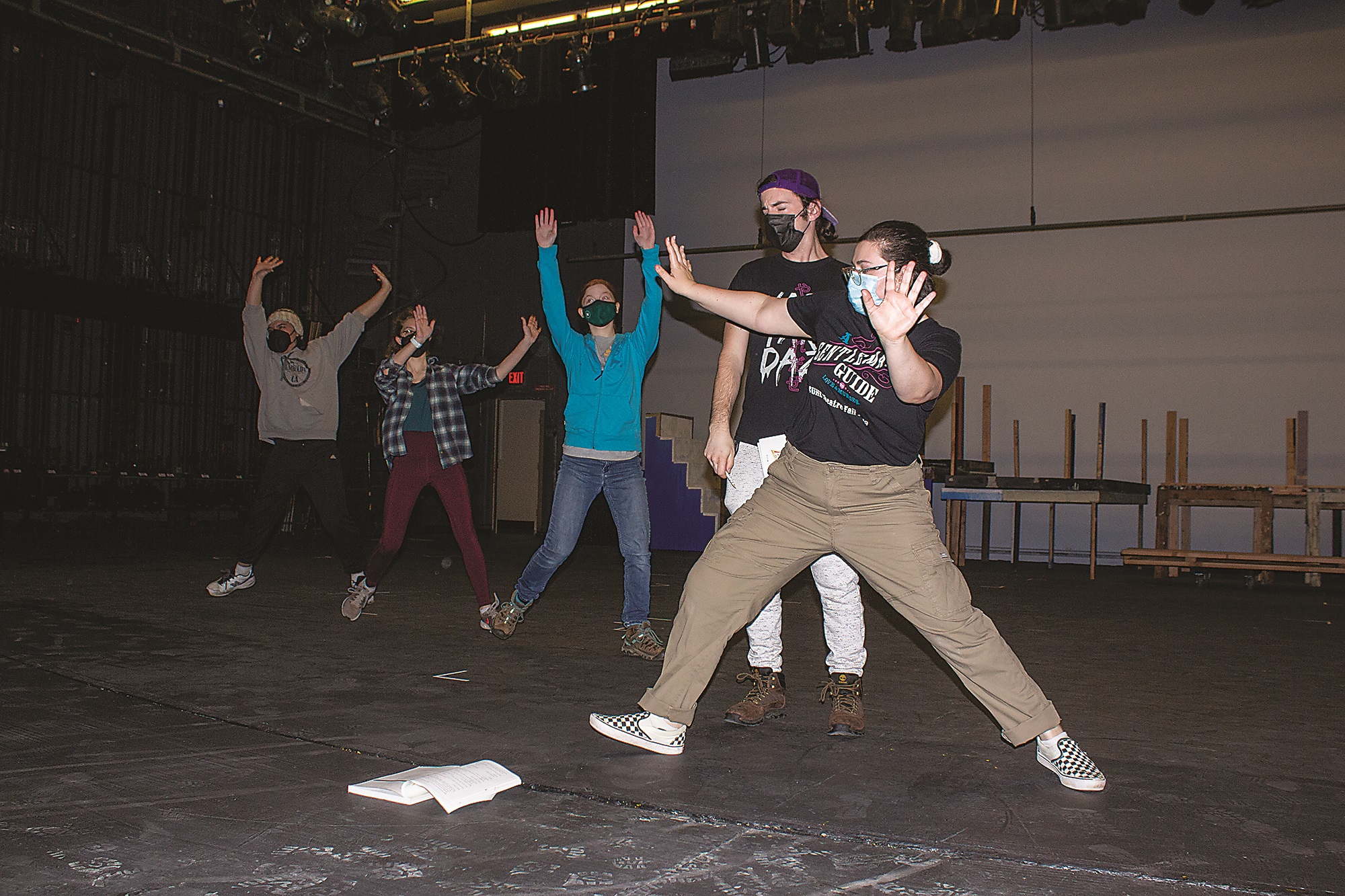
    The cast and crew of Cal Poly Humboldt’s spring musical have been meeting for two weeks now, ever since the start of the semester. Rather than fully polished scenes, their rehearsals consist of bare-bones run-throughs, scripts in hand and tape on the floor where the set will eventually be.

    The show is “Something Rotten,” a farcical comedy set in an anachronistic 16th century. The two main characters, the Bottom brothers, invent the concept of a musical and feud with their rival, Shakespeare. The show re-characterizes The Bard as a rocker, not dissimilar to a Freddie Mercury type charismatic frontman.

    “The show is about love, relationships, ego, and anachronism,” said director Michael Thomas. “You’ll see a cell phone or two, there might be a modern toilet plunger.”

    Although “Something Rotten” is set in the Renaissance, the music and dancing are rooted in Broadway tradition. At this particular rehearsal, choreographer Carrie Walpole was working with the cast on the dancing for the track “A Musical.”

    This number will feature the cast tap-dancing, and is best described as a classic musical theater style composition. Another track, “Will Power,” performed by the character of Shakespeare, is unmistakably rock. The Bard croons out his famous lines “Shall I compare thee to a summer’s day? Thou art more lovely and more temperate,” over a driving bass line.

    “It’s more like a rock musical, it’s a very upbeat score,” said Thomas.

    Cast members and crew alike were required to be at Wednesday’s rehearsal for most of the evening. Stage manager Ian Aguilera and his two assistant stage managers Benji Salisbury and David Fisher spend just as much time as the actors, if not more, preparing for and producing the final musical.

    Before the rehearsal had even started, before the director or most of the cast had arrived, Aguilera was at Van Duzer Theater, preparing.

    “Tech and acting are kinda fifty fifty,” said Aguilera, when asked about how much the crew do behind the scenes. “The director’s not here, I am.”

    With the support of the crew literally behind the scenes, the musical’s cast can do their best work. While the actors go over scenes, Aguilera sits at the front of the stage assisting with minute production details and even helping with direction.

    “Something Rotten” takes advantage of its self-aware premise for comedic effect.

    “It’s a musical about a musical,” said Aguilera. “It’s [the main characters] versus Shakespeare.”

    In one scene, the soothsayer Thomas Nostradamus, played by Sammi Pietanza, looks into the future of theater. He says that the characters will break into song and dance, and a glass of wine at concessions will cost an exorbitant amount of money.

    Pietanza’s character acting is silly, joyful, and extremely animated, even at this early stage of production. They said that it’s easier for the director to scale back an overdone performance than to draw more out of a timid one. They were the center of attention on stage, striking wizardly poses and speaking the script with mystical energy.

    “The character [Thomas Nostradamus] is like a human goblin,” Pietanza said. “Like a Danny DeVito kinda trash rat.”

    This energy that Pietanza brings seems emblematic of the production as a whole. It’s a whole lot of passionate people, coming together to make something silly, dramatic, and distinctly musical theater.

    Director Michael Thomas is looking forward to what will hopefully be a live, in person performance of “Something Rotten” in April.

    “People should come see it because it’s a fun, silly evening,” said Thomas. “It’s full of action, it’s colorful and upbeat.”

  • Humboldt State Students Voice Concerns Over Racial Casting

    Humboldt State Students Voice Concerns Over Racial Casting

    Students come forth after witnessing and experiencing racial typecasting within Humboldt State’s Theater Department.

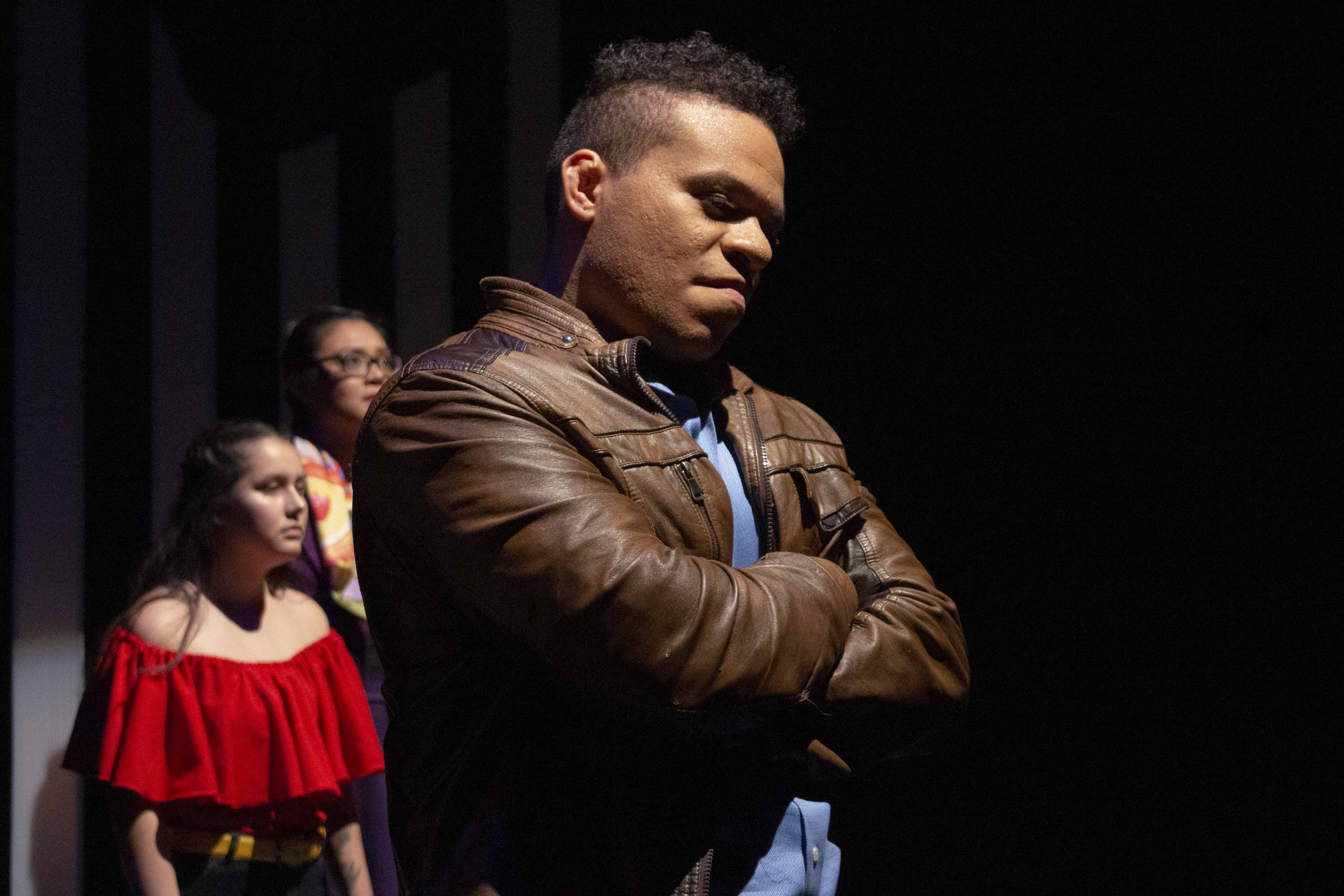
    While COVID-19 leaves the world silent, Humboldt State University theater students are trying to raise their voices and create change. Reports of racial typecasting and the wrong types of inclusivity began to surface and the students decided to work together to create a better program for future students.

    “We’ve definitely had issues in terms of racial casting,” said senior theatre major Jaiden Clark. Clark is President of Alpha Psi Omega, a theater based fraternity at HSU.

    “The higher ups in the department and the faculty try to be inclusive in the wrong ways,” said Clark.

    Part of the issue was the selection of shows. According to Clark, there is a volunteer committee where students and faculty pick which shows will be done. Although it is voluntary, Clark mentioned in a few cases of shows being catered to people who are in the committee.

    “Anyone needs to be able to have a say,” said Clark. “I think it would cool to have a more democratic system.”

    HSU senior AJ Hempstead, a double major in theatre and religious studies, has faced discrimination when accepting roles for shows.

    “People are trying to be more inclusive, especially at HSU, I get more roles,” said Hempstead. “I was offered a role because of my acting level but also because they needed someone with a specific skin color.”

    “I would really like to see shows where it doesn’t matter the race or gender of the actor playing the role,” said Clark.

    Clark and Hempstead both agreed they wanted to see more shows being chosen that had characters that could be played by anyone, so the audience is sent a more equal message.

    “Colorblind casting is not actually a thing, there’s no such thing as colorblind anything because people are going to see.”

    Jaiden Clark

    “What are they doing, what messages are being sent here and where are those messages coming from,” said Hempstead.

    Hempstead wants the audience to look at what was represented onstage and think about the decisions that were made with casting, rather than produce shows that had to have a certain type of person.

    “Colorblind casting is not actually a thing, there’s no such thing as colorblind anything because people are going to see,” said Clark. He noted the faculty needs to be more color-conscious instead.

    Hempstead’s idea for improvement involved wanting to see a more active teacher assistants program where higher level students could help teach other students along with professors.

    “Teachers aren’t the enemy in any of this that’s happening,” Hempstead said. “We want to work with them as much as possible. We empowered our students, we empowered our community and that didn’t mean taking power from them. I see that power struggle.”

    Clark agrees with Hempstead, believing that open discussion can alleviate feeling uncomfortably and create progress.

    “It’s a really important time for people to talk about what worked and what they liked and what made them uncomfortable and what shouldn’t be done again,” said Clark. “When change is needed in the theatre industry, you have to start in universities. If we are behind Broadway, then we have to catch up because our people are just the people who aren’t there yet.”

    Associate Professor and Theatre Program Leader Troy Lescher responded to the rumored racial typecasting in an email. He asked for clarification if it were about racial representation onstage.

    “These processes are imperfect and are very prone to mistakes. Theatre is also a living art that relies on human storytellers,” Lescher said in an email. “Race, gender, age, physical attributes and vocal qualities are among dozens of casting considerations that impact representation onstage.”

    In response to what HSU is doing to ensure racial typecasting will not continue, Lescher said he would listen to a student if they felt racially typecast and would try to find an alternative learning opportunity for them with the director.

    “Afterward, I would bring this matter to the Season Selection Committee (which is composed of faculty, staff, and students) so that we could collectively work to strengthen our process,” Lescher said in an email.

    Lescher acknowledged the challenge of racial representation in casting and believes the program is guilty of not following through.

    “I believe there have been instances when our program has not exercised the cultural competence necessary to best support our students and their learning,” Lescher said in an email. “Critical awareness of and cultural sensitivity to matters of representation are important to our program and we continue to learn and to strengthen.”

  • Dreams in Between

    Dreams in Between

    Cast and crew of “Dreamers: Aquí y Allá” shed light on complexities of immigration

    The story starts in the blue and red lights that bathe a replica-sized model of a wall. Not just any wall, but The Wall, the most southern one that separates country from country, family from family and the hopes of migrants for better opportunities and life.

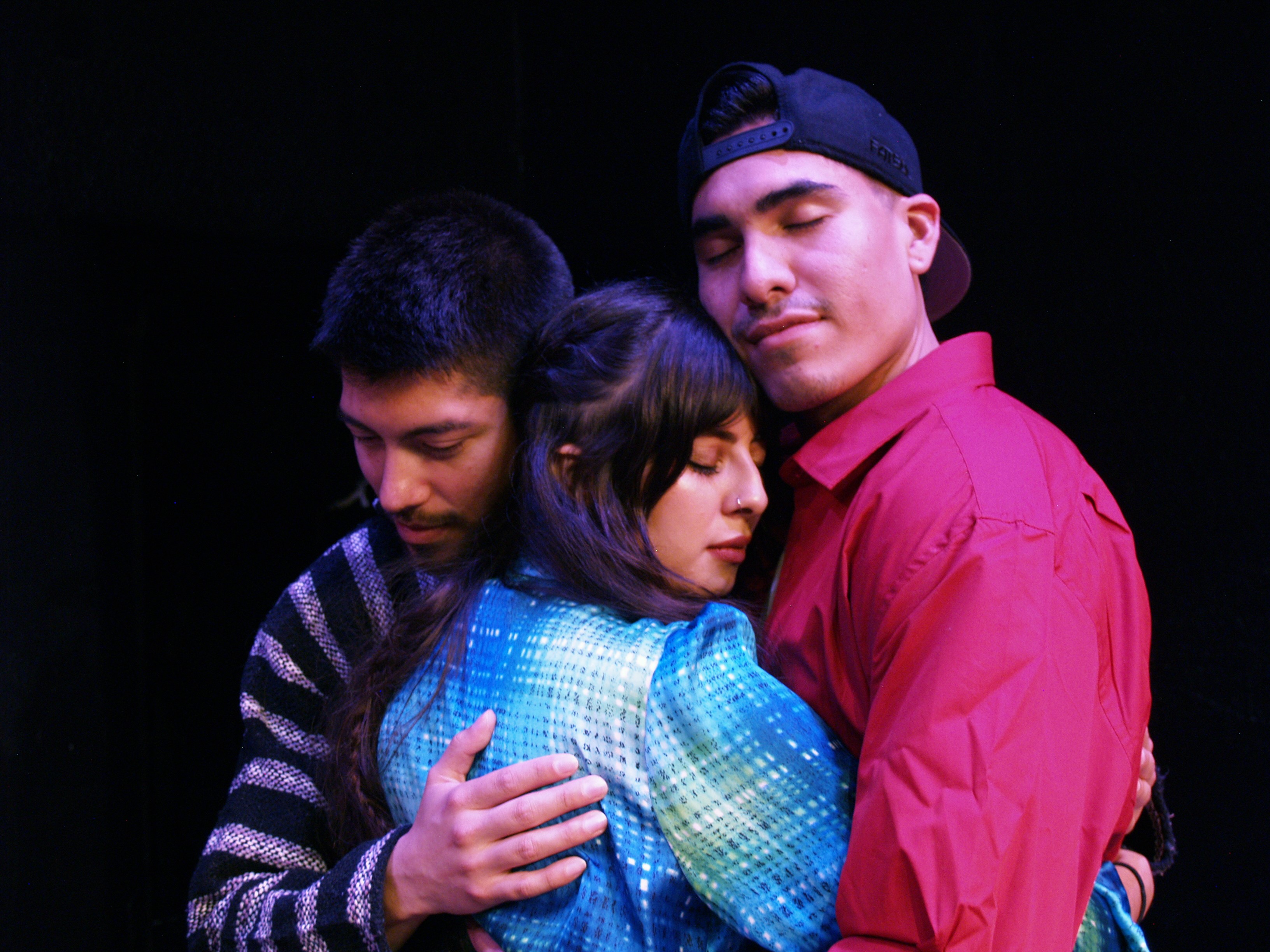
    In that obscurity, bodies shift and take steps until they’re center stage and in full view. They face you, you face them and under the spotlight, the stories of immigrants and Deferred Action for Childhood Arrival recipients begins.

    “Some of these scenes will break your heart because they show so much humanity,” Co-Director Andrea Carrillo said. “Humanity is such a great big theme within this story. You can’t help but connect and feel compassion for these individuals.”

    The Humboldt State University Theater Arts, Film and Dance Department presents “Dreamers: Aquí y Allá.” The script was written by Andrea Caban, her students, and a collaboration from source material provided by Armando Vazquez-Ramos and the California-Mexican Studies Center.

    Students in the California-Mexico Dreamers Study Abroad Program, DACA recipients and immigrant community members gave testimonials and interviews for the script.

    Troy Lescher, co-director and HSU associate professor, came upon the script in spring 2018 when Caban emailed the script to all 18 California State Universities in hopes they would produce the show.

    “I was blown away by the humanity of the story,” Lescher said. “As soon as I read it I said to myself, ‘We have to do this show at HSU.’ I mean, because of our social justice mission, commitment to minority voices on stage, how timely this issue is and this play had HSU written all over it.”

    The play follows the memories and lived experiences of immigrants and DACA recipients who then obtained advance parole, which gave them opportunity to travel to Mexico and reconnect with their culture and families.

    Carrillo said that they go through time jumps and include the audience as they break the fourth wall in various scenes from start to finish.

    However, circumstances prevented the play from happening until fall 2019. Lescher reached out to theater arts graduate students Carrillo and Amy Beltrán via email. They said that they were overjoyed about directing the play.

    “For me the biggest thing was to evoke empathy within the community because a lot of the community, as well as in Humboldt County, can be either on the middle ground or can be very conservative,” Carillo said. “These are human beings with their own experiences, their own love, their own families, and that was a big thing for me to show that to them.”

    But just as the directors were compelled to tell this story, so too were the actors.

    Business marketing major and theater arts minor Victor Parra, who plays Mateo, said he knew it was important for him to get involved when he heard about the script.

    “As an actor and artist this is the kind of stuff that catches my attention,” Parra said. “This is the kind of work that I want to do personally.”

    Parra said it’s important to remember that the play is a cumulation of many stories, real stories, and that these are real people who struggle everyday. These were stories close to him because he experienced similar struggles back home.

    “We have to keep working to give spaces for minority voices to be heard, especially voices that aren’t heard very often.”

    Troy Lescher
    Co-director

    “I brought a lot of personal past into this and it was my own decision,” Parra said. “Nobody asked it of me, but because I relate to this.”

    Parra plays Mateo, who in the play fears being deported and leaving his child and mother behind. He said that is what happened to him when one of his parents was deported not too long ago, and he brought those feelings into the production.

    “I envision my own family,” Parra said. “That’s what I just had to bring to the table because it’s so important. We need to say this. We need for our voices to be heard and something needs to happen.”

    Lescher knew that he wanted to encourage and open the production to more students, so he reached out to El Centro Académico Cultural Coordinator Fernando Paz, Interim Executive Director of the Office of Diversity, Equity and Inclusion Edelmira Reynoso and Multicultural Center Coordinator Frank Herrera.

    The result was that out of 11 cast members, six of them were non-theater majors and four of them performed for the first time.

    “This story hits differently,” Carrillo said. “It resonates differently with people. It’s such an immediate connection with a lot of Latinx people and people of color. It made sense that we had so many new faces in the theater.”

    Lescher said that the challenges DACA recipients struggle with is a big part of the conversation, because their voices are often unheard or aren’t highlighted in the news.

    “We have to keep working to give spaces for minority voices to be heard, especially voices that aren’t heard very often,” Lescher said.

  • ‘Dreamers: Aquí y Allá’ Preview

    ‘Dreamers: Aquí y Allá’ Preview

    Theater Arts Department presents a production that transcends borders

    The room is dark, the audience silent. On stage, right before your eyes, a story begins to unfold. Actors stride onto the set, and within seconds, they transport their audience into a world that deals with fears of family separation, job loss and deportation.

    But that world is reality, as the actors break the fourth wall and address issues for immigrants and Deferred Action for Childhood Arrivals recipients.

    “I read the script and I thought, ‘Wow, this needs to be told,’” Co-Director Andrea Carrillo said. “I know that there’s a good portion of undocumented people living in Humboldt County as well. It’s a great way to show the community that we see you, we hear you and we want to do what we can to share your experiences and your voices on stage.”

    Humboldt State University’s Theater Arts Department will premiere a production of “Dreamers: Aquí y Allá” this weekend and next. The show features testimonials and interviews from students in the California-Mexico Dreamers Study Abroad Program, DACA recipients and community members.

    “I’d say for people who have heard the story and don’t necessarily connect with the politics, I’d say, stay open minded about it. You never know what you might experience or learn. You might surprise yourself as an individual.”

    Andrea Carrillo

    The production is co-directed by theater art graduate students Amy Beltrán and Carrillo along with Assistant Professor Troy Lescher. “Aquí y Allá,” first produced at California State University, Long Beach, was written by Andrea Caban and presented as a collaboration between Caban, her students, material provided by Professor Armando Vazquez-Ramos and the California-Mexico Studies Center.

    “This is a story that needs to be heard. You need to be here and sit with it and listen intently and openly as well,” Carrillo said. “I’d say for people who have heard the story and don’t necessarily connect with the politics, I’d say, stay open minded about it. You never know what you might experience or learn. You might surprise yourself as an individual.”

    “Aquí y Allá” opens Dec. 6 in Gist Hall Theatre and continues Dec. 7, 12, 13 and 14 at 7:30 p.m. There will be a matinee at 2 p.m. on Dec. 15. Tickets are $10 for general admission and $8 for student and seniors. For tickets, visit the Center Arts website or call 707-826-3928.

    After the show on Dec. 6, representatives from HSU’s Scholars Without Borders and Centro Del Pueblo will present on DACA initiatives. Following the shows from Dec. 12 through 14, Professor Vazques-Ramos will present a 30-minute lecture called “Dreamers 2020: What’s Next?” followed by a Q&A.