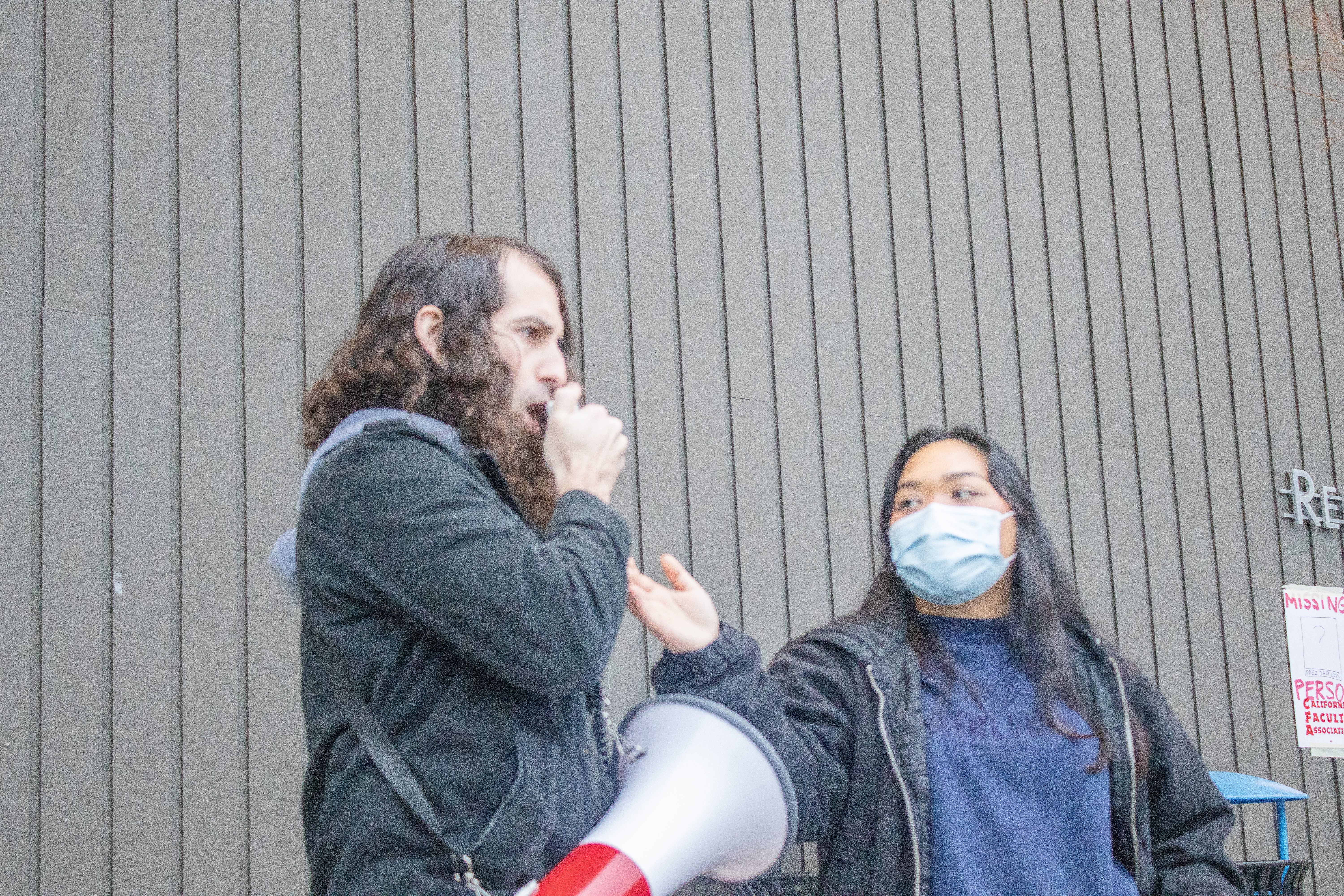
The doors were locked. The windows were covered up with cardboard. Cal Poly Humboldt President Tom Jackson was set to host a donor event on Jan. 23 at the Reese Bullen Gallery, but a couple dozen protestors gathered outside the gallery to condemn Jackson and his absence from campus, as well as the CSU tuition increase and the addition of the recent housing application fee.
Rick Toledo, a member of the Students for a Democratic Society, spoke at the rally.
“The goal was to finally get a hold of Tom Jackson, because he’s never in his office,” Toledo said. “He’s never on campus.”
One student who preferred to remain unnamed, rather going by Doe, said that they want to bring advocacy to the tuition hike.
“That is going to hurt students in the coming fall of 2024,” Doe said. “[Jackson] only cares about getting more students and then fucking them over by making us pay more tuition, more in housing.”
Where we were, what went wrong & how we build a brighter future
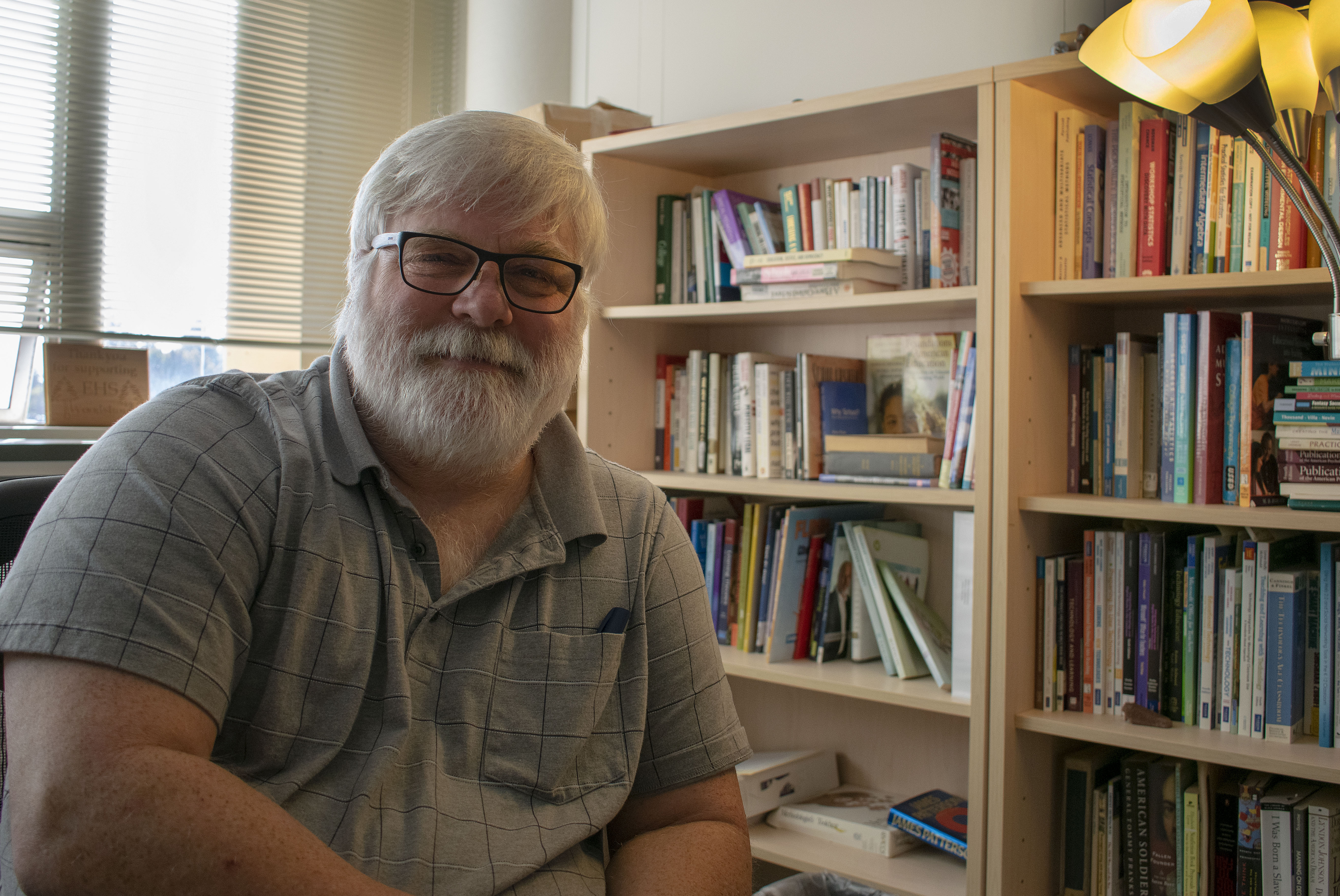
This is a letter to the editor from Humboldt State University Education Department Chair Eric Van Duzer, Ph.D. It has been edited only for minor punctuation and grammar style preferences.
As I reflect back on nearly 30 years at Humboldt State University, first as a student and then for the past 20 years as a faculty member, I wanted to share some of the thoughts that I have about HSU’s current situation and where the campus might go from here.
As a student I experienced a remarkable education where faculty were fully invested in my intellectual and personal development. There were so many opportunities to explore areas of interest and develop new ones. I have spent many hours trying to encapsulate the nature of the schooling I experienced in a way that would really represent the experience.
The best analogy I have been able to come up with was that HSU offered a graduate education to undergraduates. The small classes typical of graduate school encouraged faculty to fully invest in their student’s growth. The university, set so far from the oversight of CSU headquarters in Long Beach, offered a great deal of flexibility to shape our experiences.
This would be impossible today. In those days HSU had the third smallest class sizes in the 23 campuses of CSU. But more than that, it had a unique faculty ethos that reflected nearly 100 years as a student-focused institution that exalted excellence in teaching above all else.
I was the first student CEO of the Institute of Industrial Technology, a self-supporting club that allowed us to use the skills and knowledge we were developing to grow in business acumen, engage in manufacturing and light construction on campus as well as conduct experiments for local agencies. In its second year, Bill Wilkinson used the institute to earn enough profit making desks for campus offices that it paid for several pieces of expensive equipment for the department.
This would be impossible today. In those days HSU had the third smallest class sizes in the 23 campuses of CSU. But more than that, it had a unique faculty ethos that reflected nearly 100 years as a student-focused institution that exalted excellence in teaching above all else.
Faculty came to campus because this is where they wanted to spend their career. Unlike most universities where faculty play academic hopscotch building their resume through research reputations and earning ever-higher salaries as they bounce from college to college, HSU faculty built their reputations on teaching. These were inherently local reputations, not very valuable if one wanted to move on, but rather a reflection of the values and attitudes associated with a culture of excellence in the service of students’ intellectual growth.
As anyone who has worked with university budgets will tell you, graduate education is expensive. That is why through the first 100 years, the administration and other services were done on a shoestring. It was common for a variety of upper administrative positions to be filled by faculty who served temporarily. Staff was thin and overworked and processes were slow and inconsistent.
What happened? In the early 2000s the CSU was facing the onslaught of a Generation X student bulge. Chancellor Charles Reed decided the best strategy to deal with this situation was to homogenize campuses so that if a student could not get into Sacramento State because it was impacted, they could simply go to another campus and get a similar experience.
Yet, the campus, with significant leadership from the faculty, focused its significant resources on classroom instruction, and through that dedication, produced exceptional graduates who were deeply committed to HSU when they graduated.
I remember an administrator in the early years telling me that he had been in a restaurant on the East Coast and overheard a group of students talking at a nearby table. He was so impressed with their sophistication and the values they held he found out where they came from and immediately applied for a job at HSU.
He was the first person hired under then-president Rollin Richmond to manage our enrollments in the early 2000s. The diversity on our campus is a credit to him and Richmond, who reached out across the state to bring in students from urban areas. Sadly he became disillusioned and left. So did most of the faculty leaders.
What happened? In the early 2000s the CSU was facing the onslaught of a Generation X student bulge. Chancellor Charles Reed decided the best strategy to deal with this situation was to homogenize campuses so that if a student could not get into Sacramento State because it was impacted, they could simply go to another campus and get a similar experience.
Shortly thereafter the upper administration received inflated titles and significant raises in an apparent effort to reduce resistance. Then the attack on the faculty began.
Naturally, faculty on campuses such as HSU who were proud of their traditions and niche identities resisted. Fiercely. At one point, three campus presidents, including Rollin Richmond, suffered through votes of no confidence by their faculty as they implemented this strategy.
To achieve the required changes in the face of faculty resistance, campuses, including Humboldt, began shifting to a corporate structure of top down management. Faculty who had held a privileged position in campus life were systematically reduced to workers with only a symbolic voice in campus decisions. The administration turned its focus inward towards improving the functioning of the bureaucracy. They eliminated administrators such as Rick Vrem, an ethical provost, who refused to implement changes that hurt the traditional focus on instruction.
Vrem was replaced with a provost who had no such compunction. Shortly thereafter the upper administration received inflated titles and significant raises in an apparent effort to reduce resistance. Then the attack on the faculty began. Nearly 80 faculty positions were eliminated over several years and during the same time period, a similar number of new staff positions were created and filled to support administrative functions.
Over the majority of the intervening 15 years, budget reductions for academic programs have been the norm: reductions in staff, program availability and courses. This year it was a 6% cut, last year another and many like it before. The funds have been shifted to an ever-expanding variety of administrative initiatives.
Now we sound more like a parks and recreation office than a university. Come for the redwoods, the beaches, the bike riding—that is wonderful and I love it, but it is not why people pick a university.
We spend nearly 68% of our budget on administration and campus facilities. Despite the results of a study commissioned by Rollin Richmond’s administration that showed the two most important factors that cause a student to come to HSU are quality of education and availability of the program they are interested in, both have been repeatedly attacked, sliced and diminished.
It is surprising that no one seems to notice that every time we cut academic programs, fewer students want to come here. And when fewer students come here, the budget suffers and HSU responds by cutting academic programs even more severely—a cycle the faculty in 2004 described as a “death spiral.”
As we address our current crisis and try to figure out what we need to become in order to grow back to a sustainable enrollment, we might want to engage in some soulful reflection. What would cause a 20-year-old to come to a place five hours from major centers of civilization and spend four years with us? What do we have to offer them that is so valuable, so different from what they can get at any of the other CSU campuses which are closer, cheaper and offer a great deal more college life in the community?
We stopped selling the small classes and close academic relationships with faculty when the hypocrisy became too much to bear as campus priorities shifted. Now we sound more like a parks and recreation office than a university. Come for the redwoods, the beaches, the bike riding—that is wonderful and I love it, but it is not why people pick a university.
When I arrived here as a faculty member in 2000 we had one staff member, John Filce, doing institutional research. He was wonderful and badly overworked. I am sure he still is. Now we have nine staff members listed in the directory in the Office of Institutional Effectiveness, including a vice president. I am sure their work is valuable, but to pay for it we had to cut 64 class sections.
Today, we are an organization of inflexible rules and their keepers.
We have proliferated the bureaucracy, which is unfortunately necessary to achieve top-down control of a professional organization. Had our leadership studied industrial technology with me, they would know what companies in the 1970s learned: that this form of management is ineffective and inefficient in a professional organization.
To achieve control requires monitoring, which in turn requires more staff. For a top-down organization, where the vast majority of employees serve at the will of their manager, fear prevents innovation and compliance is key. Before the shift to this model, administrators were problem solvers. In fact, the standing joke in those days was that everything was an exception. Faculty, staff and administrators had the flexibility to serve the needs of students even when it required bending the rules.
Today, we are an organization of inflexible rules and their keepers. It has greatly diminished the effectiveness of the organization and its ability to make decisions that best serve our students. The resulting bureaucratic culture has seen a proliferation of forms, rule books and rigid adherence to often dysfunctional orders.
This is no way to run a university. Perhaps a grocery store, but not an organization of 500 highly educated experts with thousands of years of collective experience. Top-down decision-making, particularly when the president and upper administrators are drawn from institutions that do not share the culture and values of the campus, is inherently poor compared to what would be possible if faculty once again had a meaningful voice in campus affairs.
No student has ever come to HSU because we have a wonderful registrar’s office or because the president’s office is fully staffed. These only matter when they impact the quality of the education a student receives.
The proof of this is apparent everywhere at HSU. When Rollin Richmond came, he had no interest in what made HSU special. Like a white suburban principal coming to a school in Watts, he thought he knew what needed to be done to remake the university into his vision of a modern institution. That ignorance has cost us immeasurably. Today we face the consequences. The failure to fundamentally change direction of subsequent presidents has simply deepened the mess. We now have a new president, perhaps we can find a new vision.
In my view there are two key concerns that need to be addressed from a rational and values-driven perspective. First, an effective budget model that allows funding to follow enrollment is essential to support growing programs while shifting resources to where they will best serve student needs and interests. This can refocus the campus on providing the service/product students come here for—classroom instruction—and it is essential.
There are so many amazing faculty and academic staff here. They are people with a heart for their students, struggling in a system that constrains and conflicts with their efforts. Let their voices guide the future and we may yet have one worth celebrating.
No student has ever come to HSU because we have a wonderful registrar’s office or because the president’s office is fully staffed. These only matter when they impact the quality of the education a student receives.
Second, we have to decide how we are going to rebuild the excellence we once were known for in our student’s academic programs. The day Rollin Richmond refused to give the Outstanding Faculty Award to a physics professor (selected by the faculty based on his ability to delight and inspire students) because that professor had not published, is the day we snuffed out the soul of the old HSU campus.
Now we need to find out what animates us in ways that provide an experience worth the isolation, cost and struggles required to live in this remote community. Redwoods are not enough; we need a reinvestment in education.
I am retiring from HSU at the end of this May. I am sad to see what has happened to my university. There are so many amazing faculty and academic staff here. They are people with a heart for their students, struggling in a system that constrains and conflicts with their efforts. Let their voices guide the future and we may yet have one worth celebrating.
Several administrative changes at HSU suggest high turnover
In the last three months, three Humboldt State University administrators jumped ship. A game of musical chairs has since taken place as staff have shuffled around to fill the gaps.
Since November, HSU has appointed a new interim provost, interim college dean, Title IX coordinator, Student Health Center director and Human Resources staff recruitment manager.
While it’s unclear how the changes will affect HSU, the shifts appear in line with data suggesting high turnover rates among college administrators.
The changes began in November, when Provost and Vice President for Academic Affairs Alex Enyedi left HSU to become the 11th president of the State University of New York, Plattsburgh.
Enyedi served as HSU’s provost and vice president of academic affairs since 2015 after leaving Western Michigan University, where he served as a biology professor and dean of the College of Arts and Sciences.
Enyedi left WMU amid controversy as his contract expired despite a petition of support with 1,300 signatures, according to reporting from the North Coast Journal. Enyedi said he believed his contract was not renewed due to his requests for raises for female college employees. WMU pointed to enrollment declines and budget adjustments—familiar phrases for HSU—as the cause of his departure.
“The turnover rate for deans or directors of education topped the list at 22%, while the rate for provosts sat second-highest, at 21%, according to the analysis. Presidents or chancellors came in third, at 18%.”
Data from Higher Education Publications
HSU announced Dean of the College of the Arts, Humanities and Social Sciences Lisa Bond-Maupin as interim provost on Nov. 26. While Bond-Maupin serves, HSU said it would search for the next provost.
“There will be a national search for a new Provost, with opportunity for input and participation from individuals across campus,” the Nov. 26 announcement said. “Details of the search plan will be shared when they are finalized.”
HSU then appointed Spanish Professor Rosamel Benavides-Garb to take Bond-Maupin’s place. Benavides-Garb previously served as associate dean of CAHSS and chair of the World Languages and Cultures program.
On the same day as the Enyedi announcement, Nov. 20, HSU announced Executive Director of Student Health and Wellbeing Services Dr. Brian Mistler had resigned and taken the job as Chief Operating Officer of Resolution Care in Eureka.
In Mistler’s place, Associate Vice President of Student Success Stephen St. Onge now leads the Student Health Center alongside Dr. Karen Selin and Dr. Jen Sanford. The Nov. 20 press release noted that the plans for the future of the SHC’s leadership would be revealed in January. In the meantime, the release made a promise to students.
“In honoring HSU’s commitment to our students, we are looking into opportunities to expand hours and services for students starting the Spring 2020 semester,” the release said.
“Marcus has been an invaluable team member and has served HSU, with his many years of experience, during a time of great change and uncertainty for Title IX departments across the country,” the release said.
Taking Winder’s place is Human Resources Staff Recruitment Manager David Hickcox. Hickcox worked for HR and as an investigation officer for the Title IX Office for the last two and a half years, according to the release.
Recruitment Manager Nicole Log, who, according to the release, has served HSU for five and a half years in the HR department, then took Hickcox’s place.
Finally, Interim Director of Academic Resources Holly Martel got to remove the “interim” from her title on Nov. 18. Martel, who served as the interim director since 2017, has worked at HSU for 24 years in a variety of roles, from financial planning to personnel management.
According to 2016 data from Higher Education Publications, a company that publishes college data in its online Higher Education Directory, college administrators experience high rates of turnover compared to other administrators.
The turnover rate for deans or directors of education topped the list at 22%, while the rate for provosts sat second-highest, at 21%, according to the analysis. Presidents or chancellors came in third, at 18%.
A summary of the analysis gave a variety of possible causes for the high rates.
“When compared to other administrators, the cause for such high-level turnover can be linked to many diverse issues such as growing financial, faculty, Board and political pressures,” the summary said. “Also, traditionally colleges and universities have made leadership selections from within, minimizing risk.”
However, the analysis did not list the administrative turnover rates with which it compared college administrative turnover rates. The Lumberjack has reached out to Higher Education Publications and will update this story online when we receive a response.
The Lumberjack has also reached out to HSU for comment. We received word that HSU Associate Vice President of Human Resources David Montoya and his team are gathering turnover data and will have a comment at a further date. We will update this story online when we receive said comment.
An HSU memo sent out Jan. 21 revealed results from a spring 2019 Great Colleges to Work For survey conducted at HSU. The national survey, intended to inform institutions about workplace culture, sheds some light on the status of the HSU administrative staff.
Across 15 categories, the HSU results came back most positive in the job satisfaction, compensation, pride and supervisors or department chairs categories. The results came back most negative in the senior leadership, policies and faculty, administration and staff relations categories.
HSU will hold two presentations in Goodwin Forum, one on Jan. 24 and one on Feb. 4, to further discuss the findings with faculty and staff, according to the memo.
A Q&A with HSU interim Athletic Director Jill Willson
The athletic department at Humboldt State is in a transition phase under the new administration of President Tom Jackson Jr. Previous interim Athletic Director Duncan Robins left his position in June.
While searching for a permanent Athletic Director, President Jackson recruited Jill Willson and her company Double L Consulting for the position. Willson received her degree in biology from West Texas A&M University, then went on to coach the women’s basketball team and later run the athletic department for the university. Willson specializes in Division II athletics, more specifically in community outreach and recruiting and she serves on an NCAA committee for Division II athletics. Willson created Double L consulting to help Division II schools run their athletic department during times of transition.
Could you tell me about your personal background and the company you are with?
I’m a longtime women’s basketball coach and former athletic director at Texas A&M- Kingsville, which is where I spent the majority of my career. In 2007 I started my own company, which is called Double L consulting, two L’s in Jill and two L’s in Willson is how I came up with the name. I really founded the company to help Division II schools across the country. I help schools with the membership process and the transition from NAIA or Division III to Division II programs. I arrange all of the community engagement events for the Division II National Championship events. Three years ago I diversified Double-L consulting to help schools hire athletic directors, and what we do is help fill the seat while the athletic department is doing the search, so they are not down a staff member.
What are your goals, within the athletic department, for the upcoming academic year?
Our job is to help build a quality pool of candidates for the search committee to help find the next Humboldt State Athletic Director. It’s my goal to do a bit of a program review and evaluate what kinds of things we are going well and what things we need to work on so that when the permanent athletic director is hired in January, they can take off and run.
What is your current evaluation of the athletic department and where do you want it to be when you turn the reigns to the next athletic director?
Honestly, what makes Humboldt such an amazing institution is the people, and the athletic department staff is no different. They do a tremendous job at recruiting student-athletes and getting them to be great athletes, helping them do well academically and getting them to graduate. I think this is a great opportunity to help the athletic department to do an even better job at what they already do well.
What qualities are you looking for in the next athletic director for Humboldt State?
You need to have someone come in that is committed to making a difference in Humboldt County and on-campus at HSU. We need to have someone who can help fundraise, and the responsibility of the next athletic director will be to find new revenue streams and open up the athletic department to new boosters and new donors. Being a great leader and leading by example on campus for the student-athletes is crucial, and we need to be able to hold coaches accountable for academic success as well.
Introducing Tom Jackson Jr., Ph.D., Humboldt State’s new president
It’s not everyday you meet a university president who has the tenacious intention of changing their student body’s perspective beyond their educational experience.
Tom Jackson, Jr., Ph.D. began his incumbency as Humboldt State University’s eighth President in June 2019. In his second university president position, Jackson plans for more than just the future of the university, but also for the success of the current and future students.
“The students I want to gain are important,” Jackson said. “But the students we have now are more important. They are the ones that we want to see succeed and want to see finish now.”
With 11 professional positions under his belt, Jackson is far more than familiar with holding an administrative position at a university. From Assistant Director of Residence Life to Dean of Students, Jackson has worked at campuses across the United States, including the University of Southern California, Texas A&M University, University of Louisville and more recently as the president of Black Hills State University.
Aside from his educational work, Jackson spends his free time riding horses, scuba diving, flying planes and watching college sports. The last 21 years of his life, however, have also been spent raising his now 21-year-old son and 18-year-old daughter with his wife, Mona Jackson.
President Tom Jackson socializes at the Staff Family Picnic on August 23 in the UC Quad. | Photo by Collin Slavey
“I can’t have too many expensive hobbies,” Jackson said. “And being a pilot and plane owner is a very expensive hobby, particularly when you add in being a father of two college-aged students.”
When asked about the number one lesson that could be taken away from his previous presidency position at Black Hills State University, Jackson replied with the idea that he has based every administrative position around providing students with a positive, educational and meaningful experience.
“It’s the focus on our student body,” Jackson said. “It is really simple. The arguments all go away when we connect the importance of what we’re doing to what students are aspiring to do.”
Acknowledging the ups and downs of education as a meaningful practice creates for a positive outlook on day to day life. It is this similar thought process that Jackson hopes to bring to light as the new president of HSU. Over the past few semesters, students have been searching for support and protesting about issues that are important to not only the student body but the surrounding community as well.
“If you had a positive day and you learned something that links to your educational experience, you’ll be just fine the next day.” Jackson said. “If you wake up angry at the world, then you’re not starting off the day in the most positive state of mind.”
With the murder of David Josiah Lawson and the verdict declining to indict any person a part of his stabbing, students have felt pain and worry as they continue their education at HSU. Feeling safe on campus and in the community is important for students and their parents, and Jackson thinks so too.
“If you wake up angry at the world, then you’re not starting off the day in the most positive state of mind.”
Tom Jackson Jr., Ph.D.
“We have to be able to provide our students a controlled opportunity to figure it out for themselves,” Jackson said. “It is no different than what our parents tried to have us do… if they were that type of parent.”
In July 2018, an HSU press release stated the final decision made to cut the football program after the end of the season. Students, faculty and community members were outraged and disappointed with the decision.
“There is no secret that football is expensive,” Jackson said. “To keep a football program usually means you have a student body that is willing to pay a pretty good price to keep it here because that is where the source of funds comes from along with the donors.”
Jackson talks about the recent knowledge of head injuries in the sport of football and how it can add to the perspective of why so many universities cutting their teams may be a positive change. He asks the question, “Is keeping a football program the most responsible thing we could be doing today?”
According to Jackson, the Saturday evening excitement that comes with supporting a football team is an emotional experience that most students and community members look forward to.
Tom Jackson sitting in his new office. | Photo by Skye Kimya
“We’re missing that excitement on a Saturday that brings people together,” Jackson said. “That is what we have to revisit as a university. What is it that is going to bring us together today?”
With the loss of football, came the conversation of a potential diversity decrease that may result from losing the program. Although Jackson accepts the intention behind that conversation, he mentions his rejection to the argument.
“In its simplicity, that is saying that football was about diversity,” Jackson said. “That’s troubling because there are other ways to have diverse conversations.”
One of Jackson’s many goals for students is to be able to comfortably have diverse conversations on campus without having to go out of the way to do so.
In the coming years, he hopes to create a community where diversity is not just based upon the color of your skin, opinions on complicated subject matters or what you look like, but the person that you are.
Jackson is also focused on the improvement of HSU’s retention rate through marketing and outreach, which links to enrollment. He mentions that the cost of off-campus student housing may be the biggest limiting factor the school has involving enrollment.
“Another goal is to strengthen our relationships in the community and connect our student body to the community as one,” Jackson said. “Tied to that is branding ourselves in a different way.”
Jackson brings a different perspective to light when he talks about the way HSU portrays itself. He alludes to the idea that hearing all of the negativity and baggage prevents people from wanting to a part of the school’s community and believes showing off strengths is more attractive and promising.
“I want us to focus on the good,” Jackson said. “I want us to celebrate the good and enjoy the place that we happen to be at today.”
This website uses cookies to improve your experience. We'll assume you're ok with this, but you can opt-out if you wish. Cookie settingsACCEPT
Privacy & Cookies Policy
Privacy Overview
This website uses cookies to improve your experience while you navigate through the website. Out of these cookies, the cookies that are categorized as necessary are stored on your browser as they are essential for the working of basic functionalities of the website. We also use third-party cookies that help us analyze and understand how you use this website. These cookies will be stored in your browser only with your consent. You also have the option to opt-out of these cookies. But opting out of some of these cookies may have an effect on your browsing experience.
Necessary cookies are absolutely essential for the website to function properly. This category only includes cookies that ensures basic functionalities and security features of the website. These cookies do not store any personal information.
Any cookies that may not be particularly necessary for the website to function and is used specifically to collect user personal data via analytics, ads, other embedded contents are termed as non-necessary cookies. It is mandatory to procure user consent prior to running these cookies on your website.