Luke Kennedy’s katana is heavy. He busts it out for parties, which he and his roommate Miles Conte throw every weekend. Except when there’s not supposed to be class on a Tuesday. Then, Mondays are prey too.
“We were trying to pick a date that would stand us out from the crowd,” Conte said. “We were just trying to start off the extension of winter break off with a bang.”
With the CFA strike eliminating class on Monday, Jan. 22 for college students all over California, Kennedy and Conte decided to host a bonus party at their place, a dayger that started at 3 p.m. 40 people showed up to party in their house. Though some people left when everyone got the news that the strike was off, most stayed until about midnight or so.
“When we [got the news] it was evening time,” Kennedy said. “It’s the height of the party. I’m walking around with the beer bong and loading it up with [left-over beers] and loading people up. And then [someone] said, ‘Hey, I think we have classes tomorrow!’ Everyone’s pulling up the email. And so there was this whole conversation — ‘Oh, what’s going on?’ And honestly, everyone was like, ‘Fuck it, I’m not going to class’… But I think, party or not, most people would have probably ditched that Tuesday.”
Conte said it was more fun when they realized the strike was off.
“The party vibe became immaculate when we learned we had class tomorrow,” Conte said.
He turned to Kennedy for a moment.
“What do you think?” Conte said. “Is ‘Immaculate’ a good word to use in this situation? Or not?”
Conte did skip class the next day; Kennedy attended.
“[When the strike only lasted one day], I was initially rebellious,” Conte said. “Because I am not going to my classes.”
Both Conte and Kennedy said if the strike had continued as planned, they likely would have thrown at least two more parties throughout the week. Any more than that likely would have been overkill. Conte laughed at the idea while he rolled a cigarette with gas station tobacco.
“We just party, all day, every day,” Conte said. “No sleeping allowed. That would have been hilarious. Like, yeah, ‘We’re going to have a continuous party for five days straight.’”
Freshman Bryn Urdi had a good time at the strike party. She was glad that she was in bed by the time she got the news that the strike was off. Urdi said she would definitely have attended again if given the opportunity, but the best part was seeing all of her friends again.
“It was really nice to come back from break and see all of my friends again,” Urdi said. “It was great just to be with them for a while.”
Kennedy believes that the parties he and Conte throw offer an important service to students they can’t get anywhere else.
“I think that the parties make students more excited to go to class because they get to see their classmates,” Kennedy said. “[Campus] feels like a zoo environment, in that it can become a goal, clocking in and out of class every day. You don’t really know anyone there. I feel like the mark [the parties make] makes the school a thing, versus just something you clock in.”
“We bring a full-charge mentality to partying,” Conte said. “We’re passionate about making people happy and having a good time.”
Despite the attitude, Kennedy isn’t just about drinking and getting rowdy.
“I respect somebody’s performance,” Kennedy said. “I look at somebody; are they a degenerate? Do they get good grades? Are they healthy? I don’t want to encourage students to just drink and party. There’s tuition. I think it’s important that students remember that they’re here to get a degree, hopefully learn something and become a better person.”
After months of organizing, students working for CSU campuses are getting ready to vote on whether they would like to unionize as part of California State University Employees Union (CSUEU). If they vote to join, the CSUEU would negotiate contracts on the student’s behalf.
Student workers, such as Leah Baker at Cal State Monterey Bay, stress the importance of a union for this campus population.
“CSU has student workers doing the labor that usually union employees would be doing,” Baker said. “But they’re paying us much, much less, and they’re not giving us any of [union] kinds of benefits.”
With a unionized contract for student workers, Baker hopes that it will allow for improved conditions and benefits for student workers such as a discounted parking pass. Student Assistant Tori Umeda at Cal Poly Pomona shared why they are voting to unionize.
“I am voting [in favor of] a union because I am sick and tired of struggling every day to make ends meet,” Umeda said. “Many of us work multiple jobs besides being students just to cover the basics like food, rent and utilities. Often, we have to work [when we’re] sick because we don’t have sick time.”
Communications Officer for CSUEU Khanh explains how student workers can vote.
“Voting starts on Jan. 25 [and ends Feb 22]. Student Assistants will receive an email the day before [Jan. 24] with instructions to access their electronic ballot,” Khanh said. “[Students] will be issued a PIN unique to them in order to vote. This is a historic election, the largest of its kind ever, and we know thousands of student workers are ready and eager to vote, ‘union yes,’ and join CSUEU/SEIU 2579 as the next wave of union leaders building a more equitable CSU for all.”
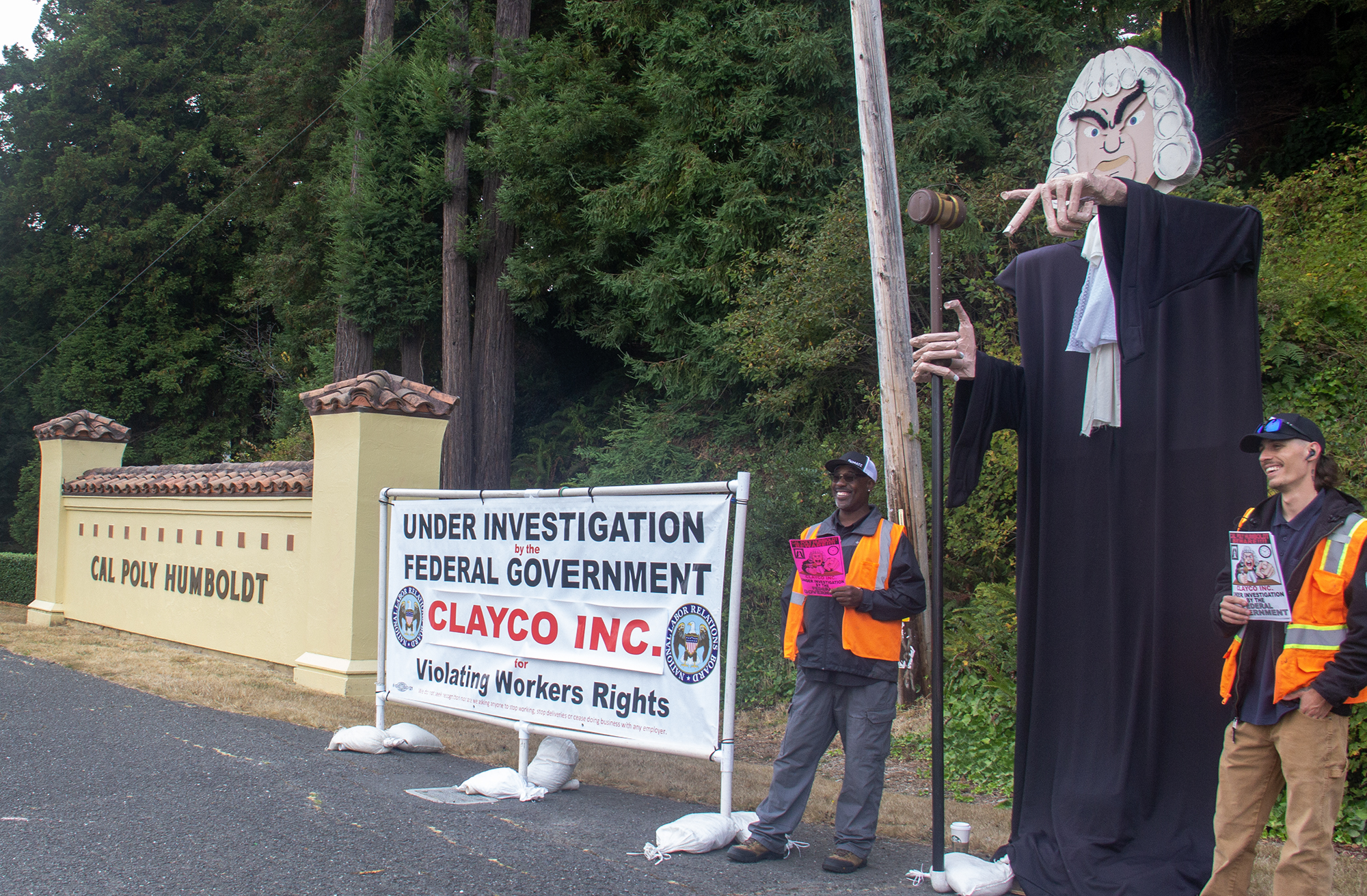
A giant stood on LK Wood. It was twice the height of the men around it, armed with a massive hammer and a demonic scowl. It pointed with a long, curled finger at every soul underneath its gaze, framed by a wooden wig and caterpillar eyebrows. It was a judge, and judge it did.
Photo by Alex Anderson | Members of the carpenters union placed a tall judge statue in front of the Cal Poly Humboldt entrance sign to protest Calyco
“Judgment day is coming,” it said. “Shame on you. Shame, shame, shame!”
No ogre was laying waste to Arcata. It was built as a protest by Local Carpenter’s Union 751 against Clayco, one the companies in the running to bid on the Cal Poly Health, Housing and Dining Infrastructure project, also referred to as #PLY106. The Union and their main goal is to bring the company’s legal issues and history of malpractice to the attention of the campus committee that awards infrastructure projects, and to the community in general.
THE CONSTRUCTION PROJECT
Construction on the Housing, Health, and Dining building is set to begin fall 2024. The new facilities include a new health center and dining hall, and will be able to house roughly 450-500 students. The facilities are planned to be operating by August 2026, or summer 2027 at the latest. The direct construction will cost at least $108.9 million and the guaranteed maximum budget is $131.9 million. The winning contractor will be announced in October of this year.
MALPRACTICE AND WORKING CONDITIONS
In a legally fact-checked letter from Union Local 751 to the CSU Board of Trustees, there is a list that cites Clayco’s history of legal issues due to allegations of malpractice. Clayco has been a defendant in at least 22 cases since March 2000. Since 2010, they have had at least 17 OSHA violations brought against them, resulting in fines around $81,336. Clayco’s legal issues include an active investigation by the Federal government concerning allegations of violating worker’s rights and harassment of union members, a pending case concerning allegations of wage theft, and a wrongful death lawsuit concerning a worker’s death that was settled last year.
OSHA Citation against Clayco documents details on Kirk Smith’s accident
In August 2017, Kirk Smith, an employee of the subcontractor Watson Companies Inc., fell 35 feet to his death while working on the construction of an Ulta Beauty warehouse in Fresno CA. The fall was a result of a weakened roof not being fixed for employees to safely work on, as well as a lack of warnings concerning the stability of the roof. Smith left behind a wife and children, who then sued Clayco along with Ulta and Watson for wrongful death in April 2018. Clayco, along with the other defendants in the case, eventually settled with the Smith family for $5 million in 2022. Attorney Brett D. Beyler, representing Smith’s family, wrote in the court settlement document that the incident was entirely avoidable.
“On August 9, 2017, Kirk Smith (the decedent) arrived at the Project,” Beyler wrote in the settlement document. “He was directed by Watson [Companies Inc.] foreman, Mr. Rabideau, to cut out the membrane and insulation on top of the metal decking. As Mr. Smith was cutting the membrane and insulation out with a hand knife, the weakened metal decking gave way like a trap door, causing Mr. Smith to fall nearly 40 feet to his death. This incident was entirely avoidable. Unfortunately, due to the negligence of Clayco and NDBS [National Design Build Services], Mr. Smith is no longer alive.”
WAGE THEFT
Decision by US District Judge John Mendez gives background info on allegations of wage theft
Clayco is currently in an active case regarding wage theft. These allegations are brought forth by labor rights organization, The Workforce Defence League (WDL), representing laborers who worked on Amazon Fulfillment Centers in Sacramento and Tracy who say that they have not been compensated for their overtime work or use of their own tools in the construction project.
According to the WDL, the laborers worked 58 hours a week and were promised $20-24 an hour. They weren’t fully paid for their regular or overtime hours, and they didn’t receive their work breaks and only got one meal break. They also didn’t get compensated for the missed breaks.
HARASSMENT OF UNION REPRESENTATIVES
NLRB charge against Clayco for allegations of harassing Union members
Clayco is also under current investigation by the federal government for allegations of violating workers’ rights as well as harassment of union representatives. Two separate documented charges brought against Clayco by the National Labor Relations Board were filed as recently as November 2021. They claim that the contractor unfairly fired a subcontractor from their position, and attempted to prevent the Carpenter’s Union from conducting their activities by barring them from Clayco properties and instructing Clayco employees to limit contact with Union representatives. Additionally, videos on the Local 751-run website, Claycofails.com, show alleged harassment of Union organizers. One instance alleges that a Clayco foreman followed and videotaped an organizer.
“[Clayco] interfered with the exercise of protected rights by firing a Union signatory subcontractor when Union Agents tried to access the site,” one document read.
“[Clayco] interfered with the exercise of protected rights by calling the police when the Union tried to access the job site, surveilled and videotaped Union agents and ordered workers not to talk to the Union,” according to the other document.
CLAYCO’S RESPONSE
In an email, Clayco’s Vice President of Marketing and Communications Sarah Green forwarded a statement from Clayco’s legal team. The statement said that Clayco is the target of a campaign of Union harassment. The statement made the case that the Union has no legal right to access any Clayco properties and that the Union’s ultimate goal is to get Clayco to sign a collective bargaining agreement with them.
“Since 2021, [Union members] have filed 11 unfair labor practice charges against Clayco with the National Labor Relations Board (NLRB),” according to the email. “8 out of these 11 charges have either been withdrawn or dismissed, and the remaining three charges will go to hearing in October [2023]. Nor does the [Union] report that the NLRB matters arise from the [Union] and/or its members attempting to forcibly enter two Clayco California projects despite having no legal bona fide right to enter those projects – resulting in them having to be removed by police.”
Labor Counsel for Clayco, Andrew Martone, adds that no one affiliated with Clayco has brought charges against the company through the National Labor Relations Board, and that any Federal investigation against Clayco is a result of Union actions only.
“No Clayco employee and no employee at any Clayco worksite has filed a complaint with the NLRB,” said Martone. “Charges brought are by the [Union], and they don’t represent any Clayco employee.”
Court document provided by Clayco that has been given a red flag by Westlaw
Green also stated that the Union has been misleading in their campaign.
“The [Union] misleads the reader to believe OSHA citations were issued against Clayco that were in fact issued to other entities,” said Green, “and reports OSHA Citations without informing the reader that OSHA found no violations existed.”
However, Lumberjack reporters were able to find OSHA violation documents concerning the death of Kirk Smith. Clayco shared a court statute with Lumberjack writers that documented tactics by the Union. However, the statute was labeled as “amended, repealed, superseded, or held unconstitutional in whole or part” by Westlaw, a legal research company. Unfortunately, since Lumberjack writers were unable to gain further access to Westlaw files, we are unable to say why it was labeled as such.
UNIVERSITY INVOLVEMENT
Lumberjack writers reached out to Procurement Specialist, Addie Dunaway of Contracts and Procurement department of Cal Poly Humboldt, as well as Humboldt Director Planning, Design & Construction, Kassidy Banducci of the Facilities Management Department. Both expressed a desire to comment, but were limited in their ability to speak as the bidding process is still active. Any comment on Clayco’s involvement from Cal Poly Humboldt staff and admin could violate legal obligations, as well as compromising fairness to the other three potential contractors.
University documents confims that Clayco, Sundt, and Swinerton are three companies on the shortlist for the #PLY106 contract. A fourth potential bidder is currently unconfirmed. The Union has also sent a letter to the Board of Trustees concerning Sundt’s history of malpractice.
Communications Specialist with the News and Information department, Grant Scott-Goforth, shared some information on the infrastructure project, though he was unable to comment on any allegations brought against potential contractors.
“The Committee remains diligent in their work towards a fair and equitable evaluation process governed under the provisions of the law in the state of California,” according to a statement released by the University. “Cal Poly Humboldt is committed to its responsibility under California regulations for public work projects and the better good of the construction industry. Any information regarding the performance or behaviors of proposing firms will be considered against CSU policies and State regulations.”
UNION AWARENESS
Union Organizers from Local 751 spread awareness to the campus community about where their money may be going—especially the funds that students give to the school as part of their tuition.
“How has a contractor with this history got this close to a major project?” said Harvey McKeon, a field representative for the Union. “Which, at the end of the day, is [funded by] public money, and it’s also by extension student’s money, and [the students] should have some sort of control and say over how that money is spent.”
The organizers from Local 751 want to make it clear that although they are a union, their endgame isn’t to try and have a union-backed construction company be awarded the contract. Rather, they want to ensure that a company with multiple legal issues and allegations of malpractice isn’t able to gain a foothold in the community and public works projects, and to try and create a better and safer working environment for all laborers.
“As a union, our recent track record has been to lift standards for workers whether they’re union or non-union,” McKeon said. “The reason why we are seeking to generate awareness about Clayco is because we want to draw attention to what Clayco does to workers that we don’t formally represent, but we care about their working conditions.”
Beyond a desire to bring Clayco’s past and current legal issues to light and try to create safer environments for workers, some organizers such as McKeon feel a personal responsibility to ensure a safe working environment for both contractors and the community at large due to their personal experience as a worker without union support. The union also wants those at Cal Poly Humboldt that awards infrastructure projects like #PLY106 and potential contractors that there must be precedence for companies rooted in ethics.
“I’ve been in jobs before I was a labor union organizer where I didn’t have anyone looking out for me because I wasn’t in a union, and I don’t think that’s a reason why you shouldn’t have people not look out for you,” McKeon said. “We’re trying to represent [all laborers] even if they’re not currently union members. It’s like trying to plant a tree whose shade you may never sit in.”
Editing note:
On Sept. 6, this article was edited to clarify that Clayco’s Vice President of Marketing and Communications Sarah Green shared Clayco’s statement from legal team with a reporter via email. The statement made the case that Clayco is the target of a campaign of Union harassment and that the Union has no legal right to access any Clayco properties and that the Union’s ultimate goal is to get Clayco to sign a collective bargaining agreement with them.
The article was also edited to remove reference to a contractor who’s bid on the project could not be confirmed.
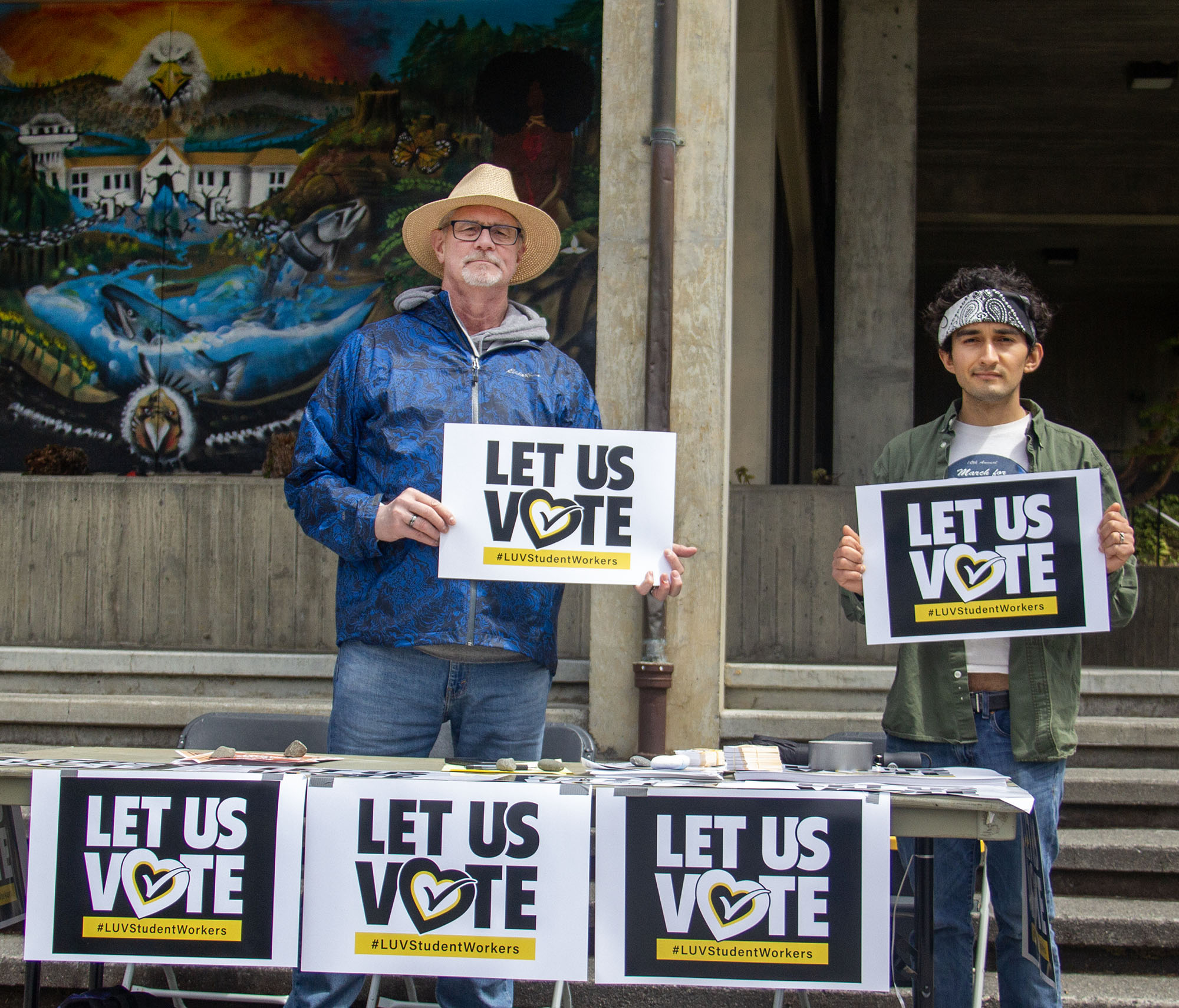
CSU officials are now deciding whether student workers should be allowed to unionize, after students petitioned the California Public Employment Relations Board (PERB) on April 17 for the right to take a union vote. This was accompanied by around 4,300 signatures from CSU student workers.
Daniel Chaidez is a student assistant at CPH, working for the university’s Waste Reduction Resource Awareness (WRRAP) Program. He says that the Let Us Vote campaign will hopefully give students a better foothold for bargaining with the university.
“It would just make things a little more equitable and bring a little more awareness to the issues that student workers are currently facing,” Chaidez said.
Chaidez tabled on the UC Quad on April 18 along with Stephen Green, a labor relations representative for CSUEU, the CSU employees union. The CSUEU is taking an active role in supporting students working for unionization.
“When hiring a lot of student assistants it’s very unorganized in a lot of ways,” Chaidez said. “It feels like it’s just a way for the school to get easy labor from students.”
“[Student Workers are] a pretty significant part of the workforce that keeps this campus running, or the system running,” Green said. “And they don’t get treated with a lot of respect. They get abused, and they have no voice at all in their working conditions.”
Chaidez thinks that better parking infrastructure for student workers would be a good first step, either with subsidized/discounted parking passes or reserved spaces. Another concern for Chaidez is the weekly hours caps for student workers.
“A lot of students are cut off at 6 or 7 hours a week,” Chaidez said. “And that’s not really working for a lot of people.”
Many student assistants and employees are paid minimum wage, and at 6 or 7 hours a week, this forces them to supplement with second or even third jobs to make ends meet. More jobs means less time for students to study, let alone relax.
Some CSU student workers are even paid less than the minimum wage in their area. This is because the CSU only pays state-wide minimum wage as a state-wide organization, as reported by CalMatters.
If the board approves this request, workers at CSU universities will have the opportunity to organize, something which is automatically given to non-student workers.
“It’s kinda a new thing for students to have a union on campuses,” Chaidez said.
Other universities and university systems have had high-profile unionization processes recently, including the University of Oregon and the UC system, according to Green. If the request to unionize at the CSU is approved and the students vote to unionize, the resulting organization would be the largest student employee union.
“Generally, the PERB is pretty worker-friendly,” Green said. “I think we have a pretty good case, that we’ve submitted a sufficient amount of legitimate signatures.”
In the meantime, advocates continue to gather support, hoping to apply pressure to the PERB.
Student workers who wish to join the unionization effort can contact the CSUEU to sign a union card, and to add their signature to the PERB petition.
“You don’t want to assume these things, so we’re still gathering more signatures,” Green said.
In the print version of this article, Dr. Loren Cannon was referred to as a psychotherapist. He should have been identified as the Cal Poly Humboldt CFA President.
An Unfair Labor Charge has been filed against the Cal Poly Humboldt Board of Trustees on November 8th due to violations found in their contracting with Timely MD. The Public Employee Relations Board found the University in violation of government codes regarding the failure to notify Unions in contracting decisions.
The charge was originally filed back in October 2021 by the California Faculty Association after being made aware a contract was signed with Timely MD without their knowledge.
“They signed this contract before meeting with CFA, the union that represents counselors, and that’s a big no-no. That’s the basis of our unfair labor practice charge,” said Loren Cannon, president of the Humboldt chapter of the California Faculty Association.
Timely MD, also known as TimelyCare, is a Texas based counseling provider that works in conjunction with CAPS. They provide 24/7 counseling support as well as individual counseling sessions during breaks and outside business hours.
“I’ve heard when you try to get an in person appointment, they refer you to TimelyCare,” said Chelsea Rios-Gomez, intern for Students for Quality Education.
TimelyCare has been available to Cal Poly Humboldt students since March 2022 after switching from the platform ProtoCall due to complaints of long wait times.
“If you’re in a mental health crisis, you don’t want to wait online. So they were looking to have something to improve that. But in doing so, they contracted with a company that isn’t just doing emergency counseling, they’re doing regular counseling, which is a union job,” Cannon said.
Outsourcing union jobs to out of state entities not only puts faculty at a disadvantage, but also poses a new risk to students engaging with TimelyCare.
“You will be finding good counselors. Not all of the counselors there are going to be bad.
But there are some counselors, some faith based counselors, more specifically Christian counselors, who are perpetrating harm to our students,” said Rios-Gomez.
Timely MD, while not a Christian organization, offers faith based counseling services to Christian universities and has a working partnership with the Council for Christian Colleges and Universities.
“We’re outsourcing union jobs, and we’re also outsourcing responsibility for our students’ wellbeing,” Cannon said.
Texas is a state with a reputation for anti LGBTQ+ policies and practices. Five years ago, Gavin Newsom Passed Assembly Bill 1887, which prohibits state-funded travel to Texas and 23 other states with discriminatory LGBTQ+ policies and practices.
“We can’t even fly to Texas for an academic conference because we’d be putting money in the Texas economy,” said Cannon.
Thanks to legal loopholes in state jurisdiction, students logging into TimelyCare who, for example, would want to file a Title IX lawsuit, would have to do so in Tarrant County, Texas.
“The Council for Christian Colleges and Universities actively argues that religious colleges should be able to receive federal funding, and to be able to discriminate against LGBTQ+ students, basically saying they are not protected under title 9,” said Cannon.
Students for Quality Education, who work in coordination with the California Faculty Union, has been made aware of an array of discriminatory encounters on on the platform.
“It’s a lot of invalidating of trans identities and queerness in terms of pushing Christinaity in that way,” said Rios-Gomez.
When it comes to addressing the needs of the Cal Poly Humboldt community, Cannon said it’s important for unions to be involved in contracting these services, so CAPS can find vetted counselors that actually understand the needs of the community they’re involved in.
“What is the most important thing is to value the people doing the important work on our campus,” Cannon said.
As of November 8th, the Board of Trustees has 20 days to respond to the complaint charges by proving they didn’t violate labor laws and union members rights.
“The fact that it went forward from that initial step is that the people at the PERB must think that our charge has merit, and I’m not a lawyer, but it’s pretty cut and dry without talking to us and without negotiating it,” Cannon said.
This website uses cookies to improve your experience. We'll assume you're ok with this, but you can opt-out if you wish. Cookie settingsACCEPT
Privacy & Cookies Policy
Privacy Overview
This website uses cookies to improve your experience while you navigate through the website. Out of these cookies, the cookies that are categorized as necessary are stored on your browser as they are essential for the working of basic functionalities of the website. We also use third-party cookies that help us analyze and understand how you use this website. These cookies will be stored in your browser only with your consent. You also have the option to opt-out of these cookies. But opting out of some of these cookies may have an effect on your browsing experience.
Necessary cookies are absolutely essential for the website to function properly. This category only includes cookies that ensures basic functionalities and security features of the website. These cookies do not store any personal information.
Any cookies that may not be particularly necessary for the website to function and is used specifically to collect user personal data via analytics, ads, other embedded contents are termed as non-necessary cookies. It is mandatory to procure user consent prior to running these cookies on your website.