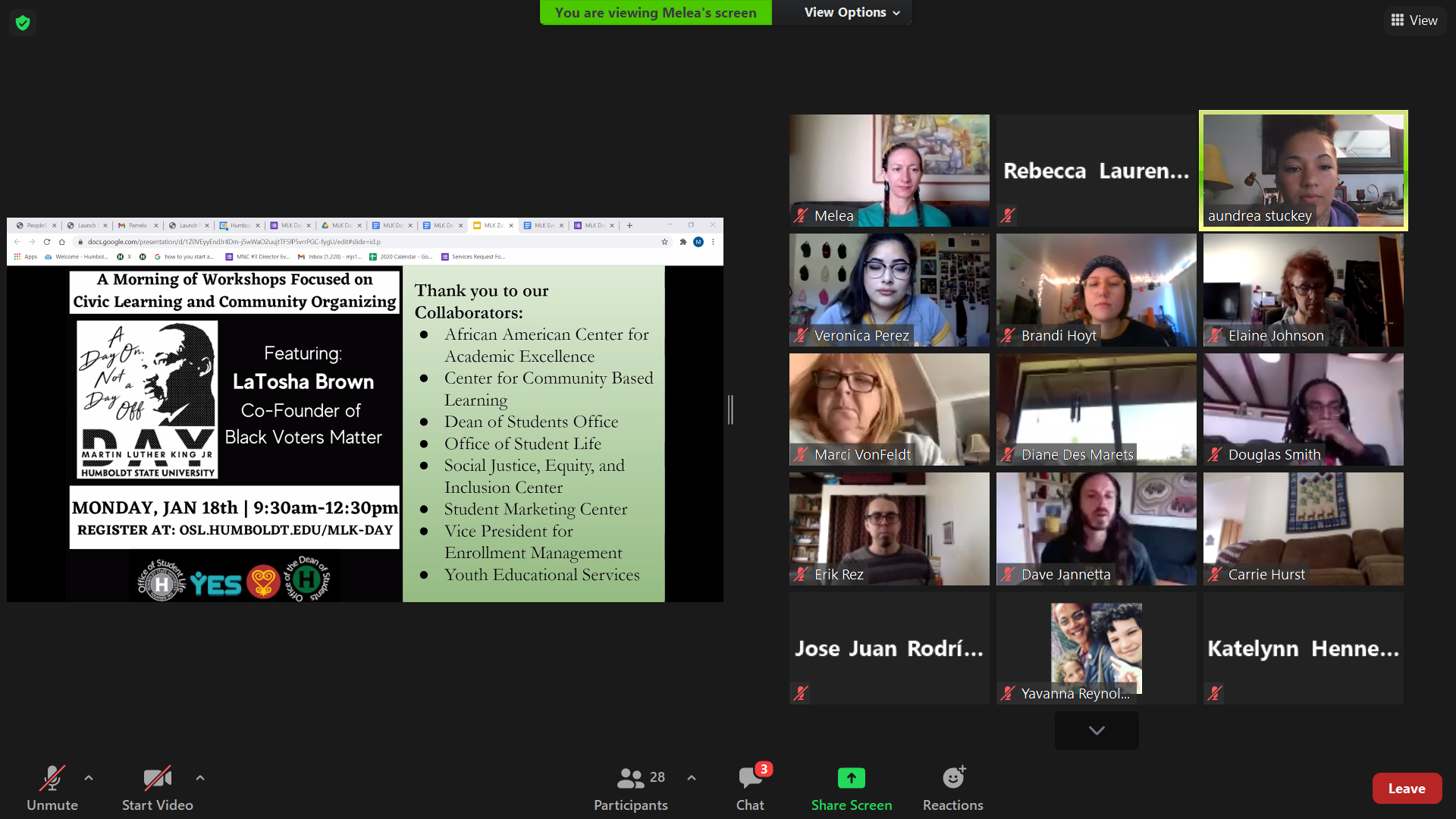
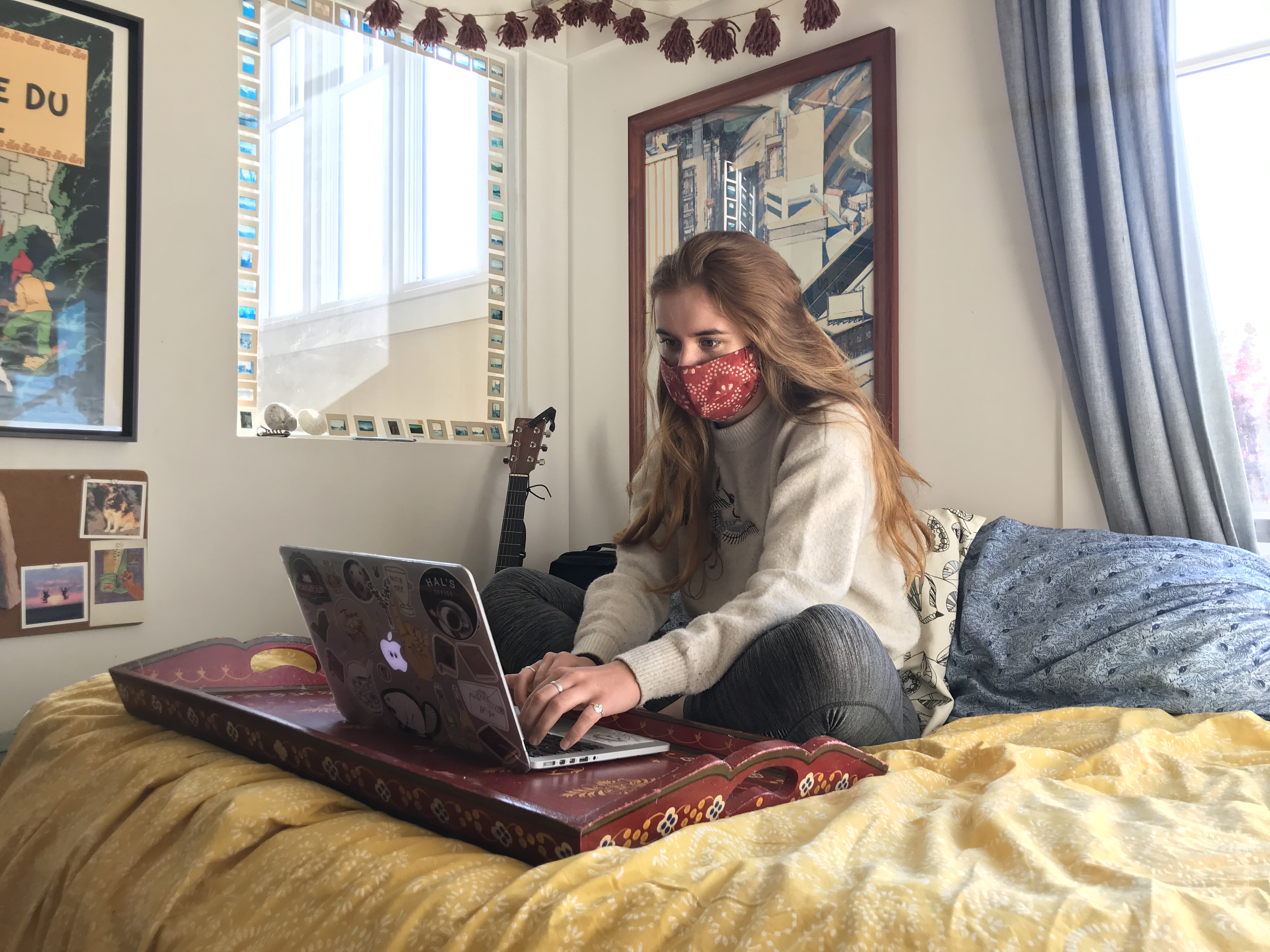
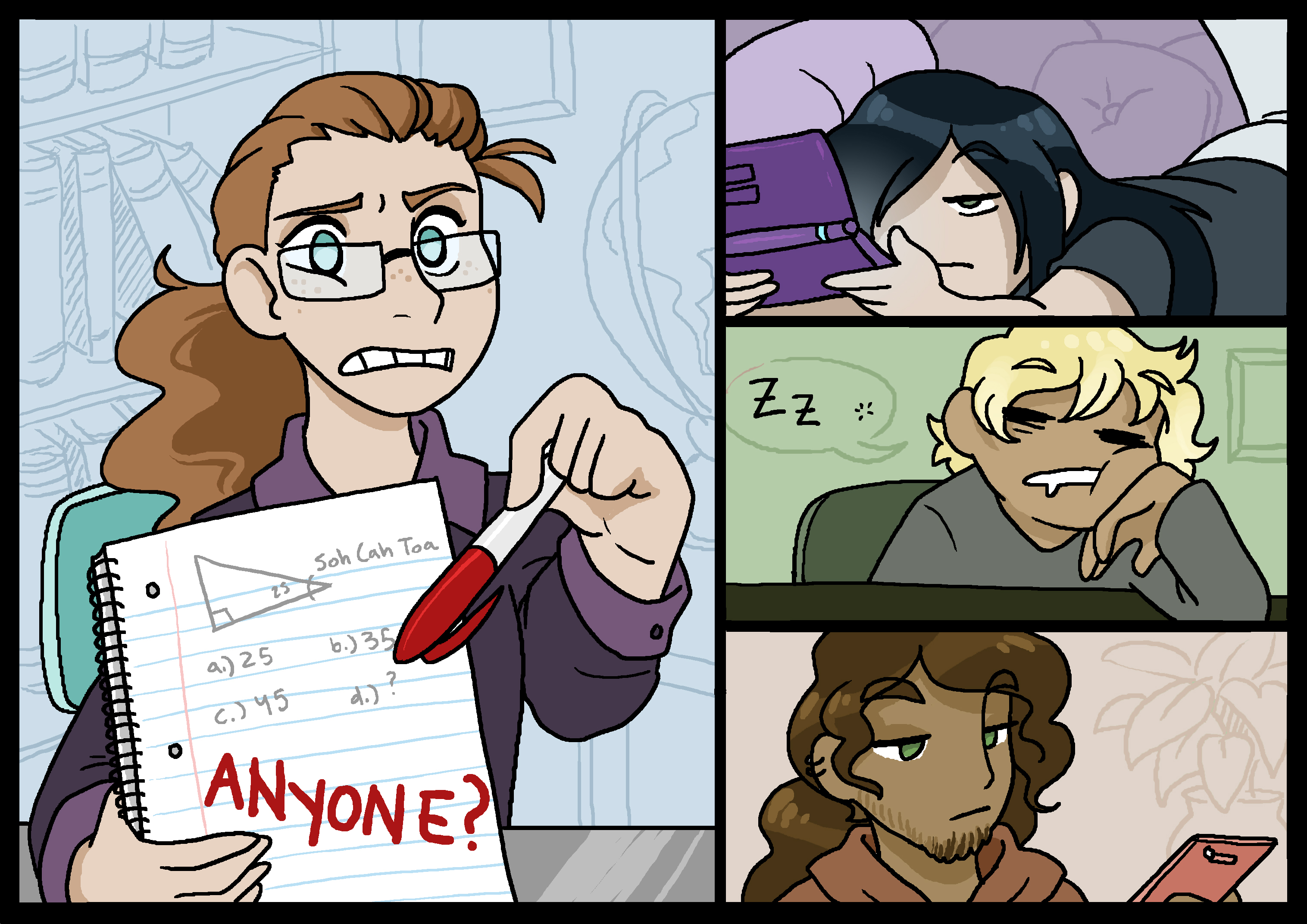
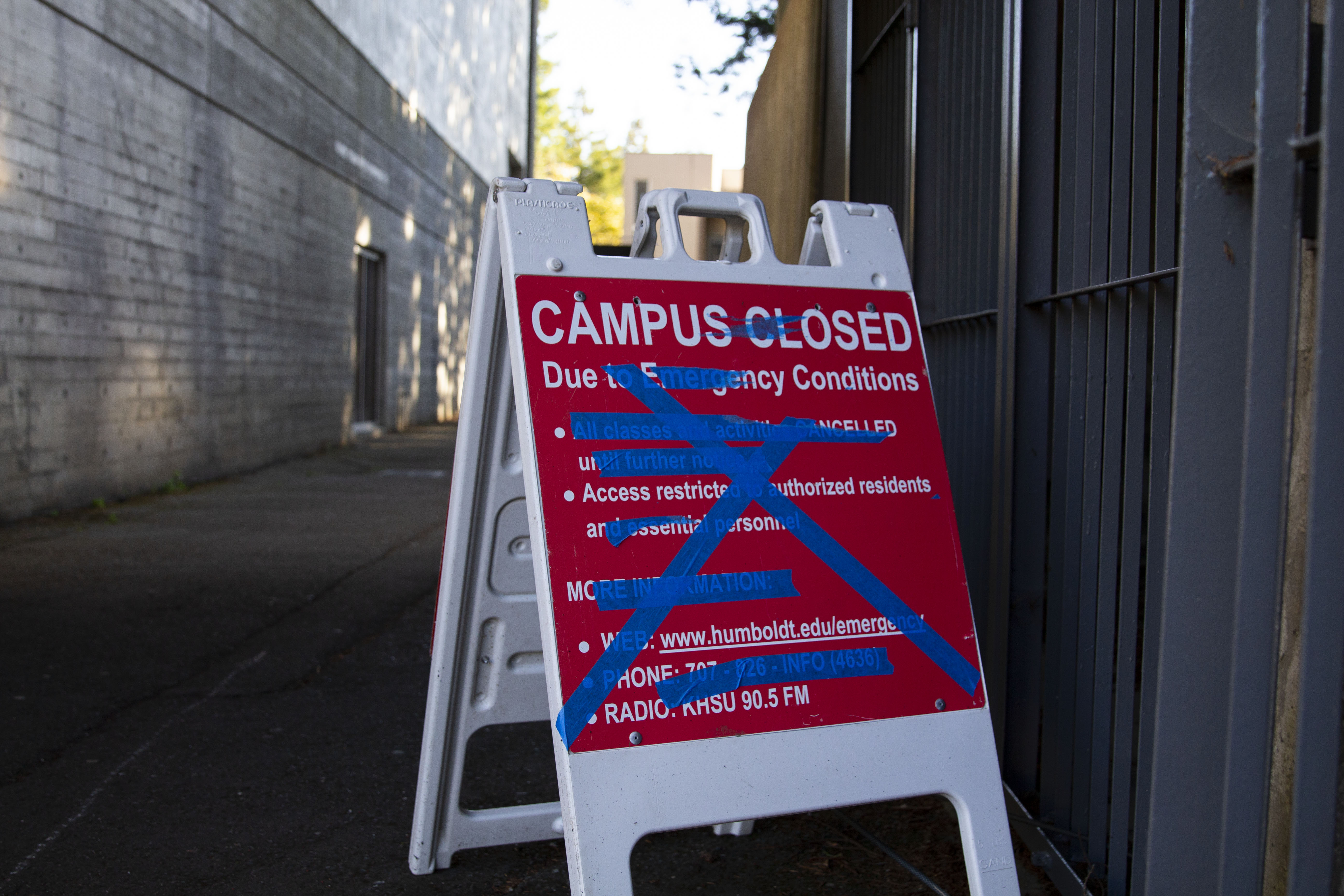
MLK day of service is a national initiative. This year at HSU there was an event hosted via Zoom for Martin Luther King Jr. that began with a keynote speaker, LaTosha Brown and continued into two breakout rooms with workshops such as Art and Community Activism by Aundrea Stuckey from Youth Art Will Succeed (YAWS).
Prior to the event, Molly Kresl, the student life coordinator, was excited about the event still going on regardless of not being able to host it in person due to the pandemic protocols.
“Last year we did MLK day of service and we had three different volunteer sets and over a hundred people to volunteer and eighty participated,” Kresl said. “It was totally successful and we were so happy.”
Kresl wanted to continue the event virtually to allow the community to be able to participate in the event from the safety of their home and still get a meaningful experience.
“Us being in a virtual semester, we wanted to continue the tradition because it is a brand new tradition, we think it is a really valuable and important event,” Kresl said. “So we had to kinda reinvent what it looked like.”
Towards the end of introductions, a slide was dedicated to labor and land recognition such as native land in Humboldt county and acknowledging the labor that built this country.
LaTosha Brown was the first keynote speaker and spoke about what MLK day means, the work she has done for Black Voters Matters, experience, and motivating the audience. In the beginning, she sang a song and spoke on the impact of the song.
“A song in their heart, they had hope,” Brown said.
Brown’s speech related to addressing those who have been affected by COVID-19 and this year in general.
Within the break, there was an option to join breakout groups composed of participants and main speaker interactions through the chat and aloud. Most of the content of the breakout rooms was back and forth conversation and understanding the importance of MLK day.
Stuckey’s breakout room focused on subjects within the art community and involvement with POC artwork in Humboldt county.
“Where do you see black art? Black people?” Stuckey said.
The second breakout room was dedicated to discussion between participants and main speaker Ron White from the Humboldt Area Foundation discussing his presentation “The Salvation of Democracy: Civic Engagement of the Dispossessed.” Sarah Hammoudi, a senior bachelor’s social work major, attended the second breakout session with White and was a participant for the event.
“I then attended the workshop held by Ron White on civic engagement and it was an amazing opportunity,” Hammoudi said. “I was even able to speak in a small breakout group with him which gave me even more insight and inspiration.”
Overall the end of the event ended with questions from participants to the main coordinators and speakers and leveled into a deep discussion.
“LaTosha Brown, the keynote speaker, was absolutely inspiring and provided amazing insight,” Hammoundi said. “ She said ‘we are called to evolve’ which makes me remember despite how unpredictable the past year’s circumstances have been, we surely can be a piece to making real change one day.”
Hammoundi was inspired not only by Brown but also the event, the other speakers, and the meaning behind the day itself.
“MLK day to me definitely is a reminder to do good for others as you wish to receive,” Hammoudi said.
Limited fact-to-face interaction challenges elementary education majors and K-8 students
The pandemic forced limited face-to-face interaction between Humboldt State University’s Liberal Studies Elementary Education majors and currently enrolled K-8 students in Humboldt County.
According to John Lee, a School of Education professor, community building amongst the LSEE students is easier in face-to-face classes. In an effort to build community in his classes, Lee used extended breakout group activities, games for students, breathing exercises, brain and music breaks and regular check-ins.
“Feeling a part of a community or social integration is essential for learning,” Lee said. “It puts students at ease so they can focus on learning.”
Fourth-year, undergraduate students and those in the teaching credential program started out the year teaching over Zoom. As more local schools opened up, HSU students were able to conduct limited face-to-face instruction with their elementary students using a hybrid instruction model.
Stella Mantova, a LSEE major, teaches in a second grade classroom at Alice Birney School in Eureka. Because Eureka started the school year online, Mantova, her students and the other teachers experienced a huge learning curve.
“Teaching over 20, seven-year-olds at once isn’t an easy task,” Mantova said. “But when you add in the fact that some of them are still learning to unmute their microphones, things become a lot more complicated.”
Of all the challenges Mantova has faced since the pandemic began, connecting with her students has been the most challenging.
“Online teaching seems like we don’t have as much time to get to know each other because we need to use the majority of our time to teach the standards,” Mantova said.
Mother of three and LSEE major, Maxine Welch, missed interacting with her teachers and peers. Instead of being in a classroom, Welch watched pre-recorded lectures.
“I would have liked to be able to be more interactive as an LSEE student, because I know a lot of my classes revolve around interaction,” Welch said. “Interaction with other teachers to learn their teaching techniques as well as interactions with students to learn how to adapt to the teaching needs.”
Along with the effects the pandemic has had on LSEE students, the Children’s Center on campus had to adapt. Following local and state guidelines, the Center is currently operating at half-capacity. They’ve had to make several adjustments to ensure the children, parents and staff stay safe.
Stephen St. Onge, director of the Children’s Center, is most concerned about the lack of social interaction between the children, classmates and teachers.
“The team at the Center has had to revamp the way children and families are greeted, the number of students allowed in any classroom at a given time, and have had to modify their learning modalities and curriculum,” St. Onge said.
Betsy Wilson, program director for the Children’s Center, added that the biggest challenges were keeping everyone healthy and making sure the Center stays staffed.
“The hardest part about being an elementary education major right now is that everything always seems to be changing,” Mantova said. “Just when I think I’ve established a routine and I know what to expect from teaching and from my HSU experience, some new guideline shifts and I have to plan my life all over again.”
Students from different CSU locations demanded changes and ideas on how to accomplish them
Hosted on Zoom Fri., Nov. 13 by Faith Garcia from California State University San Marcos, SQE held a statewide abolitionist meeting.
The meeting consisted of 65 students from different locations within the CSU system. The meeting began by going over the Key Principles of Freire to discuss popular education, including learning from social realities to make actual change, the importance of respect and dialogue and actually committing to change.
Adela Gutierrez-Diaz, a CSU student leader, expressed the need to be aware of an injustice and the call to action.
“Start with issues that carry fear, anger, sorrow, hope,” said Gutierrez-Diaz.
The discussion examined how to build a new future, to make a difference and accept that emotions will come into play. For this reason, dialogue is even more important and needs to stay open and available.
“Everyone can learn from each other,” Gutierrez-Diaz said. “Folks have different perspectives rather than more knowledge.”
Students should search for solutions considering both fact and emotion, as well as reflecting on what had occurred and what could be learned and made better.
“Use what you learn to change the world because we truly have no choice at this point,” Gutierrez-Diaz said.
The discussion began with things students had seen from police within their own lives, or through others, and why they hated them.
They shared instances of mistreatment of the LGBTQ+ community, watching family being unfairly treated or killed, or the way police profile and target communities differently.
“They treat people like they’re straight up above everyone,” said Andy Aleman-Alvarez from CSU Los Angeles.
This led to other issues, such as problems within their own communities. Many expressed homelessness as a main problem. Arcata and the HSU community also consistently struggle with homelessness.
Students mentioned getting School Resource Officer’s out of schools, the access to healthcare and its expenses, prison and unfair treatment, and student debt.
“I already have debt for my graduate degree,” said Silvia Angulo from CSU Los Angeles.
Students were not just speaking about issues but finding ways to address problems and plan to do something about it, talking specifically about the risks associated with being outspoken.
“You need to be willing to lose something,” said Louise Barros from CSU Stanislaus.
Reforming institutions founded on white supremacy was a heavily discussed topic. The goal moving forward is creating alternative systems and finding other ways for the people to do it themselves.
“Power can come from all of us supporting one another,” said Nia de Jesus from CSU Stanislaus.
Led again by Guterriez-Diaz, students engaged in group grounding exercises to calm down after the discussion. Instructed to put their feet on the ground, relax their jaw. loosen their shoulders and breathe in peace, breathe out justice.
“These conversations can make you very tense very fast,” Guterriez-Diaz said.
After the grounding exercise, three breakout rooms were created where students could reach out to the Campus Contact, CSU Board of Trustees or State and Local Governments. Contact information and scripts were provided to aid students, as well as access to graphics that could be posted on their social media.
The Campus and Community Dialogue On Race returns covering global justice for Black Lives.
The theme for this year’s Campus and Community Dialogue on Race will be “Global Justice for Black Lives: Examining the Past and Reimagining the Future.” Two guest speakers will present at the end of October and a keynote speaker will be introduced at the beginning of November. This event provides students, staff, faculty and community members a safe space to discuss race.
The events will take place on Zoom and instead of lasting a week, there will be talks and workshops taking place for two weeks from Oct. 26 – Nov. 7.
Featured speakers will be on Zoom and will be viewed webinar style, meaning the audience will not be able to view all other attendees, just the speaker.
CDOR has been holding annual events since 1998 and has grown exponentially since then. CDOR gives attendees the opportunity to participate in workshops, have those important discussions and listen to keynote speakers.
Claudia Rankine is the featured keynote speaker for this years’ CDOR event. She will be participating in two student engagements. The first will be a book talk at 11 a.m. for her new book “Just Us.” Next, is her keynote event taking place in the afternoon at 2 p.m. for “Citizen: An American Lyric,” a book loaded with poetry and media that questions racial politics.
Rankine’s talk will take place on Nov. 7 conveniently after the election.
Corrina Wells, the program coordinator for the Developing Hispanic Serving Institution (DHSI) grant program, explained that Rankine makes these questions about the topic available for her readers.
“What’s really powerful about the book is that she, as a Black woman, is making [racial politics] visible for all of her readers,” Wells said.
They added that Rankine makes relatable content for BIPOC and educational content for non-BIPOC.
The keynote event will also touch on Rankine’s process of writing and creating “Citizen,” a book-length poem about race in America.
Lawrence Ross will be holding a virtual talk Mon., Oct. 26 speaking on the politics of race in American colleges. This will be a follow-up on the talk he had earlier this year in February addressing campus racism.
Ross will be referencing his book, “Blackballed: The Black and White Politics of Race on American Campuses.” The book exposes the racist practices prevalent in university politics that targets and distances students of color from engagement.
“Ross really focuses on higher education and the ways that racism is perpetuated in institutions of higher education,” Wells said.
Ross’ talk from earlier this year in February is available on the CDOR website on the welcome page.
Bettina Love, Ph.D, will be presenting during the “So You Want To Teach” series all day and cover various aspects regarding white supremacy, incarceration, and abolition on Tues., Oct. 27.
Douglas Smith, the African American Center for Academic Excellence Coordinator, explains that Love’s talk is about restoring humanity for children in schools.
Love will be incorporating her new book, “We Want To Do More Than Survive” in her talk.
“Dr. Love focuses on K-12, the overall education industrial complex and the ways that racism happens there,” Wells said
CDOR is also a class that gives students credit for helping plan and participate in the events. Indigo Eden, a CDOR peer mentor, expressed great appreciation for this year’s event planning.
“I give so much respect to the planning committee and everyone involved,” Eden said.
Registration is open and required for all featured speakers and sessions.
HSU graduates attempt to navigate a world turned upside-down by COVID-19
In May, Humboldt State University graduated hundreds of students, as it does every year. Unlike past years, graduates didn’t get to shake hands with their respective dean and receive a diploma on-stage in front of their friends and family. Instead, the class of 2020 was graduated over a mass-Zoom call.
Claire Matulis graduated last May with a degree in psychology. She recalls the graduation experience as passable but regrets not witnessing it firsthand.
“It was interesting to have the Zoom graduation,” Matulis said. “I still had my family on, we had a Zoom going on watching the slideshow and there was a part of me that kind of wished I had the in-person graduation.”
For former HSU film major, Will Schorn, this was only the beginning of a long and winding road to finding a job. Schorn had an internship with the HSU football team as a videographer but got axed when the program was cut. He’s since gotten back on the market, looking for similar positions.
“With COVID impacting so many sports, especially if you’re not playing at the top level – if it’s not professional sports – it’s been really difficult to find a job filming sports right now,” Schorn said.
“It’s difficult for people to feel like they’re building community now because, like, I’m sitting here in my room by myself talking to a screen and even though I know I’m communicating to a person, there’s a different feeling to communicating this way than it would be sitting face-to-face.”
Madison Hazen
Other students have had less trouble finding work, even if it is remote work. Madison Hazen is one recent graduate who fits that bill. An anthropology and religious studies double-major, Hazen was able to land a job in English-language learning support and reading intervention support for elementary school students, through the AmeriCorps company. While Hazen feels very fortunate to have found a job at all, she’s not too fond of working in a virtual setting.
“At the school I’m at, I’m going to have like forty-plus coworkers, who are people I’m not going to see face-to-face at all,” Hazen said. “I think it’s difficult to feel kind of like you’re fully becoming integrated into that work environment.”
Although Hazen remains optimistic for the future of former students but admits that she misses interacting with other people in a physical space.
“I definitely took it for granted as a student and having the physical community taken away or being removed from the physical community really helped me appreciate it,” Hazen said. “It’s difficult for people to feel like they’re building community now because, like, I’m sitting here in my room by myself talking to a screen and even though I know I’m communicating to a person, there’s a different feeling to communicating this way than it would be sitting face-to-face.”
Like Hazen, Matulis was able to find a job in her field. Working as a child and family specialist for a non-profit called Evolve Youth Services, Matulis acts both as a mentor and a therapist for adopted kids. Unlike the others, Matulis is remaining in Humboldt for the time being.
“I love Humboldt and I’m actually really grateful that I’m here in the time of the pandemic,” Matulis said. “My family is in much more populated areas in L.A. and Riverside and Ventura. Here out on the trail, I don’t have to worry about there being as many people and I feel like everybody is very conscious of wearing their masks and keeping their distance, so I feel grateful to be here.”
COVID-19 rages through US as students struggle with online schoolwork
Humboldt State University transitioned to online instruction for the rest of the semester on March 26. Since then, some students have had a hard time staying focused and motivated in online classes.
Deana Lopez, a third-year zoology major at HSU, admitted that this hasn’t been an easy transition.
“I feel overwhelmed with the amount of emails professors and instructors are sending, and everything seems all over the place,” Lopez said. “I have been neglecting my school work so much that I forget that I still have classes. I’ve missed quizzes and assignments already because it’s so easy to forget that I have to do them without a professor reminding me.”
Third-year psychology major Madeline Baker said she was having a tough time staying motivated without face-to-face instruction.
“Not being able to have classes in person further discourages me,” Baker said. “Holding classes through Zoom has been easier for me in contrast to pre-recorded lectures, but they still aren’t the same. Not having that in-person connection alters the learning environment in a way that makes me feel disconnected from my overall learning experience.”
Not only are students dealing with the move from face-to-face instruction to online classes, but they also have to manage the stress of living in a pandemic. With many students moving back home, there’s added family stress as well.
Not only do I feel like my beginning of therapy has been interrupted, but the full college experience for this semester.”
Madeline Baker
Lopez was feeling pressure from school alongside tension from life in general.
“I know I can find the motivation, but everything is hectic at the moment,” Lopez said. “My grandma recently passed away so there was that on top of the COVID-19 situation, and a lot of family problems have occurred as well. I’m trying to get myself and my surroundings organized before I can actually put all of my focus into school.”
No matter how good a job professors are doing, online education doesn’t appear to be the same. For the students, it’s not just the classes they feel they’re missing out on, but the whole college experience.
Meanwhile, the state of the world may be taking a toll on student mental health.
“The resource I would like to use most right now is CAPS,” Baker said. “Before all of this happened, I finally decided to go in and begin appointments, something I feel like I’ve needed to do for a while now. I feel like that has now been interrupted for me. I had a private safe space provided to speak with someone and learn to cope with things. Given my current housing situation, I do not have a private enough space in which I would feel comfortable confiding in someone and work through my personal feelings and issues over the phone or video. Not only do I feel like my beginning of therapy has been interrupted, but the full college experience for this semester.”
Many students are also dissatisfied about paying full-price tuition for resources they won’t be able to access for the rest of the semester.
Kayla Rodenburg, a third-year English major, thinks the tuition price doesn’t add up with all classes now online.
“I do feel like the tuition price is too high for online classes,” Rodenburg said. “Online university is dirt cheap and we are paying CSU prices for that which is kinda ridiculous in my opinion. I’m pretty sure many parts of our tuition fund things on campus that we now don’t have access to, so I hope some type of refund happens, even though it’s kind of a stretch.”
With life disrupted, lecturer Kerri Malloy perseveres with flexibility and humor
A professor noticed students often left Kerri Malloy’s class laughing. One day the professor asked what he was teaching.
“Oh, that’s my genocide class,” Malloy said.
Malloy teaches courses in the Humboldt State Native American studies department on colonialism and genocide. With such somber subjects, Malloy relies on humor and honesty to engage students. Now that classes have gone online during the pandemic, Malloy has employed those traits, alongside plenty of flexibility, to keep students connected.
“The hurdle is going to be maintaining that connection with the students,” he said.
He created class blogs for students to post what they want—questions, memes, dog or cat or reptile pictures. Glance through Malloy’s Instagram, Twitter or Snapchat accounts, and you’ll find lots of memes, like one he posted April 3 on Instagram:
“The year 2020. Brought to you by the letters W, T & F.”
“I think you have to walk into it—at least my plan is to walk into it—with an incredible amount of flexibility.”
Kerri Malloy
“I love a good meme,” he said in one of two Zoom interviews. He sat in his home office. Behind him, family photos and a Star Wars Yoda action figure topped a bookshelf. He wore glasses and a button-up shirt.
Memes dominate Malloy’s social media accounts, but there’s more to the accounts than humor. They make him accessible to students. He receives messages on those accounts about class, and he replies happily.
“There are times where I’m like, ‘Why am I doing this?’” he said. “And then I realize, I’m getting to see a different side of students, and my colleagues, too.”
Malloy also emphasized the importance of flexibility.
“I think you have to walk into it—at least my plan is to walk into it—with an incredible amount of flexibility,” he said. “And let them—let the students—help guide where we’re going to go.”
Yurok and Karuk by heritage, Malloy was born on the Oglala Lakota Reservation in South Dakota, but he grew up on the Quinault Indian Nation Reservation in Washington.
Marlon Sherman, chair of the HSU NAS department, knew Malloy from working together for the Yurok tribe. Sherman and Malloy have a family connection, as Sherman grew up on the Oglala Lakota Reservation where Malloy was born.
“If it wasn’t for Kerri, there might not be a NAS department right now.”
Marlon Sherman, chair of the Native American studies department at Humboldt State
After working together for the Yurok tribe, Sherman and Malloy parted. About six years ago, Sherman asked Malloy to come to HSU to teach two courses for a semester.
Shortly after Malloy came on board, Sherman had to take time off. He had cancer. Sherman returned in about a year, but Malloy became program leader and helped steer the department. Sherman said Malloy basically did all the work and helped the department hire two professors.
“If it wasn’t for Kerri, there might not be a NAS department right now,” Sherman said over the phone.
Malloy said Sherman was too generous, but there’s no doubt that Malloy works, a lot—so much so that Sherman joked it might be illegal.
Malloy wakes up around 4:30 a.m. every day. He gets up so early partly because he finds those early hours productive, and partly because his back is built on metal rods and pins that make lying flat for too long unbearable. He’s not exactly sure how he damaged his back—maybe a car accident—but he had to have surgery that put him out of commission for three years.
He estimated he’s on eight to 10 HSU committees, from the University Resources Planning Committee to the Diversity, Equity and Inclusion Committee. Malloy does this while teaching multiple classes as a lecturer—a position with an uncertain future amid HSU’s projected enrollment decline and budget cuts. He joked when asked how he has the time.
“People usually don’t like my answer,” he said. “How do I have the time? A calendar.”
Kumi Watanabe-Schock, a 23-year HSU employee, works in public programming and as the library media coordinator. She first met Malloy when he was an HSU student getting degrees in economics and Native American studies.
Since then, Watanabe-Schock has worked with Malloy on committees and for classes. Every time she talks to Malloy, he seems to be attending workshops or giving talks around the world. She praised his willingness to help out.
“He’s not good at saying, ‘No,’” she said over the phone. “I don’t know if he’s that way with everybody, but when you ask him to do a favor he always follows through and he always says, ‘Yes.’ So I really am appreciative, yeah. He’s a good person.”
When not working, Malloy is more private. He has a husband and three dogs. He has two sisters and 14 nieces and nephews he tries to see every year. Around 8 p.m. every night, he tries to unwind. Maybe he’ll watch some TV, or maybe he’ll read a book about genocide. Fun.
While COVID-19 has pushed teaching online, Malloy has found his courses as relevant as ever.
A key concept in Native American studies is survivance, a portmanteau of survival and resistance. Survivance is about the living of Native American lives in the present tense. By surviving, Natives resist, and by resisting, Natives survive.
Malloy said people must fight right now to have their voices heard, like many Natives must do at all times. He said individual voices humanize current events and prevent people from kicking the ball of reality down the road.
On that note, Malloy told a story. Last summer, he taught Native history in a program that spent two days in Auschwitz I, the main site of the Nazi concentration camp. One day he stopped and looked out a window. The bizarreness of the situation dawned on him. Here they were, decades later, standing in a place of horror and trying to learn from it.
A window at Auschwitz I, the main site of the Nazi concentration camp on August 20, 2019. | Photo courtesy Kerri Malloy
Later that night he received an email from then-HSU President Lisa Rossbacher. She was checking in, so he wrote back.
“If we can educate in such a place of incredible horror and death, we have the ability to change the world,” he remembered writing. “We really do. If we can actually go into these places and find this incredible darkness and turn it into something that allows us to reach out to other human beings and get us to talk to each other and push the things that really don’t matter aside, I think we can do this.”
To get people to talk, Malloy uses humor, which he said can get us past anything—and Malloy does seem capable of getting past anything. It seems strange to call research on genocide a passion, but Malloy approved the descriptor.
“Passion’s a good word for it, actually,” he said. “You’ll find that for those of that this is what we do, it is a passion.”
Every student interviewed for this story agreed on a few descriptions of Malloy. He’s open and funny, they said, and he can be brutally honest. They warned against getting into an argument with him.
“If you’re gonna have an argument with him, you better have good stats and have all your ducks in a row, because you’re not gonna win Kerri in an argument—I’ve tried,” HSU biology major Michelle Navarette said over the phone.
“And he told me, like, ‘You can’t let the system fuck you up and throw you down.’”
Michelle Navarette, Humboldt State biology major
Navarette, a senior, first had Malloy for a 9 a.m. general education course. Once she got to know him, she tried not to miss his class. Since that first course, she’s tried to have a course with him every semester.
Navarette’s appreciation of Malloy goes beyond the classroom. She said she was losing her job last semester due to discrimination from her boss. She didn’t know what to do, so she went to Malloy.
“He sat me down and was like, ‘You know what, this is just a portion of how life is,’” she said. “’You’re gonna have these obstacles all the time.’ And he told me, like, ‘You can’t let the system fuck you up and throw you down.’”
When she thinks of Malloy, she remembers his honesty.
“I think he was like the first person to tell me, ‘This shit is going to be hard.’”
As a lecturer of general education courses, he usually has to work for the attention of students. He goes into his courses hoping for students to leave with more questions than answers. Students have told him he gives too many assignments, but no interviewed students said Malloy graded harshly.
“My philosophy,” he said, “is if I can get one brain cell to function per student on an assignment, we’ve succeeded.”
Malloy once had a student he didn’t think he had triggered any brain cells in. Malloy said the student believed everyone should be committed to a single belief. Malloy respected the devotion, but he worried about the implications.
About a year after the student left his class, Malloy received a message on one of his social media accounts. The student wanted to know if a site he shopped on looked like a hate group.
“I went and checked the site out and went, ‘Yeah, this is definitely an organization that supports anti-Islam—very Islamophobic,’” he said.
The student thanked him and decided to shop elsewhere. Malloy remembered that as a success.
“It’s when you see those little things, you’re like OK,” he said. “Even at some small level, we were able to plant some idea, some seed that is getting people to think differently, or at least question.”
Like many of Malloy’s students, Joshua Overington, an HSU environmental science senior, only took Malloy’s introductory Native American studies course for a general education requirement.
The class was so good Overington signed up for more. He eventually worked with Malloy on the Northwest Genocide Project, an online archive Malloy manages.
Overington also worked with Malloy on a research project on Tuluwat Island for HSU’s IdeaFest, which led into a research paper Overington is now finishing.
“He is incredibly passionate in what he does and he is uncompromising in his views,” Overington said over the phone. ”If Kerri feels something or has an opinion, he always speaks his mind and really, he’s always the one who’s honest and puts himself out there. And that’s not something I see at all in other teachers.”
“If we can make those connections on that level, this is much more understandable. And then we get to be more willing to go, ‘Alright, maybe I need to look in the mirror.’”
Kerri Malloy
Malloy likes to tell people teaching about genocide is fun. People usually give him a blank stare and change the subject. But if asked, Malloy will elaborate.
“And what it means is not fun as in, ‘Yay, happy stuff.’ It means that it’s fundamental,” he said. “Atrocity is a fundamental part of the human existence. Peace is a fundamental part of the human experience. It’s understandable—we can understand why it happened, how it happened, what needs to be done to prevent it. And it’s necessary.”
Malloy knows most people don’t want to talk about atrocities all day. To get past that, Malloy said we have to be willing to look at ourselves.
Malloy tries to relate concepts directly to his students. He sometimes asks if students curate their social media profiles—do they post every photo they take? They admit they do some curating, and he suggested history books do the same.
“If we can make those connections on that level, this is much more understandable,” he said. “And then we get to be more willing to go, ‘Alright, maybe I need to look in the mirror.’”
Malloy teaches because he believes we’re all here to learn. He admits his own ignorance and encourages others to do the same. That openness to learning is perhaps what makes Malloy love his job. His willingness to let students guide his classes is perhaps what makes students love him.
“I tell my students this directly: ‘This is not my class,’” he said. “’This is yours. You guys are the ones who are paying for it. I am just the tour guide on this expedition.’”
Malloy always ends each of his classes—each chapter of the expedition—with the same message.
“Go out and learn something,” he tells his students. “Go out and breathe.”
While you were copied on a series of emails to me, and thus, on my responses, there are still a few important facts that I believe you will find useful in the wake of the April 16thstory. Since my email was the source of the quotes by me in the article, I never had an opportunity to answer a couple of fundamental questions as you prepared for your story. As such, I ask you to please consider the following:
The University did not violate California Law.
When I received the original email, which copied numerous parties, Vice President Dawes and I took immediate action to verify that HSU was not in violation of the law. This included going into consultation with other university stakeholders, including legal counsel. This consultation reassured us that no violation of policy or law was taking place.
In particular, I urge you to please review the actual requirements of the Bagley-Keene Act. First, please review a guidance document provided by the State’s Attorney General which outlines the scope of Bagley-Keene. Most pertinent to this issue, the Bagley-Keene requirements at issue apply only to meetings of a statutorily defined “state body” (Section 11121) that do not apply to the informal meetings hosted by VP Dawes and me. As explained in Section 11121 and in the guide from the State’s Attorney General, the sessions that were hosted do not fall within the scope of Bagley-Keene, which, based on guidance from legal counsel, means this law does not apply and was not broken.
With respect to the Brown Act, which was also referred to in the series of emails and in your article, this statute applies to local government agencies and essentially stands as a counterpart to Bagley-Keene, so to speak. The California State University, in particular Humboldt State, is a state agency, which does not fall under the Brown Act. Because Humboldt State, as a part of the CSU, is not subject to the Brown Act, legal counsel has advised us that the law was not broken.
Why did we add a public link to the originally scheduled presentations?
We did so to eliminate any perceived barriers to participation. As quoted in the story from one of my emails, “the entire point of the meetings was to be transparent.”
While we were fully aware that we were compliant with the law and that no persons were being barred from the meeting, the very notion that we were trying to keep people out, even though it was false and based on an incorrect interpretation of the law, compelled us to add an extra way to view the meeting. In our perspective, if any person felt uncomfortable or interpreted the registration function as a barrier, then adding the extra link made sense. In total, over 300 members of the university, media, and local community attended both meetings, and not a single person was excluded. The zoom webinar function was not sought out as a barrier, but as the best way to allow so many people to receive the information at hand. Registration for this meeting was not like a conference presentation or an event with limited access or hidden behind a paid wall. Many instructors and students are using zoom for class and the majority, if not all, meetings and presentations are held over zoom. We sent the information out to the entire campus, it was posted on the public events website, and we did not deny access to anyone. Simply stated, because we could not have a meeting in the Great Hall or KBR, a zoom meeting appeared to be the best option to make sure that this important information was shared with the campus.
To be candid, the public webinars were not an attempt at secrecy. Any notion to the contrary is simply false. In our belief, these sessions were about being honest with the campus and sharing data that impacts everyone. Making the report and data available online and readily sharing it with the media, students, faculty, and all interested parties was also necessary. Personally, I can assure you that it would have been easier to not conduct public presentations about such a negative set of projections, but in fact, the public presentations were the right thing to do.
The first person to receive a copy of my report was a journalist from the Lumberjack who received the report even before my first public presentation to the University Senate. The Senate presentation was also via zoom and on the same day I met with the student journalist. This information has been presented to Associated Students, the University Senate, the University Planning and Resource Committee, and in two public meetings. The report has also been cited by the media and directly provided to reporters who requested it. These actions do not align with any intention to violate the law or fail in transparency.
In conclusion, I am committed to the voice of students through journalism, which I believe has been demonstrated during my first year at Humboldt State. That commitment will not change. To that end, my commitment to providing facts, information, and access to student journalists has also been demonstrated. Accordingly, I ask that you please review the information and facts above and please weigh against the information that was provided to you and the information that was published in the article.
HSU freshmen got the short end of the stick after facing blackouts and the COVID-19 pandemic
Humboldt State students have experienced a crazy school year. From blackouts in October and COVID-19 ending face-to-face classes, it’s been quite the ride for everyone. For freshmen, this was their first experience with college.
Freshmen learn to live on their own, make new experiences and acclimate to their new surroundings. For the freshmen that entered in fall 2019, it’s been a different story.
Mikayla Diaz, an environmental science management major from Torrance, California, struggled with scheduling her first semester during the blackouts.
“It was just really unexpected,” Diaz said. “Starting college, people will tell you how to stay organized and to keep a weekly planner and stuff like that, so everything I heard just kind of went out the window. Like, I wanted to keep a weekly planner but how do I if I don’t even know if I’m having class? It was difficult to make my way and get the bare minimum done.”
“Keeping in contact with my teachers has been helpful, but it is difficult to do the Zoom thing with my teachers. It’s kind of awkward.
Mikayla Diaz
HSU has a prominent science program, and with that comes a lot of lab classes. Megan Bach, a wildlife management major from Boulder, Colorado, admitted that the blackouts affected her lab class.
“Because of both blackouts I missed two labs,” Bach said, “which I was super bummed about because we didn’t get to do certain activities. Same with the coronavirus too though.”
COVID-19 has affected students throughout the world by pushing classes that are normally face-to-face online. Classes are conducted from home and teachers have been forced to cut assignments that can’t be done from home or without certain equipment.
Bach is concerned about the lack of hands-on learning, specifically for her chemistry lab.
“The teachers are doing a great job. I’m still getting all the information,” Bach said. “It’s just rough because it’s hard, especially from home. I hate online classes. It makes everything harder. I’m a very hands-on learner and I can’t even imagine how they’re gonna do my chemistry lab.”
Although classes are changing to accommodate online learning, students are missing out most on science classes.
“Teachers are cutting out a lot of work,” Diaz said. “Keeping in contact with my teachers has been helpful, but it is difficult to do the Zoom thing with my teachers. It’s kind of awkward. For classes—especially lab classes—I need to go to the Arcata Marsh or something and I can’t go and do that because I’m in SoCal. It’s just kind of disappointing.”
Science students feel they aren’t getting the education they paid for. Science and freshman botany professor, Mihai Tomescu, admits some of his students are struggling with the online format.
“There’s just a lot of stuff I’m missing out on.”
Mikayla Diaz
“Just recently I had a student emailing me and she was a really good student until COVID hit,” Tomescu said. “She was really involved in class, really liked the material, was there in lectures all the time, worked in the lab really hard, she really enjoyed it. She missed an assignment and I checked in with her to see how things were going and she told me that she has really big problems with the internet.”
Tomescu admits that he can’t directly do anything about the situation or to help in any way with the problems his students are facing, such as internet access.
“It’s either slow or not available or spotty. Parts of lectures will stop and she’ll have to wait for the internet to come back on and stuff like that,” Tomescu said. “That’s very worrisome, especially when you see that in a student that was doing really well in class and she was excited. I don’t want it to be a missed opportunity.”
Doing school from home can be frustrating, difficult and demotivating. At times, it’s inaccessible for people that don’t have the resources they need to complete the work. Not only are students missing opportunities on campus or in classes, but they’re also missing out on social opportunities they’ll never get back.
“It’s really frustrating because I’m not getting the material for my classes,” Diaz said. “There’s just a lot of stuff I’m missing out on.”
How and when to watch HSU administrators make big decisions
University Senate Meetings:
Meetings are available online via Zoom from 3-5 p.m. Email senate@humboldt.edu to receive a Zoom link.
Senate meetings will be held Tuesdays on April 21, May 5 and May 19 (if needed—undecided at the moment).
University Senate Meetings are open to the public. If members of the campus wish to speak during the senate’s open forum period from 3:15-3:30 p.m., sign-ups are available on their website.
University Senate Executive Committee Meetings:
Meetings are available online via Zoom from 3-5 p.m. Email senate@humboldt.edu to receive a Zoom link.
Executive Committee meetings will be held on alternate Tuesdays from regular University Senate meetings on April 28 and May 12 (if needed—undecided at the moment).
Associated Students Board of Finance Meetings:
Meetings are available online via Zoom from 2:30-3:30 p.m. Zoom link (unless changed).
Thursdays on April 23, April 30 and May 7.
Weekly schedule of administrative meetings:
Mondays
Tuesdays
Wednesdays
Thursdays
Fridays
4/21: University Senate Meeting 3-5 p.m.
4/23: CAHSS Council of Chairs Meeting TBD AS Board of Finance Meeting 2:30-3:30 p.m.
4/28: Executive Committee Meeting 3-5 p.m.
4/30: CAHSS Council of Chairs Meeting 9-11 a.m. AS Board of Finance Meeting 2:30-3:30 p.m.
5/5: Associated- Residential-Athletic Council 1-2:30 p.m. University Senate Meeting 3-5 p.m.
5/7: CAHSS Council of Chairs Meeting 9-11 a.m. A.S. Board of Finance Meeting 2:30-3:30 p.m.
HSU briefly required registration for two public webinars as a security measure
Update, April 22: Humboldt State Vice President of Enrollment Management Jason Meriwether penned a letter to The Lumberjack, making the case that HSU did not violate California law. Read it here.
Editor’s note: Grace Caswell is a student in Journalism Department Chair Vicky Sama’s media law course. Almost the entire staff of The Lumberjack has also had Sama as an instructor in journalism courses.
Humboldt State University hosted public meetings via Zoom to inform the public about its projected enrollment decline and budget cuts April 13 and 15. However, as a security measure protecting the university from “Zoom bombings,” HSU enacted mandatory registration requirements prior to entering the meetings in violation of California state law.
“Zoom bombings” describe a new term for an infiltration or hijacking of a Zoom session with the intent to harass and disrupt the session. With an increase in Zoom users, from 10 million in December 2019 to more than 200 million in March of 2020, Zoom CEO Eric S. Yuan released a statement April 1 detailing additional measures being taken to enhance Zoom security over the next 90 days.
HSU Vice President of Enrollment Jason Meriwether claimed HSU has experienced Zoom bombings and enacted the registration as an additional security measure. The additional measures required the public to respond twice via Google forms before being sent the Zoom meeting invitations, basically giving the administration, a government body, the power to sift through and deny public access.
An approved registration screen for one of HSU’s enrollment and budget webinars held April 13 and 15.
HSU Chair of the Department of Journalism and Mass Communication and media law professor Vicky Sama alerted and engaged with HSU administration, specifically Meriwether, on the violations being committed.
“Using ‘security’ reasons to require the public additional registration to access a public meeting on the people’s business does not satisfy the openness and liberties that our Constitution provides,” Sama said in an email. “In addition to violating state law that I explained in my earlier email.”
“The unintentional message is that some people are not welcome and/or we at HSU don’t want the public to know what is going on.”
Vicky Sama, HSU journalism chair
Sama said the additional requirement for the public to register prior to receiving an invitation was tantamount to reviewing their qualifications.
“The email did not justify the registration nor did it outline its purpose, raising suspicions that the university doesn’t want certain people to attend or know what is going on,” Sama wrote. “The unintentional message is that some people are not welcome and/or we at HSU don’t want the public to know what is going on.”
Specifically, HSU’s actions against the public violated the Brown Act and Bagley-Keene Act. Both California state acts provide assurance of rights to the public. Sommer Ingram Dean, staff attorney for the Student Press Law Center, explained how these security measures directly conflict with both acts.
“Section 54953.3 of Brown says ‘A member of the public shall not be required, as a condition to attendance at a meeting of a legislative body of a local agency, to register his or her name, to provide other information, to complete a questionnaire, or otherwise to fulfill any condition precedent to his or her attendance,’” Dean explained in an email.
“Section 11124 of Bagley Keene says ‘No person shall be required, as a condition to attendance at a meeting of a state body, to register his or her name, to provide other information, to complete a questionnaire, or otherwise to fulfill any condition precedent to his or her attendance.’”
Sommer Ingram Dean, staff attorney for Student Press Law Center
Additionally, Dean cited the Bagley-Keene Act and the measures it provides ensuring the public’s rights.
“Section 11124 of Bagley Keene says ‘No person shall be required, as a condition to attendance at a meeting of a state body, to register his or her name, to provide other information, to complete a questionnaire, or otherwise to fulfill any condition precedent to his or her attendance,’” Dean wrote.
Sama informed Meriwether of the illegal activity violating both the Brown and Bagley-Keene Acts April 13, citing the specific sections mentioned above. In response, Meriwether continued with the registration in place and adjusted the meetings by offering public links.
“Since this issue was just raised today, it appears to me that the best thing to do is to move forward with today as planned,” Meriwether said in an email. “We will also explore hosting a third event. We will provide both the option for registration and the public link for the already scheduled event on Wednesday. The entire point of having these events was to be transparent.”
Since then, the links to the April 13 and 15 meetings went public. However, the concern more surrounds HSU’s decision to filter through the public’s right to access a public meeting regarding matters directly impacting them.
The registration requirement, Sama wrote, amounts to intimidation and goes against the spirit of openness and transparency, and “reeks of sneakiness.” In a time of crisis, government bodies can use the mirage of security to deny the public their right to voice their opinions. Ultimately, it can amount to an abuse of power against the public.
Telehealth has a chance to make a name for itself in the US
Many physicians and patients aren’t likely to want to or be able to do face-to-face appointments for now and into the foreseeable future. In the midst of this, a potential solution lies in telehealth.
Telehealth—also known as telemedicine—involves the interaction of medical practitioners and patients through virtual means. Doctors and other physicians can attend to more serious matters in-person while remotely prescribing and treating other, less critical patients.
“I think people are gonna be more and more open to going to the doctor full-time via telehealth if not doing a follow-up visit. I think that we’ve made more progress in the last six months than we have in the last six years and I think it’s only gonna go this way forward.”
Jacob Horn
Jacob Horn is the managing director at Vivo HealthStaff in Dublin, California. A Humboldt State University graduate, Horn now contracts with various medical clinics and offers immediate telehealth solutions for more rural communities. He projected a lot of growth for telehealth.
“Before this COVID-19, it was very meager, to say the least—it was underutilized,” Horn said in a phone interview. “I think people are gonna be more and more open to going to the doctor full-time via telehealth if not doing a follow-up visit. I think that we’ve made more progress in the last six months than we have in the last six years and I think it’s only gonna go this way forward.”
Horn detailed what he sees to be the benefits of telehealth.
“I think it will address provider burnout,” he said. “I think it will increase patient satisfaction because now they have a wider access of care. I think it will also make the insurance companies happy because follow-up visits might not cost them as much. But also, the patients will see, hopefully, a savings by seeing their doctors at home for low-acuity visits.”
Kate Schiff, a physician assistant in the HSU Student Health Center, is trying to incorporate telehealth into her practice in a multitude of ways.
“For the most part, we are utilizing the phone for triage, evaluation of new problems, and management of existing problems and conditions,” Schiff wrote via email. “We are also managing most of our medication refill requests this way.”
Schiff also uses Zoom video calls to conduct business.
“We do have the capability to have Zoom visits which we are primarily using for mental health visits at this time,” she wrote. “Counseling and Psychological Services is using the phone and Zoom to provide individual and group therapy for students.”
Dr. Caroline Connor, a local physician, wasn’t sure how regular telehealth would become in the future.
“I think it’s gonna bring more accessibility to healthcare, especially for seniors, in Humboldt County but also to the HSU students.”
Jacob Horn
“The question is—how regular it’s going to be—is gonna be a very interesting story that has not yet been written,” Dr. Connor said. “If I was still in practice, how many of my patients would still be coming in? Now, most patients, if they had the choice, would rather see you in person, I think. But you wonder—busy millennials, if they want to get an appointment, will they just start making telemedicine appointments? And how is that gonna be incorporated into the daily life of a physician? I have no idea.”
Speaking of busy millennials, HSU students are no stranger to the lack of healthcare in Humboldt County. Horn said telehealth could help fight that shortage.
“I think it’s gonna bring more accessibility to healthcare, especially for seniors, in Humboldt County but also to the HSU students,” he said. “We have a massive shortage, we have long waitlists and a lot of people are leaving the county for certain specialty care. I think in the next year, that will switch up—you’ll be able to have more resources at your disposal in Humboldt County due to telehealth.”
Connor said nursing students in HSU’s revitalized program could take advantage of telehealth to connect with remote specialists.
“Let’s say somebody is going through nursing school and they have to learn a little about the intensive care unit—there might not be enough educators in Humboldt County about nursing intensive care units,” Connor said. “So, maybe they’ll have telemedicine education.”
Online classes don’t feel like real learning and stifle student motivation
Spring semester has turned into one of the worst semesters of my life, and online classes aren’t helping.
Don’t get me wrong, online classes are nice to clear up some room in your schedule for work or other classes. They are still classes and shouldn’t be forgotten. I’ve taken at least one—but no more than two—online classes per semester.
But online classes usually have a set schedule. Something like: discussion posts due Monday, comments due Wednesday and a quiz every Friday, plus a project like an essay or media presentation due at some point in the semester. Online classes that start at the beginning of the semester allow both the professor and students to be prepared for the whole semester.
Online classes that start in the middle of the semester? Yeah, those aren’t for me. They’re also not what I paid for.
None of us know what is going on right now and we’re all taking it day by day, but when your professors start to panic, you start to panic. Some professors know what they’re doing and let you know everything right away, while others don’t know what to do or don’t know how to use Zoom or record online lectures.
It took me a minute to learn how to use Zoom, and although I appreciate the service and enjoy seeing my classmates’ faces, it’s awkward. It’s just a big FaceTime where your professor is trying to make the education worth your money. And just like in an everyday classroom, not everyone talks in the Zoom sessions. Zoom sessions always seem to glitch and are mostly only useful for group discussions, critiques and presentations.
We’ve all lost motivation, and quite frankly, it doesn’t even feel as if we’re in school anymore.
I learn better on paper and in person. I realize a lot of work is done on computers and submitted on Canvas, but being in a classroom and taking notes while a professor is lecturing is how something sticks in my head. There are too many distractions at home that I can’t get away from that just make it even harder to learn.
Social media tells me that a lot of people feel the same way. Even though we get to be home and work at our own pace, most of the time being at home just makes us not want to work.
We’ve all lost motivation, and quite frankly, it doesn’t even feel as if we’re in school anymore. Having to remind myself is getting pretty annoying.
With all of this said, I know we should probably be grateful we’re still getting some kind of education. This is my last semester of college, and although I’m not a fan of how it’s ending, I’m grateful I won’t have to take any more online classes.
Associated Students Board of Directors redesigns spring elections
The Associated Students Board of Directors motioned to push their voting period for their upcoming elections back two weeks and expand the period from three to five days, now April 27 through May 1.
The March 27 AS Board meeting held through Zoom included the extension of the filing period for AS candidates to April 16 and several other amendments to the upcoming elections. Elections Commissioner Cassaundra Caudillo said postponing the election could be beneficial.
“It allows for professional staff and the Elections Commission to promote elections a bit longer, so that way we raise our chances of having candidates for each position,” Caudillo said. “Because at the moment, we don’t have a candidate for every position. Not only that, but it also allows students themselves to have an additional two weeks to apply for candidacy.”
“In general, postponing elections for two weeks allows everyone to have a fair and equitable chance at running.”
Cassaundra Caudillo, AS Elections Commissioner and Public Relations Officer
AS Executive Director Jenessa Lund said students expressed interest running in this election who haven’t had the opportunity to take the necessary steps to sign up before the office closed.
“In general, postponing elections for two weeks allows everyone to have a fair and equitable chance at running—keeping in mind the situation we’re all in and how much added stress we’ve all been faced with as students and as human beings,” Caudillo said.
While minimum residency and unit load qualifications are still in place, candidates are no longer required to appear in person to obtain their nomination materials, as the AS office has closed its doors. Students can find everything they need under the “Elections!” tab on the AS website.
Students are also no longer required to supply petitions with 150 student signatures. The candidate quad talk will be replaced with one-minute videos of candidates reading their speeches that will be shared on AS social media. Requirements of wet signatures from candidates will be swapped with a Google forum, and the candidate orientations will now be held over Zoom on April 16 and 17.
The AS Board is willing to review and consider reimbursing any campaign supplies that can no longer be distributed.
AS President Lizbeth Cano-Sanchez described the value of joining AS in a separate interview with The Lumberjack.
“Education is power, and in AS you can put your education to practice, because there’s a lot of things that correlate with it,” Cano-Sanchez said. “It helps you develop yourself, and at the same time, we’re students serving students and that’s really important.”
Students react to in-person class cancellations due to global pandemic
As spring break arrived and the COVID-19 pandemic continued its tear across the globe, many Humboldt State University students wondered what to do as HSU canceled face-to-face instruction until at least April 17. Some students stuck around while others went home. The pandemic, directly or not, has affected all students.
“I feel like it’s a very serious outbreak and people need to take it seriously. I do think it’s getting blown out of proportion in some ways and people are panicking before they need to, but it’s just something I’m kind of trying to roll with, essentially.”
Ashley Bailey, molecular biology major
Ashley Bailey, a junior molecular biology major, planned to travel home. She admitted feeling stressed.
“I feel like it’s a very serious outbreak and people need to take it seriously,” Bailey said. “I do think it’s getting blown out of proportion in some ways and people are panicking before they need to, but it’s just something I’m kind of trying to roll with, essentially.”
Kiera Price, a junior journalism major, also said she would travel home. She thought both academic and national leaders should be more vigilant.
“I feel like instead of limiting social interaction, they should do more to prepare for it,” Price said. “Like, for example, the fact that there isn’t more of a stricter way to limit survivors from coming in.”
Price recognized there isn’t a lot to be done, but still expressed a longing for something more.
Tim Arceneaux, a senior English major, looked forward to staying in Humboldt. With a sigh, Arceneaux said he understood the measures taken by HSU.
“I think the precautions that the University is taking here and all around the country make sense, but at the same time, I find them to be really frustrating,” Arceneaux said. “I hope that this issue will bring the global community together and allow people to realize the importance of universal healthcare.”
Journalism major Kiera Price on March 13. | Photo by Gabe Kim
Film major Norbert Rodriguez on March 13. | Photo by Gabe Kim
English major Tim Arceneaux on March 13. | Photo by Gabe Kim
Arceneaux said there was one key thing HSU could do to mitigate the spread of the novel coronavirus.
“They could try to alert students more about the health resources on campus,” Arceneaux said. “Because I feel like at this point, it’s almost an inevitability that someone is going to contract the coronavirus, and I’m not sure exactly what health resources are going to be available to students that contract the disease.”
Norbert Rodriguez, a junior film major, had planned to travel to Southern California to visit family, but decided to stick around once the coronavirus broke out. He said he thought HSU took too long to respond to the pandemic compared to other universities.
“At the moment, there aren’t any test kits [in Humboldt], so there’s really no way of knowing that there are any confirmed cases,” Rodriguez said. “I feel like it should’ve been a bit more proactive.”
Editor’s note: St. Joseph and Redwood Memorial Hospitals have set up screening tents for patients with COVID-19 symptoms.
This website uses cookies to improve your experience. We'll assume you're ok with this, but you can opt-out if you wish. Cookie settingsACCEPT
Privacy & Cookies Policy
Privacy Overview
This website uses cookies to improve your experience while you navigate through the website. Out of these cookies, the cookies that are categorized as necessary are stored on your browser as they are essential for the working of basic functionalities of the website. We also use third-party cookies that help us analyze and understand how you use this website. These cookies will be stored in your browser only with your consent. You also have the option to opt-out of these cookies. But opting out of some of these cookies may have an effect on your browsing experience.
Necessary cookies are absolutely essential for the website to function properly. This category only includes cookies that ensures basic functionalities and security features of the website. These cookies do not store any personal information.
Any cookies that may not be particularly necessary for the website to function and is used specifically to collect user personal data via analytics, ads, other embedded contents are termed as non-necessary cookies. It is mandatory to procure user consent prior to running these cookies on your website.