Congratulations on not being racist! We know resisting your natural instinct to be racist is no easy task. You deserve to be acknowledged for all the non-racist things you do.
Do like Drake, Beyonce, Kendrick Lamar? Everyone knows that if you enjoy black performers you can’t possibly be racist. You might even try becoming knowledgeable about black culture. Everyone is copying style, dance, words and music from black culture anyways. If you’re able to name all four aspects of hip hop culture, but you’ve never shown support for the black community, it’s okay, mimicry is the sincerest form of flattery.
Maybe you eat tacos or even venture out and try mexican candy, you know, the spicy kind. Afterall, if you enjoy aspects of another race’s culture, then you’re not racist.
And if you went so far as to acquire a friend that is a different race than you, then you get double points. They might not be your best friend, maybe they’re a friend of a friend who you would never hang out with one-on-one, but hey, it counts.
Have you ever told an Asian person they should be better at math or piano or karate? I mean come on, that’s not racist, those are positive stereotypes.
Maybe you’ve walked by a Muslim person and didn’t put your head down in an extremely awkward manner, maybe you even managed a smile. Well pat yourself on the back cause you deserve it.
Do you like to make negative comments about white people? That’s okay because reverse racism doesn’t exist, so we can forget about individual people’s feelings.
You’ve used the hashtag #alllivesmatter? Of course it wasn’t to take the focus off an oppressed group and make it about yourself, it’s because you truly so not racist that you care about everyone equally. It’s so unfair to focus on one problem at a time. I mean how can we ethically have a breast cancer awareness month when all illnesses matter.
You slept with a person of color? You are definitely not racist. Everyone knows that having sex with someone and then telling everyone about it is the ultimate sign of respect.
So once again, congratulations on not being racist. Go on and tell the world, because nothing says “I’m not racist” like repeatedly telling people that you’re not racist.
Sincerely,
Your conscience
P.S.
You might not be racist because racism is a social system, not an individual’s characteristic, but you are most likely prejudice. All sarcasm aside, we have to acknowledge our own prejudice in order to become more open-minded and accepting people. You should not be congratulating yourself for not being blatantly racist. Becoming defensive when prejudice is brought up will not make you less prejudice. Claiming that you are not racist will not make you less prejudice. Admitting that you are prejudice and being conscious of what factors have caused you to be prejudice is the first step to change.
One of the greatest aspects of playing sports is the ability to play in front of a home crowd. Unfortunately, Humboldt State’s top rated softball team has not been able to play a single game this season on their own home field.
The team had to play their last home series in McKinleyville located about 5 miles north of Humboldt State University.
This did not prevent fans from coming out and showing their support for the softball team. Sydney Roberts, who plays second base for the Lumberjacks, said fans had
creative ways to come out and watch the team.
“In McKinleyville we had people ride up on horses to come watch our game,” Roberts said. “Locals love us, they support us, and we cannot have their support if we cannot play at home.”
Roberts spoke on whether the team will be able to even play a home game at Humboldt this season.
“We cannot if it rains two days in a row at Humboldt,” Roberts said. “We are hoping to play our first home game against Chico on April 10th…we have already had to reschedule twice already with them.”
Roberts went on to say how she would like to play at least a couple of home games at HSU in her senior year, and considering that the softball team is one of the winning teams on campus it would be great to play at home for the fans to see.
“We do not lose at home,” Roberts said. “But we do not get the opportunity everyone else gets playing on their home field…it is harder to keep yourself pumped up when you do not have that home field advantage.”
Breonna Bejaran, who plays catcher and 1st base for the lumberjacks, says that playing at home can really energize the squad.
“We really feed off of the home crowd energy,” Bejaran said. “Something should have been done along time ago with the success of our team, not just this team, but past teams also…there should be a field that is playable for us in Humboldt County…I would love to play here as senior at least once.”
Pitcher Madison Williams expresses her feelings about not being able to play at home.
“It is definitely frustrating having to play all of our games on the road,” Williams said. “But we cannot control the weather…Our home field is in bad condition and it would be dangerous to play on right now.”
Party! Party! Party! that’s all I see in the new Las Vegas Raiders future as a professional football team. Early morning on March 27 the National Football League passed a vote moving the Oakland Raiders to Las Vegas, Nevada. The former Oakland Raiders packed up their bags and started getting ready for their new home in sin city.
Being a Raiders fan my whole life, hearing this news was like a nightmare you wish to wake up from. The Oakland Coliseum has always been the home of the Raiders and now it will truly never be the same. Ever since I can remember, my household was always the epitome of “Raider Nation” every Sunday during football season. Taking away the Raiders from Oakland is like ripping a tradition from my family for years.
A major concern I have with the Raiders relocation is the amount partying that might take place in their off time. This is a young team that previously has had troubles complying with rules on and off the field in the NFL which brings an even more concern when moving to the “party” city.
According to Josh Planos from the Washington post, since 2000 the Oakland Raiders have committed a whopping 2080 penalties. Planos goes on saying this sets them with 215 more penalties than any other team in the league.
Although I am devastated over the move, Humboldt State student and former Oakland resident Lorea Euskadi expresses how she is torn apart over the change as well. “Ever since I could remember my mom would always secure our spots for our season tickets for the Raiders, but not this year.” Euskadi said. “Growing up in Alameda, where the Raiders practice field was, makes them not only a team but apart of my childhood and town.”
Euskadi goes on to mention how even though she is spiteful against the Raiders moving she is still a loyal fan and is hoping for a strong season in 2017.
Another heartbreaking change that is coming with the Raiders’ move is a large increase in ticket prices. According to Levi Damien from the online sports publication SB Nation, almost every section of ticket prices have increased by at least 25 percent with some even increasing by 100 percent. Damien reveals how the Raiders new stadium will cost around $925,000 per year and $3.5 million in total, which explains the fans having to pay the price in ticket increases.
Even though many people are upset about the move, Kassidy Hayes, an HSU student from Las Vegas, talks about how she is more than excited for the new Las Vegas Raiders.
“As I transfer to UNLV, I am beyond excited for what the Raiders are gonna do for my college in terms of football.” Hayes said. “The amount of recognition that the Rebels will be getting is incredible.”
Hayes also discusses how as a resident of Nevada it might not so inviting to have them come.
“The area already gets ridiculously congested with traffic,” Hayes said. “And the location of the stadium is going to make matters worse.”
As a Raider fan all I can hope is that the new Las Vegas Raiders will truly succeed and not get distracted from the crazy environment they now call home.
Track and field coaches Sarah Ingram and Scott Pesch were frustrated to find that very few of the athletes they entered into two Division I track meets made it.
They entered a total of 13 HSU athletes into two prestigious Division I track meets; the 90th Clyde Littlefield Texas Relays and the Stanford Invitational.
“The ones we entered who didn’t make it had very strong marks,” Ingram said. “It’s really surprising.”
Four women, Ariel Oliver, Alyssabeth DeJerez, Marisa McCay and Kori Gilley, qualified for Texas Relays, hosted by University of Texas in Austin. No men qualified for Texas Relays.
Ingram and Pesch entered in the same four women they had entered into Texas Relays into Stanford Invitational as a backup in case their entries were rejected. Three more women were entered into Stanford Invitational. Two high jumpers, Ellie Earl-Rouse and Brailee VandenBoom, qualified.
Ingram said distance events at Division I tournaments, such as the 800, the 1500, the 5k and the 3000 meter steeplechase, are highly competitive and are tougher to get into. When junior Tatiana Gillick did not qualify in the 1500 meters with her impressive 4:31, Ingram and Pesch were shocked.
“That was like a slap in the face,” Ingram said. “If you have a better mark than somebody, you deserve to be there.”
Both coaches expressed that division 1 track and field meets often favor division 1 over division 2 athletes when they receive the entries.
Luckily, six males and four females made it into the entries for Stanford Invitational.
Mario Kaluhiokalani, a sprinter on HSU’s track team, will be racing for the second year in a row at Stanford Invitational this weekend.
“Last year I only made it for the 110 meter hurdles,” Kaluhiokalani said. “I’m hoping to get a provisional mark in both my events this weekend.”
Kaluhiokalani will be running the 110 meter hurdles and the 400 meter hurdles at Stanford Invitational.
While ten athletes will be competing in Palo Alto and three in Austin, Texas the rest of the track and field squad will be competing in San Francisco at the 2017 San Francisco Distance Carnival.
The meet will be hosted by San Francisco State on Friday, March 31 through Saturday, April 1, 2017.
One athlete is actually competing at both Stanford Invitational and San Francisco Distance Carnival. Junior transfer Corey Berner said he is looking forward to running the 100 and the 200 meters at Stanford and the 4 by 100 meter relay at San Francisco.
“It’s definitely going to be a busy weekend. There’s going to be good competition at both meets,” Berner said.
The sprinter is aiming to get pulled to fast times in his events since he will be running up against Division I athletes.
“Stanford will definitely be my main focus,” Berner said. “The competition is there at Division I tournaments.”
Clyde Littlefield Texas Relays
Alyssabeth DeJerez led the way with another strong performance in the 400m hurdles. She finished 10th against top level division one competition. DeJerez finished in a time of 58.96.
Ariel Oliver placed tenth in the Shotput throwing 44-00.00.
Marissa McKay ran a 14.59 in the 100m hurdles
McKay Placed 14th in the High Jump clearing 5-05.00.
Kori Gilley saw her outing cut short when she was injured in the 300m steeplechase trying to avoid a fallen runner.
Stanford Invite
Teigan Eilers placed 5th in the Javelin throw with a toss of 56.05m.
Also placed 13th in the High Jump, clearing 1.91m.
Calvin Herman placed 13th in the 400m hurdles with a time of 54.26.
Mario Kaluhiokalani placed 24th in the same event coming in at 56.29.
Corey Berner placed 24th in the 100m dash with a time of 11.22.
Ellie Earle-Rouse placed 6th in High Jump clearing 1.60m.
As I sat down Sunday to read the latest issue of The Lumberjack, I was dismayed at the end of the paper. The meme on page 11 of the Wednesday March 22 print was demoralizing. It serves as an excellent example of reinforcing negative racial stereotypes. A meme image was printed with a stereotyping context giving a drug dealer type feel with a caption of broken grammar. It read, “Yall got any more of that Spring Break?” as an attempt at humor. It’s bad enough that this made it to print at all. It’s worse that it appears right next to an article titled Act Like a Man: Reinforcing Negative Gender Roles by Dominique Crawford directly on the previous page!
I hope I was not the only person to spot this obvious disgrace. The meme promotes the same type of demeaning stereotype thinking that is discussed in Crawford’s article, the only differences being that it involves race rather than gender roles and it uses a light hearted meme setting rather than common verbal expressions. I feel disgusted as this paper is a representation of Humboldt State University, the school I attend and have a strong connection to, and the editors allowed this to be printed. This simply promotes racial labelling that goes back through this country’s long history, a complex history inarguably tainted throughout with many past and present examples of discrimination and propagation of racial hierarchical structures.
Please work more diligently in the future to prevent such content from getting to print. I write this not seeking to patronize, condescend, or humiliate those involved. I hope this letter may open people to a new perspective on the fine line that, unfortunately but so often, exists between humor and offensiveness.
The who’s who of Humboldt State University gathered on April 4 at 10 a.m. to discuss the University’s budget deficit. The meeting was lead by the University Resources and Planning Committee, a sub-committee made up from HSU administrators, faculty, and students. The committee, known as URPC, works as a conduit between the CSU main office and HSU’s administration to help address and deal with budget issues.
The URPC first addressed a charge made by Lisa Rossbacher, who was absent from the meeting. Rossbacher called for the URPC to balance the 2017-2018 budget, identify solutions to the recent drop in enrollment, and create a two-year plan for HSU’s budget. This plan is split into two phases.
Phase one will take effect this coming year and will save HSU $1 million over the next year. Phase one will draw 83 percent, or about $800,000 from personnel cuts. Phase two will not be set in stone until the end of October, this year. However, URPC has discussed areas of the university open to cuts. Possible phase 2 cuts may include: $1 million from the Instructional/academic colleges, $250,000 from Student Services, $400,000 from Administrational costs, and $400,000 from Informational Technologies.
HSU will face its eighth consecutive year of deficit spending. The deficit is expected to grow by $500,000 during the 2017-2018 year, to a staggering $6 million. In addition to a growing deficit, HSU is expected to see its second consecutive year of decreased enrollment; roughly 3.5 percent less students are expected to attend HSU during the 2017-2018 year.
Furthermore, HSU expects to be 543 students short of its expected 7,603 Full Time Equivalent Student Enrollment, set by the CSU main office. Failing to reach this threshold could result in further cuts to HSU’s funding.
The budget deficit continued to grow even as HSU’s enrollment rose during the first half of this decade. HSU simply spends too much money per student, and a solution to HSU’s budget deficit will include cuts to how much money is spent on each student’s education during their time at HSU according to URPC. HSU spent $15,810 per student during the 2015-2016 year. The average amount of money spent per student for other small CSU schools during that year was $14,339. Matching the CSU average would save HSU $5.7 million a year.
These potential budget cuts will occur during Rossbacher’s new graduation initiative. The initiative calls for a doubling of HSU’s current graduation rate by 2025. This includes bringing underrepresented minority students and student beneficiaries of the Pell Grant graduation rate to even with the rest of HSU. UPRC did not explain how Rossbacher’s graduation initiative would coincide with budget cuts that affect students.
Mark Rizzardi, faculty co-chair on the URPC, led much of Tuesday’s budget discussion. At the conclusion of the meeting Rizzardi said, “all the low hanging fruit has been picked, so it’s time to cut.”
The URPC only briefly addressed the nearly $1 million athletic department deficit, and did not discuss any possible cuts to athletics. Read The Lumberjack next week for an in-depth look into the athletics deficit and the future of HSU athletics.
*This story has been edited to fix the correct date for the meeting. From March 4 to April 4.
23-year-old Kyle Zoellner will be released following the week long pre-trial hearing that took place this week.
Judge Dale Reinholtsen decided after hearing four and a half days of testimony that the prosecution did not have sufficient evidence to proceed to trial.
Zoellner was arrested and held on the April 15 stabbing death of 19-year-old Humboldt State student, David Josiah Lawson.
The Arcata Police Department released a statement shortly after Judge Reinholtsen made his decision.
“After five days of testimony, this afternoon a Superior Court Judge ruled there was insufficient evidence to hold Kyle Zoellner in the death of David Josiah Lawson. The following are statements from Arcata Vice-Mayor Sofia Pereira and Police Chief Tom Chapman:
Vice-Mayor Pereira: ‘My thoughts are with the Lawson family, our community and the students at HSU. We continue to grieve and search for answers to this senseless act of violence. The city and the police department’s focus must continue to remain on achieving justice for Josiah. I have been in communication with the Police Chief and I know our officers are continuing their work on this case. Once the investigation is complete the city will also review all aspects of our response to this tragedy. I have confidence in our police department’s dedication to solve this murder and I support their efforts to find the truth.’
Chief Chapman: ‘The result of the preliminary hearing does not change the vigor in which we will continue to pursue this case. The men and women of the Arcata Police Department are committed to justice for Josiah. As shown by the sworn testimony at the hearing, this case is difficult. However, we will not stop our investigation. Our focus will remain on this investigation and the pursuit of justice.’”
The Lumberjack will continue to provide updates as more information becomes available.
When I first got interested in the criminal justice system, I began following community leaders throughout the nation who were involved in the reform movement. One person I began following was Glenn E. Martin, founder and president of JustLeadershipUSA and a formerly incarcerated individual. JustLeadershipUSA is an organization committed to cutting the U.S. correctional population in half by 2030. Their mission is to empower the people most affected by incarceration to drive policy reform. One of their biggest campaigns was #closeRikers, which was a battle to close Rikers Island, New York City’s main jail complex. It is a facility notoriously known for its brutal treatment and violation of human rights. As Kerry Kennedy, president of Robert F. Kennedy Human Rights, stated, “Rikers Island is a whirlpool of poverty, incarceration, and injustice.”
Throughout Rikers Island history, there have been many cases and controversies regarding conditions and treatment. One case involved Kalief Browder who was arrested for stealing a backpack. Since he was underage during his arrest he was placed in solitary confinement for his ‘protection.’ After serving 3 years, he was released without charge, but it was clear his incarceration had took a toll on his overall well being. He failed his first suicide attempt shortly after his release. Unfortunately, after a second attempt he ended his life.
While his case is not reflective of all cases, it does serve as an example of the faults at Rikers Island and in our criminal justice system as a whole.
After years of advocating, organizing, and protesting JustLeadershipUSA celebrated a victory this past Friday, March 21, when New York City’s mayor Bill de Blasio vowed to close the facility.
“It will take many years. It will take many tough decisions along the way, but it will happen,” de Blasio said at a City Hall press conference.
While no specifics were given, Mayor de Blasio did say it would take roughly 10 years to close the detention facility and it would require reducing the jail population.
So why does something that happened across the country matter to us?
Personally, it serves as inspiration and on a larger scale it provides a model for us to follow. California currently has 123 county jails which are used to house inmates awaiting trial or those who are sentenced to one year or less. Our jails like many across the nation are overcrowded with mentally ill inmates or people awaiting trial simply because they cannot afford bail or solid legal representation. Over 12 million people funnel through our jails annually and if California is rethinking prisons, it must rethink jails.
Right now, the goal of majority of criminal justice reform advocates along with JustLeadershipUSA is to cut the incarcerated population in half by 2030. That is going to take some serious coalition building and community organizing which the citizens of New York engaged in. Reducing incarceration in jails and prisons requires addressing homelessness, education, public benefits, employment, and the stigmatization of formerly incarcerated individuals. If New York can successfully close down its largest jail, then California can begin to close down its local jails.
Hope is in sight. Despite the new Presidential administration’s barrage of legislation that raises the cost of higher education, Sen. Bernie Sanders (I-Vt). re-introduced the College for All Act.
Sanders’ 2015 dream of tuition-free education came a step closer to reality. Along with Sanders, Elizabeth Warren (D-Mass.) and Representatives Keith Ellison (D-Minn.) and Pramila Jayapal (D-Wash.) presented the bill on April 3.
Although a glimmer of hope exists, we still have to be wary of the reality of the state of politics. The power has changed hands from Democrats to Republicans. Democrats passing legislation with a Republican House and Congress seems unlikely. Republicans are flexing their power by enacting their educational standards and repealing any policies adopted or created under the Obama administration.
As promised, the College for All Act makes all community colleges tuition-free and offers free public tuition at four-year colleges and universities for students earning less than $125,000 a year. The bill calls for the federal government to pay 67 percent of tuition subsidies, leaving state and tribal governments to cover the last third of the cost. The bill also looks out for students already struggling with student loan debt. The bill cuts the government lending rate for new undergraduate borrowers to 1.88 percent and refinances loans for existing borrowers at lower rates as well.
Republican and Democratic views on our education system are counterproductive. The current GOP’s proposed budget cut of $9 billion to the Department of Education eliminates chances for low-income students to earn a college education. These policies snatch the money away from students while the College for All Act gives it back with interest.
Ryanne Bailey in the hospital with her father, Mark Rivero | Denise Bailey
Senior recreation major Ryanne Bailey was 17 years old when she woke up and could not recognize anyone, even her own parents.
“That’s when they told me I had a seizure,” Bailey said.
One minute Bailey was taking a shower, the next thing she knew she was riding in an ambulance on the way to the hospital.
“I woke up and started pulling the IVs from my arms,” Bailey said. “I didn’t know what was happening.”
Earlier in the day before the incident, Bailey had a busy schedule. She skipped breakfast, went to class and made an effort to catch up on school work. She had an extensive amount of homework to catch up on after being gone for a week and a half on a school-related field trip to Washington D.C. She didn’t get back to her hometown in Las Vegas until late Sunday evening.
Without having much to eat that day, Bailey went to a two-hour long track practice, followed by another two-hour long Powder-Puff football practice. Strained and drained from the day’s activities, she took a nap at her grandma’s house while waiting for her parents to pick her up and take her home.
At home, the demand of school work and the physical exhaustion from sports was taking a toll on her. She decided she needed a hot shower after dinner. It was around 10 p.m.
That’s when things took a turn for the worst.
“We heard something loudly banging against the wall, so I ran to the bathroom to see if she was okay,” Bailey’s mother, Denise Bailey, said.
The water was still running when she saw her daughter shaking uncontrollably in the bathtub. Her mother picked her up out of the shower and set her on the floor.
Mark Rivero, Bailey’s father, is a retired firefighter. He had seen numerous people have seizures before in the 20 years he worked at the City of Las Vegas Fire Department. Still, his heart could not handle it when he witnessed his own daughter have a seizure. “This was by far the hardest seizure to watch,” Rivero said.
Bailey’s mother called 911. She waited outside for the ambulance to arrive, shaken by the culmination of events.
“When Mark said she had stopped breathing, I stepped outside. I couldn’t watch my daughter die,” Denise Bailey said.
Emergency personnel arrived to the family’s home in a matter of minutes. Firefighters were handling her when Bailey woke up and tried to reach to turn off the water in the shower.
There are three possible outcomes that can happen to a person after they have had a seizure.
Firefighters told Bailey’s parents she would either wake up and continue what she was doing, her brain would reset itself and she won’t remember anything that happened, or she will gain abnormal strength and act violently.
Everyone was shocked to witness the 17-year-old display all three behaviors.
Bailey tried to push the firefighters off of her. When she fell asleep again, they were successful in getting her into the ambulance.
Then she woke up again during the ride. She tried to pull the IVs out of her arms. Ambulance personnel quickly stopped her and informed her she had a seizure and needed to keep them in.
“I was so confused. I didn’t know what was happening,” said Bailey.
Bailey was rushed into emergency care. Doctors ran an entire panel of drug tests on her, and conducted various tests throughout the next couple of days to figure out the cause of the seizure. All results of the tests, the CAT scan, X-Ray, MRI, and blood sugar analysis, came back negative. Even the MRI showed her brain was in perfect condition.
A nurse relayed to Bailey’s parents that they were going to have to do a spinal tap on her in order to test for meningitis.
Meningitis can have fatal results if not treated promptly, however Bailey’s parents were skeptical of the spinal tap. If done incorrectly, a spinal tap can cause permanent paralysis of the spine.
Bailey’s parents allowed the doctors to administer the spinal tap. The procedure was the most painful experience Bailey has ever endured till this day.
“It’s excruciating pain, and a slow process too,” said Bailey.
The cerebrospinal fluid was tested for meningitis and came back negative. The family was relieved, but frustrated at the same time to still have no idea what caused the seizure.
For the next two weeks, Bailey suffered adverse side effects from the spinal tap. She could not bend her knees, which made walking an agonizing pain.
Bailey continued to go to school, her teachers showed understanding.
Denise Bailey had not recovered from the emotional distress of her daughter’s seizure. For the next couple of weeks after the incident she slept in the same bed as her daughter every night. Whenever something drops on the floor, Denise is quick to rush into the room.
“I’m a very protective parent. But when you have seen your daughter nearly die, you tend to be overprotective,” Denise Bailey said.
Bailey has not had any more seizures since the one that occurred when she was 17 years old. Even at 22 years old, the possibilities of having another seizure in any moment at any time is daunting, but taking medication helps assure her that she is safe.
The tap tilts forward. Fresh alcoholic refreshment begins to flow out. Twelve ounces later, you have yourself a glass of Humboldt Regeneration’s Red Jay craft beer.
Pressey is the owner and brewmaster of Humboldt Regeneration Brewery and Farm, a sustainable farmhouse brewery.
Humboldt Regeneration Brewery off Central Avenue in McKinleyville, California. Follow the “Beer to Go” sign | Carlos Olloqui
“The concept built overtime,” Pressey said. “We are one of the first breweries in the country, and the first in California, to grow and malt our own grains since prohibition.”
The wheat and barley they grow is floor-malted on site at their brew house located at the north end of McKinleyville, California. Humboldt Regeneration Brewery and Farm also grows their own grains and hops. They produce everything from seed to sip.
“This was something that was pretty normal in the old days,” Pressey said. “But nowadays, the reason it’s not as normal is because a lot of the agriculture industries got scaled up after the Green Revolution. Everything became really mechanized.”
Pressey grew up in Napa one of the biggest wine counties in California.
“I worked in the wine industry during high school,” Pressey said. “During the summer time I’d bottle. My friends family owned the winery so, after I graduated, they ask me to stay on for crush. That’s when you actually make the wine.”
He then moved to Humboldt County to attend College of the Redwoods before he transferred to Humboldt State University.
“I was always interested in plants and sustainable agriculture,” Pressey said. “When I got to college I knew I needed a job to pay rent, so I basically just started applying at all the breweries here.”
Humboldt Regeneration’s Red Jay craft beer | Carlos Olloqui
In 2001, Pressey was hired on at Eel River Brewery as an assistant brewer.
“I pretty much just got lucky with the timing, they needed someone,” Pressey said. “I started off just doing cellar work and night brewing, but I got trained up pretty fast.”
Pressey graduated HSU in 2010 with a degree in environmental science, focusing on soils and alternative agriculture.
He worked at Eel River Brewery for over seven years before trying to brew his own.
“I just wondered why aren’t there truly local breweries anymore,” Pressey said. “Why aren’t people using local ingredients?”
That was when he realized that it was because of the malting process. In comparison to some of these other beverages such as wine or cider, beer requires an intermediate step.
“For wines and ciders you are just growing the raw ingredient, such as the grapes or the pear and apples,” Pressey said. “With beer, your growing barley and other grapes – but you can’t just make beer out of that.”
Pressey began to put his degree to work and Humboldt Regeneration Brewery and Farm was born.
Upon arrival at his brew house, after you take a left at the “Beer to Go” sign off Central Avenue, you’ll notice the some of the “sustainable” aspect of the operation. A barbecue grill turned into a roaster, solar panels on the side of the building, and a malting table which he built himself.
Jacob Pressey speaking to a customer about his newest brew | Carlos Olloqui
“We dry farm all our grains,” Pressey said. “This means you plant in the Spring and use the Spring rains. There’s no irrigation.”
Humboldt Regeneration Brewery has been up and running since 2012. The operation is currently a two man team that consists of Pressey and his partner Matt Kruskamp.
“I was a customer here, I used to come around here regularly when he first opened,” Kruskamp said. “I asked him if he needed an intern, I told him he wouldn’t have to pay anything since it was through HSU.”
Kruskamp was hired on full time after he graduated in 2014.
“It’s great to be such a big part of this and to be able to say I contributed so much of the ideas and effort towards it,” Kruskamp said.
You can find over 100 different house recipes being filtered through the brewery Wednesday through Sunday from 11 a.m. to 7 p.m.. A new flavor comes out every week.
Pressey transforms his labor into alcoholic beverages and serves it to a growing clientele. Sean von Devlin is one of the many fans of Humboldt Regeneration Brewery. He is amazed by Pressey’s passion for the product.
“The beer is great, I used to live just across the street. It truly epitomizes the local handmade blue collar mindset,” von Devlin said. “I have spoken with Jacob only a few times and he always is excited to share his story. It amazes me to see how everything operates.”
Humboldt Regeneration’s weekly beers on tap | Carlos Olloqui
Humboldt Regeneration is not only Humboldt’s first locally grown beer, they also offer a community supported brewery program. This program gives community members the opportunity to purchase shares that will allow them to a free weekly growler fill-up.
“I have a new beer come out every week, you can miss weeks and not lose your credit,” Pressey said. “We fill our growlers on a bottling machine. They are fully carbonated, just like a store-bought beer.”
The principle is simple, sustainability.
“Right now we are just on tap at a handful of spots in Northern Humboldt,” Pressey said. “But no distribution and no bottling, the whole concept is to reduce waste.”
With a brewery, your main waste products are water and spent grains.
“After you’ve extracted all your sugars and proteins from the grain you got all the wet solid grains left over,” Pressey said. “Most breweries will give that to a rancher as feed in exchange for them taking it off site.”
Unlike other breweries, Pressey grows a mixture of bacteria and mixes his spent grain in with it. This ferments into a soil amendment.
“There’s a similar process called Bokashi, I call it Beerkashi,” Pressey said. “We spray that [soil amendment] pretty heavy twice a year in the fields, this basically makes the soil extra healthy.”
From seed in the field, to the malt floor, to the brewing process, and then back out to the fields, an entire lifecycle of a foamy pint of beer is what you can expect at Humboldt Regeneration Brewery and Farm.
“In the future I hope to establish a larger brewery and have the farm all in the same location,” Pressey said. “We could give tours and have a full beer garden.”
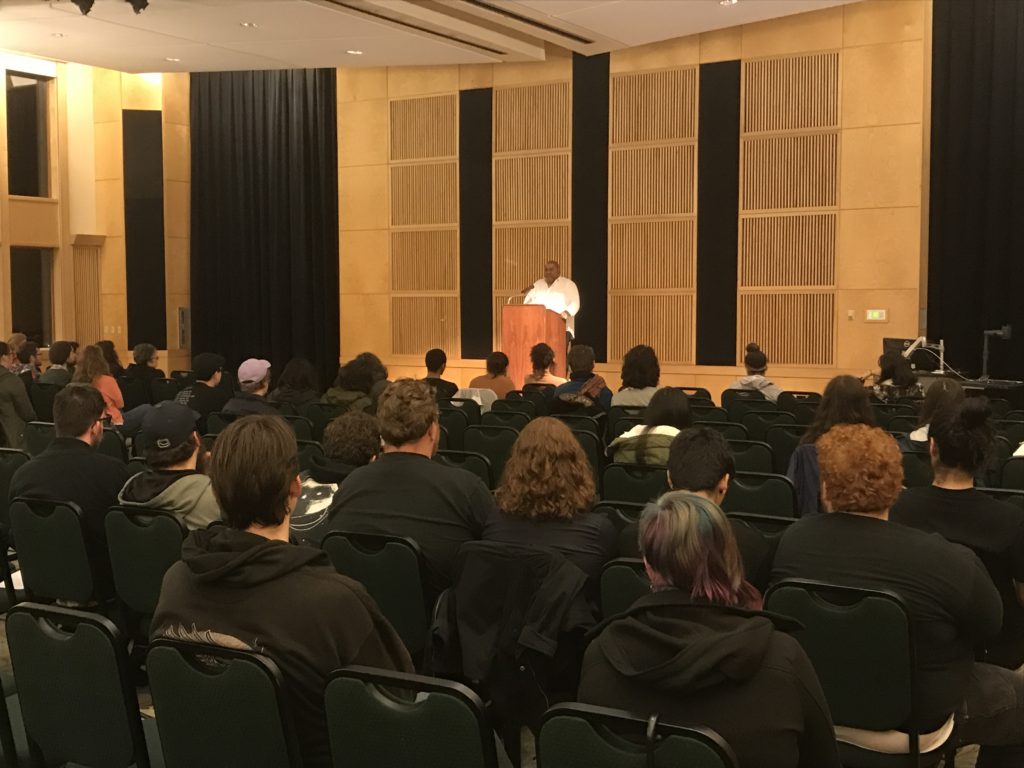
Humboldt State University hosted radical author and poet Chris Abani for our Visiting Writer series on March 29. He visited a couple of writing-based classes and talked with students. He also held a reading and talk in the Kate Buchanan Room.
Chris Abani | Andre Hscall
“The classes are around writing, so I’ve been mostly discussion craft,” Abani said. “As well as addressing worries that writers have.”
Chris Abani is a Nigerian-American author and poet. He is from Afikpo, located in in southern Nigeria. His most recent award-winning writing is his book “The Secret History of Las Vegas.” A suspenseful novel where a detective and a doctor must solve a crime while one is haunted by their past of betrayal during apartheid in Africa. This book won the 2015 Edgar Award for best paperback.
The overall goal of Abani’s writing is to show readers the experience of those born and raised in the troubled nation of Nigeria.
“I’m interested in people more than places,” Abani said. “Places show what distinct differences we have, but once you peel away those distinctions you’ll see how similar we all are.”
Abani is known for speaking out against unjust governments. Abani was arrested three times in Nigeria for his novels and plays that were seen as an attempt to overthrow the government.
He was released from jail in 1991, moved to the United Kingdom and then to the U.S. in 2001.
“Everything that happens to us in life has an impact on our writing,” Abani said.
Abani currently resides in the U.S. and is a professor at Northwestern University in Illinois. While in Nigeria, he attended Imo State University and earned a bachelor’s degree in English. He also earned a masters in gender studies at Birkbeck College in London and a masters in English at The University of Southern California.
At the event in the KBR, was mainly a crowd of student writers. One of these students in attendance was senior English major, Nicolas Poulter. While actually interested in Chris Abani’s talk, Poulter had the incentive of extra credit as well.
“It was interesting, and provoking to get to hear that perspective,” Poulter said.
Students and other guests in attendance had the opportunity to ask Abani questions after his speech. Sophomore environmental studies major Joey Hajduk had the chance to ask Abani a question.
“I asked him personally about his suffering in prison,” Hajduk said. “I was worried about not being able to connect, but Chris saw that, and he told me that everybody has a pain and that you can’t put pain in a hierarchy.”
Technology, especially the smartphones that most people have with them on a daily basis have already changed the way people write and opened up a new realm of possibilities in storytelling.
“All writing is so deeply linked to technology, language is a technology, writing is a technology and the internet,” Abani said. “Now there are more blogs than there are books.”
A true fan of stories, being a storyteller himself. Abani loves different forms of stories such as television and movies.
“Within a day I’ll watch shows like “Dating Naked”, “The Kardashians”, the new “24”, a documentary on National Geographic,” Abani said. “I am a big fan of story.”
Abani’s point is that you can find story in everything, it’s all connected. From the architecture in Founder’s Hall to the various books in our Library.
“Stories are everywhere,” Abani said. “Everything is a story.”
Step One: Cook the rice. For this recipe to work you need day old rice. While you could go buy the rice from a chinese food restaraunt and leave it in your fridge overnight, it’s more fun to cook it yourself. Bring 2 ¼ cups water to a boil with some salt and pepper and olive oil. Once at a boil, pour in your rice, quickly stir, and then cover for 20 minutes. Once your rice is cooked let it cool then lay it out on a tray to dry out overnight.
Step Two: Cut everything. Before you can start cooking your are going to want to get everything cut and prepared. Take your onion and cut it into small half inch by half inch slices. They don’t have to be uniform but roughly the same size so they cook evenly. Then take your garlic cloves, crush them with the side of your knife, and then mince them until they’re in very small pieces. Open your can of spam and dice the spam into little cubes. You’re also going to want to crack your 4 eggs and beat them until they’re mostly yellow, as if you were making an omelet.
Step Three: Start cooking all the other things. Melt your butter down in a large pot on medium to low heat, once melted throw in your garlic, stir until browned, but not burnt. Then in the same pot throw in your chopped onion and stir it around. Once the onions are browned you’re going to throw in the spam and cook until every piece has a nice golden brown edge.
Step Four: Time for the rice. Dump in your rice that has been sitting overnight and mix everything together. Now take the soy sauce and start adding till you get a light brown color, constantly stirring so make sure every piece of rice gets coated. Add salt and pepper to taste, and if you think it needs more soy sauce, add it. Once done, you’re going to push everything to one side of the pot and put your beaten eggs on the side that is empty. Cook them just like scrambled eggs, constantly moving the eggs until golden and fluffy. Then mix it all together.
Step Five: Enjoy. You could be done here as it is, but the way I was originally taught to make it, would be to add one small mixed bag of peas and carrots and cover it until the peas and carrots thawed.
“Iron Fist” is a good show with interesting plotlines and characters throughout the season, but does suffer from some pacing and visual issues. “Iron Fist” is the latest Marvel show on Netflix, following the character Danny Rand (Finn Jones) otherwise known as The Iron Fist.
“Iron Fist” is the fourth installment of Marvel television shows on Netflix along with “Daredevil”, “Jessica Jones”, and “Luke Cage.” “Iron Fist” is the last Marvel Netflix show before the big team up of the four heroes called “The Defenders”.
“Iron Fist” is written by Scott Buck and directed by John Dahl. While neither have worked on a Marvel show before, they both have many years of experience in television, and have collaborated on the show “Dexter”.
While on a trip to China, the Rand family plane goes down somewhere in the Himalayas. After seeing both of his parents die in the plane crash, young Danny Rand is found by some monks that reside in the mystical city of K’un-Lun, where he is trained in martial arts and eventually is granted the power to summon the Iron Fist.
After being presumed dead for the last 15 years, Danny returns home to New York City. He goes to Rand Enterprises to have meeting with Harold Meachum (David Wenham), to try and reclaim his company, but to Danny’s surprise Harold had died shortly after the Rand plane went down 15 years ago.
Now Harold’s children and Danny’s childhood friends Ward Meachum (Tom Pelphrey) and his sister Joy (Jessica Stroup) run Rand enterprises. They are understandably skeptical of Danny, and do not believe he is the real Danny Rand.
Danny also finds out that members of his sworn enemies criminal organization, known as The Hand, are not only in New York but have infiltrated Rand Enterprises.
So now Danny must force his way back into Rand enterprises, while also protecting the company and the city from ‘The Hand’.
One of Danny’s allies in his quest is Colleen Wing (Jessica Henwick). Colleen owns her own martial arts dojo in New York City, and allows Danny to stay at her dojo when he has nowhere else to turn.
There are some outside characters and references to other Marvel shows.
For instance, The Hand plays a central role in both “Daredevil” and “Iron Fist”. The Hand is a criminal organization that manufactures and distributes drugs, along with having highly skilled assassins.
Jeri Hogarth (Carrie-Anne Moss) or ‘J-Money’ is a lawyer, who has a recurring role in Jessica Jones. Before becoming a lawyer Hogarth interned at Rand Enterprises, where she met a young Danny Rand, which leads Danny to seek out Hogarth to help him get control of his company again.
Former nurse Claire Temple (Rosario Dawson) has now made an appearance in each of the four Marvel shows. She was introduced in “Daredevil” as a nurse for an injured Matt Murdock. In “Jessica Jones” Claire is brought in by Jessica to help an injured Luke Cage. This leads to Claire making an appearance in “Luke Cage” as a love interest of Luke.
In “Iron Fist” Claire joins Colleen Wing’s dojo to try and improve her martial arts skills. She also assists Danny and Colleen on a couple adventures throughout the season. Claire mentions to Danny that she knew somebody that had battled ‘The Hand’ in the past (Daredevil).
Madame Gao (Wai Ching Ho) was also in Daredevil, as an associate of the crime boss Wilson Fisk. Gao has her own drug operation along with ties to ‘The Hand’ and presents a problem to Danny throughout the show.
One of the main issues with the show is that some of the actual plot points took too much time to get going, and that it spends too much time dealing with Rand Enterprises issues and not Iron Fist action or superhero related issues.
However, there are a lot of scenes in the first half of the series that have to do with Rand Enterprises, but they are presented in an interesting fashion. The struggle for Danny not only to prove that he is in fact Danny Rand, but also the struggle get back majority shareholder status in a company that his father created.
There are a few times that a plotline was dragged out an episode or so longer than it needed to be. The scenes that were long were not terrible, they are just sometimes not really essential.
There is also a need for more action throughout the show. There are only a handful of solid action scenes, but the overall story makes up for it. There are times that you can tell that it is not actually Finn Jones doing his own stunts.
Speaking of Finn Jones (Danny), his acting is kind of bland throughout the season, it is hard to tell whether it is the writing or his acting. For instance, there is a scene where Danny is supposed to be furious with Ward and Joy when they are still trying to keep him out of the company. Danny makes a scene and throws plates and glasses, but his overall demeanor did not seem angry at all.
In scenes where he is not fighting, which is the majority of the show, he does not show enough charisma on screen, and that is something that is essential if there is not going to be a lot of action in the show. “Jessica Jones” is a perfect example of little action, but it is entertaining throughout, because the characters are interesting.
That is not to say there is no interesting characters in “Iron Fist”. Jessica Henwick nails her role as Colleen Wing. She is easily the most likable character in the series, and when she is on screen she steals the scene. There are a few cage match fights she is in that are unrealistic, but that is not really her fault. It is not a stunt double issue, it is more of a six foot 300 pound guy getting his butt kicked by five and a half foot 115 pound Colleen. It is awesome to watch her fight scenes, a couple in particular in the back half of the season that really show how skilled she is in martial arts.
Despite the show suffering from pacing and visual issues, it makes up for it with an interesting plotline and deep and well thought out characters throughout the season. “Iron Fist” is a solid show to watch for anyone out there looking for a nice binge on Netflix, and the show is a four out of five stars.
HSU has been discussing making the switch to the cloud network over the last year, in hopes to improve file access for students and increase storage space.
Anna Kircher, who is the chief information officer for Information Technology Services, said currently students have 200 megabytes available on the user drives provided by the university, and about 15 gigabytes available through their school google account, though those 15 gigabytes include Gmail, Google drive and Google photos.
“The university is at the point to either move to the cloud or buy more servers,” Kircher said. “It’s cheaper and better to move to the cloud then to buy more hardware.”
Kircher said moving to a cloud network would allow for larger individual students files and office collection files.
Switching to a cloud network may sound like a good idea to some, but for students like junior marketing major Jessica Rocha, it raises concerns.
“I do have concerns about the safety and privacy of things stored in the cloud,” Rocha said.
Kircher said the university has been spending a lot of time talking about security.
“Two of the most important things to us are making sure that students only have access to their own files,” Kircher said. “And two, that this new system would not be hackable.”
Kircher said the university will most likely decide the vendor based off of the level of security they offer.
According to Kircher, who said the technology services budget is not going up, it would be less expensive to switch to the cloud network, though the end cost would depend on the vendor that the university chooses to go with.
According to Kircher there are four different vendors that the university is looking into for switching to their cloud network, Drobox, Box.net, Microsoft One Drive, or Google.
This switch would take place over the summer to be fully available in the fall of 2017.
The HSU Big Time, presented by the Indian Tribal & Educational Personnel Program, is a social gathering with dancing and cultural sharing events. What makes this event unique from other gatherings, is that it takes advantage of the campus to use this event as an educational opportunity for the community. Vincent Feliz, Chumash Master of Ceremonies, explained the songs and prayers during the event and introduced the dance groups from the Santa Ynez Chumash to the Tolowa Nation in Del Norte County. Each dance group also said who they are and where they come from, then lists the songs they sing. Along with the dance demonstrations, there were many cultural sharing events outside the arena that featured men’s and women’s gambling, basket weaving, carving, and a children’s tour of the fish hatcheries.
Photo by Stella Stokes
Feliz began the Big Time with a prayer with Julian Lang, a local Karuk storyteller. Then Feliz sang a grounding song with Lyn Risling, a local Yurok/Karuk/Hupa artist.When Feliz introduced the first dancers, the Maidu tribe, he explained they were one of the first tribes ITEPP invited to dance. They invited more tribes to dance and incidentally, Feliz said they decided to bring other California tribes. Chairs surrounded the dance arena in the West Gym, and each dance demonstration brought in a bigger crowd.
After the Chumash singers finished, Feliz invited the ITEPP alumni and students who are graduating this year to the arena. He called out everyone by each name.
“People wonder how we treat our introvert Indians,” Feliz said to the crowd. “We call them out.”
A crowd of 30-40 people came, including some HSU faculty like Pimm Allen, who is one of the coordinators of the Big Time. They were met with a Chumash honoring song to thank them. Earlier that morning, ITEPP hosted an alumni breakfast to honor them.
Photo by Stella Stokes
Feliz emphasized the importance of educated Indigenous people and the need for the Indigenous youth to succeed on a national and state level. On the HSU Fast Facts of the fall 2016 semester, there were a total of 89 students identifying as American Indian which makes up about one percent of the total student population. That population reflects the one percent of the national American Indian population in the U.S. at nearly three million citizens, according to the 2010 U.S. Census. The ITEPP’s mission is, “to facilitate and promote academic success and self-efficacy for primarily Native American Indian students at Humboldt State University.”
Students in ITEPP like Bryce Baga and Adrian Romo would hang out at the Brero House, where ITEPP is located. They would study, talk to the advisors, or just hang out with other students. Baga also offers beading classes on his free time. He admits that being a double major in Native American Studies and Economics can be difficult.
“It’s two completely different ways of thinking,” Baga said. “In my NAS classes, it’s all about community and connection. But in Economics, it’s all about-”
“Supply and demand,” Romo said.
“Yeah,” Baga said. “Just make money.”
They were on the table to sell t-shirts to benefit ITEPP. There were more tables that featured non-profits and health programs from United Indian Health Services. The men’s gambling tournament was hosted by a newly founded non-profit called Ancestral Guard, whose goal is to teach Indigenous youth their culture. Founder Sammy Gensaw IV hopes to connect with Chile to fight for their water rights, just as the local tribes are fighting for water rights on the Klamath River. Having a student’s culture validated helps them succeed and help their communities, and the Big Time celebrates that.
A new sanctuary shelter is available for those being affected by the political storms set off by the statements of President Trump. The shelter is called Extreme Bullshit Shelter (EBS), operated by the Arcata Shelter Collective. According to Mad River Union, the shelter keeps track of each time the president makes rude comments or undermines another American institution. The shelter then offers a place where no cell phones, tablets, computers, TV, radio or even recent newspapers and magazines are allowed. Participants may stay up to three days at the EBS to restore some of their emotional stability and psychic balance.
Source: Mad River Union
-New juvenile hall in the works
Developers began the replacement of the new Humboldt County juvenile hall on April 3. The new juvenile hall will improve the safety of all who go inside and will provide more appropriate program space to address the needs of youth who go into the detention facility.
Source: Times Standard
-Costco evacuates
A gas leak at Costco evacuated the building. A forklift operator accidentally struck the gas line supplying one of the store’s heaters. Humboldt Bay Fire responded and ventilated the building.
Source: News Channel 3
U.S.
-Ads are pulling out
Advertisements from Mercedes-Benz and Hyundai are pulling their ads out from Fox News after reports revealed that the show’s host Bill O’reilly paid off five women to settle allegations of sexual harassment and verbal abuse.
Source: Chicago Tribune
-Teen punches shark
A Louisville teen punched a shark in the face as it started attacking her in Destin, Florida. The teen, Caitlyn Taylor, was visiting Florida on her spring break. Taylor only suffered a bite wound on her leg.
Source: USA Today
-California passes sanctuary state bill
The California Senate passed a bill that limits the state and local police cooperation with federal immigration authorities. Federal immigration authorities would be prohibited from asking people about immigration status and would prohibit federal immigration authorities to interview a person in custody and would prohibit local law enforcement agents from assisting immigration enforcement.
Source: CNN
World
-Colombia landslide
A landslide hit southwestern Colombia on Saturday morning. The landslide filled with mud and debris killed over 250 people and more than 200 people are still missing.
Source: Now This
-Bomb in Russia metro
11 people were killed and 50 were injured in an explosion that hit a metro station in St. Petersburg, Russia. The Russian prime minister, Dmitry Medvedev describe the incident as a terrorist attack. According to CNN, The explosion tore through a train as it was traveling between two stations. A second bomb was found and defused at a different station.
Source: CNN
-Chemical attack in syria
58 people were killed and dozens were wounded in a chemical attack in a northwestern town in Syria. Warplanes were reported to have attacked Khan Sheikhoun 30 miles south of the city of Idlib.
President Donald Trump has donated all of his earnings as President of the United States to the National Park Service. Trump donated $78,333, his first salary installment which covers the first 10 weeks he’s been in office. $78,333 is 0.005% of the money Trump’s budget would cut from the National Park Service.
President Trump wants to warn China that the clock will run out in North Korea when they meet in Florida later this week. President Trump would like Chinese President Xi Jinping to take a tougher stance on North Korea regarding the country’s nuclear program.
On Monday President Trump signed legislatures to diminish many Obama-era regulations. One of the legislatures included issue about education and school performance. One of President Trump’s new legislation scraps new requirements for programs that train new K-12 teachers and rolls back a set of rules outlining how states must carry out the Every Student Succeeds Act, a bipartisan federal law meant to hold schools accountable for student performance.
President Trump signed a legislative on Monday that repeals the Federal Communications Commission’s privacy protection for internet users. The new legislature would diminish the landmark policy from President Obama’s time in office. President Obama’s policy would have stopped internet providers from collecting, storing, and selling data from internet users without their consent.
Joshua Tree National Park is known for its breathtaking rock piles, rugged landscape, and its unique inhabitant the Joshua tree. However, the park has experienced a surge of visitation increasing by a half million visitors every year for the past three years creating crowding and overpopulation inside the boundaries of the national park. For some, the increase in visitors are a welcome sight providing an economic boost and funding to the park. For others, the overpopulation inside the park threatens the majestic beauty and solitude this desert landscape has to offer.
According to the National Park Service’s website, the annual visitation in Joshua Tree has increased from one and a half million in 2014 to more than two million in 2015. Making 2015 the first time Joshua Tree National Park had ever received more than two million visitors in a single year. Before 1990, Joshua Tree National Park had never received more than one million visitors in a single year.
“For the last 5 years the park has made a concerted effort to market the park both through the press and online through social media. Those efforts started coming to maturity about 3 years ago,” said George Land, a Public Information Officer and Community Outreach Ranger. “Also, 2016 was the Centennial of the National Park Service and there is no doubt the increased awareness of the park service in general contributed to the number of people visiting.”
Joshua Tree National Park has received added attention over the past few years, raising the amount of visitors in the park each day. Certain times of the year are more popular due to weather. According to their Facebook page, Joshua Tree National Park is busiest during mid-week, with Saturday having the least traffic flow in the park. Summer months are usually greeted with high temperatures and low crowds, while the wintertime brings cold weather, including freezing temperatures and slightly fewer crowds. Fall and spring in the park are beautiful times to visit, as wildflowers may be in bloom and the temperature mild and enjoyable. However, these are the main reasons visitation increases during these times.
“Visitation is going to be high the next six weeks,” said Susan Luster, a ranger at the west entrance to the park. “It’s likely due to the time of year and weather.”
Tanner Huibregtse, a 22-year-old college student, visited Joshua Tree National Park during his school’s spring break with some friends.
“We knew we were heading there during the busiest time of year (spring) so my friends and I decided the best time to go was on a Monday morning when everyone would be leaving from the weekend,” said Huibregtse. “We arrived at the park around 11a.m. and there were more people than I had ever seen in Joshua Tree before. Getting a campsite was difficult. It took us circling all the campsites to find some people leaving at the right time that we pulled up.”
Huibregtse hiked Ryan Mountain trail during his visit to Joshua Tree National Park.
“Pulling our car into Ryan Mountain trailhead, there was only one spot available to park,” said Huibregtse. “When my friends and I started hiking up the trail, we passed almost 20 people.”
“Capacity issues including heavy traffic, full campgrounds, and illegal parking have all been problems associated with an increase in annual visitation,” said Land.
With so many visitors entering the park each day, hiking trails and trailheads are becoming congested. According to Land, Joshua Tree National Park has a number of projects planned to take action and against the increasing visitation inside the park.
“We hope the projects will offset some of our capacity issues,” said Land. “The number of visitors to Joshua Tree National Park for 2016 was just over 2.5 million. We consider it a good thing that people are coming out and discovering Joshua Tree National Park. We just need to get the staff and resources to handle the upsurge in visitation.”
An official at the 29 Palms Visitor Center said the increase in visitation could also be a result from Los Angeles finding a national park in their backyard. With the drive between Los Angeles and Joshua Tree National Park being less than three hours, it creates a national park accessible to one of the busiest cities in the country
Newton B. Drury, a National Park Service Director from 1940-1951, described the parks system as an opportunity for growth.
“It means that America presents to its citizens an opportunity to grow mentally and spiritually, as well as physically,” Drury said. “The National Park System and the work of the National Park Service constitute one of the Federal Government’s important contributions to that opportunity. Together they make it possible for all Americans to enjoy unspoiled the great scenic places of the Nation…. The National Park System also provides, through areas that are significant in history and prehistory, a physical as well as spiritual linking of present-day Americans with the past of their country.”
It was Drury’s vision that the National Park System would provide an opportunity for people to discover the beauty of the outdoors. Drury believed by experiencing these parks, people could grow from both a mental and physical state. But Drury also believed in the parks acting as a connection for people to spiritually and physically link themselves to their countries history.
With an increasing amount of visitors entertaining the park each year, it means more and more money towards economics associated with the park. An economic analysis of Joshua Tree National Park posted in 2013 to the nps.org website said, “of an estimated $63 million dollars spent by visitors to Joshua Tree National Park, most was for lodging 30 percent followed by food and beverages 27 percent, gas and oil 12 percent, admissions and fees 10 percent and souvenirs and other expenses 10 percent.”
This means benefits to the surrounding areas and more funding for the park itself. However, with the amount of benefits associated with increased visitation there are equal if not more downsides to the mass of people visiting the park.
“Because there is not enough space for parking people are pulling off to the sides in non-designated spaces resulting in resource damage,” said an official at the 29 Palms Visitor Center. “Overcrowding in the park can cause a negative visitor experience.”
When asked what people visiting Joshua Tree National Park can do to help improve the overcrowding issue, Land mentioned a number of strategies that will help improve the experience of everyone inside the park.
“By and large, people can help by not parking illegally, staying on prescribed trails and refraining from any type of graffiti, vandalism or other malicious damage to the park,” said Land.
A supporter of the parks system, President Franklin D. Roosevelt, said on the nps.org website, “There is nothing so American as our national parks…. The fundamental idea behind the parks…is that the country belongs to the people… for the enrichment of the lives of all of us.”
Tips for visiting a crowded Joshua Tree National Park:
Avoid Hidden Valley and Ryan Campgrounds, these are the first two campsites when entering the park from the west entrance and are often the most popular among hikers and climbers, as there is a lot of climbing is in this area of the park. Try camping at Jumbo Rocks, Belle, Cottonwood, White Tank or even Indian Cove for more site availabilities. Visit the campsites in the morning when campers are most likely to be leaving from the night before.
When trying to avoid people while inside the park, get out of your car. Most people traveling in the park are doing so by their vehicle. Park your car at a trailhead or designated parking area and walk. Walking is a great way to experience any park and get off the busy road with all the other tourists. Joshua Tree National Park has an immense system of trails meant to get you exploring the park. Barker Dam is a great one-mile loop that takes you through some of the history of the park, including a water tank built by early cattle ranchers.
Avoid visiting the park during peak seasons and hours. Spring is the busiest time of year with the wildflower bloom. Summer is least crowded due to extreme heat. Winter brings snow to the high desert and low crowds but when temperatures rise in the fall, crowds turn moderate.
At just 2 years old Eddie Medrano and his four siblings were forced into the foster care system. Medrano is now a 22-year-old Humboldt State graduate, and soon to be USC masters graduate, who created and owns his own business. Medrano was in and out of eight foster homes between the ages of 2 to 5, and diagnosed with Langerhans Cell Histiocytosis tumors. He is now graduating from the University of Southern California with a master’s in business.
“My mother had a drug addiction and was an alcoholic,” Medrano said. “My father was nowhere to be found.”
They were taken into the foster care system after their mother left them home alone for three days. When Medrano was 6 years old, he and his oldest brother Jorge were adopted by the Medrano family. He finally felt like a normal kid after being adopted.
“They gave me my first holidays, birthdays but best of all they gave me the feeling of unconditional love,” Medrano said. “They helped me with my PTSD, depression, ADHD and so many other things that I was finally living my dream childhood.”
Medrano lost contact with his oldest sister Bonnie. His second oldest sister Lupita committed suicide at 23. Angel, his second oldest brother, was adopted to a separate family.
Then, when Medrano was 9 years old, he was diagnosed with Langerhans cell histiocytosis tumors.
Photo by Eddie Medrano
According to the National Cancer Institute’s website, “Langerhans cell histiocytosis is a type of cancer that can damage tissue or cause lesions to form in one or more places in the body. Langerhans cell histiocytosis is a rare cancer that begins in LCH cells [a type of dendritic cell which fights infection].”
Medrano’s basketball coach was the one who helped catch the signs of cancer by noticing that Medrano was limping during a game. The doctors found tumors in Medrano’s hips and skull after performing x-rays and Magnetic Resonance Images.
“I went through countless radiation treatments, surgeries and chemotherapy treatments,” Medrano said. “I felt cheated and because I was brought up with Catholicism, the only person I could ask why me, was God.”
Medrano didn’t understand why get got cancer. He was afraid of everything being taken away from him after finally getting the life he wanted.
“I had no control of what was going on but luckily I started improving slowly through countless treatments and surgeries, I was on my way to remission,” Medrano said. “When I was young I was blinded by the pain and anger to see the amount of support I had throughout my battle.”
After graduating high school Medrano went on to Cuyamaca Community College in San Diego. He was on their track team and received an AA degree in communication. He then transferred to Humboldt State and joined the track team, but his major changed.
“After one semester, my passion for business directed me to work more in class in hopes of attending USC Marshall’s MSEI [Master of Science In Entrepreneurship & Innovation] Program,” Medrano said. “Whether it was selling things on craigslist, working as a marketing employee or starting my own company, business was something that has always been in my life.”
Medrano had a love for skateboarding and figured that he could find a way to make a business out of it. Hunter Fine, Humboldt State communication instructor, was not only an instructor to Medrano but also a friend. Fine also loved skateboarding like Medrano.
“He gifted me a poster of Eazy-E that featured him with a local venice brand deck,” Medrano said. “I knew right then and there that I had to continue my dream of starting a skate brand company.”
Medrano saw skateboarding not just as a hobby but a business venture. It wasn’t until after he graduated HSU and started at USC Marshall’s MSEI program that he learned how hard it was going to be to turn his dream into a reality.
“It wasn’t that easy, yeah I had all these great ideas and designs, but as my professor for the feasibility class at USC, Albert Napoli would say, what problem are you solving?” Medrano said. “I took a step back, visited some local skate parks in Long Beach, where I currently live and just watched the skaters until something enlightened me.”
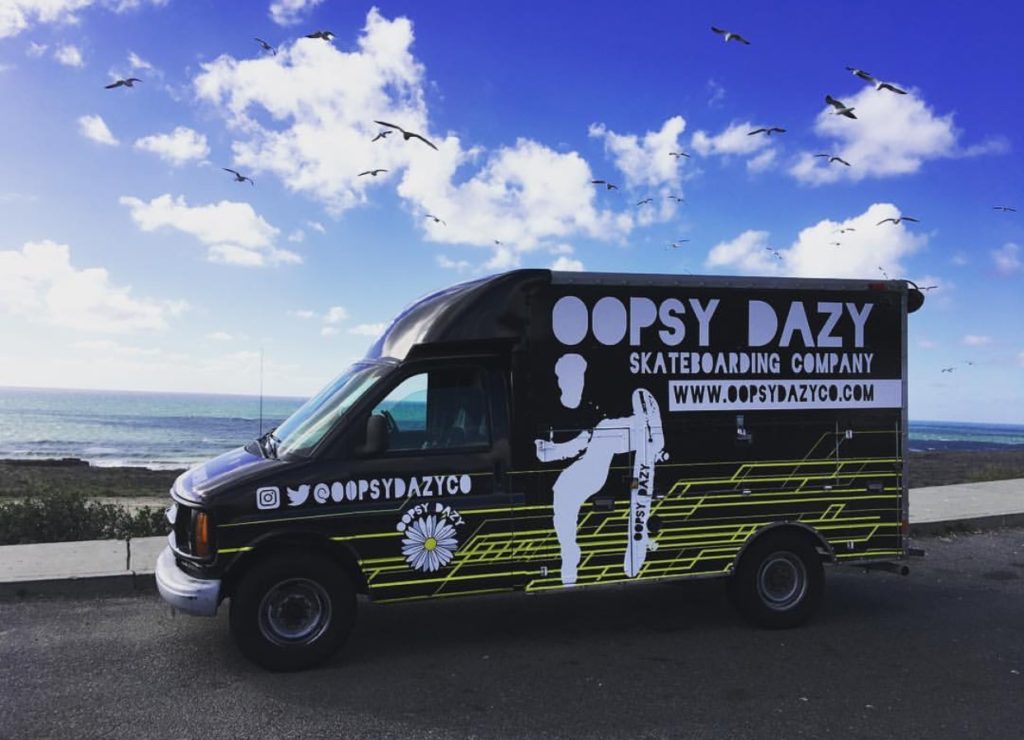
Medrano learned after watching the skaters for hours that the skaters boards were snapping or getting damaged. The skaters would have to stop skating until they found a shop to get their skate boards fixed. His business would be a mobile truck to help the skaters fix their boards and get back to skating. The mobile truck is available in Los Angeles and San Diego at skate parks.
“This is where OOPSY DAZY Co. comes in,” Medrano said. “We provide on-site products through our mobile store but overall we fill that huge gap and problem of distribution that typical skate-shops create.”
Medrano saw skaters needing a place to fix their boards on the spot immediately at the skate parks so they don’t have to wait to get back on their boards. He noticed that boards can break down easily after hours of skating and that wax for the boards were hard to find also.
Scientists at the Georgia Institute of Technology conducted experiments to come to the conclusion that the windy conditions of Saturn’s largest moon, Titan, have the ability to electrically charge the sands covering the moon’s surface. As the grains of sand are blown about by Titan’s winds, they move across the moon’s uneven surface in a motion called saltation. They make contact and rub against each other in such a way that a static charge is created, strong enough to hold the grains of sand together for extended periods of time. The reason the experiments were conducted in the first place was in an attempt to come up with an answer for why the 300-foot-tall sand dunes on Titan were leaning opposite the direction the wind was blowing in. The research suggested that the electrically charged sands were being pulled toward the direction the dunes were leaning, with the wind too weak to push them the other way.
Source: Science Daily
Medicine – Printing human skin
Graphic Illustration by Claire Roth
The gruesome and scarring process of skin grafting, where a portion of healthy skin is removed from one part of the body in order to cover an injured part of the body, may be a thing of the past. Scientists from the Universidad Carlos III de Madrid, the Center for Energy, Environmental and Technological Research, the Hospital General Universitario Gregorio Marañón, and the BioDan Group were recently successful in creating a prototype for a 3D bioprinter that has the ability to print viable human skin. A 3D bioprinter is a machine that has the ability to print cells, complete with the desired cell function, structure and longevity. Like real human skin, 3D bioprinted skin includes layers that protect against the outside environment and help the body to maintain functionality. The 3D bioprinter uses substances called bioinks, made up of biological components, to create the skin and keep it as lifelike as possible. This 3D printed skin could be used for cosmetic tests as well, possibly helping to eliminate the controversial practice of testing new products on animals.
On April 3, at approximately 5:30 p.m. a man attacked another man in the Arcata Plaza.
The attacker, Nicholas Inskip Kistler, ran up and hit another man over the head with a hammer.
Photo by Claire Roth
The attacker was caught on camera running away from the scene by passerby, Terry Finigan.
“I always have my camera ready,” Finigan said, “I saw all these people screaming and yelling, so I just followed him for a while.”
Kistler was chased by a group of observers towards Safeway, where he hid under a house. Arcata Police Department’s K-9 unit arrived on scene and apprehended Kistler.
“With the aid of K-9 ‘Baron’, officers were able to locate the suspect hiding under an occupied residence,” An APD press release said. “After refusing numerous commands to come out from under the residence, the K9 was deployed and the assault suspect was quickly taken into custody.”
Kistler, a Eureka resident, was already on court ordered probation.
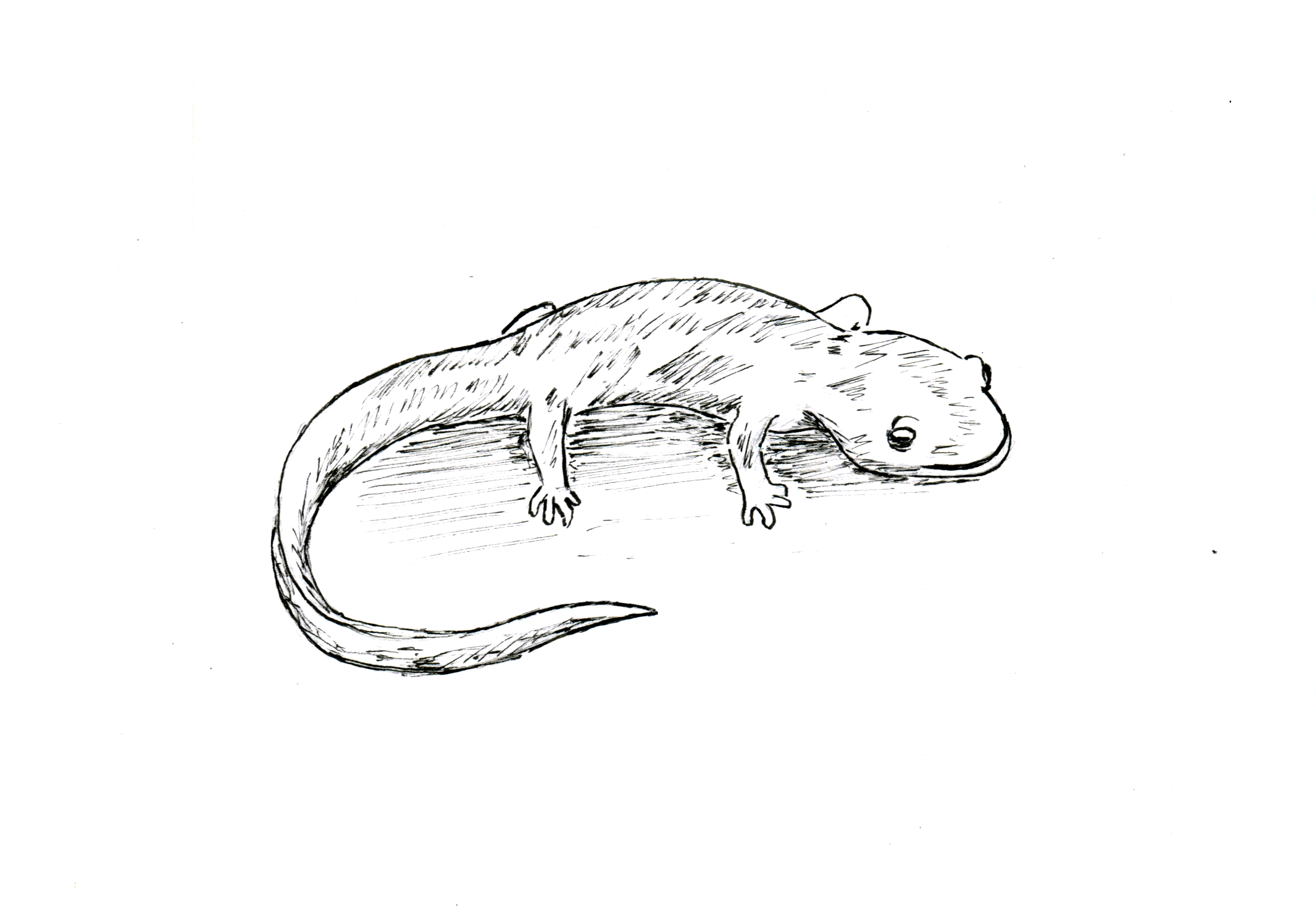
The coastal giant salamander (Dicamptodon tenebrosus) is a native species to Humboldt County and is certainly a critter to keep an eye out for. Growing up to 13 inches in length, this salamander is the largest terrestrial salamander in North America. Coastal giant salamanders have a purple-brown hue with dark spots across the top of their body and are most commonly spotted on rainy nights near streams or other forms of running water.
The coastal giant salamander eats invertebrates and even small vertebrates like mice and smaller salamanders. They sit and wait for prey to approach them, using their camouflage to blend into their habitat. Adults defend themselves by thrashing around erratically or by delivering a painful bite to their offender.
Where to find them: While they have been spotted regularly in the Arcata Community Forest during the winter, they can also be found in the Jacoby Creek Watershed area regularly. However, they are distributed throughout Humboldt, Del Norte, Trinity and Mendocino Counties and can be found near most running bodies of water.
Information sourced from CaliforniaHerps.com
This website uses cookies to improve your experience. We'll assume you're ok with this, but you can opt-out if you wish. Cookie settingsACCEPT
Privacy & Cookies Policy
Privacy Overview
This website uses cookies to improve your experience while you navigate through the website. Out of these cookies, the cookies that are categorized as necessary are stored on your browser as they are essential for the working of basic functionalities of the website. We also use third-party cookies that help us analyze and understand how you use this website. These cookies will be stored in your browser only with your consent. You also have the option to opt-out of these cookies. But opting out of some of these cookies may have an effect on your browsing experience.
Necessary cookies are absolutely essential for the website to function properly. This category only includes cookies that ensures basic functionalities and security features of the website. These cookies do not store any personal information.
Any cookies that may not be particularly necessary for the website to function and is used specifically to collect user personal data via analytics, ads, other embedded contents are termed as non-necessary cookies. It is mandatory to procure user consent prior to running these cookies on your website.