By Brad Butterfield
From the initial police response, to the weeks-long “hard closure” of campus, and on to the busloads of police in riot gear which finally ended the pro-Palestine protest in April — the university administration’s decision-making during and after the protest has sparked confusion and criticism among many the campus community. Recently released public records, including body-worn camera footage and administrative communications, have shed light on how and why decisions were made this April.
Body-worn camera footage, April 22
“I don’t have any fears for my safety or anybody else’s safety,” said Chief of Staff Mark Johnson on April 22 during the first hour of Cal Poly Humboldt’s pro-Palestine protest, which received international coverage.
“This is not a violent group … they’re just misguided,” Johnson said, responding to Sergeant Andy Martin’s offer for an escort out of the building. Martin’s body-worn camera (BWC) recorded this key moment during the protest’s infancy.
Among the first protesters in Siemens Hall on April 22 was Jack McCann, a senior studying environmental science. McCann described the initial protest plan as an “open occupation.”
“Business would continue to run, the university would be able to remain open — the people would be able to work in their offices and be in classrooms,” McCann said.
The occupation would not be tolerated by Johnson, who directed Interim Police Chief Peter Cress to remove the protesters from the building around 5 p.m., according to BWC footage. Johnson emphasized that the protest group would not be permitted to “camp out” in Siemens Hall. “They are free to go out on the quad and voice their political opinion all day… and all night, as long as they’re not sleeping on campus property,” Johnson said while Martin’s BWC recorded.
At 5:06 p.m., Cress recommended the formation of the Emergency Operations Center (EOC) to Cris Koczera, Director of Risk Management & Safety Services. The protest group refused to leave Siemens Hall, prompting the University Police Department (UPD) to call for backup. Then, violence broke between protesters and a combined police force of at least four Humboldt County law enforcement agencies who had joined the UPD. Several protesters were arrested before nightfall. Law enforcement left the quad before 11 p.m., by which point the protest group had grown considerably.
Just before 9 p.m. on April 22, the university sent out an email referring to the protest as a “dangerous situation” and announced that campus would be closed through April 24.
Of the six known UPD officers who responded to the original call, only three officers’ BWC footage was released. Cress, who’s BWC footage was the most complete, had a 2.5 hour gap of missing footage beginning at 7:40 p.m. The university stated they did not have any responsive documents in response to a public records request for Lt. Janelle Jackson’s BWC footage, whose camera is shown to be recording in Cress’ footage. The university clarified that Jackson was —allegedly unintentionally— using an unassigned backup camera that was not registered to any officer in the BWC system. Despite contacting the vendor, the university was unable to retrieve any of Jackson’s footage, according to Joy Finney, a staff member in the president’s office. A 2020 receipt for Wolfcom BWC equipment shows a $1,595 charge for a 24 TB external harddrive, five technical support plans totalling $6,000, and an annual fee of $500 for backup and recovery service.
Three-letter leadership teams
Throughout the protest, the EOC made recommendations to the Policy Management Group (PMG). From there, the PMG made decisions, according to an email sent on Sep. 11 signed by President Michael Spagna. The PMG consists of the president, vice presidents, chief of staff, special assistant to the president for tribal & community engagement, the athletics director, university counsel, and government relations, according to the university-wide email. Members of the EOC have not been made public despite repeated inquiries to the university’s News and Information office. Aileen Yoo, director of News & Information, advised that members of the EOC are not revealed due to the evolving nature of its membership, as well as safety concerns.
“The university has reason to believe members may potentially be harassed,” Yoo said.
Spagna’s Sep. 11 email also states that the university is committed to transparency and wants to clear up misunderstandings about, “decision-making and leadership during emergency situations.”
Spagna, Johnson, and Cress, along with five members of the PMG, were contacted for an interview for this article. None granted an interview.
As the week wore on
Primarily, the university communicated throughout the week-long protest by Humboldt Alerts sent via email. A Humbodlt Alert sent on April 27 informed the campus community of a hard closure of campus. Of the decisions made by the EOC and PMG throughout the protest, the hard closure of campus was among the most controversial.
“It’s the escalation, from the initial attempts to dislodge folks from the building, right?,” said Tony Silvaggio, Interim California Faculty Association President. “The overreaction…. It started there, and then came the closure, the decision to close campus. It’s really hard to make sense of the decision-making of administrators at the end of the spring.”
The CFA filed an unfair practice charge with California’s Public Employer Employee Relations Board in May due to the hard closure of the campus.
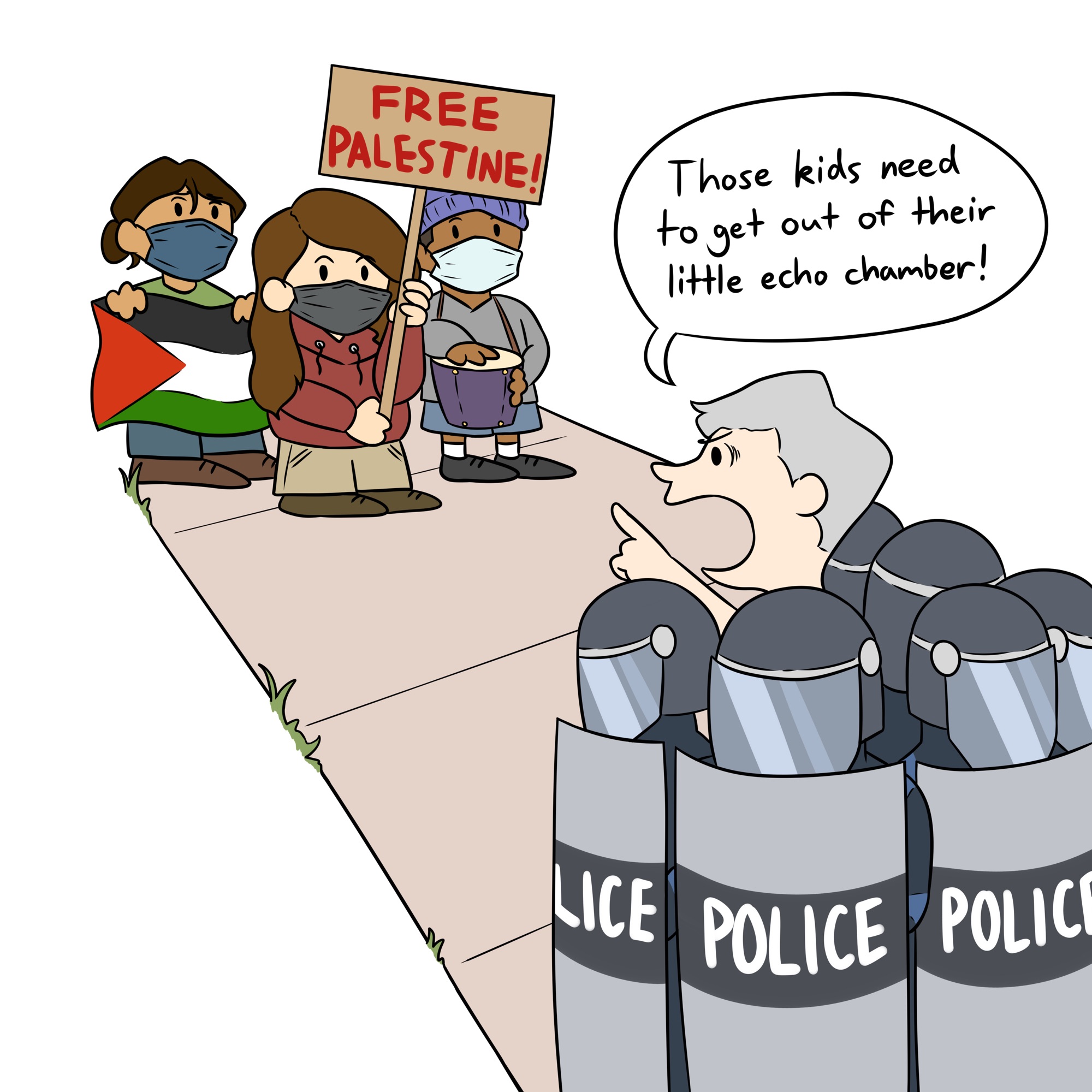
Recently released public records give insight into the framework by which the university’s decision-makers orchestrated their response. Johnson, in response to a concerned faculty member, outlined a fundamental distrust in the campus faculty in an April 28 email. “These are crimes committed by young adults who have been misguided (at least in part by faculty at this university) into believing that their cause justifies this criminal activity, and that there should be no consequences for their actions,” Johnson said. “You must understand that the behavior of this faculty, outside of the little echo chamber that we live in, is seen as shameful and harmful to our students.”
In addition to the EOC and PMG, the chancellor’s office was in “constant communication” with campus leadership throughout the protest, according to Amy Bentley-Smith, a spokesperson for the chancellor’s office.
Governor Gavin Newsom did not respond to an interview request and neither the university nor his office would confirm or deny his involvement in the protest’s response.
April 30, the end
On April 30, Cress led an impressive force of police in riot gear onto campus in the early hours of the morning, putting an end to the historic protest. Where the initial police response on April 22 was marked by confusion and chaos, the second attempt saw a fleet of officers prepared for a fight, had it come their way.
“Remaining demonstrators have shown a strong commitment to their pro-Palestinian and anti-law enforcement ideology and there is a strong possibility of violence against responding officers,” read the SFPD’s tactical support document, obtained through public records.
In addition to the SFPD, at least six other agencies sent officers for the April 30 operation. Among the remaining protest group on April 30 was McCann, who described the lasting impact the tremendous show of force had.
“It made me feel scared, you know, scared for my own personal safety,” McCann said. “But, it really violated any trust that I might have had… that this was an institution that valued, you know, not necessarily truth, but open discourse. Any threat to their power is perceived as violent.”
For Silvaggio, the iron-fist response was both unsurprising and representative of former President Tom Jackson’s style of leadership.
“It was emblematic, however, of the approach of the president and his administration of the last four years, right?” Silvaggio said. “It was emblematic of their approach to students, to student concerns and demands.”
This article is the second of a three-part protest follow-up series.
Leave a Reply