By Mia Costales
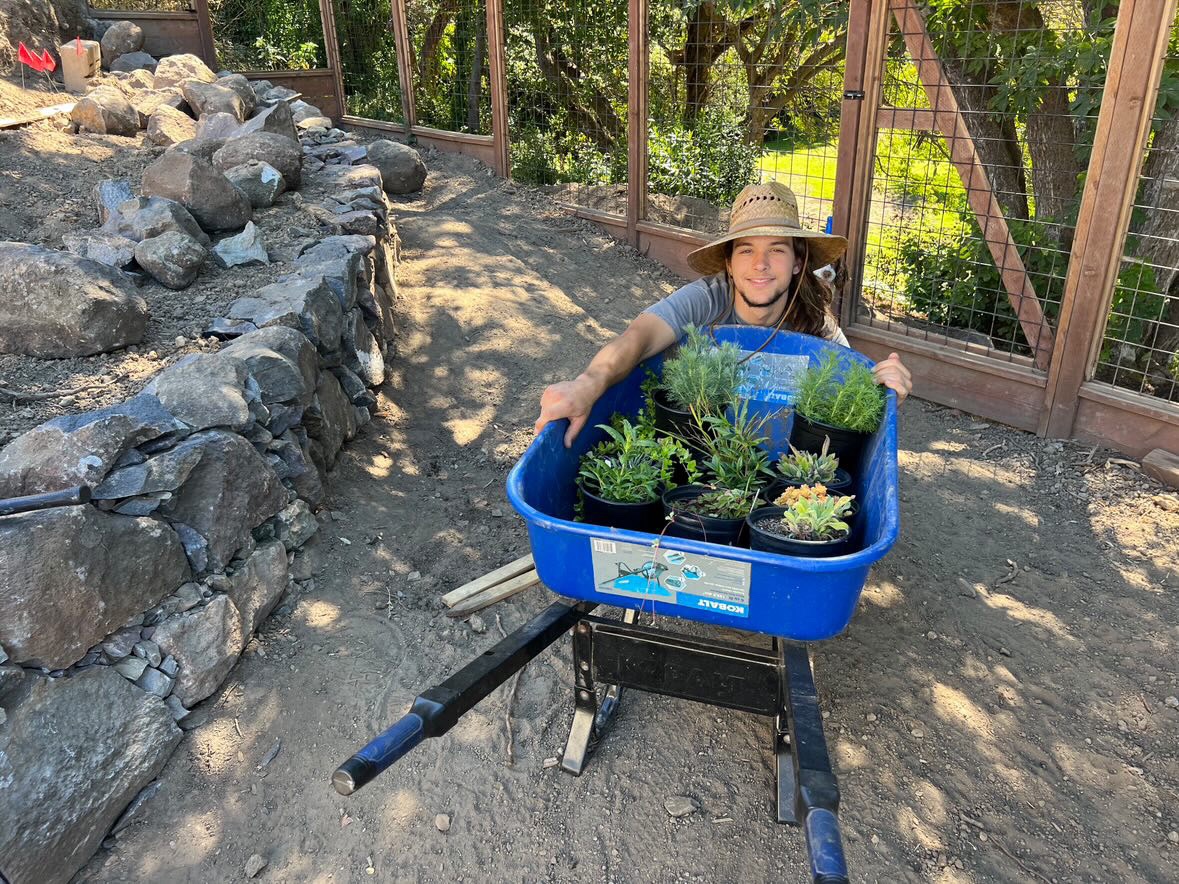
On any given day, Jack McCann can be found tending to the Campus Center for Appropriate Technology’s (CCAT) native plant garden, hosting Mycology Club hikes in the Arcata Community Forest, or strumming his guitar in a neon tie-dye shirt on campus. As an environmental science major with a focus on ecological restoration, McCann holds a lively passion for all things nature-related. He strives to live this passion through the lens of decolonization, which has translated into his latest project, a native plant zine.
McCann first got his foot in the door through learning about mycology and native mushroom species with the help of tools like iNaturalist, a wildlife identifying app. However, his passion for gardening was uninspired at this time, due to his interest in fungi. He recalls being uninterested in planting fruit and vegetable gardens because of the easy access to fresh produce in local grocery stores. It wasn’t until later, when McCann learned about native plant and wildflower gardens and the benefits they can have on local ecology, that he started to become involved in advocating for the process of radical ecological decolonization.
“I can feed myself fine, but the creatures that really need help are native pollinators, and all these insects that make up a base of the food web that are essential for ecosystems to function,” McCann said. “Native plants are so underrepresented in gardens wherever you are, so it’s really unique to have a native garden, especially if you collect the seeds yourself and grow local ecotones.”
Ecotones are the area of land, flora, and fauna between two biological ecosystems that serve as a transitional zone between the two regions. A large part of McCann’s radicalization has been educating himself on ways of easing the damage done to the environment and restoring land to its natural state. Native plant gardening has opened up the door for McCann to learn and educate people on the effects that colonization has had on the environment.
“Decolonizing our relationship [with nature] is essential to the idea behind native plant revolution,” McCann said. “Decolonizing our relationships with the natural world —for me — that is native plant gardening.”
One of the ways McCann is educating people is through the distribution of his zine detailing native plant gardening through a decolonial perspective. The first edition of his zine acknowledges the work he is willing to do to educate himself, and also invites its readers to contact him with any comments or suggestions. The contents explain the history behind the colonization of nature and ecological systems, as well as how many of these current systems were put in place as an attempt to erase indigenous culture and practices.
The zine calls for readers to become involved in the native plant revolution through planting native species and educating people on the ecological dangers of upholding eurocentric practices. As of now, McCann has been distributing the zines by hand on campus. However, he is looking into dropping some off at several local businesses such as Northtown Coffee on G Street. McCann also has plans of possibly uploading a free pdf online.
“Everything is built on the people that came before us,” McCann said. “No one is free until we are all free. If you can take care of the smallest insect that seems so insignificant to someone who doesn’t care, then you can ensure the basis of survival. In a world that doesn’t give much credit or see those things as important, it can be a political act to garden native plants if that’s your intention.”
Mia is a journalism major at Cal Poly Humboldt. She is a reporter and the Life & Arts editor for the Lumberjack. In her freetime she loves attending shows and music events in town.
Leave a Reply