By Jordan Huber
EDIT: Updated with new information on the protest in the quad
Pseudonyms have been used for sources in this article.
On October 7, 2023, over 1200 people in Israel and its occupied territories were killed by Hamas operatives. It has been one year since the events that have taken place. With frustrations from both pro-Palestine and pro-Israel members of the community rising, both groups opted to mobilize on Monday.
March on the Plaza
A flyer was distributed both on campus and through social media platforms detailing a march to take place at noon Monday, Oct. 7. The group chose to meet at the recently painted David Josiah Lawson Mural at the D Street Neighborhood Center. By 12:30 p.m., the crowd had swelled to over 150 participants ranging from community members, students, and professors. Almost every person was masked, and those who were not were immediately offered a mask and a stick of chalk. The crowd varied in age from college students to elderly community members. They dressed in anything from all black clothing to colorful displays of rainbow garb. Around 10 of the protestors donned high visibility vests to act as buffers between any possible counter-protesters, and to make sure any of the participants in the march would be safely able to cross any streets. Rick Toledo, a member of the Students for a Democratic Society of Humboldt, rallied the crowd with the use of a megaphone.
“We are here today to rally together,” Toledo said.
Protestors began marching up LK Wood Boulevard toward the university. Students carried signs written on Korbel Champagne bottle cases with phrases advocating for ceasing bombing in Lebanon and calling attention to the plight of Palestinians, since the inception of Israel and in the year since October 7, 2023. The crowd made their way to LK Wood and Sunset Avenue intersection. The Cal Poly Humboldt sign, subjected to frequent taggings of pro-Palestine messaging and even a car accident in the past, was graffitied with chalk linking the university with Israel and that the university is complicit in genocide. The crowd rested at the sign, and began erupting in chants directed at the passing vehicles.
“Judaism yes, zionism no,” the crowd roared over the blaring of horns and lunchtime traffic.
Cars passing by honked in support, while some drivers gave a thumbs down to the actions of the group. The sun beat down as the protestors made their way back towards the mural, with the goal of reaching the plaza. A new leader of the march asked if the crowd wanted to begin chanting in Arabic.
“Palestine hurra, hurra,” was heard as the protestors passed the library circle. Several of the protesters began splitting off to head back to campus, with the majority still determined to reach the plaza. The safety buffers helped escort protestors across the streets of Arcata, eventually reaching the Arcata plaza at 1:30 p.m. Speakers began addressing the crowd one at a time. Some read out handwritten stories, others implored the community to come together to care about Palestine and its citizens.
“What is happening to Palestine is what happened to indigenous peoples here,” Toledo pleaded with the crowd over the microphone.
Around 2:00 p.m., the crowd began making their way back to the D Street Neighborhood Center, where they dispersed without incident.
Unrest in the Quad
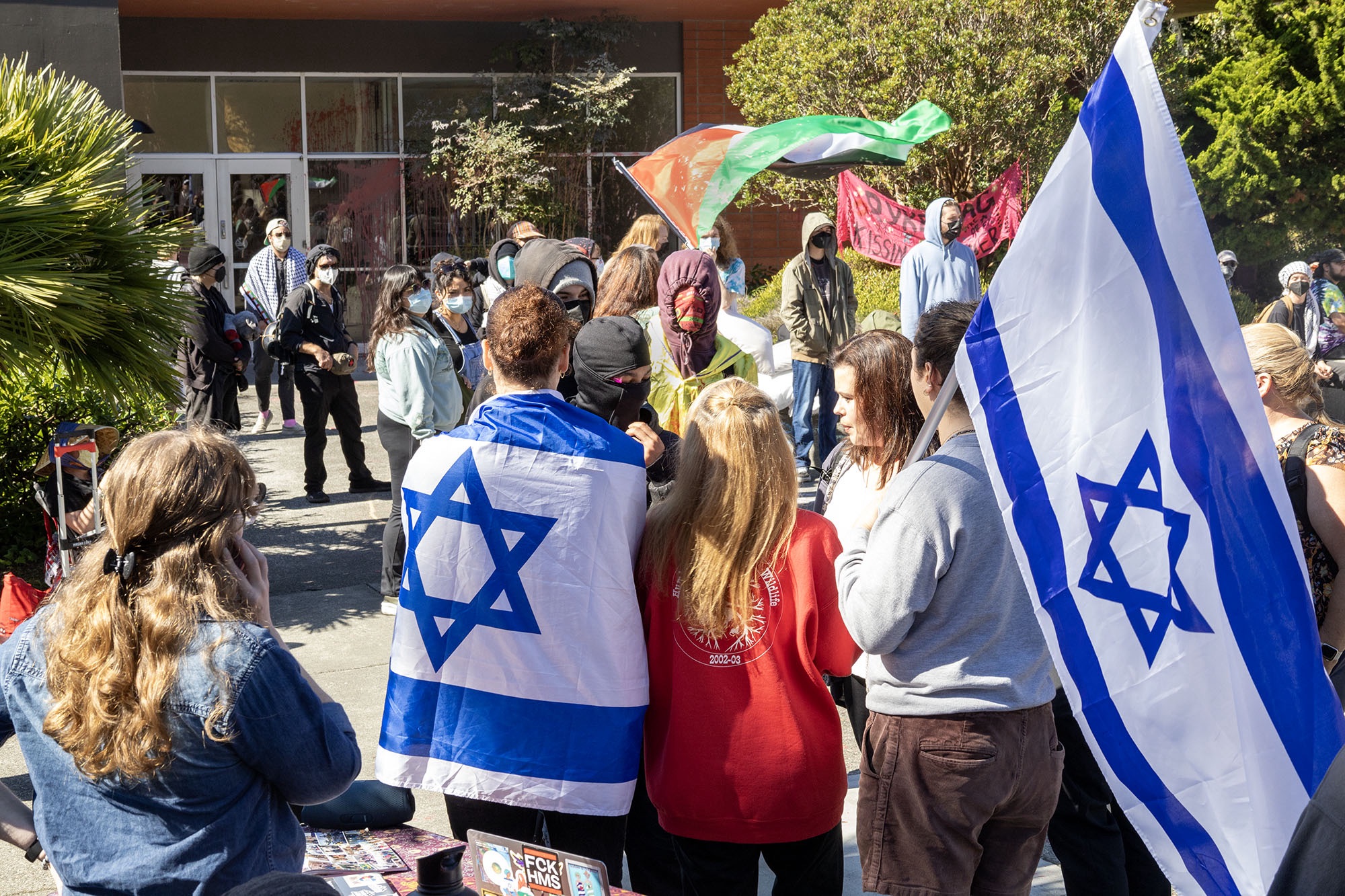
A separate flyer circulated through social media that called for students to gather in the library circle on Monday at 11:15 a.m. The flyer advertised that students should, “Come have a pillow fight and give the admin a fright!” By 11:30 a.m., only four students had gathered by the tree, with one equipped with a pillow. This group eventually made their way to the Student Activity Center Quad at the heart of campus. They linked up with another small group of pro-Palestine protestors, who had already begun congregating in front of Siemens Hall. In the Student Activity Center quad, a table was set up earlier within twenty-five feet of the entrance to Siemens Hall in the afternoon by the Jewish Student Union. Each group stood in defiance of the other with flags of Palestine and Israel being carried by the light wind.
Two signs sat on either side of the pro-Israel table: “I am an American Jew, ask me about October 7th” and “I am an Israeli, ask me about October 7th.” Both sides of activists did not cede ground to the other. Tensions rose as the clock moved past 12:00 p.m. Mentions of the growing crowds drew the attention of Dean of Students Mitch Mitchell, as well as other university administrators. Mitchell engaged with both sides and stood between both as frustrations climbed to a breaking point.
At 12:30 p.m., a person dressed in a yellow rain jacket began scooping red paint out of a crock pot with a ladle. Paint was splattered on Siemens Hall and the quad. Police were called due to a report of paint being thrown onto people associated with the Jewish Student Union. An email was sent out at approximately 6:30 p.m. on Tuesday evening by University Police asking for assistance in identifying the individual who was involved in the alleged assault with paint.
A video posted last Wednesday morning of the protest in the university quad on Instagram by the account “humjews” appears to show the individual who the University Police are asking for assistance in identifying from Monday’s protest. A person dressed in black appears to tell another individual in a yellow jacket, who was holding a crock pot filled with paint, that they should get it on a nearby camera. Equipped with a ladle, the individual with a yellow jacket on began flinging paint in the direction of the camera.
“Don’t take pictures,” the crockpot holder said.
The individual wearing a yellow jacket claims that the red liquid is to represent Palestinian martyrs and blood of students from the protest in April. The video ends with still-frame photos of the camera that captured the video with paint on it, as well as another individual with visible paint marks.
Emotions remained high, and gradually subsided as the afternoon continued. Remnants of glitter and paint coated the quad and Siemens Hall for the rest of the day.
Reactions to Monday’s events
Two students, who chose to identify themselves as K and R, were involved in the march to the plaza protest. Both are sophomores at Cal Poly Humboldt and were motivated to participate in the event due to ongoing conflicts in Palestine and the Middle East.
“For me, I think it’s just important to stand up and not be complacent in genocide,” K said. “I think it’s imperative that we show that that’s not something that we align with, that we’re not comfortable with our tax money going to that, that we’re not comfortable with innocent Palestinian civilians dying, getting murdered.”
“Yeah, and I think even though we’re such a small community, and a lot of people think that we are going to Humboldt and we’re kind of secluded and removed from issues around the world, it’s important to show that even in our isolation, we’re still paying attention to what’s going on, and we still want to make our voice heard,” R said.
Both K and R believed that holding the protest on October 7 was justified.
“I think that it’s important to show that today marks the escalation from apartheid to genocide. I think resistance of people under occupation is always justified,” K said. “I don’t think that [the date of the protest] should be taken into account. I think it’s very important that we show that we’re upset that genocide is still going on.”
They believed that there should have been more radical action from the crowd.
“Personally, I think this talk of de-escalation needs to switch to talk of escalation,” K said. “I think once you have people put on vests and keep protesters in line, that’s like a volunteer police department. They’re just an extension of the state at that point.”
Other students felt that holding any kind of event on the anniversary of last year’s events was insensitive. Another student, choosing the name Ally, is a senior in the College of Arts and Humanities. Ally self-identifies as a practicing member of the Jewish faith.
“I don’t think that that was the day for people to be protesting, either against or pro-Israel,” Ally said. “I don’t think it was appropriate to spend the day yelling and in conflict, being violent and aggressive towards each other.”
Ally felt that both the choice to hold the protest on October 7 and the actions of pro-Palestine protestors was counterproductive.
“The fact that they’re protesting on October 7 is a complete disregard to the amount of grief and violence that occurred last year, and the amount of grief and violence that occurred every day after to protest on October 7 is to disregard all the lives that have been lost now,” Ally said. “The actions directly — the notion of the pillow fight that was advertised, the paint and pretty much the conflict that ensued. The tension, all of that tarnished the memories of all lives that were lost.”
Jordan is a senior political science major and the president of the Politics Club. With a keen interest in current affairs and a passion for informed debate, Jordan brings a well-rounded perspective to their opinion column. Through their studies and leadership, Jordan is dedicated to exploring the complexities of political issues and fostering meaningful discussion.
Leave a Reply