By Brad Butterfield
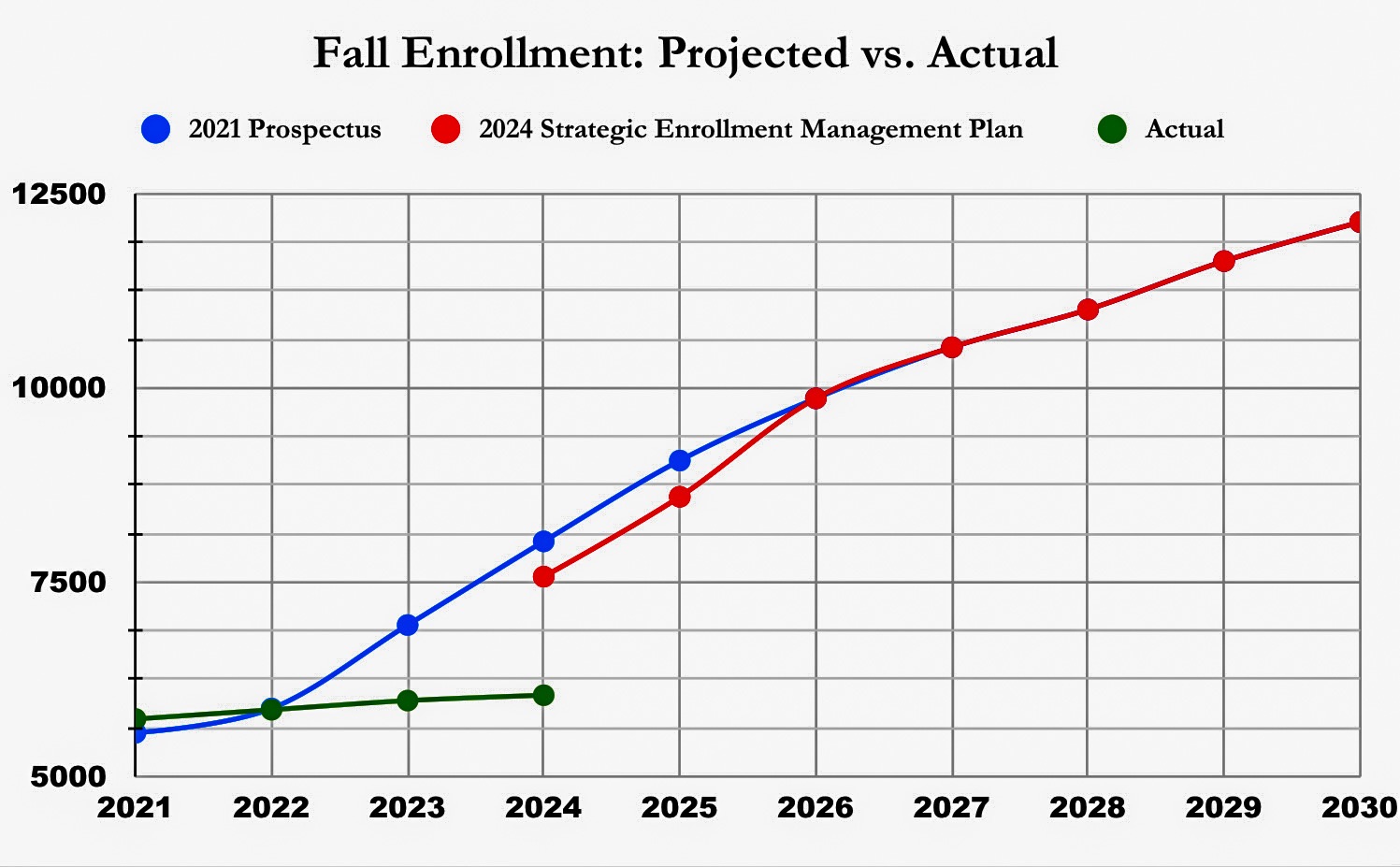
Cal Poly Humboldt’s projected enrollment of over 8,000 students for Fall 2024 has fallen short by a significant margin. Due to low enrollment, the university will lose millions in state funding for the 2024-25 academic year. Despite the enrollment and financial troubles, officials remain optimistic, citing progress in retention, applications, and transfer enrollment. On top of that, a 225 million dollar housing complex, funded by state polytechnic money, promises to dampen student and faculty housing difficulties.
The university prospectus, released in September 2021, projected 8,024 students enrolled for the Fall 2024 semester. This fall, however, the university had only 6,045 students enrolled at the time of census. The university aimed for enrollment growth varying between 3% and 13% each year following the polytechnic change. In reality, the university has had an increase of about 1% since becoming a polytechnic. While growth has been slower than projected, the university’s Vice President for Enrollment Management and Student Success Chrissy Holliday has not been surprised.
“I knew we had a long road ahead of us to grow in the manner the polytechnic prospectus outlined,” Holliday said. “And that the transition to a polytechnic institution provides an impetus for growth, but that we still must do the heavy lifting to realize the growth.”
According to the National Student Clearinghouse Research Center — which has researched, reported, and provided information about colleges and universities since 1993 — public 4-year enrollment is up 2.2% nationwide for the Fall 2024 semester. While Cal Poly Humboldt is slightly behind the average enrollment increase nationwide, the university significantly increased its new, upper division transfer enrollment and retention of students, according to Aileen Yoo, director of News and Information at Cal Poly Humboldt.
“This means we are outperforming many of our peers, thanks to the strategic work that is underway,” Yoo said.
The enrollment projections laid out in the 2021 prospectus were based upon previous enrollment patterns, capacity and demand for other polytechnics, and demand in Humboldt County to fill that need, according to Yoo. This ambitious projection did not reflect the time it would take to establish the university as a polytechnic. Moreover, the polytechnic change brought on previously unforeseen application volume growth of more than 80% in a single year. The shift in baseline data meant the university has had to refine its enrollment prediction processes, Yoo said.
Losing money by the millions
Due to the university missing its enrollment target by over the 10% recalibration threshold set by the CSU, state funding will be cut by 5%, equivalent to 3.4 million dollars for the 2024-25 school year. The final effect of the budget cuts is yet to be determined, according to Yoo. According to Jeff Crane, Dean of the College of the Art Humanities, and Social Sciences, the budget cuts will likely have an effect on the number of classes that the university can offer and how majors are supported in the coming academic year.
“You have the most flexibility — and it’s terrible to say — in what you offer as classes,” Crane said.
Ironically, the budget cuts themselves make it more difficult to increase enrollment to meet the CSU target, but budget cuts will only stop when the CSU target is met.
“Budget cuts make it less likely that we can achieve those targets, as the work to recruit and retain students requires personnel, marketing, and other activities that call for sustained funding,” Yoo said.
Enrollment to double by 2030?
A revised enrollment projection was released in Aug. 2024, which adjusted the “onramp” towards the — unchanged — overall goal of 12,000 students by 2030. This revised plan still saw the enrollment over 1500 students shy of the target for the fall 2024 semester.
“I think the numbers they projected were ambitious,” Crane said. “I think eight or nine thousand is a nice resting place with stable growth after that, I don’t think we’ll hit 12,000 personally. I think if we level off at eight or nine thousand — that’s a good number.”
Alex Stillman, who has served 18 years on the Arcata City Council, has no doubts that the university can and should reach the enrollment goals.
“We used to have eight to ten-thousand students attending Humboldt State, and so this has been a decrease for us, but we were able to do very well with that number of students in the past,” Stillman said, also an alum of the university. “I don’t see why there would be an issue with us being able to have that number of students.”
Why the low enrollment and why the need to grow?
Cal Poly Humboldt has its sights locked on the resident full-time student target set by the CSU, which will then trigger a recalibration and put an end to the funding cuts. If the target isn’t met, funding will be cut and the target enrollment number reduced. Currently, the resident full-time student target is 7,375. This will likely be reduced to 7,006 for Fall 2025, according to Yoo.
The cause of the consistently low enrollment is anything but simple. Yoo, Stillman, Crane, and Holliday all noted various factors outside of the university’s control.
“We should also never forget external factors — demographic shifts, declining college-going rates, state budget reductions and world events,” Holliday said.
On top of the uncontrollable occurrences, Crane pointed out the factors like the widely reported — potential — plan in 2023 to house students on a barge in the Eureka Bay, as well as consistent protests.
“We’ve shot ourselves in the foot a little bit,” Crane said. “We’ve attracted some negative attention. That is limiting our ability to grow.”
Not only is the university below its CSU-set enrollment target, it’s also well below the enrollment of many previous years.
“We need people in seats,” Crane said. “Butts in seats. I look at classes that have seven students and 11 students, we need those classes a little more full.”
The low enrollment and decreasing support from the state both put financial strain on the university, Crane added.
Some students see enrollment growth as a double-edged sword.
“I think it’d be amazing for small businesses,” said Henry Grand, a senior studying business administration. “It would help them grow, help them support their families if there was an increase in enrollment. And for some folks, it would drive up the cost of living. It would make commuting really challenging. It would kind of take away from the natural beauty… you know, they would feel like their home was being kind of invaded.”
Changes, large and small
In fall of 2021, the CSU system dropped ACT/SAT scores as a requirement to enroll, instead adopting a multi-factor admission scoring process (MFAS). During the Fall 2024 semester, an automated system-wide CSU MFAS process was put in place to further streamline the admissions process. These changes, at least initially, appear to be achieving the goal of increased enrollment. Fall 2024 saw a record number of applicants at 22,690. 47 new faculty have been hired, since the Spring 2022 semester, to areas where the university expects growth, according to Yoo — who also noted the low student to faculty ratio at the university.
But, the biggest change, at least visually, comes in the form of a massive housing complex called the Craftsman’s Mall, which is under construction. The building’s completion will come in two stages, according to Yoo. The first tower includes 608 beds and will be ready for occupancy in the fall semester of 2025, according to Yoo. The second tower will be ready for occupancy for the spring 2025 semester. In total, the complex will boast 964 beds and is currently slated to cost 225 million — 125 million over the initial estimate. Following the planned demolition of the Campus Apartments, costing an estimated 2 million and expected to be complete in 2026, the university will offer 2,827 beds.
As changes to campus come one after the other, Grand questioned whether students’ best interests had been adequately included in the process.
“I am feeling though, that maybe the students’ perspective isn’t really what the university cares about,” Grand said. “They kind of care more about what their stakeholders see…it kind of feels like the school is being changed for an outside perspective, from an outside perspective.”
Growing pains aside, Stillman emphasized the undeniable value that the university brings to the Humboldt County community.
“I know a lot of people that live here are not happy with Cal Poly, or Humboldt, or whatever you want to call it, and I think then possibly they are living in the wrong community,” Stillman said. “Because if we didn’t have Cal Poly, we would not have the richness that we currently have.”
Leave a Reply