The Lumberjack


Students Serving The Cal Poly Humboldt Campus and Community Since 1929

Month: March 2025

  • Locations of Little Free Libraries in Arcata

    By Dylan Jewett and Mia Costales

    If you’ve ever driven around the residential neighborhoods in Arcata, there’s a good chance you’ve come across a little free library. Often quaint wooden boxes painted in bright colors and full to the brim with books, these little libraries are an unexpected goldmine of all things literary. 

    Many have a “take one, leave one” policy in which community members can leave books they no longer need in exchange for a new one. Books from all genres such as children’s fiction, cook books, and even college textbooks are just some of the content that can be found in these little free libraries. 

    The website littlefreelibrary.org offers a map of all of the libraries around the world registered under the nonprofit Little Free Library. Each library has an assigned charter number that you can look up on the website to pinpoint its location. There are over ten libraries in and near the Arcata area registered with Little Free Library. 

    A graphic showing all of the locations of Little Free Libraries in Arcata, where people can pick up a book, give one way, or swap one for another.

    Mia Costales is a senior journalism major and the Life & Arts Editor for The Lumberjack. With a background in music performance, she hopes to combine her love of music and the arts with her passion for localized news and activism to bring thoughtful and informed stories to the public.

    Dylan Jewett is a junior journalism major at Cal Poly Humboldt. They are an avid photographer and loves to crochet, hang out with their cat, and go to concerts in their free time.

  • Why representation matters for female student athletes

    Why representation matters for female student athletes

    Recognizing how female coaches empower and inspire young athletes for Women’s History Month

    By Alexis Blue

    March marked the start of Women’s History Month, a time to celebrate women’s contributions to American history and their evolving roles in all aspects of life, including sports. In a field still largely dominated by men, recognizing and acknowledging the impact of women head coaches on student athletes is more important than ever. 

    Cal Poly Humboldt offers collegiate-level athletics for both men and women. Basketball, cross-country, soccer, track and field, and wrestling are offered as men’s sports. Basketball, cross-country, rowing, track and field, softball, soccer, triathlon, and volleyball are all sports offered for women. Of these sports offered at Humboldt, the head coaching positions have nearly the same number of male and female head coaches. Many of the women’s sports are also coached by women, with the exception of women’s cross-country, rowing and soccer. 

    With women coaches in influential positions, young student athletes have found a unique sense of guidance. Poppy Edge, a freshman student athlete on the women’s triathlon team majoring in molecular cellular biology, reflected on the role that her head coach, Kinsey Mattison, has played both in and outside of her sport.

    “I am able to relate to her on so many levels, even just from her being a woman athlete,” Edge said. “She cares about what we are going to be doing in the future and what it looks like beyond [college].”

    Edge also discussed the great experiences that she had with men coaches in high school, noting that each coach varied in their coaching style. Notably, Edge said that Mattison’s coaching creates a sense of comfort and understanding, especially when it comes to difficult topics for athletes like injuries. 

    “She’s also very conscious about injury, more than any other coach I’ve had,” Edge said. “She wants to make sure that from the start, you’re not doing anything that’s even going to start an injury.” 

    Julia Rivera, a senior softball player majoring in criminal and justice studies, shared sincere gratitude towards a coach who also acted as a role model of hers prior to college. While playing travel softball and amid college recruitment, Rivera’s assistant coach was Humboldt Alumni and Softball Hall of Fame recipient Andrea Williams, now Andrea Williams Padilla. Rivera articulated the confidence and growth that Padilla gave her. 

    “This woman was definitely the deciding factor of me playing college softball,” Rivera said. “Seeing her succeed at every single thing in her life gave me so much confidence, and I can definitely say she’s a role model.” 

    Rivera’s drive to continue to pursue athletics collegiately can also be attributed to the coaches she had growing up. 

    “Being that every female coach I’ve ever had played college softball, I think working up to that point, there was never a doubt in my mind that I wanted to do this,” Rivera said. 

    Kinsey Mattison, head women’s triathlon coach, shared a similar sentiment of hope for the athletes she coaches to have an athletic experience as positive as her own. Prior to Humboldt, Mattison competed in women’s swim and cross-country as a student athlete at the University of Alaska-Fairbanks, where she also became the assistant women’s swim coach after graduation. She then coached as the head women’s triathlon and assistant men’s swim coach at Colorado Mesa University. 

    “Seeing how [college athletics] completely changed the trajectory of my life and thinking, ‘I can do this for other people,’ then I have to,” Mattison said. “There’s no other option. If this is possible, to help people have an experience like I had and find themselves, then that’s what I want to do.” 

    Mattison discussed her approach to mentorship and leadership for her athletes and the development of this process over the course of her career as a college coach. She acknowledged how she has begun to lean into vulnerability in her coaching style.  

    “I think that is something that has changed as I’ve gone along is not just wanting to coach them, but give them kind of a real-life example of what it looks like to be not just a woman in this profession, but a mom in this profession,” Mattison said. “And it’s not easy or perfect.”

    According to the 2022-2023 NCAA Demographics Database, only 24% of the 20,255 NCAA teams, including both men’s and women’s sports across all three divisions, are led by female head coaches. As an NCAA DII college coach, Mattison reflected on challenges she faced prior to Humboldt in feeling underrepresented and like her voice was less important. Ultimately, she emphasized the support she feels specifically within Humboldt’s athletic department. 

    “To be in an athletic department where it’s 50/50, we get a seat at the table and our opinion matters,” Mattison said. 

    Mattison acknowledged that what each individual athlete needs from a coach is a bit different, but the best thing she can do is stay true to her coaching style by leaving athletes with confidence beyond their sport. 

    From the earliest days of recreation sports, to collegiate athletics, to competing professionally, coaches are there every step of the way. It is important to acknowledge the role models, and specifically women coaches, because their impact on the younger generation of athletes contribute to a cycle of leadership and empowerment for future generations to come. Coaches act as role models on and off the field, guiding and potentially inspiring athletes to push through challenges and believe in their own potential.  

    “It is gonna take a long time, it’s gonna be a lot of work with sacrifices and hard days, but if I put my mind to something — I can do it,” Mattison said. “I want other people to feel that way.” 

    Alexis Blue is a junior at Cal Poly Humboldt, majoring in journalism and minoring in writing. She enjoys drinking coffee, sunsets on the beach, and playing soccer.

  • Cannabis Studies Program hosts cannabis symposium

    Compiled by Savana Robinson

    The information in this article is taken from a press release courtesy of the Cal Poly Humboldt Cannabis Studies Program.

    The second annual Cannabis and Environmental Stewardship Symposium will be held on Friday, March 28, from 8:30 a.m. to 5 p.m. in the Native American Forum at Cal Poly Humboldt. The symposium will feature 23 speakers, three panels, two presentations, a town hall, and free food for breakfast and lunch. 

    Among the speakers is Cal Poly Humboldt Associate Professor of Native American studies, Kaitlin Reed, the university’s Traditional Ecological Knowledge faculty fellow and the co-director of the Rou Dalagurr Food Sovereignty Lab & Traditional Ecological Knowledges Institute. Michael Polson, the director of UC Berkeley’s Cannabis Research Center and a member of the State of California’s Cannabis Advisory Committee, is also scheduled to speak.

    The symposium will explore current and possible policy options for encouraging sustainable cannabis agriculture and ideal practices for legal cannabis production that challenge the existing set of rules and regulations.

    The symposium is produced by the Cal Poly Humboldt cannabis studies program cannabis studies lab and funded through the Land-Sea Connection Program of Resources Legacy Fund, made possible by the Keith Campbell Foundation for the Environment.

    A poster advertising the Cannabis and Environmental Stewardship Symposium. It reads, "Held by the Cannabis Studies Program, this symposium aims to: develop a community definition of environmental stewardship through the lens of regenerative agricultural practices."
  • No mason jar? No, thank you.

    No mason jar? No, thank you.

    It’s time to revive the reusable jar program at the library cafe

    By Ursula Newman

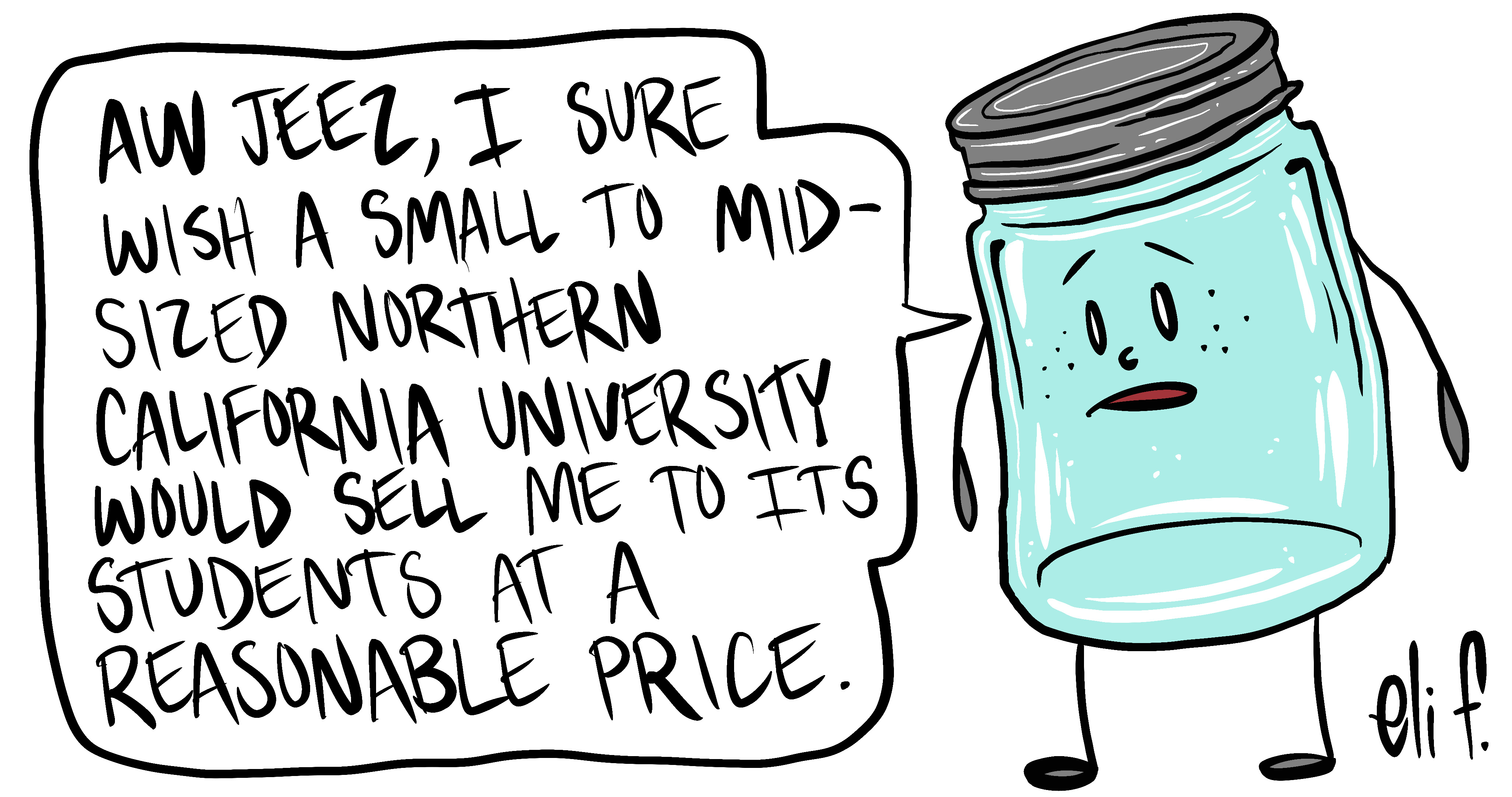
    Humboldt has a long history of environmentally friendly initiatives, with sustainable waste management being a priority at the University. In the spring of 2016, the university supported the national campaign, Kill the Cup, that aimed to end the use of disposable cups and promote reusable coffee cups. After that campaign, the Waste Reduction and Resource Awareness Program (WRAAP), Zero Waste Humboldt and Cal Poly Dining services opted to start selling mason jars. The program was then tracked in a research project in partnership with the Technology and the Environment (Engr308) class, the Sustainability Office and Dining Services. The research from Engr308 can be found on Appropedia.org, under HSU Mason Jar Analysis. The project analyzed the effects of mason jars and disposables, going over monetary costs, carbon dioxide emission and embedded energy, or the energy used to make a product. It was found that within just a few uses, the environmental impact of the mason jar was less than if a user had used paper or plastic cups on those occasions.  

    I miss the good old days of the library cafe when you could purchase a mason jar with a lid to-go. At some point, the mason jar program disappeared. I say we bring it back, or something similar to the OZZI boxes for to-go items. 

    The affordable price of $0.75 made it a no-brainer for me to get a mason jar. Growing up in Humboldt going to Arcata High, I loved going to the library to do homework, and order a chai tea in a mason jar. The jars were purchased by the palette for about $0.59 per jar, and so even with the low price of $0.75, they generated $0.16 profit.

    The Library Cafe is a part of Humboldt Dining, which has several sustainability initiatives such as a composting program, the reusable OZZI boxes, and a certification from the Green Restaurant Association. On their website, they explain that the Green Restaurant Association evaluates several categories — waste and recycling, and disposables are included in that evaluation. The university puts good effort into sustainability, which leads me to wonder why there is no reusable cup option available for purchase at the Cafe — talk about a missed marketing opportunity. 

    In March of 2023, I brought it up to the Humboldt Dining retail director Kyle McEdward over email, and he was open to bringing the program back, but wondered if there was a more eco-friendly alternative. His concern was that the glass used in mason jars is not technically recyclable, and wanted to avoid introducing more products into the waste stream.

    I had not thought about it like that, as I would never recycle a mason jar unless it broke, which does not happen easily. Mason jars can withstand high temperatures for canning, and so they are a little harder to melt down. However, it seems they can still be recycled. The company Berlin Packaging sells mason jars online, and states that while the lids may not be recyclable, the clear glass can be recycled with no problem. 

    The versatility of a mason jar is endless. For students, it’s a practical way to store food and drinks, use as a vase or hold literally anything you can think of. I love mason jars, but my main goal is to encourage students to use a reusable cup. If priced affordably, I believe many people would purchase a reusable option on the spot, similar to what is sold at the campus store. Maybe the university could implement a reusable cup program, and an option exists from the company that the university currently gets its OZZI boxes from. Next time you stop at the Library Cafe, make sure to bring your own cup and take advantage of the discount. But what is the reason for having no cup option for purchase? I see a profitable and sustainable opportunity for the cafe, and a chance to bring back a beneficial program that students and faculty formulated almost ten years ago.

    Ursula Newman is a journalism major and Humboldt local. You can find her all over town doing all kinds of things, and talking to all sorts of people.


  • Reel Talk with Julia

    Reel Talk with Julia

    Ground control to Mickey 17, this space oddity is great!

    By Julia Kelm

    Mickey 17 (2025) is a quirky sci-fi story based on the 2022 novel Mickey7 by Edward Ashton. The film follows the unlikely protagonist Mickey Barnes, played by Robert Pattinson, as he finds himself in strange circumstances, forced to flee Earth due to owing an obscene amount of money to a mafia boss.

    To escape Earth quickly, Mickey decides to sign up for a space program where he becomes what is called an “expendable.” In this program, he is basically asked to die for a living — however, he always wakes up a few hours later after being reprinted. One day after surviving a near-death experience, he comes face to face with himself.

    I saw this with a group of friends in Arcata, and we were sorta a mixed bag in how we felt about the film. I, however, enjoyed it quite a bit.

    Pattinson’s performance unquestionably shines in this film. I don’t know what has gotten into Pattinson that’s got him doing a weird little accent/voice in his recent movies like this one and The Boy and the Heron (2023), but I am here for it!

    This film also brings up some interesting philosophical and political thinking points. 

    What does it mean to die if you know you’re gonna just wake up again? Would you still fear death, or is it scary every time? If cloning technology like this existed, how would the government use it? All questions were answered to some degree, in a surprisingly poignant way.

    Bong Joon Ho is essentially the ruling king of cinematography that centers class consciousness and wealth redistribution — “Eat the Rich” cinematography in Layman’s terms. I would say Mickey 17 and Joon Ho’s earlier work in Parasite (2019), and especially Snowpiercer (2013), demonstrate that point.

    Mickey 17 and Snowpiercer are particularly comparable since both films are based on sci-fi novels and have a theme of a lower class overtaking the oppressive upper class. If you liked Mickey 17, try Snowpiercer for your next movie night!

    Naomi Ackie also proves herself to be a great supporting actress as Nasha Mickey’s significant other. This was my first time seeing Ackie in anything besides Star Wars: The Rise of Skywalker (2019), so I didn’t really have any expectations for her performance, but she really stood out to me in this film. I hope to see more of her in movies to come.

    Steven Yeun and Mark Ruffalo were also great, but I’ve seen enough from them in quirky sci-fi to expect a great performance from both — exemplified with Yeun in Nope (2022) and Ruffalo in Poor Things (2023).

    To conclude, go see Mickey 17 before it leaves theaters, it’s a fun watch you won’t forget anytime soon.

    Julia is a journalism major at Cal Poly Humboldt. She loves film and is a regular on Letterboxd. To quote Robin Williams in her all-time favorite movie, Dead Poets Society, “The powerful play goes on and you may contribute a verse. What will your verse be?”

  • From rubble to renewable — Former Children’s Center is grounds for new energy and sustainability center

    From rubble to renewable — Former Children’s Center is grounds for new energy and sustainability center

    By Jess Carey

    These days, the whirrs and booms of machinery have become a familiar presence on campus. Walking up B St. comes with the added challenge of dodging beeping trucks and equipment; bangs and clangs echo clear up to the Redwood Bowl. Construction noise is a constant reminder of changing times as the state’s $433 million investment in campus infrastructure is being converted into concrete and steel. While a giant crane looms over the new science building, visible from most of Arcata, another project has been breaking ground around the corner on 14th and B St. Four buildings of the former Children’s Center have been demolished — the Mary Warren House, Walter Warren House, Baiocchi House and the Toddler Center.

    As the administration demolishes a historic structure on campus, questions are raised about what the big H chose to build instead. The site is grounds for a new building, dubbed the Energy Research and Sustainability Center (ERSC). The planned 20,000 square-foot two-story building has a budget of $28 million, and is slated to be the epicenter of sustainability and energy programs on campus. The project is funded by one-time Cal Poly funds that were designated for facilities improvements in 2022.

    The site has been abandoned since the Children’s Center moved to the renovated Trinity Annex in 2023. The buildings were former residential homes that the university reused, examples of what Mike Fischer, Associate Vice President of Facilities Management, calls the campus’s legacy homes. These older buildings on campus were acquired from donations or purchased from the surrounding community as the campus grew over time. While originally built as residences, they are now used primarily as offices and community spaces.

    “While [legacy homes] are quaint and a vision of the past, they are old, expensive and inefficient,” Fischer said. “When it comes to better land utilization and increasing density to serve our population, these are some of the buildings we’d like to remove.”

    Fischer cited constant maintenance needs, including “leaky pipes and windows,” as a recurring problem. He says that the new ERSC will consolidate existing sustainability programs that are currently scattered around the campus, like the energy systems engineering program and the Office of Sustainability. 

    “This project will give sustainability programs visibility, and a place to manifest a real place to live,” Fischer said. 

    The Schatz Energy Research Center, which already has a building of its own on campus, is expected to have a footprint in the ERSC. The non-profit agency is partnering with Cal Poly Humboldt on this project. The building will contain labs and equipment for energy research including the development of a campus microgrid solar energy system.

    Fischer also noted that the entry to campus is a little lost on the south side, as the buildings looked like part of the resident community. Walkability is awkward, as the lack of pedestrian connection between Union and B Streets causes foot traffic to frequently cut across the G14 and G15 parking lots. The ERSC will establish a “southern place” on the campus border and improve walkability by building new sidewalks and pedestrian routes. 

    With the Campus Center for Appropriate Technology and the community gardens being just up the hill, the ERSC will complete the sustainability theme of the south campus. 

    “That quadrant of campus is really gearing up to be our sustainability and land stewardship center, becoming something really unique,” Fischer said. 

    While the sustainability of leaving buildings empty for years only to demolish them raises some ethical questions, the university has recently renovated several historic buildings. The Trinity Annex project, completed in 2023, preserved the aesthetic of a unique old-growth redwood building and converted it from decrepit campus storage into a fully functional childcare and educational center. The ongoing restoration of the former technology building will preserve its architectural style while transforming it into a new state-of-the-art sculpture lab.

    It is important to remember where we come from, and nods to the past can still be seen in the remaining legacy homes scattered throughout campus. However, it is clear that as the university settles into its Cal Poly future, not every treasured, quirky building is going to stick around.

    Jess Carey is a senior at Cal Poly Humboldt, majoring in biology and double minoring in botany and journalism, and the science editor for The Lumberjack. They are passionate about telling stories that are relevant to the community, branching their interests in science, music, and storytelling.

  • Local permaculture and Humboldt culture

    Local permaculture and Humboldt culture

    Gardening community grows at 24th annual seed and plant exchange

    By Jess Carey and Nick Escalada

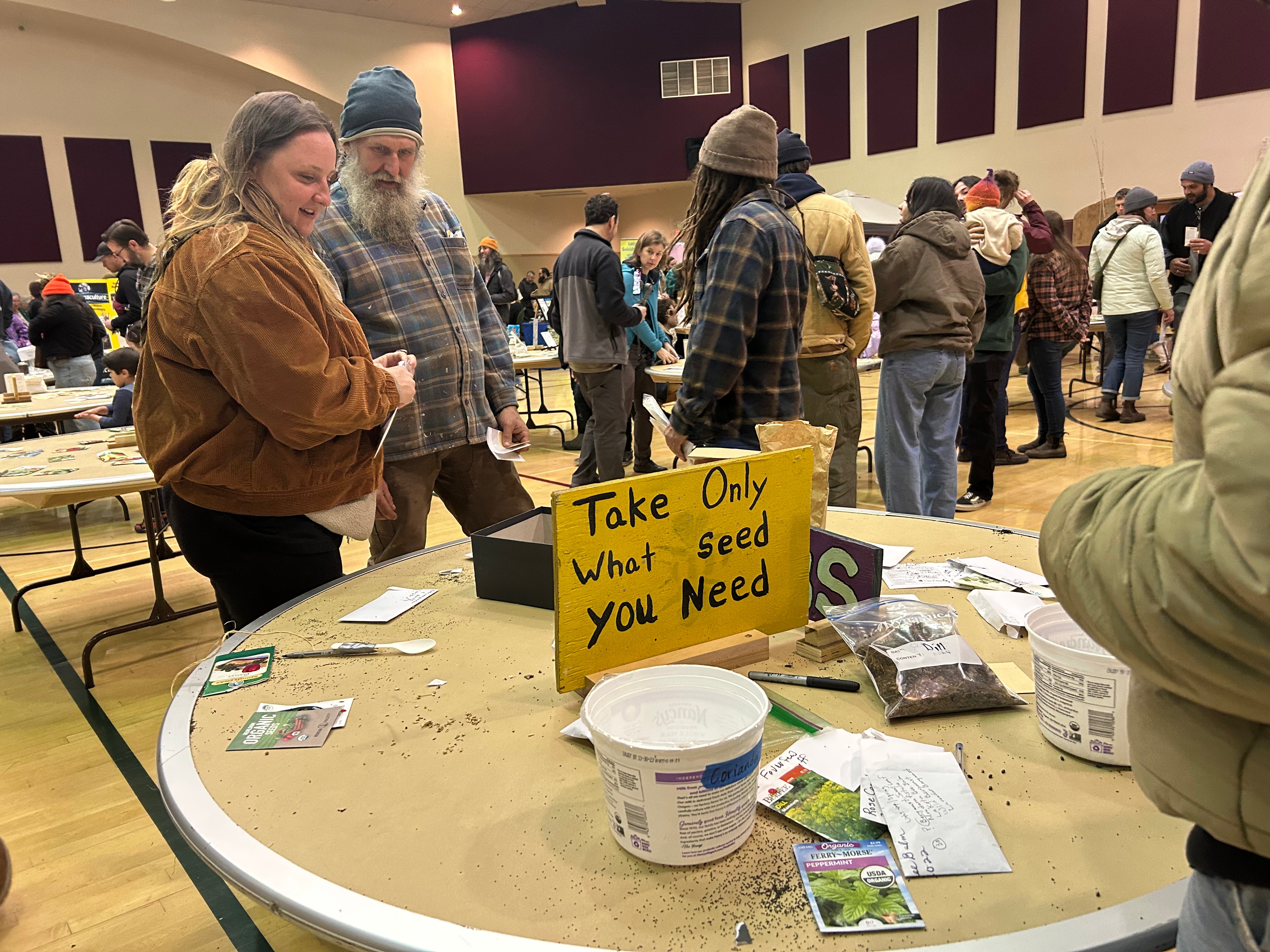
    The Humboldt Permaculture Guild hosted their 24th annual Seed and Plant Exchange last week on March 15. Thousands of agricultural enthusiasts gathered at the Arcata Community Center to trade seeds and build community around local permaculture. Hundreds of varieties of vegetable, fruit, herb and flower seeds were available for free, donated by community members with excess to share. Exchanging seeds reduces waste, as oftentimes plants produce many more seeds than gardeners are able to use. Vendors sold plants, herbal medicine, books and more. 

    Somewhat unique to this convention was a scion exchange, which entails sharing varieties of fruit trees that can then be used to graft new varieties onto existing trees. In addition to grafting workshops, demonstrations of sustainable agricultural practices such as making biochar, and properly cleaning and saving seeds took place throughout the day.

    Along with the myriad of plants and seeds for the taking, there was a raffle and several workshops. Community members and local organizations tabled around the perimeter of the event, sharing gardening tips and information about local environmental projects. 

    Rosemary Meisler co-directs the Campus Center for Appropriate Technology, Cal Poly Humboldt’s student-run and community-led sustainability education program, and was a fan of the event. 

    “Exchanging seeds has so many benefits on so many levels,” Meisler said. “It is a great way to tangibly invest in keeping our gardens native and diverse while mutually supporting each other’s farms of all sizes.” 

    The Humboldt Permaculture Guild organizes events like these year-round with shared themes of conservation and land stewardship through plant cultivation. In addition to gatherings like the seed exchange — which is the most ambitious and popular event of the year — they host gardening education workshops and community projects, such as building seed libraries.

    “This event is a really wonderful opportunity for people of all ages and backgrounds,” Meisler said. “I learned so much about farming techniques, growing food and medicine independently, and participating in our local economies and ecologies.” 

    Three college students - one wearing a beige sweater and beanie, one wearing a blue and white jacket, and another wearing a black hoodie and red beanie, sit at a decorated table for the Campus Center for Appropriate Technology. Two of the directors are holding up seedlings in small planter boxes.
    Photo by Jess Carey | Co-directors of the Campus Center for Appropriate
    Technology — Rosemary Meisler, Myranda Felton and Abby Mingus — tabled at the event.

    Jess Carey is a senior at Cal Poly Humboldt, majoring in biology and double minoring in botany and journalism, and the science editor for The Lumberjack. They are passionate about telling stories that are relevant to the community, branching their interests in science, music, and the arts.

    Nick is a sophomore minoring in journalism who reports on happenings of all sorts. As a wildlife major, he enjoys nature-related pieces. On his off days, you can find him taking a hike behind campus or collecting shiny stuff on the beach.

  • CSU system announces new landmark AI initiative

    CSU system announces new landmark AI initiative

    By Ursula Newman

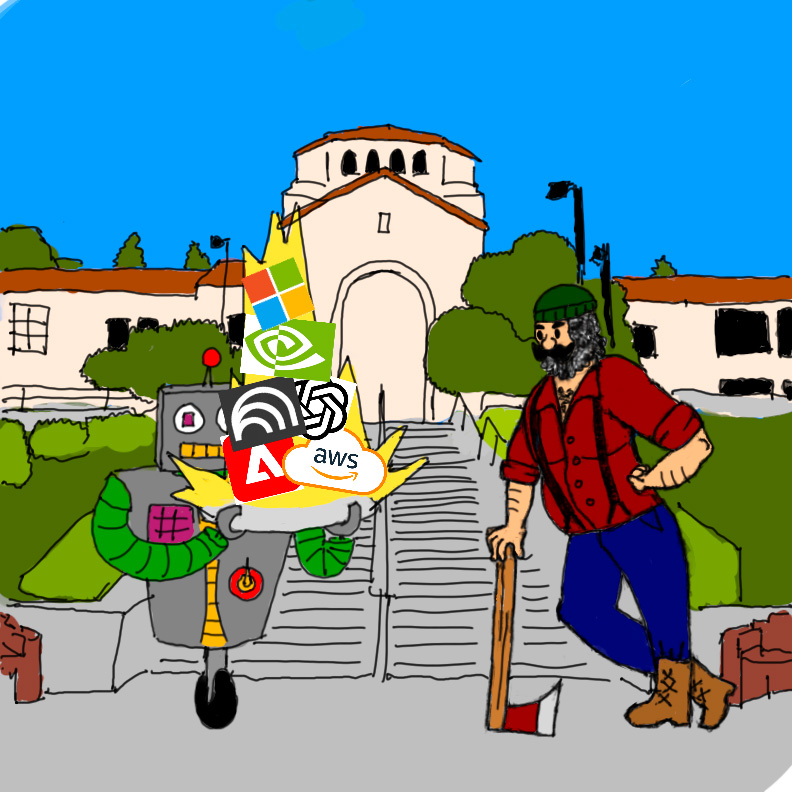
    The California State University (CSU) system announced its new Artificial Intelligence (AI) initiative to enhance access to AI technology and prepare students to be AI literate in future careers. This initiative is the first of its kind, with the CSU stating that no other university systems have implemented AI initiatives at this scale. This means AI software is becoming accessible through the university system, with a licensed version of ChatGPT joining the list of digital resources available to our campus community. In addition to new tech, training programs have been released to students and faculty to promote education on the growing AI sphere.

    The initiative includes partnerships with leading tech companies such as Adobe, AWS, IBM, Instructure, Alphabet (Google), Intel, LinkedIn, NVIDIA, Microsoft, OpenAI, and the Office of California Governor Gavin Newsom. These names, along with several CSU

    Representatives — which can be found on the California State University AI commons web page — make up the AI Workforce Acceleration Board, which plans to help pinpoint which AI skills are needed in California’s workforce and address those needs. The CSU system put out a press release on Feb. 4 titled “CSU Announces Landmark Initiative to Become Nation’s First and Largest AI-Empowered University System,” announcing the initiative and explaining that more tech companies are expected to be added to the advisory board in the near future.

    AI tools available at the university 

    Several services are being made available to students and faculty. Cal Poly Humboldt currently has licensed versions of generative AI chatbots Microsoft Copilot and Google Gemini, Zoom AI Companion, which takes notes and makes summaries, and Adobe Firefly for AI image generation. 

    Coming soon to the university is Notebook LM, Google’s AI-powered research and note-taking tool that organizes, summarizes and brainstorms, and OpenAI’s ChatGPT Edu, a chatbot that uses natural language processing to respond to prompts. Additional information about what is available may be found on the university website’s Information Technology Services page under the Artificial Intelligence tab. 

    The Center for Teaching & Learning Director, Enoch Hale, gave comment on the university’s game plan regarding this new initiative.

     “Humboldt has taken a robust, yet measured approach to implementing AI,” Hale said. “We are committed to supporting educators, learners, and all employees in this rapidly evolving digital landscape. The CSU has provided additional resources for its staff, faculty, and students, [which] include guides and courses they can take to address multiple areas of AI literacy.  Additionally, resources are provided to help all of us think through the ethical and responsible uses of AI in our work, in our learning, and in our lives.”

    Perspectives on AI in schools

    While there are classes where use of AI is limited or banned, this new initiative challenges that with the ChatGPT Edu agreement being specifically designed for the CSU system. The implementation of this is rooted in the concept that the job market is changing, and California’s workforce will need to learn to meet demands. 

    In a study from Microsoft and LinkedIn that surveyed 31,000 people across 31 countries, it was found that in 2024, over a six month period, the use of generative AI almost doubled, and now 75% of global knowledge workers use it regularly at work. However, this does not necessarily mean that companies are providing AI programs. 78% of AI users are using AI tools not provided by their organization and around 50% of workers who use AI said they are reluctant to admit using it for important tasks and worry that it might make them look replaceable. 

    Drawbacks of AI in schools 

    Despite the many uses of AI, there are concerns regarding AI use in academic settings. In a study by Geoffrey M. Currie, titled Academic Integrity and Artificial Intelligence, Currie explores the controversy around AI tools such as ChatGPT. He explains that at the core of the issue is the potential damage to institutions, professions and public safety if graduates do not genuinely develop certain skills and capabilities, and instead become overly reliant on AI programs. 

    Issues surrounding equity, access and data collection are addressed in the CSU’s statements. One of the initiative’s main goals is to make services accessible to all.

    Cade Webb, acting Chief Information Officer of Information Technology Services, explained that OpenAI will be providing training materials and workshops to help students develop effective and responsible AI. Critical thinking, informed use and reducing the impact on our environment will all be main points of emphasis. He also mentioned that by investing in this resource system wide, the CSU is helping to expand access and build a strong foundation for students’ engagement with AI. 

    Environmental impact 

    The CSU system has a sustainability policy, with a Climate Action Plan — one that outlines a goal of reducing systemwide facility carbon emissions significantly by 2040. 

    “CSU will strive to reduce systemwide facility carbon emissions to 40 percent below 1990 levels consistent with SB 32, California’s Global Warming Solutions Act of 2006 Emissions will include both state and auxiliary organization purchases of electricity and natural gas; fleet, marine vessel usage; and other emissions the university or self-support entity has direct control over,” according to the CSU Climate Action Plan. 

    The CSU system’s goals of reducing systemwide facility carbon emissions promises their dedication to sustainability. In contrast, the creating and training generative AI models — such as ChatGPT — requires a lot of electricity, which leads to increased carbon dioxide emissions. This is explored in an article by Massachusetts Institute of Technology about generative AI’s environmental impact. They stated that researchers have estimated that asking ChatGPT a question uses five times more electricity than a standard web search. 

    After initial development, the use of these programs continues to draw large amounts of energy. Fossil fuels are also used to create energy, as renewable sources of energy are not always enough. Data centers also require large amounts of water for cooling and generating electricity. There are also indirect environmental impacts from the increased demand for high-performance computing hardware and the need for more of these data centers to be built. 

    Scientists from Google and University of California, Berkeley estimated that the training process of a generative AI program uses 1,287 megawatt hours of electricity and generates about 552 tons of carbon dioxide. This is the same amount of power that 120 average US homes will use in a year. 

    Training and education

    Training and education around AI programs is another key part of the initiative. A student Generative AI (GenAI) micro credential titled “Academic Applications of AI (AAAI),” and a GenAI micro credential for faculty were designed by SDSU and are currently available to all CSUs. The goal of these online training programs is to enhance understanding of AI, explore its benefits and promote responsible use and ethical practices. Users will receive a credential or certificate upon completion, after engaging with several hours of education. 

    Webb explained that here at the university, there has been significant interest in generative AI tools, with over 2,700 users accessing the free version of ChatGPT.

    “While this shows the growing demand and curiosity around AI, the new education-specific license will provide a more secure environment for our students, faculty, and staff, ensuring that data is protected and usage aligns with campus privacy expectations,” Webb said. “We expect this tool to be available to our students this year, providing access to ChatGPT’s powerful capabilities for personalized learning support, research assistance and creative exploration.”

    Ursula Newman is a journalism major and Humboldt local. You can find her all over town doing all kinds of things, and talking to all sorts of people.

  • Jack off, Squatch on. Change our mascot

    Jack off, Squatch on. Change our mascot

    We need to leave our problematic mascot behind and embrace local legends

    By Jess Carey

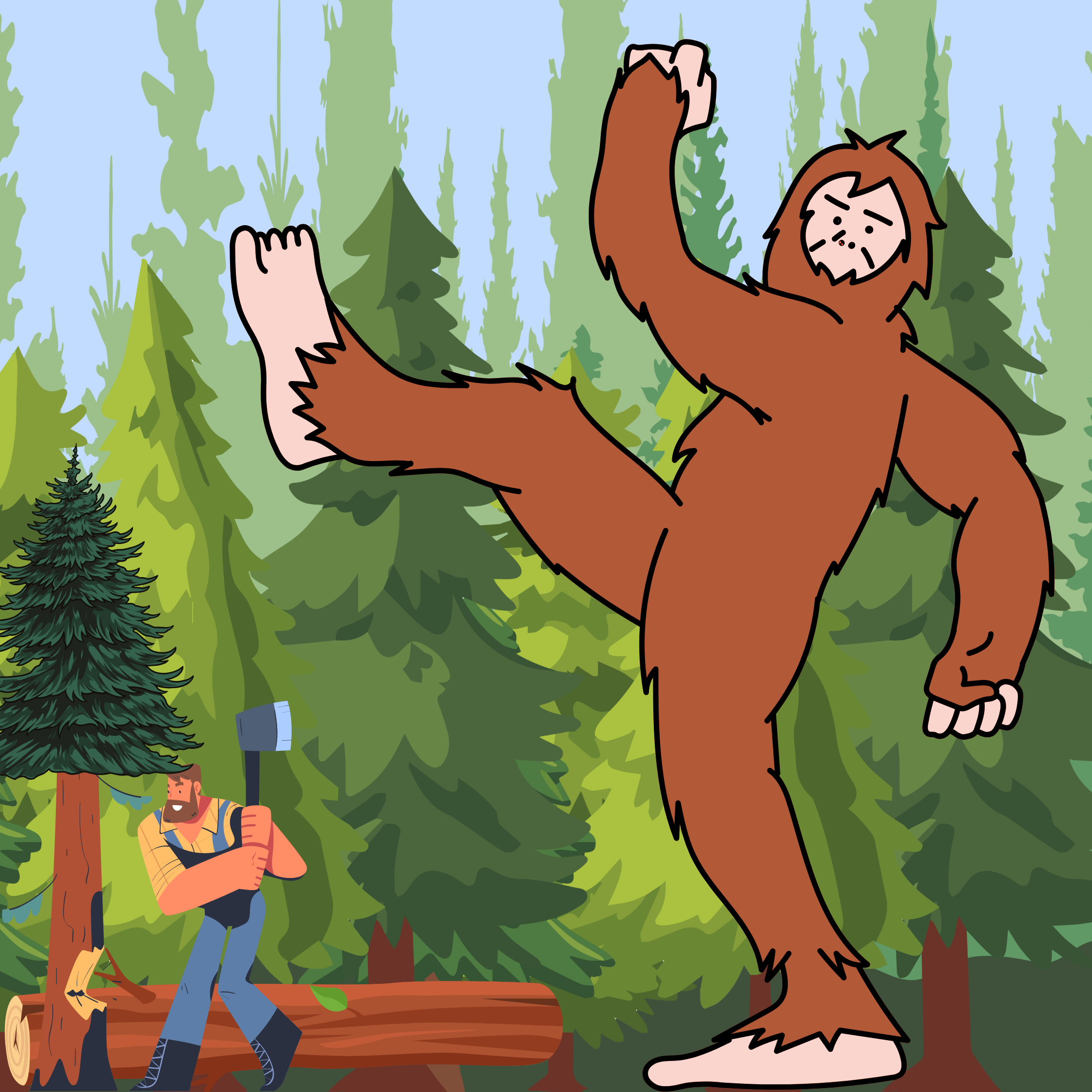
    Mascots are a staple of American college culture. Easily reproducible and widely circulated, mascots are a quick and easy way to publicize and create connections. If a picture is worth a thousand words, then the images we choose to represent ourselves should be intentional reflections of our values. A mascot change would steer us away from celebrating colonialist narratives. Sasquatch, or Bigfoot, is a beloved local legend whose image would better represent the values of the campus and community at large.

    The redwood logging industry and its lumberjacks built Humboldt County as we know it. From the 1800’s onwards, settlers poured into the North Coast seeking fortune from the new red gold. The redwoods with their unparalleled height and size presented an irresistible opportunity for exploitation. A dark undertone of violence and exploitation took root simultaneously with the influx of settlers to the region, and left brutal scars on this land and in the memories of its people.

    The Native American Health Commission has a list of over 100 documented violent incidents in the greater Humboldt region alone between 1850 and 1870, with an estimated death toll of 2,278-3,816 documented individuals. The few survivors of the Tuluwat Island massacre in particular were forcibly relocated to Klamath and other reservations, while their land was desecrated and its resources were squeezed out like water from a sponge. Alongside blatant genocide, the forests were decimated, with only 5% of the original old-growth redwood trees remaining standing today. The same individuals who perpetrated a genocide and destroyed old-growth forests are those whose legacy we have chosen to represent our campus.

    Lucky the Lumberjack has deep roots in campus history, and this paper itself. Humboldt State Teachers College was renamed Humboldt State College in 1935. The lumberjack mascot was adopted the next year. Our paper has been dubbed The Lumberjack since 1929. Lucky continues to be one of the first images that comes to mind when people think about the campus. T-shirts and plastic stickers of muscly, hairy, white men wearing red flannel are mailed out all over the country to prospective students. A cardboard cutout outside the campus store is clad in suspendered denim with one leathered boot on a redwood log and an axe in hand. An animated foam and plastic caricature dances at competitions and events, the grotesquely cartoonish image of a colonizer and usurper fabricated into a costume, prancing on land that was stolen and soaked in blood.

    Consider Sasquatch as an alternative. The word Sasquatch arises from the term sasq-ets, which means wild-man or hairy man in the Salish languages of Native peoples from the Pacific Northwest. The image of Sasquatch celebrates the folklore of Northern California. The common term “Bigfoot” originated locally in a 1958 article in the Humboldt Times describing intriguing large footprints found along the Trinity River. The infamous 1967 Patterson-Gimlin film was recorded just north of Humboldt County at Bluff Creek, a tributary of the Klamath River. The nearby town of Willow Creek is the self-proclaimed “Bigfoot Capital of the World.” The image of an aloof hairy giant with outspread arms, mid-stride and confident, turning to face the camera over its shoulder remains an iconic part of local culture.

    While several other major American colleges have lumberjack mascots, no one has Sasquatch. Our campus is uniquely located in the heart of Bigfoot’s territory, and Sasquatch’s story and legend inspire whimsy and a connection with nature. This novel move would set Cal Poly Humboldt apart and better reflect our values of sustainability, connection with nature, and accountability. Making the shift to Sasquatch as our mascot would foster a more relatable campus culture while celebrating our land and its stories, solidifying our identity, and unifying our community.

    Jess Carey is a senior at Cal Poly Humboldt, majoring in biology and double minoring in botany and journalism, and the science editor for The Lumberjack. They are passionate about telling stories that are relevant to the community, branching their interests in science, music, and the arts.

  • Finding joy and employment in the art industry

    Finding joy and employment in the art industry

    By Griffin Mancuso

    I have only been angry once after being told art was a fruitless pursuit. I was sitting in a square classroom decorated with prints of the U.S. Constitution, previous presidents, and the U.S. flag. At the front of the classroom was my 8th grade history teacher, who would practice his golf swings while we worked and was not as good at hiding his republican beliefs as he thought he was — he was also a bit of a hater.

    He decided to go on a 10-minute lecture about how pursuing art as a career isn’t worth the effort and won’t make you enough money to live off of, even if you do get a job. Not practical, he said.

    Eight years later, I am at a California College Media Association awards banquet in Long Beach. I am wearing a gaudy southern dress shirt and I am watching the projector screen at the front of the room as some of the best journalists in the state are recognized for their efforts.

    “First place [for best illustration], Cal Poly Humboldt’s The Lumberjack!” the host announced.

    I completely lose my strength and start laughing, slumped against the table as the image of my burly bear lumberjack wearing red fishnets is displayed for the entire state to see. Practical? Maybe not. But I have never heard so much laughter from the audience in all three years I’ve attended that conference.

    The Situation with Oversaturation

    Us artists have probably heard countless times that the art industry is “oversaturated” and that finding success to the point of earning a comfortable living wage is nearly impossible, or just comes down to dumb luck. However, the Bureau of Labor Statistics (BLS) reports that art and design occupations are projected to grow at about the same rate as other occupations from 2023 to 2033. About 87,900 openings are projected each year, and the median annual salary in May 2023 was $51,660. This statistic, of course, doesn’t include freelance artists who have ascended beyond the bounds of corporate work.

    The BLS reports that the top three careers that are facing decline in the next 10 years aren’t even art-related. Word processor and typist jobs are predicted to decline by 38% from 2023-2033, roof bolting and mining jobs will decline by 32% and telephone operator jobs will drop by 26.4%.

    Of course, there are far more than 87,900 artists in the U.S. The BLS’s data also applies to a wide range of occupations like interior designers, art directors and even florists. If you look into more specific positions like graphic designers, the numbers are a little less hopeful. Some positions are going to be highly competitive — who hasn’t wanted to be a storyboard artist at one point? — but saturation in the art industry isn’t equally distributed. 

    The Need for a Niche

    My cunty lumberjack taught me a valuable lesson about finding success in art — you have to like what you’re doing, and you have to find your niche. There’s a reason fursuit makers are swimming in their pool of gold coins like Scrooge McDuck. If you force yourself to cater to a market you’re not that passionate about, you are going to be miserable and it is going to show in your work. If it did work, we’d all be making fursuits.

    One of the perks of working in art is that almost every facet of society needs it. An artist designed the McDonald’s logo, an artist created those weird sparkly Humboldt crosswalks in Arcata and an artist designed the packaging of your cough drops you’ve been inhaling for the last week. Your “niche” can be as niche as it gets, even if it doesn’t sound that cool when people ask you what you do for work.

    I will forever encourage artists to explore different areas of the art industry because they may unexpectedly find their new passion. Someone needs their album covers designed, someone needs a visual director for the new line of Kanha edibles, and for me, someone needed a top fold design for a Valentine’s Day newspaper. If you can’t find a job that you’re really interested in, you can create your own. There are plenty of people who make a living off of selling their own products and commissions, and there’s an immense joy to be found in seeing people wearing or using your art.

    That obviously doesn’t mean you have to abandon your current art pursuits, but it may not be the thing that’s making you a living wage. And who says you only have to have one job? That being said, please girlboss responsibly.

    Make Your Own Luck

    Like most jobs, getting into art isn’t going to be easy. Finding your speciality and building a portfolio is a skill in and of itself and will require a lot of research, perseverance, and trial and error. Unfortunately, sometimes it is pure dumb luck. I had no idea there was a market among college students for sexy, burly lumberjacks in crop tops and booty shorts, but luck in this industry isn’t fully based on chance. It’s determined by what you believe you’re capable of and if you’re willing to take your ridiculous ideas to the moon. That one fit of creative passion you got at 3 a.m. may become a pivotal point in your career.

    Above all, find something that drives you and don’t let go of that. If you’re like me, maybe it’s to spite your 8th grade history teacher. Maybe it’s buying that cabin in the woods and smoking a pipe while you paint the forest landscape. Maybe it’s just to make a comfortable living in this capitalist landscape. Let that motivation propel you forward as you keep searching for your place in this ever changing industry. It may just lead you to something unexpected.

    Griffin Mancuso is a journalism major and one of the managing editors of The Lumberjack. He has written stories for every category in the paper, but particularly enjoys writing human-centric stories. He has also freelanced for the North Coast Journal and News Decoder.

  • Plant of the Week: Equisetum telmateia

    Plant of the Week: Equisetum telmateia

    The plant that once towered above the dinosaurs

    By Jess Carey

    Dinosaurs once roamed through forests of giant horsetails, large bamboo-like plants up to 100 feet tall. Today’s horsetails may seem tall to an insect. Plants in the genus Equisetum are the sole living representatives of their ancient lineage that towered over dinosaurs in the Jurassic age. Today, they grow in dense clusters in wet areas, as a microcosm of their former glory. A bank of Equisetum looks like a tiny forest. Every spring, long tapering green stalks poke through the understory, arising from underground roots specialized for hibernation through winter. Our local species, Equisetum telmateia, is in abundance in wet places on campus and around the Arcata Community Forest. A particularly robust community of horsetails thrive along the creek that runs by the College Creek soccer field. 

    Equisetum’s ancient origin is reflected in its alien appearance. Bottlebrushy leaves spiral from green stalks, broken up into nodes that progressively get smaller as the plant grows higher. Fertile, leafless stalks are a lighter brown-green and culminate with a corncob-looking reproductive structure called the strobilus. The strobilus is basically similar to a pinecone, except this plant makes single-celled spores instead of seeds. This reproductive strategy is similar to how fungi reproduce. If you pop off a node and rub it in your fingers, you’ll notice a coarse texture, thanks to silica deposited in the plant’s cell walls. This brittle texture is the origin of the plant’s other common name, scouring rush, as the plant can be used to scour dishes clean.

  • Genrephobia is a disservice to you

    Genrephobia is a disservice to you

    By Kaylon Coleman

    There’s a good chance that nine out of the ten of you who read that headline immediately thought about country music, and with good reason too. I feel like almost everyone has a genre of music they don’t generally listen to, which is fine. But let me ask you this, how many people actually give a genre a chance before cutting it off?

    This quandary stems from my problem with generalizations as a whole. I believe that generalizations perpetuate certain ideologies that may or may not be true about a certain concept or population. And while this principle extends to way more than just personal preference of music genres — which is a whole other can of worms — I want to talk specifically about how not opening yourself up to new music, because of your own generalizations, may be doing you harm.

    Now don’t get me wrong, I believe if you try something out and it isn’t your cup of tea, more power to you. I respect it – you gave it a chance. But, if you’ve heard a few rap songs, or a country song or two, and immediately decided that you weren’t gonna listen to the whole genre, I think you’re doing yourself a disservice.

    An example of an artist that I didn’t quite grasp until recently was ian. I didn’t get the hype at first, I thought he was a white boy who was using rap as a gateway into the music industry similar to how Post Malone did. But after Lil Yachty’s performance of Hate Me at my recent trip to the Tyler, The Creator concert, it finally clicked for me. That wasn’t my first time hearing the song. It wasn’t even my first time hearing it live, but this time I finally got the hype. Since then, I’ve given ian another chance, and I can say that I thoroughly enjoy some of his music, and even changed my perspective on him as a person.

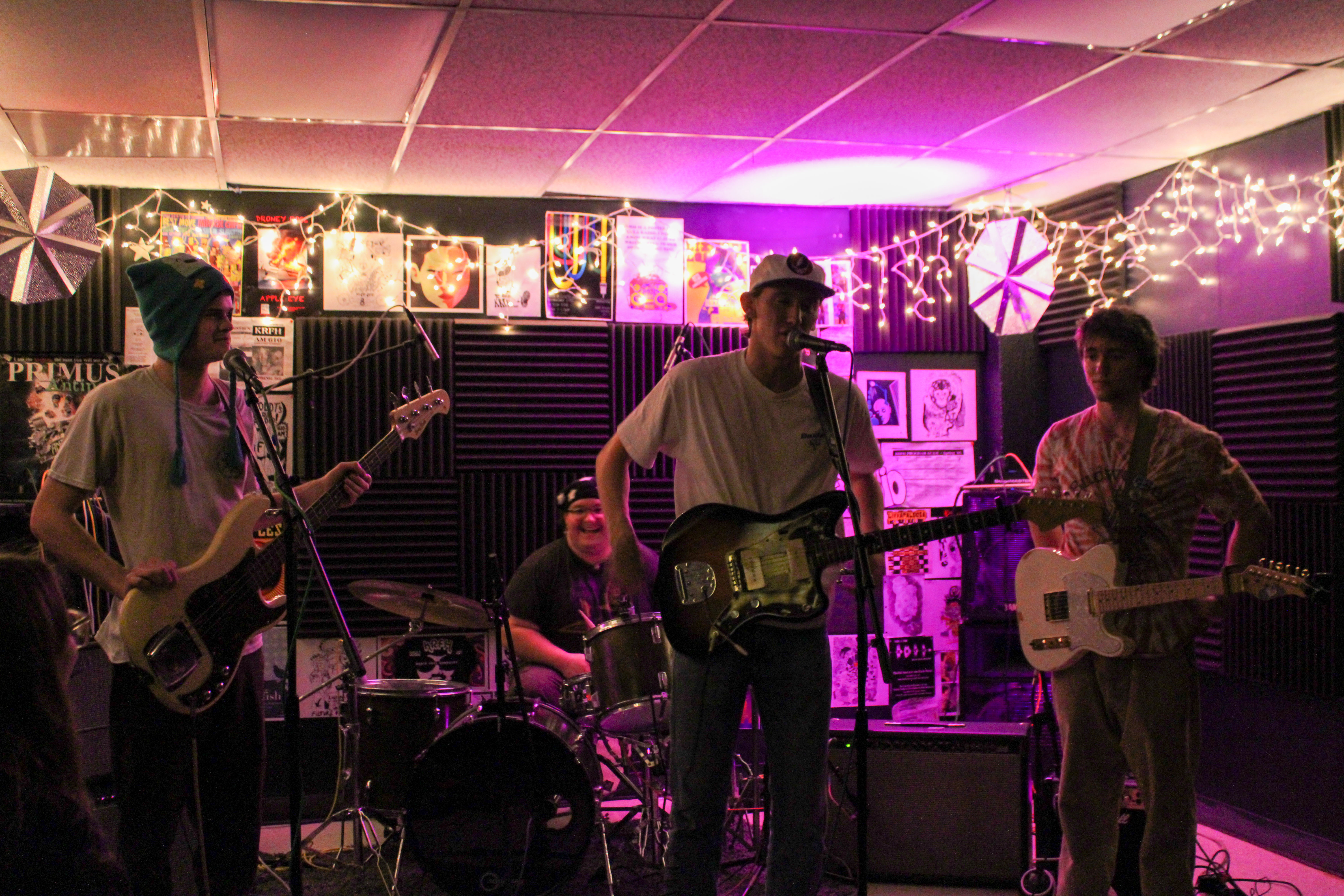
    There are so many ways that you can expand your music taste, even here in Humboldt. Tuning into 105.1 KRFH at any given time opens you up to a variety of different tastes and sounds from your local college students. Stopping by People’s Records in the plaza and utilizing one of their listening booths is another way to expand your music taste. 

    Music is so expansive, and that’s what I love about it. With a nearly never-ending amount of music to choose from, there’s something out there for anyone and everyone to enjoy. That’s why when I hear someone say, “I don’t like this genre” or “I only listen to this one specific thing” and they haven’t tried to venture outside of that, I feel like they’re missing out on potential hidden gems. I don’t like country, but there are some country songs that I absolutely love like Chris Stapleton’s Tennessee Whiskey (especially the T-Pain cover) and I’m Gonna Miss Her by Brad Paisley.

    I want to extend this point by saying that if you find yourself only listening to one genre of music, I implore you to venture outside your comfort zone. You’re closing yourself off from a near-infinite pool of songs to listen to.

    My point being, before you make the decision on whether or not you like or dislike a whole genre, open yourself up to more than a couple songs. It might not change your opinion on the genre as a whole, but you may actually find some songs you enjoy.

    Kaylon Coleman is a junior journalism major with a concentration in news and a minor in Psychology and Communications. He is the Social Media Assistant Manager for LJ. He is also the president of the Black Student Union at CPH, social media coordinator for the Umoja Center, and a part-time radio DJ.

  • A honkin’ good time

    A honkin’ good time

    A late-night jam with KRFH’s DJ Goosepunch

    By Barley Lewis-McCabe

    “I’m DJ Goosepunch, and you’re in for a honkin’ good time,” KRFH DJ Nico Patadakis said. “So get ready, we’re gonna start the night with Philosophy by Ben Folds Five and see where we go from there.” 

    Immediately the small studio became engulfed in a mid-90s rock piano ballad, the walls shaking when Patadakis turned up the speakers, and spun his chair around to look at me. 

    “How did I sound?” Patadakis said.

    11-12 p.m. on a Sunday night may not be an appealing time slot to folks who have spent the day nursing a hangover, have an 8 a.m. class, an early shift, or all three. However, a weekend sendoff can be found in the KRFH radio booth with Patakidis, a freshman English major. He’s a cat-like man with sharp features, and pointed hair, truly passionate about what he does.

    Patadakis and I exited the ghost town campus to enter Gist Hall, creepy as ever, about 30 minutes before the set. When going deeper into the building and closer to the studio, signs of life appear such as band posters, wooden cutouts, a populated bulletin board, and a room with a big KRFH sticker on it. 

    Everything changes walking through that door. You can’t argue that the studio isn’t lively. Even this late, the music’s still bumping. 

    The booth itself is maximalist to the greatest extent, covered wall to wall in stickers. Some read, “Hot girls listen to KRFH,” and, “This is a drug-free zone.” The autonomous broadcast program played some smooth funky Miles Davis. Goosepunch chuckled smugly as he took the helm, put on some Cat Stevens and prepared for his first set. 

    The studio’s ambience is confusingly bright, the studio’s naturally dark — everything’s dark at this hour, of course. The soundproofing insulation blocked out any light and held in as much heat as the DJs (and inquisitive journalists) could produce, hence the large box fan and its never ending, “Brrrmmmmm.” But as the machines hummed, they each produced a separate light and their own ticking sound. Each button and switch carried out some important task.

    As energetic as the host was, the stale, burnt coffee wore off and Goosepunch and mine’s conversation began to slow down. I leaned back in my chair and saw the calmness of a late-night set. It was like the only sounds in the world were coming from this one room. 

    At 11:34 p.m., we went into a short break to hear some promos and continued to talk. Any moment he wasn’t on the mic, we would talk. I got to see his improvisational style, his dry jokes and quirks. I got to know him. He’s honest to the mic, no persona or excessive showmanship but he’s not like any average Joey KRFH. Take the name, “Goosepunch”, chosen because goose rhymes with juice, fruit punch is juice. Combine that with his love of geese and punch and you’ve got a memorable moniker.  

    “Why did you join KRFH?” I asked him.

    “It seemed like an interesting thing to do.”

    He didn’t elaborate further, there wasn’t anything else to say. Patakidis found something interesting, did it, and did it well. Eventually, it was time to end it.

    “I’m DJ Goosepunch. It’s 11:54 p.m. and my show is coming to an end. I’m back next week, same time same day. Have a good night” 

    And as suddenly as the music began, it was off. Time for the next set. We walked into the pitch-black campus, the working week beginning, and once again the DJ was just a man.

    Barley Lewis-McCabe is a freshman journalism major, photojournalist, and untraditional reporter. They like to cover interesting stories that center on social change and human impact.

  • Tyler, The Creator’s Chromakopia tourwas the mid-semester refresh I needed

    Tyler, The Creator’s Chromakopia tourwas the mid-semester refresh I needed

    By Kaylon Coleman

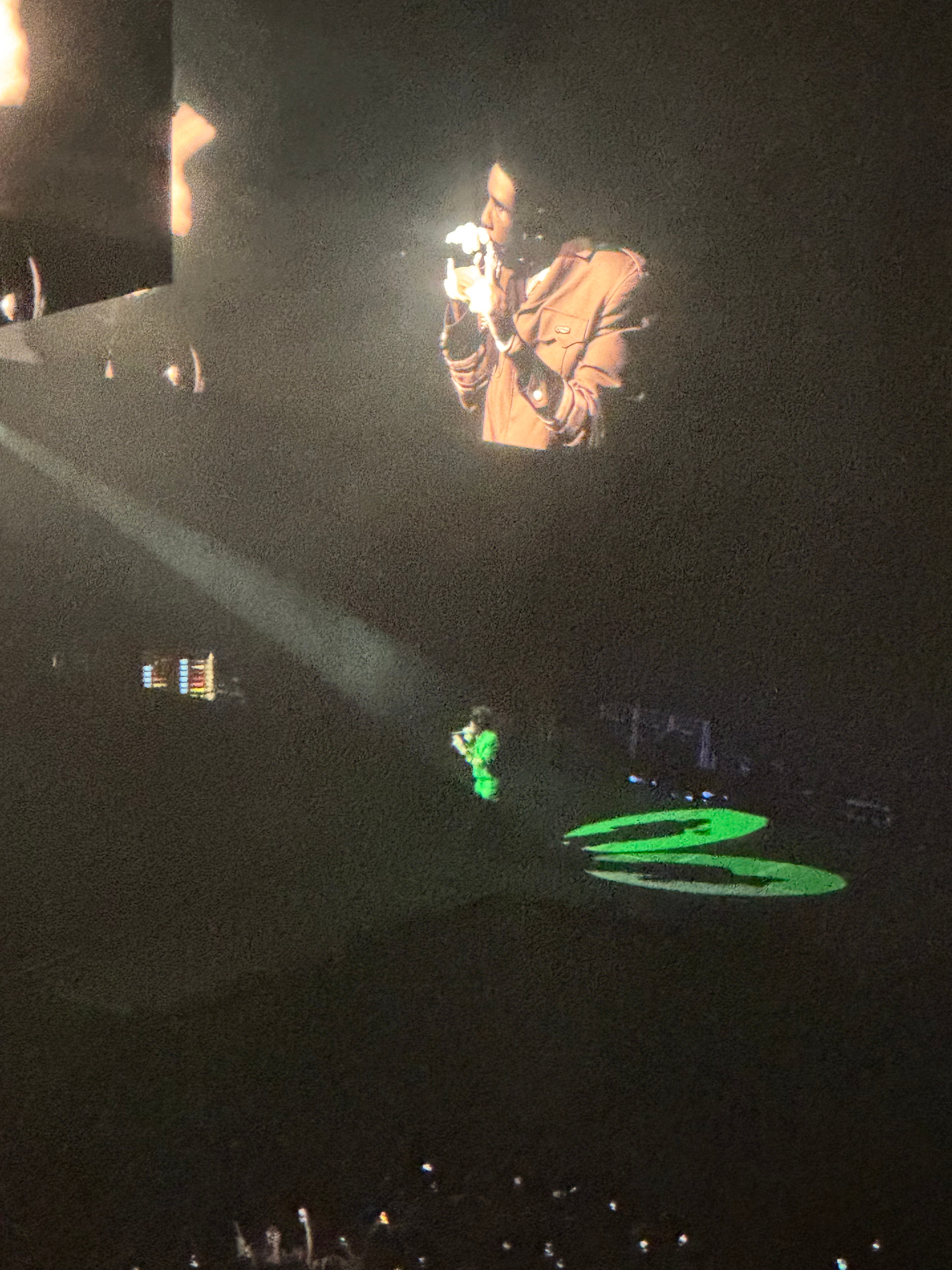
    I remember the excitement I felt as soon as the lights dimmed, and the track began. “Chromakopia… Chromakopia” erupted from the crowd as the wall shrouding Tyler, The Creator slowly raised to reveal the artist. 

    As soon as I stepped into the Golden 1 Center on Feb. 23, I was immediately overwhelmed by the sheer size and magnitude of the venue. It was my first time going to an arena for an event. I was there for Tyler, The Creator’s “Chromakopia World Tour,” with openers Paris Texas and Lil Yachty. 

    In the days leading up to the event, I could not contain my excitement. It wasn’t just the concert I was excited about, but the whole trip itself. I feel like two things revitalize my spirit during the semester, and they are road trips and concerts. Whenever I get to do a two-for-one, best believe I’m over the moon.

    Sometime before I left for the trip, I had an opportunity to talk to Camo!, a member of the Concrete Boys, the collective led by Lil Yachty. They’re traveling alongside Yachty as the tour progresses, so I asked if it was possible to get an interview when they stopped in Sacramento. Long story short, I did not get the interview. To be fair, I don’t even think they went to the show that night, but that’s neither here nor there. In spite of not getting an interview, the concert was still electrifying to say the least.

    Once we found our seats, my friend and I roamed a little bit to grab the essentials — popcorn and some water — before scouting out the merch line to see where we would have to book it once the concert was over. To our surprise, the first openers of the night, Paris Texas, started their performance as we were still perusing. We excitedly rushed back to our seats and locked in for the first of many performances that night.

    An overhead view of a concert venue with a small center stage illuminated by stage lights. Two performers sing into their microphones facing each other, while a third person stands in front of a soundboard. The stage is surrounded by hundreds of fans holding up phones and watching intently.
    Photo by Kaylon Coleman | Paris Texas performing FORCE OF HABIT to hype up the crowd for Tyler.

    I had never heard a Paris Texas song before the concert, and neither had my friend, so we both decided to go in blind and just experience their music for the first time live. I can say they were actually pretty cool. From what I heard, I’m guessing the duo is an alt hip-hop/alt rock band, but I don’t know for certain. What I do know is that they had the crowd moving in what was ultimately a fun performance. The band seemed to be feeding off the energy of the crowd and delivering it right back. During one of their last songs, the group asked for everyone to light up the arena in what was probably the most beautiful moment I captured from the night.

    Once their performance was up, my friend and I sat giddy with excitement as we knew it was only up from here. It was only maybe ten minutes after Paris Texas got off stage that Lil Yachty made his appearance, which was incredibly shocking to me. In all my concert experiences, (some of which were Yachty himself), I’ve never experienced such a non-delayed schedule time like this. I was pleasantly surprised to see him hop on stage that fast after the last performance and to see how fast Paris Texas got on stage too.

    Needless to say, Yachty served as the opener I needed to really get turnt up. Yachty played a variety of songs during his performance, starting with hits such as Hate Me, Split/Whole Time, and From The D To The A. He then followed this up by going into his more popular older songs such as Minnesota, iSpy, and One Night. He concluded his set by playing songs off his newest solo album release, Let’s Start Here, and at this point I had practically already lost my voice. 

    Once Yachty walked off stage, I couldn’t stop talking about how we were getting treated to a Lil Yachty concert AND a Tyler concert (can’t forget about Paris Texas, too). My friend and I were ecstatic as we bounced around in our seats anticipating the main performance. This time it took about 40 minutes before Tyler graced us with his presence on stage, but none of that mattered once his performance started.

    A shot of two large digital screens showing Lil Yachty, wearing a backwards baseball cap and a sweater leaning back as he holds the microphone with both hands close to his mouth, bathed in red light and surrounded by smoke.
    Photo by Kaylon Coleman | Lil Yachty serenading the crowd during his opening performance.

    The entire arena boomed in unison as everyone chanted “Chromakopia… Chromakopia,” the intro to Tyler’s song St. Chroma and his album Chromakopia in extension. Tyler then followed up that intro with the next three songs on the album, and can I just say seeing the transition from Rah Tah Tah to Noid live was everything I needed and more. He followed this up by playing more songs from the album, including Sticky, which probably drew the most hype from the crowd.

    Before Tyler performed the second half of his album, he switched things up by implementing a creative way to showcase his various eras. He had a set up that resembled a cozy living room accompanied by a record player and a box of records. He then flipped through the records until he found one of his previous albums, put the record on, and performed hits from that era. 

    I was mesmerized by the dedication, the atmosphere, and the sheer magnitude of the event. For my first arena-sized concert, I can say unabashedly that it was a 10/10 experience. As Tyler ended off his set with I Hope You Find Your Way Home, (my favorite song off the album that I was dying to see), I was left with a sense of bliss, knowing this trip was undoubtedly worth the effort. I was also left with a sense of yearning for my next concert this month, Laila!, with hopefully the potential of an interview as well.

    Kaylon Coleman is a junior journalism major with a concentration in news and a minor in Psychology and Communications. He is the Social Media Assistant Manager for LJ. He is also the president of the Black Student Union at CPH, social media coordinator for the Umoja Center, and a part-time radio DJ.

  • Nobody has fun like the Marching Lumberjacks

    Nobody has fun like the Marching Lumberjacks

    Cal Poly Humboldt’s marching band members form bonds through their unique performances

    By Savana Robinson

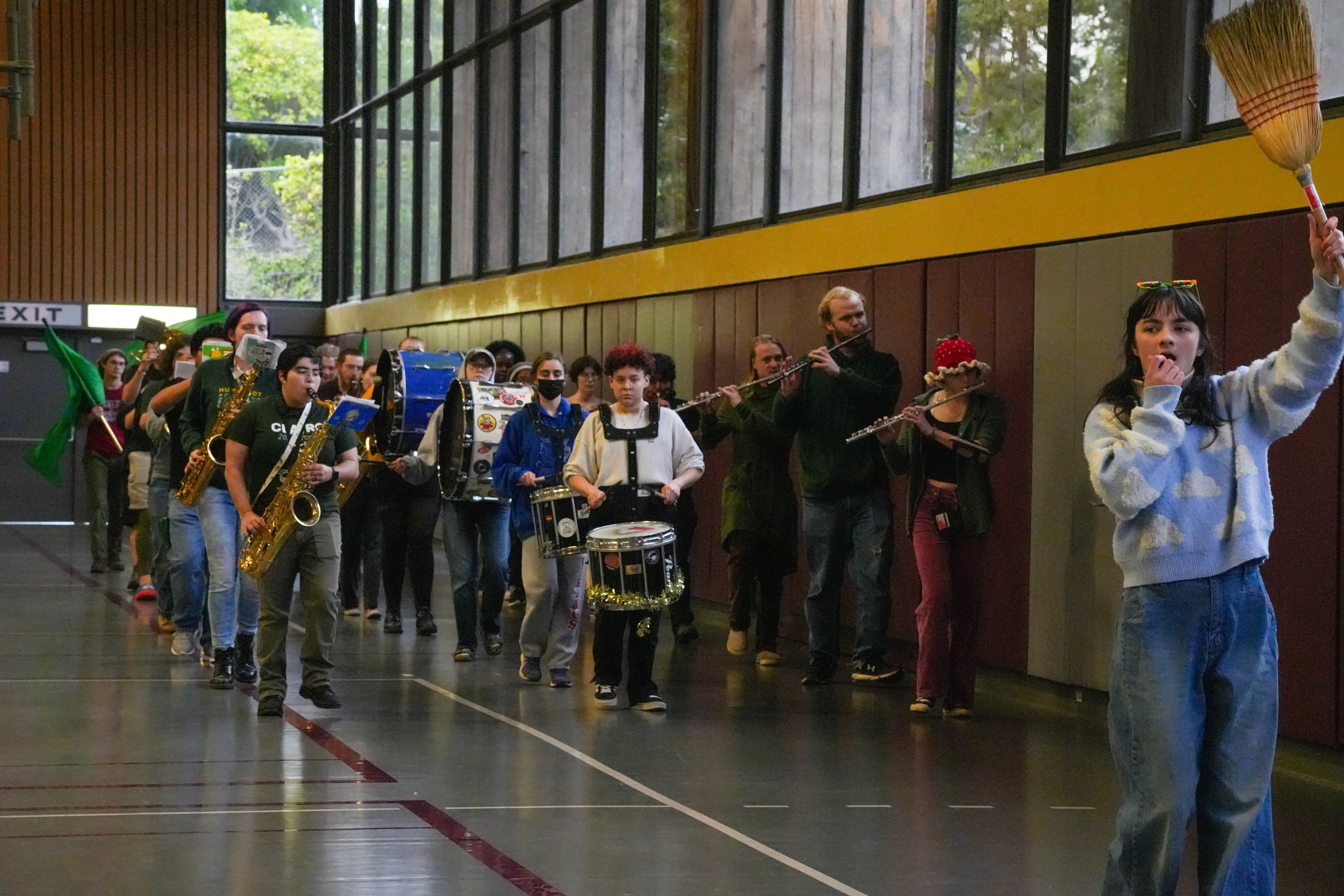
    From playing on a carousel in Cloverdale to marching in a parade in San Francisco to performing in Battle of the Bands at UC Davis, the Cal Poly Humboldt Marching Lumberjacks play a variety of gigs around northern California. 

    Alfie Chiper, junior environmental science and management major and clarinetist for the Marching Lumberjacks, pointed out their favorite gig.

    “I think my favorite that we do — and it’s actually coming up this week — we play for the St. Patrick’s [Day] parade in San Francisco, and I really like that one,” Chiper said. “It’s just super cool to be in such a big city and have so many people watch us and listen to us and like, feel our energy and stuff.”

    The Marching Lumberjacks, created in 1968, are the oldest student-run organization at Cal Poly Humboldt, according to Tati Bond, who is in charge of public relations for the band. Bond also said there are currently about 40 members in the band.

    Jessi Fleming, senior studio art major, tuba player and axe major (or conductor) for the Marching Lumberjacks, spoke about why she liked Davis Picnic Day, where they participate in Battle of the Bands.

    “My favorite gig is definitely one we have to travel to. I like Davis Picnic Day because we get to stay there for two nights instead of one,” Fleming said. “I really appreciate the bonding opportunity for the band because we’re all a bunch of friends, and it’s like going on a road trip with your friends, and it’s a lot of fun.”

    Nick De Anda is an alumnus who still plays guitar with the Marching Lumberjacks. He has been playing with the band since 2021 and graduated with a degree in music performance in 2023.

    “If you go to the Battle of the Bands, you’ll notice that we are the band that has the most fun,” De Anda said. “Everybody else, they can bring it, but nobody has fun like we do.”

    De Anda noted that the Marching Lumberjacks are unique and that his instrument, the guitar, is not usually seen in a marching band. He said they are not a traditional marching band, and he learned to play guitar on the go.

    De Anda explained how the band plays.

    “We’re more categorized as a scatter band — it’s pretty self-explanatory. We just kind of scatter ourselves around. There’s no formation. We don’t really follow a strict marching code. We try to march in step, but it’s very free-flowing,” De Anda said. “The uniforms are very relaxed but simple, just a yellow shirt and green pants.” 

    De Anda explained that his favorite part of playing in the band was getting his emotions out through sound.

    “Bobbing my head or screaming at the top of my lungs — it gets the demons out, essentially,” De Anda said. “So I feel like when I am playing a song where it’s traditionally high energy or I feel a responsibility to upkeep the morale, that’s when I feel more empowered. That’s my favorite part about being in front of people in that uniform and with all those wacky instruments and stuff.”

    De Anda also spoke about the appeal of playing in the band and how being silly and expending energy is good for the soul.

    “All these college kids have all this pent up energy and they just want to spend it somewhere and making music with their friends and acting a fool and screaming at the top of their lungs for these songs that are super, super old, but we all happen to know,” De Anda said.“It’s got its own little charm in comparison to other groups.”

    Chiper said anyone at any skill level or who wants to learn an instrument can join, and Fleming noted that joining the band is low stakes.

    “The band is very lowkey. If you want to show up to one rehearsal a month, that’s fine,” Fleming said. “We have no time commitment, no playing ability [requirement]. We take everyone and anyone.”

    Savana Robinson is a senior journalism major and news editor of The Lumberjack, as well as a multimedia journalist and producer at Redwood News. She loves motorcycles, cats and video games.

  • Don’t pause the music, we’re about to play

    Don’t pause the music, we’re about to play

    Student athletes share how music plays into their pre-game routine

    By Alexis Blue

    The grass is warm to the touch and the white lines marking the bounds of the field are glowing as bright as the white jerseys of the Jacks as they roll out of the travel bus, each player with headphones on and their minds centered on the win to come. The silence from the scene is reflective of the laser focus of these athletes, but what plays in their headphones is anything but silent. 

    Humboldt student athletes may not agree on one favorite pre-game song, but they can agree on how important music is to their competition. Song choices not only vary from athlete to athlete, but for some, music is essential for attaining a game-ready mindset. Cam Timmons, a graduate student athlete in men’s basketball majoring in kinesiology, noted the role that music plays in his mindset towards competing. 

    “I feel music plays a big role, just in training and getting prepared for a game for me, because I like to tune out the world and all the excess noise,” Timmons said. “Just listening to music puts me into the zone.” 

    Timmons’ go-to artists for reaching this mentality are often Rod Wave or Drake, but he enjoys listening to a variety of music that matches his energy for the day. Songs like The Greatest and Already Won by Rod Wave are particularly meaningful to him. When asked what his personal walk-up song would be, Timmons was quick with a response.

    “I used to play baseball, and I always wanted a walk-up song,” Timmons said. “ I like a song by Lil Uzi called Celebration Station. It’s very upbeat and uptempo, and I feel like that’s the type of vibe I like and personality I have, too.”

    Seth Uson, a junior on the men’s soccer team majoring in business administration, uses music as a way to compose himself before a game. He commended Gratitude by Brandon Lake as a way to feel more present in the moment.   

    “I have a pretty different perspective or view of music compared to other people. Personally, I like to listen to a lot of worship or gospel music,” Uson said. “It is grounding and something that gives me a bigger perspective, that it is more than just myself.”

    Uson shared how his team also uses music as a bonding experience, a way to connect and be on the same page as one another prior to training or competition. 

    “A lot of music that we listen to as a team — it’s something that’s very upbeat, something that’s very catchy and something that we could all vibe to,” Uson said. 

    Senior Sebastian Vaisset-Fauvel, a kinesiology major on the men’s track and field team, offers an additional perspective by sharing his interest in listening to artists like $uicideBoy$ and Nas. Vaisset-Fauvel shared a special shoutout to songs Low Key by $uicideBoy$ and Purple by Nas. He even has a playlist meant to get him in the race-ready mindset.

    “I have a big playlist, and I usually use that, but recently I’ve been shuffling between a bunch of different songs,” Vaisset-Fauvel said. “Before racing, it gets me in the right mindset to just go crazy.” 

    From Rod Wave to $uicideBoy$ to Brandon Lake, every athlete sings and plays to their own beat. The tunes ringing in the ears of athletes before they take the pitch are diverse and necessary to reach a winning-ready-mindset.

    Alexis Blue is a junior at Cal Poly Humboldt, majoring in journalism and minoring in writing. She enjoys drinking coffee, sunsets on the beach, and playing soccer.

  • Bridge the gender listening gap

    Bridge the gender listening gap

    Break up with your boyfriend, his Spotify Wrapped was only men

    By Mia Costales

    There’s a well-known saying that goes, “The eyes are the window to the soul,” and I’m here to tell you that’s bullshit — it’s your playlists. I’m a firm believer that the music you listen to is a direct reflection of who you are as a person, the perfect glimpse into your soul. Sure, a Tinder profile or Instagram page can provide you with a preview of what you’re getting yourself into. In Humboldt it’s mostly just some guy posing with a dead fish, some guy gently caressing a guitar, or what have you. But once you’ve tapped into arguably the most crucial information — someone’s music taste — that’s when you’ll know if he’s a keeper. Chris Brown, Jason Aldean, Drake and not a single woman to be found? GIRL, RUN!

    According to Spotify’s 2023 listening data reported by everynoise.com, 31.9% of female listeners streamed female or mixed-gender artists, while only 19.2% of male listeners streamed female or mixed-gender artists. This statistic is disappointing to say the least, especially when there are so many prominent female artists topping the charts. Artists like Chappell Roan, Sabrina Carpenter and Billie Eilish consistently placed in the top ten of Billboard’s 2024 Hot 100. So why is it so hard for men to listen to women artists? Senior kinesiology major Nick Weil chalked it up to prevalent misogyny within the scene.  

    “Men should diversify their music taste,” Weil said. “A lot of male-dominated music is misogynistic and upholds those values and the patriarchy, which is really disappointing. There is so much to explore in the world of music and women have been crucial to the development of it, and so not listening to female artists is like shooting yourself in the foot.”

    Starting at the source is the only way to level out the gender listening gap. So many local music scenes are grossly inaccessible for women, and especially queer women and women of color. While Arcata’s scene may be better than most, we still have a long way to go. Practically every femme has a similar story of feeling unsafe or unwelcomed in their local music scene, and it’s up to the men and masc-presenting people to create a non-hostile environment that not only accepts femme-produced art, but celebrates it. However, it is also up to femmes to allow themselves to take up space, even if it makes people uncomfortable. It’s up to us to not take no for an answer and advocate for female voices in spaces where they’ve been historically suppressed. 

    Stream more female artists. Go to your local record shop and buy their albums. Support women at shows. Listen to your local femme DJs on the radio. I implore you to step outside of your comfort zone and consume femme-produced art, because the biggest red flag is a man who doesn’t listen to women. 

    “I think that it’s important for us all to challenge ourselves to listen to more underrepresented artists,” Alexis Roberts, a junior music major, said. “I’d challenge us all to find a new female composer, rockstar, blues player, jazz artist today. Because everyone’s voices should be heard and a lot of these voices have been stifled historically. Listen to more POC, queer, disabled and femme sections of all genres.”

    Mia Costales is a senior journalism major and the Life & Arts Editor for The Lumberjack. With a background in music performance, she hopes to combine her love of music and the arts with her passion for localized news and activism to bring thoughtful and informed stories to the public. 

  • The good, the bad, and the melodic

    The good, the bad, and the melodic

    Diving into the science behind consonance and dissonance in music

    By Mia Costales

    You watch as the actress cracks open the basement door. The camera pans down, revealing rickety wooden stairs leading to a pitch black abyss. As she descends down the steps, the soundtrack swells. The boom of timpani grows louder, mimicking the sound of a human heartbeat. The sharp shrill of violin strings send an involuntary chill down your spine. As the tempo picks up, you notice your pulse is steadily rising as well. Then, BOOM. A cacophony of noise blares through the speakers as a monster emerges from the dark. You may not have noticed, but that feeling of impending dread is thanks to the music. 

    Music is a unique medium in that it has the power to replicate human emotion through sound. Music can influence mood, trigger memories and even shape emotional responses to experiences. To many, music in minor keys evokes feelings of sadness, longing and exhaustion. Major keys may evoke feelings of joy, jubilation and excitement. Music theory, the study of the fundamental elements of music — such as notation, rhythm and form — can offer scientific explanations as to why we associate particular sounds with emotions. 

    Michael Fabian, a music professor at Cal Poly Humboldt, explained that in Western cultures, certain elements of music can sound consonant or dissonant. Typically, Western music that is considered consonant has a neutral or pleasing quality to it. On the other hand, dissonance is characterized by tension or unpleasantness.      

    “Western music uses a tuning system based on ratios,” Fabian said. “The closer the ratio, the more dissonant the sound. There is an argument about the mathematical purity of the ratios being more ‘naturally’ pleasing to our ears, but that is a trend and not a guarantee.”

    These ratios are also known as intervals. Intervals are the tonal distance between two notes. The term ratio concerns the proportional relationship of the frequencies of the sound waves between any two notes. The further apart each note’s sound wave frequency is from one another, the more pleasing to the ear it sounds.

    In music theory, an interval such as a perfect fifth, is considered very consonant because the distance between each note is seven half steps — half steps being the smallest interval between two notes in Western music. Thus, the distance between each note’s sound wave  frequency is further apart. A popular example of a perfect fifth is the jump between the notes in the first two “twinkles” and the notes in the second two “twinkles” in Twinkle Twinkle Little Star

    Conversely, a minor second interval, which sounds tense, only contains one half step, making it sound dissonant. This is because the distance between each note’s sound wave frequency is much closer together. An example of a half-step is the difference in tone between an F# key on a piano, which is a black key, to the G key, the white key directly next to the black key.

    The tempo, or speed, at which music is played also plays a large part in evoking human emotion. Rebekka Lopez, a 2023 music performance graduate, shared how she believes the tempo can affect the way a listener absorbs music. 

    “The same exact melody can be played at different tempos and have a completely different effect on the listener depending on that,” Lopez said. “Even a super ‘happy’ melody can sound nostalgic or pensive if it’s performed more slowly. Vice versa, a normally slow melody can be sped up and take on a different meaning. As humans, we all experience higher heart rates for anxiety, excitement, fear and happiness, and much slower heart rates for calm, tired, empty, depressive and pensive moments.”

    While elements like tempo, dynamics or phrasing definitely contribute to how a listener interprets the music, it’s important to note that no two people hear a piece of music exactly the same. Cultural, geographic and even generational differences hugely factor into how a person perceives music and what they perceive as ‘good’ or bad.’ For example, a 2016 study conducted by MIT and Brandeis University found that Westerners considered the interval between the notes C and F#, known as an augmented fourth, to be very dissonant, while members of the Tsimane’ tribe found the chord pleasing to the ear. 

    “It’s crucial to remember that our perception of sound and music is hugely influenced by the musical culture we grow up listening to,” Fabian said. “To many people in my class, songs in minor keys sound ominous, tritones sound dissonant, et cetera. But for others, minor sounds melancholy, and tritones sound energetic. It really has so much to do with the music you heard growing up.”

  • My top five favorite movie soundtracks to jam out to

    By Julia Kelm

    The Royal Tenenbaums (2001)

    Wes Anderson is known for his well-crafted soundtracks and — for me — The Royal Tenenbaums is the cream of the crop. Not only are the song choices just plain good songs, but they also fit the emotion of every scene they’re in. If you’ve seen The Royal Tenenbaums, you probably remember the use of Needle In The Hay by Elliott Smith, which is a tough scene to watch. At the same time, the song perfectly encapsulates the feeling of dread, uneasiness and loneliness. Other notable tracks include Judy Is a Punk by the Ramons and of course, These Days by Nico.

    Pulp Fiction (1994)

    I’ll be straight with you — I’m not a huge fan of the film Pulp Fiction. It just isn’t my favorite Quentin Tarantino movie, but I’d be lying if I didn’t mention how hard the soundtrack slaps. Tarantino does a lot of questionable things, but I’d let him on aux any day if he played Urge Overkill’s Girl, You’ll be a Woman Soon, Chuck Berry’s You Never Can Tell, or Misirlou by Dick Dale & His Del-Tones. Every song not only fits the quirky, fast-paced vibe of the film, it’s just banger after banger — say less!

    The Good, The Bad, and The Ugly (1966)

    I can sense your side-eye through the paper. You’re thinking, “Who listens to The Good, The Bad, and The Ugly soundtrack?” I do buddy, and I must say it’s definitely the best soundtrack to listen to on a eight-hour-long drive back home. When The Ecstasy of Gold – L’Estasi Dell’oro by Ennio Morricone and Edda Dell’Orso starts playing, suddenly, I’m on horseback on the open range and my only worries are those of avenging my father’s death. Long gone are my troubles with homework and tuition costs; I only seek justice. 

    Megamind (2010)

    If you didn’t expect Megamind to be on this list, then you need to WAKE UP. Because Megamind might just have the best, most well crafted, down to every last minute detail, soundtrack out of any film. 7-year-old me gained consciousness when Will Ferrell shouted, “Presentation!” as that blue alien glided down to the sweet sound of Guns N’ Roses’ Welcome To The Jungle. Absolute cinema.

    The Muppets Most Wanted (2014)

    I think I’ve mentioned before that I’m not a huge fan of musicals — I lied. I love this movie so much and I’m pretty sure it’s my favorite musical of all time. I’m Number One, sung by Constantine and Ricky Gervais, is just the greatest villain song ever, and The Big House by Tina Fey and Josh Groban is also a regular on my playlists. If for some reason you’re not already locked into the Muppet soundtracks, give this soundtrack a listen first.

    Julia is a journalism major at Cal Poly Humboldt. She loves film and is a regular on Letterboxd. To quote Robin Williams in her all-time favorite movie, Dead Poets Society, “The powerful play goes on and you may contribute a verse. What will your verse be?”

  • Animals in Outer Space

    Animals in Outer Space

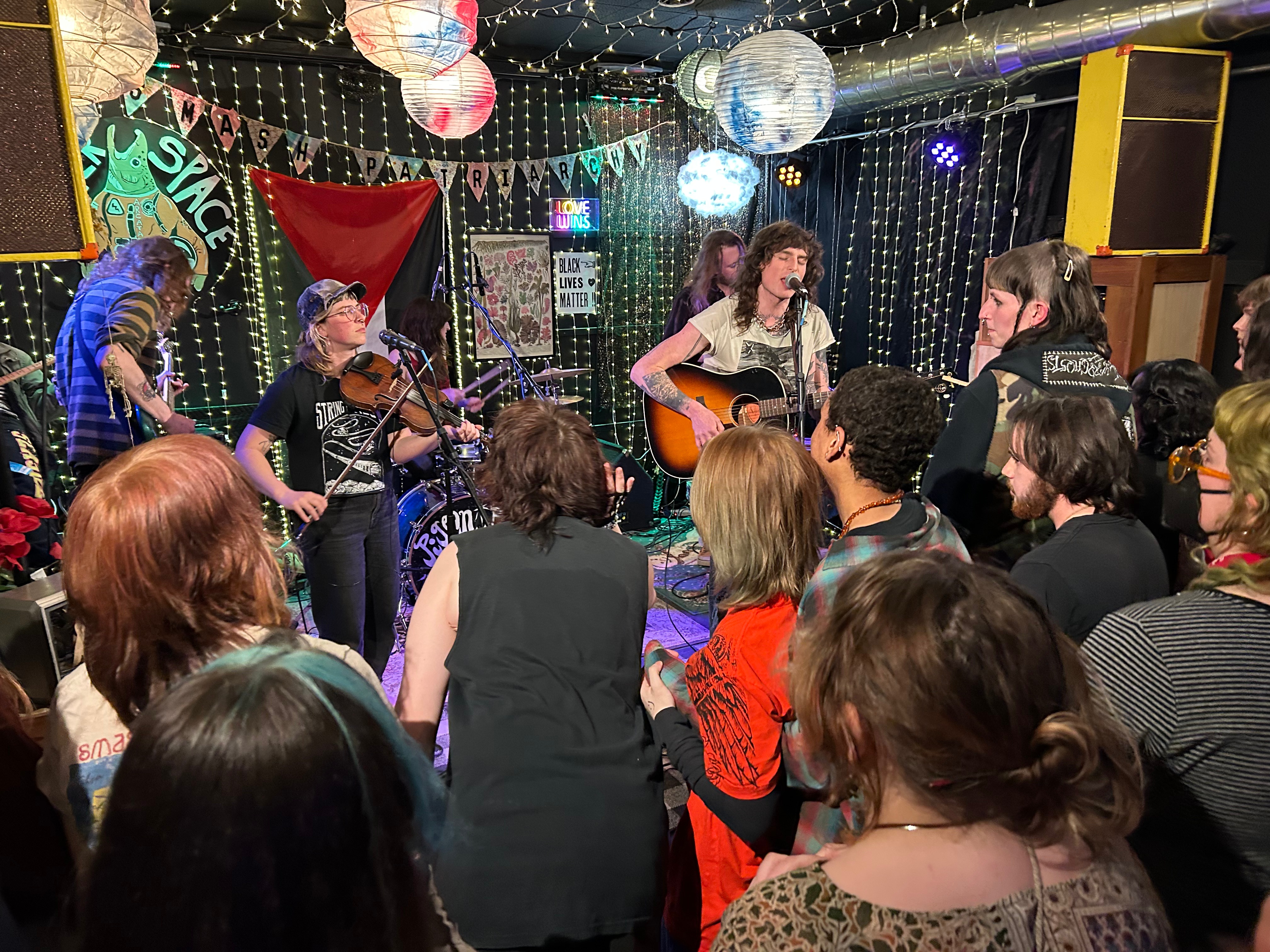
    Pigeon Pit, Foot Ox and other local bands sell out folk punk show at Arcata venue

    By Jess Carey

    There’s a line out the door and down the street at Outer Space in Arcata. Mulleted concert goers sport patched up jackets and Doc Martens poking out from underneath baggy jeans. Smoke from cigarettes and weed drift in the crisp cold late winter air. The chatter of the queue is cut through by the occasional bark of a dog or car engine revving. Lonely chords from an acoustic guitarist on the lawn color the scene. The Plaza seems alive, breathing with activity. Outside the venue, a hand-drawn whiteboard sign reads “Pigeon Pit Tonight, Friday March 7th.” The turnout is notably large.

    Outer Space is a pillar of the Arcata music scene. Their location at 837 H St. is a relic, having been built in 1900, and have been hosting shows on the Plaza since 2022. Outer Space’s sober space and all ages policy make it a unique and accessible island of culture and community. The space is managed by a volunteer-run and non-hierarchical collective. The venue’s DIY values are reflected in its colorful interior, featuring a zine library, local art for sale and eclectic decor. 

    Handmade cloud lights floating from the ceiling colored the room with a faint blue as the crowd trickled into the venue. Per the collective’s policy, no one is turned away for lack of funds. A large crowd eagerly awaited the show while soundchecks were wrapped up. Brandon Hook was the secret superman audio engineer of the night, who skillfully mixed the sound for both the in-house audience and live stream. Recordings can be found on Outer Space’s YouTube channel, @outerspacearcata. 

    Local musicians open the show

    The chatter cut down as the lights dimmed. Trinket, the opener for the four-band lineup, took the stage and greeted the packed house. Trinket is the solo project of Arcata local Caleb Van Lynn, who can also be found around town selling mushrooms at farmer’s markets and hosting the open mic at Culture Shrooms. Trinket’s gritty, wholesome songs are comforting but edgy, holding space for determined resistance and big feelings simultaneously. He sings and accompanies himself on the guitar with an occasional harmonica break. His heartfelt lyrics and bright presence set the scene, warming up the crowd for a night of down-to-earth acoustic jams. 

    Trinket closed the set with a tune called, Feeling All Those Feelings That You Are Feeling. The lyrics invite listeners to be present with big emotions. 

    “Feeling bad, feeling sad, it’s natural,” Van Lynn sang. 

    Next in the lineup was Wounded Animal, the self-proclaimed bard-core project of Eureka’s Ethan Rubin, whose style is refreshingly unique. The ensemble consists of upright bassist Norm Crawford’s thumping support. Local singer-songwriter Polimana colored the tunes with jangling accompaniment on a handmade fretless gourd banjo. Rubin’s piercing viola playing was the heart of the music, impressively belting strong lead vocals whilst fiddling up a storm. The songs felt dark and alive, like the smell of the forest floor, with lyrics spinning tales of strange creatures and odd happenings. 

    Foot Ox was up next. Hailing from Portland, Oregon, their music is spinning and vivid, grounded in folk influences while taking influence from psychedelia and embracing experimentation. As Pigeon Pit’s tourmates, their sounds are very complimentary, even sharing bandmates as the bassist, pedal steel player, and violinist rolled over to the next set.

    Folk Punk legends Pigeon Pit take the stage

    Pigeon Pit is a poster child for contemporary folk punk, founded by frontwoman Lomes Oleander in Olympia, Washington nearly a decade ago. Folk punk’s appeal is in its rawness, realness and approachability. The anarchist spirit of punk takes on a new acoustic color without compromising any of the volume or attitude. Traditional punk’s typical electric guitars and noisy feedback are replaced with banjos and fiddles, grounded in a DIY spirit. The band’s senior album Crazy Arms was independently released in Jan. 2025, and the show in Arcata was sandwiched between stops in Sacramento and Portland on a West Coast tour. 

    The band took the stage met with roaring applause as they launched into a fiery rendition of Bad Advice, the first track off of their new album. Pigeon Pit’s well-polished musicianship and seasoned stage presence shined through their entire set. Oleander’s warbling vocals are simultaneously vulnerable and strong. Her sharp rhythm guitar was the sturdy guts of the ensemble, punctuated by Maddie Bun’s twangy banjo. Violinist Eva held it down on backing vocals while decorating the music with fiddling flourishes. Drummer Olive Hannah tapped out a steady backbone, working together with bassist Jake to ground the vibrant tempo. The sliding spinning riffs of pedal steel were the sonic sprinkles on top.

    Pigeon Pit’s songs are grounded in honesty with a punk edge and cutting lyrics that describe sparks of joy punching through the gloom of the world. Oleander’s almost frantic lyricism cascades vignettes of daily life and memories. Their song Soup for My Family was a notable fan favorite. The whole audience sang along to the chorus as a mosh broke out in the center of the dance floor.

    DIY sentiments shine through the music 

    After a few vibrant full-band songs, Oleander stood alone to pick out some solo tunes while the band took a break. Her music was just as strong without accompaniment, a testament to the power of her songwriting.

    Lomes Oleander, a vocalist with long, curly brown hair wearing a white graphic tee and black jeans, stands front and center playing an acoustic guitar while singing into a microphone. Behind them is an array of decorations, including strings of lights, stage lights, lanterns, and flags. A keyboard and drum set sits behind them, the latter labeled, "Pigeon Pit."
    Photo by Jess Carey | Lomes Oleander, lead singer for Pigeon Pit, performs a few songs solo.

    “I love local DIY music scenes and one of the coolest fucking things about tours is getting to go to local shows and different scenes every night,” Oleander said, while tuning her guitar in between songs. “It’s really cool to see what other people are doing, it’s really fun for me.”

    She expressed gratitude for the venue and its community, cementing the music’s message of resilient joy in the face of struggle.

     “It’s about our collective power, you know, when we work together to make things different in our world, which is what DIY means,” Oleander said “That’s why I love it so much.” 

    The band returned to jam out a few more, and the energy was even more electric. Oleander broke a string during a vibrant rendition of Bronco, not skipping a beat. They closed the set with a sparkling rendition of Milk Crates, the song ending with an echoing mantra. 

    “No job, no place to get away from / I’ve been to a world worth living in / no rent, no lies to memorize/ No fucked up world to drown out,” Oleander sang. 

    An encore brought the band back up for Run Your Pockets, a heart-wrenching number with themes of changing times and fading light, ending the night on a bittersweet note. 

    “Support your local DIY music scene and harm reduction collectives and all the cool direct action shit that’s happening here in Arcata,” Oleander said. “Disperse peacefully!”

    Jess Carey is a senior at Cal Poly Humboldt, majoring in biology and double minoring in botany and journalism, and the science editor for The Lumberjack. They are passionate about telling stories that are relevant to the community, branching their interests in science, music, and the arts.

  • Local indie surf rock band Pickpocket makes their debut on student-run radio station KRFH’s LIXX

    Local indie surf rock band Pickpocket makes their debut on student-run radio station KRFH’s LIXX

    By Dylan Jewett

    College radio has always been a unique branch of the broadcast world and the radio programs here at Cal Poly Humboldt have been no small feat. Every Thursday at 8 PM, a new band from the community or other places in California gets hosted in a studio on campus called the LIXX Lounge, located in Gist Hall. LIXX broadcasts live to listeners online at krfh.net and over the radio waves on 105.1 FM.

    Pickpocket, a local indie and surf rock band made up of university students Colby Palmer on drums, Luke Shanafelt on guitar and vocals, Andy Garvin on bass and vocals, and Jesse Sammel on guitar, was hosted on Feb. 20 in the LIXX Lounge. They played an hour-long set of originals and covers and got the crowd moving. The turnout of students who showed up to support the band in person was impressive and heartwarming to see.

    They have been a band for two months and are looking forward to the future with the local music scene. The LIXX show was Pickpocket’s first time performing as a band, and the energy they brought to the table was incredible. As students, they said it can be hard to find time to practice. 

    “Finding time to all practice and get together is hard enough, not to mention finding new music and learning it all together,” Palmer said. “We try our hardest, though, and I think it shows.” 

    In the near future, the band hopes to record and share their music online to expand their reach. With the band members still in school, they plan to keep playing in the local scene and record their music. “We do want to record and post our music online and reach people as far as possible,” Palmer said.

    The energy of the show was truly electric. For their final song, they performed Rock and Roll Night Club by Mac DeMarco and a dance party in the middle of the room erupted. Everyone was grooving to the music and creating a wonderful environment full of love and support for local music.

    Having a space on our campus that’s able to put a spotlight on local talent is truly incredible. Every week, a different band is highlighted on KRFH for everyone to tune in to. A range of genres is highlighted, and no band is too much like the other. With new shows every week, there is no shortage of new music to discover in the local community. If you have a local band and want to play on air, you can reach out to the LIXX team through the KRFH website. The future looks bright for the LIXX program as bands continue to play and students continue to help put on these shows. The Next LIXX performance is on Thursday, March 13 with Spitbug.

    “Our first show together was a blast! We all had a ton of fun, and of course with a first show we all noodled a bit, but that’s part of being new musicians in a new scene,” Palmer said. “Overall, a really awesome and inspiring performance for all of us.”

    Dylan Jewett is a junior journalism major at Cal Poly Humboldt. They are an avid photographer and loves to crochet, hang out with their cat, and go to concerts in their free time.

  • Lady Gaga better have a good legal team, because Mayhem sounds a lot like the album of the year

    Lady Gaga better have a good legal team, because Mayhem sounds a lot like the album of the year

    A comprehensive review of Lady Gaga’s seventh studio album that had me levitating off the ground

    By Julia Kelm

    Mayhem (2025) is Lady Gaga’s long-awaited seventh studio album. Gaga returns to her dark dance pop roots, making little monsters relieve their childhood from a new, more mature perspective.

    I have been a fan of Lady Gaga since I was 13, obsessed with her music and her as an ethereal being. I own all her albums on vinyl (besides Mayhem), and can probably guess any of her songs within the first 5 seconds of them playing. So I hope that’s enough credentials for me to be considered a true “little monster.”

    Here’s my track-by-track opinions:

    1. Disease: 

    This is what started it all. It’s dark, it’s sexy, it’s bangin’, dare I say perfect? I think Disease is probably my number one for this album in the amount of times I have this on repeat. The chorus just sent me to another plane of existence. She really is the queen of pop (Sorry Madonna, you had your moment.)

    1. Abracadabra:

    When Gaga says her name in a song, you know you’re witnessing peak. Abracadabra to me feels like it could’ve been a track on The Fame Monster (2009), which I feel like Gaga fans have been begging for, for years (excluding, of course, Artpop act 2.)

    1. Garden Of Eden:

    Another steller, perfect Gaga song to add to this album. Gaga can craft a hook and chorus like no other, I swear to fuck. When she sings, “I could be your girlfriend for the weekend. You could be my boyfriend for the night,” my soul left my body in the most heavenly way, and my feet floated off the ground. And relive a truly religious experience every time I turn it on as I walk around campus.

    1. Perfect Celebrity:

    This song makes me wanna drive a car off the bridge that connects Arcata to Eureka, in how crazy and alive I feel when I listen to this song. The rock-esque instrumentals in this track is a nice little switch-up from the heavy dance pop we heard in the previous three songs.

    1. Vanish Into You:

    I’m pretty sure I levitated listening to this song too. I’m sorry if you were expecting a more objective review, but if you weren’t having a holy experience listening to this album, then you probably aren’t reading this review anyways.

    1. Killah (feat. Gesaffelstein):

    The opening to Killah is what pure ecstasy sounds like. The little guitar riff that sounds like the guitar in Need You Tonight by INXS makes me so happy. The general harking back to 90s and 80s influential musicians is just great, and I need more. MORE!

    1. Zombieboy:

    Okay disco vibes, say less. Zombieboy’s opening also reminds me of Hollaback Girl (2004) by Gwen Stefani, which I didn’t realize I needed until I heard this. I can feel the TikTok trends to this song in my bones, wait and see.

    1. LoveDrug: 

    I yearn for the club when LoveDrug starts playing. I need twirling room, and at least two gin and tonics inside me, and then I think I’ll finally experience true happiness. I’ve been too stressed, I need to dance to Gaga now or I might explode.

    1. How Bad Do U Want Me:

    I heard someone say this song sounded like Taylor Swift, and now I can’t unhear it. Which I have to admit, ruined the song for me slightly. Regardless, I’m gonna call this a banger and move on, because Gaga can do no wrong.

    1. Don’t Call Tonight:

    For me this is a tad skippable, but it’s still Lady Gaga, so I won’t say it’s bad, because she’s never made a bad song. It just doesn’t stand out to me when compared to all the hot liquid gold that this album is swimming in. 

    1. Shadow Of A Man:

    I think Michael Jackson was somehow resurrected for this song to be made, because it sounds just like something he would’ve made in his prime. When Gaga sings, “ ‘Cause I won’t be used for my love and left out to cry” in that fast tempo, I absolutely lose my mind. Dare I say…banger?

    1. The Beast:

    This is the one song on this album I don’t really care for. Something about it feels like a song that would play in a shitty Wattpad movie sex scene. It’s campy, and fun though, so again, I won’t say it’s bad. Just not my favorite, and I probably will not listen to it as often as I do the rest of this album. 

    1. Blade Of  Grass:

    Gaga’s solo ballad for this album is quite good, although I wish it felt a little more like Speechless, off of The Fame Monster. Although I still had a good time with this track, it’s just not on repeat for me at the moment. 

    1. Die With A Smile:

    I love this song so much… as a stand alone track. I sorta wish Blade Of  Grass was what ended this album for me, but I’m not angry that it’s here either. Regardless, it’s a good song and not a terrible way to close out this stellar album.

    Julia is a journalism major at Cal Poly Humboldt. She loves film and is a regular on Letterboxd. To quote Robin Williams in her all-time favorite movie, Dead Poets Society, “The powerful play goes on and you may contribute a verse. What will your verse be?”

  • More than beer, trucks and propaganda

    More than beer, trucks and propaganda

    In defense of country, the most misunderstood music genre

    By Barley Lewis-McCabe

    Unlike most genres, country music has a very specific, unsavory reputation. In the modern day it’s associated with right-wing propaganda, Bud Lite, electric guitars, and the worst guy you know playing Toby Keith on TouchTunes jukeboxes. But it wasn’t always like this. Country music got its start with Jimmie Rodgers, a dirt poor brakeman who started playing music at a young age when he was taught blues guitar techniques by black railroad workers.

    His biggest musical influences came from the traditionally black music genres gospel and folk. His adoption of them led to his distinct playing style and vocalization — such as the yodel which was adopted and essentially created the genre known as country music. In 1924, at the age of 27 he was diagnosed with tuberculosis as a result of his work on the railroads. It was then that he decided to focus more on his music.

    Rodger’s work would directly inspire the likes of Hank Williams, Roy Acuff, and folks like Merle Haggard and Bob Dylan later down the line. Country was the music of poor folks in the south. It wasn’t seen as the monolith it is today, and through the honkey tonk-age up until the era of Elvis, country music was associated with dirt and grime over rhinestones and shine.

    The change in country music was visible in the 60s, when the genre was essentially split into two groups: Bakersfield sound — an evolution of honkey-tonk that focused heavily on a central beat with drums and eclectic guitars — and the Nashville sound, favored at the Grand Ole Opry, which used more refined string instruments and would oftentimes carry the beliefs of the Nashville establishment. One fueled by the success of the Opry to above all else make money. 

    In the south, country became more visibly right-wing with a series of pro-Vietnam war songs becoming chart toppers, and country music being used as a central fixture in both Richard Nixon and radical segregationist George Wallace’s 1968 presidential campaigns. 

    George Wallace was the first major politician to capitalize on country music’s burgeoning popularity, bringing out country performers to play at his rallies in order to attract people, and connecting his campaign intrinsically to the genre. According to an NPR article, Wallace once assured an aide that country music would help him win the election.

    “The people who like country music will vote for me,” Wallace said.

    Wallace would inevitably lose the election to Nixon, but he attracted a large block of middle class southern white voters, whom Nixon won over in 1972. Nixon adopted country music just as much as the genre adopted him. The 1968 anti-hippie song Okie From Muskogee by Merle Haggard became the unofficial theme song for the Nixon campaign. 

    At the same time, a more left-wing folk revival was at its height, in part due to country artists like Johnny Cash’s embrace of the subculture. While the 70s saw right wing prominence in country music, there were also some great non-political songs by artists like Jerry Reed (my personal favorite), John Denver and Kenny Rogers. But country had begun to lose sight of what originally made it so special — its authentic connection to the music. In my opinion, a lot of prominent country musicians today just hopped on the bandwagon in order to make money, not because they care about the genre. This is why country gets such a bad rap, poser cowboys who don’t know what they’re doing. Waylon Jennings talked about this shift in the song Are you sure Hank done it this way, a critique of the rhinestone-heavy culture.

        Country music’s bad association comes prominently from a lack of understanding in what the genre is, and could be. So if you will, open your mind and try something new. 

    Here are some country artists I personally recommend: Dick Curless, Hank Williams, The Highwaymen, John Prine, Willie Nelson, Blaze Foley, Glenn Campbell, Ferlin Husky, Don Williams, C.W. McCall, Jimmy Buffett, George Jones, Buck Owens, Linda Rondstadt, Chet Atkins, Marty Robbins, Roger Miller, Billy Strings, Nick Shoulders, Tyler Childers, Dale Hollow, Old Crow Medicine Show, Sturgill Simpson, Sierra Ferrell and Willi Carlisle.

    Barley is a freshman journalism major, Photojournalist, and untraditional reporter, they like to cover interesting stories that center on social change, and human impact.