By Ursula Newman
The California State University (CSU) system announced its new Artificial Intelligence (AI) initiative to enhance access to AI technology and prepare students to be AI literate in future careers. This initiative is the first of its kind, with the CSU stating that no other university systems have implemented AI initiatives at this scale. This means AI software is becoming accessible through the university system, with a licensed version of ChatGPT joining the list of digital resources available to our campus community. In addition to new tech, training programs have been released to students and faculty to promote education on the growing AI sphere.
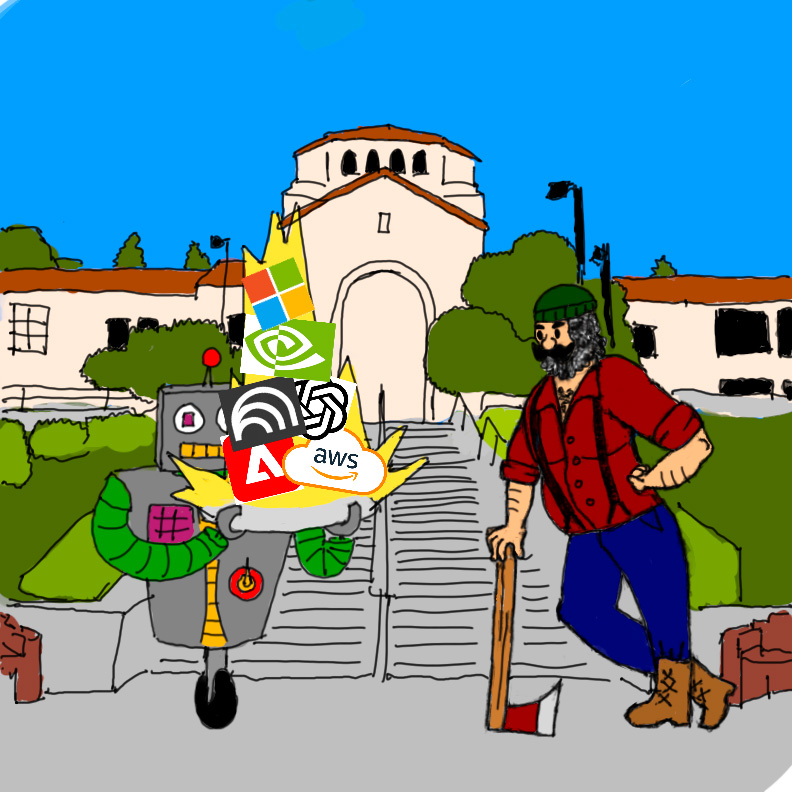
The initiative includes partnerships with leading tech companies such as Adobe, AWS, IBM, Instructure, Alphabet (Google), Intel, LinkedIn, NVIDIA, Microsoft, OpenAI, and the Office of California Governor Gavin Newsom. These names, along with several CSU
Representatives — which can be found on the California State University AI commons web page — make up the AI Workforce Acceleration Board, which plans to help pinpoint which AI skills are needed in California’s workforce and address those needs. The CSU system put out a press release on Feb. 4 titled “CSU Announces Landmark Initiative to Become Nation’s First and Largest AI-Empowered University System,” announcing the initiative and explaining that more tech companies are expected to be added to the advisory board in the near future.
AI tools available at the university
Several services are being made available to students and faculty. Cal Poly Humboldt currently has licensed versions of generative AI chatbots Microsoft Copilot and Google Gemini, Zoom AI Companion, which takes notes and makes summaries, and Adobe Firefly for AI image generation.
Coming soon to the university is Notebook LM, Google’s AI-powered research and note-taking tool that organizes, summarizes and brainstorms, and OpenAI’s ChatGPT Edu, a chatbot that uses natural language processing to respond to prompts. Additional information about what is available may be found on the university website’s Information Technology Services page under the Artificial Intelligence tab.
The Center for Teaching & Learning Director, Enoch Hale, gave comment on the university’s game plan regarding this new initiative.
“Humboldt has taken a robust, yet measured approach to implementing AI,” Hale said. “We are committed to supporting educators, learners, and all employees in this rapidly evolving digital landscape. The CSU has provided additional resources for its staff, faculty, and students, [which] include guides and courses they can take to address multiple areas of AI literacy. Additionally, resources are provided to help all of us think through the ethical and responsible uses of AI in our work, in our learning, and in our lives.”
Perspectives on AI in schools
While there are classes where use of AI is limited or banned, this new initiative challenges that with the ChatGPT Edu agreement being specifically designed for the CSU system. The implementation of this is rooted in the concept that the job market is changing, and California’s workforce will need to learn to meet demands.
In a study from Microsoft and LinkedIn that surveyed 31,000 people across 31 countries, it was found that in 2024, over a six month period, the use of generative AI almost doubled, and now 75% of global knowledge workers use it regularly at work. However, this does not necessarily mean that companies are providing AI programs. 78% of AI users are using AI tools not provided by their organization and around 50% of workers who use AI said they are reluctant to admit using it for important tasks and worry that it might make them look replaceable.
Drawbacks of AI in schools
Despite the many uses of AI, there are concerns regarding AI use in academic settings. In a study by Geoffrey M. Currie, titled Academic Integrity and Artificial Intelligence, Currie explores the controversy around AI tools such as ChatGPT. He explains that at the core of the issue is the potential damage to institutions, professions and public safety if graduates do not genuinely develop certain skills and capabilities, and instead become overly reliant on AI programs.
Issues surrounding equity, access and data collection are addressed in the CSU’s statements. One of the initiative’s main goals is to make services accessible to all.
Cade Webb, acting Chief Information Officer of Information Technology Services, explained that OpenAI will be providing training materials and workshops to help students develop effective and responsible AI. Critical thinking, informed use and reducing the impact on our environment will all be main points of emphasis. He also mentioned that by investing in this resource system wide, the CSU is helping to expand access and build a strong foundation for students’ engagement with AI.
Environmental impact
The CSU system has a sustainability policy, with a Climate Action Plan — one that outlines a goal of reducing systemwide facility carbon emissions significantly by 2040.
“CSU will strive to reduce systemwide facility carbon emissions to 40 percent below 1990 levels consistent with SB 32, California’s Global Warming Solutions Act of 2006 Emissions will include both state and auxiliary organization purchases of electricity and natural gas; fleet, marine vessel usage; and other emissions the university or self-support entity has direct control over,” according to the CSU Climate Action Plan.
The CSU system’s goals of reducing systemwide facility carbon emissions promises their dedication to sustainability. In contrast, the creating and training generative AI models — such as ChatGPT — requires a lot of electricity, which leads to increased carbon dioxide emissions. This is explored in an article by Massachusetts Institute of Technology about generative AI’s environmental impact. They stated that researchers have estimated that asking ChatGPT a question uses five times more electricity than a standard web search.
After initial development, the use of these programs continues to draw large amounts of energy. Fossil fuels are also used to create energy, as renewable sources of energy are not always enough. Data centers also require large amounts of water for cooling and generating electricity. There are also indirect environmental impacts from the increased demand for high-performance computing hardware and the need for more of these data centers to be built.
Scientists from Google and University of California, Berkeley estimated that the training process of a generative AI program uses 1,287 megawatt hours of electricity and generates about 552 tons of carbon dioxide. This is the same amount of power that 120 average US homes will use in a year.
Training and education
Training and education around AI programs is another key part of the initiative. A student Generative AI (GenAI) micro credential titled “Academic Applications of AI (AAAI),” and a GenAI micro credential for faculty were designed by SDSU and are currently available to all CSUs. The goal of these online training programs is to enhance understanding of AI, explore its benefits and promote responsible use and ethical practices. Users will receive a credential or certificate upon completion, after engaging with several hours of education.
Webb explained that here at the university, there has been significant interest in generative AI tools, with over 2,700 users accessing the free version of ChatGPT.
“While this shows the growing demand and curiosity around AI, the new education-specific license will provide a more secure environment for our students, faculty, and staff, ensuring that data is protected and usage aligns with campus privacy expectations,” Webb said. “We expect this tool to be available to our students this year, providing access to ChatGPT’s powerful capabilities for personalized learning support, research assistance and creative exploration.”
Ursula Newman is a journalism major and Humboldt local. You can find her all over town doing all kinds of things, and talking to all sorts of people.
Leave a Reply