Wellbeing and Stewardship Team formed to facilitate conversations
By Savana Robinson
Cal Poly Humboldt’s response to the pro-Palestine protest that occupied Siemens Hall from April 22 – 30, 2024, and ended in 32 arrests, was met with disapproval from the campus community. Just before the following semester, the university updated its Time, Place and Manner policy, which imposed restrictions on amplified sound and public access to campus. This was met with disappointment from activists and students alike.
Emergency Operations Center and Policy Management Group
When the protest first unfolded, the university activated its Emergency Operations Center (EOC) as required by the CSU Emergency Management Policy (EMP) and California’s Standardized Emergency Management System.
“Those who serve on the EOC are trained employees who represent departments from across campus. Under this structure, they are tasked with making recommendations on operations, planning, logistics, administration and communications to the decision-making body called the Policy Management Group (PMG),” the EOC After Action Report (AAR) read.
The university’s Emergency Operations Plan and Guidelines state that the PMG approves policies concerning emergencies before they occur. The plan and guidelines also clarify that the PMG does not take part in operational aspects of emergency responses, meaning they only make decisions with the advice of the EOC.
After Action Reports
The CSU EMP also requires that the university compile an AAR, a document detailing findings and insight gained as a result of the incident. Cal Poly Humboldt began its compilation of two AARs in late summer 2024, according to an email written by Acting Vice President for Administration and Finance, Mike Fisher, in response to a request to university marketing and communications for an interview. One report was for the EOC, and another was for Incident Command (IC) — the university’s emergency personnel, law enforcement and on-scene command. The process involved interviews with people involved in the EOC and IC along with the help of California Office of Emergency Services. The report was finished in November 2024.
“The After Action Reports (EOC and IC) are based on the perspectives of those who were involved with the operational processes and structures and provided a starting point for a broader conversation,” Fisher said in the email.
Wellbeing and Stewardship Team meetings
On Jan. 21, the university sent an email to the campus community with both AARs linked. Along with the documents, the email introduced the members of the Wellbeing and Stewardship Team and announced five meetings to be held on campus involving the team.
“The purpose of these conversations is to reflect together on the events of April 2024 and their impact on our campus and community,” the email said. “Our primary focus is to listen to your experiences, concerns, and ideas. We will share resources and information that are available, including mandated, operationally focused after-action reviews.”
Aimed at engaging the campus community in conversations about the April 2024 protest, the meetings were held earlier this semester and included University Senate and Associated Students meetings and campus and staff council open forums. Three of these meetings offered world café-style community conversations, which were facilitated breakout group sessions that emphasized listening and participation from everyone in each group.
“There have been many different lived experiences from individuals shared in our community conversations, including those facilitated by the campus wellbeing and stewardship group. These include a range of feedback from the campus community,” Fisher said. “This is important because these conversations provide a more inclusive picture of what happened and can help us learn from the event and improve our emergency response efforts.”
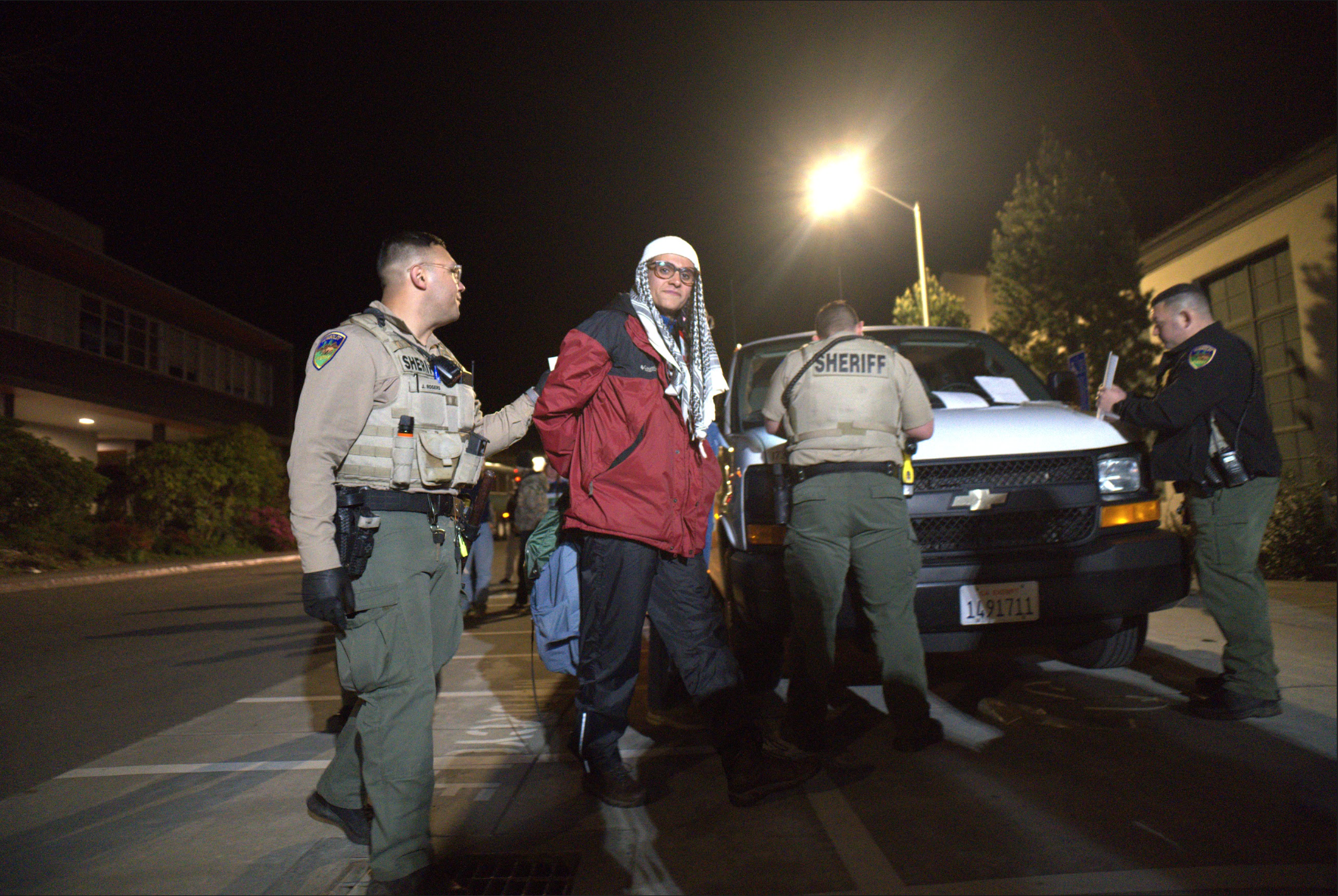
Rouhollah Aghasaleh, assistant professor and University Senate faculty representative for the College of Professional Studies, was arrested at the protest in 2024. At the Jan. 28 University Senate meeting, they offered a framed photograph of their detainment to the Wellbeing and Stewardship Team.
Reception of the After Action Reports
Aghasaleh took issue with the AARs because neither said who specifically was in the EOC or PMG. Each AAR said the PMG was comprised of the President’s Advisory Team, University Council and government relations. According to the university’s most recent Emergency Operations Plan and Guidelines linked on the university website, dated Oct. 2018, the PMG consists of the president, provost, the executive director of the office of diversity, equity and inclusion, chair of the academic senate, associated student president, legal advisor, public information officer and vice presidents of academic affairs, administration and finance, student affairs and advancement.
“Those two reports are not only insufficient but also are insulting our intelligence, our being. I spoke about this at some smaller meetings. There are concerns about if those members become known, then they might become attacked, or become targeted,” Aghasaleh said. “And I understand that’s a reality, and that’s unfortunate, but it’s important to remember what they did, like for instance, my own case, being suspended for five months.”
Aghasaleh pointed out that the event summary of each AAR was only seven paragraphs long. Upon further inspection, the two summaries were identical save for one term in the last sentence of each, where it says EOC/IC was deactivated on May 20.
Strengths and areas for improvement
Following the event summary, both AARs laid out what the EOC and IC did well and what they could have done better in response to the protest. The EOC AAR claimed three strengths and six areas for improvement, while the IC AAR listed three and five, respectively. For example, the EOC AAR noted that their good local relationships helped with resources and assistance. Both reports also had plans for addressing each issue, some of which have been accomplished. The report listed improving the IC and EOC interface as something that could be improved upon, which, according to the report, has been completed.
“On the night of April 22 in particular, poor communications between the IC and EOC led to inter- and intra-team information gaps and consequently to tactical errors and inadequate operational planning,” the EOC AAR read. “The IC/EOC interface was not fully established until an IC Coordinator was assigned two days into the incident.”
One of the strengths listed in the IC AAR was that no injuries were reported as a result of the 32 arrests made in the early hours of April 30, 2024. Areas for improvement included bettering management of public relations and technical issues with body-worn cameras. Dealing with both issues is in progress.
Fisher noted that the AAR is only part of the story.
“I think this is a single reference point of a much more complex experience of an incredibly impactful event on campus,” Fisher said. “There is much more to learn beyond this report and I am encouraged by community conversations I have been a part of and I look forward to more.”
Why form a Wellbeing and Stewardship Team?
The organization of the team was first promised in a statement signed by university Interim President Michael Spagna, which was sent to all of campus via email on Oct. 29, 2024. According to the email, the team was formed to facilitate productive conversations and build trust.
“We have work to do as a community to fulfill our potential. Some of that work is in progress, while much else remains to be done. To those who have expressed the need for more inclusive decision-making processes, we hear you,” Spagna’s statement said. “Over the last few weeks, we have been leaning on the collective expertise of our campus community, empowering students, faculty, and staff to help us reflect on and learn from the past and to build a safer, more supportive environment.”
The Wellbeing and Stewardship Team saw potential in the conversations that took place in the meetings. From the same request for an interview to university marketing and communications, the Wellbeing and Stewardship Team responded collaboratively via email.
“The conversations that have happened so far have given us valuable insight into how campus leadership handled the events and how the campus community felt about their response. Based on the feedback we received, we get the sense that these meetings created a meaningful space for some participants to share how the events affected their studies, work, sense of safety, and connections to both their close groups and the larger campus community,” the Wellbeing and Stewardship Team wrote. “We feel like there’s interest and value in continuing this dialogue – and finding ways for campus groups to come together and shape what we want our future to look like.”
Moving forward
Aghasaleh noted that the university may have the right intentions in its efforts to build trust back up between the university and the campus community.
“I think there is some genuine intention to make things right, especially after President Spagna took the lead,” Aghasaleh said. “I do hear them having some genuine conversation to find ways to make things right.”
Aghasaleh noticed a strain on the university’s relationship with students, which will not go away on its own.
“I am very concerned right now with this widening gap between admin and students on campus … By giving ourselves more time, things are not going to get easier. I’m pretty sure some tensions will come up pretty soon, and I know we are not prepared,” Aghasaleh said. “We have not learned our lessons from last year.”
Leave a Reply