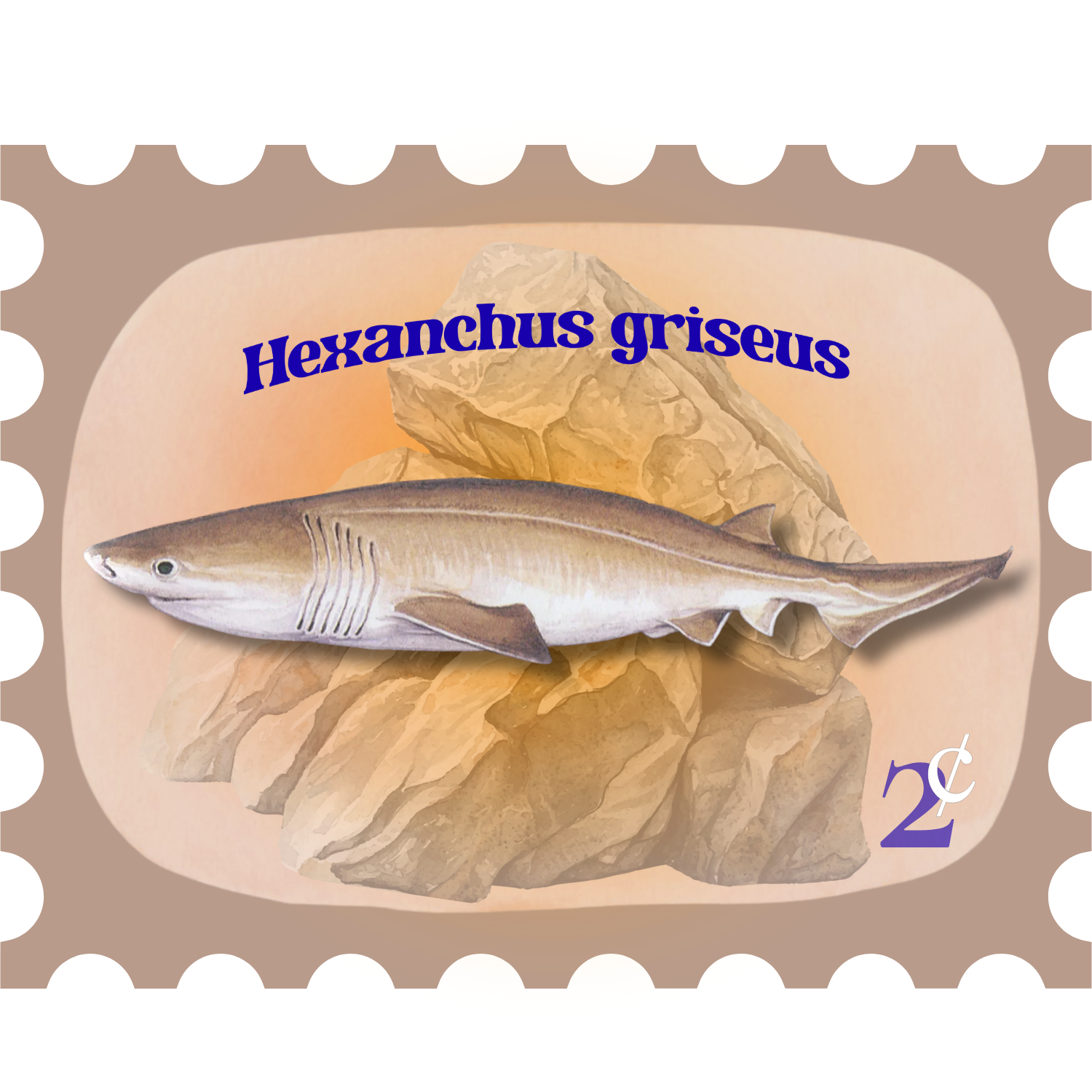
Hexanchus Griseus
by Ariana Wilson
The ‘Cow shark’ consists of two species: the bluntnose sixgill and broadnose sevengill shark. The sixgill shark is a deep-water dweller with the widest distribution of all shark species, ranging from the northern and temperate regions, where water temperatures are about 40-60 degrees Fahrenheit. Adults are found along the continental shelf at depths of at least 8,000 feet, while juveniles have been known to come as far inshore as Humboldt Bay and the San Francisco Bay Area. Male sixgill sharks reach maturity at about 10 feet, while females fully develop at about 14 feet. The size at birth is between 24 and 29 inches. Their prey typically consists of other sharks, rays, chimaeras, bony fish and marine mammals.
The sevengill shark is a common coastal species worldwide in most temperate seas with water temperatures of about 54-64 degrees Fahrenheit, but on rare occasions has been found at depths of 330 to 660 feet. Males mature between five and six feet and females mature between seven and eight feet. These powerful creatures can reach impressive lengths of up to 16 feet and live up to 80 years.
In Washington State, the sixgill shark is making a name for itself as the potential state shark. Washington’s Puget Sound is said to be the breeding ground of the sixgill shark, connecting an inland estuary to the Pacific Ocean, alongside the state’s northwest coast. Washington State recently introduced legislation to protect these beautiful creatures: the Sixgill Shark Bill (HB 2447). This bill highlights the need and responsibility for humans to protect our environment, starting with the animals that are right under our noses. Sixgill sharks are designated as a Species of Greatest Conservation Need (SGCN) under the State Wildlife Action Plan.
“SGCN-classified species include both those with and without legal protection status under the Federal or State Endangered Species programs,” according to the Washington Department of Fish & Wildlife.
Ari is a senior journalism major and the science editor this semester with an adoration for the environment and conservation. She is currently pursuing her scientific diving certification and plans to meld her journalistic passions with scientific research in the future. For any science inquiries please contact ajw167@humboldt.edu.
Leave a Reply