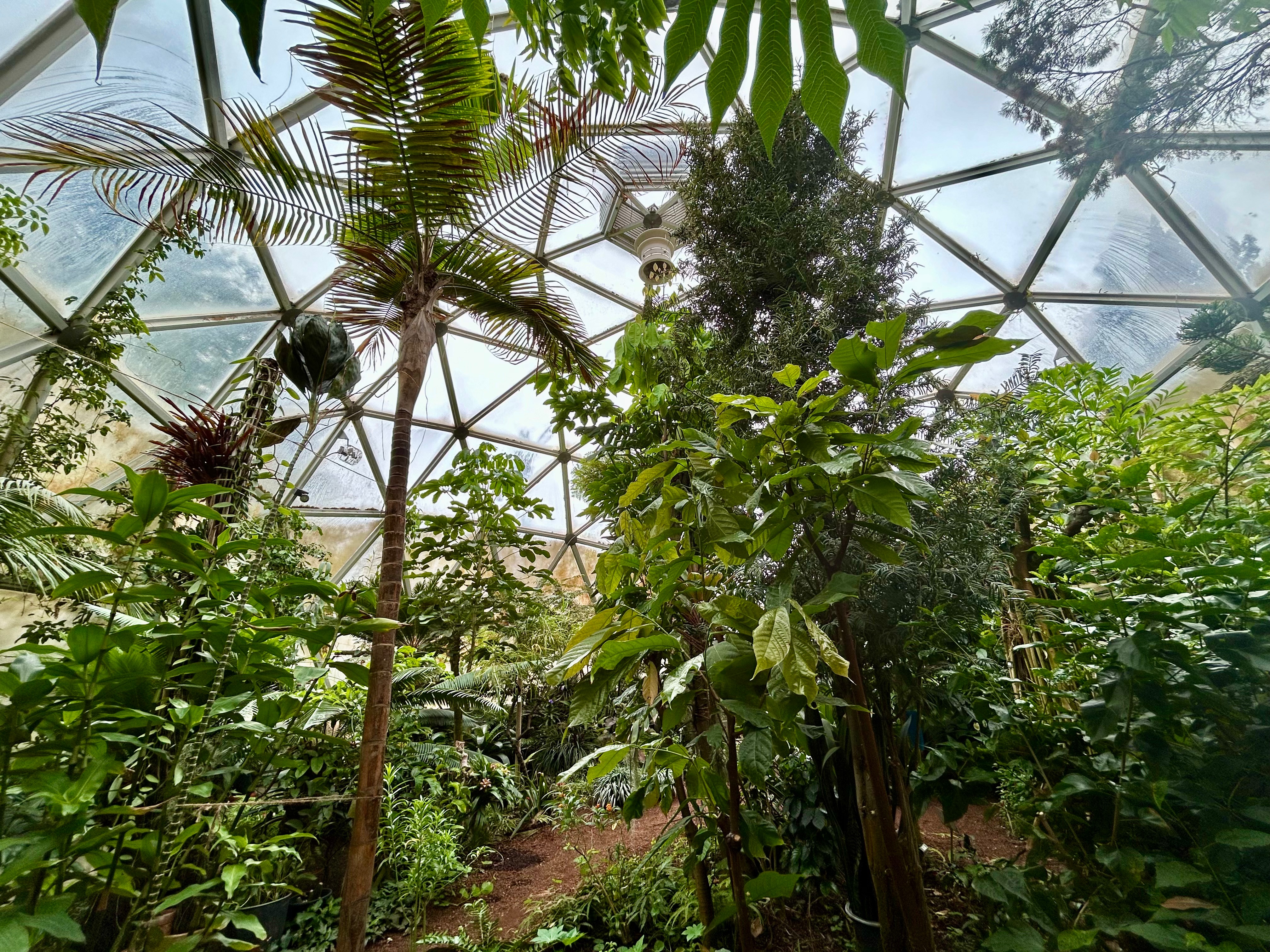
A trip through the Dennis K. Walker Greenhouse’s extensive collection
By Jess Carey and Nick Escalada
Take a break from class and step into the lush island of life that is the Dennis K. Walker Greenhouse. The giant translucent dome sitting between Wildlife and Fisheries and the science buildings is a familiar landmark of Humboldt’s campus to most students, even if some have no idea what it contains. The greenhouse includes over 1,000 specimens from 187 families.
Specimens on display range from backyard garden favorites to potential once-in-a-lifetime viewing opportunities. Each time you peruse the greenhouse collections, something new may be in bloom.
Temperate Room
The largest room in the greenhouse other than the dome is the first stop on the right from the entrance, and it stores a myriad of fruiting plants from temperate regions. Several members of the Solanaceae family on display include Capsicum, the habanero, and devil’s trumpet, Datura. Affectionate types will fawn over the sweetheart plant, whose modified leaves indent at the tip to form an adorable heart shape. There are many specimens of cycads, unique plants that at first glance appear very similar to palms, but are actually conifers. This means that they are more closely related to trees with cones, like pines.
Desert Room
Warm, parched air swells forth from the desert room whenever its door is opened. The section features dozens of impressive species of cacti, from the branching white Mammillaria magnifica to the beach ball-sized Grusonii. On both sides of a stylish cow skull are the delightfully hairy Indian comb cactus and the imposing Madagascar Palm. There are several specimens of Welwitschia, which is considered a living fossil as the only extant member of its lineage. Its unique trailing tendril-like leaves continue growing for its whole life, dying off near the ends.
Aquatic Room
The aquatic room features several large concrete ponds teeming with life, not limited to plants. Look closely into the water and you can see many aquatic creatures, including worms and shrimps, sharing their habitat with the likes of Taro and water lilies. Dainty Azolla coats the surface of some ponds, floating on the water’s surface and following its rippling movement.
Several carnivorous plants call this room home. Drosera and Pinguicula exude sticky droplets of a compound that attracts small bugs. Similar to the more well-known venus flytrap, the plants trap bugs. These plants send their flowers up on tall thin stalks, in order to prevent their pollinators from becoming prey.
Tropical Room
The tropical room includes many Araceae like laceleaf and peace lily. These plants have unique stalk-like flowers called a spathe. Other fun, tropical characters are the carnivorous pitcher plant, and many common houseplant species like Philodendron and string-of-pearls. Many houseplant species are of tropical origin, because the warm and dimly lit conditions of most homes mimic tropical environments.
Fern Room
Ferns are lush, leafy plants that lack the ability to produce seeds. Instead, they produce spores. Look under the leaves in this room and you’ll see small yellow-brown spots called sori that are the site of spore production. Species in this room range from native Polypody and Bracken fern to tropical giant fern.
Dome
Stepping into the tropical dome on a cold rainy Humboldt day provides a lush respite from the gloom. The warm and humid room mimics a tropical climate, and the beautifully designed room is as aesthetically pleasing as it is scientifically informative. Tree ferns tower over a small waterfall, its banks lush with Pothos and other tropical understory plants. There are several pitcher plants, milkweeds and even a coffee tree. Air plants and orchids decorate the walls. There is even a rare corpse flower, although it only blooms every two to ten years.
The greenhouse has open visiting hours from 10 a.m.-2 p.m., Monday through Thursday. Mouse Sloan is a senior in the Botany program at Cal Poly Humboldt, and works as a student assistant in the greenhouse. They say that the collection is an awesome resource for students.
“It also serves the community as a place of solace amidst academic and life stress,” Sloan said.
Click here to see the greenhouse map with room names.
Nick is a sophomore minoring in journalism who reports on happenings of all sorts. As a wildlife major, he enjoys nature-related pieces. On his off days, you can find him taking a hike behind campus or collecting shiny stuff on the beach.
Jess Carey is a senior at Cal Poly Humboldt, majoring in biology and double minoring in botany and journalism, and the science editor for The Lumberjack. They are passionate about telling stories that are relevant to the community, branching their interests in science, music, and the arts.
Leave a Reply