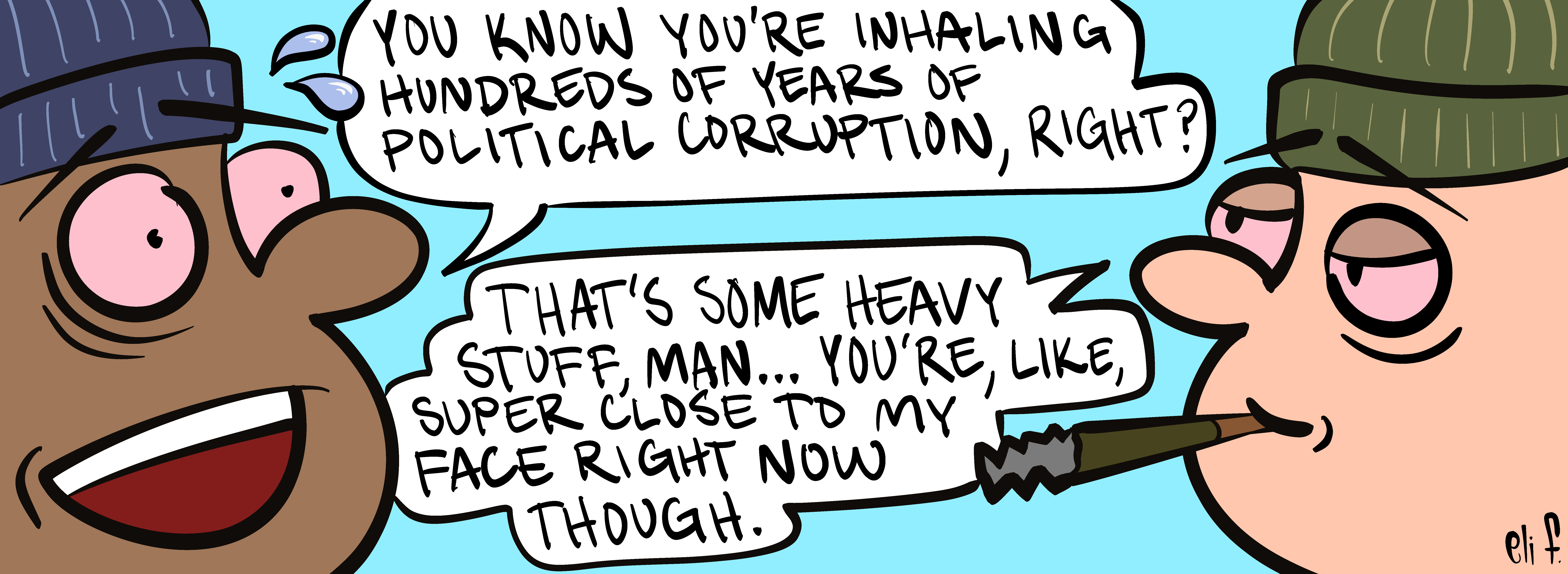
By Eli Farrington
Nothing says peace and love like the hyper-politicization and weaponization of one of America’s most highly disputed and controversial substances. Throughout history, cannabis has played a major role in politics. The political history of cannabis in the U.S. is anything but brief, but I’ll try to summarize it as best I can for those of you who may be a little too high for a long-form story.
Prior to the 1920s, cannabis was historically viewed as a versatile all-purpose plant, used in textiles as well as medicine. Although recreational use did exist, it wasn’t what cannabis was known for at the time.
It wasn’t until the 1920s that recreational use of cannabis gained the attention of mainstream society. Because recreational use of the plant was introduced after the Mexican Revolution, American lawmakers viewed it as a dangerous foreign substance that threatened American Pharmaceutical companies, and completely ignored any of its medicinal benefits. Classic America, rejecting natural remedies in favor of pharmaceuticals concocted in a lab. This shift in perception created a domino effect that would eventually lead to generations of weaponization of what was once a simple medicinal plant.
The “Marijuana Tax Act” was introduced in 1937, marking the first major piece of cannabis legislation in the United States. The act essentially outlawed the plant and solidified its status as an illegal drug. Supporters of the act argued that cannabis posed a threat to larger pharmaceutical and textile companies, while racism — shocker — was another key factor leading to the plant being outlawed. At the time, lawmakers associated the plant with Mexican immigrants and African-American musicians. One lawmaker in particular was responsible for creating this stereotype. His name was Harry Anslinger, and he was the first commissioner of the Federal Bureau of Narcotics (FBN). Anslinger was a strong believer in the prohibition of all drugs and narcotics except for alcohol, but the one substance that he hated above all others was cannabis. He would go on to use the media as his platform to spew racist and xenophobic misinformation about the plant on a national level.
Anslinger basically dedicated his entire career with the FBN to convincing the country that cannabis was an evil substance sent by Satan to destroy everything that the white man had worked so hard to build. Here are a few of the batshit crazy things that this guy actually said about cannabis:
1. “Marijuana is the most violence-causing drug in the history of mankind.”
2. “You smoke a joint and you’re likely to kill your brother.”
3. “The primary reason to outlaw marijuana is its effect on the degenerate races.”
4. “Marijuana leads to pacifism and communist brainwashing.”
5. “If the hideous monster Frankenstein came face to face with marijuana, he would drop dead of fright.”
The next significant pieces of legislation regarding cannabis came in the 1950s when Congress passed the Boggs Act of 1952 and the Narcotics Control Act of 1956. These acts created mandatory sentencing for first-time cannabis possession, with a minimum sentence of 2-10 years and a $20,000 fine.
In 1970, Congress passed the Controlled Substances Act (CSA), essentially wiping the slate clean of any previous cannabis legislation and starting from scratch. The CSA categorized cannabis as a schedule one substance alongside drugs like heroin, LSD and peyote, and determined that it had no medicinal use and a high potential for abuse.
On June 17, 1971, President Nixon declared drug abuse “public enemy number one” and waged a nationwide offensive on drug abuse, known as the war on drugs. Although Nixon claimed drugs to be the enemy, his campaign disproportionately targeted African-Americans and anti-Vietnam War protesters.
In fact, one of Nixon’s own advisors, John Ehrlichman was quoted saying that the Nixon campaign had two enemies: the anti-war left and Black people, and the war on drugs was just a cover up to target these groups.
“We knew we couldn’t make it illegal to be either against the war or Black… but by getting the public to associate the hippies with marijuana and blacks with heroin, and then criminalizing both heavily, we could disrupt those communities… We could arrest their leaders, raid their homes, break up their meetings, and vilify them night after night on the evening news. Did we know we were lying about the drugs? Of course we did,” Ehrlichman said.
The result was a drastic increase in the percentage of cannabis arrests in the following decades. Today, nearly one quarter of all drug arrests are for cannabis possession and people of color are far more likely to be impacted due to racial profiling in policing.
Nixon, and many presidents that followed him, used and manipulated drug policy laws to bring their political careers to new heights and gain leverage. Nowadays, cannabis law making is done at the state level, with 24 states voting to legalize it despite it being illegal on the federal level.
Cannabis is just as politicized today as it was in the 1930s. For people who enjoy cannabis, a politician’s political stance can be a huge deciding factor in the way they vote. In today’s world, cannabis legalization or decriminalization is a familiar proposal on many ballots. It’s not uncommon to see politicians running for office make promises of cannabis reform, when just a few decades ago they were the ones responsible for putting people behind bars for possession.
Cannabis has an incredibly complex and contentious history in the U.S. spanning over a century. Wars have been fought, lives have been lost, and laws have been drafted all in the name of this plant. As the generation of legalization, it is our responsibility to acknowledge that history and do what we can to avoid repeating it. So, next time you roll one up, remember that you are smoking a piece of the past in the name of a brighter future.
Eli Farrington is a highly intelligent human life form working as the opinion editor for The Lumberjack. In his free time, he enjoys analyzing the complexities of the human condition. His passion for journalism knows no boundaries and exceeds time and space itself.
Leave a Reply