By Nick Escalada
The Union Street sidewalk between the Kinesiology and Behavioral and Social Science buildings is a well-trodden path at Cal Poly Humboldt. Whether it’s their first or hundredth commute, students often divert their gazes to the fenced-off aquatic compound beside them, many having little idea of its purpose.
This is the university’s fish hatchery, a remarkable piece of infrastructure rarely seen on college campuses. The hatchery was constructed to serve the school’s equally unique fisheries curriculum. It acts as a small-scale representation of the wider ecological and aquacultural breeding programs that occur in commercial and government fisheries.
Hatchery Manager Patrick Nero explained that this hatchery leans toward a conservation-based model, aimed to raise native species of fish that can be released into the wild to bolster populations.
“There’s a lot of uncertainty with the climate and our biological systems coming up in the future, and we need this next generation to be able to help us,” Nero said. “[Students] need to be able to do what they can to mitigate the damage that we’re doing.”
Among these species are the Northern California steelhead trout and its close relative, the coastal cutthroat trout, who are both listed as endangered under the Endangered Species Act. Versions of these fish that are bred in controlled environments like hatcheries may not receive the same protections under the act as their wild counterparts, but these programs still serve as a safety net for the ecosystems they contribute to.
“I want them to value the resource that we have, and appreciate nature,” Nero said. “But also to know that not everything is under human control.”
The first stop upon entering the hatchery is the spawning room, which features dozens of small tanks connected to a central filtration system. The occupancy of these tanks varies throughout the year, and currently the room only houses one group of newborn steelhead that are each just larger than a human thumbnail.
The back door of the spawning room leads to the larger outdoor section of the hatchery visible from the street. A wooden shade structure covers an elongated concrete raceway that loosely resembles a river. Here, adult steelhead and cutthroat are released to swim more freely until student researchers facilitate spawning by gently squeezing sperm out from males and mixing them with females’ eggs. Fisheries majors are taught other common practices with these adult subjects, such as marking, tagging, anesthetizing and even surgical procedures for those who need them.
Despite the hatchery appearing tailored to a very specific field of study, it offers resources for scholars well beyond the fisheries program. Fellow students in the College of Natural Resources and Sciences frequently conduct research in the compound, and even non-STEM undergrads are welcome to find project material in the outdoor ponds.
Understanding fisheries can build foundational knowledge of government policy, business in the private sector and indigenous food sovereignty depending on which hatcheries are looked at. The one on campus is an especially calming and romantic spot for the arts and humanities.
Sharing a department, fisheries and wildlife management have close ties both academically and physically.
“We’ve had non-fisheries majors do independent research and their own studies here at the fish hatchery,” Nero said. “So the opportunities are not exclusive for fisheries majors,
and you get a good view of the game pens from our side of the fence as well.”
Perhaps the most striking features of the hatchery are the circular pools that occupy most of the yard. Juvenile trout are placed here to swim against a constant rotational current that will ensure healthy development and proper water quality. Up until a few months ago, the excess nutrients and waste from the pools were collected in a large man-made pond in the back, which gave rise to explosive duckweed growth on its surface. The duckweed has since been removed and the pond is now home to several orange koi.
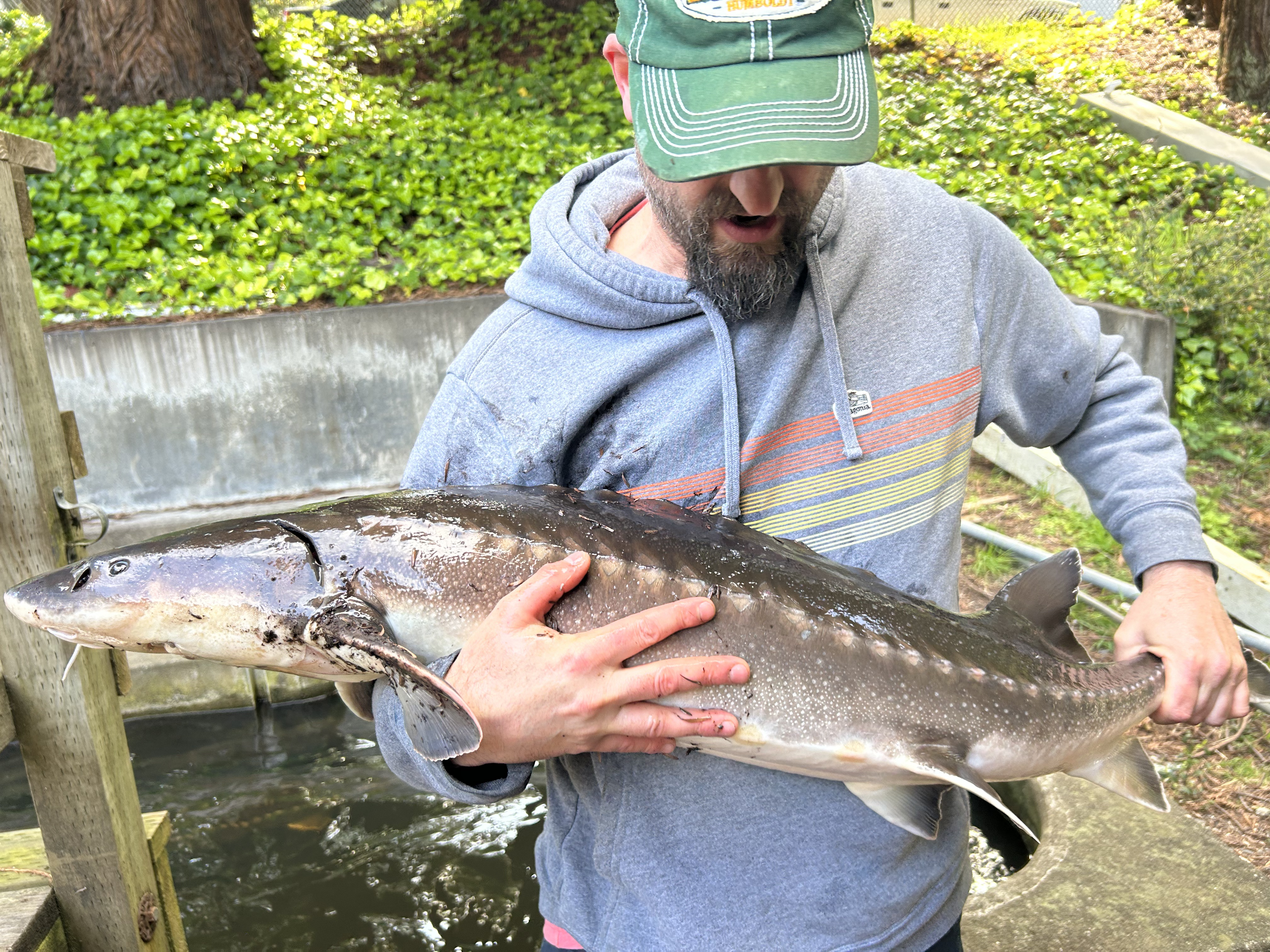
The few fish visible from the outer sidewalk emerge as giant shark-like silhouettes from a dark rectangular pool. These are white sturgeons, which the university acquired from a local caviar farm and repurposed for student research. Nero easily caught each of the fish held at the hatchery for display in this article, but struggled to contain the immense tail strength of these bottom-feeding behemoths. These fish are only about a third of the way along their 15 to 20-year journey toward sexual maturity.
Aside from its professional and academic applications, the fish hatchery proves itself a source of inspiration and wonder to those curious enough to inquire about it. Nero expressed his desire for ordinary folk to feel welcome to explore the hatchery freely whenever they walk by.
“The doors are open Monday through Friday for visitors. Anybody who’s interested, come on in through the front doors,” Nero said. “It’s a beautiful part on campus where you can stroll through, admire the fish, ask questions and scratch your curiosity button.”
Nick is a sophomore minoring in journalism who reports on happenings of all sorts. As a wildlife major, he enjoys nature-related pieces. On his off days, you can find him taking a hike behind campus or collecting shiny stuff on the beach.
Leave a Reply