by Jess Carey
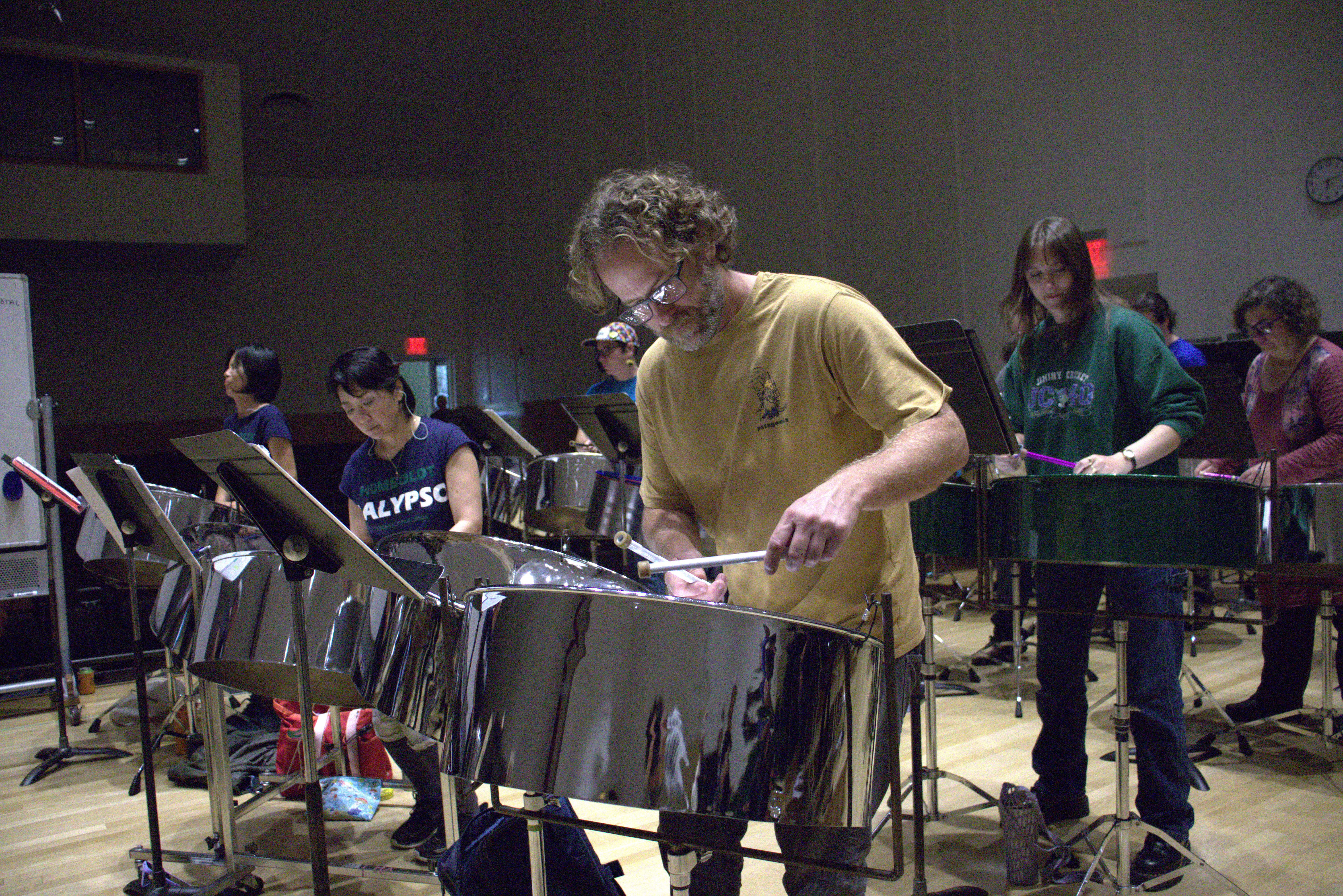
Bright and bouncy music drifts out of Fulkerson Hall on Monday evenings as Cal Poly Humboldt’s Calypso Ensemble gather for their weekly rehearsal. Rhythmic and soaring, it’s a vibrant sound with Caribbean origin. The program has been bringing the tropical sound of calypso to the fog-laden forests of northern California since 1986.
The group of more than 50 musicians play an assortment of drum-like instruments, glimmering bright in stage lights across the dark auditorium. Their swinging bodies and delicate mallet work are precise and practiced, infused with a clear groove and sense of expression.
It was a captivating performance. A hybrid of rhythm, dance, and bright melody — cut to a stop with a jarring clang as director Eugene Novotney banged mallets on his pan stand, apparently signaling to the band that something was up. Novotney founded the ensemble and has been directing the program ever since.
“Let’s take it again from section B,” he said with the wave of a hand. “I need percussion to sit this one out.”
Calypso originated in the islands of Trinidad and Tobago in the Caribbean. The music is recognizable by particularly melodic vocals, with down-to-earth lyrics spanning topics of daily life to political resistance. The style has roots in African musical tradition, fused with indigenous Caribbean and western elements.
Novotney said that after spending time studying percussion techniques all over the world, he was inspired to start the ensemble in Humboldt because he felt like it was the right place for the project.
“I just had an absolute sense and a positive feeling that if I could get a steel band going here, it would be very well received by the community,” Novotney said.
And well-received it was. The group now consists of more than 50 students and community members. Calypso projects have also popped up in the surrounding community. The majority of instrumentalists play different sizes of the steel pan, the iconic instrument associated with calypso music.
The steel pan was invented in an act of resilience by Trinidadians subject to oppressive colonial leadership. When British authorities outlawed skin drums in the 1880s in an effort to squash community organizing and self-expression, the people got creative. They made melodic drums out of bamboo, cookware, and junked 55-gallon oil drums.
“Eventually, it was discovered that pitches could be tuned. Then pitch became a part of the style, evolving to what [the steel pan] is today,” Novotney said.
Players in the ensemble perform on steel pans of several sizes, from the 4-foot-tall bass drums to the smaller tenor and cello pans. Larger, deeper-pitched drums have fewer notes per drum, and the smaller, higher-pitched pans have more notes per drum. Since each pan has a limited suite of pre-tuned notes, some musicians play several pans at the same time. Each of the bass players perform on four pans at once!
Senior marine biology major Aiden Mahl takes music classes for fun and plays the cello pan in the ensemble. His interest in the band sparked from hearing them practice while walking around campus. He said he enjoys how all the different parts come together to make one “big instrument.”
“You have to move your arms around in a coordinated manner and swing your body to hit notes on the different pans,” Mahl said. “It lets you get into the music and dance along while you’re playing, which I think is really cool.”
In addition to dozens of steel pans, the calypso ensemble has a vibrant rhythm section. Novotney said they use the Trinidadian term, ‘engine room.’ Players utilize a drum kit, congas, bongos, timbales, scrapers, gogo bells, and more. The driving force of such an assortment of percussion is certainly momentous, much like an engine, and it lays the groundwork for the bright notes of the pans to dance on top of. One surprising addition is an automobile brake drum, struck with nails to produce a bright ting sound. Novotney explained that the brake was also used as a historical makeshift drum.
“It’s still in the band as a wink and nod to the tradition in the genre,” he said.
Novotney believes that the steel pan is an accessible and fun instrument, and the music speaks for itself. He emphasized that no matter how you play a pan, the pitch is there.
“The instrument speaks itself,” Novotney said. “And that is the beauty of percussion.”
Jess Carey is a botanist, musician, and friend. They enjoy pondering the sky, running around, and making a scene. They are a senior studying ecology with a journalism minor. Reach them by email at jc876@humboldt.edu with comments or story ideas.
Leave a Reply