by Sadie Shields
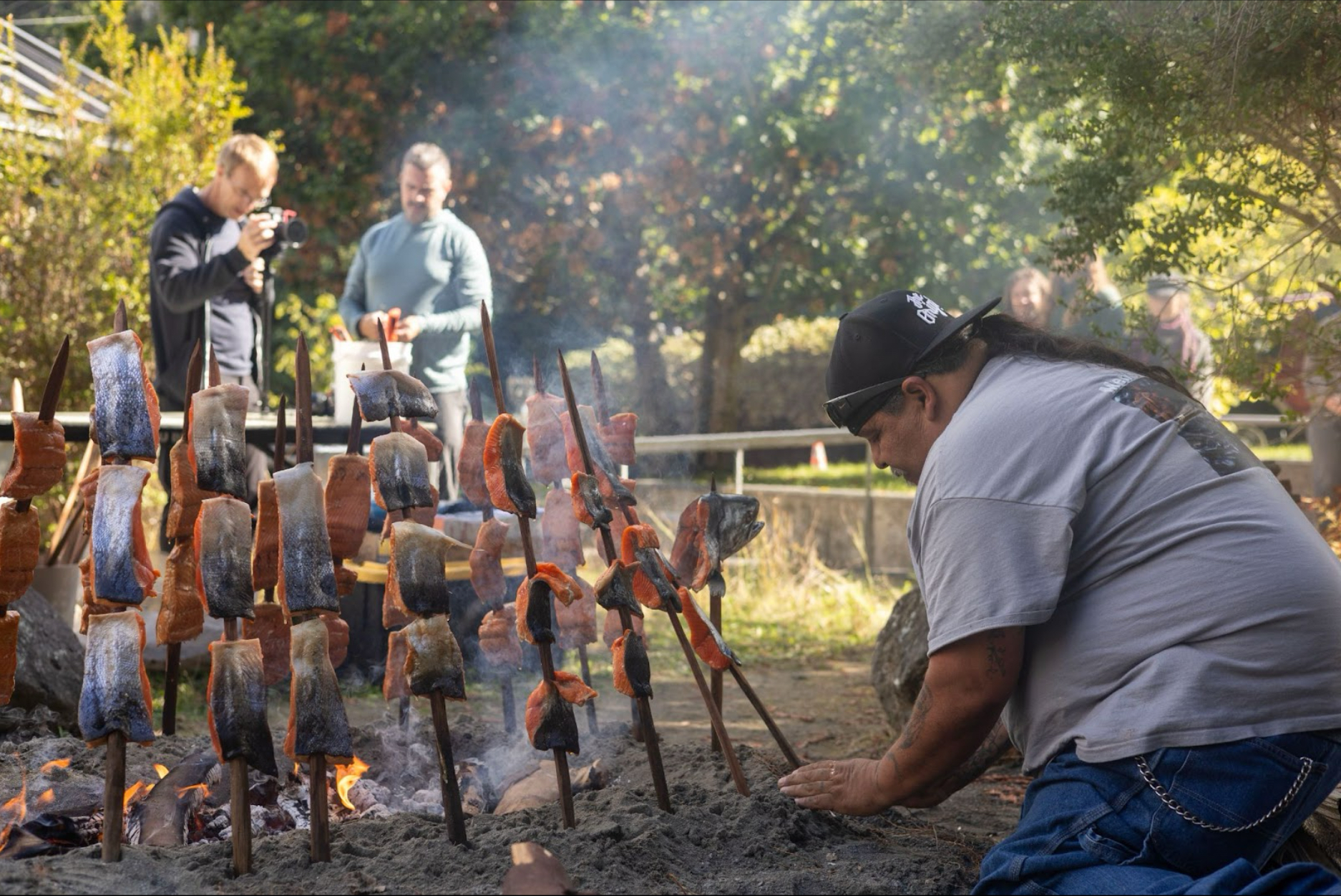
Heading up the stairs towards Wiyot Plaza, the scent of salmon cooking over a fire wafted by as students, faculty, staff and elders gathered for the Indigenous Food Festival on Saturday afternoon.
The Indigenous Food Festival began as a student-led initiative to foster community while the Rou Dalagurr Food Sovereignty Lab was still under construction. The event has grown bigger and bigger since it began, with members from the Native Youth Council, Wiyot Tribe, Aquili Metzil Cooperative, Native Women’s Collective, Aunties on The River, Yurok Tribe, Karuk tribe and the Tolowa Dee-ni’ nation in attendance. The festival is rooted in the celebration of Indigenous food practices, sovereignty and intergenerational knowledge-sharing throughout the community. Cutcha Risling Baldy, co-director of the Rou Dalagurr Food Sovereignty Lab and an associate professor of Native American studies, stressed the importance of the event.
“They wanted to bring people in so they could get a sense of this place and build community,” Baldy said. “We thought, yeah, we should bring everybody together in celebration of food sovereignty work.”
Isaac Kinney, a second-year graduate student dedicated to environmental and community-based work, reflected on the broader significance of the Indigenous Foods Festival. For him, the event is more than a celebration — it’s a form of advocacy and cultural affirmation.
“This event is a direct action to continue the Indigenous voices on campus,” Kinney said. “Making sure that the presence is a part of the experience of anyone coming through the school — as a student, as a parent, as a community member — they understand that things here are tribally-led, Indigenous women-led and that’s what this event means to me.”
One key difference in this year’s Indigenous Foods Festival was the opening of the Rou Dalugurr Food Sovereignty Lab to the public last year, which allowed for community workshops and broader engagement. Cal Poly Humboldt graduate and Graduate Student Coordinator for the Kelp Guardian project Delaney Schroeder-Echavarria explained that the lab’s purpose is to introduce people to the concept of traditional ecological knowledge as a legitimate and foundational science.
Traditional ecological knowledge highlights how food sovereignty centers relationships with the land and interconnectedness — something she believes Western science has historically failed to recognize.
“A lot of Western scientists are finally starting to realize, ‘oh, everything is interconnected… we need to actually speak to the people who know how to be in relationships,’” Schroeder-Echavarria said.
However, while Rou Dalugurr Food Sovereignty Lab is community-based, it is not a public walk-in space.
“We are very much like any lab space on campus,” Schroeder-Echavarria said. “You can’t just go into the chemistry lab or the Marine Lab and fool around.”
While the lab is mostly closed, they are open to community members to do workshops and also host visiting scholars. These workshops and events prepare food for students and the community.
“[The class] is open to anybody to take, and you can take it more than once,” Schroeder-Echavarria said.
Schroeder-Echavarria further encouraged students to take Native American Studies courses, explaining that it helps people learn skills necessary to work with one another.
Colonization had a huge impact on Indigenous communities, which went after the culture, the land, and the food traditions they passed down generations.
Baldy expressed the importance of food to Indigenous culture.
“Colonization was attempting to really eradicate Indigenous peoples. It was trying to remove and just possess us of our land and really, it also went after our foods, ” Baldy said. “Our foods really tie us to a place. They really tie us to family and community and culture and knowledge.”
Even with the attempts to suppress the culture through colonization the cultural knowledge still endured.
“Even with all of the attempts to try to make it so that we wouldn’t do this anymore, we still carried our food knowledge forward… Native people will still continue to pass on knowledge because they know it’s what’s right,” Baldy said.
Sadie is a junior communications major, journalism minor at Cal Poly Humboldt who has an interest in covering and taking photos for sports and wildlife journalism, and a slight interest in breaking news. She can be reached at sls331@humboldt.edu.
Leave a Reply