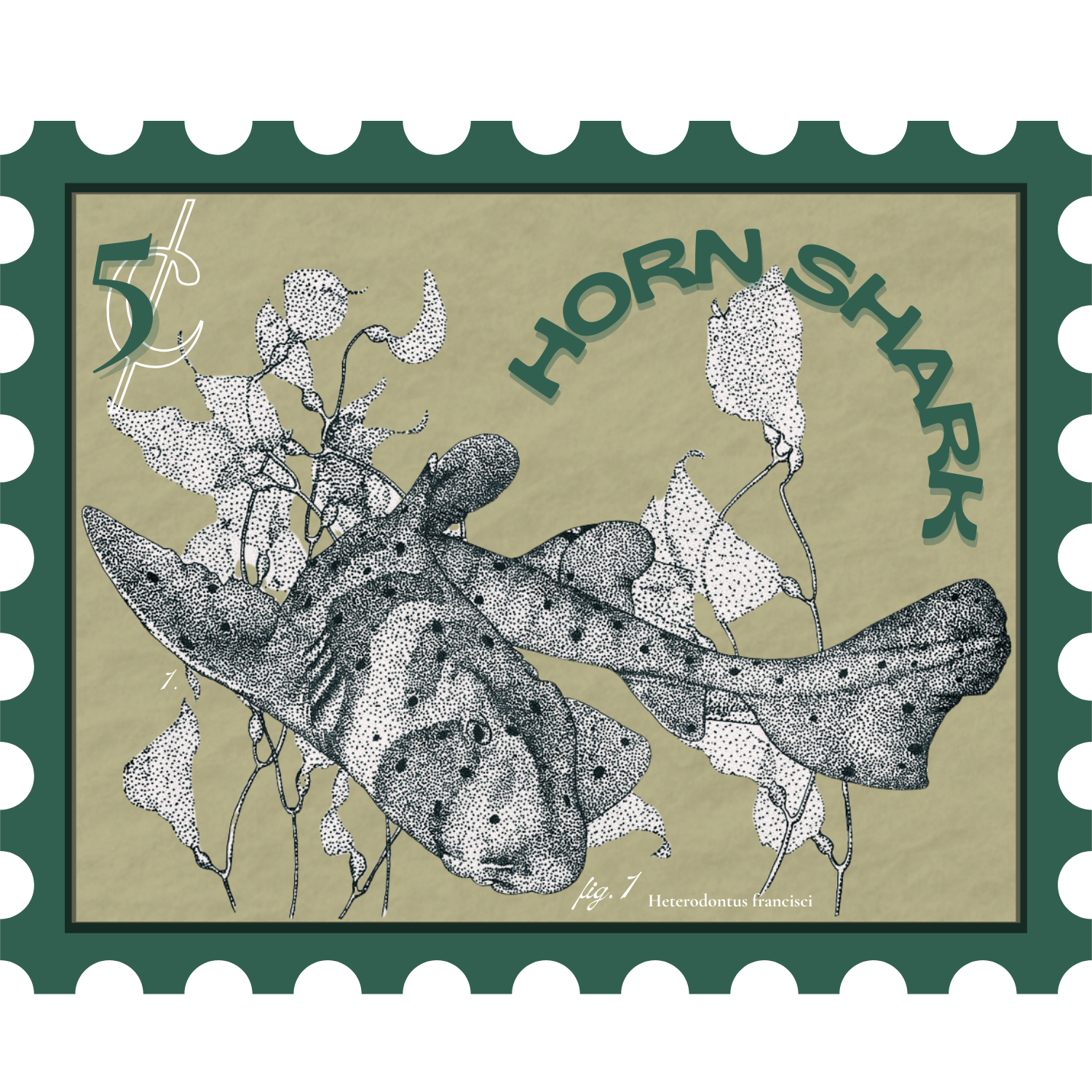
The Horn Shark, a misunderstood fish
by Ariana Wilson
Horn Sharks are solitary, slow-moving predators native to the temperate rocky reefs, algal beds and kelp forests of the Pacific Ocean from California all the way down to western Mexico. They are considered one of the smaller shark species and can grow to four feet long.
The majority of their diet consists of clams, mollusks, small crustaceans and sea urchins — which are becoming increasingly abundant on California’s coast. Their mouths are on the underside of their body, positioned to sweep the seabed and crush the hard shells of crustaceans that they eat. Kelp forests provide critical ecosystems for many species and are facing decline due to sea urchins devouring kelp at unsustainable rates.
Horn sharks are oviparous, laying between two spiral shaped eggs outside of their wombs, every 11-14 days typically between February and April, depositing up to 24 eggs in a single breeding season. Horn sharks can live up to 25 years in the wild and a little over a decade in captivity. Though, in the wild, these sharks roam a territory of approximately 10,000 square feet for their entire lives.
They are not targeted by commercial or recreational fisheries, but they are sometimes caught as bycatch. According to the International Union for Conservation of Nature (IUCN) horn sharks are “data deficient,” meaning there is not enough information to determine their conservation status, but they are not currently a protected species or endangered.
Ari is a senior journalism major and the science editor this semester with an adoration for the environment and conservation. She plans to meld her journalistic passions with scientific research in the future through environmental communication. For any science inquiries, please contact ajw167@humboldt.edu.
Leave a Reply