The Lumberjack


Students Serving The Cal Poly Humboldt Campus and Community Since 1929

Day: February 4, 2026

  • Humboldt Burlesque: Reclaiming while Entertaining

    Humboldt Burlesque: Reclaiming while Entertaining

    by Luke Shanafelt

    Tasseled titties spun in circles as the host, Mr. Gino, emerged onto the stage in an emerald crusted blazer. The swing band filled ears with waves of roaring twenties jazz tunes. A pastel pink haircut bounced to the beat, waiting for a dancer to throw shreds of underwear upon them.

    Burlesque entertainment uses elements of comedy, music and striptease to create a feminist counterculture rooted in tradition. On the night of Saturday, Feb. 7, more than 10 dancers, including Eureka Mayor Kim Bergel, took the stage at the Eagle House.

    Harry Sass closed the show with a flamboyant display of unapologetic swag. He came in hot dressed with a funky white suit and a long silver wig. As the crowd begged for more, that white suit began to dematerialize. With an array of stringed disassembly, pasty white quadrecepts revealed themselves in the red light. 

    “Burlesque was kind of like women taking back their power,” Sass said. “It’s about celebrating the beauty in everybody. The perfect body is what society says it is, and it’s unattainable.”

    In Humboldt County, people use burlesque to express themselves without feeling shame. The host for the evening, Mr. Gino, helped highlight why Humboldt is a great spot for drag and burlesque.

    “We have so many performers who feel safe putting themselves out there because we have love and support from our community,” Mr. Gino said.

    Mr. Gino’s hosting skills kept the momentum of the show beating like a pulse. Backed by an incredible talent of jazz musicians and two beautiful singers, Mr. Gino could do no wrong. Cheers rang almost every minute. It was the same enthusiasm some give to the Super Bowl.

    Ryan Citro, an organizer and performer in the event, talked about the style associated with drag and the time period it comes from.

    “When I dress up, I want to look like Marilyn Monroe,” Citro said. “I just love old Hollywood glamor, I love being on the stage and I love creating costumes.” 

    Citro took the stage with the attitude of a burlesque seasoned veteran. Her personality came through in her act with a calm confidence. Her peacock inspired attire also reflected her leadership and owning her own body, flaunting it not to attract mates, but to impress herself beyond her own expectations.  

    “Burlesque gives me a lot of confidence,” Citro said.

    Stripteasing takes some guts, especially performing to a sold-out crowd of more than 50 people. Citro created the peacock costume herself, something she tries to do with most of her costumes when she has the time and money. When she doesn’t, she looks to the community for help. Burlesque has themes of mocking high society, so hand-made costumes are not only sustainable, but also mimic the incredibly expensive culture of high fashion. 

    To striptease for a sold out crowd of people takes major skill, practice and confidence. These artists work hard to own their body and their style, and embracing themselves makes it easy for outsiders to come in and find confidence as well. 

    Burlesque dancers express themselves in a way that inspires. It’s an art form that shines light on glistening nipple pasties of all shapes, colors and sizes. In times of heated political turmoil, Americans have always had the freedom of expression to fall back on. Humboldt county’s hippie transplant origins gave the performers a comfort that holds them soft like a fern. 

    Humboldt is artistically rich. Whether it’s finding confidence in yourself by watching your favorite dancer, getting inspired by the epic costume design and music, or supporting the people who work hard to create events like this. 

    Mr. Gino had some final comments for the students of Humboldt regarding drag and burlesque.  

    “Get out into your community,” Mr. Gino said. “A lot of times students come up here just for school. Don’t just come to school and leave, w. We have a beautiful place here. It really is a special little bubble.”

    Luke is a senior journalism transfer from Socal who enjoys video editing, music journalism, and man on the street interviews. Contact him at ls432@humboldt.edu.

  • Floral Folly Wrens Whimsical Window

    Floral Folly Wrens Whimsical Window

    by Wren Salazar

    A flower once bloomed for me. In it, I saw the face of a man. He spoke gently, his voice carrying a soft demeanor. He spoke of a place he recalled with such clarity. Illustrious and illuminating, this place. I wouldn’t believe a word of it, just how could I? He’s a flower, simple as can be. With roots in the ground and forced to face one way. Sensing my suspicion, he regaled me with a tale. Another lie I could only assume, but it wasn’t just that. It was a lesson as well. For he could leave whenever he pleased. A traveler and a nomad. When he wished, he simply closed his eyes and dreamt. Little did this flower know, I couldn’t dream. So, I stomped him. Plain as can be, jealous as I can be.

    Wren is an artist and story writer looking to add some whimsy and curiosity to those around her. A lover of all things, Wren seeks to help others around her with advice or humor. She can be reached at ws81@humboldt.edu.

  • Iron Lung movie review

    Iron Lung movie review

    by Bodhi Haugen

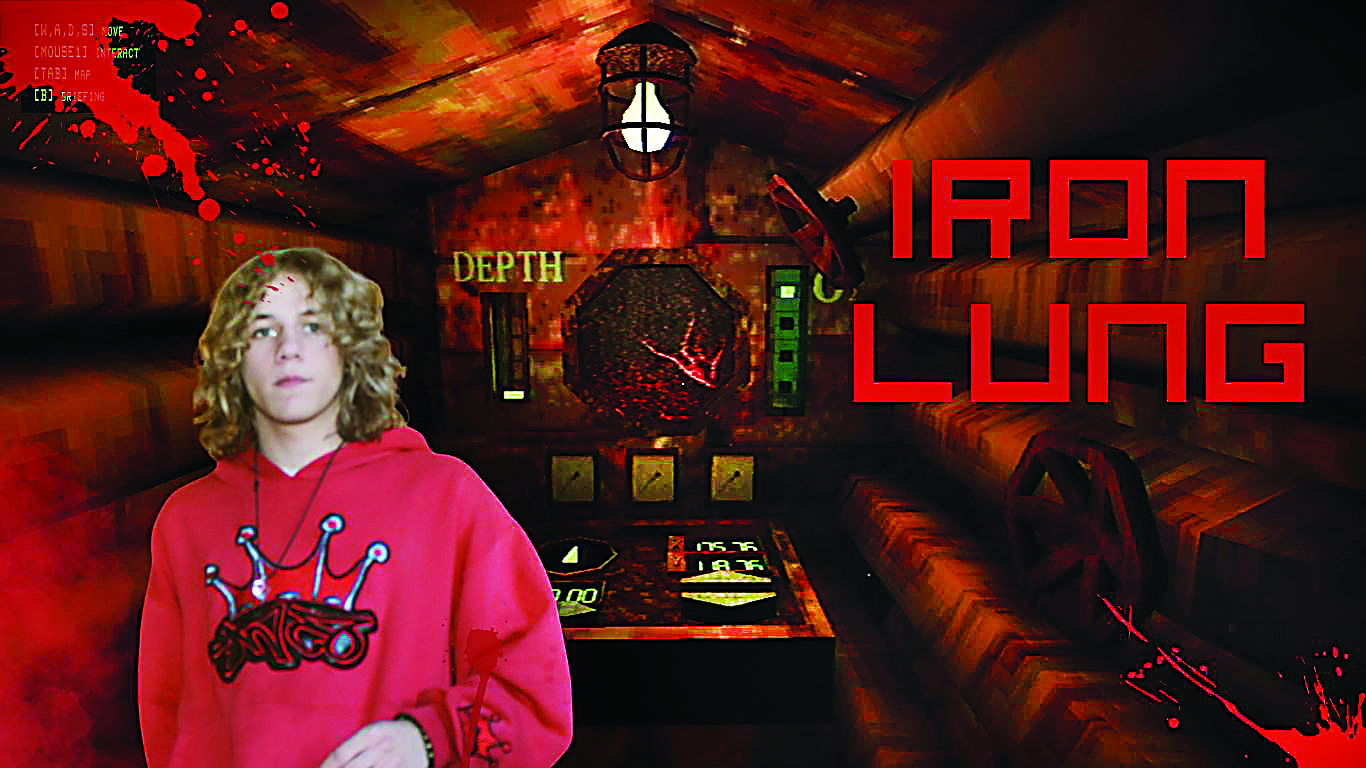
    Iron Lung is based on an unsettling indie horror game released in 2022. Mark Fischbach, also known as popular YouTuber Markiplier, served as the film’s writer, director, producer, editor, and lead actor. The movie was also entirely self-financed by Fischbach, which made the project even more ambitious. 

    I purchased my tickets a week prior and was excited to see Fischbach bring his passion project to life in theaters. I was stunned by what I saw when I walked into Broadway Cinemas late on a Friday night — I hadn’t seen a theater so packed since the release of The Force Awakens over 10 years ago.

    Going in, I wasn’t sure where to place my expectations for a YouTuber movie. I had concerns that the acting might fall short or that the thriller genre could be tainted by my preconceived knowledge of Markiplier as the protagonist. Still, I had hope. 

    Nearly the entire film takes place inside a cramped submarine, with the window and exit welded shut. In this universe, all known planets have mysteriously disappeared, leaving only a single planet with an ocean of blood behind, along with space stations where what remains of humanity survives. Simon, played by Fischbach, is assigned to explore the ocean floor as punishment for his crimes, tasked with researching the phenomenon known as The Quiet Rapture.

    The film excels at making the viewer feel claustrophobic. The submarine is dimly lit and tightly confined, and I rarely saw more than Simon himself could. This limited perspective heightened the tension in various scenes.

    Throughout most of the movie, the only characters we hear are Simon and various voices over the intercom built into the submarine. This places Fischbach’s performance under the spotlight, as the audience spends nearly the entire runtime alone with him. Although the acting wasn’t the best I have seen, Fischbach sold a convincing performance in many of the film’s tense scenarios. 

    A setting like this thrives on silence, and that’s where the movie occasionally stumbles. I felt that Iron Lung relied too heavily on unnecessary monologues from both Simon and the intercom, which pulled me out of the immersion in certain scenes rather than letting the tension speak for itself.

    Visually, the film does not fall. Fischbach was creative with his shot composition, which amplified the anxiety of being on an underwater vessel. The use of unconventional camera angles helped me feel like I was in the submarine with Simon, rather than just observing it.

    Despite watching gameplay videos beforehand and being familiar with Markiplier’s content, I left the theater with more questions than I had going in. The film expands on the game’s eerie lore, but not enough information is provided for all the pieces to easily fall into place by the time the credits roll. While this may have been intentional, a bit more clarity would have helped the average viewer feel a little less lost.

    This movie isn’t for everyone — if you’re a fan of the game or of Markiplier, you’ll probably love it, despite some flaws. As a passion project and self-funded film, Iron Lung is visually compelling and holds its own alongside big Hollywood budgets. Even if you don’t have any prior connection to the game or Fischbach himself, the movie is still worth watching, but it doesn’t necessarily need to be experienced in theaters.

    I give it a 78% on ripe potatoes.

  • A special Super Bowl Sunday snack (for Seahawks fans only)

    A special Super Bowl Sunday snack (for Seahawks fans only)

    by Alexis Blue

    The best Sunday of the year is on the horizon. I can already see the glorious arrangement of snacks awaiting and a heated debate on who has a better donut: Don’s or McIntosh Farm Country Store? Of course, with a side of football and waiting forever for the real reason we’re all watching —  the halftime show. 

    Superbowl Sunday is a time to get together with your friends and family, cry tears of joy when Bad Bunny comes on the screen and, most importantly, eat buffalo chicken dip. I’m not sure if this is just a thing that I have become accustomed to in recent years, but buffalo chicken dip is a must on this special Sunday in particular. Whether you’re rocking blue and red or blue and green this year, this dip can bridge the rivalry that is stewing in your dorm room. Once you try this dip, you’ll be making it every chance you get. Here’s how to do it!

    Ingredients 

    2-3 large skinless, boneless chicken breasts

    2 (8 oz) blocks of cream cheese

    1 cup of hot sauce 

    1 cup of ranch dressing

    1 block of cheddar cheese 

    Salt

    Pepper

    Garlic powder

    Onion powder to taste

    Chips or crackers of your choice

    Step 1 – Season and cook your chicken

    Regardless of how you cook it, what really matters is that you season your chicken. This is going to give you deeper flavors when it comes to your actual dip. Generously apply seasonings to suit your taste. Cook your chicken in the oven at 350°F for one hour, or chop it and cook it on the stovetop — my go-to, since it’s the quickest method — until the internal temperature is 165°F with visibly no pink. 

    Step 2 – Mix & build your dip 

    I think the best part of this recipe is that it doesn’t require you to dreadfully shred your chicken — unless, of course, your team is losing and you need a distraction. Chop your cooked chicken into small chunks and place into a bowl to mix with the rest of your ingredients. 

    Shred your cheddar cheese from the block into the bowl. This will make all the difference in the flavor of this dip and ensure ultimate gooey, creaminess. I’m a cheese-lover to my core, so I measure with the heart for this one. 

    The choice of hot sauce in this recipe is also pivotal to the experience. My personal choice is Frank’s RedHot Buffalo Wings Hot Sauce because it gives just the perfect amount of spice and signature buffalo flavor you’re craving. 

    Now with all your ingredients in the bowl, give everything a hearty mix until well combined and creamy.

    Step 3 – Bake 

    Place your mixture in a greased baking dish and top with more shredded cheddar cheese. Bake uncovered for about 30 minutes at 375°F or until the top begins to crispen. 

    Step 4 – Dip & enjoy 

    After its time in the oven, let it rest for about 10 minutes before serving warm with tortilla chips or whatever you may choose to dip into this ooey-gooey, cheesy buffalo — minus The Bills — dip. 

    It’s packed with flavor, not too spicy and will be there as a comfort when your favorite team falls short — or as a celebratory treat when you’re the victor. Happy Super Bowl Sunday snacking! 

    Alexis Blue is a senior at Cal Poly Humboldt, majoring in journalism – public relations and minoring in writing. In her free time, you’ll probably find her drinking coffee, watching sunsets and collecting shells on the beach and playing soccer.

  • CSU ups admin pay, again

    CSU ups admin pay, again

    Barley Lewis-McCabe and Nico Patakidis

    Another increase in presidential pay across all California State University (CSU) campuses has been approved by the California State University (CSU) Board of Trustees in a meeting Nov. 2025. Among a base presidential salary increase as high as 20%, the meeting also saw the implementation of at-risk pay, and deferred compensation. Unlike at-risk pay and deferred compensation, the presidential base pay increases will be paid for using the CSU General Fund, which is composed of state funds as well as student tuition. 

    “Our philosophy is to get folks as close to the median as we can get while remaining financially sustainable,” Trustee Diego Arambula said. “What are the ways in which we might do that? Of course, base pay is one. That comes from the money we get from the state, from tuition.”

    CSU Trustee Jean Firstenberg introduced the programs to support the retention of presidents and attract qualified candidates. Deferred compensation programs provide an opportunity for university presidents to save an amount of their salary to be received at a later date and defer taxes until the compensation is received. At-risk pay is pay that is not guaranteed, but tied to performance. 

    These policies were passed to ensure CSU presidents reach the median pay for a university president in America. The CSU Chancellor’s office enlisted the help of Segal, a private investment firm, to determine a competitive salary and benefits package that would attract a qualified president to head a CSU. Segal found that 18 out of the 22 CSU presidents base salary fell below the 25th percentile of the market median, meaning that the base salary of presidents in the CSU system falls below the median pay of university presidents in the U.S.. Within Segal’s presentation, the market median of base salary was not stated.

    “It is based on achievement of specific goals throughout the year,” CSU Trustee Leslie Gilbert-Lurie said during the meeting. “I wanted to also make it clear that it is also linked to our northstar goal of market competitiveness and getting to median… it’s not only based on performance; it’s based on that they are under market getting to market.” 

    Reiterated throughout the meeting and within the agenda is the CSU’s goal of attracting competent faculty, staff and leadership through the means of offering competitive compensation. In 2023, the CSU board of trustees approved a multi-year tuition increase proposal in which tuition will increase by 6% until the 2028-2029 school year. The proposal for tuition increases also includes emphasis on the CSU’s goal of providing competitive and sustainable compensation. 

    The proposed base pay increases for CSU presidents would result in an additional estimated cost of $1,431,647 spent from the CSU General Fund. While he isn’t eligible for the new pay increases, President Richard Carvajal’s salary is $39,609 more than Interim President Spagna’s, amounting to $435,765. Humboldt California Faculty Association (CFA) President Ryder Dschida weighed in on appropriate uses of the Fund’s resources.

    “Can that money be spent better elsewhere? Like, say, improving accessibility on campus, or providing clean, safe, sanitary places to live for students on campus in the dormitories,” Daschida said. “Yes, it should be, it could be better spent on those types of things. On top of the president’s salary increasing by about $40,000, they also get a housing stipend of about $65,000 a year to pay for housing in Humboldt and [$1,000 monthly for] a car. So in reality, his salary is probably closer to almost $600,000 a year.” 

    Along with the at-risk and deferred compensation plans, Item 9 also proposed a removal of the 10% cap from salary adjustments for new presidents. Previously, new presidents were unable to receive a salary adjustment higher than 10% of the previous president’s salary. This policy is accompanied by annual fixed compensation increases that are guaranteed for current presidents. However, new presidents will not be eligible for these increases until completing their first triennial review as stated in Item 9 of the Nov. 19 2025 agenda. 

    “Our philosophy is to get folks as close to the median as we can get while remaining financially sustainable,” Trustee Diego Arambula said, discussing the third way they plan on increasing presidential funding. “What are the ways in which we might do that? Of course, base pay is one. That comes from the money we get from the state, from tuition.”

    The CFA thinks the presentation of these policies were more malicious. Base pay increases being paid for from tuition and state funds were only clarified once during the meeting, in contrast to the at-risk pay and deferred compensation funding source being explained thoroughly,

    “These aren’t half-truths; they’re lies by omission, plain and simple,” The CFA wrote in a statement on the meeting released Dec 11. “Despite the emphasis on the policy having nothing to do with students or the state, more than half of campus presidents will now see their base pay increase as a direct result of student tuition and state funds!” 

    Associated Students (A.S.) President Eduardo Cruz points out that the language used throughout board meetings can be difficult to follow — even more so for students who may not be familiar with these meetings. As a campus leader and president of A.S., Cruz understands that members can become captivated by the official terminology; they often struggle to account for those who may not understand it. Cruz said that while he can’t speak to the intentions of the board, the information presented was confusing, but overall accurate.

    “They should be held to a higher standard of clarity and plain language for that transparency aspect,” Cruz said. “They could have done a better job at being transparent when it came to what they were actually discussing.”

    Barley is the opinion editor and an untraditional reporter who focuses on social change and stories with a real human impact. If you’d like to reach him for whatever reason email bl258@humboldt.edu.

    Nico is the photo editor with an interest in covering local government and political affairs. In his free time he enjoys hanging out and having fun with his friends. Reach him at np211@humboldt.edu.

  • Arming the Artists Humboldt Brews hosts Arcata Rising, a community benefit fundraiser

    Arming the Artists Humboldt Brews hosts Arcata Rising, a community benefit fundraiser

    by Bodhi Haugen

    The warm smell of food and the golden glow of freshly poured beer welcomed Arcata performers and locals to the doors of Humboldt Brews this weekend.

    A three-day, all-ages event called Arcata Rising brought together over 50 bands to raise funds for those affected by the Jan. 2 fire near Arcata Plaza. In addition to live music, the fundraiser featured private auctions and community donations to support neighbors and business owners affected by the fire.

    The event was inspired by the fire’s proximity to Humboldt Brews. Shelley Ruhl, an owner of the brewery, said witnessing the fire firsthand motivated the decision to host the fundraiser.

    “I saw it happening and just really felt terrible for my neighbors and business owners, watching it and not being able to do anything,” Ruhl said. “That night, I said we should do a benefit concert.”

    The brewery was busy each day of the event, with organizers highlighting packed crowds and high community involvement. Event organizer Brian Swislow said Saturday reached capacity early in the afternoon.

    “Yesterday, we were close to capacity by 3 p.m.,” Swislow said. “It stayed sold out throughout the day, completely packed from 3 p.m until 1 a.m.”

    Swislow also spoke about the importance of local artists in Humboldt County and their role in fundraising efforts.

    “There are ways to raise funds for the community in multiple areas, and music and culture are big ones,” Swislow said. It would be great to see the community lean on the artists so that we can actually raise money, as opposed to awareness.”

    Arcata local Michael Lehaman, who attended the event to see a longtime friend perform, saw how Arcata’s community is supporting one another after the fire.

    “I think it’s really great that people are making something positive out of a tragedy,” Lehaman said.

    Musicians who participated in the fundraiser praised both the organizers and the diversity of performances. Musician and former instructor of Cal Poly Humboldt’s Marching Lumberjacks Jeremy Cotton, also known as The Wizard, said the event ran smoothly with a concise schedule.

    “I was here yesterday from about three in the afternoon until about 10 at night, and I saw a lot of bands,” Cotton said. “The two stages going back and forth, and such a tight schedule, made it super smooth. There was such a variety of music, you can’t beat it.”

    Wolf Navarro, singer and guitarist for War Möth, said he was impressed by how well the event came together over all three days.

      “Today, fundraising has been going great,” Navarro said. “I can’t believe how well it’s been organized and how everything just sort of melted together.”

    Bodhi Haugen is a journalism major and writer for the Lumberjack at CalPoly Humboldt. Bodhis is on KRFH and enjoys reading, writing, photography, and art. You can reach him at bgh27@humboldt.edu.

  • Frankie and the Witch Fingers brew a cauldron of sweat with opener Zookraught

    Frankie and the Witch Fingers brew a cauldron of sweat with opener Zookraught

    by Will Bishop

    This Saturday night, beneath a haloed Waxing Gibbous moon, the high ceilings of Kate Buchanan were filled with churning and rapturous sludge. Main act Frankie and the Witch Fingers, in tandem with opener Zookraught, metamorphosed the vast, generally bean bag adorned space into a downright disgusting melee of bodies and sonic warfare. No vast Orwellian projections of Kevin from The Office on the walls this time around. If you wanted to escape your roommates and sleep for an alarming amount of time in Cal Poly Humboldt’s unofficially-official chamber of nap-titude, you were gonna be better off trying your luck under that big lightbulb in the sky.

    Launching the night in T-minus to dance-punk doomsday fashion was Zookraught, a trio from Seattle consisting of Stephanie Jones on bass, Sam Frederick on guitar and Baylee Harper on drums adorned with facepaint that invited the tantalizing question, “What if Kiss was good?” Well, if Kiss was good, and a completely different genre of music and not in any way remotely similar to Kiss with the exception of their facepaint, then perhaps they would be like Zookraught — and perhaps they would be face-meltingly sick as fuck. Like Zookraught. For the first minute or two, I wondered where exactly their vocals were even coming from before realizing this is one of those “OH MY GOD THE DRUMMER SINGS”-type bands, promptly followed by the realization that they in fact all sing, and they will throw around that vocal baton at breakneck speed.

    Describing themselves after the show as “Team Fun,” the band conjures an aura of whimsicality, theatricality and ferocicality (sometimes bands deserve new words) in equal measure, crossing guitar necks like simulated ten-string intercouse and raging at the American political machine with all manner of electro-acoustical might. Nary an ass was left unshaken by the end of this blistering set, as the band perfectly navigated the precarious zone between hard as nails punk and hooky-danceable-borderline pop that you could show to your pop-loving suburban aunt if you wanted to kill her or something. 

    By night’s end, frontman of Frankie and the Witch Fingers Dylan Sizemore was among Zookraught’s biggest admirers, even going as far as to call them one of his favorite bands. 

    “It’s insane they even opened for us, because they’re amazing,” Sizemore said. “I wouldn’t even call them an opener, we just played with them tonight.” 

    Which brings us neatly to psych rock extraordinaires Frankie and the Witch Fingers, whose current lineup is comprised of the aforementioned Dylan Sizemore on vocals and guitar, Nicole “Nikki Pickle” Smith on bass, Josh Menashe on guitar, Jon Modaff on synths and Nick Aguilar on drums. The lone synth of Trash Classic introductory track Channel Rot heralded their arrival, prickling up the back of my neck and wriggling into my ears. Now that I’ve been infected with the Mind Virus, it is time to begin. 

    Cue guitars. The relentless, borderline monotonic ripper T.V. Baby immediately established the cadence of the set. From there on out, it was go, go, go. The jerky stork-like posture dancing of Sizemore, like the hands of a rapidly malfunctioning clock, could practically show you how the music sounded without hearing it. With a head rigidly strapped to a constantly pecking gimbal metronome hybrid apparatus some might refer to as a “perfectly human neck” and a hard V stance akin to an upside down yield sign — which for those of you who don’t have driver’s licenses, means go very fast. He is the visual embodiment of the band’s sound.

    While some may think of psych rock as eternally dressed in kaleidoscopic spaced out collages of LSD ambiance, Frankie and the Witch Fingers quote from a very different book. After the mayhem, Sizemore could be heard telling eager young fans about proto-electronic group Crash Course in Science, and it is precisely this kind of out-of-left-field reference that holds the keys to their unique sonic makeup. The high precision playing, the mutating repetition, the synth lead-ins; it all very much evokes the ethos of fringe, punk-inflected techno long before you would ever think of genre staples such as Spiritualized or Pink Floyd. Like motorik refracted through the scuzzed-out fuzz of psych rock. A mutant, a freak, a disgusting and abominable thing. Give me more, I want to keep hanging out with the swamp monster robot.

    Will Bishop is a Cal Poly Humboldt journalism major. He is prone to writing essays about things that bother him, and fictional works about things that also bother him but in different ways. A highly bothered individual, and a lover of cinema, music, and large trees/rocks, he can often be found in the woods, dancing to bring down the sky.

  • Wrestling ends Second Season back on a high note

    Wrestling ends Second Season back on a high note

    by Sadie Shields

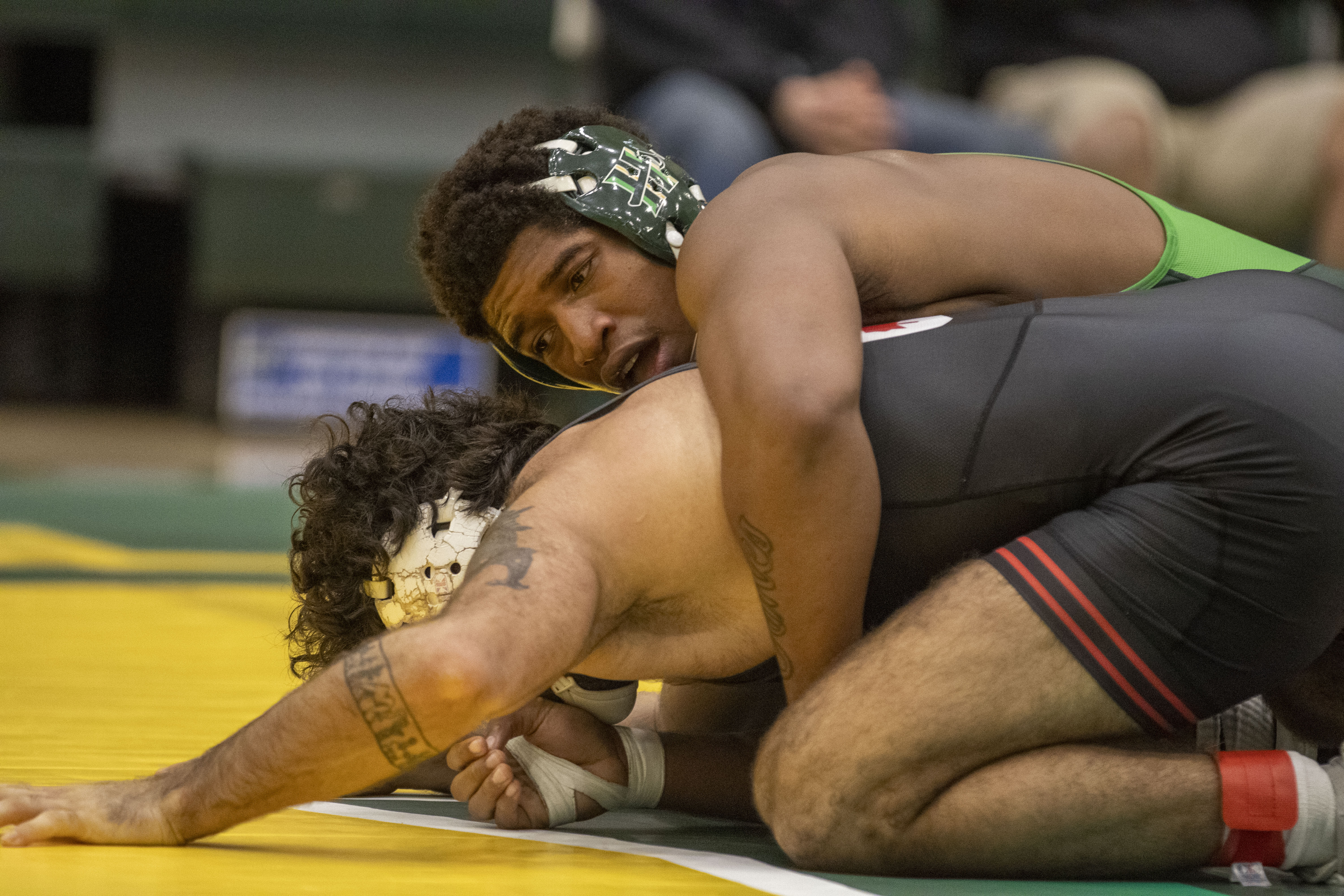
    The Cal Poly Humboldt Wrestling team finished their season strong with one win and one loss against Simon Fraser University and Vanguard University. Their senior night performance earned them second place overall in the Mountain Pacific Sports Federation Championship (MPSF) this Sunday.

    On Friday, Jan. 30, the Lumberjacks defeated Simon Fraser with wins in the 125, 133, 141, 149 and 157 pound weight class with wrestlers Joe Anthony Perez and Garen Keshishian dominating their opponent by six points. 

    However, the Jacks’ momentum faded during their matchup against Vanguard, losing 18-21. Despite an early win at 125 pounds, where Dakota Sanders scored four points and Darrel Nguyen earned five points, it wasn’t enough to beat Vanguard. Even Sage Adie’s six point victory at 197 pounds couldn’t close the gap.

    On Sunday, wrestling travelled to Atherton, Calif., to compete in the MPSF Championship, finishing second overall in conference with 126 points, behind Menlo College. The Jacks claimed victory over San Francisco State University and Vanguard University and lost to Menlo College who earned 155 points, the strongest showing from Humboldt since the championship began last year. Sophomore Josh Neiwert won the MPSF title in the 133 pound bracket, becoming a conference champion. Wrestling earned eight additional podium finishes, including three second place finishes from Darrell Nanpuya, Eric Ruiz-Cornelio and Isaiah Miller, and five third place finishes from Carson Hatch, Joe Anthony Perez, Micaiah Montalbin, Nathan Vasquez and Sam Weinberg.

    The men’s wrestling team will be heading down to Golden Colorado for the National Collegiate Athletic Association (NCAA) Super Region IV Championship on Feb. 28. 

  • Record breaking king tides at the start of the year

    by Ursula Newman and Barley Lewis-McCabe

    Low lying communities of Humboldt Bay faced floods as king tides hit record highs on Jan. 2 and 3, which caused significant damages to the King Salmon and Fields Landing areas. The term king tide is used to describe exceptionally large tides that are influenced by the gravitational pull of the moon and sun. 

    On Saturday, Jan. 3, the National Oceanic and Atmospheric Administration (NOAA) tide gauge, housed in Humboldt Bay at the north spit measured a high of 10.37 feet, the highest ever recorded since its establishment in 1977. In the days following the record high tide, The Humboldt County Office of Emergency Services asked residents to avoid the King Salmon area due to the extreme flooding, and encouraged those in need of shelter to contact the American Red Cross. 

    Amanda Admire, lecturer in the geology and oceanography departments, discussed how king tides aren’t always breaking news.

    “When there’s damage and economic impact, that’s really when people start to take notice,” Admire said. “It’s different if we saw a really high storm surge and the water rushed up and put some debris on the roadway. That’s one thing. But that’s not as [notable as], ‘oh my gosh, there’s someone who has damage in their home.’” 

    Our area has mixed semi diurnal tides, meaning there are two high tides and two low tides a day. NOAA is able to track and predict tides with high accuracy, and is used to know when to expect impressively high tides. A king tide is the highest of the especially high tides and, as always, tides are controlled by the rotation of the earth and moon. 

    A king tide happens when the sun and the moon are in alignment.

    “Their gravitational pulls are working together to pull more on the hydrosphere,” Admire said. “Versus if the moon were perpendicular in location to the sun, the moon is going to pull and make it more spherical, because they’re not lined up with each other.”

    When living in or near a coastal zone there are a lot of factors that come into play. Admire emphasized the importance of education around different ocean conditions and noted that the water itself has incredible power. 

    “Becoming more aware of our surroundings and the potential hazards in those zones is really valuable to residents,” Admire said. “As well as the visiting populations to those areas, to help know what to do and to be more prepared.”

    As of now, there has been no emergency declaration for the King Salmon and Fields Landing areas. 

    “Unfortunately, we sometimes are in the path of that water,” Admire said. “And I was really sad to see that there was so much damage that happened to the people of King Salmon, and I hope that they are able to get some resources to help come out of that.”

    Ursula Newman is a journalism major, Lumberjack science editor and Humboldt local. You can find her all over the county doing all kinds of things, and talking to all sorts of people. Contact her at uon1@humboldt.edu.

    Barley is an untraditional reporter, photographer and opinion editor who focuses on stories about social changes that have a real human impact. If you’d like to reach him for whatever reason email bl258@humboldt.edu.

  • Humboldt’s newest president returns home

    Humboldt’s newest president returns home

    by Nick Escalada

    Prior to his departure, Interim President Michael Spagna imparted the Lumberjack with optimistic words about Cal Poly Humboldt’s next head administrator. Richard A. Carvajal of Valdosta State University in Georgia was characterized as a cooperative leader — open to peer input in completing the school’s polytechnic transition, keen on successful athletics programs and perhaps most importantly, hip to local culture as a former Humboldt resident.

    In a private Lumberjack interview near the end of his debut week, the president divulged more about his upbringing in Humboldt County and his excitement to return to a familiar setting. Born in Los Angeles, Carvajal’s family moved to the North Coast in his early years and held residences in Eureka, Hydesville and Carlotta, before his father eventually found employment in Oklahoma, bringing his family and teenage son with him.

    “The only way he convinced me to get in the station wagon and go was that he promised that we’d only be gone for a year or two, and then we’d get to come back,” Carvajal said. “It obviously took me a little longer than that to get back. My mother literally bawled when she found out that I was coming here, because this is personal for my entire family, and so this is a place I love.”

    Like many natives, newcomers and transients, Carvajal defines Humboldt by its unique natural beauty. Most of his memories of the region involve recreating in pristine wilderness, which he immediately got back to doing upon his return.

     “As a kid, right on my backyard was the Van Duzen River and [I would be] running through the forest and enjoying the river and fishing and all those kinds of things,” Carvajal said. “The day before I started work here, I’d spent a week just unpacking boxes and trying to move into our place. But I needed one day that I held back so that I could go to the ocean, and then I drove up a little north to the forest and just walked through the redwoods.”

    Carvajal arrives at an institution midway through a historic identity shift toward STEM education and hands-on learning. Left with the new expectations of the Cal Poly branding and millions in the state’s transitional funding left to manage, the president envisions a broader approach to finishing this transition.

    “Every place gets to define exactly what their version of Polytechnic can look like. Here, I met my wife in the theater. I have a real appreciation for the arts,” Carvajal said. “And so to know that those programs are going to continue to thrive here, while we also grow out our STEM programs and the like, and all of our students, no matter what major they’re in, we’re going to try to make sure that they have an experiential opportunity while they’re here.”

    One of Carvajal’s more attractive qualities as a candidate to the administration was Valdosta State’s excellent Division II athletics records under his leadership. Carvajal attended a Jacks basketball game during one of his early campus tours, where he handed out pizza to students and talked shop about sports.

    “I was talking with somebody during the course of the night, and they asked me about my past experience. And I said, ‘Well, what you can know about me is I like to win,’” Carvajal said. “It does communicate that championship culture to our public and to our supporters and to our own student body that we’re going to try to be good at what we do, whether that’s on the athletic field, in the court or in the classroom. I want us to have a championship culture in everything we do. I want us to be a place that is about winning.”

    Carvajal is the son of a Mexican-American immigrant, and expressed his intent to uphold Humboldt’s hispanic-serving label and assist students of all documentation statuses.

    “My wife, our new First Lady… she looks a lot like my mom, actually, she’s very fair-complected, blonde hair. Her family broke off all ties with her for picking me,” Carvajal said. “Does that mean that I understand what everyone has gone through in their own individual situation? No, but I absolutely understand what it’s like to be thought of as less than or different, and to suffer because of it. So while I still have much to learn about what we have done and what we’re going to continue to do, I want us to be a supportive place for our students.”

    A major point of controversy surrounding previous president Tom Jackson’s resignation was his heavy-handed response to the pro-Palestine student occupation of campus. Students now hold their breath that their incoming overseer will handle such events more gracefully, a hope that Carvajal acknowledged.

    “I love that the CSU and Humboldt are unequivocally committed to free expression here, and so I want this to be a place that is supportive for all,” Carvajal said. “I want all voices to be supported here. I want students to feel that those voices are supported here. What am I going to do? I’m going to be out there. I’m going to be very transparent. I’m going to communicate with folks in the same way I’ve been this week.”

    The president’s excursions into lecture halls and out onto the Quad on his first week have undoubtedly been for introductory purposes. However, Carvajal says he wishes to maintain that presence among his constituents until he, as he hopes, retires from Cal Poly Humboldt.

    “If I walked across campus, I really couldn’t do so without being asked several times to stop for selfies,” Carvajal said. “I want that experience. I want our students to know who their president is. I can’t do that by sitting in here.”

    Nick Escalada is the News Editor of The Lumberjack. He studies wildlife and aspires to be a nature journalist. Find him bouncing between Gist Hall and the science buildings and reach him at ne53@humboldt.edu!

  • What are rare earth elements?

    What are rare earth elements?

    by  Ursula Newman

    Rare earth elements (REEs) are a group of elements, including the 15 elements in the lanthanide series, plus scandium and yttrium. This group of elements is considered critical, and has applications in the medical field, electronic displays, magnets and more.

    Cal Poly Humboldt Chemistry and Biochemistry Professor Jorge Monteiro’s research focuses on REEs and he explained some of the common applications of these elements.Neodymium, an REE, makes for the strongest magnets on earth. Batteries, wind turbines and hard drives are some of the most critical examples of items that need neodymium to function. Other REEs, such as europium, terbium and cerium, are luminescent — often used in electronics, lighting and other industrial applications. 

    “That’s basically 75% of our modern life, right? Screens and magnets, production of energy, medical diagnosis and all of that,” Monteiro said. 

    Rare earth elements

    The types of rocks that contain rare earth elements only account for about 1% of all igneous rocks. Cal Poly Humboldt Geology Professor Brandon Browne explained that REE igneous rocks, in terms of the minerals they have, the colors they show and the elements they’re made of, are very distinct from other igneous rocks. 

    REEs are considered “incompatible,” and to appear in these igneous rocks, they require specific minerals to bond onto. REEs are abundant within earth’s crust, but to make an economically viable mining area — an area with a high enough concentration of REEs — these specific, uncommon igneous rocks are required. 

    “You need really old rock. Most of the rocks of this kind are, like, a billion years old,” Browne said. “The earth recycles itself, and it’s not always easy to find a billion year old rock.”

    Open pit mining is the main method used to access the deposits of rock containing REEs. Large amounts of soil and rock are removed leaving massive pits and waste piles behind. This method of mining is associated with loss of habitat, landscape disruption, water contamination, social displacement, as well as air and noise pollution.

    “The story that tech and energy companies tell is one that’s going to help us with better battery life, but they’re not telling them that this will require some really big holes in the ground,” Browne said. 

    After the raw material is obtained, the refinement process begins — and that’s where things get complicated. 

    Refinement of elements

    “The name, ‘Rare Earths,’ is a little misleading, because they are not rare like gold or things like that,” Monteiro said. “The name comes from the difficulty to separate them, it’s rare to have the pure thing.” 

    Some of the elements are harder to refine than others, and prices reflect that, but it’s not actually that hard to mine for them. 

    REEs are the elements located between barium and hafnium on the periodic table. They sit below the main body of the table in their own two rows, with the lanthanides forming the top row and the actinides below them. Scandium and yttrium are also REEs, but are located in group 3 of the periodic table. Monteiro explained that the reason why they are grouped together between barium and hafnium on the periodic table, is because the REEs are very similar to each other. 

    “They are very similar chemically,” Monteiro said. “When you want to separate elements, they have to be distinguishable. Because they are all very similar, you do a reaction [where different elements would typically react differently] and all of [the elements] will react.”

    When mining, usually you’ll find anywhere from two or three, to all of the elements in one mineral or area. You have to repeat the separation process over and over to find small differences. When you track them, eventually you’ll be able to tell the elements apart. This process is called purification and is the hardest part of getting REEs. Different elements are useful for different things, and the desired result is a pure element. Monteiro explained that bio-luminescent REEs are used in medical imaging and cancer cell targeting, and the elements need to be very pure for safety and effectiveness. 

    “Let’s say we’re going to use gadolinium for an MRI; you want the compound to be as pure as possible,” Monteiro said. “If there are impurities, it might end up killing you.” 

    Current market control

    China has established mines that are rich in all of the REEs. They have an advantage over other countries whose mines might primarily produce only one or two elements.

    “There are lots of reserves in China, so that means they control the market. The purification process is not very environmentally friendly, and China doesn’t care. That’s why they can get a high output, because there are no regulations,” Monteiro said.

    They essentially control the market, but that doesn’t mean it’s the only place you can find REEs. The elements are actually spread across the world and are quite common in the grand scheme of things. California has a lot of REEs, specifically in an unincorporated community in San Bernardino County called Mountain Pass. 

    The main issue is that the deposits are small and spread out, so the cost for many countries to mine and refine them is not competitive with what China can offer. 

    “The ability to find and extract these elements is currently more of a political and engineering race, than a concern of depletion,” Browne said. 

  • Men’s Basketball wins amidst a team loss

    by Ariana Wilson

    The Cal Poly Humboldt Men’s Basketball Team began its 2025 season on Saturday, Oct. 18, hosting College of the Redwoods for a home-opener exhibition game. The Lumberjacks left the arena with a decisive 103-76 win. 

    After a successful 2024-25 season, with a 13-9 final result in conference play, last year’s team concluded the season at the California Collegiate Athletic Association Basketball Tournament. The Jacks’ former coaching staff, Chris Tifft and Brandon Billups, transferred to CSU San Bernardino, along with Aiden Fowler, a key player for the team’s success last season.  

    Expectations were high for this year’s group of athletes, but this year’s team is green, from athletes to head coach, DJ Broome. The Jacks aim to build on last year’s momentum with a roster of talented transfers and newcomers.

    A familiar face returns to DJ Broome’s staff as assistant coach, Kevin Johnson Jr. Johnson Jr. aims to add to his Lumberjack legacy and class of 2014 Hall of Famer title. 

    The Jacks’ win on Saturday will not count toward official records. Still, their preseason journey continues with a non-conference game against Santa Rosa Community College on October 25, with their CCAA Opener on December 4 to tip off their official season.

    Ari is a senior journalism major and the science editor this semester, with an adoration for the environment and conservation. She is currently pursuing her scientific diving certification and plans to meld her journalistic passions with scientific research in the future. For any science inquiries please contact ajw167@humboldt.edu.