by Ursula Newman
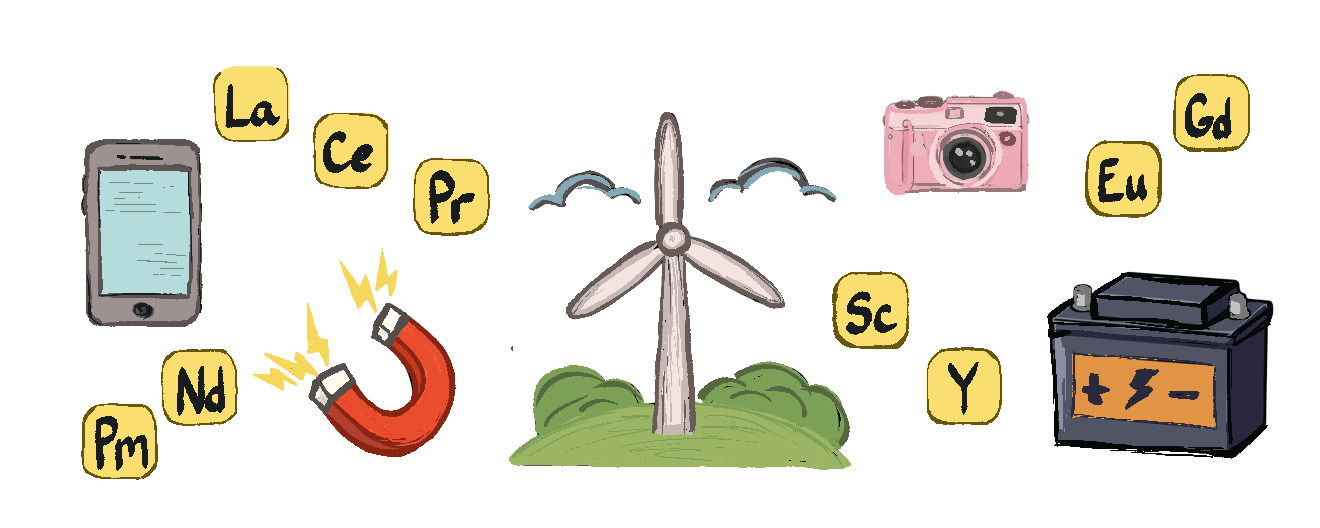
Rare earth elements (REEs) are a group of elements, including the 15 elements in the lanthanide series, plus scandium and yttrium. This group of elements is considered critical, and has applications in the medical field, electronic displays, magnets and more.
Cal Poly Humboldt Chemistry and Biochemistry Professor Jorge Monteiro’s research focuses on REEs and he explained some of the common applications of these elements.Neodymium, an REE, makes for the strongest magnets on earth. Batteries, wind turbines and hard drives are some of the most critical examples of items that need neodymium to function. Other REEs, such as europium, terbium and cerium, are luminescent — often used in electronics, lighting and other industrial applications.
“That’s basically 75% of our modern life, right? Screens and magnets, production of energy, medical diagnosis and all of that,” Monteiro said.
Rare earth elements
The types of rocks that contain rare earth elements only account for about 1% of all igneous rocks. Cal Poly Humboldt Geology Professor Brandon Browne explained that REE igneous rocks, in terms of the minerals they have, the colors they show and the elements they’re made of, are very distinct from other igneous rocks.
REEs are considered “incompatible,” and to appear in these igneous rocks, they require specific minerals to bond onto. REEs are abundant within earth’s crust, but to make an economically viable mining area — an area with a high enough concentration of REEs — these specific, uncommon igneous rocks are required.
“You need really old rock. Most of the rocks of this kind are, like, a billion years old,” Browne said. “The earth recycles itself, and it’s not always easy to find a billion year old rock.”
Open pit mining is the main method used to access the deposits of rock containing REEs. Large amounts of soil and rock are removed leaving massive pits and waste piles behind. This method of mining is associated with loss of habitat, landscape disruption, water contamination, social displacement, as well as air and noise pollution.
“The story that tech and energy companies tell is one that’s going to help us with better battery life, but they’re not telling them that this will require some really big holes in the ground,” Browne said.
After the raw material is obtained, the refinement process begins — and that’s where things get complicated.
Refinement of elements
“The name, ‘Rare Earths,’ is a little misleading, because they are not rare like gold or things like that,” Monteiro said. “The name comes from the difficulty to separate them, it’s rare to have the pure thing.”
Some of the elements are harder to refine than others, and prices reflect that, but it’s not actually that hard to mine for them.
REEs are the elements located between barium and hafnium on the periodic table. They sit below the main body of the table in their own two rows, with the lanthanides forming the top row and the actinides below them. Scandium and yttrium are also REEs, but are located in group 3 of the periodic table. Monteiro explained that the reason why they are grouped together between barium and hafnium on the periodic table, is because the REEs are very similar to each other.
“They are very similar chemically,” Monteiro said. “When you want to separate elements, they have to be distinguishable. Because they are all very similar, you do a reaction [where different elements would typically react differently] and all of [the elements] will react.”
When mining, usually you’ll find anywhere from two or three, to all of the elements in one mineral or area. You have to repeat the separation process over and over to find small differences. When you track them, eventually you’ll be able to tell the elements apart. This process is called purification and is the hardest part of getting REEs. Different elements are useful for different things, and the desired result is a pure element. Monteiro explained that bio-luminescent REEs are used in medical imaging and cancer cell targeting, and the elements need to be very pure for safety and effectiveness.
“Let’s say we’re going to use gadolinium for an MRI; you want the compound to be as pure as possible,” Monteiro said. “If there are impurities, it might end up killing you.”
Current market control
China has established mines that are rich in all of the REEs. They have an advantage over other countries whose mines might primarily produce only one or two elements.
“There are lots of reserves in China, so that means they control the market. The purification process is not very environmentally friendly, and China doesn’t care. That’s why they can get a high output, because there are no regulations,” Monteiro said.
They essentially control the market, but that doesn’t mean it’s the only place you can find REEs. The elements are actually spread across the world and are quite common in the grand scheme of things. California has a lot of REEs, specifically in an unincorporated community in San Bernardino County called Mountain Pass.
The main issue is that the deposits are small and spread out, so the cost for many countries to mine and refine them is not competitive with what China can offer.
“The ability to find and extract these elements is currently more of a political and engineering race, than a concern of depletion,” Browne said.
Leave a Reply