Barley Lewis-McCabe and Nico Patakidis
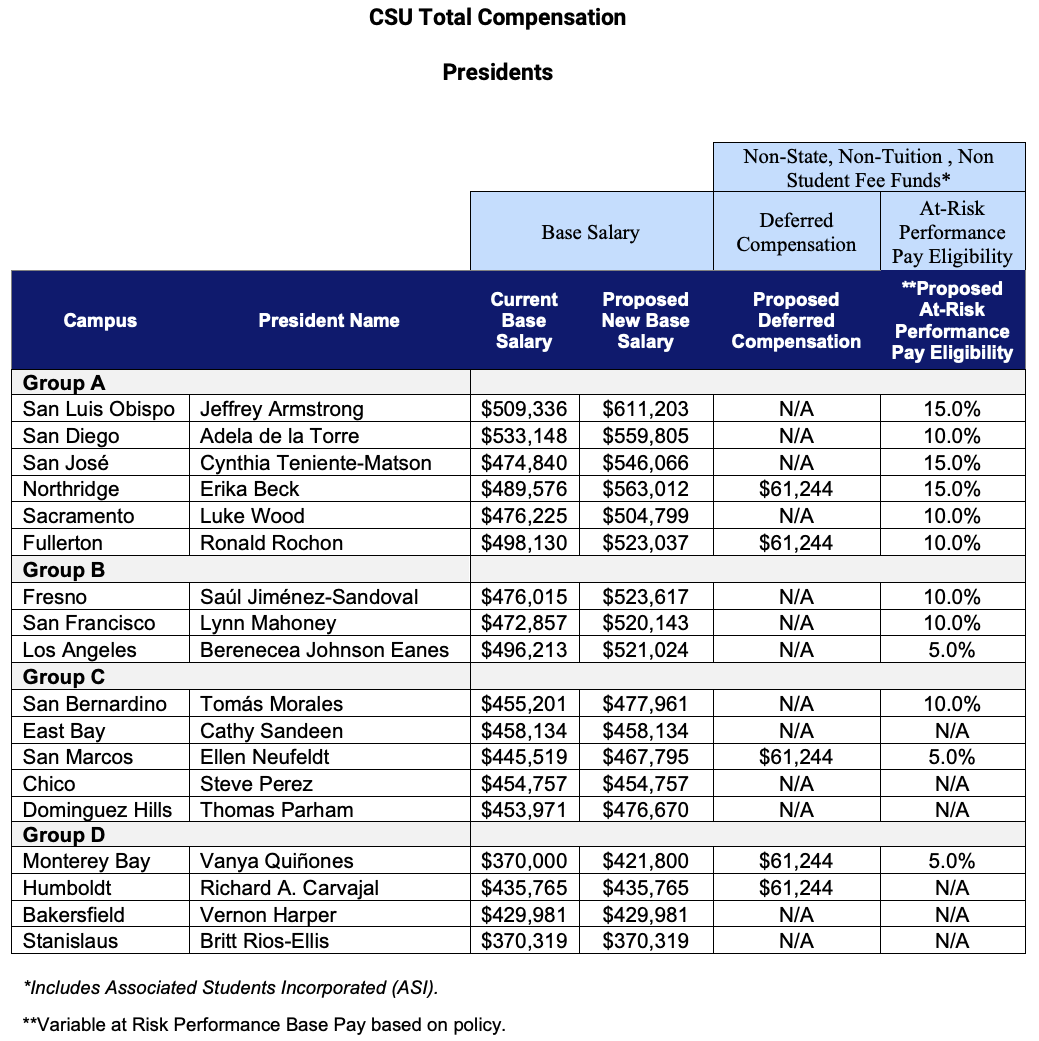
Another increase in presidential pay across all California State University (CSU) campuses has been approved by the California State University (CSU) Board of Trustees in a meeting Nov. 2025. Among a base presidential salary increase as high as 20%, the meeting also saw the implementation of at-risk pay, and deferred compensation. Unlike at-risk pay and deferred compensation, the presidential base pay increases will be paid for using the CSU General Fund, which is composed of state funds as well as student tuition.
“Our philosophy is to get folks as close to the median as we can get while remaining financially sustainable,” Trustee Diego Arambula said. “What are the ways in which we might do that? Of course, base pay is one. That comes from the money we get from the state, from tuition.”
CSU Trustee Jean Firstenberg introduced the programs to support the retention of presidents and attract qualified candidates. Deferred compensation programs provide an opportunity for university presidents to save an amount of their salary to be received at a later date and defer taxes until the compensation is received. At-risk pay is pay that is not guaranteed, but tied to performance.
These policies were passed to ensure CSU presidents reach the median pay for a university president in America. The CSU Chancellor’s office enlisted the help of Segal, a private investment firm, to determine a competitive salary and benefits package that would attract a qualified president to head a CSU. Segal found that 18 out of the 22 CSU presidents base salary fell below the 25th percentile of the market median, meaning that the base salary of presidents in the CSU system falls below the median pay of university presidents in the U.S.. Within Segal’s presentation, the market median of base salary was not stated.
“It is based on achievement of specific goals throughout the year,” CSU Trustee Leslie Gilbert-Lurie said during the meeting. “I wanted to also make it clear that it is also linked to our northstar goal of market competitiveness and getting to median… it’s not only based on performance; it’s based on that they are under market getting to market.”
Reiterated throughout the meeting and within the agenda is the CSU’s goal of attracting competent faculty, staff and leadership through the means of offering competitive compensation. In 2023, the CSU board of trustees approved a multi-year tuition increase proposal in which tuition will increase by 6% until the 2028-2029 school year. The proposal for tuition increases also includes emphasis on the CSU’s goal of providing competitive and sustainable compensation.
The proposed base pay increases for CSU presidents would result in an additional estimated cost of $1,431,647 spent from the CSU General Fund. While he isn’t eligible for the new pay increases, President Richard Carvajal’s salary is $39,609 more than Interim President Spagna’s, amounting to $435,765. Humboldt California Faculty Association (CFA) President Ryder Dschida weighed in on appropriate uses of the Fund’s resources.
“Can that money be spent better elsewhere? Like, say, improving accessibility on campus, or providing clean, safe, sanitary places to live for students on campus in the dormitories,” Daschida said. “Yes, it should be, it could be better spent on those types of things. On top of the president’s salary increasing by about $40,000, they also get a housing stipend of about $65,000 a year to pay for housing in Humboldt and [$1,000 monthly for] a car. So in reality, his salary is probably closer to almost $600,000 a year.”
Along with the at-risk and deferred compensation plans, Item 9 also proposed a removal of the 10% cap from salary adjustments for new presidents. Previously, new presidents were unable to receive a salary adjustment higher than 10% of the previous president’s salary. This policy is accompanied by annual fixed compensation increases that are guaranteed for current presidents. However, new presidents will not be eligible for these increases until completing their first triennial review as stated in Item 9 of the Nov. 19 2025 agenda.
“Our philosophy is to get folks as close to the median as we can get while remaining financially sustainable,” Trustee Diego Arambula said, discussing the third way they plan on increasing presidential funding. “What are the ways in which we might do that? Of course, base pay is one. That comes from the money we get from the state, from tuition.”
The CFA thinks the presentation of these policies were more malicious. Base pay increases being paid for from tuition and state funds were only clarified once during the meeting, in contrast to the at-risk pay and deferred compensation funding source being explained thoroughly,
“These aren’t half-truths; they’re lies by omission, plain and simple,” The CFA wrote in a statement on the meeting released Dec 11. “Despite the emphasis on the policy having nothing to do with students or the state, more than half of campus presidents will now see their base pay increase as a direct result of student tuition and state funds!”
Associated Students (A.S.) President Eduardo Cruz points out that the language used throughout board meetings can be difficult to follow — even more so for students who may not be familiar with these meetings. As a campus leader and president of A.S., Cruz understands that members can become captivated by the official terminology; they often struggle to account for those who may not understand it. Cruz said that while he can’t speak to the intentions of the board, the information presented was confusing, but overall accurate.
“They should be held to a higher standard of clarity and plain language for that transparency aspect,” Cruz said. “They could have done a better job at being transparent when it came to what they were actually discussing.”
Barley is the opinion editor and an untraditional reporter who focuses on social change and stories with a real human impact. If you’d like to reach him for whatever reason email bl258@humboldt.edu.
Nico is the photo editor with an interest in covering local government and political affairs. In his free time he enjoys hanging out and having fun with his friends. Reach him at np211@humboldt.edu.

Leave a Reply