by Jacqueline Zuniga
College students experience a host of new freedoms when they leave home for the first time. As many freshmen border the ages of 17 and 18, sex is something they often think about, yet many may not know how to protect themselves. With misinformation they may hear from their friends or awkward conversations they weren’t paying attention to with their parents, they may have some unanswered questions. Cal Poly Humboldt’s Student Health and Wellbeing Services Center (SHWSC) serves to provide students with accurate information, whether it’s via brochure, their website or conversations with a clinical peer health educator.
Practicing safe sex is one of the most important ways to stay healthy in college, especially while navigating new experiences and relationships. Using protection such as condoms, dental dams and internal condoms can help reduce risk. Natalie Treacy, Health Educator and Lead for Check It and Peer Health believes that there is no such thing as 100% safe sex, but there are ways to ensure a positive experience for all parties.
Many things are important when it comes to having sex, like boundaries, consent, expectations and knowing what you want. Communicate what you want and respect yourself and your partners.
“Use protection, get tested regularly and understand your contraception options,” Tracey said.
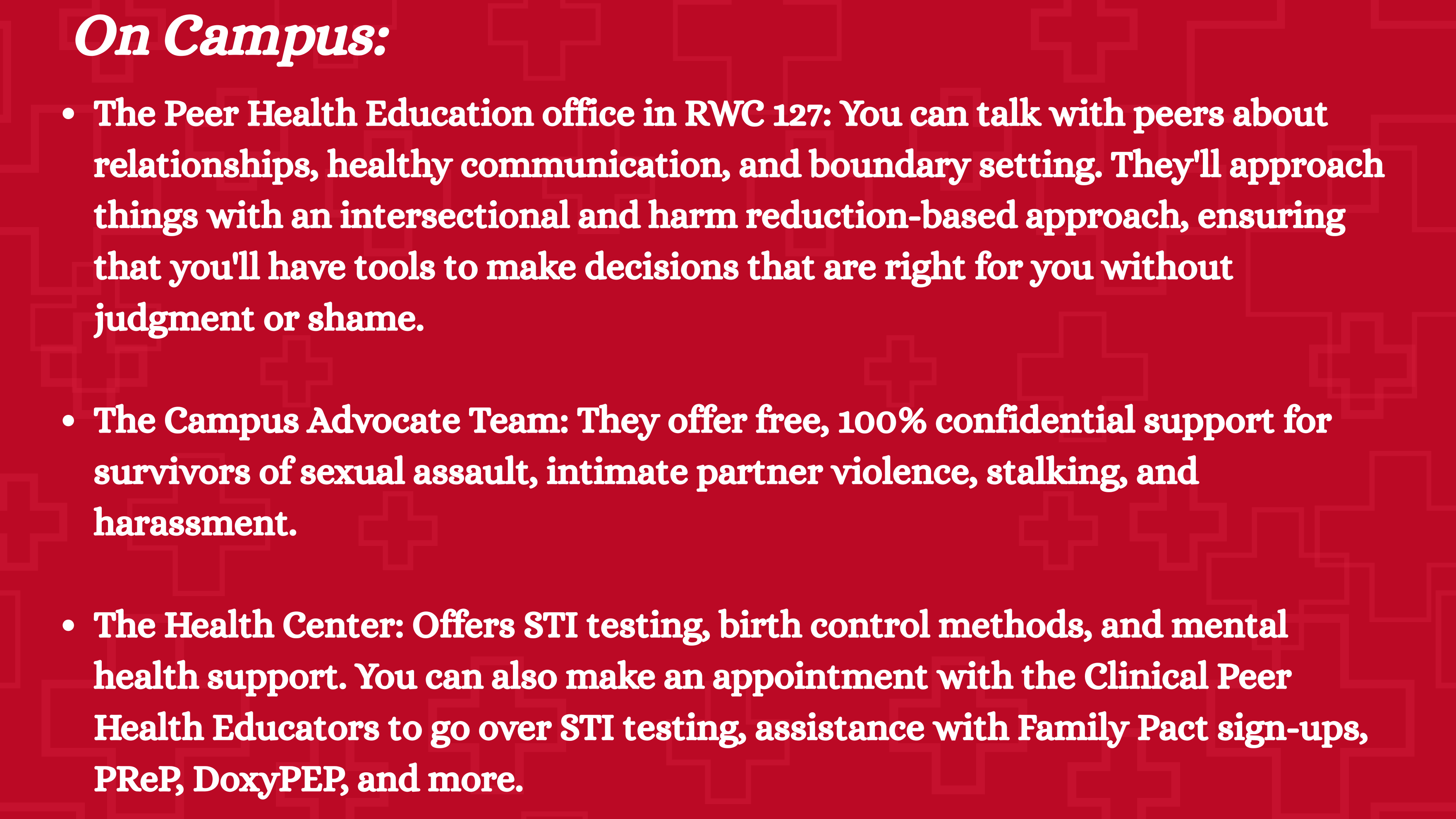
When it comes to birth control, students may not know that they have multiple options. The SHWSC has multiple options both hormonal and non-hormonal. They offer birth control pills, Nuva rings, implants, intrauterine devices (IUDs), Depo-Provera shots and transdermal patches. They also have emergency contraceptives available like Plan B and Ella. You can find them at a health vending machine on campus like at the Depot, Nelson Hall East, The J, HHM and mail room at College Creek for just $11. The center also has condoms, dental dams and underwear that functions as dental dams. Peer Health Educator Thea Lamers, a senior in social work, explained how students can make an appointment with a provider or peer health educator about what’s best for them.
“If you make an appointment with a clinical parent educator, we can have this whole conversation with you, and then you can make an appointment with a provider, and then just get what you’re looking for,” Lamers said.
If a student finds themself in a situation where they have an unintended pregnancy the Health Center also provides medical abortions at a low cost. Lead for Health Education and Clinical Support Services Nira Friedman mentioned how students can talk to medical professionals if that’s something they want to do.
“We do have information that we can share with people,” Friedman said. “A brochure, talking about a medical provider, talking to a clinical peer educator, they can talk to me as well.”
A major topic students should really understand is the importance of sexually-transmitted infections (STI) testing. Multiple forms of testing exist at the SHWSC if you think you have been exposed. They have asymptomatic and symptomatic STI testing for chlamydia, gonorrhea, HIV, syphilis, trick and urinary tract infections. You can self administer these tests depending on what anatomy you have and what sex you’re having. There’s throat swabs, genital swabs, urine tests and blood tests.
“[You should test] anytime you may be at risk, like, had an encounter where you may have contracted an STI,” Lamers said.
If you have been exposed, the SHWSC can provide antibiotics to help.
“You get a prescription through a provider, but also through an appointment of the clinical peer health educator, which is a dose of antibiotics,” Lamers said.
Providers are able to prescribe Doxypep, an antibiotic that prevents STIs like chlamydia, gonorrhea and syphilis. Pre-exposure prophylaxis (PREP)is a prophylactic medication used to prevent contraction of HIV. Post-exposure Prophylaxis(PEP) is used if you have been exposed to HIV, stopping it from establishing an infection in your body.
Understanding consent is one of the most important parts when navigating sexual experiences. It’s not just a yes or no, it’s an ongoing agreement that requires communication and respect. Zoë Banks from CHECK IT! says it should be a wholehearted affirmation that is continuous throughout the whole encounter.
“At the end of the day, if the vibe isn’t an enthusiastic, ‘hell yes,’ then it’s a no,” Banks said.
Consent is not only verbal, but physical as well. You can learn a lot about a person’s emotions by observing their body language, so it’s important to take notice. Boundaries can be set in between participating parties about what they are willing to do. Consent is an important factor when it comes to intimacy and should be taken seriously as well as discussed before any sexual encounter.
Jacqueline is a journalism major, a news manager for KRFH and she aspires to be a sports journalist one day
Leave a Reply