Will Bishop
As students return to campus and switch gears into the school year, their needs are many. Some may feel plagued with academic anxiety and the stress of adapting to a new social environment. Not all student needs are universal; however, there is one daily concern for every student. Getting from point A to B.
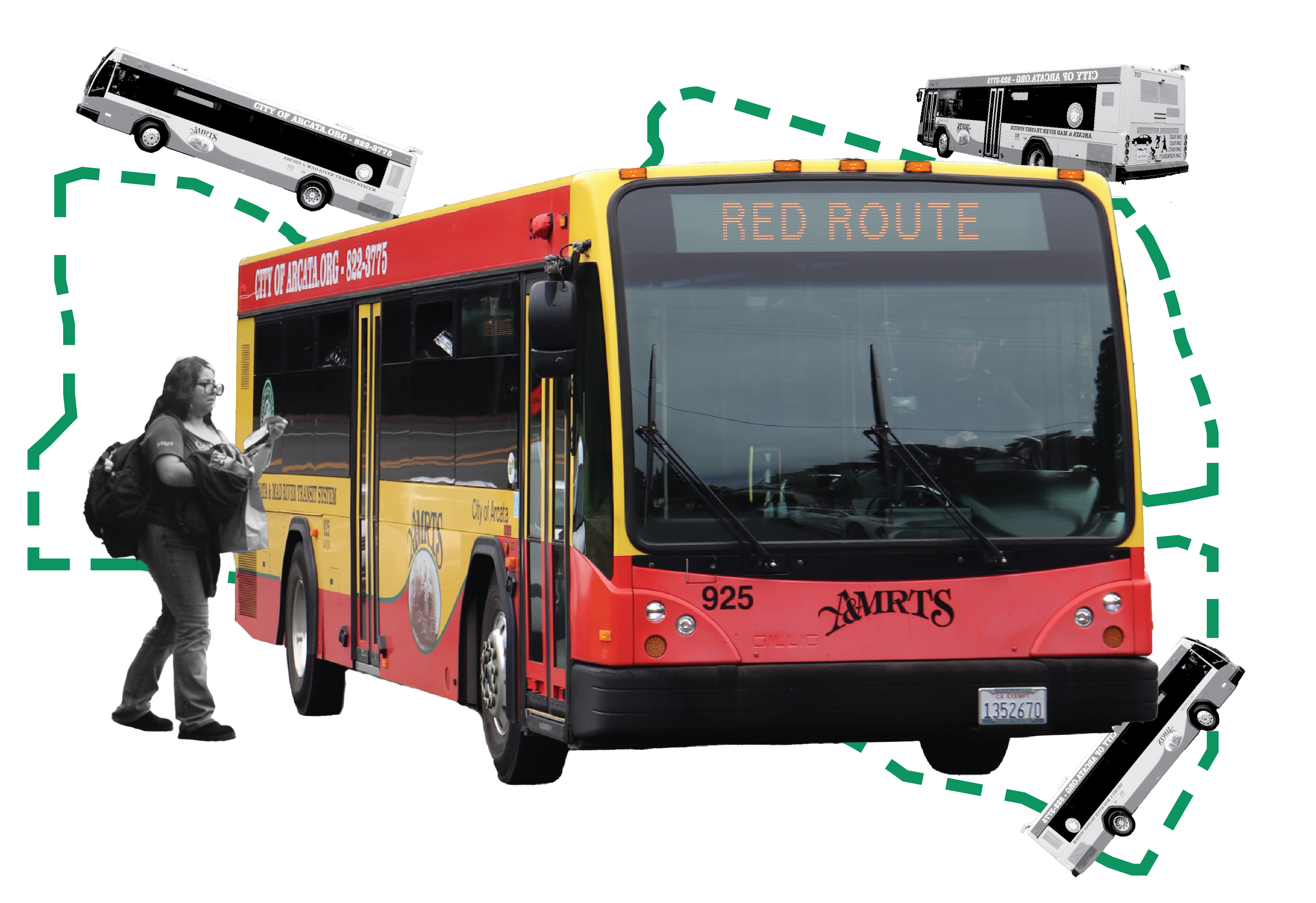
Since 2023, Cal Poly Humboldt (CPH) has provided full operational costs for the Green and Gold lines — a supplementary service meant to reduce wait times for Humboldt Transit Authority’s (HTA) existing Gold line; as well as the Red and Yellow lines. The following provide the area’s main source of evening transit. According to a publicly available report sent to the HTA Board of Directors on Aug 5 by HTA General Manager Katie Collender, CPH leadership has decided to cease the funding stream, with operations ending this fall. Director of News & Information at CPH Aileen Yoo confirmed the end of Green and Gold in an email sent on Aug 24, but claimed that the Red and Yellow lines would remain operational.
During an Associated Students meeting on Aug 25, campus officials contradicted much of the information dispersed the day prior. Stating that the Red and Yellow lines will be cut as well, with evening service being added to the Orange line. Admin further claims that this decision was recommended by the HTA itself. The Hinarr Hu Moulik shuttle service — also said to be protected in Yoo’s email, is on the chopping block, with operations ending in December.
According to Yoo, low ridership on the Green and Gold was an issue HTA had brought up in 2025. “Despite the recommendation, the University decided to keep the service for an additional year to see if there were changes, but we continued to see low ridership.”
Executive Director of the Coalition for Responsible Transportation Priorities Colin Fiske stated that these routes still served a valuable need. “What it did do — even though it sort of replicated the route- is it effectively increased the frequency of buses going between Valley West and campus, and so that does make it more convenient to ride the bus.”
The HTA report stated, “On June 16, 2026, representatives from CPH contacted HTA to set up a meeting to discuss their contract. At this meeting, HTA was notified that due to budgetary constraints, they did not plan to continue any of their public transit services.”
With some lines being sunsetted and others potentially in limbo, CPH’s commitment to public transit is undergoing some scrutiny.
“I think that the University has, frankly, always looked towards parking first as a solution rather than encouraging public transit, or biking, or walking. They certainly have some programs to encourage those things, but they have never received the same kind of resources,” said Fiske.
Yoo rebuked the notion that changes to transit represent any ideological shift.
“Improving parking capacity doesn’t mean the University is moving away from public transit. The University recognized that in our polytechnic expansion planning and incorporated additional parking into infrastructure projects that are already underway,” said Yoo.
Fiske believes that financial support for the transit is still vital for CPH.
“This is an important commitment, and in the scope of the university’s budget it’s not that much money. The university has a budget that’s roughly twenty times the size of the transit agency’s budget. So it’s a lot more money for HTA than it is for the university. I think it’s well worth that commitment, and that more could and should be done to direct resources towards transit and provide support for students, as well as staff and faculty, using transit to meet the sustainability goals and the accessibility goals,” said Fiske.
According to Yoo, CPH’s total public transit operational costs last year were approximately $1,119,980; this tally includes the lines mentioned here, in addition to the Hinarr Hu Moulik shuttle service, and the Jackpass service — which offers free swipes to students. On Aug 17, CPH posted a 5.1% increase in their budget for 2026-27, claiming a total of $184.3 million. The transit contract as previously established would cost about .6% of their overall budget. Based on the HTA’s preliminary budget for the same fiscal year — excluding CPH’s potential funding- they will be operating with $17,393,553 in resources.
Will Bishop is a Cal Poly Humboldt journalism major. He is prone to writing essays about things that bother him and fictional works about things that also bother him, but in different ways. A highly bothered individual and a lover of cinema, music, large trees and rocks. He can often be found in the woods, dancing to bring down the sky.
Leave a Reply